


Luke 8:35
“Healing the Gerasene Demoniac”Luke 8:26–39
Bible text: King James Version (1769 Blayney text) · Public domain
Bible text: King James Version with Strong's numbers · Public domain
Bible text: Berean Standard Bible · Public domain
Bible text: American Standard Version (1901) · Public domain
Bible text: World English Bible, Messianic edition · Public domain
Bible text: Geneva Bible (1599) · Public domain
Bible text: Young's Literal Translation · Public domain
- ἐξῆλθονexēlthonThey went outG1831V-2AAI-3PVerb 2nd Aorist Active Indicative 3rd Plural
- δὲdethenG1161CONJConjunction
- ἰδεῖνideinto seeG1492V-2AANVerb 2nd Aorist Active Infinitive
- τὸtothatG3588T-ASNDefinite article Accusative Singular Neuter
- γεγονὸςgegonoshaving happenedG1096V-2RAP-ASNVerb 2nd Perfect Active Participle Accusative Singular Neuter
- καὶkaiandG2532CONJConjunction
- ἦλθονēlthonthey cameG2064V-2AAI-3PVerb 2nd Aorist Active Indicative 3rd Plural
- πρὸςprostoG4314PREPPreposition
- τὸνton[the]G3588T-ASMDefinite article Accusative Singular Masculine
- ἸησοῦνIēsounJesusG2424N-ASM-PNoun Accusative Singular Masculine Individual
- καὶkaiandG2532CONJConjunction
- εὗρονheuronfoundG2147V-2AAI-3PVerb 2nd Aorist Active Indicative 3rd Plural
- καθήμενονkathēmenonsittingG2521V-PNP-ASMVerb Present Middle Or Passive Deponent Participle Accusative Singular Masculine
- τὸνtontheG3588T-ASMDefinite article Accusative Singular Masculine
- ἄνθρωπονanthrōponmanG444N-ASMNoun Accusative Singular Masculine
- ἀφ᾽aph᾽fromG575PREPPreposition
- οὗhouwhomG3739R-GSMRelative pronoun Genitive Singular Masculine
- τὰtatheG3588T-NPNDefinite article Nominative Plural Neuter
- δαιμόνιαdaimoniademonsG1140N-NPNNoun Nominative Plural Neuter
- ἐξῆλθενexēlthenhad gone outG1831V-2AAI-3SVerb 2nd Aorist Active Indicative 3rd Singular
- ἱματισμένονhimatismenonclothedG2439V-RPP-ASMVerb Perfect Passive Participle Accusative Singular Masculine
- καὶkaiandG2532CONJConjunction
- σωφρονοῦνταsōphronountabeing of sound mindG4993V-PAP-ASMVerb Present Active Participle Accusative Singular Masculine
- παρὰparaatG3844PREPPreposition
- τοὺςtoustheG3588T-APMDefinite article Accusative Plural Masculine
- πόδαςpodasfeetG4228N-APMNoun Accusative Plural Masculine
- τοῦtou[the]G3588T-GSMDefinite article Genitive Singular Masculine
- ἸησοῦIēsouof JesusG2424N-GSM-PNoun Genitive Singular Masculine Individual
- καὶkaiAndG2532CONJConjunction
- ἐφοβήθησανephobēthēsanthey were afraidG5399V-AOI-3PVerb Aorist Passive Deponent Indicative 3rd Plural
English is a literal word-by-word gloss of the Greek, not the KJV's wording. Why?
This is the Greek text the KJV’s translators worked from, with each word given its own literal English meaning in this verse. The word-by-word meanings were prepared by scholars at Tyndale House, Cambridge. The KJV translates whole sentences rather than single words, so its wording often differs: one Greek word can become several English words, and the KJV may say “charity” where the word-by-word meaning reads “love”. The two are made for different purposes, and both are faithful to the Greek. To read the KJV’s own wording, switch to the KJV text.
Words in [ ] are added by the English.
- devils (KJV) / demons (BSB) δαιμόνιον
Details
See on the biblical-era maps
Study this verse
Public-domain commentary
Matthew Henry
From his Commentary on the Whole Bible. Henry wrote on whole passages, and this entry covers Luke 8:22–39. He set out his notes in a three-level outline, kept here as he numbered it.
We have here two illustrious proofs of the power of our Lord Jesus which we had before - his power over the winds, and his power over the devils. See Mk. 4 and 5.
I.His power over the winds, those powers of the air that are so much a terror to men, especially upon sea, and occasion the death of such multitudes. Observe,
1.Christ ordered his disciples to put to sea, that he might show his glory upon the water, in stilling the waves, and might do an act of kindness to a poor possessed man on the other side the water: He went into a ship with his disciples, Luke 8:22. They that observe Christ's orders may assure themselves of his presence. If Christ sends his disciples, he goes with them. And those may safely and boldly venture any where that have Christ accompanying them. He said, Let us go over unto the other side; for he had a piece of good work to do there. He might have gone by land, a little way about; but he chose to go by water, that he might show his wonders in the deep.
2.Those that put to sea in a calm, yea, and at Christ's word, must yet prepare for a storm, and for the utmost peril in that storm; There came down a storm of wind on the lake (Luke 8:23), as if it were there, and no where else; and presently their ship was so tossed that it was filled with water, and they were in jeopardy of their lives. Perhaps the devil, who is the prince of the power of the air, and who raiseth winds by the permission of God, had some suspicion, from some words which Christ might let fall, that he was coming over the lake now on purpose to cast that legion of devils out of the poor man on the other side, and therefore poured this storm upon the ship he was in, designing, if possible, to have sunk him and prevented that victory.
3.Christ was asleep in the storm, Luke 8:23. Some bodily refreshment he must have, and he chose to take it when it would be least a hindrance to him in his work. The disciples of Christ may really have his gracious presence with them at sea, and in a storm, and yet he may seem as if he were asleep; he may not immediately appear for their relief, no, not when things seem to be brought even to the last extremity. Thus he will try their faith and patience, and quicken them by prayer to awake, and make their deliverance the more welcome when it comes at last.
4.A complaint to Christ of our danger, and the distress his church is in, is enough to engage him to awake, and appear for us, Luke 8:24. They cried, Master, master, we perish! The way to have our fears silenced is to bring them to Christ, and lay them before him. Those that in sincerity call Christ Master, and with faith and fervency call upon him as their Master, may be sure that he will not let them perish. There is no relief for poor souls that are under a sense of guilt, and a fear of wrath, like this, to go to Christ, and call him Master, and say, "I am undone, if thou do not help me."
5.Christ's business is to lay storms, as it is Satan's business to raise them. He can do it; he has done it; he delights to do it: for he came to proclaim peace on earth. He rebuked the wind and the raging of the water, and immediately they ceased (Luke 8:24); not, as at other times, by degrees, but all of a sudden, there was a great calm. Thus Christ showed that, though the devil pretends to be the prince of the power of the air, yet even there he has him in a chain.
6.When our dangers are over, it becomes us to take to ourselves the shame of our own fears and to give to Christ the glory of his power. When Christ had turned the storm into a calm, then were they glad because they were quiet, Psalm 107:30. And then,
(1.)Christ gives them a rebuke for their inordinate fear: Where is your faith? Luke 8:25. Note, Many that have true faith have it to seek when they have occasion to use it. They tremble, and are discouraged, if second causes frown upon them. A little thing disheartens them; and where is their faith then?
(2.)They give him the glory of his power: They, being afraid, wondered. Those that had feared the storm, now that the danger was over with good reason feared him that had stilled it, and said one to another, What manner of man is this! They might as well have said, Who is a God like unto thee? For it is God's prerogative to still the noise of the seas, the noise of their waves, Psalm 65:7.
II.His power over the devil, the prince of the power of the air.
In the next passage of story he comes into a closer grapple with him than he did when he commanded the winds. Presently after the winds were stilled they were brought to their desired haven, and arrived at the country of the Gadarenes, and there went ashore (Luke 8:26, Luke 8:27); and he soon met with that which was his business over, and which he thought it worth his while to go through a storm to accomplish.
We may learn a great deal out of this story concerning this world of infernal, malignant spirits, which, though not working now ordinarily in the same way as here, yet we are all concerned at all times to stand upon our guard against.
1.These malignant spirits are very numerous. They that had taken possession of this one man called themselves Legion (Luke 8:30), because many devils were entered into him: he had had devils a long time, Luke 8:27. But perhaps those that had been long in possession of him, upon some foresight of our Saviour's coming to make an attack upon them, and finding they could not prevent it by the storm they had raised, sent for recruits, intending this to be a decisive battle, and hoping now to be too hard for him that had cast out so many unclean spirits, and to give him a defeat. They either were, or at least would be thought to be, a legion, formidable as an army with banners; and now, at least, to be, what the twentieth legion of the Roman army, which was long quartered at Chester, was styled, legio victrix - a victorious legion.
2.They have an inveterate enmity to man, and all his conveniences and comforts. This man in whom the devils had got possession, and kept it long, being under their influence, wore no clothes, neither abode in any house (Luke 8:27), though clothing and a habitation are two of the necessary supports of this life. Nay, and because man has a natural dread of the habitations of the dead, they forced this man to abide in the tombs, to make him so much the more a terror to himself and to all about him, so that his soul had as much cause as ever any man's had to be weary of his life, and to choose strangling and death rather.
3.They are very strong, fierce, and unruly, and hate and scorn to be restrained: He was kept bound with chains and in fetters, that he might not be mischievous either to others or to himself, but he broke the bands, Luke 8:29. Note, Those that are ungovernable by any other thereby show that they are under Satan's government; and this is the language of those that are so, even concerning God and Christ, their best friends, that would not either bind them from or bind them to any thing but for their own good: Let us break their bands in sunder. He was driven of the devil. Those that are under Christ's government are sweetly led with the cords of a man and the bands of love; those that are under the devil's government are furiously driven.
4.They are much enraged against our Lord Jesus, and have a great dread and horror of him: When the man whom they had possession of, and who spoke as they would have him, saw Jesus, he roared out as one in an agony, and fell down before him, to deprecate his wrath, and owned him to be the Son of God most high, that was infinitely above him and too hard for him; but protested against having any league or confederacy with him (which might sufficiently have silenced the blasphemous cavils of the scribes and Pharisees): What have I to do with thee? The devils have neither inclination to do service to Christ nor expectation to receive benefit by him: What have we to do with thee? But they dreaded his power and wrath: I beseech thee, torment me not. They do not say, I beseech thee, save me, but only, Torment me not. See whose language they speak that have only a dread of hell as a place of torment, but no desire of heaven as a place of holiness and love.
5.They are perfectly at the command, and under the power, of our Lord Jesus; and they knew it, for they besought him that he would not command them to go eis ton abusson - into the deep, the place of their torment, which they acknowledge he could easily and justly do. O what a comfort is this to the Lord's people, that all the powers of darkness are under the check and control of the Lord Jesus! He has them all in a chain. He can send them to their own place, when he pleaseth.
6.They delight in doing mischief. When they found there was no remedy, but they must quit their hold of this poor man, they begged they might have leave to take possession of a herd of swine, Luke 8:32. When the devil at first brought man into a miserable state he brought a curse likewise upon the whole creation, and that became subject to enmity. And here, as an instance of that extensive enmity of his, when he could not destroy the man, he would destroy the swine. If he could not hurt them in their bodies, he would hurt them in their goods, which sometimes prove a great temptation to men to draw them from Christ, as here. Christ suffered them to enter into the swine, to convince the country what mischief the devil could do in it, if he should suffer him. No sooner had the devils leave than they entered into the swine; and no sooner had they entered into them than the herd ran violently down a steep place into the lake, and were drowned. For it is a miracle of mercy if those whom Satan possesses are not brought to destruction and perdition. This, and other instances, show that that roaring lion and red dragon seeks what and whom he may devour.
7.When the devil's power is broken in any soul that soul recovers itself, and returns into a right frame, which supposes that those whom Satan gets possession of are put out of the possession of themselves: The man out of whom the devils were departed sat at the feet of Jesus, Luke 8:35. While he was under the devil's power he was ready to fly in the face of Jesus; but now he sits at his feet, which is a sign that he is come to his right mind. If God has possession of us, he preserves to us the government and enjoyment of ourselves; but, if Satan has possession of us, he robs us of both. Let his power therefore in our souls be overturned, and let him come whose right our hearts are, and let us give them to him; for we are never more our own than when we are his.
Let us now see what was the effect of this miracle of casting the legion of devils out of this man.
(1.)What effect it had upon the people of that country who had lost their swine by it: The swineherds went and told it both in city and country (Luke 8:34), perhaps with a design to incense people against Christ. They told by what means he that was possessed of the devils was healed (Luke 8:36), that it was by sending the devils into the swine, which was capable of an invidious representation, as if Christ could not have delivered the man out of their hands, but by delivering the swine into them. The people came out, to see what was done, and to enquire into it; and they were afraid (Luke 8:35); they were taken with great fear (Luke 8:37); they were surprised and amazed at it, and knew not what to say to it. They thought more of the destruction of the swine than of the deliverance of their poor afflicted neighbour, and of the country from the terror of his frenzy, which was become a public nuisance; and therefore the whole multitude besought Christ to depart from them for fear he should bring some other judgment upon them; whereas indeed none need to be afraid of Christ that are willing to forsake their sins and give up themselves to him. But Christ took them at their word: He went up into the ship, and returned back again. Those lose their Saviour, and their hopes in him, that love their swine better.
(2.)What effect it had upon the poor man who had recovered himself by it. He desired Christ's company as much as others dreaded it: he besought Christ that he might be with him as others were that had been healed by him of evil spirits and infirmities (Luke 8:2), that Christ might be to him a protector and teacher, and that he might be to Christ for a name and a praise. He was loth to stay among those rude and brutish Gadarenes that desired Christ to depart from them. O gather not my soul with these sinners! But Christ would not take him along with him, but sent him home, to publish among those that knew him the great things God had done for him, that so he might be a blessing to his country, as he had been a burden to it. We must sometimes deny ourselves the satisfaction even of spiritual benefits and comforts, to gain an opportunity of being serviceable to the souls of others. Perhaps Christ knew that, when the resentment of the loss of their swine was a little over, they would be better disposed to consider the miracle, and therefore left the man among them to be a standing monument, and a monitor to them of it.
Historical interpretation
Seven Centuries of Reception
10 surviving comments on this verse. Each one is dated, so this reads as a timeline rather than a list.
Select a marker to jump to its quote. Markers stagger vertically where authors wrote within a few decades of each other.
(de vita Anton.) But if they have no power over swine, the evil spirits have much less against men who are made after the image of God. We ought then to fear God alone, but despise them.
Many accurate copies have neither "Gerazenes" nor "Gadarenes," but "Gergezenes." For Gadara is a city in Judæa, but neither lake nor sea is found at it; and Geraza is a city of Arabia, having neither lake nor sea near. But Gergeza, from which the Gergezenes are called, is an ancient city near the lake of Tiberias, above which is a rock hanging over the lake, into which they say the swine were dashed down by the devils. But since Gadara and Geraza border upon the land of the Gergezenes, it is probable that the swine were led from thence to their parts.
(Vide Victor. Ant. in Mark 5.) But the shepherds take flight, lest they should perish with the swine. Hence it follows, When they that fed them saw what was done they fled, and went and told it in the city and in the country, and excited the like alarm among the citizens. But the severity of their loss led them to the Saviour; for it follows, Then they went out to see what was done, and came to Jesus; and here remark, that while God punishes men in their substance, He confers a blessing upon their souls. But when they had set out, they see him in his right mind who had been long vexed. It follows, And they found the man out of whom the devils had departed sitting at the feet of Jesus clothed, (whereas before he was naked,) and in his right mind. For he departed not from those feet, where he obtained safety; and so acknowledging the miracle, they were astonished at the cure of the malady, and marvelled at the event; for it follows, And they were afraid. But this thing they discover partly by sight, partly hearing it in words. It follows, They also which saw it told them by what means he that was possessed of the devils was healed. But they ought to have besought the Lord not to depart from them, but to be the guardian of their country, that no evil spirits might come near them; but through fear they lost their own salvation, asking the Saviour to depart. It follows, Then the whole multitude of the country of the Gadarenes round about besought him to depart from, them, for they were taken with great fear.
But as He was departing, the man who had been afflicted will not part from his Saviour, for it follows, Now the man out of whom the devils were departed besought him that he might be with him.
He does not however turn aside from the law of truth, for whatever the Son doth the Father doth. But why does He, who every where charged those who were delivered to tell no one, say to this man who was delivered from the legion, show how great things God hath done for thee? Because in truth that whole country knew not God, and was in bondage to the worship of devils. Or more truly, now that He refers the miracle to His Father, He says, show how great, &c. but when He speaks of Himself He charges to tell no one. But he who was healed of the evil spirits knew Jesus to be God, and therefore published what great things God had done for him. For it follows, And he went through the whole city, &c.
(Hom. 14. in Cantic.) Certain evil spirits imitating the heavenly hosts and the legions of Angels say that they are legions. As also their prince says that he will exalt his throne above the stars that he may be like to the Most High. (Isaiah 14:13.)
But the devils could not endure the clearness of the light of heaven, as those who have weak eyes can not bear the sun's rays.
Now although the number of those healed by Christ is different in Luke and Matthew, yet the mystery is one and the same. For as he who had a devil is the figure of the Gentile people, the two also in like manner take the figure of the Gentiles. For whereas Noah begat three sons, Shem, Ham, and Japhet; the family of Shem only was called to the possession of God, and from the other two the people of different nations were descended. He (as Luke says) had devils long time, inasmuch as the Gentile people was vexed from the deluge down to our Lord's coming. But he was naked, because the Gentiles lost the garment of their nature and virtue.
Or what are the bodies of the unbelieving but kinds of tombs in which the word of God abides not?
They are carried violently down, for they are reclaimed not by the contemplation of any good deed, but thrust as from a higher place to a lower, along the downward path of iniquity, they perish amidst the waves of this world, shut out from the approach of air. For they who are carried to and fro by the rapid tide of pleasure cannot receive the communication of the Spirit; we see then that man himself is the author of his own misery. For unless a man lived like the swine, the devil would never have received power over him, or received it, not to destroy but to prove him. And perhaps the devil, who after the coming of our Lord can no longer steal away the good, seeks not the destruction of all men, but only the wanton, as the robber lies in wait not for armed men, but the unarmed. When those who kept the herd saw this they fled. For neither the teachers of philosophy nor the chief of the synagogue can bring a cure to perishing mankind. It is Christ alone who takes away the sins of the people.
Or there seems to have been a kind of synagogue in the city of the Gerasenes who besought our Lord to depart, because they were seized with great fear. For the weak mind receives not the word of God, nor can it endure the burden of wisdom. And therefore He no longer troubled them, but ascends from the lower parts to the higher, from the Synagogue to the Church, and returned across the lake. For no one passes from the Church to the Synagogue without endangering his salvation. But whoever desires to pass from the Synagogue to the Church, let him take up his cross, that he may avoid the danger.
(Hom. 28. in Matt.) But as soon as our Lord had departed from the sea, He meets with another more awful wonder. For the demoniac, like an evil slave, when he sees Him confirms his bondage, as it follows, And when he went forth to land, there met him out of the city a certain man, &c.
(Hom. 28. in Matt.) Or, Luke selected from the two the one who was most savage. Hence he gives the most melancholy account of his calamity, adding, And he wore no clothes, neither abode in any house, but in the tombs. But the evil spirits visit the tombs of the dead, to instil into men that dangerous notion, that the souls of the dead become evil spirits.
(ubi sup.) But because the people acknowledged Him to be man, the devils came publishing His divinity, which even the sea had proclaimed by its calmness. Hence it follows, When he saw Jesus he fell down before him, and with a loud voice said, &c.
(ubi sup.) Therefore since no one could hold the possessed, Christ goes to him and addresses him. It follows, And Jesus asked him, saying, What is thy name?
(ubi sup.) But when the Lord had overcome the evil spirits which disturbed His creatures, they thought that because of the enormity of those things which had been done, He would not wait the time of their punishment, and therefore since they could not deny their guilt, they entreat that they may not quickly undergo the penalty. As it follows, And they besought him that he would not command them to go out into the deep.
(ubi sup.) But observe the humility of Christ; for when after conferring so great benefits upon them they sent Him away, He offers no obstacle, but departs, leaving those who had proclaimed themselves unworthy of His teaching. It follows, And he went up into the ship, and returned back again.
(ubi sup.) And so abandoning those who had proclaimed themselves unworthy of His teaching, He appoints as their teacher the man who had been released from the evil spirits.
(de Qu. Evan. l. ii. q. 13.) Or, by the herdsmen of the swine flying and telling these things, He represents certain rulers of the wicked, who though they evade the law of Christianity, yet proclaim it among the nations by their astonishment and wonder. But by the Gerasenes, when they knew what was done, asking Jesus to depart from them, for they were struck with great fear, he represents the multitude delighting in their old pleasures, honouring indeed, but unwilling to endure the Christian law, saying that they cannot fulfil it, while they still marvel at the faithful released from their former abandoned mode of life.
(Ep. ad Georgium.) Now the Lord ordains for each class of sinners an appropriate punishment. The fire of Hell unquenchable for fleshly burnings, gnashing of teeth for wanton mirth, intolerable thirst for pleasure and revelry, the worm that dieth not for a crooked and malignant heart, everlasting darkness for ignorance and deceit, the bottomless pit for pride. Hence the deep is assigned to the devils as unto the proud, it follows, And there was there an herd of swine, &c.
Those who came to Jesus, and found the man from whom the demons had gone out, sitting, clothed, and in his right mind, at His feet, and they were afraid, etc. This signifies the multitude delighted with ancient sweetness, honoring indeed, but unwilling to endure the Christian law, while they say that they cannot fulfill it, yet admiring the faithful people healed from their formerly lost conduct. For to sit at the feet of the Lord is to gaze upon the footprints of the Savior, supported by the rational examination of someone's mind, which he should follow. To resume being clothed is to be adorned with the studies of virtues, which he had lost by being deceived.
For Geraza is a famous city of Arabia, on the other side of the Jordan, close to the mountain of Galaad, which was possessed by the tribe of Manasseh, and not far from the lake of Tiberias, into which the swine were cast headlong.
He enquires not his name as ignorant of it, but that when the demoniac had confessed the plague which he endured, the power of the Healer might shine forth more welcome to him. But the priests also of our time, who through the grace of exorcism are able to cast out devils, are wont to say that the sufferers can no otherwise be cured than by openly telling in confession every thing which either waking or sleeping they have endured from the unclean spirits, and above all when they imagine that the devils seek and obtain the possession of the human body. So also here the confession is added, And he said, Legion, because many devils were entered into him.
Now mystically; Gerasa signifies the Gentile nations, whom after His passion and resurrection Christ visited in His preachers. Hence Gerasa or Gergesa, as some say, is by interpretation "casting out an inhabitant," that is, the devil by whom it was before possessed, or, "a stranger approaching," who before was afar off.
Which indeed the devils demand, wishing yet longer to mix with mankind.
They feared lest they should again suffer some loss, as they had suffered in the drowning of the swine.
For as one who had been tried by experience, he feared, lest perhaps when far from Jesus he should again become the prey of evil spirits. But the Lord shows him, that though He is not present with him, He can protect by His grace, for it follows, But Jesus sent him away, saying, Return to thine own house, and show how great things God hath done for thee. But he said not, "how great things I have done for thee," giving us an example of humility, that we should attribute all our righteousness to God.
Continue studying Luke 8:35 across the web’s major study libraries — every link below opens this exact verse, chapter, or book on the destination site.
Read & Compare
 BibleGatewayThis verse in more than 200 translations and 70 languages.
 Bible.comThe YouVersion reader — hundreds of translations, reading plans, and highlights.
 ESV.orgCrossway's official English Standard Version reader.
 NET BibleThe NET translation with 60,000+ translators' notes on every rendering decision.
 STEP BibleTyndale House's free study tool — original text, vocabulary, and scholarly resources.
 BibliaLogos Bible Software's free web reader.
 USCCBThe New American Bible (Revised Edition) with the U.S. bishops' study notes.
Commentaries
 BibleHub CommentariesDozens of classic commentaries on this verse, gathered on one page.
 StudyLightMore than 100 commentary sets — the largest collection on the web.
 BibleRefPlain-English commentary on what this verse means, verse by verse.
 Enduring WordDavid Guzik's free commentary on this chapter, widely used by Bible teachers.
 Bible Study ToolsVerse commentary alongside Greek and Hebrew study aids.
Original Language & Research
- BibleHub InterlinearThe verse word by word — original language, transliteration, and English.
- BibleHub LexiconEvery word's original-language definition and Strong's entry.
 Blue Letter BibleDeep-study tools — Strong's numbers, concordance, and word studies.
 CNTR CollationThe earliest Greek manuscripts of this verse, collated letter by letter.
Sermons, Hymns & Audio


TrulyRandomVerse is not affiliated with these sites and does not control their content.
Written with AI assistance. Always check it against Scripture.
This verse
The people come out and find the man sitting at the feet of Jesus, clothed and in his right mind, and they are afraid.
“Then they went out to see what was done;”
The report draws the people out to see for themselves.
“and came to Jesus, and found the man, out of whom the devils were departed,”
They find Jesus and the man together, the demons gone.
“sitting at the feet of Jesus,”
The posture of a disciple.
“clothed, and in his right mind:”
Two visible signs that he was whole again.
“and they were afraid.”
Their fear is the first thing Luke records of them.
Passage studyLuke 8:26–39
Jesus Sets Free the Man Called Legion
Summary
Jesus crosses the Sea of Galilee to the Gentile country of the Gadarenes, and as he steps ashore a man comes to meet him who has been held by demons for a long time. He lives naked among the tombs, and every chain put on him breaks. The demons in him know Jesus at once as the Son of God most high and beg him to spare them. Their name is Legion, for they are many. At their request Jesus lets them go into a herd of swine, which rushes into the lake and drowns, and the man is found sitting at Jesus’ feet, clothed and in his right mind. The people of the region are afraid and ask Jesus to leave. The man asks to go with him, and Jesus sends him home to tell how great things God has done for him. Here the Son of God shows himself stronger than every power of darkness, and his mercy reaches a man everyone else had given up.
Jesus Crosses to the Gentile Shore
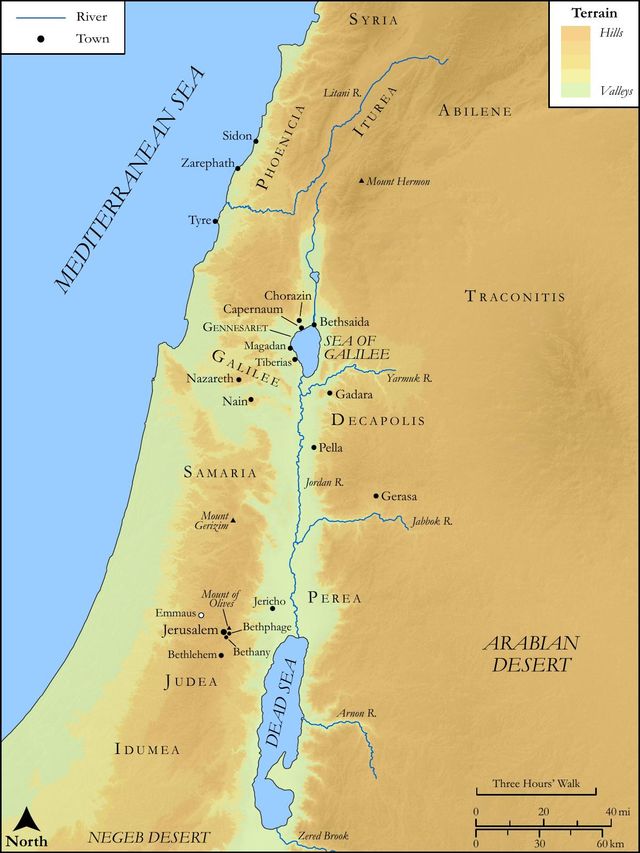
Luke places this landing straight after the storm on the lake, where Jesus rebuked the wind and the water and his disciples asked one another who he could be (Luke 8:22–25). He has shown his authority over the sea, and on the far shore he meets the powers of darkness in a man. “They arrived” translates katapléō, to sail down upon a place, to land. “The country” is chṓra, a stretch of territory, the land around a town as well as the town itself, which is why the story unfolds among tombs, hillside pasture and fields. “Over against Galilee” is antipéran, on the opposite side. They have crossed to the eastern shore, facing the Jewish region where Jesus did most of his work.
The Gadarenes take their name from Gadara (a Gadarēnós is an inhabitant of Gadara), a town east of the Jordan and one of the Decapolis, ten cities of Greek language and culture in that region. Gadara stood about six miles south-east of the lake, and its lands reached down to the shore. Most of the people there were Gentiles who did not keep the law of Moses, and the great herd of swine later in the story fits such a place. Matthew and Mark tell the same events (Matthew 8:28–34, Mark 5:1–20).
Jesus crosses the lake to free one man in a land outside Israel, and that points ahead to the gospel going to all nations (Matthew 28:18–20). Peter learned in the house of Cornelius that “God is no respecter of persons” (Acts 10:34–35), and Paul says that Christ “hath made both one”, Jew and Gentile, breaking down the wall between them (Ephesians 2:14). So God keeps his promise to Abraham that all the families of the earth would be blessed in him (Genesis 12:3).
Gadarenes, Gerasenes or Gergesenes?
The manuscripts of the Gospels and the parallel accounts give the people of this place three names: Gadarenes, Gerasenes and Gergesenes. All three point to the same stretch of the eastern shore. Gadara was a major city whose territory reached the lake, Gerasa lay further inland, and Gergesa (Khersa) was a smaller village right on the shore. The lands of these towns overlapped, so the region could be named after any of them, and every account places the event on the Gentile side of the lake.
A Man Living Among the Tombs
The man who meets Jesus comes “out of the city”, so he belonged to the town, though he had long since stopped living in it. He “had devils long time”. The word is daimónion, a demonic being, and the KJV’s “devils” here means demons, evil spirits, which are distinct from Satan himself, the Devil. “Long time” pairs hikanós, considerable, with chrónos, a span of time, so his suffering had lasted a great while.
He “ware no clothes”. Himátion is clothing, an outer garment such as a cloak, and he went naked. In Israel nakedness went with utter poverty, madness or public shame. He lived in the tombs, mnēma, a memorial or burial place. Under the law, touching a grave made a person unclean (Numbers 19:16), and tombs were thought of as haunts of evil spirits. So this man was cut off from his family, his town and every decent human life, living among the dead. He is exactly the kind of captive Jesus came for, as he said in the synagogue at Nazareth, “to preach deliverance to the captives” (Luke 4:18–19).
Chains, fetters and the wilderness
Verse 29, set in brackets in the KJV, fills in the man’s story. “Oftentimes it had caught him”, seizing him again and again. The people had tried to restrain him: he was kept under guard, bound with chains, with fetters on his feet. Each time he broke the bands, and the strength that did it came from what possessed him. Then he “was driven of the devil into the wilderness”. Elaúnō means to drive or push along, as wind or oars drive a boat, and it is used of the driving force of a demon. The man went where the spirit forced him. The word behind “the devil” in this verse is daímōn, an evil spirit, the unclean spirit the verse began with. The wilderness, érēmos, is lonely, waste country, the kind of place where Jesus himself had been tempted by the devil (Luke 4:1–13).
Luke calls the spirit “unclean”, akáthartos, which means impure. Joined with pneûma, spirit, as akáthartos pneûma, it is one of the New Testament’s usual names for a demon, a being whose impurity stands against the holiness of God. Every chain the town could find gave way before it, which is the truth Paul puts into words: “we wrestle not against flesh and blood, but against principalities, against powers, against the rulers of the darkness of this world, against spiritual wickedness in high places” (Ephesians 6:12).
The same verse explains the man’s cry. “For he had commanded the unclean spirit to come out of the man.” Parangéllō means to pass on a message, and so to give an order, to command. Jesus had already told the spirit to leave, and the shriek and the plea of verse 28 were its answer.
The Demons Know the Son of God Most High
When the man sees Jesus he cries out, anakrázō, to scream aloud, and falls down before him, prospíptō, to fall down before someone. People fall at Jesus’ feet to worship him or to ask his help, and here fear brings the man down. A power that broke every chain bows the moment it meets him.
“What have I to do with thee” is in Greek ti emoi kai soi, literally “what to me and to thee?”, a way of pushing someone off: leave me alone, keep out of my affairs. A man with an unclean spirit cried out in almost the same words in the synagogue at Capernaum: “Let us alone; what have we to do with thee, thou Jesus of Nazareth? art thou come to destroy us? I know thee who thou art, the Holy One of God” (Mark 1:24).
“Son of God most high” is a full confession. Hýpsistos means highest, the Supreme God. The disciples in the boat were still asking who Jesus was, and the demons name him at once.
“I beseech thee, torment me not.” Déomai means to beg, to make a request. Basanízō means to torture, to torment. The spirits who had tormented a man for years now beg to be spared torment themselves. They know a judgment is waiting for them, and they know this man has the power to bring it. Scripture shows where that judgment ends, when the devil is cast into the lake of fire (Revelation 20:10).
The man is the one who speaks, and the plea comes from what holds him, as verse 30 makes plain when the answer “Legion” is explained by the many devils that “were entered into him”.
Why do the demons know who Jesus is?
Spirits, good and evil, know things about God that people come to know only as he reveals them. The demons are fallen angels who have known God’s power, even in their rebellion, and they recognize the Son at sight. Their words are a confession forced out of them by fear, the kind James describes: “the devils also believe, and tremble” (James 2:19). People come to faith as God opens their eyes, and sin and pride can keep those eyes shut, as John says of those whose eyes were blinded (John 12:40). One day every knee will bow to Jesus and every tongue confess “that Jesus Christ is Lord, to the glory of God the Father” (Philippians 2:10–11). On this shore the demons are already on their knees.
Legion: Many Spirits in One Man
Jesus asks, “What is thy name?” and the answer comes: “Legion: because many devils were entered into him.” Legeōn is a word of Latin origin, the Roman regiment. A legion at full strength numbered between three thousand and six thousand soldiers, and everyone in that land knew what one looked like. The name speaks of a great number and of an ordered, armed force. “Were entered” is eisérchomai, to go in, to enter. Many spirits had gone into one man.
Why did Jesus ask the name?
Jesus asked in order to bring the whole truth into the open, so that everyone could see how many held this man and how heavy his bondage was. He already knew the man’s state. The question also shows his authority, for the spirits must answer him, and in the ancient world learning a name went with gaining control over the one named. At Capernaum the people said in amazement, “with authority commandeth he even the unclean spirits, and they do obey him” (Mark 1:27), and Luke tells the same scene (Luke 4:31–37). Jesus later gave his disciples power “over all the power of the enemy” (Luke 10:19).
The Deep the Demons Dread
“And they besought him that he would not command them to go out into the deep.” The verb for besought here is parakaléō, to call near, to invite, and so to plead earnestly. Epitássō means to order, to command. They beg him to leave one particular order unspoken, which shows they know his word would be obeyed.
“The deep” is ábyssos, depthless, the abyss, the “bottomless pit” of Revelation. There an angel lays hold on the devil, binds him for a thousand years and shuts him in the pit (Revelation 20:1–3). Peter says God cast the angels that sinned down into chains of darkness, kept for judgment (2 Peter 2:4), and Jude writes of angels who left their own habitation and are held in everlasting chains under darkness until the judgment of the great day (Jude 1:6). The abyss is a prison for rebellious spirits until the last judgment, and these spirits dreaded it so much that they would rather go into a herd of swine.
Their pleading shows that demons are real beings with minds and wills. They recognize Jesus, they fear, and they ask for things, and all of it happens within the bounds God allows. The Christ they plead with is the one God has raised and set “far above all principality, and power, and might, and dominion” (Ephesians 1:20–22).
Why Did Jesus Let the Demons Enter the Swine?
Jesus let the demons go because their going proved to everyone that the man was free, and it showed what kind of masters had held him. “There was there an herd of many swine feeding on the mountain.” Ekeî is simply “there”, at that place. A herd, agélē, is a drove, and hikanós here means many, a large number. Mark’s account puts it at about two thousand. Bóskō means to pasture or graze. The law counted swine unclean (Leviticus 11:7–8), and a herd of this size belonged to a Gentile land and was a large part of its living.
The demons ask again with parakaléō, the same verb as in verse 31, “that he would suffer them to enter into them”. Epitrépō means to allow, to give leave, to permit. “Enter” is eisérchomai again, with eis, into. They need his leave even for this, and Luke records his answer in four words: “And he suffered them.”
Then the demons go out of the man and into the swine, and the herd runs violently down a steep place into the lake. “Were choked” is apopnígō, to stifle, here by drowning. The man is set free, and the herd is destroyed in a moment.
The rush of the herd gave visible proof that the demons had left the man, and it showed how many they were. It also revealed their nature. Given leave to enter the swine, they drove them straight to death, which is the work Jesus describes: “The thief cometh not, but for to steal, and to kill, and to destroy” (John 10:10). The ruin came from the demons, and Jesus gave the leave as Lord over them.
What about the owners’ loss?
The owners lost a great deal, and that loss helps explain why the people later asked Jesus to go. Jesus counted one man restored to God and to his right mind as worth far more than a herd of animals. He asked elsewhere, “For what is a man profited, if he shall gain the whole world, and lose his own soul?” (Matthew 16:26), and Mark records the same saying (Mark 8:36). The Lord of all creation has the right to use what is his to show his power and to set a captive free.
Clothed and in His Right Mind
The men who fed the swine saw it all. “Saw” is eídō, to see, and what they saw sent them running. They fled, pheúgō, to run away, and they told it, apangéllō, to report or announce, in the city and through the countryside. They ran in fear, and their report brought the whole region out to see. So the first news of Jesus in that land was carried by frightened herdsmen.
The people “went out to see what was done”, and what they found was the man “sitting at the feet of Jesus, clothed, and in his right mind”. Each part answers what came before. The man who had been driven from place to place sits still. The man who “ware no clothes” is clothed. The man under the grip of a legion is sōphronéō, of sound mind, sane, self-controlled. To sit at a teacher’s feet was the place of a disciple among the Jews, so he is already listening to Jesus.
“And they were afraid.” Phobéō means to be alarmed, frightened, and it can also mean to stand in awe. When Jesus healed the paralysed man, those who saw it were also filled with fear, and they glorified God (Luke 5:26). These people see a neighbour restored and feel only dread.
The eyewitnesses then “told them by what means he that was possessed of the devils was healed”. Daimonízomai means to be possessed or vexed by a demon. Pōs is the simple question “how?”, so they told the whole story of how it happened, Jesus’ command, the plea of the demons and the herd in the lake. The word for “healed” is sṓzō, to save, to deliver, to keep safe. The man was saved in every sense: freed, restored and made whole. Luke wrote his Gospel from the accounts of those who “from the beginning were eyewitnesses” (Luke 1:1–4), and here too the report rests on people who saw it.
Why the People Asked Jesus to Leave
“Then the whole multitude of the country of the Gadarenes round about besought him to depart from them; for they were taken with great fear.” Plēthos is a great number, a crowd, the people of the whole district. “Besought” is a different verb here, erōtáō, to ask or request. “Fear” is phóbos, alarm, fright, and mégas makes it great.
Luke gives fear as their reason. They had seen a power they could neither understand nor control, and it had cost them a herd. They had the Son of God on their shore and a neighbour restored before their eyes, and they asked him to go. John sums up the same response in Israel: “He came unto his own, and his own received him not” (John 1:11). Years later the magistrates of Philippi would ask Paul and Silas to leave their city in the same way (Acts 16:39), and even among Jesus’ own followers many went back and walked with him no more (John 6:66).
Jesus takes them at their word. “He went up into the ship, and returned back again.” Hypostréphō means to turn back, to return. He leaves, and he leaves behind one witness.
Sent Home to Tell What God Had Done
The freed man “besought him that he might be with him”. The verb is déomai, the same one the demons used in verse 28, “I beseech thee”. They begged to be spared from Jesus’ presence and power. He begs to stay with him. His wish is the one Peter spoke for the twelve: “Lord, to whom shall we go? thou hast the words of eternal life” (John 6:68).
“But Jesus sent him away.” Apolýō means to let go, to dismiss, and the words that follow show what the dismissal was for. “Return to thine own house, and shew how great things God hath done unto thee.” The word for “return” is hypostréphō, the one just used of Jesus himself going back across the lake. Jesus returns to Galilee, and the man returns home. “Shew” is diēgéomai, to relate fully, to tell the whole account. The people of the region had asked Jesus to leave, and he left them a man they all knew, who could tell them what had happened.
“And he went his way, and published throughout the whole city how great things Jesus had done unto him.” Kērýssō means to herald, to proclaim as a public crier, and in the New Testament chiefly to preach the gospel. Jesus sent him to his house, and he carried the news through the whole city, the same city he had once come out of to live among the tombs. Following Jesus, for this man, meant going home as his witness, and the gospel still begins at home and goes outward (Acts 1:8). Jesus promised, “Whosoever therefore shall confess me before men, him will I confess also before my Father which is in heaven” (Matthew 10:32).
Why did Jesus tell this man to speak when he told others to keep silent?
Jesus sent this man to speak because he was in a Gentile land where the people knew little of him and needed a witness from among themselves. In Jewish regions Jesus often told those he healed to say nothing, as with the leper (Mark 1:44), and charged the crowds that they should not make him known (Matthew 12:16). There he was guarding against people taking him for a political deliverer and against a clash with the religious leaders before his time had come, so that his true mission as the suffering servant could unfold. In the Decapolis none of those expectations stood in the way, Jesus himself was leaving, and this man was known to everyone as the one who had lived in the tombs. He became Jesus’ first messenger to that Gentile region.
“God hath done” and “Jesus had done”
Jesus told the man to show how great things theós, God, had done for him, and the man published how great things Iēsoûs, Jesus, had done. The phrase “how great things” stands twice in verse 39, once in each half, and Luke lets both statements stand side by side. What Jesus did for this man, God did. The man had met God’s own power in the person of Jesus, and his telling of it is a confession of who Jesus is. The name Iēsoûs is the Greek form of Joshua, a name meaning “the LORD saves”, and that is what this man found.
The Son of God Who Sets Captives Free
This shore shows us who Jesus is. “For this purpose the Son of God was manifested, that he might destroy the works of the devil” (1 John 3:8). He is the stronger one who binds the strong man and spoils his house (Mark 3:27), and what he did for one man among the tombs he did for all his people on the cross: “having spoiled principalities and powers, he made a shew of them openly, triumphing over them in it” (Colossians 2:15). Through death he destroyed the one who had the power of death, and set free those who were held in bondage by the fear of it (Hebrews 2:14–15). God promised from the beginning that the woman’s seed would bruise the serpent’s head (Genesis 3:15), and here we watch that promise at work.
The man’s change is a picture of what Christ does for every sinner he saves. We were dead in trespasses and sins and under the prince of the power of the air, and God made us alive together with Christ (Ephesians 2:1–5). He delivers us from the power of darkness into the kingdom of his dear Son (Colossians 1:13–14). He clothes us “with the garments of salvation” (Isaiah 61:10), renews our minds (Romans 12:2), and makes us new creatures in him (2 Corinthians 5:17). No chain and no legion is too strong for him, and “greater is he that is in you, than he that is in the world” (1 John 4:4).
The passage also gives every freed person the same work it gave this man. The one Jesus sets free has a story of how great things God has done, and the first place to tell it is among the people who knew us before.
Luke 8:26
“And they arrived at the country of the Gadarenes,”
The landing comes straight after the storm, so the disciples step from one display of Jesus’ power into another. The verse joins the two scenes with kaí, “and”.
“which is over against Galilee.”
Directly across the lake from Galilee, on the Gentile side.
Luke 8:27
“And when he went forth to land,”
The meeting comes the moment Jesus leaves the boat.
“there met him out of the city a certain man,”
He was a man of the town. Luke gives no name for him.
“which had devils long time,”
Many demons, over a long span of years.
“and ware no clothes, neither abode in any house, but in the tombs.”
Three marks of his ruin: naked, homeless and living among the dead in a place the law counted unclean.
Luke 8:28
“When he saw Jesus, he cried out, and fell down before him,”
The man’s own legs carry him to Jesus, and the spirits in him fall in fear.
“and with a loud voice said, What have I to do with thee,”
A plea to be left alone, shouted aloud.
“Jesus, thou Son of God most high?”
The demons name him truly, with the title for the Supreme God.
“I beseech thee, torment me not.”
The tormentors beg for mercy. The verb for “beseech” comes back in verse 38 on the lips of the freed man.
Luke 8:29
“(For he had commanded the unclean spirit to come out of the man.”
The cry of verse 28 answers this command, which Jesus had already given.
“For oftentimes it had caught him:”
The spirit seized him again and again over the years.
“and he was kept bound with chains and in fetters;”
The town kept him under guard, chained, with shackles on his feet.
“and he brake the bands,”
Every restraint failed.
“and was driven of the devil into the wilderness.)”
The demon drove him out into lonely, waste country, away from every human home.
Luke 8:30
“And Jesus asked him, saying, What is thy name?”
Jesus speaks to the man and requires an answer.
“And he said, Legion:”
A name taken from the Roman army.
“because many devils were entered into him.”
Luke explains the name for his readers: a multitude of demons in one man.
Luke 8:31
“And they besought him”
The voice is plural now, “they”, the many demons of verse 30.
“that he would not command them”
They know his command settles their fate.
“to go out into the deep.”
The abyss, the prison of rebellious spirits.
Luke 8:32
“And there was there an herd of many swine feeding on the mountain:”
A large herd grazing on the hillside above the lake.
“and they besought him that he would suffer them to enter into them.”
They ask leave, which shows they can go nowhere without it.
“And he suffered them.”
Jesus grants the request, and everything that follows happens under his permission.
Luke 8:33
“Then went the devils out of the man, and entered into the swine:”
The man is freed in that moment.
“and the herd ran violently down a steep place into the lake,”
The whole herd plunges over the slope at once.
“and were choked.”
They drowned in the lake.
Luke 8:34
“When they that fed them saw what was done,”
The herdsmen saw it with their own eyes.
“they fled,”
They ran from the place in fear.
“and went and told it in the city and in the country.”
Town and farms alike heard the news.
Luke 8:35 This verse
“Then they went out to see what was done;”
The report draws the people out to see for themselves.
“and came to Jesus, and found the man, out of whom the devils were departed,”
They find Jesus and the man together, the demons gone.
“sitting at the feet of Jesus,”
The posture of a disciple.
“clothed, and in his right mind:”
Two visible signs that he was whole again.
“and they were afraid.”
Their fear is the first thing Luke records of them.
Luke 8:36
“They also which saw it told them”
The “also” stands for kaí, and the verse opens with dé, a small linking word left untranslated in the KJV. The eyewitnesses add their account to what the people see.
“by what means he that was possessed of the devils was healed.”
They explain how it happened, so the people know Jesus did this.
Luke 8:37
“Then the whole multitude of the country of the Gadarenes round about”
The whole district, the land around Gadara.
“besought him to depart from them;”
The whole region asks the Son of God to leave.
“for they were taken with great fear:”
Fear gripped them and held them.
“and he went up into the ship, and returned back again.”
Jesus goes back across the lake to Galilee.
Luke 8:38
“Now the man out of whom the devils were departed”
Luke names him by what Jesus has done for him.
“besought him that he might be with him:”
He asks to go with Jesus in the boat and be one of those who are with him.
“but Jesus sent him away, saying,”
Jesus lets him go, and the next verse gives the charge he goes with.
Luke 8:39
“Return to thine own house,”
To his own household, which he had not lived with for a long time.
“and shew how great things God hath done unto thee.”
He is to tell the whole account and give the glory to God.
“And he went his way,”
He obeyed and went.
“and published throughout the whole city”
He proclaimed it through the whole town as well as his house.
“how great things Jesus had done unto him.”
He names Jesus as the one who did these great things.
Last revised