


Luke 23:52
Bible text: King James Version (1769 Blayney text) · Public domain
Bible text: Berean Standard Bible · Public domain
Bible text: American Standard Version (1901) · Public domain
Bible text: World English Bible, Messianic edition · Public domain
Bible text: Geneva Bible (1599) · Public domain
Bible text: Young's Literal Translation · Public domain
- οὗτοςhoutosHeG3778D-NSMDemonstrative pronoun Nominative Singular Masculine
- προσελθὼνproselthōnhaving goneG4334V-2AAP-NSMVerb 2nd Aorist Active Participle Nominative Singular Masculine
- τῷtō<the>G3588T-DSMDefinite article Dative Singular Masculine
- ΠιλάτῳPilatōto PilateG4091N-DSM-PNoun Dative Singular Masculine Individual
- ᾐτήσατοētēsatoasked [for]G154V-AMI-3SVerb Aorist Middle Indicative 3rd Singular
- τὸtotheG3588T-ASNDefinite article Accusative Singular Neuter
- σῶμαsōmabodyG4983N-ASNNoun Accusative Singular Neuter
- τοῦtou<the>G3588T-GSMDefinite article Genitive Singular Masculine
- ἸησοῦIēsouof JesusG2424N-GSM-PNoun Genitive Singular Masculine Individual
English is a literal word-by-word gloss of the Greek, not the KJV's wording. Why?
This is the original text the KJV's translators worked from — each Greek word with its own literal English meaning in this verse, prepared by scholars at Tyndale House, Cambridge. The KJV translates whole sentences, not word by word, so its wording differs: one Greek word can become several English words, and the KJV may choose “charity” where the gloss reads “love”. Both are faithful — they answer different questions. For the KJV's own rendering, switch to the KJV text.
Details
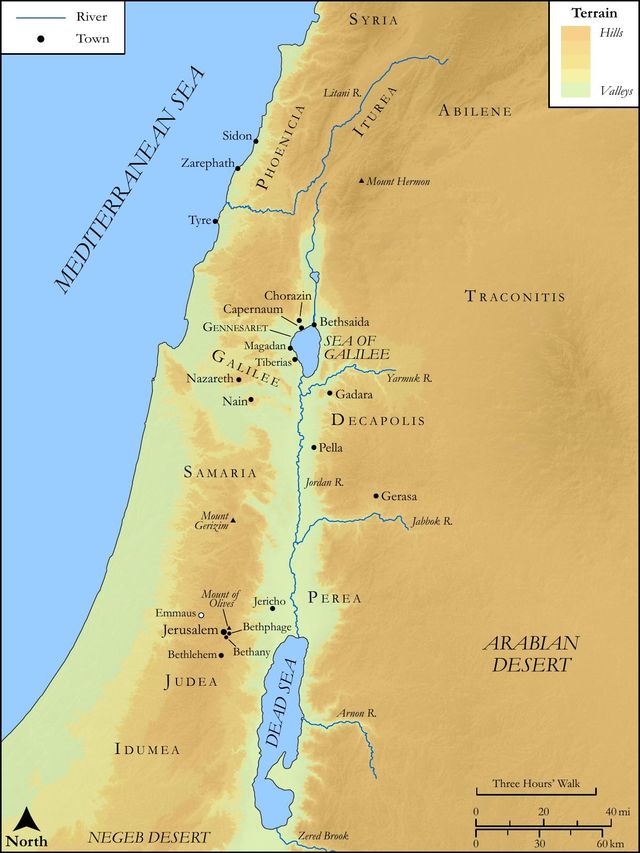
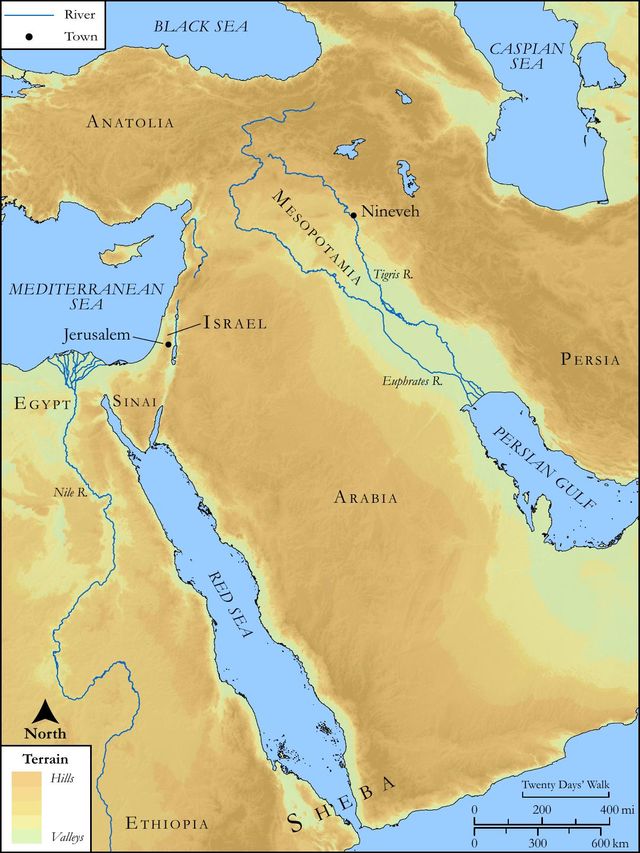
See on the biblical-era maps

Study this verse
Public-domain commentary
Matthew Henry
From his Commentary on the Whole Bible. Henry comments on passages, not single verses — this entry covers Luke 23:50–56. His two-level outline is real structure in the source text, so it is rendered as structure.
We have here an account of Christ's burial; for he must be brought not only to death, but to the dust of death (Psa 22:15), according to the sentence (Gen 3:19), To the dust thou shalt return. Observe,
I.Who buried him.
His acquaintance stood afar off; they had neither money to bear the charge nor courage to bear the odium of burying him decently; but God raised up one that had both, a man named Joseph, Luk 23:50. His character is that he was a good man and a just, a man of unspotted reputation for virtue and piety, not only just to all, but good to all that needed him (and care to bury the dead, as becomes the hope of the resurrection of the dead, is one instance of goodness and beneficence); he was a person of quality, a counsellor, a senator, a member of the sanhedrim, one of the elders of the Jewish church. Having said this of him, it was necessary to add that, though he was of that body of men who had put Christ to death, yet he had not consented to their counsel and deed (Luk 23:51), though it was carried by the majority, yet he entered his protest against it, and followed not the multitude to do evil. Note, That evil counsel or deed to which we have not consented shall not be reckoned our act. Nay, he not only dissented openly from those that were enemies to Christ, but be consented secretly with those that were his friends: He himself waited for the kingdom of God; he believed the Old Testament prophecies of the Messiah and his kingdom, and expected the accomplishment of them. This was the man that appears upon this occasion to have had a true respect for the Lord Jesus. Note, There are many who are hearty in Christ's interests, how, though they do not make any show in their outward profession of it, yet will be more ready to do him a piece of real service, when there is occasion, than others who make a greater figure and noise.
II.What he did towards the burying of him.
1.He went to Pilate, the judge that condemned him, and begged the body of Jesus, for it was at his disposal; and, though he might have raised a party sufficient to have carried off the body by violence, yet he would take the regular course, and do it peaceably.
2.He took it down, it should seem, with his own hands, and wrapped it in linen. They tell us that it was the manner of the Jews to roll the bodies of the dead, as we do little children in their swaddling-clothes, and that the word here used signifies as much; so that the piece of fine linen, which he bought whole, he cut into many pieces for this purpose. It is said of Lazarus, He was bound hand and foot, Joh 11:44. Grave-clothes are to the saints as swaddling-clothes, which they shall out-grow and put off, when they come to the perfect man.
III.Where he was buried.
In a sepulchre that was hewn in stone, that the prison of the grave might be made strong, as the church, when she was brought into darkness, had her way enclosed with hewn stone, Lam 3:2, Lam 3:9. But it was a sepulchre in which never man before was laid, for he was buried on such an account as never any one before him was buried, only in order to his rising again the third day by his own power; and he was to triumph over the grave as never any man did.
IV.When he was buried.
On the day of the preparation, when the sabbath drew on, Luk 23:54. This is given as a reason why they made such haste with the funeral, because the sabbath drew on, which required their attendance to other work, preparing for the sabbath, and going forth to welcome it. Note, Weeping must not hinder sowing. Though they were in tears for the death of Christ, yet they must apply themselves to the sanctifying of the sabbath; and, when the sabbath draws on, there must be preparation. Our worldly affairs must be so ordered that they may not hinder us from our sabbath work, and our holy affections must be so excited that they may carry us on in it.
V.Who attended the funeral; not any of the disciples, but only the women that came with him from Galilee (Luk 23:55), who, as they staid by him while he hung on the cross, so they followed him, all in tears no doubt, and beheld the sepulchre where it was, which was the way to it, and how his body was laid in it. They were led to this, not by their curiosity, but by their affection to the Lord Jesus, which was strong as death and which many waters could not quench. Here was a silent funeral, and not a solemn one, and yet his rest was glorious.
VI.What preparation was made for the embalming of his body after he was buried (Luk 23:56):
They returned, and prepared spices and ointments, which was more an evidence of their love than of their faith; for had they remembered and believed what he had so often told them, that he should rise again the third day, they would have spared their cost and pains herein, as knowing that in a short time there would be a greater honour put upon his body, by the glory of his resurrection, than they could put upon it with their most precious ointments; but, busy as they were in this preparation, they rested on the sabbath day, and did none of this servile work thereon, not only according to the custom of their nation, but according to the commandments of their God, which, though the day be altered, is still in full force: Remember the sabbath day, to keep it holy.
Historical interpretation
Nine Centuries of Reception
12 surviving comments on this verse. Each one is dated, so this reads as a timeline rather than a list.
Select a marker to jump to its quote. Markers stagger vertically where authors wrote within a few decades of each other.
(in Vit. Ant. 90.) They also act absurdly who embalm the bodies of their dead, and do not bury them, even supposing them to be holy. For what can be more holy or greater than our Lord's body? And yet this was placed in a tomb until it rose again the third day. For it follows, And he laid it in a hewn sepulchre.
Mary stands for Eve, and Joseph stands for another Joseph. He who asked for his corpse was also named Joseph. The earlier Joseph was a righteous man who did not denounce Mary publicly. The other one was also a righteous man because he did not consent to the detractors. So that it might be clear that the Lord was entrusted at the beginning to one having this name when he was born, he further allowed one with this name to prepare him for burial when he was dead. This name receives the full reward for serving him at his birth in the cave and for having served his corpse at the tomb.
We seek to know exactly where he was buried. Was his tomb made with hands? Does it rise above the ground, like the tombs of kings? Was the sepulcher made of stones joined together? What is laid upon it? O prophets, tell us exactly about his tomb. Where is it? Where should we look for it? They answer, “Look at the solid rock that you have hewn.” Look and see. You have in the Gospels, “In a rock-hewn tomb.” What is next? What kind of door does the sepulcher have? Again, the prophet says, “They have ended my life in the pit, and they have laid a stone over me.” I am “the chief cornerstone, chosen, precious.” He that is “a stone of stumbling” to the Jews but of salvation to those that believe was for a while within a stone. The tree of life was planted in the earth, to bring blessing for the earth that was cursed and to bring release for the dead.
Now mystically, the just man buries the body of Christ. For the burial of Christ is such as to have no guile or wickedness in it. But rightly did Matthew call the man rich, for by carrying Him that was rich he knew not the poverty of faith. The just man covers the body of Christ with linen. Do thou also clothe the body of Christ with His own glory, that thou mayest be thyself just. And if thou believest it to be dead, still cover it with the fulness of His own divinity. But the Church also is clothed with the grace of innocence.
Nor without meaning has one Evangelist spoken of a new tomb, another of the tomb of Joseph. For the grave is prepared by those who are under the law of death; the Conqueror of death has no grave of His own. For what fellowship hath God with the grave. He alone is enclosed in this tomb, because the death of Christ, although it was common according to the nature of the body, yet was it peculiar in respect of power. But Christ is rightly buried in the tomb of the just, that He may rest in the habitation of justice. For this monument the just man hews out with the piercing word in the hearts of Gentile hardness, that the power of Christ might extend over the nations. And very rightly is there a stone rolled against the tomb; for whoever has in himself truly buried Christ, must diligently guard, lest he lose Him, or lest there be an entrance for unbelief.
(de Con. Ev. lib. iii. c. 22.) Now John says, that Joseph was a disciple of Jesus. Hence it is also here added, Who also himself waited for the kingdom of God. But it naturally causes surprise how he who for fear was a secret disciple should have dared to beg our Lord's body, which none of those who openly followed Him dared to do; for it is said, This man went unto Pilate, and begged the body of Jesus. We must understand then, that he did this from confidence in his rank, by which he might be privileged to enter familiarly into Pilate's presence. But in performing that last funeral rite, he seems to have eared less for the Jews, although it was his custom in hearing our Lord to avoid their hostility.
Someone might say of last Sunday’s sermon, in which we preached that there was no less glory in Joseph’s grave receiving the Lord than in holy Mary’s womb begetting him, “What comparison can there be between the womb and the grave, since the one brought forth a son from its innermost bowels while the other only gave him a place of burial?” But I say that Joseph’s love was no less than Mary’s, since she conceived the Lord in her womb and he did so in his heart. She offered the secret place of her inmost members to the Savior; he did not deny him the secret place for his own body. She wrapped the Lord in swaddling clothes when he was born; he wrapped him in linen cloths when he died. She anointed his blessed body with oil; he honored it with spices. Each one’s service is similar and each one’s love is similar; hence each one’s reward must also be similar. But there is this difference: an angel called Mary to her service, but righteousness alone persuaded Joseph.
Let us see, then, what happens to the Lord’s body after they take it down from the cross. Joseph of Arimathea, a righteous man, as the Evangelist says, took it and buried it in his new tomb in which no one had ever been laid. Blessed is the body of the Lord Christ, which in birth comes forth from a virgin’s womb and in death is placed in the grave of a righteous man! Clearly this body is blessed. Virginity brought it out, and righteousness held it! Joseph’s grave held him incorrupt, just as Mary’s womb preserved him inviolate. In the one, a man’s impurity does not touch him; in the other, death’s corruption does not hurt him. In every way, holiness and virginity are bestowed on that blessed body. A new womb conceived him, and a new grave enclosed him. The womb is the Lord’s womb. It is virginal. The tomb is virginal. Should I not rather say that the tomb itself is a womb? There is, in fact, a great similarity. Just as the Lord came out from his mother’s womb living, so also he rose living from Joseph’s tomb. Just as he was born from the womb in order to preach, so also now he has been reborn from the tomb in order to evangelize. The last birth is more glorious than the first. The first conceived a mortal body, but the last brought out an immortal one. After the first birth, he descends to hell, but after the last birth, he returns to the heavens. The last birth is more religious than the first. The first kept the Lord of the whole world locked in the womb for nine months, but the last held him in the belly of the grave for only three days. The first offered hope to all rather slowly, but the last raised salvation for all quite quickly.
Let us see why they placed the Savior in someone else’s grave instead of his own. They placed him in another person’s grave because he died for the salvation of others. They did not impose death on him. He endured death for us. Death did not just happen to him, but it benefited us. Why should he, who did not have his own death in himself, have his own grave? Why should he, whose dwelling remained in heaven, have a burial place on earth? Why should he have a grave? For only three days, he did not so much lie as one dead in a tomb as rest as one sleeping in a bed. The brief period of time itself certainly indicates sleep rather than death. A tomb is the dwelling of death. Christ who is life did not need a dwelling for death, nor did he who is always living require a habitation of the deceased. We have correctly laid up this life in our own tomb so that as he gives life to our death, we may rise with him from the dead.
A counsellor, or decurio, is so called because he is of the order of the curia or council, and administers the office of the curia. He is also wont to be called curialis, from his management of civil duties. Joseph then is said to have been of high rank in the world, but of still higher estimation before God; as it follows, A good man, and a just, of Arimathæa, a city of the Jews, &c. Arimathæa is the same as Ramatha, the city of Helcanah and Samuel.
So then being fitted by the righteousness of his works for the burial of our Lord's body, he was worthy by the dignity of his secular power to obtain it. Hence it follows, And he took it down, and wrapped it in linen. By the simple burial of our Lord, the pride of the rich is condemned, who not even in their graves can be without their wealth.
That is, hewn out of a rock, lest if it had been built of many stones, and the foundations of the tomb being dug up after the resurrection, the body should be said to have been stolen away. It is laid also in a new tomb, wherein never man before was laid, lest when the rest of the bodies remained after the resurrection, it might be suspected that some other had risen again. But because man was created on the sixth day, rightly being crucified on the sixth day our Lord fulfilled the secret of man's restitution. It follows, And it was the day of the παρασκευὴ, which means the preparation, the name by which they called the sixth day, because on that day they prepared the things which were necessary for the Sabbath. But because on the seventh day the Creator rested from His work, the Lord on the Sabbath rested in the grave. Hence it follows, And the Sabbath was dawning. Now we said above, that all His acquaintance stood afar off, and the women which followed Him. These then of His acquaintance, after His body was taken down, returned to their homes, but the women who more tenderly loved Him, following His funeral, desired to see the place where He was laid. For it follows, And the women also, which came with him from Galilee, followed after, and beheld the sepulchre, and how his body was laid, that in truth they might make the offerings of their devotion at the proper time.
He also wraps Jesus in clean linen, who has received Him with a pure mind.
Now that the Lord is crucified on the sixth day and rests on the seventh, signifies that in the sixth age of the world we must of necessity suffer for Christ, and as it were be crucified to the world. (Gal. 6:14.) But in the seventh age, that is, after death, our bodies indeed rest in the tombs, but our souls with the Lord. But even at the present time also holy women, (that is, humble souls,) fervent in love, diligently wait upon the Passion of Christ, and if perchance they may be able to imitate Him, with anxious carefulness ponder each step in order, by which this Passion is fulfilled. And having read, heard, and called to mind all these, they next apply themselves to make ready the works of virtue, by which Christ may be pleased, in order that having finished the preparation of this present life, in a blessed rest they may at the time of the resurrection meet Christ with the frankincence of spiritual actions.
He approached Pilate and asked for the body of Jesus. Joseph, indeed, was of great dignity in the world, but he is praised for having greater merit before God, so that by the righteousness of his merits he was worthy to bury the Lord’s body, and by the nobility of his worldly power he could receive the same body. For not just anyone unknown could approach the governor and obtain the body of the crucified.
But the race of women formerly cursed remains and sees all these things; for it follows, And the women which followed him from Galilee, seeing these things. And thus they are the first to be renewed by justification, or by the blessing which flows from His passion, as also from His resurrection.
For they had not yet sufficient faith, but prepared as if for a mere man spices and ointments, after the manner of the Jews, who performed such duties to their dead. Hence it follows, And they returned, and prepared spices. For our Lord being buried, they were occupied as long as it was lawful to work, (that is, until sun-set,) in preparing ointments. But it was commanded to keep silence on the Sabbath, that is, rest from evening to evening. For it follows, And rested the sabbath day according to the commandment.
(Photius.) Joseph had been at one time a secret disciple of Christ, but at length bursting through the bonds of fear, and become very zealous, he took down the body of our Lord, basely hanging on the cross; thus gaining a precious jewel by the meekness of His words. Hence it follows, And, behold, there was a man named Joseph, a counsellor.
Continue studying Luke 23:52 across the web’s major study libraries — every link below opens this exact verse, chapter, or book on the destination site.
Read & Compare
 BibleGatewayThis verse in more than 200 translations and 70 languages.
 Bible.comThe YouVersion reader — hundreds of translations, reading plans, and highlights.
 ESV.orgCrossway's official English Standard Version reader.
 NET BibleThe NET translation with 60,000+ translators' notes on every rendering decision.
 STEP BibleTyndale House's free study tool — original text, vocabulary, and scholarly resources.
 BibliaLogos Bible Software's free web reader.
 USCCBThe New American Bible (Revised Edition) with the U.S. bishops' study notes.
Commentaries
 BibleHub CommentariesDozens of classic commentaries on this verse, gathered on one page.
 StudyLightMore than 100 commentary sets — the largest collection on the web.
 BibleRefPlain-English commentary on what this verse means, verse by verse.
 Enduring WordDavid Guzik's free commentary on this chapter, widely used by Bible teachers.
 Bible Study ToolsVerse commentary alongside Greek and Hebrew study aids.
Original Language & Research
- BibleHub InterlinearThe verse word by word — original language, transliteration, and English.
- BibleHub LexiconEvery word's original-language definition and Strong's entry.
 Blue Letter BibleDeep-study tools — Strong's numbers, concordance, and word studies.
 CNTR CollationThe earliest Greek manuscripts of this verse, collated letter by letter.
Sermons, Hymns & Audio


TrulyRandomVerse is not affiliated with these sites and doesn’t control their content. They’re linked because they’re genuinely useful.
Summary
Luke 23:52 records the courageous and pivotal act of Joseph of Arimathaea, a respected member of the Jewish council, who boldly approached Pontius Pilate to request the body of Jesus for burial. This action, taken immediately after Jesus' death and on the eve of the Sabbath, was a significant public identification with the crucified Messiah, demonstrating profound faith and ensuring that Jesus received a dignified burial, a crucial step in the unfolding of God's redemptive plan.
Context
ShowHideLiterary Context
This verse immediately follows the crucifixion and death of Jesus, as described in Luke 23:44-49. Luke highlights the dramatic signs (darkness, torn temple veil), the centurion's confession, and the sorrow of the crowds and followers. Prior to this, Luke 23:50-51 introduces "this man," Joseph of Arimathaea, as a good and righteous council member who did not consent to their decision regarding Jesus and was "waiting for the kingdom of God." His action in verse 52 is thus presented as a direct, bold response to Jesus' death, fulfilling his quiet discipleship.
Historical & Cultural Context
Roman crucifixion practices typically left bodies on the cross to decompose or be consumed by scavengers, serving as a gruesome public deterrent. However, Jewish law, particularly Deuteronomy 21:22-23, strictly prohibited leaving a body exposed overnight, especially if executed. Given that Jesus died on the "day of preparation" (Luke 23:54), meaning the Sabbath (Passover Sabbath, a high holy day) was about to begin at sunset, there was immense urgency to remove and bury the body. Approaching the Roman governor, Pilate, to request the body of a condemned criminal was a highly unusual and dangerous act, carrying the risk of public association with a perceived enemy of Rome and the Jewish authorities.
Key Themes
ShowHideLuke 23:52 contributes significantly to several key themes within the Gospel. It underscores the theme of unexpected discipleship, as Joseph, a wealthy and influential council member, steps forward when many of Jesus' closest disciples have scattered in fear. His act demonstrates courage and boldness, openly identifying with a crucified criminal, contrasting sharply with the earlier denials of Peter or the flight of other disciples. This action also highlights divine providence, as Joseph's wealth and position enable him to provide a tomb, directly fulfilling Old Testament prophecy concerning the Messiah's burial (e.g., Isaiah 53:9). Finally, it emphasizes the necessity of Jesus' burial as a factual and historical event, a prerequisite for the subsequent resurrection, which is central to the Christian message (1 Corinthians 15:3-4).
Exposition and Analysis
ShowHideKey Word Analysis
ShowHideThis demonstrative pronoun, referring to Joseph of Arimathaea, emphasizes the specific individual who took this extraordinary action. It highlights that it was this particular man, a member of the very council that condemned Jesus, who stepped forward, underscoring the unexpected and significant nature of his intervention.
Derived from "to" (πρόs) and "to come" (ἔρχομαι), this verb signifies an approach, a coming near, often with a sense of purpose or intention. In this context, it describes Joseph's deliberate and direct movement toward Pilate, indicating a formal and determined initiative rather than a casual encounter. It suggests a certain boldness and resolve in his approach to the Roman governor.
This verb denotes to ask, request, or even to crave or require. It implies an earnest and formal petition, not merely a casual inquiry. Joseph's "begging" was a serious appeal to a figure of ultimate authority (Pilate) for a highly sensitive matter, reflecting the gravity and urgency of his desire to secure Jesus' body. It was a request that required Pilate's explicit permission and carried significant personal risk for Joseph.
Verse Breakdown
ShowHide"This man went unto Pilate"
"This man" refers to Joseph of Arimathaea, as identified in the preceding verses (Luke 23:50-51). His act of "going unto Pilate" was a remarkable display of courage and conviction. Pilate, the Roman governor, held absolute authority over matters of execution and burial. For a respected Jewish council member to approach him publicly concerning a crucified criminal was an act of profound risk, potentially jeopardizing Joseph's reputation, position, and even his life, as it openly associated him with Jesus.
"and begged the body of Jesus"
Joseph's request was not merely for permission to bury Jesus, but specifically for "the body of Jesus." This highlights his desire to provide a dignified burial, in stark contrast to the ignominious death Jesus had suffered. The act of "begging" implies a formal, earnest, and perhaps even desperate plea, underscoring the urgency of the situation before the Sabbath and the deep reverence Joseph held for Jesus, despite the public disgrace. This act was crucial for the historical reality of Jesus' burial, which is foundational to the Christian belief in His bodily resurrection.
Literary Devices
ShowHideLuke's account of Joseph's actions employs several powerful literary devices. There is significant Irony in the fact that while Jesus' closest disciples have fled or are in hiding, it is Joseph, a member of the very council that condemned Jesus, who steps forward to honor Him. This unexpected act highlights the surprising nature of God's work and the diverse ways in which individuals are called to faith. The act itself is imbued with Symbolism, as Joseph's securing of Jesus' body for burial is not merely a practical necessity but a profound act of reverence and a testament to Jesus' humanity and the reality of His death. This dignified burial contrasts sharply with the brutal crucifixion, symbolizing the ultimate triumph of honor over ignominy. Furthermore, there is a powerful Contrast between the fear and scattering of many followers and Joseph's bold, public identification with Jesus, demonstrating a courageous faith that stands out in a moment of despair.
Theological and Thematic Connections
ShowHideJoseph of Arimathaea's courageous act in Luke 23:52 is deeply significant for Christian theology. It underscores the absolute necessity of Jesus' physical death and burial for the reality of His resurrection. Without a verifiable death and burial, the resurrection would lack its historical anchor. Joseph's actions, driven by a quiet but profound faith, demonstrate that God uses unexpected individuals in pivotal moments to fulfill His divine plan. His willingness to risk his reputation and standing for the sake of honoring Jesus serves as a powerful testament to the nature of true discipleship, which may manifest in quiet acts of service and courage rather than public displays. This event also fulfills Old Testament prophecy, showing God's meticulous orchestration of even the seemingly mundane details of His Son's life and death.
Reflection and Application
ShowHideJoseph of Arimathaea stands as a compelling example of faith that manifests in costly and courageous action. At a moment when Jesus' public ministry had seemingly ended in disgrace and His followers were scattered in fear, Joseph, a man of significant social standing and influence, stepped forward to perform an act of profound devotion. His willingness to publicly associate with a condemned criminal, risking his own reputation and safety, challenges us to consider the nature of our own discipleship. Do we use our positions, resources, or influence to honor Christ, especially when it is unpopular, inconvenient, or requires personal sacrifice? Joseph's act reminds us that faithfulness is not always about grand public declarations, but often about quiet, determined obedience and service in moments of crisis. His example encourages us to be bold in our faith, to value and care for what others might discard, and to trust that God can use even our seemingly small acts of courage to advance His sovereign purposes.
Questions for Reflection
ShowHideFAQ
ShowHideWho was "this man" mentioned in Luke 23:52?
ShowHide"This man" is Joseph of Arimathaea. Luke explicitly identifies him in the preceding verses, Luke 23:50-51, as "a counselor, a good and just man" who "had not consented to their counsel and deed" regarding Jesus. He was also described as "waiting for the kingdom of God," indicating his quiet but sincere faith in Jesus.
Why was it so urgent for Joseph to beg for Jesus' body?
ShowHideThere was extreme urgency due to Jewish law and the approaching Sabbath. According to Deuteronomy 21:22-23, a body could not remain exposed overnight, especially if the person was executed. Since Jesus died on the "day of preparation" (Luke 23:54), the Sabbath was beginning at sunset, making it imperative to remove and bury the body before then. Failure to do so would desecrate the holy day.
What was the risk for Joseph in approaching Pilate for Jesus' body?
ShowHideJoseph faced significant personal and social risk. By publicly requesting the body of a crucified criminal, he was openly identifying himself with Jesus, whom the Roman authorities had condemned as a rebel and the Jewish leadership as a blasphemer. This act could have led to his own arrest, loss of social standing, excommunication from the Jewish council, or even accusations of sedition. It was a courageous act of faith in a highly volatile political and religious climate.
Christ-Centered Fulfillment
ShowHideJoseph of Arimathaea's seemingly simple act of "begging the body of Jesus" is a profoundly Christ-centered event, essential to the grand narrative of redemption. While it appears to be an act of human compassion, it is a crucial step orchestrated by divine providence, ensuring the proper burial of the Messiah. This burial is not merely the respectful disposition of a corpse; it is the historical anchor for the resurrection. For Jesus to rise, He first had to truly die and be buried. Joseph's provision of a tomb, a rich man's grave, directly fulfills the prophecy of Isaiah 53:9, demonstrating that even in apparent defeat, God's sovereign plan for His Son was unfolding precisely as foretold. The fact that Jesus' body was laid in a verifiable tomb, secured by Pilate's permission, makes the subsequent discovery of the empty tomb (Luke 24:1-3) and His bodily resurrection (Luke 24:36-43) undeniably powerful and historically grounded. Joseph's act, therefore, is an indispensable part of the good news, confirming the reality of Jesus' death and setting the stage for the triumph of His resurrection, which is the cornerstone of Christian faith and the ultimate victory over sin and death (1 Corinthians 15:3-4).