


Luke 23:42
Bible text: King James Version (1769 Blayney text) · Public domain
Bible text: Berean Standard Bible · Public domain
Bible text: American Standard Version (1901) · Public domain
Bible text: World English Bible, Messianic edition · Public domain
Bible text: Geneva Bible (1599) · Public domain
Bible text: Young's Literal Translation · Public domain
- καὶkaiAndG2532CONJConjunction
- ἔλεγεν·elegenhe was sayingG3004V-IAI-3SVerb Imperfect Active Indicative 3rd Singular
- τῷtō<the>G3588T-DSMDefinite article Dative Singular Masculine
- ἸησοῦIēsouJesusG2424N-VSM-PNoun Vocative Singular Masculine Person Gentilic
- μνήσθητίmnēsthētido rememberG3403V-APM-2SVerb Aorist Passive Imperative 2nd Singular
- μουmoumeG3165P-1GSPersonal pronoun Genitive 1st Singular
- κύριεkurieLordG2962N-VSM-TNoun Vocative Singular Masculine Person Gentilic
- ὅτανhotanwhenG3752CONJConjunction
- ἔλθῃςelthēsYou may comeG2064V-2AAS-2SVerb 2nd Aorist Active Subjunctive 2nd Singular
- εἰςeisintoG1519PREPPreposition
- τὴνtēntheG3588T-ASFDefinite article Accusative Singular Feminine
- βασιλείανbasileiankingdomG932N-ASFNoun Accusative Singular Feminine
- σουsouof You!G4771P-2GSPersonal pronoun Genitive 2nd Singular
English is a literal word-by-word gloss of the Greek, not the KJV's wording. Why?
This is the original text the KJV's translators worked from — each Greek word with its own literal English meaning in this verse, prepared by scholars at Tyndale House, Cambridge. The KJV translates whole sentences, not word by word, so its wording differs: one Greek word can become several English words, and the KJV may choose “charity” where the gloss reads “love”. Both are faithful — they answer different questions. For the KJV's own rendering, switch to the KJV text.
Details
See on the biblical-era maps
Study this verse
Public-domain commentary
Matthew Henry
From his Commentary on the Whole Bible. Henry comments on passages, not single verses — this entry covers Luke 23:32–43. His four-level outline is real structure in the source text, so it is rendered as structure.
In these verses we have,
I.Divers passages which we had before in Matthew and Mark concerning Christ's sufferings.
1.That there were two others, malefactors, led with him to the place of execution, who, it is probable, had been for some time under sentence of death, and were designed to be executed on this day, which was probably the pretence for making such haste in the prosecution of Christ, that he and these two malefactors might be executed together, and one solemnity might serve.
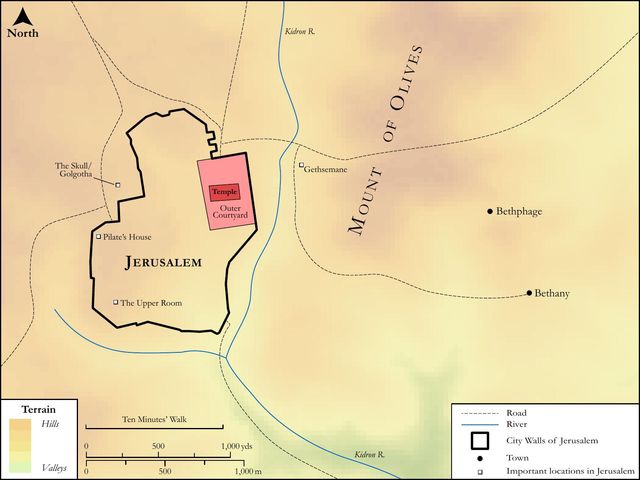
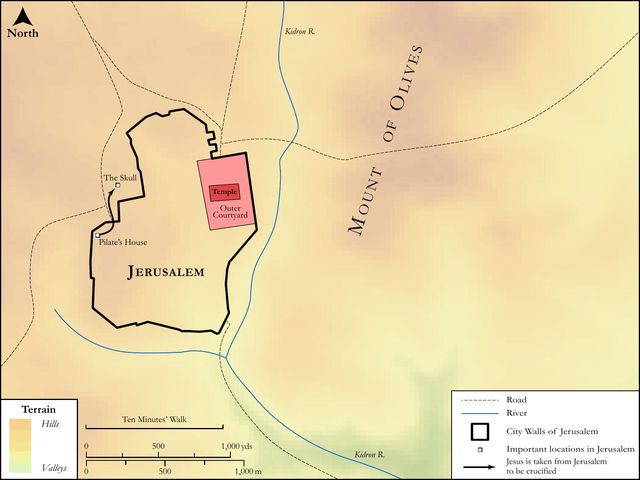
2.That he was crucified at a place called Calvary, Kranion, the Greek name for Golgotha - the place of a skull: an ignominious place, to add to the reproach of his sufferings, but significant, for there he triumphed over death as it were upon his own dunghill. He was crucified. His hands and feet were nailed to the cross as it lay upon the ground, and it was then lifted up, and fastened into the earth, or into some socket made to receive it. This was a painful and shameful death above any other.
3.That he was crucified in the midst between two thieves, as if he had been the worst of the three. Thus he was not only treated as a transgressor, but numbered with them, the worst of them.
4.That the soldiers who were employed in the execution seized his garments as their fee, and divided them among themselves by lot: They parted his raiment, and cast lots; it was worth so little that, if divided, it would come to next to nothing, and therefore they cast lots for it.
5.That he was reviled and reproached, and treated with all the scorn and contempt imaginable, when he was lifted up upon the cross. It was strange that so much barbarity should be found in the human nature: The people stood beholding, not at all concerned, but rather pleasing themselves with the spectacle; and the rulers, whom from their office one would take to be men of sense and men of honour, stood among the rabble, and derided him, to set those on that were about them to do so too; and they said, He saved others, let him save himself. Thus was he upbraided for the good works he had done, as if it were indeed for these that they crucified him. They triumphed over him as if they had conquered him, whereas he was himself then more than a conqueror; they challenged him to save himself from the cross, when he was saving others by the cross: If he be the Christ, the chosen of God, let him save himself. They knew that the Christ was the chosen of God, designed by him, and dear to him. "If he, as the Christ, would deliver our nation from the Romans (and they could not form any other idea than that of the Messiah), let him deliver himself from the Romans that have him now in their hands." Thus the Jewish rulers jeered him as subdued by the Romans, instead of subduing them. The Roman soldiers jeered him as the King of the Jews: "A people good enough for such a prince, and a prince good enough for such a people." They mocked him (Luk 23:36, Luk 23:37); they made sport with him, and made a jest of his sufferings; and when they were drinking sharp sour wine themselves, such as was generally allotted them, they triumphantly asked him if he would pledge them, or drink with them. And they said, If thou be the king of the Jews, save thyself; for, as the Jews prosecuted him under the notion of a pretended Messiah, so the Romans under the notion of a pretended king.
6.That the superscription over his head, setting forth his crime, was, This is the King of the Jews, Luk 23:38. He is put to death for pretending to be the king of the Jews; so they meant it; but God intended it to be a declaration of what he really was, notwithstanding his present disgrace: he is the king of the Jews, the king of the church, and his cross is the way to his crown. This was written in those that were called the three learned languages, Greek, and Latin, and Hebrew, for those are best learned that have learned Christ. It was written in these three languages that it might be known and read of all men; but God designed by it to signify that the gospel of Christ should be preached to all nations, beginning at Jerusalem, and be read in all languages. The Gentile philosophy made the Greek tongue famous, the Roman laws and government made the Latin tongue so, and the Hebrew excelled them all for the sake of the Old Testament. In these three languages is Jesus Christ proclaimed king. Young scholars, that are taking pains at school to make themselves masters of these three languages, should aim at this, that in the use of them they may increase their acquaintance with Christ.
II.Here are two passages which we had not before, and they are very remarkable ones.
1.Christ's prayer for his enemies (Luk 23:34): Father, forgive them. Seven remarkable words Christ spoke after he was nailed to the cross, and before he died, and this is the first. One reason why he died the death of the cross was that he might have liberty of speech to the last, and so might glorify his Father and edify those about him. As soon as ever he was fastened to the cross, or while they were nailing him, he prayed this prayer, in which observe,
(1.)The petition: Father, forgive them. One would think that he should have prayed, "Father, consume them; the Lord look upon it, and requite it." The sin they were now guilty of might justly have been made unpardonable, and justly might they have been excepted by name out of the act of indemnity. No, these are particularly prayed for. Now he made intercession for transgressors, as was foretold (Isa 53:12), and it is to be added to his prayer (Jn. 17), to complete the specimen he gave of his intercession within the veil: that for saints, this for sinners. Now the sayings of Christ upon the cross as well as his sufferings had a further intention than they seemed to have. This was a mediatorial word, and explicatory of the intent and meaning of his death: "Father, forgive them, not only these, but all that shall repent, and believe the gospel;" and he did not intend that these should be forgiven upon any other terms. "Father, that which I am now suffering and dying for is in order to this, that poor sinners may be pardoned." Note,
[1.]The great thing which Christ died to purchase and procure for us is the forgiveness of sin.
[2.]This is that for which Christ intercedes for all that repent and believe in the virtue of his satisfaction; his blood speaks this: Father, forgive them.
[3.]The greatest sinners may, through Christ, upon their repentance, hope to find mercy. Though they were his persecutors and murderers, he prayed, Father, forgive them.
(2.)The plea: For they know not what they do; for, if they had known, they would not have crucified him, Co1 2:8. There was a veil upon his glory and upon their understandings; and how could they see through two veils? They wished his blood on them and their children: but, had they known what they did, they would have unwished it again. Note,
[1.]The crucifiers of Christ know not what they do. They that speak ill or religion speak ill of that which they know not, and it is because they will not know it.
[2.]There is a kind of ignorance that does in part excuse sin: ignorance through want of the means of knowledge or of a capacity to receive instruction, through the infelicities of education, or inadvertency. The crucifiers of Christ were kept in ignorance by their rulers, and had prejudices against him instilled into them, so that in what they did against Christ and his doctrine they thought they did God service, Joh 16:2. Such as to be pitied and prayed for. This prayer of Christ was answered not long after, when many of those that had a hand in his death were converted by Peter's preaching. This is written also for example to us. First, We must in prayer call God Father, and come to him with reverence and confidence, as children to a father. Secondly, The great thing we must beg of God, both for ourselves and others, is the forgiveness of sins. Thirdly, We must pray for our enemies, and those that hate and persecute us, must extenuate their offences, and not aggravate them as we must our own (They know not what they do; peradventure it was an oversight); and we must be earnest with God in prayer for the forgiveness of their sins, their sins against us. This is Christ's example to his own rule (Mat 5:44, Mat 5:45, Love your enemies); and it very much strengthens the rule, for, if Christ loved and prayed for such enemies, what enemies can we have that we are not obliged to love and pray for?
2.The conversion of the thief upon the cross, which is an illustrious instance of Christ's triumphing over principalities and powers even when he seemed to be triumphed over by them. Christ was crucified between two thieves, and in them were represented the different effects which the cross of Christ would have upon the children of men, to whom it would be brought near in the preaching of the gospel. They were all malefactors, all guilty before God. Now the cross of Christ is to some a savour of life unto life, to others of death unto death. To them that perish it is foolishness, but to them that are saved it is the wisdom of God and the power of God.
(1.)Here was one of these malefactors that was hardened to the last. Near to the cross of Christ, he railed on him, as others did (Luk 23:39): he said, If thou be the Christ, as they say thou art, save thyself and us. Though he was now in pain and agony, and in the valley of the shadow of death, yet this did not humble his proud spirit, nor teach him to give good language, no, not to his fellow-sufferer. Though thou bray a fool in a mortar, yet will not his foolishness depart from him. No troubles will of themselves work a change in a wicked heart, but sometimes they irritate the corruption which one would think they should mortify. He challenges Christ to save both himself and them. Note, There are some that have the impudence to rail at Christ, and yet the confidence to expect to be saved by him; nay, and to conclude that, if he do not save them, he is not to be looked upon as the Saviour.
(2.)Here was the other of them that was softened at the last. It as said in Matthew and Mark that the thieves, even they that were crucified with him, reviled him, which some think is by a figure put for one of them, but others think that they both reviled him at first, till the heart of one of them was wonderfully changed, and with it his language on a sudden. This malefactor, when just ready to fall into the hands of Satan, was snatched as a brand out of the burning, and made a monument of divine mercy and grace, and Satan was left to roar as a lion disappointed of his prey. This gives no encouragement to any to put off their repentance to their death-bed, or to hope that then they shall find mercy; for, though it is certain that true repentance is never too late, it is as certain that late repentance is seldom true. None can be sure that they shall have time to repent at death, but every man may be sure that he cannot have the advantages that this penitent thief had, whose case was altogether extraordinary. He never had any offer of Christ, nor day of grace, before how: he was designed to be made a singular instance of the power of Christ's grace now at a time when he was crucified in weakness. Christ, having conquered Satan in the destruction of Judas and the preservation of Peter, erects this further trophy of his victory over him in the conversion of this malefactor, as a specimen of what he would do. We shall see the case to be extraordinary if we observe,
[1.]The extraordinary operations of God's grace upon him, which appeared in what he said. Here were so many evidences given in a short time of a blessed change wrought in him that more could not have been given in so little a compass.
First, See what he said to the other malefactor, Luk 23:40, Luk 23:41. 1. He reproved him for railing at Christ, as destitute of the fear of God, and having no sense at all of religion: Dost not thou fear God? This implies that it was the fear of God which restrained him from following the multitude to do this evil. "I fear God, and therefore dare not do it; and dost not thou?" All that have their eyes opened see this to be at the bottom of the wickedness of the wicked, that they have not the fear of God before their eyes. "If thou hadst any humanity in thee, thou wouldest not insult over one that is thy fellow-sufferer; thou art in the same condition; thou art a dying man too, and therefore, whatever these wicked people do, it ill becomes thee to abuse a dying man." 2. He owns that he deserves what was done to him: We indeed justly. It is probable that they both suffered for one and the same crime, and therefore he spoke with the more assurance, We received the due reward of our deeds. This magnifies divine grace, as acting in a distinguishing way. These two have been comrades in sin and suffering, and yet one is saved and the other perishes; two that had gone together all along hitherto, and yet now one taken and the other left. He does not say, Thou indeed justly, but We. Note, True penitents acknowledge the justice of God in all the punishments of their sin. God has done right, but we have done wickedly. 3. He believes Christ to have suffered wrongfully. Though he was condemned in two courts, and run upon as if he had been the worst of malefactors, yet this penitent thief is convinced, by his conduct in his sufferings, that he has done nothing amiss, ouden atopon - nothing absurd, or unbecoming his character. The chief priests would have him crucified between the malefactors, as one of them; but this thief has more sense than they, and owns he is not one of them. Whether he had before heard of Christ and of his wonderous works does not appear, but the Spirit of grace enlightened him with this knowledge, and enabled him to say, This man has done nothing amiss.
Secondly, See what he said to our Lord Jesus: Lord, remember me when thou comest into thy kingdom, Luk 23:42. This is the prayer of a dying sinner to a dying Saviour. It was the honour of Christ to be thus prayed to, though he was upon the cross reproached and reviled. It was the happiness of the thief thus to pray; perhaps he never prayed before, and yet now was heard, and saved at the last gasp. While there is life there is hope, and while there is hope there is room for prayer. 1. Observe his faith in this prayer. In his confession of sin (Luk 23:41) he discovered repentance towards God. In this petition he discovered faith towards our Lord Jesus Christ. He owns him to be Lord, and to have a kingdom, and that he was going to that kingdom, that he should have authority in that kingdom, and that those should be happy whom he favoured; and to believe and confess all this was a great thing at this time of day. Christ was now in the depth of disgrace, deserted by his own disciples, reviled by his own nation, suffering as a pretender, and not delivered by his Father He made this profession before those prodigies happened which put honour upon his sufferings, and which startled the centurion; yet verily we have not found so great faith, no, not in Israel. He believed another life after this, and desired to be happy in that life, not as the other thief, to be saved from the cross, but to be well provided for when the cross had done its worst. 2. Observe his humility in this prayer. All his request is, Lord, remember me. He does not pray, Lord, prefer me (as they did, Mat 20:21), though, having the honour as none of the disciples had to drink of Christ's cup and to be baptized with his baptism either on his right hand or on his left in his sufferings when his own disciples had deserted him he might have had some colour to ask as they did to sit on his right hand and on his left in his kingdom. Acquaintance in sufferings has sometimes gained such a point, Jer 52:31, Jer 52:32. But he is far from the thought of it. All he begs is, Lord, remember me, referring himself to Christ in what way to remember him. It is a request like that of Joseph to the chief butler, Think on me (Gen 40:14), and it sped better; the chief butler forgot Joseph, but Christ remembered this thief. 3. There is an air of importunity and fervency in this prayer. He does, as it were, breathe out his soul in it: "Lord, remember me, and I have enough; I desire no more; into thy hands I commit my case." Note, To be remembered by Christ, now that he is in his kingdom, is what we should earnestly desire and pray for, and it will be enough to secure our welfare living and dying. Christ is in his kingdom, interceding. "Lord, remember me, and intercede for me." He is there ruling. "Lord, remember me, and rule in me by thy Spirit." He is there preparing places for those that are his. "Lord, remember me, and prepare a place for me; remember me at death, remember me in the resurrection." See Job 14:13.
[2.]The extraordinary grants of Christ's favour to him: Jesus said unto him, in answer to his prayer, "Verily I say unto thee, I the Amen, the faithful Witness, I say Amen to this prayer, put my fiat to it: nay, thou shalt have more than thou didst ask, This day thou shalt be with me in paradise," Luk 23:43. Observe,
First, To whom this was spoken: to the penitent thief, to him, and not to his companion. Christ upon the cross is like Christ upon the throne; for now is the judgment of this world: one departs with a curse, the other with a blessing. Though Christ himself was now in the greatest struggle and agony, yet he had a word of comfort to speak to a poor penitent that committed himself to him. Note, Even great sinners, if they be true penitents, shall, through Christ, obtain not only the pardon of their sins, but a place in the paradise of God, Heb 9:15. This magnifies the riches of free grace, that rebels and traitors shall not only be pardoned, but preferred, thus preferred.
Secondly, By whom this was spoken. This was another mediatorial word which Christ spoke, though upon a particular occasion, yet with a general intention to explain the true intent and meaning of his sufferings; as he died to purchase the forgiveness of sins for us (Luk 23:34), so also to purchase eternal life for us. By this word we are given to understand that Jesus Christ died to open the kingdom of heaven to all penitent obedient believers. 1. Christ here lets us know that he was going to paradise himself, to hades - the invisible world. His human soul was removing to the place of separate souls; not to the place of the damned, but to paradise, the place of the blessed. By this he assures us that his satisfaction was accepted, and the Father was well pleased in him, else he had not gone to paradise; that was the beginning of the joy set before him, with the prospect of which he comforted himself. He went by the cross to the crown, and we must not think of going any other way, or of being perfected but by sufferings. 2. He lets all penitent believers know that when they die they shall go to be with him there. He was now, as a priest, purchasing this happiness for them, and is ready, as a king, to confer it upon them when they are prepared and made ready for it. See here how the happiness of heaven is set forth to us. (1.) It is paradise, a garden of pleasure, the paradise of God (Rev 2:7), alluding to the garden of Eden, in which our first parents were placed when they were innocent. In the second Adam we are restored to all we lost in the first Adam, and more, to a heavenly paradise instead of an earthly one. (2.) It is being with Christ there. That is the happiness of heaven, to see Christ, and sit with him, and share in his glory, Joh 17:24. (3.) It is immediate upon death: This day shalt thou be with me, tonight, before tomorrow. Thou souls of the faithful, after they are delivered from the burden of the flesh, immediately are in joy and felicity; the spirits of just men are immediately made perfect. Lazarus departs, and is immediately comforted; Paul departs, and is immediately with Christ, Phi 1:23.
Historical interpretation
Seven Centuries of Reception
14 surviving comments on this verse. Each one is dated, so this reads as a timeline rather than a list.
Select a marker to jump to its quote. Markers stagger vertically where authors wrote within a few decades of each other.
One robber said, “Are you not the Messiah? Save yourself and us with you!” The Lord however did not take him down from the cross as he asked, in order to exalt the other robber on the right of the cross and who was believing in the crucified Savior. It would have been easy for him to use a miracle to conquer anyone as a disciple. He produced a more powerful miracle when he forced the scoffer of truth to adore him. That is why the apostle said, “That which is the weakness of God is stronger than human beings.” He submitted all peoples to the weakness of the cross.Stretch out your arms toward the cross, so that the crucified Lord may stretch out his arms toward you. The one who does not stretch out his hand toward the cross cannot approach his table either. He will deprive of his table the guests who should have come to him hungry but instead came full. Do not fill yourself before going to the table of the Son. He might then make you leave the table while you are still hungry.
Here again, we must examine how the thief should be thought worthy of Paradise, seeing that a flaming sword prevents the entrance of the saints. But observe that the word of God describes it as turning about, so as it should obstruct the unworthy, but open a free entrance to life to the worthy.
A most remarkable example is here given of seeking after conversion, seeing that pardon is so speedily granted to the thief. The Lord quickly pardons, because the thief is quickly converted. And grace is more abundant than prayer; for the Lord ever gives more than He is asked for. The thief asked that He should remember him, but our Lord answers, Verily I say unto thee, This day shall thou be with me in Paradise. To be with Christ is life, and where Christ is, there is His kingdom.
But it must also be explained how the others, that is, Matthew and Mark, introduced two thieves reviling, while Luke, one reviling, the other resisting him. Perhaps this other at first reviled, but was suddenly converted. It may also have been spoken of one, but in the plural number; as in the Hebrews, They wandered in goat-skins, and they were sawn asunder; (Heb. 11:37.) whereas Elijah alone is related to have had a goat-skin, and Isaiah to have been sawn asunder. But mystically, the two thieves represent the two sinful people who were to be crucified by baptism with Christ, (Rom. 6:3.) whose disagreement likewise represents the difference of believers.
Here the condemned performs the office of judge, and he begins to decide concerning truth who before Pilate confessed his crime only after many tortures. For the judgment of man from whom secret things are hid is of one kind; the judgment of God who searches the heart of another. And in the former case punishment follows after confession, but here confession is made unto salvation. But he also pronounces Christ innocent, adding, But this man hath done nothing wrong: as if to say, Behold a new injury, that innocence should be condemned with crime. We kill the living, He raised the dead. We have stolen from others, He bids us give up even what is our own. The blessed thief thus taught those that stood by, uttering the words by which he rebuked the other. But when he saw that the ears of those who stood by were stopped up, he turns to Him who knoweth the hearts; for it follows, And he said to Jesus, Lord, remember me when thou comest into thy kingdom. Thou beholdest the Crucified, and thou acknowledgest Him to be thy Lord. Thou seest the form of a condemned criminal, and thou proclaimest the dignity of a king. Stained with a thousand crimes, thou askest the Fountain of righteousness to remember thy wickedness, saying, But I discover thy hidden kingdom; and thou turnest away my public iniquities, and acceptest the faith of a secret intention. Wickedness usurped the disciple of truth, truth did not change the disciple of wickedness.
Here then might one see the Saviour between the thieves weighing in the scales of justice faith, and unbelief. The devil cast Adam out of Paradise. Christ brought the thief into Paradise before the whole world, before the Apostles. By a mere word and by faith alone he entered into Paradise, that no one after his sins might despair of entrance. Mark the rapid change, from the cross to heaven, from condemnation to Paradise, that you may know that the Lord did it all, not with regard to the thief's good intention, but His own mercy.
But if the reward of the good has already taken place, surely a resurrection will be superfluous. For if He introduced the thief into Paradise while his body remained in corruption without, it is clear there is no resurrection of the body. Such are the words of some, But shall the flesh which has partaken of the toil be deprived of the reward? Hear Paul speaking, Then must this corruptible put on incorruption. (1 Cor. 15:53.) But if the Lord promised the kingdom of heaven, but introduced the thief into Paradise, He does not yet recompense him the reward. But they say, Under the name of Paradise He signified the kingdom of heaven, using a well-known name in addressing a thief who knew nothing of difficult teaching. Now some do not read it, This day shall thou be with me in Paradise, but thus, I say unto thee on this day, and then follows, thou shalt be with me in Paradise. But we will add a still more obvious solution. For physicians when they see a man in a desperate state, say, He is already dead. So also the thief, since he no longer fears his falling back to perdition, is said to have entered Paradise.
Yet nevertheless, even when these things were said and done, they prevailed nothing, not even at the very time. At any rate, he, who was depraved in such great wickedness, and who had spent his whole life in murders and house-breakings, when these things were being said, then confessed Him, and made mention of a kingdom, and the people bewailed Him. And yet the things that were done seemed to testify the contrary in the eyes of those who knew not the mysterious dispensations, that He was weak and of no power, nevertheless truth prevailed even by the contrary things.
How then saith Luke that one "rebuked?" Both things were done, for at first both upbraided Him, but afterwards one did so no more. For that thou mightest not think the thing had been done by any agreement, or that the thief was not a thief, by his insolence he showeth thee, that up on the cross he was a thief and an enemy, and at once was changed.
Water and blood flow out from the pierced sides of the Savior.
Blood indicates the victory, and water stands for baptism.
The two robbers on crosses on each side dispute with each other.
One denies Christ is God, but the other wins heavenly glory.
Let us look at his most beautiful confession of faith. He says, "Jesus, remember me when you come in your kingdom." You see him crucified and call him a king. You expect the One who bears scorn and suffering to come in godlike glory. You see him surrounded by a Jewish crowd, the wicked gang of the Pharisees, and Pilate's band of soldiers. All of these were mocking him, and no one confessed him.
The suffering of the cross was a stumbling block to many, as the apostle says. “We preach Christ crucified, a stumbling block indeed to the Jews and foolishness to the Gentiles.”The penitent thief considered the cross of Christ not to be a stumbling block but power rightly merits paradise. The same apostle says, “To those Jews who have been called, Christ the power of God and the wisdom of God.” The Lord also correctly gives paradise to him, because on the gibbet of the cross the thief confesses the one whom Judas Iscariot had sold in the garden. This is a remarkable thing. The thief confesses the one whom the disciple denied! This is a remarkable thing, I say. The thief honors the one who suffers, while Judas betrayed the one who kissed him! The one peddled flattering words of peace, and the other preached the wounds of the cross. He says, “Remember me, Lord, when you come in your kingdom.”
Although he sees his gaping wounds and observes his blood pouring forth, he believes him to be God whom he does not recognize as guilty. He acknowledges him to be righteous whom he does not think of as a sinner. He says to that other complaining thief, “We certainly are receiving what is due our deeds, but this man has done nothing wrong.” He understood that Christ received these blows because of others’ sins. He sustained these wounds because of others’ crimes. The thief knew that the wounds on the body of Christ were not Christ’s wounds but the thief’s; therefore, after he recognized his own wounds on Christ’s body, he began to love all the more.
Most fittingly does the world rejoice, with great gladness, upon this day; for with Christ returning from the dead the hope of resurrection has everywhere been awakened in the hearts of men. For it is but right that when the Lord of creation triumphs, the creatures He has made should also rejoice. This day the heavens rejoice, for now at length they see the earth, defiled by sin, made clean in the Blood of the Lord. The multitudes of the hosts of heaven rejoice, for their king has overthrown in battle the hosts of the prince of evil. The sun rejoices, and now with unceasing thankfulness holds back by its joyful beams that woeful darkness that overshadowed it as Christ was dying. And together with them we too above all others must rejoice, for whom the Only-Begotten Son of God, Who also is True God, clothed Himself in our flesh, that through that flesh He might come to the Cross, by the Cross suffer death, and through death despoil the kingdom of hades. Should we not rejoice: we whose sins the Mystery of this new Mystery has taken away, to whom heaven is given, paradise restored?
And as He drew near His end, the Lord Himself says to the Thief then hanging on his cross: he whose faith, neither Christ’s torment, nor his own, had weakened: Amen, I say to you, this day thou shalt be with me in paradise. For the Thief had said to Him: Lord, remember me when Thou shalt come into Thy kingdom (Lk. xxiii). How admirable this faith, Brethren: that a thief who had been judged unworthy of this life, should amid his torments nourish the hope of life eternal, and believe, that this could be given to him by One Who also was being crucified? And how justly does the believing Thief receive the favour of such a promise: he who, in that hour when the Apostles scattered in fear, had confessed the Kingdom of God? And the merit of this one confession wipes away all his past sins; in that brief moment whatever crimes he had committed, throughout all the years of his life, were now forgiven. Nor did the blood he shed in his robberies condemn him before God for he believed that the Blood of Christ was shed for a Kingdom, not for a punishment. And that this death was a gain for all men, there can, Beloved Brethren, be no possible doubt. For who can despair of God’s grace, when the Thief was forgiven; should he unite the faith of the Thief with his own humble prayer for pardon?
We have yet another shining example of the Lord’s most loving kindness, and because of it, let us, putting away all fear, and all deadly despair, place our trust in the unspeakable generosity of Our Redeemer. For when, condemned by the Godless, Christ hung upon the Cross, and the Jews in their evil rage mocked at Him they had crucified, in the midst of His agony, this kind Petitioner prayed to His Almighty Father for His executioners, and said: Father, forgive them, for they know not what they do (Lk. 23:34). And though in His hands was the judgement of both the living and the dead, He implored pardon for those who were then perishing in sin; and this, I believe, that He might show us beyond any manner of doubt, that He forgave them their awful crime, and that His Father would also spare them, if they, putting away their unbelief, would come together in Christ’s Name. For who can doubt the effect of that prayer, where He Who is Goodness asks help for those in misery? They know not, He says, what they do. The Jews knew well that they were shedding the blood of an innocent Man; but they did not know that the guilt of all men was being washed away in that Blood. They knew they were punishing Christ by this most bitter torment of the Cross; but they did not know that it was through this Cross the Son of God would triumph. They knew He would die; but they did not know He would rise again. So, well might the Lord declare: They know not what they do.
For they knew not, the Jews, of what immense goodness their very wickedness was the instrument. But the Lord, in the knowledge of His own majesty, has compassion on their human errors, and knowing how great the joy that would follow these torments, while He yet endured them, forgives the crime of those who were crucifying Him: willing that His death would give life to His slayers, and be the condemnation of those who willed to perish. Returning from hades, He seeks His Apostles, so that He might show them that within Him there was both the power of divinity and the reality of our flesh*. Because of this, Brethren, let us rejoice in Christ, now risen from the dead. Let us hold firmly, that He has recalled this flesh* from the sepulchre that we may merit to have part in that wondrous common heritage: namely, the grace of the Apostles and the Resurrection of the Lord, by the help of this Same Lord Who with the Father and the Holy Ghost lives and reigns unto the ages of ages. Amen.
(Mor. 18. c. 40.) On the cross nails had fastened his hands and feet, and nothing remained free from torture, but his heart and tongue. By the inspiration of God, the thief offered to Him the whole which he found free, that as it is written, With the heart he might believe unto righteousness, with the mouth he might confess unto salvation. (Rom. 10:10.) But the three virtues which the Apostle speaks of, (1 Cor. 13:13.) the thief suddenly filled with grace both received and preserved on the cross. He had faith, for example, who believed that God would reign whom he saw dying equally with himself. He had hope who asked for an entrance into His kingdom. He preserved charity also zealously in his death, who for his iniquity reproved his brother and fellow-thief, dying for a like crime to his own.
(Mor. 12. c. 9.) Or that flaming sword is said to be turning, because that He knew the time would come when it must be removed; when He in truth should come, who by the mystery of His incarnation was to open to us the way of Paradise.
Did not the thief come at the eleventh hour, who, even if he did not have time through age, yet had it late through punishment, who confessed God on the cross, and breathed out the spirit of life almost with the voice of his sentence? The householder began to give the denarius from the last, because he led the thief to the rest of paradise before Peter.
For as many of us as were baptized in Christ Jesus, were baptized in His death; but we are washed by baptism, seeing we were sinners. But some, in that they praise God suffering in the flesh, are crowned; others, in that they refuse to have the faith or works of baptism, are deprived of the gift which they have received.
Observe a second time the device of the devil turned against himself. For in letters of three different characters he published the accusation of Jesus, that in truth it might not escape one of the passers by, that He was crucified because He made Himself King. For it is said, In Greek, Latin, and Hebrew, by which it was signified, that the most powerful of the nations, (as the Romans,) the wisest, (as the Greeks,) those who most worshipped God, (as the Jewish nation,) must be made subject to the dominion of Christ.
And as every king who returns victorious carries in triumph the best of his spoils, so the Lord having despoiled the devil of a portion of his plunder, carries it with Him into Paradise.
This however is more true than all, that although they have not obtained all the promises, I mean, the thief and the other saints in order that without us they might not be made perfect, (Heb. 11:40.) they are notwithstanding in the kingdom of heaven and Paradise.
Continue studying Luke 23:42 across the web’s major study libraries — every link below opens this exact verse, chapter, or book on the destination site.
Read & Compare
 BibleGatewayThis verse in more than 200 translations and 70 languages.
 Bible.comThe YouVersion reader — hundreds of translations, reading plans, and highlights.
 ESV.orgCrossway's official English Standard Version reader.
 NET BibleThe NET translation with 60,000+ translators' notes on every rendering decision.
 STEP BibleTyndale House's free study tool — original text, vocabulary, and scholarly resources.
 BibliaLogos Bible Software's free web reader.
 USCCBThe New American Bible (Revised Edition) with the U.S. bishops' study notes.
Commentaries
 BibleHub CommentariesDozens of classic commentaries on this verse, gathered on one page.
 StudyLightMore than 100 commentary sets — the largest collection on the web.
 BibleRefPlain-English commentary on what this verse means, verse by verse.
 Enduring WordDavid Guzik's free commentary on this chapter, widely used by Bible teachers.
 Bible Study ToolsVerse commentary alongside Greek and Hebrew study aids.
Original Language & Research
- BibleHub InterlinearThe verse word by word — original language, transliteration, and English.
- BibleHub LexiconEvery word's original-language definition and Strong's entry.
 Blue Letter BibleDeep-study tools — Strong's numbers, concordance, and word studies.
 CNTR CollationThe earliest Greek manuscripts of this verse, collated letter by letter.
Sermons, Hymns & Audio


TrulyRandomVerse is not affiliated with these sites and doesn’t control their content. They’re linked because they’re genuinely useful.
Summary
Luke 23:42 captures the extraordinary plea of one of the criminals crucified alongside Jesus, often referred to as the "penitent thief." In a moment of profound suffering and impending death, this man, recognizing Jesus' true identity and future reign despite His present humiliation, humbly requests to be remembered when Jesus enters His kingdom. This poignant exchange stands as a powerful testament to the accessibility of God's grace and the simplicity of faith, even in the direst circumstances.
Context
ShowHideLiterary Context
This verse is situated within the climactic crucifixion narrative in Luke's Gospel, immediately following the various groups of people—the rulers, soldiers, and even one of the criminals—mocking Jesus (Luke 23:35-39). The scene is set on Golgotha, where Jesus is crucified between two condemned men. The dialogue in Luke 23:40-41, where the penitent thief rebukes his companion and acknowledges Jesus' innocence, directly precedes his plea in Luke 23:42. This sets up Jesus' immediate and gracious response in Luke 23:43. The entire sequence highlights Jesus' compassion and authority even in His deepest suffering, contrasting the hardened unbelief of many with the desperate, last-minute faith of one.
Historical & Cultural Context
The crucifixion was a brutal form of capital punishment employed by the Romans, typically reserved for slaves, rebels, and the lowest classes of criminals. It was a public spectacle designed to inflict maximum pain and humiliation, serving as a deterrent. The Jewish people, at this time, largely anticipated a Messiah who would be a conquering king, liberating them from Roman rule and establishing an earthly kingdom. The idea of a crucified Messiah was scandalous (as seen in 1 Corinthians 1:23), and the mockery Jesus endured reflected this disconnect from their expectations. The thief's recognition of Jesus' "kingdom" despite His apparent defeat is remarkable, suggesting an understanding that transcended common cultural and religious assumptions.
Key Themes
ShowHideThis verse powerfully contributes to several major themes within Luke's Gospel and the broader biblical narrative. It underscores the Sovereignty of Jesus' Kingship, affirming His royal authority even as He hangs on a cross, in stark contrast to the taunts of the crowd and religious leaders (see Luke 23:35-37). It is a profound illustration of Salvation by Grace Through Faith, demonstrating that salvation is not earned through works or rituals but freely given to those who turn to Jesus in genuine belief, as highlighted in Ephesians 2:8-9. The thief's plea exemplifies True Repentance and Humble Faith, showing a turning from sin and a turning toward Christ, even in the final moments of life. Finally, it speaks to the Nature of Jesus' Kingdom, revealing it to be not of this world (as Jesus Himself stated in John 18:36), but a spiritual and eternal dominion that transcends earthly limitations and death itself.
Exposition and Analysis
ShowHideKey Word Analysis
ShowHideThis term (G2962), derived from a word meaning "supremacy," denotes one who is supreme in authority, a controller, or a master. By addressing Jesus as "Lord," the thief elevates Jesus beyond a mere man or prophet, acknowledging His divine authority and sovereign power, even as Jesus is being crucified. This title implies a recognition of Jesus as the rightful ruler and a plea for His benevolent exercise of that rule.
The Greek word (G3415) means "to bear in mind" or "recollect," but it also carries the implication of "to reward or punish." In this context, the thief is not merely asking for a casual recollection but for Jesus to act on his behalf, to include him in the blessings and benefits of His coming reign. It's a plea for active, redemptive remembrance, a petition for inclusion in Jesus' future glory.
This word (G932) signifies "royalty," "rule," or "a realm" (literally or figuratively). The thief's use of "kingdom" demonstrates a profound understanding that Jesus' authority and dominion extended beyond His earthly life and the immediate circumstances of the crucifixion. He grasped that Jesus' rule was eternal and spiritual, a realm into which he desperately desired entry.
Verse Breakdown
ShowHide"And he said unto Jesus"
This clause identifies the speaker as the penitent thief, setting the stage for his direct address to Jesus. It highlights the personal and intimate nature of this final conversation between a dying man and his dying Savior.
"Lord, remember me"
This is the heart of the thief's plea. The address "Lord" signifies his recognition of Jesus' divine authority and kingship, even in His apparent weakness. The request to "remember me" is not a casual one, but a deep, faith-filled cry for inclusion in Jesus' future, a plea for salvation and eternal life.
"when thou comest into thy kingdom"
This phrase reveals the thief's remarkable faith. Despite seeing Jesus crucified, he believes Jesus will indeed "come into" His kingdom, indicating a belief in Jesus' resurrection, ascension, and ultimate reign. It expresses his hope for a place in that future, eternal dominion, demonstrating a spiritual insight that eluded many others present.
Literary Devices
ShowHideLuke's account of the penitent thief masterfully employs several literary devices. There is profound Irony in the scene: while the religious leaders and Roman soldiers mock Jesus as a king (Luke 23:36-37), it is a condemned criminal, dying alongside Him, who truly recognizes and acknowledges His kingship. This stark Contrast between the hardened unbelief of the other thief and the humble, last-minute faith of this man serves to highlight the transformative power of Jesus' presence. The thief's statement also contains an element of Prophecy or Foreshadowing, as he speaks of Jesus' "coming into His kingdom," implicitly affirming the future resurrection and ascension of Christ to His heavenly throne, which would indeed establish His eternal reign.
Theological and Thematic Connections
ShowHideLuke 23:42 stands as a profound theological statement on the nature of salvation and God's boundless grace. It unequivocally demonstrates that salvation is a gift received by grace through faith, not by human merit or religious ritual. The thief had no time for good works, baptism, or adherence to religious laws; his salvation was based solely on his recognition of Jesus' lordship and his humble, sincere plea. This moment underscores the immediate accessibility of God's kingdom to all who genuinely turn to Christ, regardless of their past or present circumstances, affirming that it is never too late to experience divine forgiveness and enter into a relationship with God.
Reflection and Application
ShowHideThe account of the penitent thief offers immense hope and comfort to believers across all generations. It powerfully assures us that God's grace is not limited by our past failures, our present circumstances, or even our final moments. This passage challenges any notion that salvation is earned through a lifetime of good deeds or religious adherence, instead pointing to the simple, yet profound, act of turning to Jesus in faith. It reminds us that God's forgiveness is immediate and unconditional for those who humbly acknowledge Jesus as Lord and King. The thief's story encourages us to embrace the simplicity of faith, to trust in Jesus' sovereign authority, and to never despair, knowing that His kingdom is open to all who call upon His name with a sincere heart, even at the eleventh hour.
Questions for Reflection
ShowHideFAQ
ShowHideWas the thief truly saved without being baptized or performing any good works?
ShowHideYes, the thief was truly saved. This passage is a powerful demonstration of salvation by grace through faith alone, apart from works or religious rituals. While baptism is an important act of obedience and a public declaration of faith, it is not a prerequisite for salvation itself, which is a gift received through belief in Jesus Christ. The thief's unique circumstances, dying on a cross, precluded any opportunity for baptism or a life of good works. His salvation rested solely on his genuine repentance and his profound faith in Jesus' identity as Lord and King, evident in his plea. Jesus' immediate response in Luke 23:43 ("Truly, I say to you, today you will be with me in Paradise") confirms that his faith was sufficient for immediate entry into God's presence. This account highlights God's sovereign grace and the accessibility of salvation to all who, by faith, call upon the name of the Lord.
Christ-Centered Fulfillment
ShowHideLuke 23:42 finds its ultimate fulfillment in the person and work of Jesus Christ, who is the King of kings and Lord of lords, even in His crucifixion. The thief's plea, "remember me when thou comest into thy kingdom," is answered not by a distant, future monarch, but by the very One who, through His death on the cross, was actively inaugurating His spiritual kingdom. Jesus' response in Luke 23:43—"Truly, I say to you, today you will be with me in Paradise"—reveals that His kingdom is not merely a future hope, but a present reality accessible through Him. Jesus, as the sacrificial Lamb of God who takes away the sin of the world, paid the ultimate price to open the way to this kingdom. His resurrection on the third day (as prophesied in Luke 24:7) and subsequent ascension to the right hand of God (as described in Acts 1:9-11) definitively established His eternal reign and demonstrated His power over sin and death. Thus, the thief's request is fulfilled by Christ's redemptive work, making salvation and entry into God's eternal presence possible for all who, like the thief, turn to Him in faith, acknowledging Him as their Lord and Savior.