


Job 36:30
Bible text: King James Version (1769 Blayney text) · Public domain
Bible text: Berean Standard Bible · Public domain
Bible text: American Standard Version (1901) · Public domain
Bible text: World English Bible, Messianic edition · Public domain
Bible text: Geneva Bible (1599) · Public domain
Bible text: Young's Literal Translation · Public domain
- הֵןhenthere!H2005PrtParticle Interjection
- פָּרַשׂpa·Rashe spreads outH6566V-Qal-Perf-3msVerb Qal Perfect 3rd Singular Masculine
- עָלָיו'a·Lavon himH5921Prep ¦ 3msPrepositionעָלָיonוhim
- אוֹרוֹ'o·Rohis lightH216N-fsc ¦ 3msNoun Singular Feminine Constructאוֹרlightוֹhis
- וְשָׁרְשֵׁיve·sha·re·Sheiand [the] roots ofH8328Conj-w ¦ N-mpcNoun Plural Masculine Constructוְandשָׁרְשֵׁי[the] roots of
- הַיָּםhai·Yamthe seaH3220Art ¦ N-msNoun Singular Masculine Absoluteהַtheיָּםsea
- כִּסָּהki·Sahhe coversH3680V-Piel-Perf-3msVerb Piel Perfect 3rd Singular Masculine
English is a literal word-by-word gloss of the Hebrew, not the KJV's wording. Why?
This is the original text the KJV's translators worked from — each Hebrew word with its own literal English meaning in this verse, prepared by scholars at Tyndale House, Cambridge. The KJV translates whole sentences, not word by word, so its wording differs: one Hebrew word can become several English words, and the KJV may choose “the LORD” where the gloss reads “Yahweh”. Both are faithful — they answer different questions. For the KJV's own rendering, switch to the KJV text.
Details
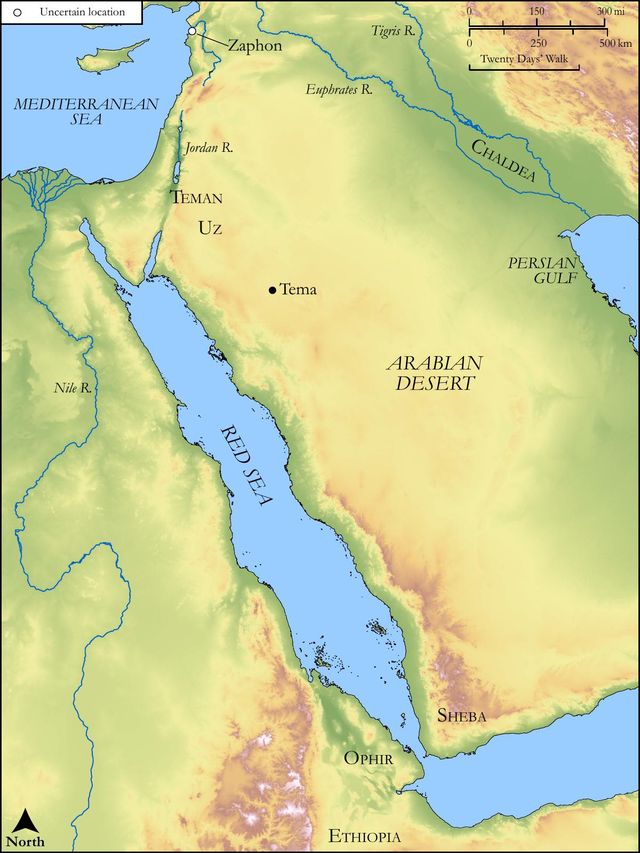
See on the biblical-era map
Study this verse
Public-domain commentary
Matthew Henry
From his Commentary on the Whole Bible. Henry comments on passages, not single verses — this entry covers Job 36:24–33. His three-level outline is real structure in the source text, so it is rendered as structure.
Elihu is here endeavouring to possess Job with great and high thoughts of God, and so to persuade him into a cheerful submission to his providence.
I.He represents the work of God, in general, as illustrious and conspicuous, Job 36:24.
His whole work is so. God does nothing mean. This is a good reason why we should acquiesce in all the operations of his providence concerning us in particular. His visible works, those of nature, and which concern the world in general, are such as we admire and commend, and in which we observe the Creator's wisdom, power, and goodness; shall we then find fault with his dispensations concerning us, and the counsels of his will concerning our affairs? We are here called to consider the work of God, Ecc 7:13.
1.It is plain before our eyes, nothing more obvious: it is what men behold. Every man that has but half an eye may see it, may behold it afar off. Look which way we will, we see the productions of God's wisdom and power; we see that done, and that doing, concerning which we cannot but say, This is the work of God, the finger of God; it is the Lord's doing. Every man may see, afar off, the heaven and all its lights, the earth and all its fruits, to be the work of Omnipotence; much more when we behold them nigh at hand. Look at the minutest works of nature through a microscope; do they not appear curious? The eternal power and godhead of the Creator are clearly seen and understood by the things that are made, Rom 1:20. Every man, even those that have not the benefit of divine revelation, may see this; for there is no speech or language where the voice of these natural constant preachers is not heard, Psa 19:3.
2.It ought to be marvellous in our eyes. The beauty and excellency of the work of God, and the agreement of all the parts of it, are what we must remember to magnify and highly to extol, not only justify it as right and good, and what cannot be blamed, but magnify it as wise and glorious, and such as no creature could contrive or produce. Man may see his works, and is capable of discerning his hand in them (which the beasts are not), and therefore ought to praise them and give him the glory of them.
II.He represents God, the author of them, as infinite and unsearchable, Job 36:26.
The streams of being, power, and perfection should lead us to the fountain. God is great, infinitely so, - great in power, for he is omnipotent and independent, - great in wealth, for he is self-sufficient and all-sufficient, - great in himself, - great in all his works, - great, and therefore greatly to be praised, - great, and therefore we know him not. We know that he is, but not what he is. We know what he is not, but not what he is. We know in part, but not in perfection. This comes in here as a reason why we must not arraign his proceedings, nor find fault with what he does, because it is speaking evil of the things that we understand not and answering a matter before we hear if. We know not the duration of his existence, for it is infinite. The number of his years cannot possibly be searched out, for he is eternal; there is no number of them. He is a Being without beginning, succession, or period, who ever was, and ever will be, and ever the same, the great I AM. This is a good reason why we should not prescribe to him, nor quarrel with him, because, as he is, such are his operations, quite out of our reach.
III.He gives some instances of God's wisdom, power, and sovereign dominion, in the works of nature and the dispensations of common providence, beginning in this chapter with the clouds and the rain that descends from them. We need not be critical in examining either the phrase or the philosophy of this noble discourse. The general scope of it is to show that God is infinitely great, and the Lord of all, the first cause and supreme director of all the creatures, and has all power in heaven and earth (whom therefore we ought, with all humility and reverence, to adore, to speak well of, and to give honour to), and that it is presumption for us to prescribe to him the rules and methods of his special providence towards the children of men, or to expect from him an account of them, when the operations even of common providences about the meteors are so various and so mysterious and unaccountable. Elihu, to affect Job with God's sublimity and sovereignty, had directed him (Job 35:5) to look unto the clouds. In these verses he shows us what we may observe in the clouds we see which will lead us to consider the glorious perfections of their Creator. Consider the clouds,
1.As springs to this lower world, the source and treasure of its moisture, and the great bank through which it circulates - a very necessary provision, for its stagnation would be as hurtful to this lower world as that of the blood to the body of man. It is worth while to observe in this common occurrence,
(1.)That the clouds above distil upon the earth below. If the heavens become brass, the earth becomes iron; therefore thus the promise of plenty runs, I will hear the heavens and they shall hear the earth. This intimates to us that every good gift is from above, from him who is both Father of lights and Father of the rain, and it instructs us to direct our prayers to him and to look up.
(2.)That they are here said to distil upon man (v. 28); for, though indeed God causes it to rain in the wilderness where no man is (Job 38:26, Psa 104:11), yet special respect is had to man herein, to whom the inferior creatures are all made serviceable and from whom the actual return of the tribute of praise is required. Among men, he causes his rain to fall upon the just and upon the unjust, Mat 5:45.
(3.)They are said to distil the water in small drops, not in spouts, as when the windows of heaven were opened, Gen 7:11. God waters the earth with that with which he once drowned it, only dispensing it in another manner, to let us know how much we lie at his mercy, and how kind he is, in giving rain by drops, that the benefit of it may be the further and the more equally diffused, as by an artificial water-pot.
(4.)Though sometimes the rain comes in very small drops, yet, at other times, it pours down in great rain, and this difference between one shower and another must be resolved into the divine Providence which orders it so.
(5.)Though it comes down in drops, yet it distils upon man abundantly (Job 36:28), and therefore is called the river of God which is full of water, Psa 65:9.
(6.)The clouds pour down according to the vapour that they draw up, Job 36:27. So just the heavens are to the earth, but the earth is not so in the return it makes.
(7.)The produce of the clouds is sometimes a great terror, and at other times a great favour, to the earth, Job 36:31. When he pleases by them he judges the people he is angry with. Storms, and tempests, and excessive rains, destroying the fruits of the earth and causing inundations, come from the clouds; but, on the other hand, from them, usually, he gives meat in abundance; they drop fatness upon the pastures that are clothed with flocks, and the valleys that are covered with corn, Psa 65:11-13.
(8.)Notice is sometimes given of the approach of rain, Job 36:33. The noise thereof, among other things, shows concerning it. Hence we read (Kg1 18:41) of the sound of abundance of rain, or (as it is in the margin) a sound of a noise of rain, before it came; and a welcome harbinger it was then. As the noise, so the face of the sky, shows concerning it, Luk 12:56. The cattle also, by a strange instinct, are apprehensive of a change in the weather nigh at hand, and seek for shelter, shaming man, who will not foresee the evil and hide himself.
2.As shadows to the upper world (Job 36:29): Can any understand the spreading of the clouds? They are spread over the earth as a curtain or canopy; how they come to be so, how stretched out, and how poised, as they are, we cannot understand, though we daily see they are so. Shall we then pretend to understand the reasons and methods of God's judicial proceedings with the children of men, whose characters and cases are so various, when we cannot account for the spreadings of the clouds, which cover the light? Job 36:32. It is a cloud coming betwixt, Job 36:32; Job 26:9. And this we are sensible of, that, by the interposition of the clouds between us and the sun, we are,
(1.)Sometimes favoured; for they serve as an umbrella to shelter us from the violent heat of the sun, which otherwise would beat upon us. A cloud of dew in the heat of harvest is spoken of as a very great refreshment. Isa 18:4.
(2.)Sometimes we are by them frowned upon; for they darken the earth at noon-day and eclipse the light of the sun. Sin is compared to a cloud (Isa 44:22), because it comes between us and the light of God's countenance and obstructs the shining of it. But though the clouds darken the sun for a time, and pour down rain, yet (post nubila Phoebus - the sun shines forth after the rain), after he has wearied the cloud, he spreads his light upon it, Job 36:30. There is a clear shining after rain, Sa2 23:4. The sunbeams are darted forth, and reach to cover even the bottom of the sea, thence to exhale a fresh supply of vapours, and so raise recruits for the clouds, Job 36:30. In all this, we must remember to magnify the work of God.
Historical interpretation
Historical reception
1 surviving comment on this verse from the historical church.
“And he will also cover the hinges of the sea.” From Elihu’s voice we hear that this will happen, but we see that through the agency of God, it has happened already. The almighty Lord, in fact, has covered the limits of the sea with glowing clouds, because, through the fulminating miracles performed by his preachers, he has led to faith even the most extreme lands of the world.… “For by these he governs peoples; he gives food in abundance.” By these words of his preachers, that is, by these drops of the clouds and by the lightning of miracles, God judges people. He calls to repentance their frightened hearts. Indeed, as soon as they hear the heavenly words, as soon as they see the wondrous works, they come back to their heart and, repenting of their past iniquities, fear the eternal chastisements.
Continue studying Job 36:30 across the web’s major study libraries — every link below opens this exact verse, chapter, or book on the destination site.
Read & Compare
 BibleGatewayThis verse in more than 200 translations and 70 languages.
 Bible.comThe YouVersion reader — hundreds of translations, reading plans, and highlights.
 ESV.orgCrossway's official English Standard Version reader.
 NET BibleThe NET translation with 60,000+ translators' notes on every rendering decision.
 STEP BibleTyndale House's free study tool — original text, vocabulary, and scholarly resources.
 BibliaLogos Bible Software's free web reader.
 USCCBThe New American Bible (Revised Edition) with the U.S. bishops' study notes.
Commentaries
 BibleHub CommentariesDozens of classic commentaries on this verse, gathered on one page.
 StudyLightMore than 100 commentary sets — the largest collection on the web.
 BibleRefPlain-English commentary on what this verse means, verse by verse.
 Enduring WordDavid Guzik's free commentary on this chapter, widely used by Bible teachers.
 Bible Study ToolsVerse commentary alongside Greek and Hebrew study aids.
Original Language & Research
- BibleHub InterlinearThe verse word by word — original language, transliteration, and English.
- BibleHub LexiconEvery word's original-language definition and Strong's entry.
 Blue Letter BibleDeep-study tools — Strong's numbers, concordance, and word studies.
 SefariaThe Hebrew text with Rashi and centuries of Jewish commentary.
Sermons, Hymns & Audio


TrulyRandomVerse is not affiliated with these sites and doesn’t control their content. They’re linked because they’re genuinely useful.
Summary
Job 36:30, a profound declaration within Elihu's discourse, powerfully illustrates God's boundless power and omnipresence through the vivid imagery of light and the deep sea. It asserts that God simultaneously extends His radiant light across the heavens and intimately controls the deepest, most hidden parts of the ocean. This verse serves as a compelling testament to God's absolute sovereignty over all creation, from the visible expanse to the unseen depths, emphasizing that nothing is beyond His knowledge, reach, or ultimate control.
Context
ShowHideLiterary Context
Job 36:30 is situated within Elihu's final and most extensive speech, which spans from Job 32 to Job 37. Elihu, a younger man, enters the dialogue after Job and his three friends have exhausted their arguments, claiming to speak for God with greater understanding and divine inspiration. His primary aim is to vindicate God's justice and wisdom, arguing that God is not indifferent to human suffering but rather uses it as a means of discipline, instruction, and a call to repentance. This particular section, Job 36:24-33, focuses on God's majestic control over meteorological phenomena—rain, thunder, clouds, and lightning—as irrefutable evidence of His immense power and sovereignty. Verse 30, with its striking imagery of light and the sea, serves as a climactic illustration of God's universal dominion, extending from the celestial realms to the abyssal depths, reinforcing Elihu's argument that God's ways are inscrutable yet perfectly just and wise.
Historical & Cultural Context
The Book of Job is set in the land of Uz, likely during the patriarchal period, though its exact dating remains a subject of scholarly debate. Scripture describes creation in three parts, as in the second commandment: the heavens above (firmament, clouds, celestial bodies), the earth (dry land, mountains, valleys), and the waters below (the deep, the sea, Sheol). God's power was often demonstrated through His control over these elements, particularly the chaotic and mysterious waters of the deep, which represented the primordial forces of creation and, at times, threats to human order. For Elihu to declare that God "spreadeth his light upon it" (referring to the heavens/clouds) and "covereth the bottom of the sea" would have profoundly communicated God's absolute, comprehensive dominion over every conceivable part of creation, both visible and hidden, known and unknown. This understanding of God's universal reach was a common theme in the wisdom books, where God's power is shown by His control over nature, as when He "shut up the sea with doors."
Key Themes
ShowHideJob 36:30 powerfully contributes to several key themes within Elihu's discourse and the broader Book of Job. Foremost is the theme of Divine Omnipotence and Omnipresence, illustrating God's boundless reach and capability. His simultaneous control over the expansive heavens and the deepest parts of the sea underscores that no place, however vast or hidden, is outside of God's knowledge and command, echoing sentiments found in Psalm 139:7-12. This verse also highlights God's Sovereignty over Creation, presenting Him as the supreme ruler of all natural forces and of all creation. Elihu consistently points to the natural world as a profound testament to God's majesty, urging Job and the others to consider the wonders of His work as undeniable proof of His greatness, a theme eloquently captured in Psalm 19:1. Finally, the imagery of "covereth the bottom of the sea" subtly emphasizes God's Knowledge of Hidden Things, suggesting His intimate awareness and command over even the most obscure and inaccessible parts of His creation, reinforcing the biblical truth that nothing is hidden from Him, as articulated in Hebrews 4:13.
Exposition and Analysis
ShowHideKey Word Analysis
ShowHideThe Hebrew verb פָּרַשׂ (pâras', H6566) means "to break apart, disperse, scatter, spread (abroad, forth, selves, out), stretch (forth, out)." In this context, it conveys the expansive and unhindered action of God in distributing His light across a vast area, suggesting an unconstrained and pervasive reach. It implies a deliberate, powerful act of extending His influence or manifestation across the celestial realm.
The Hebrew noun אוֹר (ʼôwr', H216) refers to "illumination or (concrete) luminary (in every sense, including lightning, happiness, etc.)." While it can refer to literal sunlight or the flash of lightning (which Elihu discusses extensively in this chapter), it also carries broader connotations of divine glory, revelation, and presence. The spreading of God's light signifies His visible manifestation and the pervasive nature of His glorious power.
The Hebrew verb כָּסָה (kâçâh', H3680) means "to plump, i.e. fill up hollows; by implication, to cover (for clothing or secrecy); clad self, close, clothe, conceal, cover (self), (flee to) hide, overwhelm." Here, it denotes God's profound and intimate dominion over the deepest parts of the sea. It suggests not merely a superficial covering but a comprehensive control, implying His knowledge, authority, and perhaps even the containment or concealment of the ocean's mysterious depths.
Verse Breakdown
ShowHide"Behold, he spreadeth his light upon it"
This opening clause functions as an urgent summons to observe God's visible display of power. The "it" refers to the clouds or the expanse of the sky, which Elihu has been discussing as the canvas for God's meteorological displays. God's "light" here likely refers to the brilliant flash of lightning, the radiant sun, or the general luminosity associated with His glorious presence. The action of "spreading" signifies a vast, encompassing reach, demonstrating God's unconstrained power and dominion over the celestial sphere. It evokes a sense of awe at the sheer scale of God's activity, which is both grand and pervasive.
"and covereth the bottom of the sea"
This second clause provides a dramatic contrast and expansion of God's dominion. From the visible, expansive heavens, the focus shifts to the unseen, unfathomable depths of the ocean. "The bottom of the sea" is a poetic rendering of the Hebrew "roots of the sea" (שָׁרְשֵׁי הַיָּם, shorshê hayyām), emphasizing the deepest, most inaccessible, and mysterious parts of the ocean, far beyond human reach or sight. The act of "covering" implies intimate knowledge, profound control, and perhaps even protection or concealment, underscoring that no part of creation, however remote or mysterious, is beyond God's sovereign grasp. This powerful juxtaposition highlights the totality of God's power, extending from the highest heavens to the lowest, most hidden depths.
Literary Devices
ShowHideJob 36:30 is rich in Poetic Imagery, particularly through the striking phrase "roots of the sea," which the KJV renders as "bottom of the sea." This Metaphor vividly personifies the ocean, giving it a hidden, foundational structure akin to a tree's roots, thereby emphasizing its profound and mysterious depths that are beyond human comprehension. The verse also employs powerful Juxtaposition by contrasting the visible, expansive "light" spread across the sky with the hidden, unfathomable "bottom of the sea." This contrast serves as a form of Merism, where two extreme or opposite parts (the heavens and the deep sea) are mentioned to represent the totality of God's creation and His comprehensive dominion over it. The opening word "Behold" acts as an Interjection, drawing the reader's immediate attention and emphasizing the profound truth being revealed, enhancing the sense of wonder and awe at God's limitless power.
Theological and Thematic Connections
ShowHideJob 36:30 stands as a profound declaration of God's absolute sovereignty and omnipresence, echoing themes found throughout Scripture that assert His dominion over all creation. It reminds us that God's power is not limited to the visible or the accessible, but extends to the most hidden and mysterious corners of the universe, including the "roots of the sea." This comprehensive control implies His intimate knowledge of all things, His ability to act anywhere, and His ultimate authority over every force and element. The verse invites us to contemplate the vastness of God's being and the intricate detail of His governance, fostering a deep sense of reverent awe and trust in His unfathomable wisdom and might, even when His ways seem inscrutable to human understanding.
Reflection and Application
ShowHideJob 36:30 offers a powerful invitation to cultivate a profound sense of awe and reverence for God, reminding us of His boundless reach and intimate knowledge. In a world often characterized by uncertainty, anxiety, and the illusion of human control, this verse anchors us in the comforting truth that God's sovereignty extends to every corner of existence, including the "bottom of the sea"—the unknown, the terrifying, or the seemingly uncontrollable aspects of our lives. This perspective encourages us to release anxieties and trust in a God who not only sees our struggles and hidden pains but also actively governs all things with perfect wisdom and power. Furthermore, the verse challenges us to live with integrity, knowing that our every thought and action, even those hidden from human view, are known to Him. It calls us to look at the natural world—the vastness of the sky, the mystery of the oceans—not merely as scientific phenomena but as a constant testimony to the limitless power, wisdom, and omnipresence of our Creator, deepening our worship and trust in His divine plan for our lives and the world.
Questions for Reflection
ShowHideFAQ
ShowHideWhat does "the bottom of the sea" signify in this verse?
ShowHideThe phrase "the bottom of the sea" in Job 36:30 is a poetic translation of the Hebrew "roots of the sea" (שָׁרְשֵׁי הַיָּם). This vivid imagery refers to the deepest, most inaccessible, and mysterious parts of the ocean. It symbolizes the uttermost limits of creation, realms beyond human exploration or comprehension. By stating that God "covereth" these depths, Elihu emphasizes God's absolute and comprehensive dominion, not only over the visible and expansive heavens (represented by "light") but also over the hidden, unfathomable, and potentially chaotic elements of the world. It underscores that no part of creation, however remote or obscure, is outside of God's knowledge, control, and sovereign authority, as affirmed in Psalm 139:7-12.
How does Job 36:30 relate to the broader discussion of suffering and God's justice in the Book of Job?
ShowHideJob 36:30 is part of Elihu's argument aimed at vindicating God's character and actions, particularly in light of Job's suffering. Elihu asserts that God is just and wise, and His ways, though often inscrutable to humans, are always righteous. By highlighting God's immense power and universal sovereignty over all creation—from the heavens to the deepest seas—Elihu seeks to establish God's unquestionable authority and wisdom. His point is that if God is so vast and powerful in His control over all creation, then His dealings with humanity, including allowing suffering, must also be part of a wise and just, albeit mysterious, divine plan. The verse serves to humble Job and his friends, urging them to trust in God's omnipotence rather than questioning His justice from a limited human perspective, echoing the divine challenge in Job 38:1-11.
Is the imagery in Job 36:30 meant to be scientifically accurate?
ShowHideNo, the imagery in Job 36:30, like much of the language in the Book of Job and other poetic books of the Bible, is primarily poetic and theological, not scientific. The phrase "roots of the sea" is a metaphor, not a literal description of oceanic geology. It reflects the Hebrew understanding of the sea as having foundational depths, and it uses this imagery to convey a profound theological truth: God's power and knowledge are absolute and extend to every conceivable part of creation, both visible and hidden. The purpose is to inspire awe and reverence for God's limitless dominion, not to provide a scientific treatise on the structure of the ocean. This approach is common in biblical wisdom literature, where natural phenomena are used to reveal divine attributes, as seen in Psalm 104.
Christ-Centered Fulfillment
ShowHideJob 36:30, with its majestic portrayal of God's universal dominion over light and the deepest parts of the sea, finds its ultimate fulfillment and clearest revelation in the person and work of Jesus Christ. The New Testament consistently presents Jesus as the divine agent through whom all things were created and are sustained. Just as the Father "spreadeth his light" and "covereth the bottom of the sea," so too is Christ the one through whom "all things were created, in heaven and on earth, visible and invisible, whether thrones or dominions or rulers or authorities—all things were created through him and for him" (Colossians 1:16). The light that God spreads is perfectly embodied in Jesus, who is the "light of the world" (John 8:12), illuminating the darkness of sin and ignorance, and revealing the Father's character. Furthermore, Christ demonstrates the same sovereign control over the chaotic elements of creation, as seen in His calming of the storm, rebuking the wind and the waves with a mere word, proving His mastery over the very forces of nature that Job 36:30 describes (Mark 4:39). He is the one who "upholds the universe by the word of his power" (Hebrews 1:3), signifying His intimate and continuous control over all creation, from the highest heavens to the "roots of the sea." Thus, the boundless power and omnipresence of God declared by Elihu are not abstract concepts but are concretely revealed and exercised by the Son, Jesus Christ, who is "head over everything for the church" (Ephesians 1:22), and in whom "all the fullness of God was pleased to dwell" (Colossians 1:19).