


Jeremiah 44:7
Bible text: King James Version (1769 Blayney text) · Public domain
Bible text: King James Version with Strong's numbers · Public domain
Bible text: Berean Standard Bible · Public domain
Bible text: American Standard Version (1901) · Public domain
Bible text: World English Bible, Messianic edition · Public domain
Bible text: Geneva Bible (1599) · Public domain
Bible text: Young's Literal Translation · Public domain
- וְעַתָּהve·'a·Tahand thereforeH6258Conj-w ¦ AdvAdverbוְandעַתָּהtherefore
- כֹּהkohthusH3541AdvAdverb
- אָמַר'a·Marhe saysH559V-Qal-Perf-3msVerb Qal Perfect 3rd Singular Masculine
- יְהוָהYah·wehYahwehH3068N-properNoun Proper Title
- אֱלֹהֵי'e·lo·Hei[the] God ofH430N-mpcNoun Plural Masculine Construct
- צְבָאוֹתtze·va·'othostsH6635N-fpNoun Plural Feminine Absolute
- אֱלֹהֵי'e·lo·Hei[the] God ofH430N-mpcNoun Plural Masculine Construct
- יִשְׂרָאֵלYis·ra·'ElIsraelH3478N-properNoun Proper Location
- לָמָהla·Mah<to> why?H4100Prep-l ¦ InterrogPronoun Interrogativeלָ<to>מָהwhy?
- אַתֶּם'a·Tem[are] youH859Pro-2mpPronoun Personal 2nd Plural Masculine
- עֹשִׂים'o·SimdoingH6213V-Qal-Prtcpl-mpVerb Qal Participle Plural Masculine Absolute
- רָעָהra·'AhharmH7451N-fsNoun Singular Feminine Absolute
- גְדוֹלָהge·do·LahgreatH1419Adj-fsAdjective Singular Feminine Absolute
- אֶל'eltoH413PrepPreposition
- נַפְשֹׁתֵכֶםnaf·Sho·te·Khemyour selvesH5315N-fpc ¦ 2mpNoun Plural Feminine Constructנַפְשֹׁתֵselvesכֶםyour
- לְהַכְרִיתle·hakh·Ritto cut offH3772Prep-l ¦ V-Hiphil-InfVerb Hiphil Infinitive Constructלְtoהַכְרִיתcut off
- לָכֶםla·Khemto <the> yourselvesPrep-l ¦ 2mpSuffix Personal 2nd Plural Masculineלָto <the>כֶםyourselves
- אִישׁ'ishmanH376N-msNoun Singular Masculine Absolute
- וְאִשָּׁהve·'i·Shahand womanH802Conj-w ¦ N-fsNoun Singular Feminine Absoluteוְandאִשָּׁהwoman
- עוֹלֵלo·LelchildH5768N-msNoun Singular Masculine Absolute
- וְיוֹנֵקve·yo·Nekand suckling-childH3243Conj-w ¦ N-msNoun Singular Masculine Absoluteוְandיוֹנֵקsuckling-child
- מִתּוֹךְmi·Tokhfrom [the] midst ofH8432Prep-m ¦ N-mscNoun Singular Masculine Constructמִfromתּוֹךְ[the] midst of
- יְהוּדָהye·hu·DahJudahH3063N-properNoun Proper Location
- לְבִלְתִּיle·vil·Tito notH1115Prep-l ¦ N-csNoun Singular common gender Absoluteלְtoבִלְתִּיnot
- הוֹתִירho·Tirto leaveH3498V-Hiphil-InfVerb Hiphil Infinitive Construct
- לָכֶםla·Khemfor <the> yourselvesPrep-l ¦ 2mpSuffix Personal 2nd Plural Masculineלָfor <the>כֶםyourselves
- שְׁאֵרִיתshe·'e·Rita remnantH7611N-fsNoun Singular Feminine Absolute
English is a literal word-by-word gloss of the Hebrew, not the KJV's wording. Why?
This is the original text the KJV's translators worked from — each Hebrew word with its own literal English meaning in this verse, prepared by scholars at Tyndale House, Cambridge. The KJV translates whole sentences, not word by word, so its wording differs: one Hebrew word can become several English words, and the KJV may choose “the LORD” where the gloss reads “Yahweh”. Both are faithful — they answer different questions. For the KJV's own rendering, switch to the KJV text.
Details
See on the biblical-era map
Study this verse
Public-domain commentary
Matthew Henry
From his Commentary on the Whole Bible. Henry comments on passages, not single verses — this entry covers Jeremiah 44:1–14. His two-level outline is real structure in the source text, so it is rendered as structure.
The Jews in Egypt were now dispersed into various parts of the country, into Migdol, and Noph, and other places, and Jeremiah was sent on an errand from God to them, which he delivered either when he had the most of them together in Pathros (Jer 44:15) or going about from place to place preaching to this purport. He delivered this message in the name of the Lord of hosts, the God of Israel, and in it,
I.God puts them in mind of the desolations of Judah and Jerusalem, which, though the captives by the rivers of Babylon were daily mindful of (Psa 137:1), the fugitives in the cities of Egypt seem to have forgotten and needed to be put in mind of, though, one would have thought, they had not been so long out of sight as to become out of mind (Jer 44:2): You have seen what a deplorable condition Judah and Jerusalem are brought into; now will you consider whence those desolations came? From the wrath of God; it was his fury and his anger that kindled the fire which made Jerusalem and the cities of Judah waste and desolate (Jer 44:6); whoever were the instruments of the destruction, they were but instruments: it was a destruction from the Almighty.
II.He puts them in mind of the sins that brought those desolations upon Judah and Jerusalem.
It was for their wickedness. It was this that provoked God to anger, and especially their idolatry, their serving other gods (Jer 44:3) and giving that honour to counterfeit deities, the creatures of their own fancy and the work of their own hands, which should have been given to the true God only. They forsook the God who was known among them, and whose name was great, for gods that they knew not, upstart deities, whose original was obscure and not worth taking notice of: "Neither they nor you, nor your fathers, could give any rational account why the God of Israel was exchanged for such impostors." They knew not that they were gods; nay, they could not but know that they were no gods.
III.He puts them in mind of the frequent and fair warnings he had given them by his word not to serve other gods, the contempt of which warnings was a great aggravation of their idolatry, Jer 44:4. The prophets were sent with a great deal of care to call to them, saying, Oh! do not this abominable thing that I hate. It becomes us to speak of sin with the utmost dread and detestation as an abominable thing; it is certainly so, for it is that which God hates, and we are sure that hid judgment is according to truth. Call it grievous, call it odious, that we may by all means possible put ourselves and others out of love with it. It becomes us to give warning of the danger of sin, and the fatal consequences of it, with all seriousness and earnestness: "Oh! do not do it. If you love God, do not, for it is provoking to him; if you love your own souls do not, for it is destructive to them." Let conscience do this for us in an hour of temptation, when we are ready to yield. O take heed! do not this abominable thing which the Lord hates; for, if God hates it, though shouldst hate it. But did they regard what God said to them? No: "They hearkened not, nor inclined their ear (Jer 44:5); they still persisted in their idolatries; and you see what came of it, therefore God's anger was poured out upon them, as at this day. Now this was intended for warning to you, who have not only heard the judgments of God's mouth, as they did, but have likewise seen the judgments of his hand, by which you should be startled and awakened, for they were inflicted in terrorem, that others might hear and fear and do no more as they did, lest they should fare as they fared."
IV.He reproves them for, and upbraids them with, their continued idolatries, now that they had come into Egypt (Jer 44:8):
You burn incense to other gods in the land of Egypt. Therefore God forbade them to go into Egypt, because he knew it would be a snare to them. Those whom God sent into the land of the Chaldeans, though that was an idolatrous country, were there, by the power of God's grace, weaned from idolatry; but those who went against God's mind into the land of the Egyptians were there, by the power of their own corruptions, more wedded than ever to their idolatries; for, when we thrust ourselves without cause or call into places of temptation, it is just with God to leave us to ourselves. In doing this, 1. They did a great deal of injury to themselves and their families: "You commit this great evil against your souls (Jer 44:7), you wrong them, you deceive them with that which is false, you destroy them, for it will be fatal to them." Note, In sinning against God we sin against our own souls. "It is the ready way to cut yourselves off from all comfort and hope (Jer 44:8), to cut off your name and honour; so that you will, both by your sin and by your misery, become a curse and a reproach among all nations. It will become a proverb, As wretched as a Jew. It is the ready way to cut off from you all your relations, all that you shave have joy of and have your families built up in, man and woman, child and suckling, so that Judah shall be a land lost for want of heirs." 2. They filled up the measure of the iniquity of their fathers, and, as if that had been too little for them, added to it (Jer 44:9): "Have you forgotten the wickedness of those who are gone before you, that you are not humbled for it as you ought to be, and afraid of the consequences of it?" Have you forgotten the punishments of your fathers? so some read it. "Do you not know how dear their idolatry cost them? And yet dare you continue in that vain conversation received by tradition from you fathers, though you received the curse with it?" He reminds them of the sins and punishments of the kings of Judah, who, great as they were, escaped not the judgments of God for their idolatry; yea, and they should have taken warning by the wickedness of their wives, who had seduced them to idolatry. In the original it is, And of his wives, which, Dr. Lightfoot thinks, tacitly reflects upon Solomon's wives, particularly his Egyptian wives, to whom the idolatry of the kings of Judah owed its original. "Have you forgotten this, and what came of it, that you dare venture upon the same wicked courses?" See Neh 13:18, Neh 13:26. "Nay, to come to your own times, Have you forgotten your own wickedness and the wickedness of your wives, when you lived in prosperity in Jerusalem, and what ruin it brought upon you? But, alas! to what purpose do I speak to them?" (says God to the prophet, Jer 44:10) "they are not humbled unto this day, by all the humbling providences that they have been under. They have not feared, nor walked in my law." Note, Those that walk not in the law of God do thereby show that they are destitute of the fear of God.
V.He threatens their utter ruin for their persisting in their idolatry now that they were in Egypt.
Judgment is given against them, as before (Jer 42:22), that they shall perish in Egypt; the decree has gone forth, and shall not be called back. They set their faces to go into the land of Egypt (Jer 44:12), were resolute in their purpose against God, and now God is resolute in his purpose against them: I will set my face to cut off all Judah, Jer 44:11. Those that think not only to affront, but to confront, God Almighty, will find themselves outfaced; for the face of the Lord is against those that do evil, Psa 34:16. It is here threatened concerning these idolatrous Jews in Egypt,
1.That they shall all be consumed, without exception; no degree nor order among them shall escape: They shall fall, from the least to the greatest (Jer 44:12), high and low, rich and poor.
2.That they shall be consumed by the very same judgments which God made use of for the punishment of Jerusalem, the sword, famine, and pestilence, Jer 44:12, Jer 44:13. They shall not be wasted by natural deaths, as Israel in the wilderness, but by these sore judgments, which, by flying into Egypt, they thought to get out of the reach of.
3.That none (except a very few that will narrowly escape) shall ever return to the land of Judah again, Jer 44:14. They thought, being nearer, that they stood fairer for a return to their own land than those that were carried to Babylon; yet those shall return, and these shall not; for the way in which God has promised us any comfort is much surer than that in which we have projected it for ourselves. Observe, Those that are fretful and discontented will be uneasy and fond of change wherever they are. The Israelites, when they were in the land of Judah, desired to go into Egypt (Jer 42:22), but when they were in Egypt they desired to return to the land of Judah again; they lifted up their soul to it (so it is in the margin), which denotes an earnest desire. But, because they would not dwell there when God commanded it, they shall not dwell they were they desire it. If we walk contrary to God, he will walk contrary to us. How can those expect to be well off who would not know when they were so, though God himself told them?
Historical interpretation
Historical reception
1 surviving comment on this verse from the historical church.
What was the reason for this? It was because the Jews were so arrogant and obstinate. They immediately forgot what God had done for them; they ascribed his kindness to demons and reckoned that his blessings had come from them. Even when the sea was divided for them, as they went forth from Egypt, and while other wonderful things were happening to them, they forgot the God who was performing these miracles and attributed them to others who were not gods. For they said to Aaron, “Make for us gods who will be our leaders.” And they said to Jeremiah, “We will not listen to what you say in the name of the Lord. Rather, we will continue doing what we had proposed: we will burn incense to the queen of heaven and pour out libations to her, as we and our ancestors, our kings and princes have done. Then we had enough food to eat and we were well off; we suffered no misfortune. But since we stopped burning incense to the queen of heaven and pouring out libations to her, we are in need of everything and are being destroyed by the sword and by hunger.” The inspired prophets, then, foretold what would happen to the Jews so that they would ascribe none of the events to idols but would believe that both punishments and blessings always come from God: the punishment came for their sins and the blessings because of God’s love and kindness.
Continue studying Jeremiah 44:7 across the web’s major study libraries — every link below opens this exact verse, chapter, or book on the destination site.
Read & Compare
 BibleGatewayThis verse in more than 200 translations and 70 languages.
 Bible.comThe YouVersion reader — hundreds of translations, reading plans, and highlights.
 ESV.orgCrossway's official English Standard Version reader.
 NET BibleThe NET translation with 60,000+ translators' notes on every rendering decision.
 STEP BibleTyndale House's free study tool — original text, vocabulary, and scholarly resources.
 BibliaLogos Bible Software's free web reader.
 USCCBThe New American Bible (Revised Edition) with the U.S. bishops' study notes.
Commentaries
 BibleHub CommentariesDozens of classic commentaries on this verse, gathered on one page.
 StudyLightMore than 100 commentary sets — the largest collection on the web.
 BibleRefPlain-English commentary on what this verse means, verse by verse.
 Enduring WordDavid Guzik's free commentary on this chapter, widely used by Bible teachers.
 Bible Study ToolsVerse commentary alongside Greek and Hebrew study aids.
Original Language & Research
- BibleHub InterlinearThe verse word by word — original language, transliteration, and English.
- BibleHub LexiconEvery word's original-language definition and Strong's entry.
 Blue Letter BibleDeep-study tools — Strong's numbers, concordance, and word studies.
 SefariaThe Hebrew text with Rashi and centuries of Jewish commentary.
Sermons, Hymns & Audio


TrulyRandomVerse is not affiliated with these sites and doesn’t control their content. They’re linked because they’re genuinely useful.
Summary
Jeremiah 44:7 presents a solemn divine indictment against the Jewish remnant who, in defiance of God's explicit command, had sought refuge in Egypt. Through the prophet Jeremiah, the LORD, identified by His supreme covenantal and sovereign titles, confronts their persistent idolatry, declaring their actions to be a "great evil" profoundly detrimental to their very existence. This continued rebellion, mirroring the sins that led to Judah's prior desolation, is depicted as utterly self-destructive, inevitably leading to their complete annihilation—man, woman, child, and infant—leaving no survivor from Judah among them in Egypt.
Context
ShowHideLiterary Context
This verse is strategically placed within Jeremiah's final prophetic pronouncements, specifically in Jeremiah 44, which records God's comprehensive judgment against the Jewish remnant residing in Egypt after the fall of Jerusalem in 586 BC. The preceding chapters, Jeremiah 42 and Jeremiah 43, meticulously detail the people's deliberate rejection of Jeremiah's divinely inspired warning not to flee to Egypt, choosing instead to pursue their own perceived security. Jeremiah 44 then serves as a culminating denunciation of their deep-seated idolatry in Egypt, particularly their devotion to the "queen of heaven" (Jeremiah 44:17). Verse 7 immediately follows God's poignant reminder of the desolation that befell Jerusalem and Judah precisely because of their previous idolatrous practices (Jeremiah 44:2-6), setting a stark precedent for the impending judgment if they persist in their unrepentant sin. The immediate narrative flow powerfully underscores God's long-suffering patience reaching its limit and the inescapable consequences of unyielding rebellion.
Historical & Cultural Context
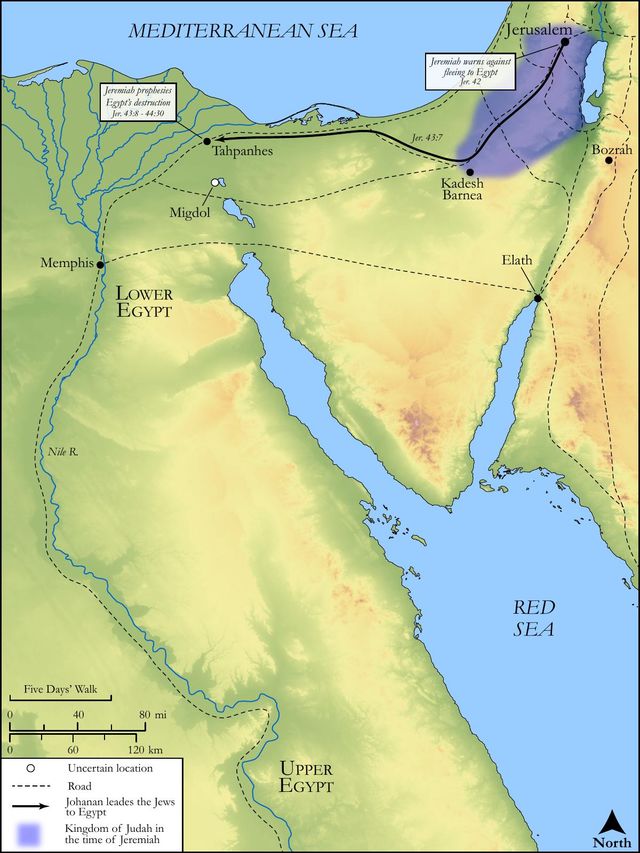
The historical setting for Jeremiah 44:7 is the turbulent aftermath of the Babylonian destruction of Jerusalem and the Temple in 586 BC. After this catastrophe, a small Jewish remnant, including Jeremiah, remained in Judah under the Babylonian-appointed governor Gedaliah. However, following Gedaliah's assassination, many Jews, gripped by fear of Babylonian reprisal and despite God's explicit prohibition delivered through Jeremiah (Jeremiah 42:19), chose to flee to Egypt. They settled in various Egyptian cities such as Migdol, Tahpanhes, Noph (Memphis), and Pathros (Upper Egypt) (Jeremiah 44:1). Culturally, Egypt was a land deeply immersed in polytheism, with a pantheon of gods and goddesses. The Jewish exiles, historically prone to syncretism, readily adopted local deities, most prominently the "queen of heaven," a fertility goddess of the nations, often identified with Ishtar or Astarte. This verse vividly illustrates the profound cultural pressures and the deep-seated spiritual apostasy that had plagued Israel throughout its history, culminating in this final, desperate, and defiant act of idolatry on foreign soil.
Key Themes
ShowHideJeremiah 44:7 contributes significantly to several foundational themes woven throughout the book of Jeremiah and broader biblical theology. Firstly, it powerfully articulates the self-destructive nature of sin, particularly idolatry and disobedience, as God explicitly states their actions constitute "great evil against your souls." This emphasizes that sin is not merely an external offense against God's holiness but fundamentally undermines the sinner's well-being, vitality, and very existence. Secondly, the verse highlights the theme of divine judgment and inescapable consequences, portraying a comprehensive and absolute annihilation for persistent disobedience. This underscores God's unwavering justice and His commitment to upholding His covenant demands, even when it means executing judgment upon His own rebellious people. The detailed description of "man and woman, child and suckling" being "cut off" reinforces the totality of this impending judgment, echoing previous prophecies of desolation and exile (Jeremiah 25:9-11). Finally, the repeated and emphatic divine titles—"the LORD, the God of hosts, the God of Israel"—reaffirm God's sovereign authority and covenant faithfulness, asserting His ultimate power to execute His word and His righteous decrees even in the face of His people's most egregious rebellion.
Exposition and Analysis
ShowHideKey Word Analysis
ShowHideFrom the root meaning "to be great," this adjective signifies something immense, significant, or profound in any sense. When paired with "evil" in this context, it emphasizes the extreme magnitude and severity of the sin committed by the people. It conveys that their actions are not a minor transgression but an offense of immense proportion, highlighting the gravity of their idolatry and rebellion in the eyes of the sovereign God.
This term denotes something bad, wicked, or morally corrupt, encompassing both natural calamity and moral depravity. In Jeremiah 44:7, it specifically refers to the moral wickedness of the people's actions—their idolatry and deliberate disobedience to God's commands. God declares this behavior to be inherently destructive and harmful, not only to His honor but fundamentally "against your souls," signifying its devastating impact on their own well-being and future.
This highly versatile word refers to the entire living being, encompassing one's life, person, vitality, and inner self. It is not limited to a spiritual component but signifies the whole individual. Thus, the phrase "great evil against your souls" means their actions were profoundly self-destructive, jeopardizing their very lives, holistic well-being, and future as a people. It is an act that leads to existential ruin and complete demise.
A primitive root meaning "to cut (off, down, or asunder)," this word carries strong connotations of destruction, consumption, and termination. It is notably used in the Bible for "making a covenant" (originally by cutting flesh and passing between the pieces), signifying a binding agreement. Here, however, it signifies a complete and decisive termination of their existence, an act of divine judgment that will utterly sever them from life and from their identity as a remnant of Judah in that land.
Verse Breakdown
ShowHide"Therefore now thus saith the LORD, the God of hosts, the God of Israel;"
This opening declaration powerfully establishes the unimpeachable divine authority behind the message. "The LORD" (Yahweh) emphasizes His covenant name, highlighting His faithfulness to His promises and warnings. "The God of hosts" (Yahweh Sabaoth) proclaims His omnipotent sovereignty over all heavenly and earthly armies, underscoring His absolute power to execute His will and judgment. "The God of Israel" reiterates His unique and personal covenant relationship with His people, even as they rebel, intensifying the gravity of their betrayal against their own God.
"Wherefore commit ye [this] great evil against your souls,"
This rhetorical question serves as a forceful expression of God's incredulity, condemnation, and profound disappointment. He directly challenges their rationale for engaging in such a "great evil." The crucial phrase "against your souls" emphasizes that their idolatry and disobedience are not merely an external offense to God but are profoundly self-destructive, leading directly to their own demise, ruin, and the jeopardizing of their very life and existence as a people.
"to cut off from you man and woman, child and suckling, out of Judah,"
This clause vividly describes the devastating, comprehensive consequence of their "great evil." The phrase "to cut off" signifies complete annihilation and termination. The exhaustive list—"man and woman, child and suckling"—emphasizes the totality of the impending judgment, indicating that no one, regardless of age or gender, will be spared. This highlights the severity and comprehensiveness of God's judgment, ensuring that no viable remnant of Judah will survive in Egypt.
"to leave you none to remain;"
This final, stark phrase reinforces the absolute and complete nature of the judgment. It underscores that their self-destructive actions will result in utter extinction, leaving no survivor or remnant to carry on their lineage or identity in that foreign land. This is portrayed as the ultimate, tragic consequence of their unrepentant idolatry and defiance, a complete end to their presence as a distinct people.
Literary Devices
ShowHideJeremiah 44:7 employs several potent literary devices to convey its urgent and severe message with maximum impact. The most prominent is the Rhetorical Question, "Wherefore commit ye [this] great evil against your souls?" This question is not posed to elicit information but functions as a powerful rebuke, expressing God's astonishment, indignation, and condemnation of their irrational and self-destructive behavior. It compels the audience to confront the utter senselessness of their actions. Repetition of divine titles—"the LORD, the God of hosts, the God of Israel"—serves to underscore God's unwavering authority, omnipotence, and covenant faithfulness, lending immense weight, solemnity, and irrefutable truth to His pronouncement. Furthermore, the verse utilizes striking Hyperbole or Exaggeration in describing the extent of the judgment: "to cut off from you man and woman, child and suckling, out of Judah, to leave you none to remain." While a literal, absolute extinction might seem extreme, this vivid imagery powerfully conveys the totality and severity of the impending divine wrath, emphasizing that the consequences will be comprehensive and leave no viable future for them as a community in Egypt. Finally, the phrase "great evil against your souls" functions as a form of Metonymy, where "souls" (referring to the whole person, life, or inner being) stands for their very existence, well-being, and future, highlighting the direct, self-inflicted harm of their persistent sin.
Theological and Thematic Connections
ShowHideJeremiah 44:7 profoundly articulates the unchanging biblical truth that sin, particularly idolatry and rebellion against God's explicit commands, is inherently self-destructive. It is not merely an external offense against divine majesty but an internal corruption that leads inevitably to personal, communal, and even existential ruin. The divine declaration that their actions constitute "great evil against your souls" underscores that God's laws and warnings are not arbitrary restrictions but are given for humanity's flourishing, preservation, and ultimate well-being. When humanity deviates from the divine order and pursues its own path, it inevitably invites consequences that undermine its very existence and purpose. This verse serves as a stark reminder of God's unwavering justice, His holiness, and His commitment to upholding His covenant, even when it means executing severe judgment upon His own people who persistently reject His ways. The comprehensive nature of the threatened judgment—encompassing all ages and genders—highlights the gravity of their unrepentant sin and the totality of divine wrath against apostasy.
Reflection and Application
ShowHideJeremiah 44:7 stands as a timeless and sobering warning for all generations, compelling us to recognize that sin, especially the idolatry of placing anything or anyone above the one true God, is not a harmless indulgence but a profoundly self-destructive act. In our contemporary world, "idols" may not be physical statues, but they manifest subtly and powerfully as obsessive pursuits of wealth, power, comfort, self-image, technological gratification, or even human relationships. These false gods promise fulfillment but ultimately lead to spiritual emptiness, relational brokenness, and existential despair. This verse challenges us to critically examine our deepest allegiances and motivations, asking what truly holds the ultimate, supreme place in our hearts and lives. It reminds us that God's commands are not burdensome restrictions but loving guidelines designed for our holistic well-being and flourishing. To ignore divine warnings, whether clearly articulated in Scripture or gently impressed upon our conscience by the Spirit-led community, is to invite inevitable and often devastating consequences. Our vital task is to heed God's voice, to turn away from anything that competes for His rightful place, and to trust implicitly in His wisdom, knowing that true life, lasting peace, and genuine flourishing are found only in Him.
Questions for Reflection
ShowHideFAQ
ShowHideWhy is God so angry and seemingly harsh in this verse?
ShowHideGod's anger here is not a capricious outburst but a righteous and holy response to profound and persistent rebellion, specifically the sin of idolatry. The Jewish remnant in Egypt had repeatedly defied His explicit commands, even after witnessing the devastating judgment that befell Jerusalem precisely because of similar sins (Jeremiah 44:2-6). God's character encompasses both perfect love and unwavering justice. His warnings, though severe, are an expression of His holiness and His covenant faithfulness. He cannot tolerate sin, especially the worship of other gods, because it fundamentally undermines His unique relationship with His people and leads directly to their destruction. The "harshness" reflects the immense gravity of their sin and the inevitable, self-inflicted consequences of rejecting the only true source of life and truth.
What does "the God of hosts" mean, and why is it used here?
ShowHide"The God of hosts" translates the Hebrew title Yahweh Sabaoth (יהוה צבאות), which is a powerful and significant divine name. "Hosts" (sabaoth) refers to armies, whether human or heavenly (such as angels or celestial bodies). Thus, "the God of hosts" signifies God's sovereign power and absolute authority over all creation, including all spiritual and earthly forces. Its emphatic use in Jeremiah 44:7 emphasizes God's omnipotence and His undeniable ability to execute the judgment He declares. It serves as a potent reminder to the rebellious remnant that they are not defying a weak or limited deity, but the supreme Commander of all the armies of heaven and earth, who possesses the ultimate power to bring about the complete annihilation He threatens.
What does it mean to commit "great evil against your souls"?
ShowHideThe phrase "great evil against your souls" is a profoundly powerful expression indicating that the people's actions—their idolatry and deliberate disobedience—were profoundly self-destructive. The Hebrew word for "souls" (nephesh) refers to the entire living being, encompassing one's life, person, and vitality. Therefore, committing "evil against your souls" means they were engaging in behavior that would ultimately lead to their own ruin, death, and existential annihilation, rather than merely offending God externally. It highlights the inherent, destructive nature of sin, which, by its very essence, works against the well-being, flourishing, and very life of the sinner. Their choices were literally cutting off their own future and existence as a people.
Christ-Centered Fulfillment
ShowHideJeremiah 44:7, with its stark warning of self-inflicted destruction due to idolatry and rebellion, finds its ultimate resolution and redemptive fulfillment in Jesus Christ. The "great evil" committed by humanity against its own "souls"—the pervasive sin that inevitably leads to spiritual and physical death (Romans 6:23)—is precisely what Christ came to address and overcome. While the Old Covenant powerfully revealed God's justice and the severe consequences of disobedience, it also foreshadowed a coming deliverer who would provide a definitive solution. Jesus, as the perfect Lamb of God (John 1:29), bore the full weight of the "great evil" of human sin on the cross, becoming the ultimate sacrifice to "cut off" the power of sin and death over all who believe in Him (Colossians 2:13-14). He offers a new covenant, not merely written on stone tablets but inscribed upon the hearts of believers, enabling true worship "in spirit and truth" (John 4:24), thereby eradicating the very root of idolatry and rebellion. Through His glorious resurrection, Christ conquered death itself, ensuring that those who are united with Him will not be "cut off" or left with "none to remain," but will receive eternal life and an imperishable inheritance (1 Peter 1:3-4). Thus, the judgment threatened in Jeremiah 44:7, while a real consequence for the unrepentant, is ultimately overcome by the boundless grace and redemptive power of Christ for all who turn to Him in faith.