


Jeremiah 44:3
Bible text: King James Version (1769 Blayney text) · Public domain
Bible text: King James Version with Strong's numbers · Public domain
Bible text: Berean Standard Bible · Public domain
Bible text: American Standard Version (1901) · Public domain
Bible text: World English Bible, Messianic edition · Public domain
Bible text: Geneva Bible (1599) · Public domain
Bible text: Young's Literal Translation · Public domain
- מִפְּנֵיmi·pe·Nei<from> because ofH6440Prep-m ¦ N-mpcNoun Plural Masculine Constructמִ<from>פְּנֵיbecause of
- רָעָתָםra·'a·Tamtheir wickednessH7451N-fsc ¦ 3mpNoun Singular Feminine Constructרָעָתָwickednessםtheir
- אֲשֶׁר'a·SherwhichH834RelParticle Relative
- עָשׂוּ'a·Suthey didH6213V-Qal-Perf-3cpVerb Qal Perfect 3rd Plural common gender
- לְהַכְעִסֵנִיle·hakh·'i·Se·nito provoke to anger meH3707Prep-l ¦ V-Hiphil-Inf ¦ 1csVerb Hiphil Infinitive Constructלְtoהַכְעִסֵprovoke to angerנִיme
- לָלֶכֶתla·Le·khetby goingH1980Prep-l ¦ V-Qal-InfVerb Qal Infinitive Constructלָbyלֶכֶתgoing
- לְקַטֵּרle·ka·Terto make smokeH6999Prep-l ¦ V-Piel-InfVerb Piel Infinitive Constructלְtoקַטֵּרmake smoke
- לַעֲבֹדla·'a·Vodto serveH5647Prep-l ¦ V-Qal-InfVerb Qal Infinitive Constructלַtoעֲבֹדserve
- לֵאלֹהִיםle·lo·Him<to> godsH430Prep-l ¦ N-mpNoun Plural Masculine Absoluteלֵ<to>אלֹהִיםgods
- אֲחֵרִים'a·che·RimotherH312Adj-mpAdjective Plural Masculine Absolute
- אֲשֶׁר'a·SherwhichH834RelParticle Relative
- לֹאlo'notH3808NegParticle Negative
- יְדָעוּםye·da·'Umthey had known themH3045V-Qal-Perf-3cp ¦ 3mpVerb Qal Perfect 3rd Plural common genderיְדָעוּthey had knownםthem
- הֵמָּהHe·mahtheyH1992Pro-3mpPronoun Personal 3rd Plural Masculine
- אַתֶּם'a·TemyouH859Pro-2mpPronoun Personal 2nd Plural Masculine
- וַאֲבֹתֵיכֶםva·'a·vo·tei·Khemand your ancestorsH1Conj-w ¦ N-fpc ¦ 2mpNoun Plural Feminine Constructוַandאֲבֹתֵיancestorsכֶםyour
English is a literal word-by-word gloss of the Hebrew, not the KJV's wording. Why?
This is the original text the KJV's translators worked from — each Hebrew word with its own literal English meaning in this verse, prepared by scholars at Tyndale House, Cambridge. The KJV translates whole sentences, not word by word, so its wording differs: one Hebrew word can become several English words, and the KJV may choose “the LORD” where the gloss reads “Yahweh”. Both are faithful — they answer different questions. For the KJV's own rendering, switch to the KJV text.
Details
See on the biblical-era map
Study this verse
Public-domain commentary
Matthew Henry
From his Commentary on the Whole Bible. Henry comments on passages, not single verses — this entry covers Jeremiah 44:1–14. His two-level outline is real structure in the source text, so it is rendered as structure.
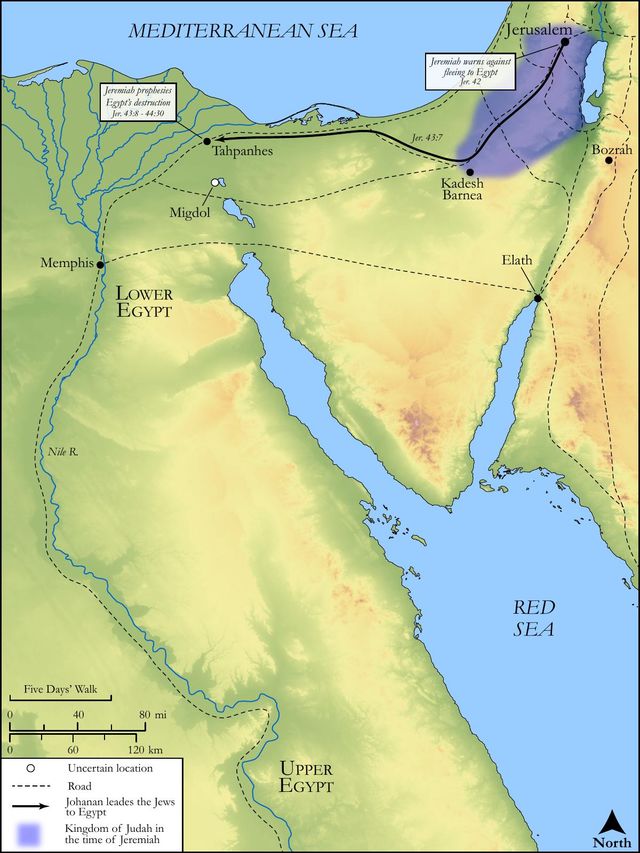
The Jews in Egypt were now dispersed into various parts of the country, into Migdol, and Noph, and other places, and Jeremiah was sent on an errand from God to them, which he delivered either when he had the most of them together in Pathros (Jer 44:15) or going about from place to place preaching to this purport. He delivered this message in the name of the Lord of hosts, the God of Israel, and in it,
I.God puts them in mind of the desolations of Judah and Jerusalem, which, though the captives by the rivers of Babylon were daily mindful of (Psa 137:1), the fugitives in the cities of Egypt seem to have forgotten and needed to be put in mind of, though, one would have thought, they had not been so long out of sight as to become out of mind (Jer 44:2): You have seen what a deplorable condition Judah and Jerusalem are brought into; now will you consider whence those desolations came? From the wrath of God; it was his fury and his anger that kindled the fire which made Jerusalem and the cities of Judah waste and desolate (Jer 44:6); whoever were the instruments of the destruction, they were but instruments: it was a destruction from the Almighty.
II.He puts them in mind of the sins that brought those desolations upon Judah and Jerusalem.
It was for their wickedness. It was this that provoked God to anger, and especially their idolatry, their serving other gods (Jer 44:3) and giving that honour to counterfeit deities, the creatures of their own fancy and the work of their own hands, which should have been given to the true God only. They forsook the God who was known among them, and whose name was great, for gods that they knew not, upstart deities, whose original was obscure and not worth taking notice of: "Neither they nor you, nor your fathers, could give any rational account why the God of Israel was exchanged for such impostors." They knew not that they were gods; nay, they could not but know that they were no gods.
III.He puts them in mind of the frequent and fair warnings he had given them by his word not to serve other gods, the contempt of which warnings was a great aggravation of their idolatry, Jer 44:4. The prophets were sent with a great deal of care to call to them, saying, Oh! do not this abominable thing that I hate. It becomes us to speak of sin with the utmost dread and detestation as an abominable thing; it is certainly so, for it is that which God hates, and we are sure that hid judgment is according to truth. Call it grievous, call it odious, that we may by all means possible put ourselves and others out of love with it. It becomes us to give warning of the danger of sin, and the fatal consequences of it, with all seriousness and earnestness: "Oh! do not do it. If you love God, do not, for it is provoking to him; if you love your own souls do not, for it is destructive to them." Let conscience do this for us in an hour of temptation, when we are ready to yield. O take heed! do not this abominable thing which the Lord hates; for, if God hates it, though shouldst hate it. But did they regard what God said to them? No: "They hearkened not, nor inclined their ear (Jer 44:5); they still persisted in their idolatries; and you see what came of it, therefore God's anger was poured out upon them, as at this day. Now this was intended for warning to you, who have not only heard the judgments of God's mouth, as they did, but have likewise seen the judgments of his hand, by which you should be startled and awakened, for they were inflicted in terrorem, that others might hear and fear and do no more as they did, lest they should fare as they fared."
IV.He reproves them for, and upbraids them with, their continued idolatries, now that they had come into Egypt (Jer 44:8):
You burn incense to other gods in the land of Egypt. Therefore God forbade them to go into Egypt, because he knew it would be a snare to them. Those whom God sent into the land of the Chaldeans, though that was an idolatrous country, were there, by the power of God's grace, weaned from idolatry; but those who went against God's mind into the land of the Egyptians were there, by the power of their own corruptions, more wedded than ever to their idolatries; for, when we thrust ourselves without cause or call into places of temptation, it is just with God to leave us to ourselves. In doing this, 1. They did a great deal of injury to themselves and their families: "You commit this great evil against your souls (Jer 44:7), you wrong them, you deceive them with that which is false, you destroy them, for it will be fatal to them." Note, In sinning against God we sin against our own souls. "It is the ready way to cut yourselves off from all comfort and hope (Jer 44:8), to cut off your name and honour; so that you will, both by your sin and by your misery, become a curse and a reproach among all nations. It will become a proverb, As wretched as a Jew. It is the ready way to cut off from you all your relations, all that you shave have joy of and have your families built up in, man and woman, child and suckling, so that Judah shall be a land lost for want of heirs." 2. They filled up the measure of the iniquity of their fathers, and, as if that had been too little for them, added to it (Jer 44:9): "Have you forgotten the wickedness of those who are gone before you, that you are not humbled for it as you ought to be, and afraid of the consequences of it?" Have you forgotten the punishments of your fathers? so some read it. "Do you not know how dear their idolatry cost them? And yet dare you continue in that vain conversation received by tradition from you fathers, though you received the curse with it?" He reminds them of the sins and punishments of the kings of Judah, who, great as they were, escaped not the judgments of God for their idolatry; yea, and they should have taken warning by the wickedness of their wives, who had seduced them to idolatry. In the original it is, And of his wives, which, Dr. Lightfoot thinks, tacitly reflects upon Solomon's wives, particularly his Egyptian wives, to whom the idolatry of the kings of Judah owed its original. "Have you forgotten this, and what came of it, that you dare venture upon the same wicked courses?" See Neh 13:18, Neh 13:26. "Nay, to come to your own times, Have you forgotten your own wickedness and the wickedness of your wives, when you lived in prosperity in Jerusalem, and what ruin it brought upon you? But, alas! to what purpose do I speak to them?" (says God to the prophet, Jer 44:10) "they are not humbled unto this day, by all the humbling providences that they have been under. They have not feared, nor walked in my law." Note, Those that walk not in the law of God do thereby show that they are destitute of the fear of God.
V.He threatens their utter ruin for their persisting in their idolatry now that they were in Egypt.
Judgment is given against them, as before (Jer 42:22), that they shall perish in Egypt; the decree has gone forth, and shall not be called back. They set their faces to go into the land of Egypt (Jer 44:12), were resolute in their purpose against God, and now God is resolute in his purpose against them: I will set my face to cut off all Judah, Jer 44:11. Those that think not only to affront, but to confront, God Almighty, will find themselves outfaced; for the face of the Lord is against those that do evil, Psa 34:16. It is here threatened concerning these idolatrous Jews in Egypt,
1.That they shall all be consumed, without exception; no degree nor order among them shall escape: They shall fall, from the least to the greatest (Jer 44:12), high and low, rich and poor.
2.That they shall be consumed by the very same judgments which God made use of for the punishment of Jerusalem, the sword, famine, and pestilence, Jer 44:12, Jer 44:13. They shall not be wasted by natural deaths, as Israel in the wilderness, but by these sore judgments, which, by flying into Egypt, they thought to get out of the reach of.
3.That none (except a very few that will narrowly escape) shall ever return to the land of Judah again, Jer 44:14. They thought, being nearer, that they stood fairer for a return to their own land than those that were carried to Babylon; yet those shall return, and these shall not; for the way in which God has promised us any comfort is much surer than that in which we have projected it for ourselves. Observe, Those that are fretful and discontented will be uneasy and fond of change wherever they are. The Israelites, when they were in the land of Judah, desired to go into Egypt (Jer 42:22), but when they were in Egypt they desired to return to the land of Judah again; they lifted up their soul to it (so it is in the margin), which denotes an earnest desire. But, because they would not dwell there when God commanded it, they shall not dwell they were they desire it. If we walk contrary to God, he will walk contrary to us. How can those expect to be well off who would not know when they were so, though God himself told them?
Historical interpretation
Historical reception
1 surviving comment on this verse from the historical church.
What was the reason for this? It was because the Jews were so arrogant and obstinate. They immediately forgot what God had done for them; they ascribed his kindness to demons and reckoned that his blessings had come from them. Even when the sea was divided for them, as they went forth from Egypt, and while other wonderful things were happening to them, they forgot the God who was performing these miracles and attributed them to others who were not gods. For they said to Aaron, “Make for us gods who will be our leaders.” And they said to Jeremiah, “We will not listen to what you say in the name of the Lord. Rather, we will continue doing what we had proposed: we will burn incense to the queen of heaven and pour out libations to her, as we and our ancestors, our kings and princes have done. Then we had enough food to eat and we were well off; we suffered no misfortune. But since we stopped burning incense to the queen of heaven and pouring out libations to her, we are in need of everything and are being destroyed by the sword and by hunger.” The inspired prophets, then, foretold what would happen to the Jews so that they would ascribe none of the events to idols but would believe that both punishments and blessings always come from God: the punishment came for their sins and the blessings because of God’s love and kindness.
Continue studying Jeremiah 44:3 across the web’s major study libraries — every link below opens this exact verse, chapter, or book on the destination site.
Read & Compare
 BibleGatewayThis verse in more than 200 translations and 70 languages.
 Bible.comThe YouVersion reader — hundreds of translations, reading plans, and highlights.
 ESV.orgCrossway's official English Standard Version reader.
 NET BibleThe NET translation with 60,000+ translators' notes on every rendering decision.
 STEP BibleTyndale House's free study tool — original text, vocabulary, and scholarly resources.
 BibliaLogos Bible Software's free web reader.
 USCCBThe New American Bible (Revised Edition) with the U.S. bishops' study notes.
Commentaries
 BibleHub CommentariesDozens of classic commentaries on this verse, gathered on one page.
 StudyLightMore than 100 commentary sets — the largest collection on the web.
 BibleRefPlain-English commentary on what this verse means, verse by verse.
 Enduring WordDavid Guzik's free commentary on this chapter, widely used by Bible teachers.
 Bible Study ToolsVerse commentary alongside Greek and Hebrew study aids.
Original Language & Research
- BibleHub InterlinearThe verse word by word — original language, transliteration, and English.
- BibleHub LexiconEvery word's original-language definition and Strong's entry.
 Blue Letter BibleDeep-study tools — Strong's numbers, concordance, and word studies.
 SefariaThe Hebrew text with Rashi and centuries of Jewish commentary.
Sermons, Hymns & Audio


TrulyRandomVerse is not affiliated with these sites and doesn’t control their content. They’re linked because they’re genuinely useful.
Summary
Jeremiah 44:3 delivers a profound divine indictment against the Jewish remnant in Egypt, unequivocally attributing the catastrophic desolation of Judah and Jerusalem to their persistent, generational wickedness. Specifically, God's anger was provoked by their defiant idolatry, manifested in burning incense and serving foreign gods whom neither they nor their ancestors truly knew. This verse powerfully underscores the righteous justice of God, demonstrating that His judgment is a direct and inevitable consequence of covenant unfaithfulness and a profound rejection of His exclusive claim to their worship, highlighting a deep-seated pattern of spiritual amnesia and rebellion.
Context
ShowHideLiterary Context
Jeremiah 44:3 is situated within a climactic prophetic message delivered by Jeremiah to the Jewish exiles who had sought refuge in Egypt. This discourse follows the devastating fall of Jerusalem and the Temple in 586 BCE. The preceding verses, Jeremiah 44:1 and Jeremiah 44:2, meticulously recount the recent catastrophe that befell Judah, explicitly stating that this judgment was not arbitrary but a direct result of the people's pervasive wickedness. Verse 3 then elaborates on the precise nature of this wickedness—their idolatrous practices. This detailed accusation sets the urgent tone for Jeremiah's subsequent warnings against continuing such practices in Egypt, emphasizing that persistence in sin would lead to an even more complete and inescapable annihilation. The entire chapter functions as God's final, impassioned plea through His faithful prophet to a people tragically determined to repeat their fatal errors.
Historical & Cultural Context
Following the assassination of Gedaliah, the Babylonian-appointed governor, a significant portion of the remaining Jewish population, driven by fear of Babylonian reprisal, fled to Egypt. This migration occurred despite Jeremiah's explicit prophetic warnings against it, as detailed in Jeremiah 42 and Jeremiah 43. These exiles settled in various Egyptian locations, including Pathros (Upper Egypt), the specific audience for this prophetic word. Culturally, ancient Egypt was a deeply polytheistic society, characterized by a vast pantheon of gods and goddesses. The temptation for the Jewish exiles to assimilate and adopt local deities was immense, particularly as they sought security and prosperity in a foreign land. The act of "burning incense" was a ubiquitous form of worship among the nations, frequently associated with pagan rituals and offerings to various deities, notably the "Queen of Heaven," whose worship is specifically mentioned later in Jeremiah 44:17-19. Such practices constituted a direct and egregious affront to the exclusive worship of Yahweh, as unequivocally commanded in the Torah.
Key Themes
ShowHideJeremiah 44:3 powerfully articulates and reinforces several foundational themes prevalent throughout the book of Jeremiah and the broader Old Testament narrative. Firstly, it underscores the theme of Divine Judgment as a Consequence of Sin, particularly the heinous sin of idolatry. God's anger is portrayed not as capricious but as a righteous and just response to persistent covenant unfaithfulness, a truth echoed throughout the prophetic literature (e.g., Hosea 4:1-2). Secondly, the verse highlights the pervasive and utterly destructive nature of Idolatry. The worship of "other gods" is presented as the quintessential "wickedness," representing a profound betrayal of the unique, covenantal relationship between Yahweh and Israel, a relationship established at Sinai (Exodus 20:3-5). Thirdly, it powerfully addresses the theme of Generational Sin and Its Consequences. The poignant phrase "neither they, ye, nor your fathers" emphasizes a deeply entrenched, long-standing pattern of disobedience and spiritual apostasy that spanned generations, ultimately culminating in the devastating desolation of the land (Lamentations 5:7). Finally, the verse implicitly yet powerfully reinforces the Sovereignty and Exclusivity of Yahweh, drawing a stark contrast between the true, living God and the impotent, "unknown" idols.
Exposition and Analysis
ShowHideKey Word Analysis
ShowHideThis term denotes a comprehensive state of moral evil, encompassing actions that are bad, displeasing, and inherently harmful. In the context of Jeremiah 44:3, it refers to the deep moral corruption embedded in Israel's actions, particularly their idolatry, which was fundamentally offensive to God. It signifies not merely isolated transgressions but a pervasive condition of spiritual depravity that led to devastating national consequences.
This word describes a profound displeasure, vexation, and righteous indignation. It signifies not a fleeting human emotion but a settled, just response from a holy God to persistent and deliberate rebellion against His character, covenant, and commands. The people's actions were a direct affront, specifically designed to incite divine wrath due demonstrating their blatant disregard for the covenant relationship.
The Hebrew verb yâdaʻ (to know) implies far more than mere intellectual acquaintance; it often refers to an intimate, experiential, and covenantal knowledge, akin to a personal relationship. When applied to the "other gods," it highlights that these deities were foreign, not revealed by God, and possessed no legitimate claim to Israel's worship or allegiance. Their worship was based on spiritual ignorance and blindness, standing in stark contrast to the personal, revealed knowledge of Yahweh that Israel was uniquely privileged to possess. This emphatic declaration of not knowing the idols underscores their emptiness, futility, and the profound folly of worshipping them.
Verse Breakdown
ShowHide"Because of their wickedness which they have committed to provoke me to anger"
This foundational clause establishes a direct and undeniable causal link between the people's actions and God's subsequent judgment. Their "wickedness" (raʻ) was not passive but actively "committed" (ʻâsâh), leading to a deliberate "provoking to anger" (kaʻaç) of God. This emphasizes the principle of divine justice: judgment is a righteous and inevitable response to persistent, willful sin, not an arbitrary act of wrath.
"in that they went to burn incense, and to serve other gods"
This segment precisely specifies the primary manifestation of their overarching wickedness: idolatry. "Burning incense" (qâṭar) and "serving" (ʻâbad) were acts of profound worship, devotion, and allegiance. The phrase "other gods" (ʼachêr ʼĕlôhîym) unequivocally highlights their egregious transgression against the First Commandment, indicating a complete turning away from the one true God to false, created deities.
"whom they knew not, neither they, ye, nor your fathers"
This concluding clause powerfully underscores the foreignness, emptiness, and impotence of these idols, sharply contrasting them with the intimately known and covenant-keeping God of Israel. The emphatic repetition "neither they, ye, nor your fathers" serves to highlight the deep-seated, generational nature of this spiritual ignorance and rebellion, implying a long and tragic history of apostasy that ultimately culminated in the devastating desolation of the land. It reveals a profound and tragic spiritual amnesia regarding their covenant God.
Literary Devices
ShowHideJeremiah 44:3 masterfully employs several potent literary devices to convey its urgent and condemnatory message. Anthropomorphism is clearly evident in the phrase "provoke me to anger," which attributes a human emotion (anger) to God. This device makes God's righteous indignation comprehensible and relatable to the human audience, emphasizing that His wrath is not a fleeting human rage but a settled, just, and holy response to profound covenant unfaithfulness. The passage also utilizes striking Repetition through the phrase "whom they knew not, neither they, ye, nor your fathers." This emphatic reiteration serves to highlight the deep-seated, persistent, and generational nature of Israel's spiritual ignorance and their tragic inclination to turn away from the revealed, living God to foreign, unknown, and impotent deities. Furthermore, a clear Contrast is established between the true, covenant-making God (whose very character is offended by their actions) and the "other gods" who were "known not," thereby emphasizing the inherent emptiness and futility of idolatry versus the vibrant, living reality of Yahweh. The entire verse functions as a concise and powerful Cause-and-Effect Statement, directly linking the people's sinful actions (their wickedness and idolatry) to the divine judgment (the desolation of Judah) they experienced.
Theological and Thematic Connections
ShowHideJeremiah 44:3 profoundly articulates the immutable theological principle that God's holiness demands exclusive worship and that persistent, defiant idolatry inevitably invites His righteous judgment. It reveals a facet of God's character as one who is deeply grieved and offended by spiritual infidelity, viewing the worship of "other gods" as a direct and personal provocation. This verse serves as a sober and timeless reminder that God's justice is never arbitrary but is always a righteous and necessary response to a people who repeatedly rejected His covenant and embraced spiritual falsehoods, even across multiple generations. The desolation of Judah, therefore, was not merely a historical event but a tangible demonstration of His unwavering commitment to His own glory and the dire consequences of violating His sacred commands.
Reflection and Application
ShowHideJeremiah 44:3 stands as a timeless and potent warning against the insidious nature of idolatry, compelling us to recognize that God demands our singular and undivided devotion. While contemporary society may not involve bowing to physical statues, modern idolatry often manifests in more subtle yet equally destructive forms: placing anything—be it career success, financial security, personal relationships, comfort, self-image, or even noble causes—above our ultimate allegiance and worship of God. This verse challenges us to engage in honest self-examination: What truly consumes our thoughts, dictates our decisions, and receives our primary worship and affection? Are we genuinely learning from the historical consequences of disobedience, or are we, like the exiles in Egypt, inadvertently repeating the errors of past generations by pursuing false securities and fleeting pleasures? Understanding God's righteous anger against sin should not lead to paralyzing fear but rather to a profound reverence for His holiness and a fervent desire to live in faithful obedience, recognizing that genuine life, enduring security, and ultimate flourishing are found exclusively in Him.
Questions for Reflection
ShowHideFAQ
ShowHideWhy was God so angry with the people's wickedness, specifically their idolatry?
ShowHideGod's anger, as vividly described in Jeremiah 44:3, is not an irrational outburst but a righteous and just response to profound covenant unfaithfulness. Israel had entered into a unique, sacred covenant relationship with Yahweh at Mount Sinai, where He revealed Himself as the one true God and unequivocally commanded them to have no other gods before Him (Exodus 20:3). Their idolatry was a direct and egregious violation of this covenant, a spiritual adultery that profoundly betrayed His love, sovereignty, and holiness. It was an act of deliberate rebellion that denied His exclusive claim to their worship, effectively exchanging the glory of the immortal God for the fleeting and empty worship of created images (Romans 1:23). God's anger stems from His inherent holiness, His unwavering commitment to His own glory, and His deep desire for His people's true flourishing, which is found only in exclusive and devoted relationship with Him.
What does "whom they knew not" imply about these "other gods"?
ShowHideThe phrase "whom they knew not" (H3045, yâdaʻ) carries profound theological significance. It implies a stark contrast between the true God, Yahweh, who had intimately revealed Himself to Israel through His mighty acts of salvation, His divine Law, and His faithful prophets, and the pagan deities. These "other gods" were fundamentally foreign, unrevealed, and ultimately impotent. Israel had no legitimate covenant relationship with them, nor did these idols possess the power, character, or redemptive history of the living God. Their worship was rooted in spiritual ignorance, superstition, and a deliberate turning away from the revealed truth. This phrase highlights the inherent emptiness and futility of idolatry, as these gods were not personal, did not act decisively in history, and possessed no capacity to save, deliver, or bless, unlike Yahweh, who had repeatedly demonstrated His power, faithfulness, and covenant love (Isaiah 44:9-20).
Is the sin of idolatry, as described in Jeremiah 44:3, still relevant for believers today?
ShowHideAbsolutely. While contemporary idolatry rarely involves burning incense to physical statues, the underlying principle remains profoundly relevant and critically important for believers today. Idolatry, at its core, is placing anything or anyone in the position that rightfully belongs to God alone. This can manifest in subtle but powerfully influential ways: an excessive pursuit of wealth, career success, personal comfort, social status, or even relationships, to the point where these things become the ultimate source of our security, identity, meaning, or joy, thereby displacing God from His rightful throne in our hearts. The New Testament broadens the definition of idolatry to include covetousness (Colossians 3:5), and Jesus Himself issued a clear warning against attempting to serve two masters, God and money (Matthew 6:24). Jeremiah 44:3 serves as a timeless reminder that God still demands our exclusive devotion, and anything that competes for His rightful place in our hearts is a form of idolatry that provokes His displeasure and profoundly hinders our spiritual well-being and flourishing.
Christ-Centered Fulfillment
ShowHideJeremiah 44:3 vividly portrays humanity's pervasive sin of idolatry and God's righteous anger against it, a spiritual condition that finds its ultimate remedy and fulfillment in the person and work of Jesus Christ. The "wickedness" and "serving other gods" that provoked God's anger represent humanity's universal rebellion, a deep-seated inclination to worship creation rather than the Creator (Romans 1:25). The "other gods whom they knew not" powerfully points to the futility of seeking life, truth, and salvation outside of God's divine revelation, a spiritual blindness that only the true Light of the World can dispel. Jesus, the Lamb of God, came not only to bear the full, crushing weight of God's righteous anger against sin on the cross (Romans 5:9) but also to liberate us from the spiritual bondage of idolatry. He is the one through whom we can truly "know" God in an intimate, saving way, for He is the exact imprint of God's nature and the exclusive way to the Father (John 14:6). Through His atoning sacrifice and resurrection, Christ makes it profoundly possible for us to turn from "idols to serve the living and true God" (1 Thessalonians 1:9), offering us a new covenant of grace where our hearts are transformed by the Holy Spirit to worship Him alone in spirit and truth (John 4:24). Thus, the judgment foreshadowed in Jeremiah finds its redemptive resolution in Christ's finished work, offering forgiveness for past idolatry and the divine power to live a life of exclusive devotion to the one true God.