


Jeremiah 32:21
Bible text: King James Version (1769 Blayney text) · Public domain
Bible text: King James Version with Strong's numbers · Public domain
Bible text: Berean Standard Bible · Public domain
Bible text: American Standard Version (1901) · Public domain
Bible text: World English Bible, Messianic edition · Public domain
Bible text: Geneva Bible (1599) · Public domain
Bible text: Young's Literal Translation · Public domain
- וַתֹּצֵאva·to·Tze'and you brought outH3318Conj-w ¦ V-Hiphil-ConsecImperf-2msVerb Hiphil Consecutive Imperfect 2nd Singular Masculineוַandתֹּצֵאyou brought out
- אֶת'et<obj.>H853DirObjMParticle Object Indicator
- עַמְּךָ'a·me·Khayour peopleH5971N-msc ¦ 2msNoun Singular Masculine Constructעַמְּpeopleךָyour
- אֶת'et<obj.>H853DirObjMParticle Object Indicator
- יִשְׂרָאֵלYis·ra·'ElIsraelH3478N-properNoun Proper Location
- מֵאֶרֶץme·'E·retzfrom [the] land ofH776Prep-m ¦ N-fscNoun Singular Feminine Constructמֵfromאֶרֶץ[the] land of
- מִצְרָיִםmitz·Ra·yimEgyptH4714N-properNoun Proper Location
- בְּאֹתוֹתbe·'o·Totby signsH226Prep-b ¦ N-fpNoun Plural Feminine Absoluteבְּbyאֹתוֹתsigns
- וּבְמוֹפְתִיםu·ve·mof·Timand by wondersH4159Conj-w ¦ Prep-b ¦ N-mpNoun Plural Masculine Absoluteוּandבְbyמוֹפְתִיםwonders
- וּבְיָדu·ve·Yadand by a handH3027Conj-w ¦ Prep-b ¦ N-csNoun Singular common gender Absoluteוּandבְbyיָדa hand
- חֲזָקָהcha·za·KahstrongH2389Adj-fsAdjective Singular Feminine Absolute
- וּבְאֶזְרוֹעַu·ve·'ez·Ro·a'and by an armH248Conj-w ¦ Prep-b ¦ N-fsNoun Singular Feminine Absoluteוּandבְbyאֶזְרוֹעַan arm
- נְטוּיָהne·tu·YahoutstretchedH5186V-Qal-PassPrtcpl-fsVerb Qal Participle Passive Singular Feminine Absolute
- וּבְמוֹרָאu·ve·mo·Ra'and with terrorH4172Conj-w ¦ Prep-b ¦ N-msNoun Singular Masculine Absoluteוּandבְwithמוֹרָאterror
- גָּדוֹלga·DolgreatH1419Adj-msAdjective Singular Masculine Absolute
English is a literal word-by-word gloss of the Hebrew, not the KJV's wording. Why?
This is the original text the KJV's translators worked from — each Hebrew word with its own literal English meaning in this verse, prepared by scholars at Tyndale House, Cambridge. The KJV translates whole sentences, not word by word, so its wording differs: one Hebrew word can become several English words, and the KJV may choose “the LORD” where the gloss reads “Yahweh”. Both are faithful — they answer different questions. For the KJV's own rendering, switch to the KJV text.
Details
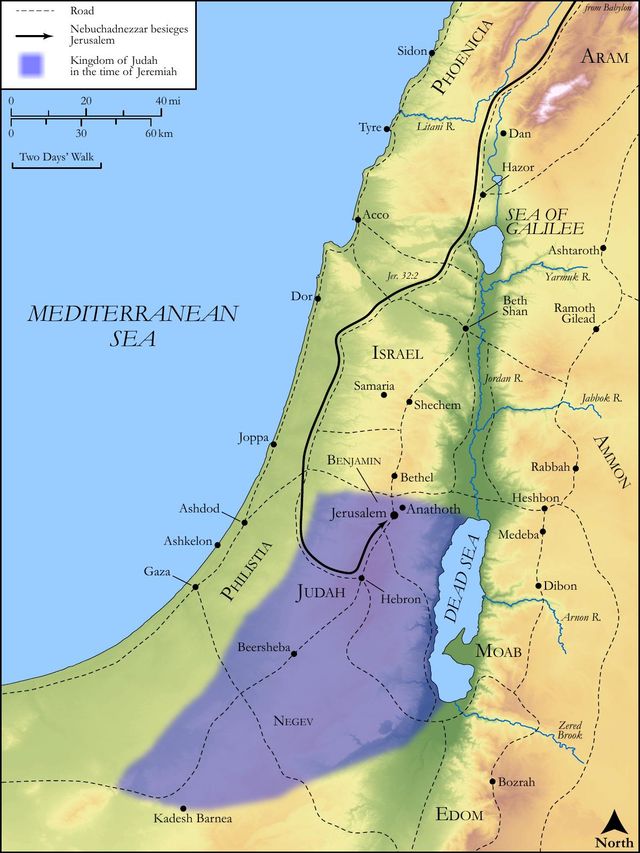
See on the biblical-era map
Study this verse
Public-domain commentary
Matthew Henry
From his Commentary on the Whole Bible. Henry comments on passages, not single verses — this entry covers Jeremiah 32:16–25. His two-level outline is real structure in the source text, so it is rendered as structure.
We have here Jeremiah's prayer to God upon occasion of the discoveries God had made to him of his purposes concerning this nation, to pull it down, and in process of time to build it up again, which puzzled the prophet himself, who, though he delivered his messages faithfully, yet, in reflecting upon them, was greatly at a loss within himself how to reconcile them; in that perplexity he poured out his soul before God in prayer, and so gave himself ease. That which disturbed him was not the bad bargain he seemed to have made for himself in purchasing a field that he was likely to have no good of, but the case of his people, for whom he was still a kind and faithful intercessor, and he was willing to hope that, if God had so much mercy in store for them hereafter as he had promised, he would not proceed with so much severity against them now as he had threatened. Before Jeremiah went to prayer he delivered the deeds that concerned his new purchase to Baruch, which may intimate to us that when we are going to worship God we should get our minds as clear as may be from the cares and incumbrances of this world. Jeremiah was in prison, in distress, in the dark about the meaning of God's providences, and then he prays. Note, Prayer is a salve for every sore. Whatever is a burden to us, we may by prayer cast it upon the Lord and then be easy.
In this prayer, or meditation,
I.Jeremiah adores God and his infinite perfections, and gives him the glory due to his name as the Creator, upholder, and benefactor, of the whole creation, thereby owning his irresistible power, that he can do what he will, and his incontestable sovereignty, that he may do what he will, Jer 32:17-19. Note, When at any time we are perplexed about the particular methods and dispensations of Providence it is good for us to have recourse to our first principles, and to satisfy ourselves with the general doctrines of God's wisdom, power, and goodness. Let us consider, as Jeremiah does here,
1.That God is the fountain of all being, power, life, motion, and perfection: He made the heaven and the earth with his outstretched arm; and therefore who can control him? Who dares contend with him?
2.That with him nothing is impossible, no difficulty insuperable: Nothing is too hard for thee. When human skill and power are quite nonplussed, with God are strength and wisdom sufficient to master all the opposition.
3.That he is a God of boundless bottomless mercy; mercy is his darling attribute; it is his goodness that is his glory: "Thou not only art kind, but thou showest lovingkindness, not to a few, to here and there one, but to thousands, thousands of persons, thousands of generations." 4. That he is a God of impartial and inflexible justice. His reprieves are not pardons, but if in mercy he spares the parents, that they may be led to repentance, yet such a hatred has he to sin, and such a displeasure against sinners, that he recompenses their iniquity into the bosom of their children, and yet does them no wrong; so hateful is the unrighteousness of man, and so jealous of its own honour is the righteousness of God. 5. That he is a God of universal dominion and command: He is the great God, for he is the mighty God, and might among men makes them great. He is the Lord of hosts, of all hosts, that is his name, and he answers to his name, for all the hosts of heaven and earth, of men and angels, are at his beck. 6. That he contrives every thing for the best, and effects every thing as he contrived it: He is great in counsel, so vast are the reaches and so deep are the designs of his wisdom; and he is mighty in doing, according to the counsel of his will. Now such a God as this is not to be quarrelled with. His service is to be constantly adhered to and all his disposals cheerfully acquiesced in.
II.He acknowledges the universal cognizance God takes of all the actions of the children of men and the unerring judgment he passes upon them (Jer 32:19): Thy eyes are open upon all the sons of men, wherever they are, beholding the evil and the good, and upon all their ways, both the course they take and every step they take, not as an unconcerned spectator, but as an observing judge, to give every one according to his ways and according to his deserts, which are the fruit of his doings; for men shall find God as they are found of him.
III.He recounts the great things God had done for his people Israel formerly.
1.He brought them out of Egypt, that house of bondage, with signs and wonders, which remain, if not in the marks of them, yet in the memorials of them, even unto this day; for it would never be forgotten, not only in Israel, who were reminded of it every year by the ordinance of the passover, but among other men: all the neighbouring nations spoke of it, as that which redounded exceedingly to the glory of the God of Israel, and made him a name as at this day. This is repeated (Jer 32:21), that God brought them forth, not only with comforts and joys to them, but with glory to himself, with signs and wonders (witness the ten plagues), with a strong hand, too strong for the Egyptians themselves, and with a stretched-out arm, that reached Pharaoh, proud as he was, and with great terror to them and all about them. This seems to refer to Deu 4:34.
2.He brought them into Canaan, that good land, that land flowing with milk and honey. He swore to their fathers to give it them, and, because he would perform his oath, he did give it to the children (Jer 32:22) and they came in and possessed it. Jeremiah mentions this both as an aggravation of their sin and disobedience and also as a plea with God to work deliverance for them. Note, It is good for us often to reflect upon the great things that God did for his church formerly, especially in the first erecting of it, that work of wonder.
IV.He bewails the rebellions they had been guilty of against God, and the judgments God had brought upon them for these rebellions.
It is a sad account he here gives of the ungrateful conduct of that people towards God. He had done every thing that he had promised to do (they had acknowledged it, Kg1 8:56), but they had done nothing of all that he commanded them to do (Jer 32:23); they made no conscience of any of his laws; they walked not in them, paid no respect to any of his calls by his prophets, for they obeyed not his voice. And therefore he owns that God was righteous in causing all this evil to come upon them. The city is besieged, is attacked by the sword without, is weakened and wasted by the famine and pestilence within, so that it is ready to fall into the hands of the Chaldeans that fight against it (Jer 32:24); it is given into their hands, Jer 32:25. Now,
1.He compares the present state of Jerusalem with the divine predictions, and finds that what God has spoken has come to pass. God had given them fair warning of it before; and, if they had regarded this, the ruin would have been prevented; but, if they will not do what God has commanded, they can expect no other than that he should do what he had threatened.
2.He commits the present state of Jerusalem to the divine consideration and compassion (Jer 32:24): Behold the mounts, or ramparts, or the engines which they make use of to batter the city and beat down the wall of it. And again, "Behold thou seest it, and takest cognizance of it. Is this the city that thou has chosen to put thy name there? And shall it be thus abandoned?" He neither complains of God for what he had done nor prescribes to God what he should do, but desires he would behold their case, and is pleased to think that he does behold it. Whatever trouble we are in, upon a personal or public account, we may comfort ourselves with this, that God sees it and sees how to remedy it.
V.He seems desirous to be let further into the meaning of the order God had now given him to purchase his kinsman's field (Jer 32:25):
"Though the city is given into the hand of the Chaldeans, and no man is likely to enjoy what he has, yet thou hast said unto me, Buy thou the field." As soon as he understood that it was the mind of God he did it, and made no objections, was not disobedient to the heavenly vision; but, when he had done it, he desired better to understand why God had ordered him to do it, because the thing looked strange and unaccountable. Note, Though we are bound to follow God with an implicit obedience, yet we should endeavour that it may be more and more an intelligent obedience. We must never dispute God's statutes and judgments, but we may and must enquire, What mean these statutes and judgments? Deu 6:20.
Historical interpretation
Two Centuries of Reception
2 surviving comments on this verse. Each one is dated, so this reads as a timeline rather than a list.
Select a marker to jump to its quote. Markers stagger vertically where authors wrote within a few decades of each other.
Of course nothing is “too hard for the Lord.” But if we choose to apply this principle so extravagantly and harshly in our capricious imaginations, we may then make out God to have done anything we please, on the ground that it was not impossible for him to do it. We must not suppose, however, because he is able to do all things, that he has done what he has not done. But we must inquire whether he has really done it. God could, if he had liked, have furnished humankind with wings to fly with, just as he gave wings to kites. We must not, however, run to the conclusion that he did this because he was able to do it. He might also have extinguished Praxeas and all other heretics at once; it does not follow, however, that he did, simply because he was able. For it was necessary that there should be both kites and heretics; it was necessary also that the Father should be crucified. In one sense there will be something difficult even for God—namely, that which he has not done—not because he could not but because he would not do it. For with God, to be willing is to be able and to be unwilling is to be unable; all that he has willed, however, he has both been able to accomplish and has displayed his ability.
(Vers. 20 seqq.) You have set signs and wonders in the land of Egypt until this day, both in Israel and among mankind (or among earthlings), and have made a name for yourself, as it is this day. You brought your people Israel out of the land of Egypt with signs and wonders, with a strong hand and an outstretched arm, and with great terror. And you gave them this land, which you swore to their fathers to give them, a land flowing with milk and honey. And they entered and took possession of it, but they did not obey your voice and did not walk in your law. Everything that you commanded them to do, they did not do, and all these disasters happened to them. From a general overview, it then focuses on what specifically Israel has accomplished. It says, 'You have set signs and wonders in the land of Egypt, which have afflicted Egypt until this day, and in Israel and among mankind, whether native-born or foreign.' This that is said, up to this day, must be connected to what follows, so that we may read and understand that your signs are fulfilled both in Israel and in all mortals daily. Alternatively, you not only performed signs and wonders in Egypt, but your power of mercy has also saved your people even until today, and you assist the whole human race as the Creator with your power. And it should be noted that Israel is separated from men and earthborn beings, as it is written: 'My firstborn son is Israel.' And you have made for yourself a name as it is to this day (Exodus IV, 22). Your praises, he says, are celebrated in the language of the whole world. And you have brought your people Israel out of the land of Egypt. It is well said, your people, for at that time when they were brought out, they served under the Lord's command. And you brought them out with signs and wonders, by which Egypt was struck, and with a strong hand, and with an outstretched arm, and with great terror: when the Red Sea provided a way for the people of Israel to cross over, and it obliterated the Egyptian army: And you have given them this land, which you swore to their fathers to give to them: namely, Abraham, Isaac, and Jacob. Therefore, not by their own merit, but by the virtues of their fathers, they received the land flowing with milk and honey. For they were not yet able to consume solid food, but were nourished with milk and honey in their infancy. Indeed, with the abundance and plenty of all things, milk and honey. And they entered and possessed it. And immediately there was no middle ground between possession and disobedience. For abundance produces security, security produces negligence, negligence produces contempt. And they did not obey, he says, your voice, and they did not walk in your law. Therefore, they promised in vain in the wilderness, saying: We will do everything that the Lord has commanded (Exodus 19:8). For the reward is not in the promise, but in the action: to refute the impudence of those who think that a man can fulfill everything that he has promised. They did not do everything that you commanded them to do, and they certainly promised to do so. And all these evils happened to them. Evils for those who are patient, but according to the judgement of the Lord, good things that give to each person according to their ways.
Continue studying Jeremiah 32:21 across the web’s major study libraries — every link below opens this exact verse, chapter, or book on the destination site.
Read & Compare
 BibleGatewayThis verse in more than 200 translations and 70 languages.
 Bible.comThe YouVersion reader — hundreds of translations, reading plans, and highlights.
 ESV.orgCrossway's official English Standard Version reader.
 NET BibleThe NET translation with 60,000+ translators' notes on every rendering decision.
 STEP BibleTyndale House's free study tool — original text, vocabulary, and scholarly resources.
 BibliaLogos Bible Software's free web reader.
 USCCBThe New American Bible (Revised Edition) with the U.S. bishops' study notes.
Commentaries
 BibleHub CommentariesDozens of classic commentaries on this verse, gathered on one page.
 StudyLightMore than 100 commentary sets — the largest collection on the web.
 BibleRefPlain-English commentary on what this verse means, verse by verse.
 Enduring WordDavid Guzik's free commentary on this chapter, widely used by Bible teachers.
 Bible Study ToolsVerse commentary alongside Greek and Hebrew study aids.
Original Language & Research
- BibleHub InterlinearThe verse word by word — original language, transliteration, and English.
- BibleHub LexiconEvery word's original-language definition and Strong's entry.
 Blue Letter BibleDeep-study tools — Strong's numbers, concordance, and word studies.
 SefariaThe Hebrew text with Rashi and centuries of Jewish commentary.
Sermons, Hymns & Audio


TrulyRandomVerse is not affiliated with these sites and doesn’t control their content. They’re linked because they’re genuinely useful.
Summary
Jeremiah 32:21 serves as a profound declaration of God's unparalleled power and unwavering faithfulness, articulated by the prophet Jeremiah during Judah's dire siege by Babylon. This verse, embedded within Jeremiah's prayer, functions as a powerful recollection of the foundational event of Israel's history: their miraculous and awe-inspiring liberation from Egyptian bondage. It vividly highlights God's active, irresistible intervention on behalf of His people, providing a historical anchor for faith in His ability to fulfill seemingly impossible promises even amidst the darkest national crisis.
Context
ShowHideLiterary Context
Jeremiah 32:21 is an integral component of Jeremiah's heartfelt prayer to the Lord, which commences in Jeremiah 32:17 and extends through Jeremiah 32:25. This prayer immediately follows God's seemingly counterintuitive command to Jeremiah to purchase a field in Anathoth, despite Jerusalem being under siege by the Babylonian army and the imminent loss of all land. This symbolic act, meticulously detailed in Jeremiah 32:6-15, represents God's promise of future restoration and return from exile. Jeremiah's prayer, therefore, is a deep theological reflection prompted by this divine instruction, as he grapples with the paradox of impending judgment alongside a promise of future hope, anchoring his trust in God's past, undeniable acts of deliverance, particularly the Exodus.
Historical & Cultural Context
The backdrop for Jeremiah 32 is a period of intense national crisis for the kingdom of Judah, specifically around 588-586 BC. Jerusalem was enduring a brutal siege by Nebuchadnezzar's Babylonian forces, a direct and devastating fulfillment of Jeremiah's prophecies of judgment against a disobedient nation. Jeremiah himself was imprisoned in the court of the guard, unjustly accused of treason for prophesying the city's inevitable fall. In this desperate hour, the recollection of the Exodus from Egypt was far more than a mere historical anecdote; it was a profound cultural and theological touchstone for Israel. The Exodus was the defining event that established Israel as God's covenant people, unequivocally demonstrating His unique power to deliver and His unwavering faithfulness to His promises, even when human circumstances seemed utterly hopeless. It served as the ultimate, irrefutable proof of God's character and capability, a memory that would have resonated deeply with any Israelite facing national annihilation.
Key Themes
ShowHideJeremiah 32:21 powerfully encapsulates several overarching themes found throughout the book of Jeremiah and the broader Old Testament narrative. Firstly, it profoundly underscores Divine Sovereignty and Power, emphasizing that God is the ultimate actor in history, capable of executing His will regardless of human resistance or apparent impossibility. The vivid description of the Exodus highlights God's irresistible might, a theme echoed in God's declaration of His power over all creation in Jeremiah 32:17. Secondly, it speaks directly to God's Unwavering Faithfulness to His Covenant, reminding both Jeremiah and the reader that despite Israel's persistent disobedience leading to severe judgment, God's foundational commitment to His people, established at the Exodus (as seen in Exodus 19:4-6), remains intact. This enduring faithfulness provides the basis for the future restoration promised in Jeremiah 32:44. Thirdly, the verse exemplifies the critical importance of Remembering God's Past Works as a vital source of hope and trust in present difficulties. Jeremiah's prayer demonstrates how reflecting on God's historical acts of salvation, particularly the miraculous deliverance from Egypt (referenced repeatedly, for example, in Deuteronomy 26:8), can bolster faith when facing seemingly insurmountable challenges.
Exposition and Analysis
ShowHideKey Word Analysis
ShowHideThis primitive root signifies "to go (causatively, bring) out" in a vast array of applications, both literal and figurative, including "to appear," "to depart," or "to issue out." In Jeremiah 32:21, it underscores God's active, decisive, and powerful agency in the Exodus. It was not a passive escape facilitated by circumstances, but a divine extraction, emphasizing God as the initiator and executor of Israel's liberation, demonstrating His sovereign will and might.
Probably derived from a root meaning "to appear," this term refers to a signal, mark, miracle, omen, or evidence. In the context of the Exodus, "signs" refer to the miraculous displays of God's power, such as the ten plagues, which served as undeniable proof of His presence, authority, and intention to deliver His people and judge their oppressors. These were visible, supernatural manifestations of divine intervention, designed to reveal God's character and power to both Israel and Egypt.
This word, stemming from the root yârêʼ (to fear), denotes fear itself, or by implication, a fearful thing or deed, dread, or terribleness. In the Exodus narrative, "great terror" describes the overwhelming awe and dread inspired by God's mighty acts, not only among the Egyptians who suffered His judgments but also among the Israelites, instilling a profound reverence for His power and sovereignty. It speaks to the awe-inspiring, fear-inducing quality of God's overwhelming might.
Verse Breakdown
ShowHide"And hast brought forth thy people Israel"
This opening clause immediately establishes God as the singular, active agent of Israel's liberation. The verb "brought forth" (H3318, yâtsâ') emphasizes a purposeful, powerful, and decisive act of extraction, not a mere escape. It highlights God's initiative in forming and delivering His chosen nation, Israel (H3478, Yisrâʼêl), underscoring His unique covenant relationship with them from their very inception as a people.
"out of the land of Egypt"
This phrase precisely pinpoints the specific historical and geographical context of this foundational act of deliverance. Egypt (H4714, Mitsrayim) represents the epitome of oppressive power and severe bondage, making God's act of liberation from such a formidable empire all the more miraculous, definitive, and demonstrative of His supreme authority over all earthly powers. It was the crucible in which Israel was forged as a distinct nation.
"with signs, and with wonders"
These two terms (H226, ʼôwth and H4159, môwphêth) are frequently paired in the Old Testament to describe supernatural occurrences that serve to demonstrate God's power and validate His message or messenger. They refer to the miraculous plagues, the parting of the Red Sea, and other divine interventions that accompanied the Exodus, proving God's sovereignty over nature and human rulers, and compelling Pharaoh to release Israel against his will.
"and with a strong hand, and with a stretched out arm"
This is a powerful and frequently used anthropomorphic idiom in the Old Testament, describing God's irresistible power and direct, forceful intervention. "Strong hand" (H2389, châzâq and H3027, yâd) denotes His might, authority, and firm grip, while "stretched out arm" (H5186, nâṭâh and H248, ʼezrôwaʻ) conveys His active, unhindered exertion of force, reaching out to accomplish His will. Together, they paint a vivid picture of God's overwhelming strength, which no human power could withstand or thwart.
"and with great terror"
The final phrase (H1419, gâdôwl and H4172, môwrâ') describes the profound and awe-inspiring impact of God's mighty acts. This "great terror" refers to the overwhelming awe, dread, and fear that God's powerful interventions instilled in both the Egyptians (who witnessed His devastating judgment) and the Israelites (who witnessed His saving power), leading to a deep reverence for His majesty and an understanding of His absolute, unchallengeable authority.
Literary Devices
ShowHideJeremiah 32:21 is rich in literary devices that amplify its message of divine power and historical significance. The most prominent is Anthropomorphism, vividly seen in the phrase "with a strong hand, and with a stretched out arm." This imagery attributes human physical characteristics (hand, arm) to God, making His abstract power more tangible, relatable, and comprehensible to the audience. It powerfully conveys His direct, active, and irresistible intervention in human affairs. Another device at play is Merism, particularly in the pairing of "signs, and with wonders." This rhetorical device uses two complementary parts to express a totality, indicating the full spectrum and comprehensive nature of the miraculous events God performed. The verse also employs Repetition and Parallelism through the cumulative list of descriptors ("signs," "wonders," "strong hand," "stretched out arm," "great terror"), which builds a powerful crescendo, emphasizing the overwhelming, multi-faceted, and undeniable nature of God's intervention. Finally, the phrase "great terror" can be seen as a form of Hyperbole, underscoring the immense, awe-inspiring, and fear-inducing impact of God's actions, which transcended normal human experience and left an indelible mark on all who witnessed them.
Theological and Thematic Connections
ShowHideJeremiah 32:21 serves as a profound theological anchor, reminding us that God's character is consistent and His power is unyielding. The Exodus, recounted here, is not merely a historical event but a theological paradigm for God's redemptive activity throughout history. It demonstrates His absolute sovereignty over nations and natural forces, His unwavering commitment to His covenant promises, and His unique ability to deliver His people from any form of bondage. In a time of national despair, Jeremiah appeals to this foundational act of salvation as the basis for trusting God's future promises of restoration, illustrating that God's past faithfulness is the bedrock for present hope. This verse affirms that the God who delivered Israel from Egypt is the same God who can bring about seemingly impossible salvation in any age, proving His enduring power and faithfulness to His people.
Reflection and Application
ShowHideIn the midst of personal or collective crises, Jeremiah 32:21 offers a powerful invitation to remember God's past acts of deliverance. Just as Jeremiah, imprisoned and facing national ruin, looked back to the Exodus as irrefutable proof of God's omnipotence and unwavering faithfulness, so too can believers today draw profound strength from recalling God's interventions both in redemptive history and in their own personal lives. This verse encourages us to anchor our hope not in fleeting circumstances, human capabilities, or political solutions, but in the unchanging character of a God whose "strong hand and stretched out arm" remains eternally capable of delivering from any bondage—whether spiritual, emotional, physical, or societal. It calls us to cultivate a robust and resilient faith that trusts God's power to act even when the future seems bleak or impossible, knowing that His past faithfulness is a divine guarantee of His future provision, ultimate triumph, and unwavering commitment to His people.
Questions for Reflection
ShowHideFAQ
ShowHideWhy is the Exodus from Egypt so frequently referenced in the Old Testament?
ShowHideThe Exodus is foundational to Israel's identity because it was the definitive act where God revealed Himself as their unique deliverer and established His covenant with them at Sinai. It demonstrated His unique power over all creation and human rulers, His unwavering faithfulness to His promises made to the patriarchs, and His sovereign choice of Israel as His treasured people. This event served as the ultimate proof that the God of Abraham, Isaac, and Jacob was actively involved in history, capable of overcoming any obstacle to save His chosen ones. It became the benchmark for all future acts of divine salvation and a constant reminder of God's character and covenant relationship with Israel, as seen in passages like Deuteronomy 6:20-25.
What does the phrase "strong hand and stretched out arm" signify about God?
ShowHideThis anthropomorphic phrase is a powerful idiom used throughout the Old Testament to convey God's absolute, irresistible, and direct power. The "strong hand" (Hebrew: yad chazaqah) denotes His might, authority, and firm grip on events, while the "stretched out arm" (Hebrew: zeroa' netuyah) symbolizes His active, unhindered exertion of force, reaching out to accomplish His will. It means that God's intervention is not passive or indirect but is a forceful, personal, and overwhelming display of His sovereignty, capable of overcoming any opposition and achieving His purposes, as seen in Exodus 13:3.
How does Jeremiah's prayer, which includes this verse, offer hope in a time of judgment?
ShowHideJeremiah's prayer, uttered during the Babylonian siege, embodies a profound tension between impending judgment and enduring hope. By recounting the Exodus, Jeremiah grounds his hope in God's unchanging character and past faithfulness. He acknowledges God's righteous power to judge a disobedient nation, but also His redemptive power to save and restore. This act of remembering serves as a theological argument: if God could miraculously deliver Israel from the formidable power of Egypt, He is certainly capable of fulfilling His promises of future restoration, even after the severe judgment of exile. It teaches that even in the darkest valleys of consequence and despair, God's redemptive power and covenant faithfulness remain the ultimate source of hope, as promised in Jeremiah 29:11.
Christ-Centered Fulfillment
ShowHideJeremiah 32:21, with its vivid portrayal of God's mighty deliverance from Egypt, finds its ultimate and most profound fulfillment in the person and redemptive work of Jesus Christ. The Exodus, a liberation from physical and spiritual bondage to Pharaoh, serves as a powerful type foreshadowing the far greater "new exodus" accomplished by Christ. Just as God brought forth His people Israel with "signs, and with wonders, and with a strong hand, and with a stretched out arm, and with great terror," so too did Jesus, the very arm of God made flesh, deliver humanity from the dominion of sin, death, and the devil. His earthly ministry was marked by countless "signs and wonders" (miracles) that testified to His divine authority and power over all creation and spiritual forces, culminating in the "strong hand" of His crucifixion, which broke the power of sin, and His "stretched out arm" in resurrection, which decisively conquered death itself. Through His atoning sacrifice and victorious resurrection, Christ has "delivered us from the domain of darkness and transferred us to the kingdom of his beloved Son" (Colossians 1:13). He is the true Lamb of God who takes away the sin of the world, leading His people out of spiritual slavery into true freedom and eternal life (John 8:36). The "great terror" of God's righteous judgment against sin, which was due to humanity, was fully borne by Christ on the cross, so that those who believe might experience not terror, but peace, reconciliation, and adoption as children of God. Thus, the Exodus stands as a powerful prophetic type, pointing forward to the ultimate, Christ-centered deliverance that secures eternal salvation and promises a future where God will dwell eternally with His redeemed people, wiping away every tear (Revelation 21:3-4).