


Jeremiah 27:10
Bible text: King James Version (1769 Blayney text) · Public domain
Bible text: Berean Standard Bible · Public domain
Bible text: American Standard Version (1901) · Public domain
Bible text: World English Bible, Messianic edition · Public domain
Bible text: Geneva Bible (1599) · Public domain
Bible text: Young's Literal Translation · Public domain
- כִּיkiforH3588PrtParticle Conditional
- שֶׁקֶרShe·kerfalsehoodH8267N-msNoun Singular Masculine Absolute
- הֵםhemtheyH1992Pro-3mpPronoun Personal 3rd Plural Masculine
- נִבְּאִיםni·be·'Im[are] prophesyingH5012V-Niphal-Prtcpl-mpVerb Niphal Participle Plural Masculine Absolute
- לָכֶםla·Khemto <the> youPrep-l ¦ 2mpSuffix Personal 2nd Plural Masculineלָto <the>כֶםyou
- לְמַעַןle·Ma·'anso asH4616PrtParticle Conditional
- הַרְחִיקhar·Chikto remove far awayH7368V-Hiphil-InfVerb Hiphil Infinitive Construct
- אֶתְכֶם'et·Khem<obj.> youH853DirObjM ¦ 2mpParticle Object Indicatorאֶתְ<obj.>כֶםyou
- מֵעַלme·'Alfrom onH5921Prep-m ¦ PrepPrepositionמֵfromעַלon
- אַדְמַתְכֶם'ad·mat·Khemyour landH127N-fsc ¦ 2mpNoun Singular Feminine Constructאַדְמַתְlandכֶםyour
- וְהִדַּחְתִּיve·hi·dach·Tiand I will drive outH5080Conj-w ¦ V-Hiphil-ConsecPerf-1csVerb Hiphil Consecutive Perfect 1st Singular common genderוְandהִדַּחְתִּיI will drive out
- אֶתְכֶם'et·Khem<obj.> youH853DirObjM ¦ 2mpParticle Object Indicatorאֶתְ<obj.>כֶםyou
- וַאֲבַדְתֶּםva·'a·vad·Temand you will perishH6Conj-w ¦ V-Qal-ConsecPerf-2mpVerb Qal Consecutive Perfect 2nd Plural Masculineוַandאֲבַדְתֶּםyou will perish
English is a literal word-by-word gloss of the Hebrew, not the KJV's wording. Why?
This is the original text the KJV's translators worked from — each Hebrew word with its own literal English meaning in this verse, prepared by scholars at Tyndale House, Cambridge. The KJV translates whole sentences, not word by word, so its wording differs: one Hebrew word can become several English words, and the KJV may choose “the LORD” where the gloss reads “Yahweh”. Both are faithful — they answer different questions. For the KJV's own rendering, switch to the KJV text.
Details
See on the biblical-era map
Study this verse
Public-domain commentary
Matthew Henry
From his Commentary on the Whole Bible. Henry comments on passages, not single verses — this entry covers Jeremiah 27:1–11. His two-level outline is real structure in the source text, so it is rendered as structure.
Some difficulty occurs in the date of this prophecy. This word is said to come to Jeremiah in the beginning of the reign of Jehoiakim (Jer 27:1), and yet the messengers, to whom he is to deliver the badges of servitude, are said (Jer 27:3) to come to Zedekiah king of Judah, who reigned not till eleven years after the beginning of Jehoiakim's reign. Some make it an error of the copy, and think that it should be read (Jer 27:1), In the beginning of the reign of Zedekiah, for which some negligent scribe, having his eye on the title of the foregoing chapter, wrote Jehoiakim. And, if one would admit a mistake any where, it should be here, for Zedekiah is mentioned again (Jer 27:12), and the next prophecy is dated the same year, and said to be in the beginning of the reign of Zedekiah, Jer 28:1. Dr. Lightfoot solves it thus: In the beginning of Jehoiakim's reign Jeremiah is to make these bonds and yokes, and to put them upon his own neck, in token of Judah's subjection to the king of Babylon, which began at that time; but he is to send them to the neighbouring kings afterwards in the reign of Zedekiah, of whose succession to Jehoiakim, and the ambassadors sent to him, mention is made by way of prediction.
I.Jeremiah is to prepare a sign of the general reduction of all these countries into subjection to the king of Babylon (Jer 27:2):
Make thee bonds and yokes, yokes with bonds to fasten them, that the beast may not slip his neck out of the yoke. Into these the prophet must put his own neck to make them taken notice of as a prophetic representation; for every one would enquire, What is the meaning of Jeremiah's yokes? We find him with one on, Jer 28:10. Hereby he intimated that he advised them to nothing but what he was resolved to do himself; for he was not one of those that bind heavy burdens on others, which they themselves will not touch with one of their fingers. Ministers must thus lay themselves under the weight and obligation of what they preach to others.
II.He is to send this, with a sermon annexed to it, to all the neighbouring princes; those are mentioned (Jer 27:3) that lay next to the land of Canaan. It should seem, there was a treaty of alliance on foot between the king of Judah and all those other kings. Jerusalem was the place appointed for the treaty. Thither they all sent their plenipotentiaries; and it was agreed that they should bind themselves in a league offensive and defensive, to stand by one another, in opposition to the growing threatening greatness of the king of Babylon, and to reduce his exorbitant power. They had great confidence in their strength thus united, and were ready to call themselves the high allies; but, when the envoys were returning to their respective masters with the ratification of this treaty, Jeremiah gives each of them a yoke to carry to his master, to signify to him that he must either by consent or by compulsion become a servant to the king of Babylon, let him choose which he will. In the sermon upon this sign,
1.God asserts his own indisputable right to dispose of kingdoms as he pleases, Jer 27:5. He is the Creator of all things; he made the earth at first, established it, and it abides: it is still the same, though one generation passes away and another comes. He still by a continued creation produces man and beast upon the ground, and it is by his great power and outstretched arm. His arm has infinite strength, though it be stretched out. Upon this account he may give and convey a property and dominion to whomsoever he pleases. As he hath graciously given the earth to the children of men in general (Psa 115:16), so he give to each his share of it, be it more or less. Note, Whatever any have of the good things of this world, it is what God sees fit to give them; we ourselves should therefore be content, though we have ever so little, and not envy any their share, though they have ever so much.
2.He publishes a grant of all these countries to Nebuchadnezzar. Know all men by these presents. Sciant praesentes et futuri - Let those of the present and those of the future age know. "This is to certify to all whom it may concern that I have given all these lands, with all the wealth of them, into the hands of the king of Babylon; even the beasts of the field, whether tame or wild, have I given to him, parks and pastures; they are all his own." Nebuchadnezzar was a proud wicked man, an idolater; and yet God, in his providence, gives him this large dominion, these vast possessions. Note, The things of this world are not the best things, for God often gives the largest share of them to bad men, that are rivals with him and rebels against him. He was a wicked man, and yet what he had he had by divine grant. Note, Dominion is not founded in grace. Those that have not any colourable title to eternal happiness may yet have a justifiable title to their temporal good things. Nebuchadnezzar is a very bad man, and yet God calls him his servant, because he employed him as an instrument of his providence for the chastising of the nations, and particularly his own people; and for his service therein he thus liberally repaid him. Those whom God makes use of shall not lose by him; much more will he be found the bountiful rewarder of all those that designedly and sincerely serve him.
3.He assures them that they should all be unavoidably brought under the dominion of the king of Babylon for a time (Jer 27:7): All nations, all these nations and many others, shall serve him, and his son, and his son's son. His son was Evil-merodach, and his son's son Belshazzar, in whom his kingdom ceased: then the time of reckoning with his land came, when the tables were turned, and many nations and great kings, incorporated into the empire of the Medes and Persians, served themselves of him, as before, Jer 25:14. Thus Adonibezek was trampled upon himself, as he had trampled on other kings.
4.He threatens those with military execution that stood out and would not submit to the king of Babylon (Jer 27:8): That nation that will not put their neck under his yoke I will punish with sword and famine, with one judgment after another, till it is consumed by his hand. Nebuchadnezzar was very unjust and barbarous in invading the rights and liberties of his neighbours thus, and forcing them into a subjection to him; yet God had just and holy ends in permitting him to do so, to punish these nations for their idolatry and gross immoralities. Those that would not serve the God that made them were justly made to serve their enemies that sought to ruin them.
5.He shows them the vanity of all the hopes they fed themselves with, that they should preserve their liberties, Jer 27:9, Jer 27:10. These nations had their prophets too, that pretended to foretell future events by the stars, or by dreams, or enchantments; and they, to please their patrons, and because they would themselves have it so, flattered them with assurances that they should not serve the king of Babylon. Thus they designed to animate them to a vigorous resistance; and, though they had no ground for it, they hoped hereby to do them service. But he tells them that it would prove to their destruction; for by resisting they would provoke the conqueror to deal severely with them, to remove them, and drive them out into a miserable captivity, in which they should all be lost and buried in oblivion. Particular prophecies against these nations that bordered on Israel severally, the ruin of which is here foretold in the general, we shall meet with, ch. 48 and 49, and Eze. 25, which had the same accomplishment with this here. Note, When God judges he will overcome.
6.He puts them in a fair way to prevent their destruction by a quiet and easy submission, Jer 27:11. The nations that will be content to serve the king of Babylon, and pay him tribute for seventy years (ten apprenticeships), those will I let remain still in their own land. Those that will bend shall not break. Perhaps the dominion of the king of Babylon may bear no harder upon them than that of their own kings had done. It is often more a point of honour than true wisdom to prefer liberty before life. It is not mentioned to the disgrace of Issachar that because he saw rest was good, and the land pleasant, that he might peaceably enjoy it, he bowed his shoulder to bear, and became a servant to tribute (Gen 49:14, Gen 49:15), as these are here advised to do: Serve the king of Babylon and you shall till the land and dwell therein. Some would condemn this as the evidence of a mean spirit, but the prophet recommends it as that of a meek spirit, which yields to necessity, and by a quiet submission to the hardest turns of Providence makes the best of bad: it is better to do so than by struggling to make it worse.
- Levius fit patientia
Quicquid corrigere est nefas.
- Hor.
- When we needs must bear,
Enduring patience makes the burden light.
- Creech.
Many might have prevented destroying providences by humbling themselves under humbling providences. It is better to take up a lighter cross in our way than to pull a heavier on our own head.
Historical interpretation
Historical reception
1 surviving comment on this verse from the historical church.
(Verse 9 and following) So do not listen to your prophets, and diviners, and dreamers, and augurs, and sorcerers, who say to you: 'You will not serve the king of Babylon, for they prophesy lies to you, in order to drive you far from your land and to expel you, and you will perish.' But the nation that puts its neck under the yoke of the king of Babylon and serves him, I will let it stay in its own land, says the Lord; and it will till it and dwell in it. The allegorical interpreter raves at this place and encourages those placed in heaven to not listen to their prophets, diviners, dreamers, and sorcerers, but rather to serve Nebuchadnezzar and take on the body of humility, the cries of infants, and the cradle of little children. For if they do these things, having completed their servitude and the condition of human mortality, they will return to their own land, live there, and do what they did before. And he says that he suspects those who have despised God's commandments will become burdened with human bodies as future demons and unclean spirits, and they will not regain their former abode. But we will simply explain that there are prophets among the nations who pretend to predict the future by divine inspiration. And there are diviners, of whom the common proverb says: The wise claim to divine. And there are dream interpreters who imitate Joseph and Daniel. And there are soothsayers, who interpret the flight and calls of birds and announce what should or should not be done. And there are sorcerers, whom we can call either poisoners or servants of the phantasms of demons, who are called Kasaph in Hebrew. All these, he says, deceive you and undermine you, so that you do not serve the king of Babylon. For it is much better to willingly embrace servitude, to have a friend whom you serve, and to cultivate one's ancestral land, than to serve as a captive by force and necessity.
Continue studying Jeremiah 27:10 across the web’s major study libraries — every link below opens this exact verse, chapter, or book on the destination site.
Read & Compare
 BibleGatewayThis verse in more than 200 translations and 70 languages.
 Bible.comThe YouVersion reader — hundreds of translations, reading plans, and highlights.
 ESV.orgCrossway's official English Standard Version reader.
 NET BibleThe NET translation with 60,000+ translators' notes on every rendering decision.
 STEP BibleTyndale House's free study tool — original text, vocabulary, and scholarly resources.
 BibliaLogos Bible Software's free web reader.
 USCCBThe New American Bible (Revised Edition) with the U.S. bishops' study notes.
Commentaries
 BibleHub CommentariesDozens of classic commentaries on this verse, gathered on one page.
 StudyLightMore than 100 commentary sets — the largest collection on the web.
 BibleRefPlain-English commentary on what this verse means, verse by verse.
 Enduring WordDavid Guzik's free commentary on this chapter, widely used by Bible teachers.
 Bible Study ToolsVerse commentary alongside Greek and Hebrew study aids.
Original Language & Research
- BibleHub InterlinearThe verse word by word — original language, transliteration, and English.
- BibleHub LexiconEvery word's original-language definition and Strong's entry.
 Blue Letter BibleDeep-study tools — Strong's numbers, concordance, and word studies.
 SefariaThe Hebrew text with Rashi and centuries of Jewish commentary.
Sermons, Hymns & Audio


TrulyRandomVerse is not affiliated with these sites and doesn’t control their content. They’re linked because they’re genuinely useful.
Summary
Jeremiah 27:10 delivers a severe divine warning against false prophets who, through deceptive messages, actively undermine God's true intentions for Judah. These prophets promised peace and security, but their lies were designed to prevent the people from submitting to God's ordained judgment via Babylon, ultimately leading to their forced removal from their ancestral land and national ruin. The verse underscores the catastrophic consequences of heeding falsehood over divine truth, highlighting God's sovereign hand in the impending exile as a just consequence for persistent disobedience.
Context
ShowHideLiterary Context
Jeremiah 27:10 is situated within a pivotal section of Jeremiah's prophecy (chapters 27-28) that directly addresses the impending Babylonian exile. The preceding verses Jeremiah 27:1-9 establish God's command to Jeremiah to wear a literal yoke, symbolizing the servitude of Judah and surrounding nations to Nebuchadnezzar, King of Babylon. God explicitly states that He has given all these lands into Nebuchadnezzar's hand as a divine instrument of judgment, and resistance would be futile and met with severe consequences. This verse, therefore, serves as a direct explanation of why the people face such a dire future: they are being misled by prophets who contradict God's clear message of submission. The immediate verses following Jeremiah 27:11-15 continue to urge submission and warn against the false prophets, emphasizing that those who submit will remain in the land, while those who listen to lies will perish.
Historical & Cultural Context
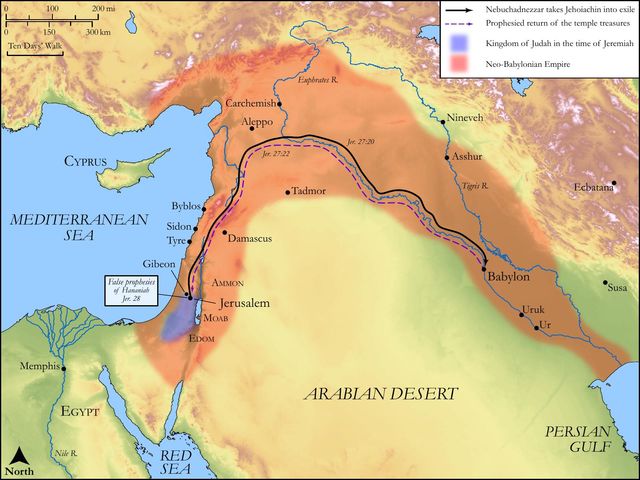
The historical backdrop for Jeremiah 27 is the early reign of King Zedekiah (around 597-594 BC), a tumultuous period following the first Babylonian deportation of King Jehoiachin and many prominent citizens. Jerusalem was filled with anxiety, and there was a strong desire for a swift end to Babylonian dominance and the return of the exiled and the temple treasures. In this climate, many prophets emerged, proclaiming messages of peace, imminent deliverance from Babylon, and the speedy restoration of the temple vessels. These messages were popular because they aligned with the people's hopes and nationalistic fervor, offering comfort rather than the harsh reality of God's judgment. Jeremiah, however, stood as a solitary, unpopular voice, proclaiming God's true, difficult message: submission to Babylon was God's will, and resistance would lead to utter destruction. The cultural expectation was often that prophets would speak reassuring words, making Jeremiah's message particularly challenging and often met with hostility.
Key Themes
ShowHideJeremiah 27:10 powerfully contributes to several overarching themes in the book of Jeremiah. Foremost is the Danger of False Prophecy, which is a recurring motif throughout the prophet's ministry. The verse explicitly states, "they prophesy a lie unto you," highlighting the destructive nature of messages that contradict God's revealed will. Such deception leads people astray, offering false hope that prevents them from taking necessary action or acknowledging divine judgment. Jeremiah frequently confronts this issue, as seen in his condemnation of those who prophesy "visions of their own minds" rather than from the Lord's mouth in Jeremiah 14:14 and his warning against prophets who speak "peace, peace" when there is no peace in Jeremiah 6:14. Another critical theme is Divine Judgment and Exile, which is the ultimate consequence of heeding these lies: "to remove you far from your land; and that I should drive you out, and ye should perish." This underscores God's sovereign hand in orchestrating the Babylonian exile as a just punishment for Judah's persistent idolatry and disobedience. The false prophets, by promising deliverance, were actually leading the people directly into the very disaster God intended to bring upon them for their refusal to submit, illustrating the theme of Deception Leading to Destruction.
Exposition and Analysis
ShowHideKey Word Analysis
ShowHideThis primitive root means "to prophesy, i.e. speak (or sing) by inspiration (in prediction or simple discourse)." In this context, it refers to the act of speaking on behalf of a divine source, but here, the inspiration is not from God but from their own imaginations or, perhaps, demonic influence. The term itself denotes the act of public proclamation as a messenger, irrespective of the truthfulness of the message's origin.
This word denotes "an untruth; by implication, a sham (often adverbial)." It signifies not merely an error or mistake, but a deliberate falsehood, deceit, or fabrication. It carries a strong connotation of treachery and misrepresentation, indicating that the messages of these prophets were intentionally misleading and without divine basis, designed to deceive the people and lead them astray from God's revealed will.
This primitive root means "to wander away, i.e. lose oneself; by implication to perish (causative, destroy)." It conveys a sense of utter ruin, destruction, and loss, encompassing not only physical death but also the complete loss of national identity, purpose, and the covenant relationship with God tied to the land. It signifies a state of being utterly undone or having no way to escape the impending disaster, a profound and comprehensive desolation.
Verse Breakdown
ShowHide"For they prophesy a lie unto you,"
This initial clause identifies the core problem: the pervasive and destructive influence of false prophets. Their message is explicitly labeled as a "lie" (sheqer), indicating a deliberate untruth that stands in direct opposition to God's revealed will through Jeremiah. This falsehood is directed "unto you," meaning the people of Judah, who are the recipients and victims of this spiritual deception, being led away from the path of obedience and life.
"to remove you far from your land;"
This clause reveals the immediate, tangible consequence of believing the false prophecy. The ultimate aim and effect of these lies, whether consciously intended by the false prophets or not, is to prevent the people from taking the necessary steps (submission to Babylon) that would allow them to remain in the land. Instead, their resistance, fueled by false hope, will lead directly to their forced exile from the land promised by God to Abraham's descendants, a profound covenantal punishment.
"and that I should drive you out,"
This part of the verse shifts the agency from the false prophets to God Himself. It emphasizes God's sovereign control over the events, asserting that the impending exile is not a mere political misfortune or a consequence of human error alone, but a divinely ordained judgment. While the false prophets' lies contribute to the people's resistance, it is ultimately God who will "drive them out" as a righteous act of discipline, highlighting His active role in history to fulfill His purposes.
"and ye should perish."
This final clause describes the ultimate, devastating outcome. "Perish" signifies not just physical death for some, but the complete ruin of the nation, the loss of its unique identity, and the destruction of its societal and religious structures. It encapsulates the profound spiritual and physical desolation that awaits those who choose to believe the comforting lies over the challenging truth of God, illustrating the full extent of divine judgment.
Literary Devices
ShowHideJeremiah 27:10 employs several potent literary devices to convey its urgent message. Irony is prominent, as the false prophets, ostensibly speaking for God and promising peace, are actually leading the people directly to destruction and exile. Their messages, intended to offer comfort and security, become the very instrument of their undoing. The phrase "that I should drive you out" demonstrates Divine Sovereignty and Anthropomorphism, attributing direct action to God in the impending judgment, emphasizing that the exile is not a random calamity but a deliberate act of divine justice. The verse also utilizes Contrast implicitly, setting the "lie" of the false prophets against the truth proclaimed by Jeremiah, highlighting the stark choice before the people. Finally, the word "perish" functions as a form of Hyperbole or Emphasis, conveying not just physical death but the utter and complete ruin of a nation, underscoring the severity of God's judgment and the devastating consequences of spiritual deception.
Theological and Thematic Connections
ShowHideJeremiah 27:10 stands as a powerful testament to the critical importance of discerning truth from falsehood, particularly in matters of divine revelation. Theologically, it underscores God's absolute sovereignty over nations and history, demonstrating that even the actions of foreign empires are instruments in His hand to bring about His purposes, whether judgment or restoration. It also highlights the gravity of false prophecy, which is not merely an error in judgment but a dangerous deception that leads people away from God's will and into ruin. The passage reveals God's justice in punishing disobedience, yet also His faithfulness in warning His people repeatedly. The ultimate perishing described is a spiritual and national catastrophe, a direct result of rejecting God's difficult truth for comforting lies.
Reflection and Application
ShowHideJeremiah 27:10 provides timeless lessons for believers navigating a world saturated with competing messages. It serves as a profound call to discernment, urging us to critically evaluate all claims, especially those presented as spiritual truth. In an age where information is abundant and voices are many, the temptation to embrace messages that soothe our anxieties or affirm our desires, rather than challenging us to repentance or submission to God's difficult truths, remains strong. This verse reminds us that such comforting lies, while appealing in the short term, ultimately lead to spiritual and temporal ruin. True wisdom lies in diligently comparing every message against the unchanging standard of God's Word, even when it demands sacrifice or goes against popular sentiment. We must cultivate a deep dependence on the Holy Spirit to guide us into all truth, ensuring that our faith is built on the solid rock of God's revealed will rather than the shifting sands of human deception. Only by heeding God's authentic voice, even when it's uncomfortable, can we avoid spiritual shipwreck and walk in the path of life.
Questions for Reflection
ShowHideFAQ
ShowHideWhat was the "lie" that the false prophets were prophesying?
ShowHideThe "lie" was primarily the message that Judah would not be subjected to Babylonian rule, that the exile was not God's will, and that the temple vessels and exiles would soon return. They promised peace and deliverance from Babylon, directly contradicting God's clear message through Jeremiah that submission to Nebuchadnezzar was God's ordained path of judgment and the only way for the nation to survive. This false prophecy offered a comforting but ultimately destructive illusion of security, preventing the people from repenting and submitting to God's plan, as detailed in Jeremiah 27:9.
Why would God "drive out" His own people from their land?
ShowHideGod's act of "driving out" His people from their land, as stated in this verse, was a severe but just consequence of their persistent idolatry, rebellion, and rejection of His covenant. The land of Israel was given to them under the condition of obedience (see Deuteronomy 28). When they repeatedly turned away from Him, worshipped other gods, and ignored His prophets' warnings, God, in His sovereignty and righteousness, used Babylon as His instrument of judgment to bring about the promised exile. This was not an act of arbitrary cruelty but a necessary discipline to purify His people and uphold His holy character, as He had warned them many times before, for example, in Leviticus 26:33.
Christ-Centered Fulfillment
ShowHideJeremiah 27:10, with its stark warning against false prophecy and the catastrophic consequences of believing lies, finds its ultimate and profound fulfillment in the person and work of Jesus Christ. He is the True Prophet whom Moses foretold (as seen in Deuteronomy 18:15 and affirmed in Acts 3:22-23). Unlike the false prophets who spoke "a lie" leading to perishing, Jesus declared Himself to be "the way, the truth, and the life" (John 14:6). His message was never one of comforting falsehoods but of challenging truth—calling for repentance, self-denial, and submission to the will of God, even when it was unpopular or led to suffering. The "perishing" described in Jeremiah 27:10, a loss of land and identity, foreshadows the ultimate spiritual "perishing" of eternal separation from God. Jesus, through His sacrificial death and resurrection, offers the only escape from this ultimate destruction, promising eternal life to all who believe in Him, so that "whoever believes in him should not perish but have eternal life" (John 3:16). Furthermore, while the Israelites faced removal from their physical land, Christ offers a spiritual "land"—a heavenly inheritance and a place in God's eternal kingdom (Hebrews 11:16), where there is no more exile or perishing for those who follow the True Shepherd and His unwavering truth.