


Isaiah 43:27
Bible text: King James Version (1769 Blayney text) · Public domain
Bible text: Berean Standard Bible · Public domain
Bible text: American Standard Version (1901) · Public domain
Bible text: World English Bible, Messianic edition · Public domain
Bible text: Geneva Bible (1599) · Public domain
Bible text: Young's Literal Translation · Public domain
- אָבִיךָ'a·Vi·khayour ancestorH1N-msc ¦ 2msNoun Singular Masculine Constructאָבִיancestorךָyour
- הָרִאשׁוֹןha·ri·Shon<the> firstH7223Art ¦ Adj-msAdjective Numerical Position Singular Masculine Absoluteהָ<the>רִאשׁוֹןfirst
- חָטָאcha·Ta'he sinnedH2398V-Qal-Perf-3msVerb Qal Perfect 3rd Singular Masculine
- וּמְלִיצֶיךָu·me·li·Tzei·khaand your spokesmenH3887Conj-w ¦ V-Hiphil-Prtcpl-mp ¦ 2msVerb Hiphil Participle Plural Masculine Constructוּandמְלִיצֶיspokesmenךָyour
- פָּשְׁעוּPa·she·'uthey transgressedH6586V-Qal-Perf-3cpVerb Qal Perfect 3rd Plural common gender
- בִיViagainst mePrep-b ¦ 1csSuffix Personal 1st Singular common genderבִagainstיme
English is a literal word-by-word gloss of the Hebrew, not the KJV's wording. Why?
This is the original text the KJV's translators worked from — each Hebrew word with its own literal English meaning in this verse, prepared by scholars at Tyndale House, Cambridge. The KJV translates whole sentences, not word by word, so its wording differs: one Hebrew word can become several English words, and the KJV may choose “the LORD” where the gloss reads “Yahweh”. Both are faithful — they answer different questions. For the KJV's own rendering, switch to the KJV text.
Details
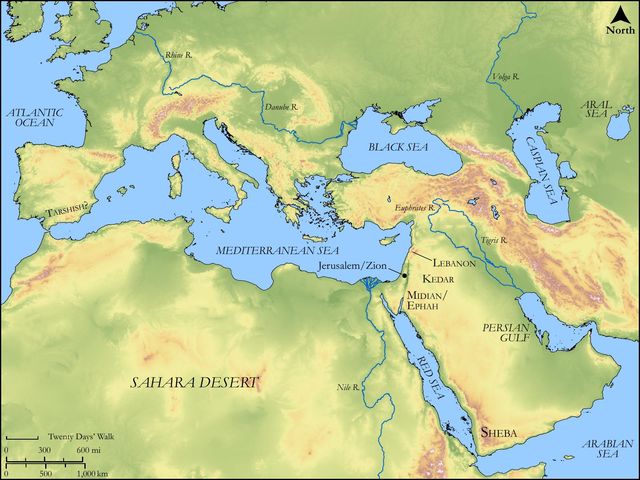
See on the biblical-era map
Study this verse
Public-domain commentary
Matthew Henry
From his Commentary on the Whole Bible. Henry comments on passages, not single verses — this entry covers Isaiah 43:22–28. His four-level outline is real structure in the source text, so it is rendered as structure.
This charge (and a high charge it is which is here exhibited against Jacob and Israel, God's professing people) comes in here, 1. To clear God's justice in bringing them into captivity, and to vindicate that. Were they not in covenant with him? Had they not his sanctuary among them? Why then did the Lord deal thus with his land? Deu 29:24. Here is a good reason given: they had neglected God and had cast him off, and therefore he justly rejected them and gave them to the curse (Isa 43:28); and they must be brought to own this before they are prepared for deliverance; and they did so, Dan 9:5; Neh 9:33. 2. To advance God's mercy in their deliverance and to make that appear more glorious. Many things are before observed to magnify the power of God in it; but this magnifies his goodness, that he should do such great and kind things for a people that had been so very provoking to him and were now suffering the just punishment of their iniquity. The pardoning of their sin was as great an instance of God's power (for so Moses reckons it, Num 14:17, etc.) as the breaking of the yoke of their captivity. Now observe here,
I.What the sins are which they are here charged with.
1.Omissions of the good which God had commanded; and this part of the charge is here much insisted upon. Observe how it comes in with a but; compare Isa 43:21, where God tells them what favours he had bestowed upon them and what his just expectations were from them. He had formed them for himself, intending they should show forth his praise. But they had not done so; they had frustrated God's expectations from them, and made very ill returns to him for his favours. For,
(1.)They had cast off prayer: Thou hast not called upon me, O Jacob! Jacob was a man famous for prayer (Hos 12:4); his seed bore his name, but did not tread in his steps, and therefore are justly upbraided with it. God takes it ill when children degenerate from the virtue and devotion of their pious ancestors. To boast of the name of Jacob, and yet live without prayer, is to mock God and deceive ourselves. If Jacob does not call upon God, who will?
(2.)They had grown weary of their religion: "Thou art Israel, the seed not only of a praying but of a prevailing father, that was a prince with God; and yet, not valuing his experiences any more than his example, thou hast been weary of me." They had been in relation to God, employed in his service and in communion with him; but they began to snuff at it, and to say, Behold, what a weariness is it! Note, Those who neglect to call upon God do in effect tell him they are weary of him and have a mind to change their Master.
(3.)They grudged the expense of their devotion, and were niggardly and penurious in it. They were for a cheap religion; and in those acts of devotion that were costly they desired to be excused. They had not brought, no, not their small cattle, the lambs and kids, which God required for burnt-offerings (Isa 43:23), much less did they bring their greater cattle, pretending they could not spare them, they must have them for the maintenance of their families. So little sense had they of the greatness of God and their obligations to him that they could not find in their hearts to part with a lamb out of their flock for his honour, though he called for it and would graciously have accepted it. Sweet cane, or calamus, was used for the holy oil, incense, and perfume; but they were not willing to be at the charge of that, Isa 43:24. What they had must serve, though it was old and good for nothing; they would not buy fresh. Perhaps it was usual for devout pious persons to bring free-will incense as well as other free-will offerings; but they were not so generous, nor did they fill the altar of God, nor moisten it abundantly, as they should have done, with the fat of their sacrifices; what sacrifices they did bring were of the lean and refuse of their cattle, that had no fat in them to regale the altar with.
(4.)What sacrifices they did offer they did not honour God with them, and so they were, in effect, as no sacrifices (Isa 43:23): Neither hast thou honoured me with thy sacrifices. Some of them offered their sacrifices to false gods; others, who offered them to the true God, were either careless in the manner of offering them or hypocritical in their intentions, so that they might be truly said not to honour God with them, but rather to dishonour him.
(5.)That which aggravated their neglect of sacrificing was that, as God had appointed it, it was no burdensome thing; it was not a service that they had any reason at all to complain of: "I have not caused thee to serve with an offering; I have not made it a task and drudgery to you, whatever you, through the corruption of your natures, have made it yourselves. I have not wearied thee with incense." None of God's commandments are grievous, no, not those concerning sacrifice and incense. They were not more costly than might be afforded by those that lived in such a plentiful country, nor did their attendance on them require any more time than they could well spare. But that which especially forbade them to call it a wearisome service was that they were required to be cheerful and pleasant, and to rejoice before God in all their approaches to him, Deu 12:12. They had many feasts and good days, but only one day in all the year in which they were to afflict their souls. The ordinances of the ceremonial law, though, in comparison with Christ's easy yoke, they are spoken of as heavy (Act 15:10), yet, in comparison with the service that idolaters did to their false gods, they were light, and not to be called services nor found fault with as wearisome. God did not require them to sacrifice their children, as Moloch did.
2.Commissions of the evil which God had forbidden; and omissions commonly make way for commissions: Thou hast made me to serve with thy sins. When we make God's gifts the food and fuel for our lusts, and his providence the patron of our wicked projects, especially when we encourage ourselves to continue in sin because grace has abounded, then we make God to serve with our sins. Or it may denote what a grief and burden sin is to God; it not only wearies men and makes the creation groan, but it wearies my God also (Isa 7:13) and makes the Creator complain that he is grieved (Psa 95:10), that he is broken (Eze 6:9), that he is pressed with sinners as a cart is pressed that is full of sheaves (Amo 2:13), and to cry out, Ah! I will ease me of my adversaries, Isa 1:24. The antithesis is observable: God had not made them to serve with their sacrifices, but they had made him to serve with their sins. The master had not tired the servants with his commands, but they had tired him with their disobedience. Those are wicked servants indeed that behave so ill to so good a Master. God is tender of our comfort, but we are careless of his honour. Let this engage us to keep close to our duty, that it is easy and reasonable, and no disparagement to us, nor too hard for us.
II.What were the aggravations of their sin, Isa 43:27.
1.That they were children of disobedience; for their first father (that is, their forefathers) had sinned; and they had not only sinned in their loins, but sinned like them. Ezra confesses this: Since the days of our fathers have we been in a great trespass, Ezr 9:7. But their forefathers are called their first father to put us in mind of the apostasy and rebellion of our first father Adam, to which corrupt fountain we must trace up the streams of all our transgressions.
2.That they were scholars of disobedience too: for their teachers had transgressed against God, were guilty of gross scandalous sins, and the people, no doubt, would learn to do as they did. It is ill with a people when their leaders cause them to err, and their teachers, who should reform them, corrupt them.
III.What were the tokens of God's displeasure against them for their sins, Isa 43:23. He brought ruin both upon church and state.
1.The honour of their church was laid in the dust and trampled on: I have profaned the princes of the sanctuary, that is, the priests and Levites who presided with great dignity and power in the temple-service; they profaned themselves, and made themselves vile, by their enormities, and then God profaned them and made them vile, by their calamities and the contempt they fell into, Mal 2:9.
2.The honour of their state was ruined likewise: "I have given Jacob to the curse, that is, to be cursed, and hated, and abused by all their neighbours, and Israel to reproach, to be insulted, ridiculed, and triumphed over by their enemies." They reproached them perhaps for that in them that was good; they mocked at their sabbaths (Lam 1:7); but God gave them up to reproach, to correct them for what was amiss. Note, The dishonour which men at any time do us should humble us for the dishonour we have done to God; and we must bear it patiently because we suffer it justly, and must acknowledge that to us belongs confusion.
IV.What were the riches of God's mercy towards them notwithstanding (Isa 43:25): I even I, am he who notwithstanding all this blotteth out thy transgressions.
1.This gracious declaration of God's readiness to pardon sin comes in very strangely. The charge ran very high: Thou hast wearied me with thy iniquities, Isa 43:24. Now one would think it would follow: "I, even I, am he that will destroy thee, and burden myself no longer with care about thee." No, I, even I, am he that will forgive thee; as if the great God would teach us that forgiving injuries is the best way to make ourselves easy and to keep ourselves from being wearied with them. This comes in here to encourage them to repent, because there is forgiveness with God, and to show the freeness of divine mercy; where sin has been exceedingly sinful grace appears exceedingly gracious. Apply this,
(1.)To the forgiving of the sins of Israel as a people, in their national capacity. When God stopped the course of threatening judgments, and saved them from utter ruin, even then when he had them under severe rebukes, then he might be said to blot out their transgressions. Though he corrected them, he was reconciled to them again, and did not cut them off from being a people. This he did many a time, till they rejected Christ and his gospel, which was a sin against the remedy, and then he would forgive them no more as a nation, but utterly destroyed them.
(2.)To the forgiving of the sins of every particular believing penitent - transgressions and sins, infirmities though ever so numerous, backslidings though ever so heinous. Observe here,
[1.]How the pardon is expressed; he will blot them out, as a cloud is blotted out by the beams of the sun (Isa 44:22), as a debt is blotted out not to appear against the debtor (the book is crossed as if the debt were paid, because it is pardoned upon the payment which the surety has made), or as a sentence is blotted out when it is reversed, as the curse was blotted out with the waters of jealousy, which made it of no effect to the innocent, Num 5:23. He will not remember the sin, which intimates not only that he will remit the punishment of what is past, but that it shall be no diminution to his love for the future. When God forgives he forgets.
[2.]What is the ground and reason of the pardon. It is not for the sake of any thing in us, but for his own sake, for his mercies'-sake, his promise-sake, and especially for his Son's sake, and that he may himself be glorified in it.
[3.]How God glories in it: I, even I, am he. He glories in it as his prerogative. None can forgive sin but God only, and he will do it; it is his settled resolution. He will do it willingly and with delight; it is his pleasure; it is his honour; so he is pleased to reckon it.
2.Those words (Isa 43:26), Put me in remembrance, may be understood either (1.) As a rebuke to a proud Pharisee, that stands upon his own justification before God, and expects to find favour for his merits and not to be beholden to free grace: "If you have any thing to say in your own justification, any thing to offer for the sake of which you should be pardoned, and not for my sake, put me in remembrance of it. I will give you leave to plead your own cause with me; declare what your merits are, that you may be justified by them:" but those who are thus challenged will be speechless. Or, (2.) As a publican. Is God thus ready to pardon sin, and, when he pardons it, will he remember it no more? Let us then put him in remembrance, mention before him those sins which he has forgiven; for they must be ever before us, to humble us, though they are pardoned, Psa 51:3. Put him in remembrance of the promises he has made to penitents, and the satisfaction his Son has made for them. Plead these with him in wrestling for pardon, and declare these things, in order that thou mayest be justified freely by his grace. This is the only way, and it is a sure way, to peace. Only acknowledge thy transgression.
Historical interpretation
Historical reception
2 surviving comments on this verse. Each one is dated, so this reads as a timeline rather than a list.
Select a marker to jump to its quote. Markers stagger vertically where authors wrote within a few decades of each other.
(Verse 25, 26 and following) I am, I am myself, who blots out your iniquities for my own sake, and I will not remember your sins. Bring me to remembrance, let us argue together; set forth your case, that you may be proved right. Your first ancestor sinned, and your interpreters transgressed against me. And I profaned the princes of the sanctuary, and delivered Jacob to destruction and Israel to reviling. LXX: I am, I am he who blots out your iniquities, and I will not remember. But remember, and let us argue together. Declare your iniquities first, that you may be justified. Your fathers have sinned, and your princes have dealt unjustly with me, and they have defiled my holy ones. And I gave up Jacob to destruction and Israel to reviling. You, Jacob and Israel, you have caused me to labor in your sins, and I could barely bear the burden of your iniquities. I do not call you my servants or slaves, but I address you simply by the names Jacob and Israel, so that I may show and prove your sins. But I, because I am kind and patient, and have many mercies, will wipe away all your iniquities in the sprinkling of the blood of the new Testament: I will wipe away the old handwriting, which was written against you; and I will no longer remember your sins, which I am willing to forgive you, if you believe, in baptism. Therefore, bring me to remembrance: if you have any just thing to answer to me, I will gladly accept it, so that we may be judged together, and you may accuse me of not doing what I should have done for you. Whom we find fuller in understanding than in Micha, saying: My people, what have I done to you, and how have I harmed you? Answer me: for I brought you out of the land of Egypt and freed you from the house of slavery, and I sent Moses and Aaron and Miriam before your face. And in the fiftieth Psalm David speaks to God: That you may be justified in your words, and may overcome when you are judged (Ps. 50:5). Therefore, tell me if you have anything, so that you may be justified. And the meaning is: I will not speak against you first, lest you claim to be overwhelmed by the multiplication of words; but if you have anything just to say, speak for yourself; so that you may seem to endure the things you suffer unworthily. And so that you may know that I have mercy on you, not because of your merit, but because of my compassion, I will repeat it from your fathers and ancestors, so that you may understand that you were born from sinners: Your father first sinned in solitude: namely, the entire people of Israel. Whether Abraham, the founder of your race, is shown to have sinned when, in response to the Lord's promise to give the land of promise to his descendants, he asked, 'How shall I know that I am to possess it?' And of your interpreters, he says, 'they have acted unfaithfully toward me' (Gen. XV, 8). Aaron and Moses at the waters of contradiction, when they were speaking between me and the Israelites (Exod. XVII). And so that we may understand this is not a forced interpretation, it is followed by the statement, 'And I have defiled the holy princes,' concerning whom it is said in the psalm, 'Their rulers were swallowed up by the rock' (Ps. CXL, 6). He says that they contaminated themselves on purpose because they did not enter the promised land. He devoted Jacob and Israel to destruction and blasphemy, so that no one except two of those who had come out of Egypt would enter into Judah, but their bodies would lie in the wilderness. According to the Septuagint, who added from their own: You speak first of your own iniquities, so that you may be justified. God calls them to repentance, so that they may understand their crimes and sins, and obtain forgiveness. For it is written in another place: 'He who pleads his own cause in the beginning of his speech is just' (Prov. XVIII, 17). And their leaders and fathers are said to have violated the holy things of the Lord, not obeying the Law of God, but seeking the traditions and commandments of men. Because of them Jacob perished, and Israel was given into reproach, expelled from his own province, and became an exile and wanderer throughout the whole world.
[The Lord] has proclaimed these words in addressing those who were in Babylon. It is not I, he says, who am the cause of these misfortunes, but your ancestors, and your priests, who have transgressed my laws. Their iniquity has transformed the renown of Israel to an object of shame.
Continue studying Isaiah 43:27 across the web’s major study libraries — every link below opens this exact verse, chapter, or book on the destination site.
Read & Compare
 BibleGatewayThis verse in more than 200 translations and 70 languages.
 Bible.comThe YouVersion reader — hundreds of translations, reading plans, and highlights.
 ESV.orgCrossway's official English Standard Version reader.
 NET BibleThe NET translation with 60,000+ translators' notes on every rendering decision.
 STEP BibleTyndale House's free study tool — original text, vocabulary, and scholarly resources.
 BibliaLogos Bible Software's free web reader.
 USCCBThe New American Bible (Revised Edition) with the U.S. bishops' study notes.
Commentaries
 BibleHub CommentariesDozens of classic commentaries on this verse, gathered on one page.
 StudyLightMore than 100 commentary sets — the largest collection on the web.
 BibleRefPlain-English commentary on what this verse means, verse by verse.
 Enduring WordDavid Guzik's free commentary on this chapter, widely used by Bible teachers.
 Bible Study ToolsVerse commentary alongside Greek and Hebrew study aids.
Original Language & Research
- BibleHub InterlinearThe verse word by word — original language, transliteration, and English.
- BibleHub LexiconEvery word's original-language definition and Strong's entry.
 Blue Letter BibleDeep-study tools — Strong's numbers, concordance, and word studies.
 SefariaThe Hebrew text with Rashi and centuries of Jewish commentary.
Sermons, Hymns & Audio


TrulyRandomVerse is not affiliated with these sites and doesn’t control their content. They’re linked because they’re genuinely useful.
Summary
Isaiah 43:27 delivers a profound divine indictment against the nation of Israel, revealing that their historical suffering and subsequent judgment were not arbitrary but stemmed from a pervasive pattern of sin. This pattern originated with their foundational ancestors and continued through the failures of their spiritual leaders, demonstrating a deep-seated and pervasive rebellion against God's covenant and His divine will. The verse underscores the cumulative impact of both ancestral and contemporary transgressions, providing a theological justification for Israel's predicament while simultaneously setting the stage for God's redemptive promises.
Context
ShowHideLiterary Context
Isaiah 43:27 is strategically positioned within the "Book of Comfort" (Isaiah 40-55), a section primarily focused on God's promises of restoration and deliverance for Israel from Babylonian exile. Prior to this verse, God has been reminding His people of His incomparable sovereignty, His role as their unique Redeemer, and His unwavering commitment to them despite their unfaithfulness. However, before articulating His astounding declaration of forgiveness in Isaiah 43:25, God confronts Israel with their persistent unfaithfulness and covenant violations (verses 22-24). Verse 27, therefore, serves as a crucial theological bridge, providing the justification for the judgment Israel has endured. It clarifies that their plight is a righteous consequence of their own historical and ongoing rebellion, thereby emphasizing God's justice and paving the way for the profound grace that immediately follows.
Historical & Cultural Context
The prophecies in Isaiah span significant periods of Israelite history, from the 8th century BCE (pre-exilic) to the 6th century BCE (exilic). During this time, both the Northern Kingdom (Israel) and the Southern Kingdom (Judah) had a long, documented history of idolatry, oppression, and covenant breaking, which ultimately led to the Assyrian and Babylonian exiles, respectively. In Israel, lineage, ancestral heritage, and the instruction provided by religious and community leaders were highly valued. The phrase "thy first father" would resonate powerfully, pointing to the nation's progenitor (Jacob/Israel) or even Adam, symbolizing humanity's foundational sin. "Teachers" would refer to the authoritative figures responsible for interpreting and upholding God's Law—priests, prophets, and elders—whose spiritual integrity was paramount for the nation's well-being. Their failure represented a profound betrayal of their sacred trust.
Key Themes
ShowHideThis verse significantly contributes to several overarching themes prevalent in Isaiah and the broader prophetic corpus. It powerfully articulates the theme of corporate responsibility and generational sin, illustrating how the consequences of disobedience extend beyond individuals to impact an entire community or nation across generations. This concept is also seen in passages like Exodus 34:7. Furthermore, the verse highlights the critical theme of leadership accountability, emphasizing that those entrusted with spiritual guidance bear immense responsibility, and their failures can lead the entire populace astray. This echoes prophetic condemnations of unfaithful shepherds, as found in Ezekiel 34:1-10. Finally, Isaiah 43:27 reinforces the theme of God's justice, demonstrating that divine judgment is a righteous and necessary response to persistent rebellion and covenant unfaithfulness, rather than arbitrary punishment. This justice, however, is consistently presented within the larger framework of God's ultimate desire for redemption and restoration, a promise beautifully articulated in Isaiah 44:22.
Exposition and Analysis
ShowHideKey Word Analysis
ShowHideThis primitive Hebrew word (H1) denotes a progenitor, ancestor, or even a chief or principal figure. In the context of "thy first father" (combining H7223 and H1), it refers to the foundational figure or figures of the nation of Israel, most likely Jacob (Israel), the patriarch from whom the twelve tribes descended. This signifies that the pattern of sin was deeply ingrained from the very inception of the nation's history, highlighting a deep-rooted, historical problem that permeated the national identity.
This primitive root (H2398) primarily means "to miss the mark." Figuratively and more broadly, it encompasses the concept of "to sin," implying a failure to meet God's standard, a deviation from His righteous path. When applied to the "first father," it signifies an initial, foundational act of disobedience or a pattern of failing to align with God's will, thereby establishing a precedent of unfaithfulness that would continue to affect subsequent generations of Israel.
This primitive root (H3887) carries multiple layers of meaning, including "to scoff," "to mock," or "to deride." However, in the context of conveying understanding, it also means "to interpret" or "to intercede." Here, "teachers" refers to those in positions of spiritual authority—priests, prophets, and elders—who were meant to interpret God's law and will to the people. Their "transgression" signifies a profound betrayal of their sacred duty, as they, who should have been conduits of divine truth, instead became agents of rebellion.
This primitive root (H6586) implies a deliberate act of "breaking away from just authority," signifying trespass, apostasy, or rebellion. Unlike simply "sinning" (missing the mark), "transgressing" denotes a more active, intentional defiance against God's established covenant and His sovereign rule. When used of the "teachers," it emphasizes their conscious and willful rebellion, a profound breach of trust and a direct affront to God's authority.
Verse Breakdown
ShowHide"Thy first father hath sinned"
This clause highlights the deep historical roots of Israel's unfaithfulness, tracing the nation's spiritual decline back to its very origins. "Thy first father" (אֲבִיךָ הָרִאשׁוֹן, ʼavicha ha'rishon) most commonly refers to Jacob, the patriarch renamed Israel, whose life, though divinely chosen, was marked by deceit and struggle. This suggests that the pattern of disobedience was ingrained from the nation's foundational figure, setting a precedent for the ongoing struggle with sin throughout Israel's history. It underscores that the nation's current predicament is not an isolated event but the culmination of a long-standing pattern of unfaithfulness.
"and thy teachers have transgressed against me"
This clause shifts the focus from the distant past to the more immediate spiritual leadership of Israel. "Thy teachers" (מְלִיצֶיךָ, melitzeycha) refers to those holding positions of spiritual authority—priests, prophets, and elders—who were responsible for interpreting God's law, guiding the people in righteousness, and interceding on their behalf. The term "transgressed" (פָּשְׁעוּ, pash'u) implies a deliberate and rebellious act against God's covenant and His authority. This indictment emphasizes the profound failure of those entrusted with spiritual oversight, whose unfaithfulness not only contributed to the nation's decline but actively exacerbated its rebellion against God, making them complicit in the nation's judgment.
Literary Devices
ShowHideIsaiah 43:27 masterfully employs several literary devices to convey its powerful message. Synecdoche is evident in "thy first father," where a part (the progenitor) represents the whole (the foundational character and historical trajectory of the nation's sin). The verse also utilizes Juxtaposition by placing the sin of the "first father" alongside the transgression of "teachers," creating a stark contrast that highlights a continuous, unbroken pattern of rebellion from the nation's origins to its contemporary spiritual leadership. This juxtaposition contributes to a sense of cumulative guilt, emphasizing that Israel's current predicament is the result of a long, unbroken chain of disobedience. The direct accusation "against me" (referring to God) functions as a powerful apostrophe, directly addressing the divine object of their rebellion and underscoring the personal nature of their offense against their covenant Lord. Finally, the parallelism between "sinned" and "transgressed" serves to intensify the indictment, showing both a failure to meet God's standard and an active, willful rebellion against His authority.
Theological and Thematic Connections
ShowHideIsaiah 43:27 profoundly illustrates the pervasive nature of sin, demonstrating that it is not merely an individual failing but can become deeply embedded within the fabric of a community, affecting both its foundational figures and its contemporary leaders. It underscores the concept of corporate responsibility, where the actions of those in authority or those who set the precedent can have far-reaching consequences for the entire group. This verse serves as a crucial theological backdrop for understanding God's righteous judgment, emphasizing that divine discipline is a just response to persistent rebellion and a broken covenant. However, it also sets the stage for the astounding declaration of God's grace and forgiveness that immediately follows, demonstrating that even in the face of profound and pervasive sin, God's ultimate character is one of redemptive love and a desire to blot out transgressions for His own glory.
Reflection and Application
ShowHideIsaiah 43:27 offers a sobering mirror, reflecting the enduring truth that sin, whether inherited or actively chosen, personal or corporate, carries significant and often generational consequences. For contemporary believers and communities, this verse calls for a deep and honest self-examination. We are challenged to discern and repent of any historical or generational patterns of disobedience that may be impacting our lives or communities, as well as to acknowledge our own complicity in perpetuating such patterns. This passage also highlights the immense and sacred responsibility of spiritual leaders—pastors, teachers, parents, and mentors—who are called to faithfully interpret, teach, and embody God's truth. Their integrity or lack thereof profoundly shapes those they guide. Recognizing the historical weight of sin should not lead to despair, but rather to a profound appreciation for God's unwavering justice and, more importantly, His boundless grace. Just as God confronted Israel's sin before extending His merciful redemption, we too must confront our own failings to fully grasp the magnitude of His forgiveness and the transformative power of His grace in Christ. This verse compels us to pray diligently for and support faithful leadership, and to actively participate in breaking cycles of sin through sincere repentance and renewed commitment to God's righteous ways.
Questions for Reflection
ShowHideFAQ
ShowHideWhat does "Thy first father hath sinned" mean in Isaiah 43:27?
ShowHideThis phrase points to the foundational sinfulness that has been present from the very beginning of the nation of Israel. While some interpretations suggest a reference to Adam as the "first father," symbolizing humanity's original sin and its inherited nature, the more immediate context within Isaiah 43 points to Jacob (Israel), the patriarch from whom the nation descended. Jacob's life, though divinely chosen and blessed, was marked by deceit, struggle, and a wrestling with God, setting a precedent for the nation's ongoing struggle with obedience. Thus, it signifies that the pattern of rebellion against God was deeply ingrained in Israel's history from its earliest days, not merely a recent development, justifying God's righteous judgment upon them.
Who are "thy teachers" mentioned in this verse, and why is their transgression significant?
ShowHide"Thy teachers" (Hebrew: melitzeycha) refers to those in positions of spiritual authority and instruction within Israel. This would encompass priests, prophets, and elders who were entrusted with the sacred duty of interpreting God's Law, guiding the people in covenant faithfulness, and speaking on God's behalf. Their transgression is particularly significant because they were meant to be exemplars of righteousness and conduits of divine truth. Their failure to uphold God's standards and their active rebellion against Him (implied by "transgressed") led the people astray and contributed significantly to the nation's widespread spiritual decline. Their unfaithfulness exacerbated the national sin and justified God's judgment, a theme consistently found in prophetic condemnations of unfaithful leaders, such as in Jeremiah 23:1-4.
Christ-Centered Fulfillment
ShowHideIsaiah 43:27, with its stark declaration of Israel's pervasive sin, tracing it from their "first father" to their "teachers," powerfully underscores humanity's desperate and universal need for a perfect Redeemer. The collective and generational sin described here highlights the utter futility of human effort and the inability of even divinely appointed leaders to break the relentless cycle of rebellion against God. This dire human condition sets the stage for the ultimate and only solution found in Jesus Christ. He is the true "first father" of a new creation, the last Adam, who, unlike the first, lived a life of absolute and perfect obedience, entirely without sin. Furthermore, Jesus is the ultimate and faithful "Teacher" and the Great Shepherd of the sheep, who not only perfectly interpreted God's will but perfectly fulfilled it, ultimately laying down His life as the Lamb of God who takes away the sin of the world. Where Israel's leaders transgressed and led astray, Jesus perfectly obeyed and perfectly led, even to the point of sacrificial death on the cross, thereby becoming the propitiation for our sins. Through His atoning sacrifice, the generational curse of sin is broken for all who believe, and a new covenant is established, founded not on human performance or the faithfulness of earthly leaders, but on the perfect righteousness and redemptive work of Christ, who is our wisdom from God, our righteousness, sanctification, and redemption.