


Isaiah 19:17
Bible text: King James Version (1769 Blayney text) · Public domain
Bible text: King James Version with Strong's numbers · Public domain
Bible text: Berean Standard Bible · Public domain
Bible text: American Standard Version (1901) · Public domain
Bible text: World English Bible, Messianic edition · Public domain
Bible text: Geneva Bible (1599) · Public domain
Bible text: Young's Literal Translation · Public domain
- וְהָיְתָהVe·ha·ye·tahand it will becomeH1961Conj-w ¦ V-Qal-ConsecPerf-3fsVerb Qal Consecutive Perfect 3rd Singular Feminineוְandהָיְתָהit will become
- אַדְמַת'ad·Mat[the] land ofH127N-fscNoun Singular Feminine Construct
- יְהוּדָהye·hu·DahJudahH3063N-properNoun Proper Location
- לְמִצְרַיִםle·mitz·Ra·yimto EgyptH4714Prep-l ¦ N-properNoun Proper LocationלְtoמִצְרַיִםEgypt
- לְחָגָּאle·cha·Ga'<into> an object of terrorH2283Prep-l ¦ N-fsNoun Singular Feminine Absoluteלְ<into>חָגָּאan object of terror
- כֹּלkoleveryH3605N-msNoun Singular Masculine Absolute
- אֲשֶׁר'a·Sher[one] whomH834RelParticle Relative
- יַזְכִּירyaz·Kirsomeone will bring to remembranceH2142V-Hiphil-Imperf-3msVerb Hiphil Imperfect 3rd Singular Masculine
- אֹתָהּ'o·Tah<obj.> itH853DirObjM ¦ 3fsParticle Object Indicatorאֹתָ<obj.>הּit
- אֵלָיו'e·Lavto himH413Prep ¦ 3msPreposition Definiteאֵלָיtoוhim
- יִפְחָדyif·Chadhe will be in dreadH6342V-Qal-Imperf-3msVerb Qal Imperfect 3rd Singular Masculine
- מִפְּנֵיmi·pe·Nei<from> because ofH6440Prep-m ¦ N-mpcNoun Plural Masculine Constructמִ<from>פְּנֵיbecause of
- עֲצַת'a·Tzat[the] plan ofH6098N-fscNoun Singular Feminine Construct
- יְהוָהYah·wehYahwehH3068N-properNoun Proper Title
- צְבָאוֹתtze·va·'otof hostsH6635N-fpNoun Plural Feminine Absolute
- אֲשֶׁר'a·SherwhichH834RelParticle Relative
- הוּאhu'heH1931Pro-3msPronoun Personal 3rd Singular Masculine
- יוֹעֵץyo·'Etz[is] planningH3289V-Qal-Prtcpl-msVerb Qal Participle Singular Masculine Absolute
- עָלָיו'a·Lavon itH5921Prep ¦ 3msPrepositionעָלָיonוit
English is a literal word-by-word gloss of the Hebrew, not the KJV's wording. Why?
This is the original text the KJV's translators worked from — each Hebrew word with its own literal English meaning in this verse, prepared by scholars at Tyndale House, Cambridge. The KJV translates whole sentences, not word by word, so its wording differs: one Hebrew word can become several English words, and the KJV may choose “the LORD” where the gloss reads “Yahweh”. Both are faithful — they answer different questions. For the KJV's own rendering, switch to the KJV text.
Details
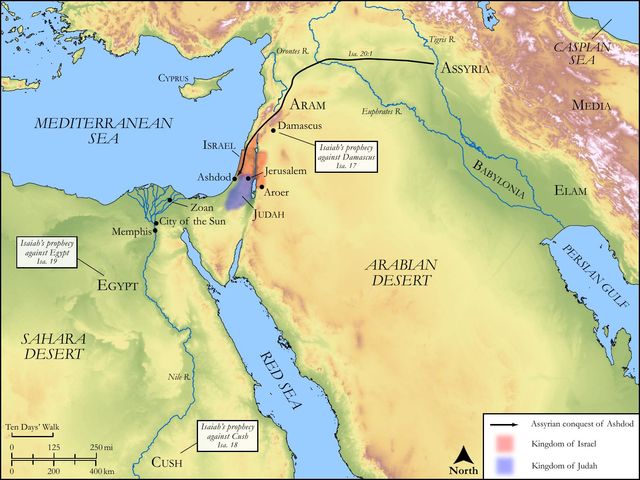
See on the biblical-era map
Study this verse
Public-domain commentary
Matthew Henry
From his Commentary on the Whole Bible. Henry comments on passages, not single verses — this entry covers Isaiah 19:1–17. His four-level outline is real structure in the source text, so it is rendered as structure.
Though the land of Egypt had of old been a house of bondage to the people of God, where they had been ruled with rigour, yet among the unbelieving Jews there still remained much of the humour of their fathers, who said, Let us make us a captain and return into Egypt. Upon all occasions they trusted to Egypt for help (Isa 30:2), and thither they fled, in disobedience to God's express command, when things were brought to the last extremity in their own country, Jer 43:7. Rabshakeh upbraided Hezekiah with this, Isa 36:6. While they kept up an alliance with Egypt, and it was a powerful ally, they stood not in awe of the judgments of God; for against them they depended upon Egypt to protect them. Nor did they depend upon the power of God when at any time they were in distress; but Egypt was their confidence. To prevent all this mischief, Egypt must be mortified, and many ways God here tells them he will take to mortify them.
I.The gods of Egypt shall appear to them to be what they always really were, utterly unable to help them, Isa 19:1.
"The Lord rides upon a cloud, a swift cloud, and shall come into Egypt. As a judge goes in state to the bench to try and condemn the malefactors, or as a general takes the field with his troops to crush the rebels, so shall God come into Egypt with his judgments; and when he comes he will certainly overcome." In all this burden of Egypt here is no mention of any foreign enemy invading them; but God himself will come against them, and raise up the causes of their destruction from among themselves. He comes upon a cloud, above the reach of the opposition or resistance. He comes apace upon a swift cloud; for their judgment lingers not when the time has come. He rides upon the wings of the wind, with a majesty far excelling the greatest pomp and splendour of earthly princes. He makes the clouds his chariots, Psa 18:9; Psa 104:3. When he comes the idols of Egypt shall be moved, shall be removed at his presence, and perhaps be made to fall as Dagon did before the ark. Isis, Osiris, and Apis, those celebrated idols of Egypt, being found unable to relieve their worshippers, shall be disowned and rejected by them. Idolatry had got deeper rooting in Egypt than in any land besides, even the most absurd idolatries; and yet now the idols shall be moved and they shall be ashamed of them. When the Lord brought Israel out of Egypt he executed judgments upon the gods of the Egyptians (Num 33:4); no marvel then if, when he comes, they begin to tremble. The Egyptians shall seek to the idols, when they are at their wits' end, and consult the charmers and wizards (Isa 19:3); but all in vain; they see their ruin hastening on them notwithstanding.
II.The militia of Egypt, that had been famed for their valour, shall be quite dispirited and disheartened.
No kingdom in the world was ever in a better method of keeping up a standing army than the Egyptians were; but now their heroes, that used to be celebrated for courage, shall be posted for cowards: The heart of Egypt shall melt in the midst of it, like wax before the fire (Isa 19:1); the spirit of Egypt shall fail, Isa 19:3. They shall have no inclination, no resolution, to stand up in defence of their country, their liberty, and property; but shall tamely and ingloriously yield all to the invader and oppressor. The Egyptians shall be like women (Isa 19:16); they shall be frightened and put into confusion by the least alarm; even those that dwell in the heart of the country, in the midst of it, and therefore furthest from danger, will be as full of frights as those that are situate on the frontiers. Let not the bold and brave be proud or secure, for God can easily cut off the spirit of princes (Psa 76:12) and take away their hearts, Job 12:24.
III.The Egyptians shall be embroiled in endless dissensions and quarrels among themselves.
There shall be no occasion to bring a foreign force upon them to destroy them; they shall destroy one another (Isa 19:2): I will set the Egyptians against the Egyptians. As these divisions and animosities are their sin, God is not the author of them, they come from men's lusts; but God, as a Judge, permits them for their punishment, and by their destroying differences corrects them for their sinful agreements. Instead of helping one another, and acting each in his place for the common good, they shall fight every one against his brother and neighbour, whom he ought to love as himself - city against city, and kingdom against kingdom. Egypt was then divided into twelve provinces, or dynasties; but Psammetichus, the governor of one of them, by setting them at variance with one another, at length made himself master of them all. A kingdom thus divided against itself would soon be brought to desolation. En quo discordi cives perduxit miseros! - Oh the wretchedness brought upon a people by their disagreements among themselves! It is brought to this by a perverse spirit, a spirit of contradiction, which the Lord would mingle, as an intoxicating draught made up of several ingredients, for the Egyptians, Isa 19:14. One party shall be for a thing for no other reason than because the other is against it; that is a perverse spirit, which, if it mingle with the public counsels, tends directly to the ruin of the public interests.
IV.Their politics shall be all blasted, and turned into foolishness.
When God will destroy the nation he will destroy the counsel thereof (Isa 19:3), by taking away wisdom from the statesmen (Job 12:20), or setting them one against another (as Hushai and Ahithophel), or by his providence breaking their measures even when they seemed well laid; so that the princes of Zoan are fools: they make fools of one another, every one betrays his own folly, and divine Providence makes fools of them all, Isa 19:11. Pharaoh had his wise counsellors. Egypt was famous for such. But their counsel has all become brutish; they have lost all their forecast; one would think they had become idiots, and were bereaved of common sense. Let no man glory then in his own wisdom, nor depend upon that, nor upon the wisdom of those about him; for he that gives understanding can when he please take it away. And from those it is most likely to be taken away that boast of their policy, as Pharaoh's counsellors here did, and, to recommend themselves to places of public trust, boast of their great understanding ("I am the son of the wise, of the God of wisdom, of wisdom itself," says one; "my father was an eminent privy-counsellor of note in his day for wisdom"), or of the antiquity and dignity of their families: "I am," says another, "the son of ancient kings." The nobles of Egypt boasted much of their antiquity, producing fabulous records of their succession for above 10,000 years. This humour prevailed much among them about this time, as appears by Herodotus, their common boast being that Egypt was some thousands of years more ancient than any other nation. "But where are thy wise men? Isa 19:12. Let them now show their wisdom by foreseeing what ruin is coming upon their nation, and preventing it, if they can. Let them with all their skill know what the Lord of hosts has purposed upon Egypt, and arm themselves accordingly. Nay, so far are they from doing this that they themselves are, in effect, contriving the ruin of Egypt, and hastening it on, Isa 19:13. The princes of Noph are not only deceived themselves, but they have seduced Egypt, by putting their kings upon arbitrary proceedings" (by which both themselves and their people were soon undone); "the governors of Egypt, that are the stay and cornerstones of the tribes thereof, are themselves undermining it." It is sad with a people when those that undertake for their safety are helping forward their destruction, and the physicians of the state are her worst disease, when the things that belong to the public peace are so far hidden from the eyes of those that are entrusted with the public counsels that in every thing they blunder and take wrong measures; so here (Isa 19:14): They have caused Egypt to err in every work thereof. Every step they took was a false step. They always mistook either the end or the means, and their counsels were all unsteady and uncertain, like the staggerings and stammerings of a drunken man in his vomit, who knows not what he says nor where he goes. See what reason we have to pray for our privy-counsellors and ministers of state, who are the great supports and blessings of the state if God give them a spirit of wisdom, but quite the contrary if he hide their heart from understanding.
V.The rod of government shall be turned into the serpent of tyranny and oppression (Isa 19:4):
"The Egyptians will I give over into the hand of a cruel lord, not a foreigner, but one of their own, one that shall rule over them by an hereditary right, but shall be a fierce king and rule them with rigour," either the twelve tyrants that succeeded Sethon, or rather Psammetichus that recovered the monarchy again; for he speaks of one cruel lord. Now the barbarous usage which the Egyptian task masters gave to God's Israel long ago was remembered against them and they were paid in their own coin by another Pharaoh. It is sad with a people when the powers that should be for edification are for destruction, and they are ruined by those by whom they should be ruled, when such as this is the manner of the king, as it is described (in terrorem - in order to impress alarm), Sa1 8:11.
VI.Egypt was famous for its river Nile, which was its wealth, and strength, and beauty, and was idolized by them.
Now it is here threatened that the waters shall fail from the sea and the river shall be wasted and dried up, Isa 19:5. Nature shall not herein favour them as she has done. Egypt was never watered with the rain of heaven (Zac 14:18), and therefore the fruitfulness of their country depended wholly upon the overflowing of their river; if that therefore be dried up, their fruitful land will soon be turned into barrenness and their harvests cease: Every thing sown by the brooks will wither of course, will be driven away, and be no more, Isa 19:7. If the paper-reeds by the brooks, at the very mouth of them, wither, much more the corn, which lies at a greater distance, but derives its moisture from them. Yet this is not all; the drying up of their rivers is the destruction,
1.Of their fortifications, for they are brooks of defence (Isa 19:6), making the country difficult of access to an enemy. Deep rivers are the strongest lines, and most hardly forced. Pharaoh is said to be a great dragon lying in the midst of his rivers, and guarded by them, bidding defiance to all about him, Eze 29:3. But these shall be emptied and dried up, not by an enemy, as Sennacherib with the sole of his foot dried up mighty rivers (Isa 37:25), and as Cyrus, who took Babylon by drawing Euphrates into many streams, but by the providence of God, which sometimes turns water-springs into dry ground, Psa 107:33.
2.It is the destruction of their fish, which in Egypt was much of their food, witness that base reflection which the children of Israel made (Num 11:5): We remember the fish which we did eat in Egypt freely. The drying up of the rivers will kill the fish (Psa 105:29), and will thereby ruin those who make it their business,
(1.)To catch fish, whether by angling or nets (Isa 19:8); they shall lament and languish, for their trade is at an end. There is nothing which the children of this world do more heartily lament than the loss of that which they used to get money by. Ploratur lachrymis amissa pecunia veris - Those are genuine tears which are shed over lost money.
(2.)To keep fish, that it may be ready when it is called for. There were those that made sluices and ponds for fish (Isa 19:10), but they shall be broken in the purposes thereof; their business will fail, either for want of water to fill their ponds or for want of fish to replenish their waters. God can find ways to deprive a country even of that which is its staple commodity. The Egyptians may themselves remember the fish they have formerly eaten freely, but now cannot have for money. And that which aggravates the loss of these advantages by the river is that it is their own doing (Isa 19:6): They shall turn the rivers far away. Their kings and great men, to gratify their own fancy, will drain water from the main river to their own houses and grounds at a distance, preferring their private convenience before the public good, and so by degrees the force of the river is sensibly weakened. Thus many do themselves a greater prejudice at last than they think of,
[1.]Who pretend to be wiser than nature, and to do better for themselves than nature has done.
[2.]Who consult their own particular interest more than the common good. Such may gratify themselves, but surely they can never satisfy themselves, who to serve a turn contribute to a public calamity, which they themselves, in the long run, cannot avoid sharing in. Herodotus tells us that Pharaoh-Necho (who reigned not long after this), projecting to cut a free passage by water from Nilus into the Red Sea, employed a vast number of men to make a ditch or channel for that purpose, in which attempt he impaired the river, lost 120,000 of his people, and yet left the work unaccomplished.
VII.Egypt was famous for the linen manufacture; but that trade shall be ruined.
Solomon's merchants traded with Egypt for linen-yarn, Kg1 10:28. Their country produced the best flax and the best hands to work it; but those that work in fine flax shall be confounded (Isa 19:9), either for want of flax to work on or for want of a demand for that which they have worked or opportunity to export it. The decay of trade weakens and wastes a nation and by degrees brings it to ruin. The trade of Egypt must needs sink, for (Isa 19:15) there shall not be any work for Egypt to be employed in; and where there is nothing to be done there is nothing to be got. There shall be a universal stop put to business, no work which either head or tail, branch or rush, may do; nothing for high or low, weak or strong, to do; no hire, Zac 8:10. Note, The flourishing of a kingdom depends much upon the industry of the people; and then things are likely to do well when all hands are at work, when the head and top-branch do not disdain to labour, and the labour of the tail and rush is not disdained. But when the learned professions are unemployed, the principal merchants have no stocks, and the handicraft tradesmen nothing to do, poverty comes upon a people as one that travaileth and as an armed man.
VIII.A general consternation shall seize the Egyptians; they shall be afraid and fear (Isa 19:16), which will be both an evidence of a universal decay and a means and presage of utter ruin. Two things will put them into this fright: - 1. What they hear from the land of Judah; that shall be a terror to Egypt, Isa 19:17. When they hear of the desolations made in Judah by the army of Sennacherib, considering both the near neighbourhood and the strict alliance that was between them and Judah, they will conclude it must be their turn next to become a prey to that victorious army. When their neighbour's house was on fire they could not but see their own in danger; and therefore every one of the Egyptians that makes mention of Judah shall be afraid of himself, expecting the bitter cup shortly to be put into his hands. 2. What they see in their own land. They shall fear (Isa 19:16) because of the shaking of the hand of the Lord of hosts, and (Isa 19:17) because of the counsel of the Lord of hosts, which from the shaking of his hand they shall conclude he has determined against Egypt as well as Judah. For, if judgment begin at the house of God, where will it end? If this be done in the green tree, what shall be done in the dry? See here, (1.) How easily God can make those a terror to themselves that have been, not only secure, but a terror to all about them. It is but shaking his hand over them, or laying it upon some of their neighbours, and the stoutest hearts tremble immediately. (2.) How well it becomes us to fear before God when he does but shake his hand over us, and to humble ourselves under his mighty hand when it does but threaten us, especially when we see his counsel determined against us; for who can change his counsel?
Historical interpretation
Historical reception
2 surviving comments on this verse. Each one is dated, so this reads as a timeline rather than a list.
(Verse 16, 17.) On that day, Egypt will be like women, and it will be astonished and afraid because of the shaking hand of the Lord of hosts, which he will bring down on it. And the land of Judah will be a terror to Egypt; everyone who thinks of it will fear because of the counsel of the Lord of hosts, which he has determined against it. At that time, which is now, as we have frequently mentioned, it signifies the day when the Lord will send the spirit of error and confusion, so that Egypt will vomit out the wine of dragons and the incurable madness of asps, understanding its own error and its former drunkenness. Egypt will be afraid like a woman, not with the usual fear that anyone may experience, whom Egypt does not love but suffocates and kills; but with a feminine fear, for Egypt alone does Pharaoh desire to live. But when the commotion, or raising up, of the hand of the Lord, by which punishments are demonstrated, moves and lifts up, in order to strike Egypt. Then the land of Judah, that is, the knowledge of the Scriptures, the law and the prophets, the Gospels and the Epistles of the Apostles, will be a cause for celebration for Egypt, if they recognize them: or a cause for fear, if by comparing their teachings and truths, they understand that they have held falsehood. All who remember this land will tremble with the fear that leads to life: For the beginning of wisdom is the fear of the Lord (Prov. 9:10). And not only in the consummation of the world, but also in the present time, we can receive this; which, every heretic should fear and be frightened by, as it is a teaching of a man knowledgeable in heavenly doctrines. But he will fear and dread the counsel of the Lord, which he has conceived upon Egypt of this world. We briefly go over each thing, in order to move on to the rest.
(Verse 16, 17.) On that day Egypt will be like women, and they will be astonished and afraid because of the shaking of the hand of the Lord of hosts, which he will bring against them. And the land of Judah will be a terror to Egypt; everyone who mentions it will fear because of the purpose of the Lord of hosts, which he has planned against it. I think it is better to correct one's own mistakes than to persist in error while being embarrassed to admit one's ignorance. In what I have translated, And the land of Judah shall be for Egypt a joy, for a joy is read in Hebrew Hagga (), which can be interpreted as both a festival (hence Haggai is translated as festival) and fear, which is more significantly translated by Aquila as 'shaking', when someone is fearful and trembling and turns their eyes around, and fears the approaching enemy. Therefore, if we want to take it in a positive sense, that the remembrance of Judah being for Egypt is a joy, it is rightly called a festival. But if, as I think, it turns into fear for the festival, let us understand fear or dread, that when Nebuchadnezzar comes, and all the hands of strong men will be loosened like those of women, even the word Judah is a terror to Egypt, because while they wanted to offer help, they have suffered so many evils. No one doubts in our times that, in comparison to Christians, all the pagans are like women, having weak opinions, and whatever they say is turned into foolishness, while they are astonished at such a great conversion of the people, and they marvel and understand the hand of the Lord, and whoever, of those who bear the name of Christians among the Gentiles, remembers the weakness of idolatry, confesses it out of fear.
Continue studying Isaiah 19:17 across the web’s major study libraries — every link below opens this exact verse, chapter, or book on the destination site.
Read & Compare
 BibleGatewayThis verse in more than 200 translations and 70 languages.
 Bible.comThe YouVersion reader — hundreds of translations, reading plans, and highlights.
 ESV.orgCrossway's official English Standard Version reader.
 NET BibleThe NET translation with 60,000+ translators' notes on every rendering decision.
 STEP BibleTyndale House's free study tool — original text, vocabulary, and scholarly resources.
 BibliaLogos Bible Software's free web reader.
 USCCBThe New American Bible (Revised Edition) with the U.S. bishops' study notes.
Commentaries
 BibleHub CommentariesDozens of classic commentaries on this verse, gathered on one page.
 StudyLightMore than 100 commentary sets — the largest collection on the web.
 BibleRefPlain-English commentary on what this verse means, verse by verse.
 Enduring WordDavid Guzik's free commentary on this chapter, widely used by Bible teachers.
 Bible Study ToolsVerse commentary alongside Greek and Hebrew study aids.
Original Language & Research
- BibleHub InterlinearThe verse word by word — original language, transliteration, and English.
- BibleHub LexiconEvery word's original-language definition and Strong's entry.
 Blue Letter BibleDeep-study tools — Strong's numbers, concordance, and word studies.
 SefariaThe Hebrew text with Rashi and centuries of Jewish commentary.
Sermons, Hymns & Audio


TrulyRandomVerse is not affiliated with these sites and doesn’t control their content. They’re linked because they’re genuinely useful.
Summary
Isaiah 19:17 delivers a potent prophetic declaration concerning the future of Egypt, foretelling a dramatic reversal of fortunes where the very mention of Judah will strike profound terror into the hearts of Egyptians. This astonishing shift is explicitly attributed to the unassailable "counsel of the LORD of hosts, which he hath determined against it," underscoring God's absolute sovereignty over all nations and His unwavering commitment to execute His divine purposes, even against formidable empires. The verse powerfully highlights the certainty of divine judgment and the ultimate futility of human resistance against the Almighty's will.
Context
ShowHideLiterary Context
Isaiah 19 is a distinct oracle, part of a larger collection of "burdens" (prophecies of judgment) against foreign nations (Isaiah 13-23). This specific chapter focuses entirely on Egypt, a traditional regional superpower. Preceding verses (1-15) vividly depict Egypt's internal chaos, economic collapse, and the failure of its idols and wise men, setting the stage for a nation brought low by divine intervention. Verse 16 describes the Egyptians becoming "like women," trembling with fear at the "shaking of the hand of the LORD of hosts." Verse 17 directly follows, intensifying this fear by identifying Judah as the unexpected catalyst for this terror, not by its own strength, but as an instrument of God's determined plan. The chapter then surprisingly pivots in verses 18-25, envisioning a future where Egypt, along with Assyria, will turn to the LORD and be blessed, demonstrating the breadth of God's redemptive purposes even amidst judgment.
Historical & Cultural Context
During Isaiah's ministry in the 8th century BCE, Egypt remained a dominant force among the nations, often serving as a potential, albeit unreliable, ally or adversary for Judah. Judah's kings frequently considered or sought alliances with Egypt to counter the rising Assyrian threat, a practice Isaiah consistently condemned, urging reliance solely on the LORD (e.g., Isaiah 30:1-7). The historical memory of Israel's enslavement in Egypt (as recounted in Exodus 1) makes this prophecy of Judah instilling terror in Egypt a profound and ironic reversal. Culturally, Egypt was renowned for its polytheistic religion, its numerous gods, and its advanced wisdom, all of which Isaiah directly challenges by prophesying their downfall (e.g., Isaiah 19:1). This context amplifies the message of divine supremacy over all human and pagan powers.
Key Themes
ShowHideThis verse contributes significantly to several overarching themes within Isaiah and the broader prophetic corpus. Foremost is Divine Sovereignty, asserting that God is the ultimate ruler of all nations, orchestrating historical events according to His unchangeable "counsel" (a concept echoed in Psalm 33:11). Second, it illustrates the Reversal of Fortunes, where the once-oppressive and mighty empire of Egypt is humbled, and the often-vulnerable Judah becomes an object of dread, not through its own military might, but through the power of its God. This theme is a recurring motif in biblical narratives, where God exalts the humble and humbles the proud (e.g., 1 Samuel 2:7). Third, the passage highlights God's Justice and Judgment, demonstrating that nations, like individuals, are held accountable for their idolatry, pride, and opposition to God's purposes. Finally, it implicitly underscores the Fear of the LORD, as the terror experienced by Egypt is not merely of Judah, but of the formidable God of Judah, whose plans cannot be thwarted, leading to an awe-filled recognition of His power.
Exposition and Analysis
ShowHideKey Word Analysis
ShowHideFrom an unused root meaning "to revolve," this word properly denotes "vertigo," and figuratively, "fear" or "dread." In this context, it signifies a profound, unsettling, and disorienting fear that grips Egypt at the mere mention of Judah. It implies a deep-seated apprehension that paralyzes and causes a sense of reeling or dizziness, rather than just a momentary fright.
Derived from the root "to advise," this term refers to advice, a plan, or purpose. Here, it emphasizes the deliberate, well-thought-out, and unchangeable plan of God. It is not a mere suggestion or a fleeting thought, but a divine decree, indicating God's intentional, strategic, and fixed will that cannot be altered or resisted by human powers.
A primitive root meaning "to advise," "to deliberate," or "to resolve." When applied to God, it signifies His sovereign decision and fixed purpose. It implies that God has not merely considered a course of action but has definitively settled upon it, ensuring its certain execution. This word underscores the divine resolve and the inevitability of His decreed outcome.
Verse Breakdown
ShowHide"And the land of Judah shall be a terror unto Egypt,"
This clause presents a dramatic and ironic reversal of the historical power dynamic between Judah and Egypt. Historically, Egypt was a formidable power that had oppressed Israel and often loomed as a threat or an unreliable ally. Here, the comparatively smaller and weaker land of Judah is prophesied to become a source of profound dread and fear for the mighty Egyptians. This terror is not attributed to Judah's military might but to the divine power that stands behind it.
"every one that maketh mention thereof shall be afraid in himself,"
This intensifies the preceding statement, indicating that the fear will be pervasive, deeply personal, and internal. The mere verbal reference to Judah will evoke a visceral, psychological terror within each Egyptian, suggesting that the reputation of Judah, inextricably linked to its God, will become so potent that its name alone triggers deep-seated dread and apprehension.
"because of the counsel of the LORD of hosts, which he hath determined against it."
This final clause provides the ultimate explanation and theological grounding for the preceding statements. The terror experienced by Egypt is not arbitrary or accidental but is a direct and certain consequence of God's sovereign, deliberate, and unchangeable plan. The divine title "LORD of hosts" (Yahweh Sabaoth) emphasizes God's supreme power as the commander of heavenly armies and all creation, reinforcing the certainty and irresistibility of His determined purpose against Egypt, leaving no doubt about the source and inevitability of this judgment.
Literary Devices
ShowHideIsaiah 19:17 employs several potent literary devices to convey its message with striking force. Hyperbole is evident in the declaration that "every one that maketh mention thereof shall be afraid in himself," exaggerating the pervasive and intense nature of the fear to underscore the dramatic shift in power dynamics and the profound psychological impact on Egypt. The phrase "the land of Judah shall be a terror unto Egypt" also uses Personification, attributing the capacity to instill terror to an inanimate geographical entity (Judah), thereby emphasizing the profound and far-reaching impact of God's actions through His chosen people. Furthermore, the verse is structured as a clear Cause and Effect statement: the effect (Egypt's terror) is directly and explicitly linked to its divine cause ("because of the counsel of the LORD of hosts, which he hath determined against it"). This highlights God's active, sovereign role in history and the absolute certainty of His decreed outcomes.
Theological and Thematic Connections
ShowHideIsaiah 19:17 serves as a profound theological statement on the absolute sovereignty of God over all nations and the unfolding of His predetermined counsel in human history. It unequivocally declares that no earthly power, however mighty or ancient, can thwart the divine will. The fear instilled in Egypt is not a result of Judah's military prowess, but a direct consequence of the "counsel of the LORD of hosts," demonstrating that God uses nations and circumstances as instruments for His purposes, whether in judgment or redemption. This passage serves as a powerful reminder that true security and power reside not in human alliances or military strength, but in humble submission to the God who "determines" the course of empires. It challenges the notion that human wisdom or might can circumvent divine decrees, ultimately exalting the Lord as the supreme arbiter of destiny and the one whose plans are eternally unshakeable.
Reflection and Application
ShowHideIsaiah 19:17 offers a profound lens through which to view God's unshakeable sovereignty and the ultimate futility of trusting in anything other than Him. In a world often dominated by political maneuvering, economic instability, and military might, this verse reminds us that the true power lies not in human strength or strategic alliances, but in the "counsel of the LORD of hosts." For believers, this truth brings immense comfort: if God can humble a mighty empire like Egypt through His determined purpose, He is certainly capable of working out His perfect will in our individual lives and in the broader sweep of history, even amidst chaos and uncertainty. It calls us to examine where our trust truly lies—in worldly systems and human solutions, or in the unfailing wisdom and power of the Almighty. This passage also serves as a sober warning against pride and self-reliance, urging us to cultivate a healthy fear of the Lord, which is the beginning of wisdom and the only true foundation for security and peace. Our response to God's sovereign plan should be one of humble submission and unwavering faith, knowing that His counsel stands forever and His purposes will never be thwarted.
Questions for Reflection
ShowHideFAQ
ShowHideWhat does "the counsel of the LORD of hosts" mean in this context?
ShowHide"The counsel of the LORD of hosts" refers to God's sovereign, deliberate, and unchangeable plan or purpose. The title "LORD of hosts" (Hebrew: Yahweh Sabaoth) emphasizes God's supreme power as the commander of heavenly armies and all creation, signifying His absolute authority and ability to execute His will without hindrance. In Isaiah 19:17, it means that the terror Egypt experiences is not random or due to Judah's own power, but is a direct and certain outcome of God's predetermined judgment against Egypt, which He has sovereignly resolved to bring to pass. This phrase highlights God's active involvement in human history and His ultimate control over the destinies of nations, as also seen in Psalm 33:11.
Christ-Centered Fulfillment
ShowHideWhile Isaiah 19:17 speaks of a specific judgment against ancient Egypt, its underlying theological principles find their ultimate and profound fulfillment in Jesus Christ. The "counsel of the LORD of hosts" that determined Egypt's fate points to God's overarching eternal plan, which culminates in Christ. Jesus is revealed as the very wisdom and power of God, the embodiment of God's ultimate "counsel" (as articulated in 1 Corinthians 1:24). Through His life, death, and resurrection, Christ executed God's most profound determination: the redemption of humanity and the establishment of His eternal kingdom. The "terror" that Judah would instill in Egypt, not by its own might but by God's decree, foreshadows the spiritual dread that the light of Christ brings to the powers of darkness and to those who oppose God's truth. The coming of Christ, though seemingly humble, brought a radical reversal of fortunes, overthrowing the dominion of sin and death (Colossians 2:15). Ultimately, the fear that should grip all people is not of an earthly nation, but the reverent fear of God, which, through Christ, leads not to destruction but to repentance and salvation (Acts 2:37-38). In Christ, God's sovereign counsel is perfectly revealed and eternally secured, inviting all nations to find peace and blessing in Him, as even Egypt is prophesied to do in the latter part of Isaiah 19.