


Hosea 9:4
- לֹאlo'notH3808NegParticle Negative
- יִסְּכוּyi·se·Khuthey will pour outH5258V-Qal-Imperf-3mpVerb Qal Imperfect 3rd Plural Masculine
- לַיהוָהla·Yah·wehto YahwehH3068Prep-l ¦ N-properNoun Proper TitleלַtoיהוָהYahweh
- יַיִןya·YinwineH3196N-msNoun Singular Masculine Absolute
- וְלֹאve·Lo'and notH3808Conj-w ¦ NegParticle Negativeוְandלֹאnot
- יֶעֶרְבוּye·'er·vuthey will be pleasingH6149V-Qal-Imperf-3mpVerb Qal Imperfect 3rd Plural Masculine
- לוֹloto himPrep-l ¦ 3msSuffix Personal 3rd Singular Masculineלtoוֹhim
- זִבְחֵיהֶםziv·chei·Hemtheir sacrificesH2077N-mpc ¦ 3mpNoun Plural Masculine Constructזִבְחֵיsacrificesהֶםtheir
- כְּלֶחֶםke·Le·chem[will be] like bread ofH3899Prep-k ¦ N-mscNoun Singular Masculine Constructכְּ[will be] likeלֶחֶםbread of
- אוֹנִים'o·Nimmourning<s>H205N-mpNoun Plural Masculine Absolute
- לָהֶםla·Hemto themPrep-l ¦ 3mpSuffix Personal 3rd Plural Masculineלָtoהֶםthem
- כָּלkolallH3605N-mscNoun Singular Masculine Construct
- אֹכְלָיו'o·khe·Lav[those who] eat itH398V-Qal-Prtcpl-mp ¦ 3msVerb Qal Participle Plural Masculine Constructאֹכְלָי[those who] eatוit
- יִטַמָּאוּyi·ta·Ma·'uthey will make themselves uncleanH2930V-Hithpael-Imperf-3mpVerb Hithpael Imperfect 3rd Plural Masculine
- כִּיkiforH3588PrtParticle Conditional
- לַחְמָםlach·Mamtheir breadH3899N-msc ¦ 3mpNoun Singular Masculine Constructלַחְמָbreadםtheir
- לְנַפְשָׁםle·naf·Sham[will be] for their selfH5315Prep-l ¦ N-fsc ¦ 3mpNoun Singular Feminine Constructלְ[will be] forנַפְשָׁselfםtheir
- לֹאlo'notH3808NegParticle Negative
- יָבוֹאya·Vo'it will goH935V-Qal-Imperf-3msVerb Qal Imperfect 3rd Singular Masculine
- בֵּיתbeit[the] house ofH1004N-mscNoun Singular Masculine Construct
- יְהוָהYah·wehYahwehH3068N-properNoun Proper Title
English is a literal word-by-word gloss of the Hebrew, not the KJV's wording. Why?
This is the original text the KJV's translators worked from — each Hebrew word with its own literal English meaning in this verse, prepared by scholars at Tyndale House, Cambridge. The KJV translates whole sentences, not word by word, so its wording differs: one Hebrew word can become several English words, and the KJV may choose “the LORD” where the gloss reads “Yahweh”. Both are faithful — they answer different questions. For the KJV's own rendering, switch to the KJV text.
Details
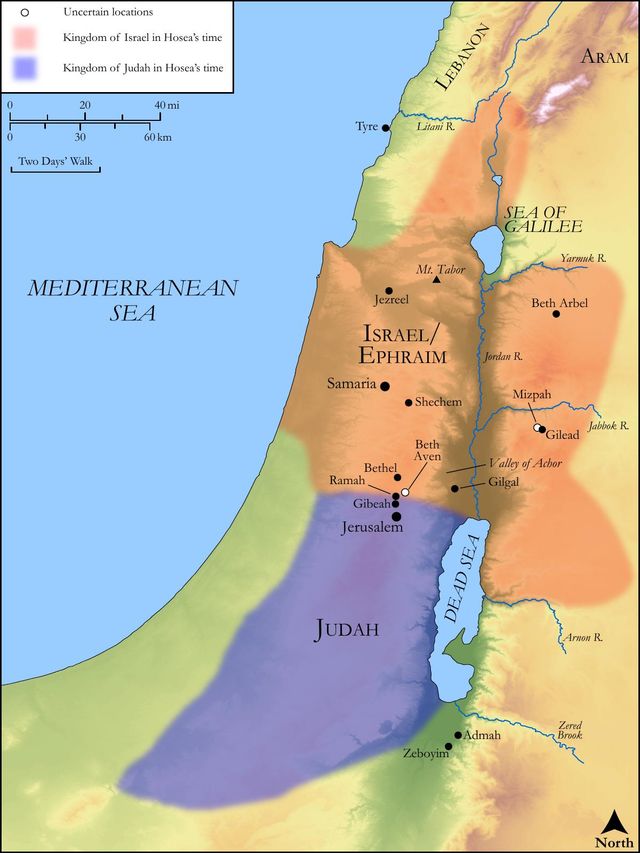
See on the biblical-era map
Study this verse
Public-domain commentary
Matthew Henry
From his Commentary on the Whole Bible. Henry comments on passages, not single verses — this entry covers Hosea 9:1–6. His two-level outline is real structure in the source text, so it is rendered as structure.
Here, I. The people of Israel are charged with spiritual adultery: O Israel! thou hast gone a whoring from thy God, Hos 9:1. Their covenant with God was a marriage-covenant, by which they were joined to him as their God, renouncing all others. But when they set up idols and worshipped them, when they fled to creatures for succour and put a confidence in them, they went a whoring from God as their God, and honoured the pretenders and rivals with the affection, adoration, and confidence, which were due to God only. Other people were idolaters, but that sin was not, in them, going a whoring from God, as it was in Israel that had been married to him. Note, The sins of those who have made a profession of religion and relation to God are more provoking to him than the sins of others. As a proof of their going a whoring from God, it is charged upon them that they loved a reward upon every corn-floor. 1. They loved to give rewards to their idols, in the offerings and first-fruits they presented to them out of every corn-floor. They took a strange pleasure in serving their idols with that which they would have grudged to consecrate to God and employ in his service. Note, It is common for those that are niggardly in the expenses of their religion to be very prodigal in spending upon their lusts. Or, 2. They loved to receive rewards from their idols; and such they reckoned the fruits of the earth to be: These are my rewards, which my lovers have given me, Hos 2:12. Note, Those are directly disposed to spiritual idolatry that love a reward in the corn-floor better than a reward in the favour of God and eternal life.
II.They are forbidden to rejoice as other people do:
"Rejoice not, O Israel! for joy. Do not expect to rejoice. What peace, what joy, what hast thou to do with either, while thy whoredoms and witchcrafts are so many?" Kg2 9:19-22. Be not disposed to rejoice, for it does not become thee, but rather to be afflicted, and mourn, and weep, Jam 4:9. Judah, that keeps close to the true God, nay, and other people that never knew him nor could ever be charged with revolting from him, may be allowed to rejoice, as not having so much cause to be ashamed as Israel has, that has gone a whoring from him. Some think that they had at this time particular occasions for joy, probably upon the account of some losses recovered, or some advantages gained, or some league made with a potent ally, for which they had public rejoicings, as other people used to have upon such occasions; but God sends to them not to rejoice. Note, Joy is forbidden fruit to wicked people. They must not rejoice, because they have gone a whoring from their God; and therefore,
1.Whatever it was that they rejoiced in, it would be no security nor advantage to them, so long as they were at a distance from God and at war with him. Note, We are likely to have small joy of any of our creature-comforts if we make not God our chief joy.
2.The sense of sin and dread of wrath ought to be a damp upon their joy and a strong alloy to all their comforts. Note, Those who by departing from God have made work for repentance have thereby marred their own mirth, till they return and make their peace with God.
III.They are threatened with destroying judgments for their spiritual whoredoms, according to what was said long before.
Psa 73:27, Thou hast destroyed all those that go a whoring from thee. It is here threatened,
1.That their land shall not yield its wonted increase. Canaan, that fruitful land, shall be turned into barrenness for the wickedness of those that dwell therein. They love the reward in the corn-floor, and are so full of the joy of harvest that they have no disposition at all to mourn for their sins; and therefore God will, for their effectual humiliation, take away from them, not only their delights and dainties, but even their necessary food (Hos 9:2): The floor and the wine-press shall not feed them, much less feast them; they shall either be blasted by the hand of God or plundered by the hand of man. The new wine with which they used to make merry shall fail in her. Note, When we make the world, and the things of it, our idol and portion, above what they were designed for, it is just with God to deny us even support and nourishment from them, according to that which they were designed for, to show us our folly and correct us for it. Let those miss of their food in the corn-floor that look for their reward in the corn-floor. We forfeit the good things of this world if we love them as the best things.
2.That their land shall not only cease to feed them, but cease to lodge them and to be a habitation for them; it shall spue them out, as it had done the Canaanites before them (Hos 9:3): They shall not dwell any longer in the Lord's land. The land of Canaan was in a peculiar manner the Lord's land, the land of the Shechinah (so the Chaldee), the land of the Lord of the world (so the Arabic); he whose all the earth is (Psa 24:1) took that for his demesne. The land is mine, says God, Lev 25:23. They had used it, or abused it rather, as if it had been their own, had not paid the rent, nor done the services, due to God as their landlord, and therefore God justly enters, and takes possession of it, they having forfeited their lease. "It is my land" (says God) "and I will make it appear, for they shall be turned off, as bad tenants, and be made to know that, though they thought themselves freeholders, they were but tenants at will." Note, It is for the honour of God's justice and holiness that those who go a whoring from God should not be suffered to dwell upon his land; and therefore, sooner or later, the wicked shall be chased out of the world. Or it is called the Lord's land because it was the holy land, Immanuel's land, the land that had peculiar tokens of God's favour to it, and presence in it, where God was known and his name was great, where God's prophets and oracles were; it was a kind of copy of the earthly paradise, and a type of the heavenly one. It was a great privilege to have a lot in such a land as this. It was a great sin and folly to rebel against God, and go a whoring from him, in such a land as this, to deal unjustly in a land of uprightness, Isa 26:10. And it was a sad and sore judgment to be driven out from such a land as this; it was like driving our first parents out of the garden of Eden, and almost amounted to an exclusion out of the heavenly Canaan. Note, Those cannot expect to dwell in the Lord's land that will not be subject to the Lord's laws, nor be influenced by his love. Those have forfeited the privileges of the church that conform not to the rules of it.
3.That, when they are turned out from the Lord's land, they shall have no rest nor satisfaction in any other land. When Cain was driven out from the presence of the Lord he was a fugitive and a vagabond ever after, and dwelt in the land of trembling. So Israel here. Some shall return into Egypt, the old house of bondage; thither they shall flee from the Assyrian (Hos 8:13) and they shall lose and ruin themselves where they thought to hide and help themselves. Others shall be carried captives to Assyria and there shall be forced to eat unclean things, either (1.) Such things as were not fit for men to eat, that which is rotten and putrefied, intimating that they shall be reduced to the utmost poverty, as the prodigal that would fain have filled his belly with the husks. Or, (2.) Such things as were not fit for Jews to eat, being prohibited by their law. It is probable that while they were in their own land, however disobedient in other things, they kept up the distinction of meats, and prided themselves in that; but, since they would not keep the law of God in other things, they should not be suffered to keep it in that, and it was a just punishment of their sin in eating things offered to idols. Note, When at any time we suffer in our food, and either through want or for our health are forced to eat or drink that which is unpleasing, we must acknowledge that God is righteous, because we have sinned about our food, and have indulged ourselves too much in that which is pleasing.
4.That in the land of their enemies, to which they shall be driven, they shall have no opportunity either of giving honour to God or obtaining favour with God, by offering any acceptable sacrifice to him; they should not be in a capacity of keeping up any face or show of religion among them; "and so" (as Dr. Pocock expresses it) "should be as it were quite cut off from any expression of relation to him, from all signs of grace, and means of reconciliation with him, which would be to them a token of their being rejected of God, estranged from him, and no more owned by him as his people." (1.) They shall have no sacrifices to offer, nor any altar to offer them on, nor priests to offer them; they shall not so much as offer drink-offerings to the Lord, much less any other sacrifices. (2.) If they should offer them, neither they nor their sacrifices shall be pleasing to him, for they cannot have any legal offerings, nor are their hearts humbled. (3.) Instead of their sacrifices of joy and praise, they shall eat the bread of mourners; they shall live desolate, and disconsolate, mourning for the death of their relations and their own miseries, so that if they had opportunity of sacrificing they should never be themselves in a frame fit for it; for they were forbidden to eat of the holy things in their mourning, Deu 26:14. All that eat of the bread of mourners are polluted, and incapacitated to partake of the altar. (4.) Their bread for their soul, the bread which they must either eat or starve, the bread which they shall have for the support of their lives, shall not come into the house of the Lord; they shall have no house of the Lord to bring it to, or, if they had, it is such as is not fit to be brought, nor are they rightly disposed to bring it. (5.) The return of the days of their sacred and solemn feasts would therefore be very melancholy and uncomfortable to them (Hos 9:5): What will you do in the solemn day, in the sabbath, the solemn day of every week, in the new moons, the solemn days of every month, at the return of the times for keeping the passover, pentecost, and feast of the tabernacles, the solemn days of every year, the days of the feasts of the Lord? Note, The feasts of the Lord are solemn days; and, when we are invited to those feasts, we ought to consider seriously what we shall do. But the question is here put to those who were to be deprived of the benefit and comfort of those solemn feasts, "What will you do then? You will then spend those days in sorrow and lamentation which, if it had not been your own fault, you might have been spending in joy and praise. You will then be made to know the worth of mercies by the want of them and to prize spiritual bread by being made to feel a famine of it." Note, When we enjoy the means of grace we ought to consider what we shall do if ever we should know the want of them, if either they should be taken from us or we be disabled to attend upon them.
5.That they should perish in the land of their dispersion (Hos 9:6): For, lo, they have gone out of the Lord's land, where they might have spent both their sabbath days and other days with comfort, gone because of destruction, gone to Egypt because of the destruction of their own country by the Assyrians, flattering themselves with hopes that they shall return when the storm is over; but those hopes also shall fail them; they shall find there are graves in Egypt, as their murmuring ancestors said (Exo 14:11), graves for them; for Egypt shall gather them up, as dead men are gathered up and carried forth to the grave, and Memphis (one of the chief cities of Egypt) shall bury them. Gathering and burying are put together, Jer 8:2; Job 27:19. Note, Those that think presumptuously to flee from the judgments of God are likely enough tp meet their death where they hoped to save their lives.
6.That their land, which they left behind and to which they hoped to return, should become a desolation: As for their tabernacles, where they formerly dwelt and where they kept their stores, the pleasant places for their silver, they shall be demolished and laid in ruins, to such a degree that they shall be overgrown with nettles; so that if they should survive the trouble, and return to their own land again, they would find it neither fruitful nor habitable; it would afford them neither food nor lodging. Note, Those that make their money their god reckon the places of their silver their pleasant places, as those that make the Lord their God reckon his tabernacles amiable and his ordinances their pleasant things, Isa 64:11. But, while the pleasures of communion with God are out of the reach of chance and change, the pleasant places of men's silver, which were purchased with silver, or in which they deposited their silver, or which were beautified and adorned with silver, are liable to be laid in ruins, in nettles, and therewith all the pleasure men took in them.
Historical interpretation
Two Centuries of Reception
3 surviving comments on this verse. Each one is dated, so this reads as a timeline rather than a list.
Select a marker to jump to its quote. Markers stagger vertically where authors wrote within a few decades of each other.
Let not the people flatter themselves as if they could be safe from contagion of sin, communicating with a sinful priest and yielding their obedience to the unjust and unlawful episcopacy of their leader, when the divine censure threatens through the prophet Hosea and says, “Their sacrifices shall be like the bread of mourning: all who eat them shall be defiled.” [This] teaching obviously [shows] that all are indeed involved in sin who have been contaminated by the sacrifice of a blasphemous and unjust priest.
"They shall not dwell in the land of the Lord. Ephraim returned to Egypt, and in Assyria he ate polluted food. They shall not offer wine to the Lord, nor shall their sacrifices please him; like the bread of mourners, all who eat it shall be defiled, because their bread does not enter the house of the Lord, which is their soul." LXX: "They did not dwell in the land of the Lord; Ephraim lived in Egypt and ate unclean things among the Assyrians. They did not pour out wine to the Lord, nor did their sacrifices please Him; their bread was like mourning; all who eat of it will be defiled; for their bread of their souls will not enter the house of the Lord." Not only has the threshing floor and the winepress not fed them, and the wine has lied in the land of Israel, when everything had perished for three years and six months, but also the inhabitants themselves will depart from the land of the Lord, and will be led into a foreign land, so that they may not dwell in the holy land which they have defiled with their fornication. "He returned," he said, "to Egypt, and in Assyria he ate defiled things." Of this place, some have added above: "and in Assyria he ate defiled things," which is not in Hebrew, as we have already said. But since they were in Chaldea without a temple and without an altar, they will not pour out wine to the Lord, but to demons, and they will not please those who pour out to alien gods, and those who are held captive and eat idols in Assyria are like mourning bread. For it is not lawful to eat of the food of mourners, and whoever shall eat of it shall be defiled, even what is lawfully offered. The Greeks call the suppers of mourners νεκρόδειπνα, and we may call them "parentalia," from the fact that they are offered to the dead. And not only he that offers, but also he that partakes of such food, shall be unclean; for their bread, that is, the food which they offer, shall not enter into the house of the Lord, which is destroyed, and burnt up with the fire of the Babylonians; let their souls be put to silence. And there is a sense, to its own gluttony, and it provides enjoyment for itself; but I do not like what is polluted. Those who have left the Church and returned to Egypt, and of the Assyrians, that is, they eat sacrifices of demons, will not dwell in the land of the Lord: nor do they drink wine offered to the Lord, in their drunkenness, and neither they nor those who offer it please Him. The sacrifice of heretics is bread of mourning and tears: for all that they do shall be turned into weeping. They will not be able to hear: 'Blessed are the mourning, for they shall be comforted' (Matt. 5:5); but on the contrary, they will hear: 'Woe to the laughing, because they will weep' (Luke 6:25). Whatever they offer, they offer not to God, but to the dead: namely those who have concocted wicked heresies; and whoever eats of their victims, will be contaminated. They will be led by the blind into the pit. Whatever they do, they do for the sake of pleasures, to deceive the people and to devour the houses of widows. We can say that grief is bread, deadly words with which they speak iniquity against the Lord: for he who does not enter the house of God is bread: for the assemblies of heretics are called not the house of God, but the dens of robbers.
Having collected the fruit of the vine into the wine-vats, they offered the firstlings as a libation to the demons, and not to the God who gave them. They also offered loaves of bread as firstfruits of the harvest—except that the sacrifice will become for them defiled and impure, he says, and the offerings will be considered as mourning breads (that is, disgusting, impure and odious). For what reason? For the law considered unclean anyone who approached a dead body either by blood relationship or rather by the very touching of the body. Therefore it was easy for the relatives or friends of the dead person to become unclean during mourning, since they handled the dead body and since they were willing to do for him what was customary. And whatever they touched became unclean. Therefore the mourning bread is that bread which was at hand as food for those who were mourning for the dead; for those who strive to avoid contamination with a dead body it is considered terrible even to taste this bread. Wherefore the breads themselves are defiled and rejected, even though they may have been offered as firstfruits of the harvest. “Those who eat them will become unclean.” They will be useful only to their souls, that is, as a food for them.
Continue studying Hosea 9:4 across the web’s major study libraries — every link below opens this exact verse, chapter, or book on the destination site.
Read & Compare
 BibleGatewayThis verse in more than 200 translations and 70 languages.
 Bible.comThe YouVersion reader — hundreds of translations, reading plans, and highlights.
 ESV.orgCrossway's official English Standard Version reader.
 NET BibleThe NET translation with 60,000+ translators' notes on every rendering decision.
 STEP BibleTyndale House's free study tool — original text, vocabulary, and scholarly resources.
 BibliaLogos Bible Software's free web reader.
 USCCBThe New American Bible (Revised Edition) with the U.S. bishops' study notes.
Commentaries
 BibleHub CommentariesDozens of classic commentaries on this verse, gathered on one page.
 StudyLightMore than 100 commentary sets — the largest collection on the web.
 BibleRefPlain-English commentary on what this verse means, verse by verse.
 Enduring WordDavid Guzik's free commentary on this chapter, widely used by Bible teachers.
 Bible Study ToolsVerse commentary alongside Greek and Hebrew study aids.
Original Language & Research
- BibleHub InterlinearThe verse word by word — original language, transliteration, and English.
- BibleHub LexiconEvery word's original-language definition and Strong's entry.
 Blue Letter BibleDeep-study tools — Strong's numbers, concordance, and word studies.
 SefariaThe Hebrew text with Rashi and centuries of Jewish commentary.
Sermons, Hymns & Audio


TrulyRandomVerse is not affiliated with these sites and doesn’t control their content. They’re linked because they’re genuinely useful.
Summary
Hosea 9:4 pronounces a severe judgment against the Northern Kingdom of Israel, declaring that their religious offerings and sacrifices are utterly rejected by the LORD. Due to their pervasive idolatry and moral corruption, their attempts at worship are not only displeasing but are likened to the ritually defiling "bread of mourners," rendering all who partake of them polluted. This verse powerfully conveys Israel's complete spiritual estrangement from God, symbolizing their loss of access to His holy presence and divine sustenance.
Context
ShowHideLiterary Context
Hosea 9 is a chapter steeped in divine judgment and lament, immediately following Hosea 8, which condemns Israel's covenant breaking, especially their reliance on foreign alliances and idolatrous practices. Verse 4 specifically details the consequences of this apostasy, particularly focusing on the defilement of their religious rituals. This verse serves as a direct fulfillment of the warnings in Hosea 8:13 that the LORD would not accept their sacrifices, and it sets the stage for the impending exile described in Hosea 9:3. The prophet paints a grim picture of a nation stripped of its spiritual privileges and facing imminent destruction and dispersion, unable to find favor or sustenance from God.
Historical & Cultural Context
Hosea ministered to the Northern Kingdom of Israel (Ephraim) during the 8th century BCE, a period marked by profound political instability, oppression, and rampant syncretism. The people, led by corrupt kings and priests, had largely abandoned the Mosaic covenant, engaging in the worship of Baal and other Canaanite deities, often blending these practices with their worship of Yahweh. This spiritual adultery was exacerbated by alliances with foreign powers like Assyria and Egypt, rather than trusting in the LORD. Culturally, sacrifices and offerings were central to Israelite worship, intended to maintain fellowship with God and atone for sin. However, as seen in Amos 5:21-24, the prophets consistently decried ritual without righteousness. The concept of ritual purity and impurity was also paramount, with specific laws governing contact with the dead or defiling substances, as outlined in Numbers 19. Hosea 9:4 leverages this understanding of purity to underscore the depth of Israel's spiritual corruption.
Key Themes
ShowHideThis verse powerfully contributes to several overarching themes in Hosea and the broader prophetic literature. It highlights the theme of Rejected Worship, emphasizing that God despises hypocritical or idolatrous religious practice, regardless of its outward form. It underscores the theme of Covenant Breach and Judgment, demonstrating how Israel's unfaithfulness inevitably leads to divine punishment and the withdrawal of God's favor. Furthermore, it speaks to the theme of Spiritual Defilement, illustrating how sin contaminates not only individuals but also their most sacred acts, rendering them impure. The verse also subtly touches upon the theme of Loss of Divine Presence and Sustenance, as their offerings are barred from the "house of the LORD," signifying a complete rupture in their relationship with God and a denial of spiritual nourishment.
Exposition and Analysis
ShowHideKey Word Analysis
ShowHideThis word (H5258) primarily means "to pour out," specifically referring to the pouring of libations or drink offerings. In the context of Israelite worship, wine offerings were a prescribed part of the sacrificial system (e.g., Numbers 15:5). Hosea's use here highlights that even these specific, commanded acts of worship, when performed by a faithless people, are utterly rejected by God. The act of pouring out, which should have signified devotion, becomes meaningless.
Derived from H6149, this term means "to be agreeable" or "to be sweet." It signifies something that brings delight or satisfaction. The declaration that their offerings "shall not be pleasing unto him" is a stark statement of God's utter displeasure and revulsion towards Israel's worship. It's not merely that the offerings are ineffective; they are actively offensive to God because they stem from hearts steeped in rebellion and idolatry.
This word (H2930) is a primitive root meaning "to be foul," especially in a ceremonial or moral sense, implying contamination or defilement. It is used extensively in the Old Testament to describe ritual impurity (e.g., from touching a dead body) or moral impurity (e.g., idolatry, sexual sin). The declaration that "all that eat thereof shall be polluted" underscores the profound spiritual decay within Israel; their very attempts at sacred communion become a source of defilement, turning what should be holy into something profane.
Verse Breakdown
ShowHide"They shall not offer wine [offerings] to the LORD, neither shall they be pleasing unto him"
This opening clause immediately establishes God's absolute rejection of Israel's religious practices. Despite their continued performance of rituals, including the pouring of wine libations, these acts are deemed unacceptable and offensive to Yahweh. Their outward conformity is devoid of inner sincerity, making their worship a detestable facade.
"their sacrifices [shall be] unto them as the bread of mourners; all that eat thereof shall be polluted"
This vivid simile illustrates the degree of defilement. In ancient Israel, contact with the dead rendered a person ritually unclean (e.g., Numbers 19:11). Food associated with mourning or funerals ("bread of mourners") was thus considered impure, and anyone who ate it would become ritually polluted. By comparing Israel's sacrifices to this defiling bread, Hosea declares that their religious acts, far from being holy or redemptive, are themselves a source of impurity, contaminating those who partake in them.
"for their bread for their soul shall not come into the house of the LORD"
This final clause provides the reason for the rejection and defilement. "Bread for their soul" likely refers to sacrificial food intended for sustenance or communion with God, or perhaps even their very lives/sustenance. The inability for these offerings to enter "the house of the LORD" (the Temple or tabernacle, the place of God's presence) signifies a complete severance of their relationship with God. They are cut off from divine blessing, communion, and spiritual nourishment, highlighting their profound spiritual alienation.
Literary Devices
ShowHideHosea 9:4 employs several potent literary devices to convey its message of divine judgment. The most prominent is Simile, explicitly stating that "their sacrifices [shall be] unto them as the bread of mourners." This comparison powerfully communicates the defiling nature of Israel's worship, leveraging the culturally understood concept of ritual impurity associated with death to illustrate their spiritual contamination. The phrase "bread of mourners" itself functions as a Metonymy or Symbolism, representing not just food eaten during mourning, but the entire state of ritual impurity and separation from the holy. Furthermore, the entire verse is an example of Hyperbole in its starkness; it's not just that God is displeased, but that their worship is utterly rejected, defiling, and barred from His presence, emphasizing the severity of their apostasy. The repeated emphasis on "not" ("shall not offer," "neither shall they be pleasing," "shall not come") creates a strong sense of Anaphora and Negation, underscoring the finality and totality of God's rejection.
Theological and Thematic Connections
ShowHideHosea 9:4 profoundly illustrates the principle that God values sincere obedience and a pure heart over outward ritualistic performance. The theological implication is clear: worship offered from a heart steeped in idolatry, hypocrisy, or unrepentance is not only ineffective but actively offensive to God. This verse serves as a stark reminder that true communion with God requires holiness and genuine devotion, not merely the mechanical execution of religious duties. It underscores the severity of breaking covenant with the LORD and the devastating consequences of spiritual adultery, where even the means of grace become a source of defilement and separation.
Reflection and Application
ShowHideHosea 9:4 serves as a timeless and sobering warning for all who seek to worship God. It challenges us to examine the true condition of our hearts, reminding us that outward acts of piety—whether attending services, giving offerings, or engaging in spiritual disciplines—are meaningless, and even offensive, if not accompanied by genuine repentance, sincere faith, and a life lived in obedience to God's commands. We are called to worship "in spirit and truth" (John 4:24), recognizing that God desires our devotion and transformed lives more than mere ritual. This verse compels us to confront any hypocrisy or spiritual compromise within ourselves, urging us to pursue holiness and integrity so that our worship might truly be pleasing to the LORD and not a source of defilement.
Questions for Reflection
ShowHideFAQ
ShowHideWhat does "bread of mourners" mean in this context?
ShowHideThe "bread of mourners" refers to food eaten in connection with a funeral or during a period of mourning. In ancient Israelite culture, contact with the dead, or anything associated with death, rendered a person ritually unclean according to Mosaic Law (e.g., Numbers 19:11-13). Therefore, consuming the "bread of mourners" would also make one ritually impure. By comparing Israel's sacrifices to this bread, Hosea emphasizes that their religious offerings, far from being holy or acceptable to God, were themselves a source of defilement, contaminating anyone who participated in them due to the nation's pervasive spiritual adultery and idolatry.
Why would God reject Israel's sacrifices if they were still performing them?
ShowHideGod rejected Israel's sacrifices not because of the rituals themselves, which were prescribed in the Law, but because of the spiritual condition of the people offering them. Israel had abandoned their covenant relationship with the LORD, engaging in widespread idolatry (particularly Baal worship), oppression, and moral corruption. Their outward religious acts were a hypocritical facade, performed without genuine repentance, faith, or obedience to God's commands. As prophets like Isaiah and Amos also declared, God despises worship that is detached from righteousness and justice (Isaiah 1:11-17 and Amos 5:21-24). Their sacrifices were an abomination because their hearts were far from Him.
Christ-Centered Fulfillment
ShowHideHosea 9:4, with its stark portrayal of rejected, defiled sacrifices and a people cut off from God's presence, finds its ultimate fulfillment and resolution in Jesus Christ. The Old Covenant sacrificial system, though divinely instituted, could not truly cleanse the conscience or perfectly atone for sin, as it relied on imperfect priests and repeated animal offerings (Hebrews 10:1-4). Israel's failure to offer sacrifices from a pure heart, rendering them "polluted" and "not pleasing," highlights the inherent limitation of human efforts to bridge the gap with a holy God. Christ, however, offered Himself as the perfect, once-for-all sacrifice, "without blemish or spot" (1 Peter 1:18-19). His blood cleanses us from all sin, making us truly pure and acceptable to God, unlike the defiling "bread of mourners" in Hosea's prophecy (Hebrews 9:13-14). Through His atoning work, the way into "the house of the LORD" – the very presence of God – is now opened to all who believe, not through physical offerings, but through faith in His perfect sacrifice (Hebrews 10:19-22). Thus, what was denied to unfaithful Israel is abundantly provided in Christ: true reconciliation, cleansing from defilement, and eternal access to God's holy presence.