


Hosea 10:7
Bible text: King James Version (1769 Blayney text) · Public domain
Bible text: Berean Standard Bible · Public domain
Bible text: American Standard Version (1901) · Public domain
Bible text: World English Bible, Messianic edition · Public domain
Bible text: Geneva Bible (1599) · Public domain
Bible text: Young's Literal Translation · Public domain
- נִדְמֶהnid·Meh[will] be destroyedH1820V-Niphal-Prtcpl-msVerb Niphal Participle Singular Masculine Absolute
- שֹׁמְרוֹןsho·me·RonSamariaH8111N-properNoun Proper Location
- מַלְכָּהּmal·Kahits kingH4428N-msc ¦ 3fsNoun Singular Masculine Constructמַלְכָּkingהּits
- כְּקֶצֶףke·Ke·tzeflike a twigH7110Prep-k ¦ N-msNoun Singular Masculine Absoluteכְּlikeקֶצֶףa twig
- עַל'alonH5921PrepPreposition
- פְּנֵיpe·nei[the] surface ofH6440N-mpcNoun Plural Masculine Construct
- מָיִםMa·yim[the] watersH4325N-mpNoun Plural Masculine Absolute
English is a literal word-by-word gloss of the Hebrew, not the KJV's wording. Why?
This is the original text the KJV's translators worked from — each Hebrew word with its own literal English meaning in this verse, prepared by scholars at Tyndale House, Cambridge. The KJV translates whole sentences, not word by word, so its wording differs: one Hebrew word can become several English words, and the KJV may choose “the LORD” where the gloss reads “Yahweh”. Both are faithful — they answer different questions. For the KJV's own rendering, switch to the KJV text.
Details
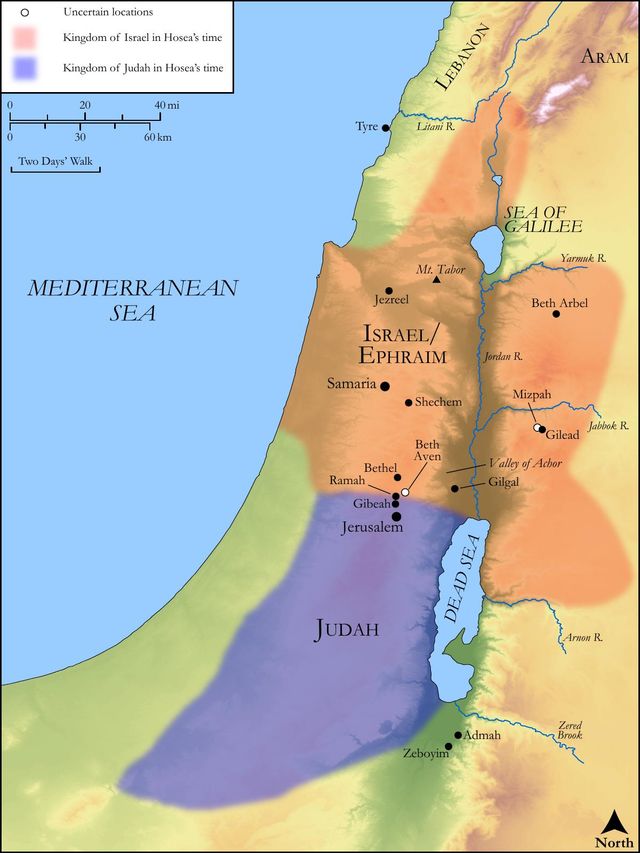
See on the biblical-era map
Study this verse
Public-domain commentary
Matthew Henry
From his Commentary on the Whole Bible. Henry comments on passages, not single verses — this entry covers Hosea 10:1–8. His four-level outline is real structure in the source text, so it is rendered as structure.
Observe, I. What the sins are which are here laid to Israel's charge, the national sins which bring down national judgment. The prophet deals plainly with them; for what good would it do them to be flattered?
1.They were not fruitful in the fruits of righteousness to the glory of God. Here all their other wickedness began (Hos 10:1): Israel is an empty vine. The church of God is fitly compared to a vine, weak, and of an unpromising outside, yet spreading and fruitful; believers are branches of that vine, and partake of its root and fatness. But this was the character of Israel, they were as an empty vine, a vine that had no sap or virtue in it, and therefore none of those good fruits produced by it that were expected from it, with which God and man should be honoured. Note, There are many who, though they have not become degenerate vines, are yet empty vines, have no good in them. A vine is of all trees least serviceable if it do not bear fruit. It is thenceforth good for nothing, Eze 15:3, Eze 15:5. And those that bring forth no grapes will soon come to bring forth wild grapes; those that do no good will do hurt. He is an empty vine, for he brings forth fruit to himself. What good there is in him is not directed to the glory of God, but he takes the praise of it to himself, and prides himself in it. Christians live not to themselves (Rom 14:6), but hypocrites make self their centre; they eat and drink to themselves, Zac 7:5, Zac 7:6. Or Israel is by the judgments of God emptied and spoiled of all his wealth, because he made use of it in the service of his lusts, and not to the honour of God who gave it to him. Note, What we do not rightly employ we may justly expect to be emptied of.
2.They multiplied their altars and images, and the more bountiful God's providence was to them the more prodigal they were in serving their idols: According to the multitude of his fruit which his land brought forth he has increased the altars, and according to the goodness of his land they have made goodly images. Note, It is a great affront to God, and an abuse of his goodness, when the more mercies we receive from him the more sins we commit against him, and when the more wealth men have the more mischief they do. Should not we be thus abundant in the service of our God, as they were in the service of their idols? As we find our estates increasing, we should proportionably abound the more in works of piety and charity.
3.Their hearts were divided, Hos 10:2.
(1.)They were divided among themselves. They were at variance about their idols, some for one, some for another, at variance about their kings, whose separate interests made parties in the kingdom, and in them their very hearts were divided, and alienated one from another, and there was no such thing as cordial friendship to be found among them; it follows therefore, Now shall they be found faulty. Note, The divisions and animosities of a people are the causes of much sin and the presages of ruin.
(2.)They were divided between God and their idols. They had a remaining affection in their hearts for God, but a reigning affection for their idols. They halted between God and Baal, that was the dividing of their heart. But God is the sovereign of the heart and he will by no means endure a rival; he will either have all or none. Satan, like the pretended mother, says, Let it be neither mine nor thine, but divide it; but, if this be yielded to, God says, Nay, let him take it all. A heart thus divided will be found faulty, and be rejected as treacherous in covenanting with God. Note, A heart divided between God and mammon, though it may trim the matter so as to appear plausible, will, in the day of discovery, be found faulty.
4.They made no conscience of what they said and what they did in the most solemn manner, Hos 10:4.
(1.)Not of what they said in swearing, which is the most solemn speaking: They have spoken words, and words only, for they meant not as they said; they did verba dare - give words. They swore falsely in making a covenant; they were deceitful in their covenanting with God, the covenant of circumcision, the fair promises they made of reformation when they were in distress; and no marvel if those that were false to their God were false to all mankind. They contracted such a habit of treachery that they broke through the most sacred bonds, and made nothing of them; subjects violated their oaths of allegiance and their kings their coronation-oaths; they broke their leagues with the nations they were in alliance with, nor was any conscience made of contracts between private persons.
(2.)Nor of what they did in judgment, which is the most solemn acting. Justice could not take place when men made nothing of forswearing themselves; for thus judgment, which should have been a healing medicinal plant and of a sweet smell, sprang up as hemlock, which is both nauseous and noxious, in the furrows of the field, in the field that was ploughed and furrowed for good corn. Note, God is greatly offended with corruptions, not only in his own worship, but in the administration of justice between man and man, and the dishonesty of a people shall be the ground of his controversy with them as well as their idolatry and impiety; for God's laws are intended for man's benefit and the good of the community, as well as for God's honour, and the profanation of courts of justice shall be avenged as surely as the profanation of temples.
II.What the judgments are with which Israel should be punished for these sins; they sinned both in civil and religious matters, and in both they shall be punished.
1.They shall have no joy of their kings and of their government. Because justice is turned into oppression, therefore those who are entrusted with the administration of it, and should be blessings to the state, shall be complained of as the burdens of it (Hos 10:3), and those that would not rule their people well shall not be able to protect them: Now they shall say, "We have no king, that is, we are as if we had none, we have none to do us any good nor stand us in any stead, none to keep us from destroying ourselves or being destroyed by our enemies, none to preserve the public peace nor to fight our battles; and justly has this come to us. Because we feared not the Lord, when we were safe under the protection of our kings, therefore we are rejected by him, and then what shall a king do for us? What good can we expect from a king when we have forfeited the favour of our God?" Note, Those that cast off the fear of God are not likely to have joy of any of their creature-comforts; nor will men's loyalty to their prince befriend them without religion, for, though that may engage him to be for them, what good will that do them if God be against them? Those that keep themselves in the fear and favour of God may say, with triumph, "What can the greatest of men do against us?" But those that throw themselves out of his protection must say, with despair, "What can the greatest of men do for us?" He was a king that said, If the Lord do not help thee, whence should I help thee? Yet he is a fool that says, If a king cannot help us, we must perish (as these intimate here), for God can do that for us which kings cannot. Time was when they doted upon having a king; but now what can a king (who, they thought, could do any thing) do for them? God can make people sick of those creature-confidences which they were most fond of. This is their complaint when their king is disabled to help them, yet this is not the worst; their civil government shall not only be weakened, but quite destroyed (Hos 10:7): As for Samaria, the royal city, which is now almost all that is left, her king is cut off as the foam from the water. The foam swims uppermost, and makes a great show upon the face of the water, yet it is but a heap of bubbles raised by the troubling of the water. Such were the kings of Israel, after their revolt from the house of David, a mere scum; their government had no foundation. No better are the greatest of kings when they set up in opposition to God; when God comes to contend with them by his judgments he can as easily disperse and dissolve them, and bring them to nothing, as the froth upon the water.
2.They shall have no joy of their idols and of their worship of them. And miserable is the case of that people whose gods fail them when their kings do.
(1.)The idols they had made, and the altars they had set up in honour of them, should be broken down, and spoiled, and carried away, as common plunder, by the victorious enemy: He shall break down their altars. God shall do it by the hand of the Assyrians: the Assyrians shall do it by order from God. He shall spoil their images, Hos 10:2. Note, What men make idols of it is just with God to break down and spoil. But the calf at Bethel was the sovereign idol; it was this that the inhabitants of Samaria doted most upon; now it is here foretold that this should be destroyed: The glory of it has departed from it (Hos 10:5) when it is thrown down and defaced, no more to be worshipped; but this is not all: It shall also be carried to Assyria (as some think that the calf at Dan was some time before) for a present to king Jareb. It was carried to him as a rich booty (for it was a golden calf, and probably adorned with the gifts and offerings of its worshippers) and as a trophy of victory over their enemies: and what more glorious trophy could they bring than this, or more incontestable proof of an absolute conquest? Thus it is said, The sin of Israel shall be destroyed (Hos 10:8), that is, the idols which they made the matter of their sin; it is said of them, They became a sin to all Israel, Kg1 12:30. Note, If the grace of God prevail not to destroy the love of sin in us, it is just that the providence of God should destroy the food and fuel of sin about us. With the idols, the high places shall be destroyed, the high places of Aven, that is, of Bethaven (Hos 10:5) or Bethel; it was called the house of God (so Bethel signifies), but now it is called the house of iniquity, nay, iniquity itself. The kings did not, as they ought to have done, take away the high places by the sword of justice, and therefore God will take them away by the sword of war; so that the thorn and the thistle shall come up on their altars, that is, they shall lie in ruins. Their altars, while they stood, were as thorns and thistles, offensive to God and good men, and fruits of sin and the curse; justly therefore are they buried in thorns and thistles.
(2.)The destruction of their idols, their altars, and their high places, shall be the occasion of sorrow, and shame, and terror to them.
[1.]It shall be an occasion of sorrow to them. When the calf at Bethel is broken the people thereof shall mourn over it. They looked upon the calf to be the protector of their nation, and, when that was gone, thought they must all be undone, which made the poor ignorant people that were deluded into the love of it lament bitterly, as Micah did (Jdg 18:24), You have taken away my gods, and what have I more? The priests that had rejoiced in it shall now mourn for it with the people. Note, Whatever men make a god of they will mourn for the loss of; and an inordinate sorrow for the loss of any worldly good is a sign we made an idol of it. They used to be very merry in the worship of their idols, but now they shall mourn over them; for sinful mirth shall, sooner or later, be turned into mourning.
[2.]It shall be an occasion of shame to them (Hos 10:6): Ephraim shall receive shame when he sees the gods he trusted to carried into captivity, and Israel shall be ashamed of his own counsel, in putting such confidence in them and paying such adoration to them. God's ark and altars were never thrown down till the people rejected them; but the idolatrous altars were thrown down when the people were doting on them, which shows that the contempt of the former, and the veneration for the latter, were the sins for which God visited them.
[3.]It shall be an occasion of fear to them (Hos 10:5): The inhabitants of Samaria shall fear; they shall be in pain for their gods and afraid of losing them; or, rather, they shall be in pain for themselves and their children and families, when they see the judgments of God breaking in upon them and beginning with their idols, as he executed judgment against the gods of Egypt, Exo 12:12. Thus idolaters are brought in trembling when God arises to shake terribly the earth, Isa 2:21. And here (Hos 10:8), They shall say to the mountains, Cover us; and to the hills, Fall on us. The supporters of idolatry (Rev 6:15, Rev 6:16) are brought in calling thus in vain to rocks and mountains to shelter them from God's wrath.
Historical interpretation
Historical reception
1 surviving comment on this verse from the historical church.
"He made his king pass like foam over the face of the water of Samaria, and the high places of idols shall be destroyed, the sin of Israel." LXX: "He has cast out his king from Samaria as a brand on the face of the water, and the altars will be removed." For "foam," which the LXX and Theodotion translated as φρύγανον, that is, "brand," Symmachus has placed ἐπίζεμα, wanting to show the upper waters of boiling water, and the foam and bubbles rising, which the Greeks call πομφόλυγας. Therefore, just as spume over the water dissolves quickly, so the kingdom of the ten tribes will quickly end, and the lofty places, that is, Bamoth, will perish, of which it is written: "Nevertheless, the people still sacrificed and burned incense on the high places" (3 Kings 22:44). But these lofty places are idols, or Aven, that is, idols, which are interpreted as "useless," which is a useless idol and a sin for Israel. But when the idol and its lofty places are dispersed.
Continue studying Hosea 10:7 across the web’s major study libraries — every link below opens this exact verse, chapter, or book on the destination site.
Read & Compare
 BibleGatewayThis verse in more than 200 translations and 70 languages.
 Bible.comThe YouVersion reader — hundreds of translations, reading plans, and highlights.
 ESV.orgCrossway's official English Standard Version reader.
 NET BibleThe NET translation with 60,000+ translators' notes on every rendering decision.
 STEP BibleTyndale House's free study tool — original text, vocabulary, and scholarly resources.
 BibliaLogos Bible Software's free web reader.
 USCCBThe New American Bible (Revised Edition) with the U.S. bishops' study notes.
Commentaries
 BibleHub CommentariesDozens of classic commentaries on this verse, gathered on one page.
 StudyLightMore than 100 commentary sets — the largest collection on the web.
 BibleRefPlain-English commentary on what this verse means, verse by verse.
 Enduring WordDavid Guzik's free commentary on this chapter, widely used by Bible teachers.
 Bible Study ToolsVerse commentary alongside Greek and Hebrew study aids.
Original Language & Research
- BibleHub InterlinearThe verse word by word — original language, transliteration, and English.
- BibleHub LexiconEvery word's original-language definition and Strong's entry.
 Blue Letter BibleDeep-study tools — Strong's numbers, concordance, and word studies.
 SefariaThe Hebrew text with Rashi and centuries of Jewish commentary.
Sermons, Hymns & Audio


TrulyRandomVerse is not affiliated with these sites and doesn’t control their content. They’re linked because they’re genuinely useful.
Summary
Hosea 10:7 delivers a stark prophetic indictment against Samaria, the capital of the Northern Kingdom of Israel, and its reigning monarch. The verse vividly portrays the impending and complete annihilation of Israel's earthly leadership and political stability, likening the king's demise to the swift and utter disappearance of foam upon the water. This powerful imagery underscores the transient and insubstantial nature of human power when it stands in opposition to God's sovereign will, signaling the imminent divine judgment upon a nation steeped in idolatry and political corruption.
Context
ShowHideLiterary Context
Hosea 10 is a chapter replete with imagery of Israel's spiritual decline and the inevitable consequences. Immediately preceding this verse, Hosea 10:1-6 describes Israel's misplaced trust in their own prosperity and idols, their divided hearts, and the impending destruction of their altars and images. The prophet laments their reliance on human kings and military might rather than on the Lord. Verse 7, by specifically naming Samaria and its king, sharpens the focus of the judgment, moving from general national apostasy to the specific locus of political power. The subsequent verses continue to detail the desolation that will befall Israel, emphasizing the harvest of injustice they have sown and the futility of their efforts to escape divine wrath.
Historical & Cultural Context
Hosea prophesied during the turbulent final decades of the Northern Kingdom of Israel (750-715 BC), a period characterized by extreme political instability. Kings frequently rose and fell through violent coups, often lasting only a few months or years. This instability was exacerbated by Israel's entanglement in the geopolitical struggles between the rising Assyrian Empire and the declining powers of Egypt and Syria. Samaria, as the capital, was a hub of both political intrigue and syncretistic worship, blending the worship of Yahweh with Canaanite Baalism. The "king" mentioned here likely refers to the current monarch at the time of the prophecy, but also symbolizes the entire institution of Israelite kingship, which had become corrupt and unfaithful to God's covenant. The Assyrians, under Shalmaneser V and Sargon II, would eventually besiege and conquer Samaria in 722 BC, leading to the exile of the Northern Kingdom, fulfilling such prophecies of its leadership being "cut off."
Key Themes
ShowHideThis verse powerfully contributes to several overarching themes within Hosea and the broader prophetic literature. It highlights Divine Judgment, demonstrating God's righteous response to Israel's persistent unfaithfulness and idolatry, as seen throughout Hosea. The imagery of vanishing foam emphasizes the Transience of Human Power and the futility of trusting in earthly rulers or military strength rather than the Lord. This theme is echoed in passages like Psalm 146:3-4, which warns against putting trust in princes. Furthermore, the verse underscores the Consequences of Sin, illustrating how Israel's spiritual apostasy and political corruption inevitably lead to national ruin and the collapse of their leadership, a consistent message from the Law to the Prophets (e.g., Deuteronomy 28).
Exposition and Analysis
ShowHideKey Word Analysis
ShowHideThis word refers to a monarch or sovereign ruler. In Hosea 10:7, "her king" specifically denotes the earthly ruler of Samaria, symbolizing the entire institution of Israelite kingship in the Northern Kingdom. The use of this term highlights the human authority that was being challenged and ultimately dissolved by divine judgment, contrasting sharply with God's eternal sovereignty.
This primitive root signifies to be dumb or silent, and by extension, to fail, perish, or be destroyed. The passive form used here ("is cut off") emphasizes that the king's demise is an accomplished fact, a divinely ordained cessation of power. It conveys a sense of finality and utter annihilation, indicating that the king's reign will not merely end, but will vanish without a trace, brought to silence.
This word refers to a splinter (as chipped off), and figuratively, rage or strife, or foam. In this context, "foam" refers to the frothy, insubstantial bubbles that form on water and quickly dissipate. This imagery is crucial to the simile, highlighting the extreme ephemerality and insignificance of the king's power in the face of God's decree. It suggests that the king's authority, despite its outward appearance, holds no lasting substance.
This word is plural but used singularly, meaning "the face." It is used in a great variety of applications, including as a preposition "upon" or "before." Here, "upon the water" specifies the location where the foam exists, emphasizing its superficial and transient existence on the surface of something larger and more enduring (the water itself, which represents a constant, though here, it's the medium for the foam's disappearance).
Verse Breakdown
ShowHide"[As for] Samaria, her king"
This opening phrase immediately identifies the target of the prophecy: the capital city of the Northern Kingdom and its ruler. Samaria was not just a geographical location but a symbol of Israel's apostasy, political instability, and defiance against God. The focus on "her king" underscores that the judgment is specifically directed at the leadership that had led the nation astray.
"is cut off"
This clause declares the king's inevitable demise. The verb "cut off" (from dâmâh) implies a complete cessation, a silencing, or an utter destruction. It conveys a sense of finality and divine agency, indicating that this is not merely a natural end but a decisive act of judgment. The king's reign and influence will be brought to an abrupt and absolute end.
"as the foam upon the water"
This powerful simile provides the vivid imagery for the manner of the king's destruction. Just as foam, a transient and insubstantial phenomenon, forms on the surface of water only to quickly disappear without a trace, so too will Samaria's king and his authority vanish. This comparison emphasizes the utter insignificance, fragility, and swift disappearance of human power when it is opposed to God's will, leaving no lasting impact or memory.
Literary Devices
ShowHideThe primary literary device employed in Hosea 10:7 is Simile. The king's fate is explicitly compared to "foam upon the water" using the comparative particle "as" (כְּ, k'qetseph). This simile is highly effective because foam is universally understood as something insubstantial, ephemeral, and easily dissipated, perfectly illustrating the fleeting nature of Samaria's political power and the swiftness of its destruction. The image evokes a sense of utter insignificance and impermanence. Additionally, there is an element of Symbolism, where "foam" symbolizes the fragility and transience of human authority, particularly when it is not divinely appointed or aligned with God's will. The "water" itself can symbolize the overwhelming forces of judgment or the vastness of history against which human power is but a fleeting ripple. The stark contrast between the perceived power of a king and the utter weakness of foam creates a powerful and memorable prophetic image.
Theological and Thematic Connections
ShowHideHosea 10:7 profoundly speaks to the theological truth of God's absolute sovereignty over all earthly powers and the inevitable consequences of national apostasy. It underscores that no human institution, no matter how mighty or established, can stand against the divine will. The transient nature of Samaria's kingship, depicted as vanishing foam, serves as a timeless warning against placing ultimate trust in human leaders, political systems, or military strength. True security and lasting stability are found only in faithfulness to the unchanging God. This verse highlights God's justice in bringing judgment upon those who persistently reject His covenant and embrace idolatry and injustice, demonstrating that sin always carries a devastating cost.
Reflection and Application
ShowHideHosea 10:7 offers a sobering yet vital lesson for believers today, reminding us that all earthly power, prestige, and influence are ultimately fleeting and subject to God's sovereign hand. In a world often captivated by political leaders, economic systems, and military might, this verse calls us to shift our ultimate allegiance and trust from the transient to the eternal. It challenges us to examine where our true security lies: is it in the stability of our nation, the strength of our economy, or the wisdom of our leaders, all of which can vanish like foam? Or is it in the unchanging character and unfailing promises of God? This passage also serves as a potent reminder of the consequences of spiritual compromise and the importance of national righteousness. As individuals and communities, we are called to live lives of faithfulness, justice, and humility before God, recognizing that true flourishing comes not from human ingenuity or strength, but from aligning ourselves with His righteous will.
Questions for Reflection
ShowHideFAQ
ShowHideWhat was the significance of Samaria in Hosea's prophecy?
ShowHideSamaria was the capital city of the Northern Kingdom of Israel (also known as Ephraim), and by Hosea's time, it had become a potent symbol of the nation's deep-seated spiritual apostasy, political instability, and oppression. It was the center of idolatrous worship, where the people had blended the worship of Yahweh with Canaanite Baalism, and where a succession of corrupt and short-lived kings had led the nation further away from God's covenant. Therefore, when Hosea pronounces judgment on Samaria and its king, he is targeting the very heart of Israel's rebellion and its failed leadership, foreshadowing the city's eventual fall to the Assyrians in 722 BC.
How does the imagery of "foam upon the water" convey the king's fate?
ShowHideThe imagery of "foam upon the water" is a powerful simile that vividly illustrates the complete and swift annihilation of Samaria's king and, by extension, the entire institution of Israelite kingship in the Northern Kingdom. Foam is inherently insubstantial, temporary, and easily dissipated; it forms on the surface of water only to quickly vanish without a trace. This metaphor emphasizes the utter insignificance, fragility, and impermanence of human power when it is not founded upon or aligned with God's sovereign will. It suggests that despite any outward show of strength, the king's authority would be swept away effortlessly, leaving no lasting impact, much like the froth on a river that disappears into nothingness. This imagery underscores the futility of trusting in earthly rulers as opposed to the eternal God, as seen in Psalm 146:3-4.
Christ-Centered Fulfillment
ShowHideHosea 10:7, with its stark prophecy of the transient nature of earthly kingship, finds its ultimate Christ-centered fulfillment in the establishment of an eternal, unshakable kingdom under the reign of Jesus Christ. While Samaria's kings were "cut off as the foam upon the water," signifying the utter collapse of human authority, Christ's kingdom is described as one that "shall never be destroyed" (Daniel 2:44). The fleeting power of human monarchs, prone to corruption and destined for destruction, stands in sharp contrast to the everlasting dominion of the King of kings, whose "dominion is an everlasting dominion, which shall not pass away" (Daniel 7:14). The judgment pronounced upon Samaria's unfaithful king foreshadows the ultimate judgment that will be meted out to all earthly powers that oppose God, culminating in Christ's triumphant return where He will "destroy every rule and every authority and power" (1 Corinthians 15:24). Thus, the instability and demise of human rule in Hosea points forward to the stable, righteous, and eternal reign of the Messiah, the true Lamb of God, who takes away the sin of the world and establishes a kingdom that will endure forever (John 1:29; Revelation 11:15).