


Ezekiel 48:27
Bible text: King James Version (1769 Blayney text) · Public domain
Bible text: Berean Standard Bible · Public domain
Bible text: American Standard Version (1901) · Public domain
Bible text: World English Bible, Messianic edition · Public domain
Bible text: Geneva Bible (1599) · Public domain
Bible text: Young's Literal Translation · Public domain
- וְעַלve·'Aland atH5921Conj-w ¦ PrepPrepositionוְandעַלat
- גְּבוּלge·Vul[the] border ofH1366N-mscNoun Singular Masculine Construct
- זְבוּלֻןze·vu·LunZebulunH2074N-proper-mNoun Proper Masculine
- מִפְּאַתmi·pe·'Atfrom [the] side ofH6285Prep-m ¦ N-fscNoun Singular Feminine Constructמִfromפְּאַת[the] side of
- קָדִמָהka·Di·maheast -wardH6921N-ms ¦ SfxNoun Singular Masculine Absoluteקָדִמָeastה-ward
- עַד'adtoH5704PrepPreposition
- פְּאַתpe·'at[the] side ofH6285N-fscNoun Singular Feminine Construct
- יָמָּהYa·mahwest -wardH3220N-ms ¦ SfxNoun Singular Masculine Absoluteיָמָּwestה-ward
- גָּדgadGadH1410N-proper-mNoun Proper Masculine
- אֶחָד'e·Chadone [portion]H259Adj-fsAdjective Numerical Singular Feminine Absolute
English is a literal word-by-word gloss of the Hebrew, not the KJV's wording. Why?
This is the original text the KJV's translators worked from — each Hebrew word with its own literal English meaning in this verse, prepared by scholars at Tyndale House, Cambridge. The KJV translates whole sentences, not word by word, so its wording differs: one Hebrew word can become several English words, and the KJV may choose “the LORD” where the gloss reads “Yahweh”. Both are faithful — they answer different questions. For the KJV's own rendering, switch to the KJV text.
Details
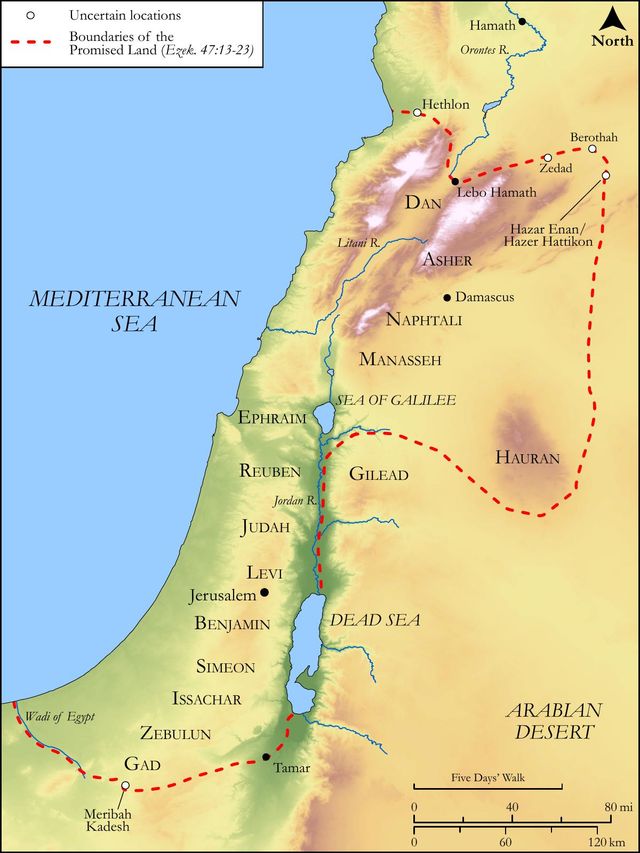
See on the biblical-era map
Study this verse
Historical interpretation
Historical reception
1 surviving comment on this verse from the historical church.
(Vers. 23 seqq.) And the rest of the tribes, from the eastern boundary to the western boundary, belong to Benjamin. And against the boundary of Benjamin, from the eastern boundary to the western boundary, belong to Simeon. And along the boundary of Simeon, from the eastern boundary to the western boundary, belong to Issachar. And along the boundary of Issachar, from the eastern boundary to the western boundary, belong to Zebulun. And along the boundary of Zebulun, from the eastern boundary to the sea, belong to Gad. And the border shall go to Gad towards the south side, and the end shall be at Thamar unto the waters of contradiction of Cades: the inheritance shall be against the great sea. This is the land which you shall divide by lot to the tribes of Israel, and these are their portions, says the Lord God. The portion which is always placed at the end in the numbering of the five and seven tribes is understood either as a part, a possession, or an inheritance: although Aquila and Symmachus interpret it as a neutral gender τὸ ὅριον, which means boundary. And it must be noted briefly that in the last five tribes, the tribe of Gad, which was mentioned earlier as being beyond the Jordan, is placed in the same area that Judas previously held, namely the southern region, and its boundary stretches from Thamar to the waters of contradiction at Kadesh, opposite the Great Sea: Thamar itself, which we have already mentioned, is now called Palmyra, and was built long ago by Solomon; for 'palm' in Hebrew is called Thamar, and some believe that it received this name because there are many palm trees there. And what follows: Even to the waters of contradiction of Cades, the inheritance against the great sea; for which seventy transferred from Theman, and the water of Mariboth, ((also Marimoth)) Cades, the inheritance even to the great sea, it is to be observed in the Hebrew language that the same word, Nehela (), is ambiguous, signifying both inheritance and torrent, and here it should be understood more as a torrent than as an inheritance. For this is the torrent that enters the great sea of Rhinocorura, as we have already mentioned. The place called Kadesh, which is also called Kadesh-Barnea in the book of Joshua, is in the desert, extending to the city of Petra. However, Mariboth, which means contradiction, is not a place name as many think, but a name for the waters in which the people contradicted the Lord and Moses offended God, as the Psalm says: They angered him also at the waters of strife, so that Moses suffered for their sins (Psalm 106:32). The entire inheritance of the Holy Land is bordered to the south by the boundaries of Egypt, Rhinocorura, and the River of Egypt. And because Gad is interpreted as temptation, in his possession we pass from the palm groves to the waters of contradiction, even to Kadesh, which is interpreted as holy, so that we may understand that even after the victory of the world we must be solicitous, and always in fear, and remember that verse: The life of man upon earth is a temptation (Job 7:1); and to attain holiness, resisting adversaries, and thus achieve victory, so that we may contemplate the nearby stream full of rain showers.
Continue studying Ezekiel 48:27 across the web’s major study libraries — every link below opens this exact verse, chapter, or book on the destination site.
Read & Compare
 BibleGatewayThis verse in more than 200 translations and 70 languages.
 Bible.comThe YouVersion reader — hundreds of translations, reading plans, and highlights.
 ESV.orgCrossway's official English Standard Version reader.
 NET BibleThe NET translation with 60,000+ translators' notes on every rendering decision.
 STEP BibleTyndale House's free study tool — original text, vocabulary, and scholarly resources.
 BibliaLogos Bible Software's free web reader.
 USCCBThe New American Bible (Revised Edition) with the U.S. bishops' study notes.
Commentaries
 BibleHub CommentariesDozens of classic commentaries on this verse, gathered on one page.
 StudyLightMore than 100 commentary sets — the largest collection on the web.
 BibleRefPlain-English commentary on what this verse means, verse by verse.
 Enduring WordDavid Guzik's free commentary on this chapter, widely used by Bible teachers.
 Bible Study ToolsVerse commentary alongside Greek and Hebrew study aids.
Original Language & Research
- BibleHub InterlinearThe verse word by word — original language, transliteration, and English.
- BibleHub LexiconEvery word's original-language definition and Strong's entry.
 Blue Letter BibleDeep-study tools — Strong's numbers, concordance, and word studies.
 SefariaThe Hebrew text with Rashi and centuries of Jewish commentary.
Sermons, Hymns & Audio


TrulyRandomVerse is not affiliated with these sites and doesn’t control their content. They’re linked because they’re genuinely useful.
Summary
Ezekiel 48:27 provides a meticulous detail within the prophet Ezekiel's grand eschatological vision, outlining the divinely ordained division of the future restored land of Israel. Specifically, this verse allocates a distinct and precisely defined portion to the tribe of Gad, situated immediately south of Zebulun's territory, extending comprehensively across the entire breadth of the land from its eastern to its western boundaries. This detailed allocation underscores God's meticulous planning, His unwavering faithfulness to His covenant promises, and the ultimate completeness and security of His redemptive work for His people in the age to come.
Context
ShowHideLiterary Context
Ezekiel 48:27 is deeply embedded within the climactic section of Ezekiel's prophecy, specifically chapters 40-48, which present an elaborate and highly detailed vision of a new temple, a renewed priesthood, and a re-divided land for the nation of Israel. This extensive vision serves as a profound message of hope, restoration, and divine order following the devastating Babylonian exile. Chapter 48 meticulously outlines the precise boundaries and portions for each of the twelve tribes, arranged in parallel strips running from the eastern to the western borders of the land. The preceding verses (Ezekiel 48:1-26) describe the allotments for the northern tribes, moving systematically southward, with Zebulun's territory immediately preceding that of Gad. This verse, therefore, continues the systematic, divinely ordered distribution, emphasizing the precise, comprehensive, and contiguous nature of the land's re-apportionment in this glorious future.
Historical & Cultural Context
The vision recorded by Ezekiel was received by the prophet during the Babylonian exile (circa 593-571 BC), a period of profound national despair, humiliation, and theological questioning for the Jewish people. Their cherished temple lay in ruins, their land was desolate, and their national identity and covenant relationship with God seemed shattered. In this desperate context, the highly detailed vision of a restored temple and a re-divided, secure land offered immense hope and a powerful affirmation of God's continued covenant faithfulness despite Israel's disobedience and subsequent judgment. The concept of land inheritance was foundational to Israel's identity and their understanding of God's promises, tracing back to God's initial promise to Abraham that his descendants would inherit the land Genesis 12:7 and its partial fulfillment through Joshua's conquest and division of the land Joshua 13. The precise boundaries and tribal allotments in Ezekiel's vision would have resonated deeply with a people whose land had been forcefully taken from them, signifying a complete, secure, and permanent return to their divinely appointed heritage.
Key Themes
ShowHideThis verse, along with the entire chapter, contributes significantly to several major theological and narrative themes central to Ezekiel's prophecy and the broader biblical narrative. Firstly, it powerfully highlights Divine Order and Allotment, showcasing God's meticulous planning, sovereign control, and perfect wisdom in orchestrating the destiny of His people. The precise geographical assignments for each tribe underscore a perfect, divinely ordained order for the future, standing in stark contrast to the chaos and displacement of the exile. Secondly, it conveys the theme of Restoration and Inheritance. The vision promises a complete and glorious restoration of Israel, including their physical land, with each tribe receiving its distinct, secure, and full inheritance. This signifies God's unwavering faithfulness to His covenant promises, even after periods of severe disobedience and judgment, echoing earlier promises of land inheritance found in texts like Numbers 34:1-12 and the actual division described in Joshua 13:7. Finally, the recurring phrase "from the east side unto the west side" emphasizes Completeness and Security. Each tribal portion spans the entire width of the land, symbolizing a full, unhindered, and secure possession, ensuring a perfect and permanent dwelling for the tribes under God's sovereign protection.
Exposition and Analysis
ShowHideKey Word Analysis
ShowHideThis term, derived from a root meaning "a cord," properly signifies a boundary, limit, or demarcation line. By extension, it also refers to the territory enclosed within those bounds. In Ezekiel 48:27, "border" emphasizes the precise, measured, and divinely established demarcation of tribal lands, ensuring each tribe's distinct and secure inheritance. It speaks to God's meticulousness in setting boundaries and providing for His people with exactness and order.
Zebulun was the tenth son of Jacob, born to Leah, and his name is associated with "habitation" or "dwelling." In this verse, Zebulun's territory is specifically mentioned as the northern border to Gad's allotment. The sequential listing of tribes, with Zebulun immediately preceding Gad, reinforces the systematic and orderly nature of the land division, emphasizing that each tribe's "habitation" is precisely located and secured within God's grand design for the restored land.
Gad was one of the twelve sons of Jacob, born to Zilpah, Leah's handmaid, with his name often associated with "fortune" or "troop." In the context of Ezekiel 48, "Gad" refers to the tribe descended from him and, crucially, the specific territory allotted to this tribe in the future restored land. The explicit inclusion of Gad by name among the tribes receiving an inheritance underscores the comprehensive, inclusive, and equitable nature of God's restoration, ensuring a distinct and secure place for every segment of His people.
Verse Breakdown
ShowHide"And by the border of Zebulun"
This phrase precisely establishes the geographical reference point for Gad's allotment. It indicates that Gad's territory is directly adjacent to, and immediately south of, the land assigned to the tribe of Zebulun. This precision highlights the orderly, contiguous, and well-defined nature of the tribal divisions, ensuring that each tribe has a clearly delineated and neighboring inheritance within the restored land.
"from the east side unto the west side"
This describes the full breadth and extent of Gad's assigned territory. It signifies that Gad's portion, consistent with all the other tribal allotments in this vision, stretches across the entire width of the land, from its easternmost boundary to its westernmost. This detail emphasizes the completeness, unhindered nature, and security of each tribe's inheritance, symbolizing a full, unencumbered, and permanent possession of the land.
"Gad a [portion]."
This is the declarative statement of the verse, explicitly assigning a segment of the land to the tribe of Gad. The KJV's "a" (from H259, meaning "one" or "a certain") implies a specific, distinct "portion" or allotment. This reinforces the idea of a measured and divinely appointed inheritance. It confirms that Gad, like all the other tribes, receives a specific and divinely appointed share in the restored land, ensuring their secure and permanent dwelling.
Literary Devices
ShowHideThe language of Ezekiel 48:27, and indeed the entire chapter, is characterized by remarkable Precision and Detailing. The meticulous listing of tribal names and their exact geographical placements, including the specific directional references ("from the east side unto the west side"), creates a profound sense of divine order, meticulous planning, and absolute certainty. This precision is not merely descriptive; it functions as a literary device to convey the absolute reliability and unwavering faithfulness of God's promises of restoration. Furthermore, the Repetition of the phrase "from the east side unto the west side" for each tribal allotment (implied throughout the chapter's structure) serves to emphasize the completeness, security, and unhindered nature of each tribe's inheritance, reinforcing the overarching theme of full and permanent possession. There is also a significant element of Symbolism, where the physical division of the land represents the spiritual reality of God's faithfulness to His covenant, His desire to establish His people in a place of perfect peace and prosperity, and His sovereign rule over all creation.
Theological and Thematic Connections
ShowHideEzekiel 48:27, as an integral part of Ezekiel's grand vision, profoundly connects to the biblical themes of divine faithfulness, covenant fulfillment, and the ultimate restoration of God's people. It powerfully underscores that God's promises are not contingent on human perfection or obedience but are rooted in His unchanging character and sovereign will. Even after severe judgment and the devastating experience of exile, God remains utterly committed to His covenant with Israel, meticulously ensuring their return to the land and a re-establishment of their national identity under His perfect order. This vision speaks to God's meticulous care for His people, providing a secure and complete inheritance, demonstrating His unwavering commitment to bring about His perfect will, culminating in a new creation where His presence dwells among His people forever.
Reflection and Application
ShowHideEzekiel 48:27, with its precise description of tribal inheritance, offers profound and enduring insights for contemporary believers. It serves as a powerful reminder that God is a God of order, meticulous detail, and unwavering faithfulness. Just as He meticulously planned and secured a distinct and complete inheritance for each tribe of Israel, so too does He have a perfect plan and purpose for our individual lives. This divine precision should inspire immense trust, knowing that our lives are not random or chaotic but are held securely within the comprehensive and loving design of our Creator. The promise of a secure "portion" for Gad, stretching from east to west, symbolizes the completeness and unshakeable security of God's provision for His people. For us, this translates into an assurance that God will provide all that we truly need, both spiritually and physically, and that our ultimate inheritance in Christ is eternally secure and unshakeable. It calls us to rest deeply in His sovereignty, knowing that He oversees every detail of our journey and will ultimately fulfill His grand redemptive plan, leading us to our eternal dwelling and perfect peace with Him.
Questions for Reflection
ShowHideFAQ
ShowHideWhat is the significance of the phrase "from the east side unto the west side" for each tribal portion in Ezekiel's vision?
ShowHideThe phrase "from the east side unto the west side" is profoundly significant because it emphasizes the completeness, full extent, and unhindered nature of each tribal inheritance. It means that each tribe's allotted territory stretched across the entire width of the land, from its eastern border to its western border, without interruption. This detail symbolizes a full, unencumbered, and secure possession of their land. It underscores God's generous and comprehensive provision, ensuring that each tribe would have ample space and a secure dwelling within the restored Israel. This stands in stark contrast to the fragmented and often contested land ownership that characterized periods of Israel's historical experience, pointing to a future of perfect divine order, peace, and unshakeable security for God's people in their divinely appointed dwelling place. This complete possession highlights the generosity and thoroughness of God's covenant faithfulness.
Christ-Centered Fulfillment
ShowHideWhile Ezekiel's vision of the land division appears to be a literal blueprint for a future Israel, its ultimate and most profound fulfillment is found in Jesus Christ and the new covenant. The meticulous division of the land, providing a secure and perfect inheritance for each tribe, foreshadows the spiritual inheritance believers receive in Christ. Just as Gad received a "portion" from east to west, so too does every believer receive a complete and secure inheritance in Christ, not of physical land, but of eternal life, boundless spiritual blessings, and an unshakeable place in God's eternal kingdom Ephesians 1:3. Jesus is the true "land" or "inheritance" in whom all God's promises find their "Yes" and "Amen" 2 Corinthians 1:20. The restoration of Israel to their land points to the greater spiritual restoration and reconciliation accomplished through Christ's atoning work, bringing people from every tribe, tongue, and nation into God's family Revelation 7:9. The ultimate "dwelling" and "habitation" is not merely a geographical location but the new heaven and new earth, where God Himself dwells with His people forever, and Christ is the center of all things, the Lamb who is our light and life Revelation 21:3. Thus, Ezekiel 48:27, with its promise of a secure and complete portion, ultimately points to the all-encompassing and eternal inheritance secured for us by the Lamb of God, Jesus Christ.