


Ezekiel 48:26
Bible text: King James Version (1769 Blayney text) · Public domain
Bible text: Berean Standard Bible · Public domain
Bible text: American Standard Version (1901) · Public domain
Bible text: World English Bible, Messianic edition · Public domain
Bible text: Geneva Bible (1599) · Public domain
Bible text: Young's Literal Translation · Public domain
- וְעַלve·'Aland atH5921Conj-w ¦ PrepPrepositionוְandעַלat
- גְּבוּלge·Vul[the] border ofH1366N-mscNoun Singular Masculine Construct
- יִשָׂשכָרyi·so·sh·KharIssacharH3485N-proper-mNoun Proper Masculine
- מִפְּאַתmi·pe·'Atfrom [the] side ofH6285Prep-m ¦ N-fscNoun Singular Feminine Constructמִfromפְּאַת[the] side of
- קָדִימָהka·Di·maheast -wardH6921N-ms ¦ SfxNoun Singular Masculine Absoluteקָדִימָeastה-ward
- עַד'adtoH5704PrepPreposition
- פְּאַתpe·'at[the] side ofH6285N-fscNoun Singular Feminine Construct
- יָמָּהYa·mahwest -wardH3220N-ms ¦ SfxNoun Singular Masculine Absoluteיָמָּwestה-ward
- זְבוּלֻןze·vu·LunZebulunH2074N-proper-mNoun Proper Masculine
- אֶחָד'e·Chadone [portion]H259Adj-fsAdjective Numerical Singular Feminine Absolute
English is a literal word-by-word gloss of the Hebrew, not the KJV's wording. Why?
This is the original text the KJV's translators worked from — each Hebrew word with its own literal English meaning in this verse, prepared by scholars at Tyndale House, Cambridge. The KJV translates whole sentences, not word by word, so its wording differs: one Hebrew word can become several English words, and the KJV may choose “the LORD” where the gloss reads “Yahweh”. Both are faithful — they answer different questions. For the KJV's own rendering, switch to the KJV text.
Details
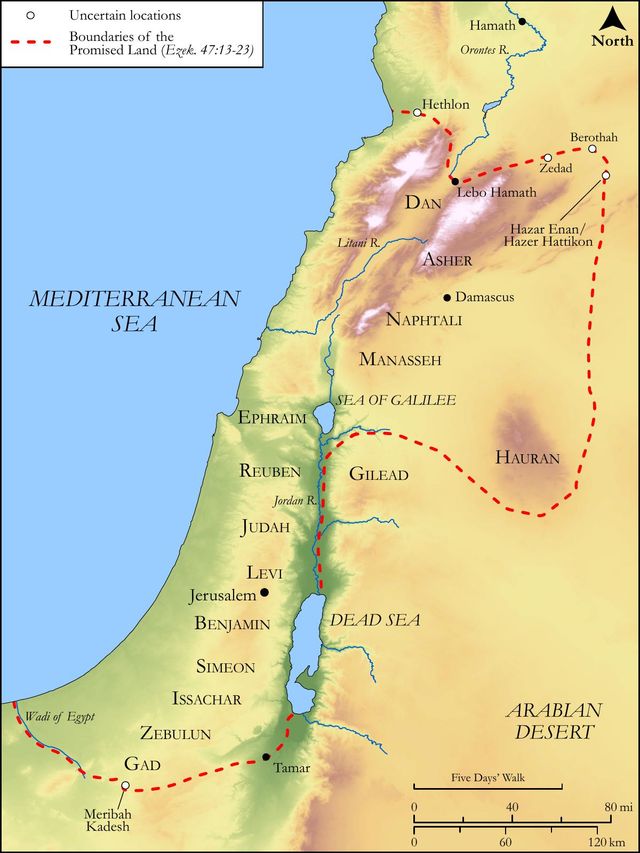
See on the biblical-era map
Study this verse
Historical interpretation
Historical reception
1 surviving comment on this verse from the historical church.
(Vers. 23 seqq.) And the rest of the tribes, from the eastern boundary to the western boundary, belong to Benjamin. And against the boundary of Benjamin, from the eastern boundary to the western boundary, belong to Simeon. And along the boundary of Simeon, from the eastern boundary to the western boundary, belong to Issachar. And along the boundary of Issachar, from the eastern boundary to the western boundary, belong to Zebulun. And along the boundary of Zebulun, from the eastern boundary to the sea, belong to Gad. And the border shall go to Gad towards the south side, and the end shall be at Thamar unto the waters of contradiction of Cades: the inheritance shall be against the great sea. This is the land which you shall divide by lot to the tribes of Israel, and these are their portions, says the Lord God. The portion which is always placed at the end in the numbering of the five and seven tribes is understood either as a part, a possession, or an inheritance: although Aquila and Symmachus interpret it as a neutral gender τὸ ὅριον, which means boundary. And it must be noted briefly that in the last five tribes, the tribe of Gad, which was mentioned earlier as being beyond the Jordan, is placed in the same area that Judas previously held, namely the southern region, and its boundary stretches from Thamar to the waters of contradiction at Kadesh, opposite the Great Sea: Thamar itself, which we have already mentioned, is now called Palmyra, and was built long ago by Solomon; for 'palm' in Hebrew is called Thamar, and some believe that it received this name because there are many palm trees there. And what follows: Even to the waters of contradiction of Cades, the inheritance against the great sea; for which seventy transferred from Theman, and the water of Mariboth, ((also Marimoth)) Cades, the inheritance even to the great sea, it is to be observed in the Hebrew language that the same word, Nehela (), is ambiguous, signifying both inheritance and torrent, and here it should be understood more as a torrent than as an inheritance. For this is the torrent that enters the great sea of Rhinocorura, as we have already mentioned. The place called Kadesh, which is also called Kadesh-Barnea in the book of Joshua, is in the desert, extending to the city of Petra. However, Mariboth, which means contradiction, is not a place name as many think, but a name for the waters in which the people contradicted the Lord and Moses offended God, as the Psalm says: They angered him also at the waters of strife, so that Moses suffered for their sins (Psalm 106:32). The entire inheritance of the Holy Land is bordered to the south by the boundaries of Egypt, Rhinocorura, and the River of Egypt. And because Gad is interpreted as temptation, in his possession we pass from the palm groves to the waters of contradiction, even to Kadesh, which is interpreted as holy, so that we may understand that even after the victory of the world we must be solicitous, and always in fear, and remember that verse: The life of man upon earth is a temptation (Job 7:1); and to attain holiness, resisting adversaries, and thus achieve victory, so that we may contemplate the nearby stream full of rain showers.
Continue studying Ezekiel 48:26 across the web’s major study libraries — every link below opens this exact verse, chapter, or book on the destination site.
Read & Compare
 BibleGatewayThis verse in more than 200 translations and 70 languages.
 Bible.comThe YouVersion reader — hundreds of translations, reading plans, and highlights.
 ESV.orgCrossway's official English Standard Version reader.
 NET BibleThe NET translation with 60,000+ translators' notes on every rendering decision.
 STEP BibleTyndale House's free study tool — original text, vocabulary, and scholarly resources.
 BibliaLogos Bible Software's free web reader.
 USCCBThe New American Bible (Revised Edition) with the U.S. bishops' study notes.
Commentaries
 BibleHub CommentariesDozens of classic commentaries on this verse, gathered on one page.
 StudyLightMore than 100 commentary sets — the largest collection on the web.
 BibleRefPlain-English commentary on what this verse means, verse by verse.
 Enduring WordDavid Guzik's free commentary on this chapter, widely used by Bible teachers.
 Bible Study ToolsVerse commentary alongside Greek and Hebrew study aids.
Original Language & Research
- BibleHub InterlinearThe verse word by word — original language, transliteration, and English.
- BibleHub LexiconEvery word's original-language definition and Strong's entry.
 Blue Letter BibleDeep-study tools — Strong's numbers, concordance, and word studies.
 SefariaThe Hebrew text with Rashi and centuries of Jewish commentary.
Sermons, Hymns & Audio


TrulyRandomVerse is not affiliated with these sites and doesn’t control their content. They’re linked because they’re genuinely useful.
Summary
Ezekiel 48:26 meticulously details a specific land allotment for the tribe of Zebulun within the prophet's grand vision of a restored Israel. This verse, part of a larger, divinely ordered blueprint for a future kingdom, describes a strip of territory extending uniformly from the eastern to the western boundary. It signifies an equitable and precise distribution of the promised land, underscoring God's unwavering faithfulness to His covenant promises and His meticulous planning for the eschatological restoration, ensuring each tribe receives its distinct and complete inheritance.
Context
ShowHideLiterary Context
Ezekiel 48:26 is situated within the climactic section of Ezekiel's prophecy, specifically chapters 40-48, which detail a visionary blueprint for a new temple, a reorganized priesthood, and a re-allotment of the land of Israel among the twelve tribes. This grand vision follows extensive prophecies of judgment against Israel and surrounding nations, culminating in a profound promise of restoration and the renewed dwelling of God's presence among His people. Chapter 48 meticulously lists the tribal inheritances, with each tribe receiving a strip of land running from east to west, beginning with Dan in the north and concluding with Gad in the south, immediately before the description of the holy district and the city. The precise, almost architectural, detail of these chapters emphasizes God's sovereign control and His commitment to establishing a perfect order for His redeemed people.
Historical & Cultural Context
The prophecies in Ezekiel were delivered during the Babylonian exile, a period of profound national trauma for Israel. The people had lost their land, their temple, and their king, leading to despair and questions about God's faithfulness. In this context, Ezekiel's vision offered immense hope, portraying a future where Israel would be restored to their land, the temple rebuilt, and God's presence re-established among them. The concept of land inheritance was central to Israelite identity and their covenant with God, rooted in promises made to Abraham, such as the one found in Genesis 12:7, and fulfilled in part during the time of Joshua, as seen in Joshua 14:1. The re-allotment in Ezekiel 48, however, differs significantly from the historical distribution, suggesting an idealized, eschatological fulfillment beyond the immediate post-exilic return, often understood to occur during a future messianic or millennial reign.
Key Themes
ShowHideThis verse, along with the entire chapter, contributes to several major theological and narrative themes. Firstly, it highlights Divine Order and Precision, demonstrating God's meticulous planning for His future kingdom, where every aspect, down to tribal boundaries, is perfectly arranged. Secondly, it powerfully conveys the theme of Restoration and Inheritance, prophesying a complete national and spiritual restoration for Israel, where each tribe fully possesses its divinely appointed land, symbolizing wholeness and renewed covenant relationship. This echoes earlier prophecies of God gathering His people from all nations, as seen in Ezekiel 37:21. Thirdly, the uniform "east side unto the west side" pattern emphasizes Equity Among Tribes, ensuring that all tribes have equal access to the full breadth of the land, signifying fairness and unity in their participation in God's kingdom. Finally, the vision underscores God's Dwelling Presence, as the land distribution is centered around the holy district and the new temple, where God's glory will reside, a theme also prominent in Ezekiel 43:1-5.
Exposition and Analysis
ShowHideKey Word Analysis
ShowHideThis term (H1366) refers to a precisely defined boundary or limit, often implying a cord or line used to mark off territory. In Ezekiel 48:26, it signifies the meticulously marked edge of Zebulun's allocated land, directly adjacent to Issachar's. The consistent use of "border" throughout Ezekiel's visionary land distribution emphasizes the exactness and divine authority behind the future division, leaving no ambiguity about each tribe's specific and secure inheritance. It speaks to God's orderly nature and His detailed, unchangeable plan for His people.
This proper noun (H2074) identifies one of the twelve tribes of Israel, descended from Jacob's tenth son, whose name means "habitation." In the context of Ezekiel 48, Zebulun is designated a specific strip of land within the restored territory. The inclusion of Zebulun, along with the other tribes, underscores the comprehensive nature of God's restoration plan, ensuring that all of Jacob's descendants, representing the whole of Israel, will participate in the future inheritance, regardless of their historical prominence or previous land holdings. This highlights the universal reach and completeness of God's redemptive purpose.
The KJV's bracketed "[portion]" clarifies the meaning of the Hebrew word ʼechâd (H259), which literally means "one" or "a single one." This simple numeral carries significant weight here, implying "one distinct portion" or "one complete share." It emphasizes that Zebulun receives a singular, undivided, and whole inheritance, not a fragmented or shared piece. This reinforces the idea of each tribe receiving its full, equitable, and divinely appointed share, contributing to the overall picture of unity, security, and completeness in the restored kingdom.
Verse Breakdown
ShowHide"And by the border of Issachar"
This phrase precisely establishes the geographical placement of Zebulun's inheritance. It indicates that Zebulun's strip of land is immediately adjacent to, and directly south of, the territory allocated to the tribe of Issachar. This sequential listing of tribal allotments from north to south (as seen in the broader context of Ezekiel 48) highlights the orderly and systematic nature of the divine land distribution, ensuring no gaps or overlaps between tribal territories and emphasizing God's meticulous design.
"from the east side unto the west side"
This recurring descriptive phrase is crucial to understanding the pattern of land distribution in Ezekiel 48. It means that Zebulun's inheritance, like that of every other tribe, will be a long, narrow strip of land stretching across the entire breadth of the promised territory, from its easternmost boundary to its westernmost boundary (presumably the Mediterranean Sea). This uniform width for each tribe emphasizes equity and equal access to the resources and opportunities of the land, signifying a perfectly balanced and just arrangement in the future kingdom, where all tribes are equally favored.
"Zebulun a [portion]"
This final clause identifies the recipient of this specifically described land. "Zebulun" is the tribe receiving this particular strip. The KJV's addition of "[portion]" accurately interprets the Hebrew "Zebulun one" (Zebulun echad), signifying that Zebulun receives a single, complete, and distinct share of the land. This reinforces the theme of individual, yet equally significant, inheritance for each tribe within the unified restored nation, highlighting the divine provision and security for each member of God's people.
Literary Devices
ShowHideEzekiel 48:26, like the entire concluding section of the book, is rich in Precision and Detail, reflecting the meticulous nature of God's divine plan. The exact measurements and specific naming of tribes and their boundaries underscore a sense of divine order and control, leaving nothing to chance in the future kingdom. The recurring phrase "from the east side unto the west side" acts as a powerful form of Repetition and Patterning, establishing a uniform and equitable method of land distribution for all twelve tribes. This consistent pattern emphasizes the fairness, comprehensiveness, and divine impartiality of God's restoration. Furthermore, the land itself functions as profound Symbolism, representing not merely physical territory but also the fulfillment of God's covenant promises, the security and stability of His people, and the tangible manifestation of His dwelling presence among them. The orderly allocation of land symbolizes the perfect harmony, justice, and peace that will characterize God's eschatological kingdom.
Theological and Thematic Connections
ShowHideEzekiel 48:26, as part of the detailed land distribution vision, profoundly underscores God's unwavering faithfulness to His covenant promises, particularly concerning the land and the restoration of Israel. This meticulous blueprint for a future kingdom demonstrates that God's plans are not vague aspirations but precisely ordained realities that will be perfectly executed. The equitable distribution of land, ensuring each tribe receives a full, east-to-west portion, speaks to God's justice and His desire for harmony and wholeness among His people. It points to a future where divine order reigns supreme, and every aspect of life is perfectly aligned with God's will. This vision, while specific to Israel, broadly testifies to God's ultimate intention to bring about a perfected creation where His presence is fully realized and His people dwell in secure, divinely appointed inheritance, a testament to His sovereign love and power.
Reflection and Application
ShowHideEzekiel 48:26, with its meticulous detail of tribal land distribution, offers profound spiritual lessons for believers today. It reminds us that God is a God of perfect order, precision, and unwavering faithfulness. In a world often characterized by chaos, injustice, and uncertainty, this vision provides a powerful anchor of hope: God has a detailed, comprehensive plan for His creation and His people, and He will bring it to perfect fruition. This should inspire us to trust in His sovereign control, even when circumstances seem out of control, and to find peace in His overarching design. Furthermore, the concept of a divinely appointed "portion" for each tribe encourages us to consider our own spiritual inheritance in Christ. While we may not receive a physical land allotment, we are promised an eternal inheritance in the heavenly kingdom, secured by God's faithfulness and grace. This should lead us to live with anticipation for God's ultimate kingdom, seeking to align our lives with His divine order and justice in the present, and to steward the spiritual "portion" He has given us.
Questions for Reflection
ShowHideFAQ
ShowHideWhy is the land distribution in Ezekiel 48 different from the original allocation in the Book of Joshua?
ShowHideThe land distribution in Ezekiel 48 is indeed distinct from the historical division described in Joshua 13-19. This difference is a key indicator that Ezekiel's vision is not merely a prophecy of a return to the past, but rather an idealized, eschatological blueprint for a future, perfected kingdom. Scholars widely interpret this vision as pertaining to the millennial reign of Christ, a time when God's presence will dwell fully among His people in a renewed earth. The symmetrical, east-to-west strips for each tribe, the central holy district, and the precise measurements all point to a divine order and perfection that transcends any historical reality, signifying a future, spiritual, and physical restoration under the direct and righteous rule of God. This vision offers a glimpse into a time when God's original intentions for creation and His people are fully realized.
What is the significance of each tribe receiving a portion "from the east side unto the west side"?
ShowHideThis recurring phrase signifies several important aspects of the future land distribution. Firstly, it emphasizes equity and impartiality. Each tribe receives a full, unbroken strip of land that spans the entire breadth of the territory, ensuring that no tribe is disadvantaged by its geographical location or access to resources. This speaks to God's perfect justice. Secondly, it highlights completeness and wholeness. Each portion is distinct and undivided, symbolizing a full and secure inheritance that is not fragmented or shared in a way that diminishes its value. Thirdly, it underscores divine order and uniformity. The consistent pattern across all tribes reflects God's perfect design and the harmonious arrangement of His future kingdom. This layout ensures that all tribes have direct access to the central holy district and the temple, symbolizing their unified worship and participation in God's glorious presence, as described in Ezekiel 43:4.
Christ-Centered Fulfillment
ShowHideWhile Ezekiel 48:26 describes a physical land allotment for the tribes of Israel, its ultimate fulfillment and spiritual significance are found in Christ. The meticulously ordered land, centered around the divine presence, foreshadows the spiritual inheritance and perfect order found in the New Covenant. Just as each tribe receives a distinct "portion," believers in Christ, as the spiritual Israel, receive an eternal inheritance that is far greater than any earthly territory, as affirmed in Ephesians 1:11. Jesus Himself is our ultimate "portion" and inheritance, as declared in Psalm 16:5, and in Him, we are granted direct access to the very presence of God, a reality that the temple and land in Ezekiel's vision only hinted at. The concept of a unified people, each with their secure place, finds its truest expression in the Church, the body of Christ, where believers from every tribe and nation are brought together into one new humanity, breaking down all barriers, as beautifully articulated in Ephesians 2:14-16. Ultimately, the vision of a perfectly ordered land with God dwelling among His people points to the New Heavens and New Earth, and the New Jerusalem, where God's tabernacle will be with humanity, and He will dwell with them forever, a reality fully realized through the redemptive and reconciling work of Christ, as revealed in Revelation 21:3.