


Ezekiel 48:13
Bible text: King James Version (1769 Blayney text) · Public domain
Bible text: King James Version with Strong's numbers · Public domain
Bible text: Berean Standard Bible · Public domain
Bible text: American Standard Version (1901) · Public domain
Bible text: World English Bible, Messianic edition · Public domain
Bible text: Geneva Bible (1599) · Public domain
Bible text: Young's Literal Translation · Public domain
- וְהַלְוִיִּםve·hal·vi·Yimand the LevitesH3881Conj-w ¦ Art ¦ N-mpNoun Gentilic Plural Masculine AbsoluteוְandהַtheלְוִיִּםLevites
- לְעֻמַּתle·'u·Mat<to> close toH5980Prep-l ¦ N-fscNoun Singular Feminine Constructלְ<to>עֻמַּתclose to
- גְּבוּלge·Vul[the] border ofH1366N-mscNoun Singular Masculine Construct
- הַכֹּהֲנִיםha·ko·ha·Nimthe priestsH3548Art ¦ N-mpNoun Plural Masculine Absoluteהַtheכֹּהֲנִיםpriests
- חֲמִשָּׁהcha·mi·Shah[will be] fiveH2568Adj-csAdjective Numerical Singular common gender Absolute
- וְעֶשְׂרִיםve·'es·Rimand twentyH6242Conj-w ¦ Adj-mpAdjective Numerical Plural Masculine Absoluteוְandעֶשְׂרִיםtwenty
- אֶלֶף'e·lefthousand [cubits]H505Adj-csAdjective Numerical Singular common gender Absolute
- אֹרֶךְ'O·rekh[the] lengthH753N-msNoun Singular Masculine Absolute
- וְרֹחַבve·Ro·chavand [the] breadthH7341Conj-w ¦ N-msNoun Singular Masculine Absoluteוְandרֹחַב[the] breadth
- עֲשֶׂרֶת'a·Se·ret[will be] tenH6235N-fscNoun Singular Feminine Construct
- אֲלָפִים'a·la·Fimthousand [cubits]H505Adj-cpAdjective Numerical Plural common gender Absolute
- כָּלkolallH3605N-mscNoun Singular Masculine Construct
- אֹרֶךְ'O·rekh[the] lengthH753N-msNoun Singular Masculine Absolute
- חֲמִשָּׁהcha·mi·Shah[will be] fiveH2568Adj-csAdjective Numerical Singular common gender Absolute
- וְעֶשְׂרִיםve·'es·Rimand twentyH6242Conj-w ¦ Adj-mpAdjective Numerical Plural Masculine Absoluteוְandעֶשְׂרִיםtwenty
- אֶלֶף'E·lefthousand [cubits]H505Adj-csAdjective Numerical Singular common gender Absolute
- וְרֹחַבve·Ro·chavand [the] breadthH7341Conj-w ¦ N-msNoun Singular Masculine Absoluteוְandרֹחַב[the] breadth
- עֲשֶׂרֶת'a·Se·ret[will be] tenH6235N-fscNoun Singular Feminine Construct
- אֲלָפִים'a·la·Fimthousand [cubits]H505Adj-cpAdjective Numerical Plural common gender Absolute
English is a literal word-by-word gloss of the Hebrew, not the KJV's wording. Why?
This is the original text the KJV's translators worked from — each Hebrew word with its own literal English meaning in this verse, prepared by scholars at Tyndale House, Cambridge. The KJV translates whole sentences, not word by word, so its wording differs: one Hebrew word can become several English words, and the KJV may choose “the LORD” where the gloss reads “Yahweh”. Both are faithful — they answer different questions. For the KJV's own rendering, switch to the KJV text.
Details
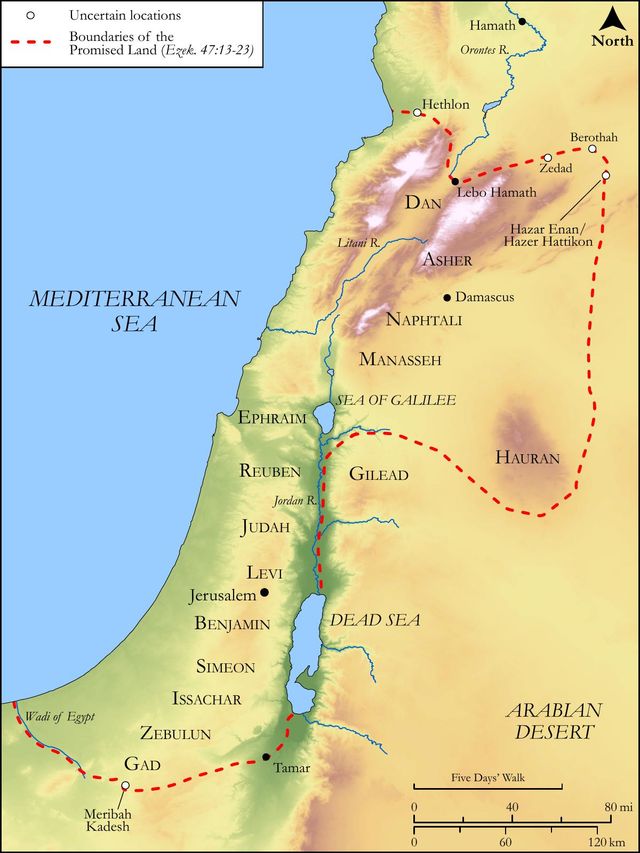
See on the biblical-era map
Study this verse
Historical interpretation
Historical reception
1 surviving comment on this verse from the historical church.
(Verse 13 and following) But the Levites shall have a portion like the priests, consisting of twenty-five thousand cubits in length and ten thousand cubits in width; the whole length shall be twenty-five thousand cubits and the width ten thousand cubits. They shall not sell any of it or exchange it, nor shall the firstfruits of the land be taken away from it, for they are holy to the Lord. The remaining five thousand cubits in width, along the twenty-five thousand, shall be for common use by the city for dwellings and common land, and the city shall be in the middle of it. What we translate as 'profane', Aquila translated as 'βέβηλον', Symmachus and Theodotion translated as 'λαἳκὸν'; the LXX used 'προτείχισμα' which can also be translated as 'antemurale'. 'Profane' and 'laicum' are both secular, that is, common, and can be used by all people everywhere. However, what the LXX said: 'It will not be measured, nor will it be taken away,' is clear that it does not have the same meaning as what we said: 'It will not be changed, nor will it be transferred.' The possession of the Levites is also described, which is indeed adjacent to the territories of the priests, and it has the same dimensions in length and breadth according to the number of Levites, which has the same number as the priests, but it uses its own boundaries and understands itself to be separate from the priestly rank: to remove the pride of the ministers, who, ignorant of the humility of their position, swell up beyond the priests, that is, the elders, and think of themselves as having dignity not by merit, but by wealth. Certainly, the one who is the first among ministers, because he preaches to the people individually and does not depart from the side of the Pontiff, considers it an injury if he is ordained a presbyter. And he does not remember that he is a minister of the altars and widows, entrusted not only to the service and ministry of the priests, but also to the widows and the poor. And they shall not sell, he says, nor exchange, so that the eternal possession of the Levitical distribution may remain, nor shall the worthiness of dignity be overcome by price, nor shall we transfer from one to another: for what has been sanctified to the Lord belongs not to those to whom it has been given, but to Him in whose name it is possessed. However, the remaining five thousand in width, by twenty-five thousand, is understood to be the length, will be profane of the city: so that it is lawful for all the Israelites and every member of the people to dwell there; not because they are unclean or because anything in the habitation of the holy land is contaminated, putrid, and filthy; but because, apart from the priests, it is permitted for everyone to dwell in them. By this we understand that all the things we refer to as sensations, that is, bodily pleasures that we perceive by sight, hearing, touch, smell, and taste, are profane and do not have the sanctity of the temple, nor do they have the privilege of the priesthood, but rather they belong to the realm of the laity and commoners. However, the city will be in the middle, concerning which it is written: The stream of the river makes the city of God glad (Ps. 46:4). And: A city set on a hill cannot be hidden (Matthew 5:14): of which we will speak in the following. Προτείχισμα, which means a fortification, and διάστημα, which means a space, which the LXX translated as suburbs, we do not know the meaning they have in this place.
Continue studying Ezekiel 48:13 across the web’s major study libraries — every link below opens this exact verse, chapter, or book on the destination site.
Read & Compare
 BibleGatewayThis verse in more than 200 translations and 70 languages.
 Bible.comThe YouVersion reader — hundreds of translations, reading plans, and highlights.
 ESV.orgCrossway's official English Standard Version reader.
 NET BibleThe NET translation with 60,000+ translators' notes on every rendering decision.
 STEP BibleTyndale House's free study tool — original text, vocabulary, and scholarly resources.
 BibliaLogos Bible Software's free web reader.
 USCCBThe New American Bible (Revised Edition) with the U.S. bishops' study notes.
Commentaries
 BibleHub CommentariesDozens of classic commentaries on this verse, gathered on one page.
 StudyLightMore than 100 commentary sets — the largest collection on the web.
 BibleRefPlain-English commentary on what this verse means, verse by verse.
 Enduring WordDavid Guzik's free commentary on this chapter, widely used by Bible teachers.
 Bible Study ToolsVerse commentary alongside Greek and Hebrew study aids.
Original Language & Research
- BibleHub InterlinearThe verse word by word — original language, transliteration, and English.
- BibleHub LexiconEvery word's original-language definition and Strong's entry.
 Blue Letter BibleDeep-study tools — Strong's numbers, concordance, and word studies.
 SefariaThe Hebrew text with Rashi and centuries of Jewish commentary.
Sermons, Hymns & Audio


TrulyRandomVerse is not affiliated with these sites and doesn’t control their content. They’re linked because they’re genuinely useful.
Summary
Ezekiel 48:13 meticulously details the precise land allocation for the Levites within the visionary temple complex, positioning their designated territory directly adjacent to the portion set aside for the priests. This specific measurement—twenty-five thousand units in length and ten thousand units in breadth, reiterated for emphasis—underscores God's divine order, His meticulous provision for those consecrated to His service, and the distinct yet complementary sacredness of the areas designated for priestly and Levitical ministry in the restored covenant community. It stands as a testament to the comprehensive, orderly, and generous nature of God's future kingdom and His faithfulness to His servants.
Context
ShowHideLiterary Context
Ezekiel 48:13 is situated within the climactic vision of Ezekiel, specifically in chapters 40-48, which describe a highly detailed blueprint for a new temple, a reorganized priesthood, and the meticulous reallocation of the land among the twelve tribes of Israel. This grand prophetic vision, delivered during the Babylonian exile, served as a profound message of hope, restoration, and the re-establishment of God's glorious presence among His people. More precisely, chapters 45-48 delineate the "holy oblation" or sacred reserve of land (referenced in Ezekiel 48:8) that is set apart for the sanctuary, the priests, and the Levites. The verse immediately preceding, Ezekiel 48:12, describes the priests' portion, and verse 13 clarifies that the Levites' land is "over against the border of the priests," emphasizing their complementary roles and physical proximity within this central, sacred district. This careful arrangement highlights the structured, hierarchical, and divinely ordained nature of the restored community and its worship.
Historical & Cultural Context
The vision of Ezekiel 40-48 was given during a period of immense despair for the Jewish people, who had suffered the destruction of their first temple, the loss of their land, and the dissolution of their national identity in the Babylonian exile. In this context, the detailed architectural and land-division blueprint served as a powerful promise of future restoration and God's unwavering faithfulness to His covenant. Culturally, land inheritance was paramount to Israelite identity, signifying God's blessing and secure dwelling. The specific provision for the Levites, who traditionally had no tribal land inheritance but were supported by tithes and offerings (as seen in Numbers 18:21-24), signifies God's direct, ample, and secure provision for those dedicated to sacred service. The emphasis on precise measurements throughout Ezekiel 40-48 reflects the care with which the land was marked out in the days of Joshua and the critical importance of order and sanctity in the sanctuary, reinforcing the idea of a divinely ordained, perfect system for God's dwelling among His people.
Key Themes
ShowHideThis verse significantly contributes to several overarching themes within Ezekiel's vision and the broader biblical narrative. Firstly, it underscores Divine Order and Precision. The meticulous dimensions given for the Levites' portion, mirroring the exactitude seen throughout Ezekiel 40-48, emphasize God's absolute sovereignty and His design for a perfectly ordered kingdom. Secondly, it highlights Provision for Service. Just as the priests were given their inheritance, the Levites, consecrated to assist in temple functions and maintain its sanctity, are amply provided for, demonstrating God's faithfulness in sustaining those dedicated to His work. This theme resonates with the broader biblical principle of supporting those in ministry, as seen in the Mosaic Law and later in the New Testament (e.g., 1 Corinthians 9:14). Finally, the distinct and measured portions for both priests and Levites emphasize Holiness and Separation, reinforcing their unique, sanctified roles within the holy land, set apart from the common tribal lands, and underscoring the sacredness of their calling and the space they inhabit, all pointing to the ultimate presence of God in their midst.
Exposition and Analysis
ShowHideKey Word Analysis
ShowHideProperly, a cord (as twisted), implying a boundary. By extension, it refers to the territory enclosed, a limit, or a quarter. In Ezekiel 48:13, "over against the border of the priests" denotes the precise demarcation line adjacent to the priests' sacred land, emphasizing the distinct, yet contiguous, allocation for the Levites. This word reinforces the theme of divine order and the clear separation of sacred spaces within the visionary land distribution.
Patronymically, a descendant of Levi. These were the tribe designated for service in the tabernacle and temple, assisting the priests in various duties, including maintaining the sanctuary, transporting sacred items, and performing musical worship. Their specific land allocation here highlights their continued, vital role in the future temple economy, signifying God's ongoing provision and recognition of their consecrated service, ensuring their ability to fulfill their duties without worldly concerns.
Primarily a numeral, signifying a large quantity. In the context of Ezekiel's measurements (e.g., 25,000 and 10,000), it refers to units of "reeds," a standard measurement unit in the vision. The repetition of "thousand" alongside the numbers emphasizes the immense scale and ample provision of the land, far exceeding mere practical needs and underscoring the divine generosity and the grandeur of the restored kingdom, highlighting God's abundant care for His servants.
Verse Breakdown
ShowHide"And over against the border of the priests"
This phrase establishes the geographical relationship of the Levites' portion within the larger sacred reserve. It indicates that their land is directly adjacent to, or facing, the sacred territory already designated for the priests (as described in Ezekiel 48:10-12). This proximity highlights their interconnected and complementary roles in temple service and the overall sacredness of this central "holy oblation" within the reallocated land, emphasizing a divinely ordered proximity for sacred functions.
"the Levites [shall have] five and twenty thousand in length, and ten thousand in breadth"
This clause specifies the precise dimensions of the land allocated to the Levites. The measurements are understood to be in "reeds," a unit of measure established earlier in the vision (Ezekiel 40:5). This translates to a substantial area (25,000 reeds by 10,000 reeds), signifying a generous and ample provision for the Levites, who traditionally did not receive a tribal land inheritance but were sustained by tithes. This grand scale underscores God's abundant care for those dedicated to His service.
"all the length [shall be] five and twenty thousand, and the breadth ten thousand"
This final clause reiterates and confirms the exact dimensions, emphasizing the precision, immutability, and certainty of the divine allocation. The repetition serves to underscore the meticulous planning and the absolute certainty of God's design for the restored land and the roles of those who serve Him within it. It leaves no ambiguity regarding the size and scope of the Levites' inheritance, reinforcing the divine order and permanence of this arrangement.
Literary Devices
ShowHideEzekiel 48:13 primarily employs Precision and Repetition to convey its message. The meticulous detailing of "five and twenty thousand in length, and ten thousand in breadth" for the Levites' portion, and the subsequent exact repetition of these dimensions, underscores the divine architect's absolute control and the perfect order of the future kingdom. This Precision is not merely for practical measurement but serves as a literary device to symbolize God's comprehensive planning and His unwavering commitment to a perfectly structured new creation where everything is in its divinely appointed place. The Repetition of the measurements reinforces their significance, immutability, and the certainty of God's provision and the established order. Furthermore, the verse contributes to the overarching Symbolism of the entire vision, where the physical layout of the land and temple represents spiritual realities of God's presence, holiness, and the ordered life of His redeemed people, all pointing to a perfect, divinely orchestrated future.
Theological and Thematic Connections
ShowHideEzekiel 48:13, with its precise allocation for the Levites, deeply resonates with the biblical theme of God's faithful and abundant provision for those consecrated to His service. Throughout Israel's history, the Levites, set apart for temple duties, were sustained by the offerings and tithes of the other tribes, as they received no direct land inheritance (e.g., Numbers 18:20-24). This verse in Ezekiel's vision elevates that provision to a grand, territorial scale, demonstrating God's ultimate intention to abundantly bless and secure the livelihood of those dedicated to Him. It speaks to God's character as a meticulous provider who ensures that His servants are cared for, enabling them to focus on their sacred duties without worldly distraction. This principle extends beyond the Old Covenant, affirming that God continues to provide for those who serve Him in the New Covenant, though the nature of service and provision has transformed from physical land to spiritual inheritance and divine sustenance.
Reflection and Application
ShowHideEzekiel 48:13 offers profound insights for believers today, reminding us of God's meticulous nature and His unwavering commitment to those who serve Him. The vast and precise allocation for the Levites, who were set apart for sacred duties, serves as a powerful metaphor for God's abundant provision for His people in every generation. It encourages us to trust in God's faithfulness, knowing that if He meticulously plans for a future earthly temple and its ministers, how much more will He care for us, His spiritual temple and priests in Christ. This passage also calls us to consider the importance of order and intentionality in our own service to God, recognizing that He is a God of order, not chaos. It challenges us to dedicate ourselves fully to His purposes, confident that He will equip and sustain us for every good work, ensuring that our spiritual "inheritance" in Him is secure and ample, enabling us to live lives of focused devotion and service without undue anxiety.
Questions for Reflection
ShowHideFAQ
ShowHideWhat do the measurements "five and twenty thousand" and "ten thousand" signify in Ezekiel 48:13?
ShowHideThese measurements refer to units of "reeds," not miles or cubits directly. As specified in Ezekiel 40:5, one reed is equivalent to six cubits. Therefore, the Levites' portion is 25,000 reeds in length and 10,000 reeds in breadth. This represents a vast and ample land allocation, far exceeding what would be practically necessary, underscoring the generosity and grandeur of God's provision for those consecrated to His service in this visionary kingdom. The emphasis is on the immense scale and divine abundance, rather than a literal geographical mapping for today, highlighting God's overflowing care.
Is this vision of the temple and land division in Ezekiel 40-48 literal or symbolic?
ShowHideThe interpretation of Ezekiel 40-48, including the land division in Ezekiel 48, is a subject of ongoing theological debate. Some interpret it as a literal blueprint for a future millennial temple and land distribution in Israel, often associated with a future earthly reign of Christ. Others view it as primarily symbolic, representing the spiritual realities of God's presence, perfect order, and abundant provision in the New Covenant church or in the eternal state. A common approach is to see it as a blend of both, with the precise details conveying a profound spiritual truth about God's holiness, order, and desire to dwell among His people, even if the exact physical manifestation remains debated or is ultimately fulfilled in a spiritual sense through Christ and His church.
Christ-Centered Fulfillment
ShowHideWhile Ezekiel 48:13 describes a specific, meticulously measured land allocation for the Levites in a future earthly temple, its deepest and most profound fulfillment is found in Jesus Christ and the New Covenant reality He inaugurated. The Levites' portion signified God's provision for those set apart for sacred service, and in Christ, all believers are made a "royal priesthood" and a "holy nation" (1 Peter 2:9), called to offer spiritual sacrifices of praise and good works. Jesus Himself is the ultimate High Priest (Hebrews 4:14), who, through His single, perfect sacrifice on the cross, fulfilled and transcended the need for Levitical offerings and priestly mediation. The meticulous land division, ensuring ample provision and order for God's servants, foreshadows the spiritual inheritance believers receive in Christ—an inheritance that is eternal, incorruptible, and far transcends any earthly plot of land (1 Peter 1:4). Furthermore, the vision of a perfectly ordered sacred space points to the new heavens and new earth, where God's presence is fully realized among His people in the New Jerusalem, a city with perfect dimensions and no need for a physical temple, for "the Lord God Almighty and the Lamb are its temple" (Revelation 21:22). Thus, the ample provision for the Levites in Ezekiel's vision finds its ultimate, glorious reality in Christ's complete provision for His people and the eternal dwelling of God with His redeemed in perfect order and abundance.