


Ezekiel 23:7
Bible text: King James Version (1769 Blayney text) · Public domain
Bible text: King James Version with Strong's numbers · Public domain
Bible text: Berean Standard Bible · Public domain
Bible text: American Standard Version (1901) · Public domain
Bible text: World English Bible, Messianic edition · Public domain
Bible text: Geneva Bible (1599) · Public domain
Bible text: Young's Literal Translation · Public domain
- וַתִּתֵּןva·ti·Tenand she gaveH5414Conj-w ¦ V-Qal-ConsecImperf-3fsVerb Qal Consecutive Imperfect 3rd Singular Feminineוַandתִּתֵּןshe gave
- תַּזְנוּתֶיהָtaz·nu·Tei·haher prostitution<s>H8457N-mpc ¦ 3fsNoun Plural Masculine Constructתַּזְנוּתֶיprostitution<s>הָher
- עֲלֵיהֶם'a·lei·Hemto themH5921Prep ¦ 3mpPrepositionעֲלֵיtoהֶםthem
- מִבְחַרmiv·Char[were] [the] choicest ofH4005N-mscNoun Singular Masculine Construct
- בְּנֵיbe·nei[the] sons ofH1121N-mpcNoun Plural Masculine Construct
- אַשּׁוּר'a·ShurAssyriaH804N-properNoun Proper Location
- כֻּלָּםku·Lamall of themH3605N-msc ¦ 3mpNoun Singular Masculine Constructכֻּלָּall ofםthem
- וּבְכֹלu·ve·Kholand by allH3605Conj-w ¦ Prep-b ¦ N-msNoun Singular Masculine Absoluteוּandבְbyכֹלall
- אֲשֶׁר'a·Sher[those] whomH834RelParticle Relative
- עָגְבָה'a·ge·Vahshe lusted afterH5689V-Qal-Perf-3fsVerb Qal Perfect 3rd Singular Feminine
- בְּכָלbe·kholby allH3605Prep-b ¦ N-mscNoun Singular Masculine Constructבְּbyכָלall
- גִּלּוּלֵיהֶםgi·lu·lei·Hemtheir idolsH1544N-mpc ¦ 3mpNoun Plural Masculine Constructגִּלּוּלֵיidolsהֶםtheir
- נִטְמָאָהnit·Ma·'ahshe made herself uncleanH2930V-Niphal-Perf-3fsVerb Niphal Perfect 3rd Singular Feminine
English is a literal word-by-word gloss of the Hebrew, not the KJV's wording. Why?
This is the original text the KJV's translators worked from — each Hebrew word with its own literal English meaning in this verse, prepared by scholars at Tyndale House, Cambridge. The KJV translates whole sentences, not word by word, so its wording differs: one Hebrew word can become several English words, and the KJV may choose “the LORD” where the gloss reads “Yahweh”. Both are faithful — they answer different questions. For the KJV's own rendering, switch to the KJV text.
Details
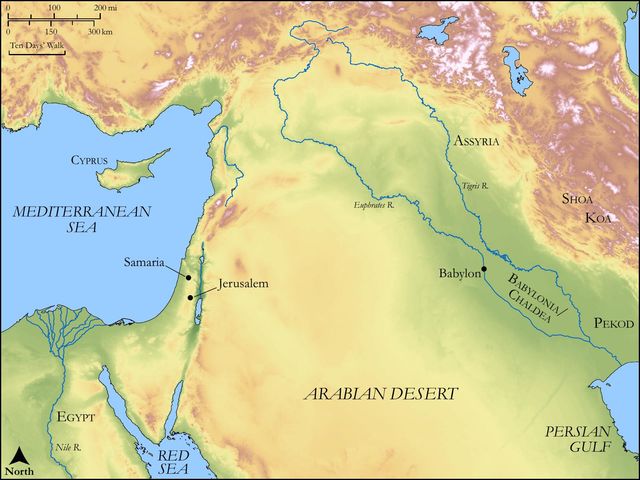
See on the biblical-era map
Study this verse
Public-domain commentary
Matthew Henry
From his Commentary on the Whole Bible. Henry comments on passages, not single verses — this entry covers Ezekiel 23:1–10.
God had often spoken to Ezekiel, and by him to the people, to this effect, but now his word comes again; for God speaks the same thing once, yea, twice, yea, many a time, and all little enough, and too little, for man perceives it not. Note, To convince sinners of the evil of sin, and of their misery and danger by reason of it, there is need of line upon line, so loth we are to know the worst of ourselves. The sinners that are here to be exposed are two women, two kingdoms, sister-kingdoms, Israel and Judah, daughters of one mother, having been for a long time but one people. Solomon's kingdom was so large, so populous, that immediately after his death it divided into two. Observe, 1. Their character when they were one (Eze 23:3): They committed whoredoms in Egypt, for there they were guilty of idolatry, as we read before, Eze 20:8. The representing of those sins which are most provoking to God and most ruining to a people by the sin of whoredom plainly intimates what an exceedingly sinful sin uncleanness is, how offensive, how destructive. Doubtless it is itself one of the worst of sins, for the worst of other sins are compared to it here and often elsewhere, which should increase our detestation and dread of all manner of fleshly lusts, all appearances of them and approaches to them, as warring against the soul, infatuating sinners, bewitching them, alienating their minds from God and all that is good, debauching conscience, rendering them odious in the eyes of the pure and holy God, and drowning them at last in destruction and perdition. 2. Their names when they became two, Eze 23:4. The kingdom of Israel is called the elder sister, because that first made the breach, and separated from the family both of kings and priests that God had appointed - the greater sister (so the word is), for ten tribes belonged to that kingdom and only two to the other. God says of them both, They were mine, for they were the seed of Abraham his friend and of Jacob his chosen; they were in covenant with God, and carried about with them the sign of their circumcision, the seal of the covenant. They were mine; and therefore their apostasy was the highest injustice. It was alienating God's property, it was the basest ingratitude to the best of benefactors, and a perfidious treacherous violation of the most sacred engagements. Note, Those who have been in profession the people of God, but have revolted from him, have a great deal to answer for more than those who never made any such profession. "They were mine; they were espoused tome, and to me they bore sons and daughters;" there were many among them that were devoted to God's honour, and employed in his service, and were the strength and beauty of these kingdoms, as children are of the families they are born in. In this parable Samaria and the kingdom of Israel shall bear the name of Aholah - her own tabernacle, because the places of worship which that kingdom had were of their own devising, their own choosing, and the worship itself was their own invention; God never owned it. Her tabernacle to herself (so some render it); "let her take it to herself, and make her best of it." Jerusalem and the kingdom of Judah bear the name of Aholibah - my tabernacle is in her, because their temple was the place which God himself had chosen to put his name there. He acknowledged it to be his, and honoured them with the tokens of his presence in it. Note, Of those that stand in relation to God, and make profession of his name, some have greater privileges and advantages than others; and, as those who have greater are thereby rendered the more inexcusable if they revolt from God, so those who have less will not thereby be rendered inexcusable. 3. The treacherous departure of the kingdom of Israel from God (Eze 23:5): Aholah played the harlot when she was mine. Though the ten tribes had deserted the house of David, yet God owned them for his still; though Jeroboam, in setting up the golden calves, sinned, and made Israel to sin, yet, as long as they worshipped the God of Israel only, though by images, he did not quite cast them off. But they way of sin is down-hill. Aholah played the harlot, brought in the worship of Baal (Kg1 16:31), set up that other god, that dunghill-god, in competition with Jehovah (Kg1 18:21), as a vile adulteress dotes on her lovers, because they are well dressed and make a figure, because they are young and handsome (Eze 23:6), clothed with blue, captains and rulers, desirable young men, genteel, and that pass for men of honour, so she doted upon her neighbours, particularly the Assyrians, who had extended their conquests near them; she admired their idols and worshipped them, admired the pomp of their courts and their military strength and courted alliances with them upon any terms, as if her own God were not sufficient to be depended upon. We find one of the kings of Israel giving a thousand talents to the king of Assyria, to engage him in his interests, Kg2 15:19. She doted on the chosen men of Assyria, as worthy to be trusted and employed in the service of the state (Eze 23:7), and on all their idols with which she defiled herself. Note, Whatever creature we dote upon, pay homage to, and put a confidence in, we make an idol of that creature; and whatever we make an idol of we defile ourselves with. And now again the conviction looks back as far as the original of their nation: Neither left she her whoredoms which she brought from Egypt, Eze 23:8. Their being idolaters in Egypt was a thing never to be forgotten - that they should be in love with Egypt's idols even when they were continually in fear of Egypt's tyrants and task-masters! But (as some have observed) therefore, at that time, when Satan boasted of his having walked through the earth as all his own, to disprove his pretensions God did not say, Hast thou considered my people Israel in Egypt? (for they had become idolaters, and were not to be boasted of), but, Hast thou considered my servant Job in the land of Uz? And this corrupt disposition in them, when they were first formed into a people, is an emblem of that original corruption which is born with us and is woven into our constitution, a strong bias towards the world and the flesh, like that in the Israelites towards idolatry; it was bred in the bone with them, and was charged upon them long after, that they left not their whoredoms brought from Egypt. It would never out of the flesh, though Egypt had been a house of bondage to them. Thus the corrupt affections and inclinations which we brought into the world with us we have not lost, nor got clear of, but still retain them, though the iniquity we were born in was the source of all the calamities which human life is liable to. 4. The destruction of the kingdom of Israel for their apostasy from God (Eze 23:9, Eze 23:10): I have delivered her into the hand of her lovers. God first justly gave her up to her lust (Ephraim is joined to idols, let him alone), and then gave her up to her lovers. The neighbouring nations, whose idolatries she had conformed to and whose friendship she had confided in, and in both had affronted God, are now made use of as the instruments of her destruction. The Assyrians, on whom she doted, soon spied out the nakedness of the land, discovered her blind side, on which to attack her, stripped her of all her ornaments and all her defences, and so uncovered her, and made her naked and bare, carried her sons and daughters into captivity, slew her with the sword, and quite destroyed that kingdom and put an end to it. We have the story at large Kg2 17:6, etc., where the cause of the ruin of that once flourishing kingdom by the Assyrians is shown to be their forsaking the God of Israel, fearing other gods, and walking in the statutes of the heathen; it was for this that God was very angry with them and removed them out of his sight, Eze 23:18. And that the Assyrians, whom they had been so fond of, should be employed in executing judgments upon them was very remarkable, and shows how God, in a way of righteous judgment, often makes that a scourge to sinners which they have inordinately set their hearts upon. The devil will for ever be a tormentor to those impenitent sinners who now hearken to him and comply with him as a tempter. Thus Samaria became famous among women, or infamous rather; she became a name (so the word is); not only she came to be the subject of discourse, and much talked of, as the desolations of cities and kingdoms fill the newspapers, but she was thus ruined for her idolatries in terrorem - for warning to all people to take heed of doing likewise; as the public execution of notorious malefactors makes them such a name, such an ill name, as may serve to frighten others from those wicked courses which have brought them to a miserable and shameful end. Deu 21:21, All Israel shall hear and fear.
Historical interpretation
Historical reception
4 surviving comments on this verse. Each one is dated, so this reads as a timeline rather than a list.
(Chapter 23, verses 1 onwards) And the word of the Lord came to me, saying: Son of man, there were two women, the daughters of one mother. And they played the harlot in Egypt, in their youth they played the harlot. There their breasts were pressed and their virgin bosoms were broken (or, as it is in the Septuagint, There their breasts fell and there they were deflowered). Their names were Oholah the elder (or, the elder sister), and Oholibah her sister. And I took them (whether they were given to me) and they bore sons and daughters. And their names were Samaria Oolla and Jerusalem Ooliba. Therefore, Oolla prostituted herself with me and she went mad (or went away) to her lovers in Assyria, who approached her, dressed in purple, rulers and officials, all young men, choice horsemen. And she gave her fornications over them, all the elect sons of Assyria, and in all on whom she had been mad upon with her uncleanness (or inventions), she was defiled. Moreover, she did not leave her fornications which she had in Egypt. For they also had slept with her in her youth, and they broke the breasts of her puberty (or they also deflowered her): and they poured their fornication over her. Therefore, I handed her over to the hands of her lovers, to the hands of the sons of Assyria, on whose lust she had gone mad. They uncovered her shame; they took away her sons and daughters, and killed her with the sword. And she became a byword among women; judgments were executed upon her. The Scripture testifies that the twelve tribes of Israel, which were united in Egypt, later divided into two and ten tribes, called Judah and Israel, as recorded in the books of Kings and Chronicles. The tribe of Judah ruled from the line of David, with Rehoboam as the son of Solomon in Jerusalem, where there was a temple and priests, and a large part of the tribe of Levi. But in Samaria, Jeroboam the son of Nabat from the tribe of Ephraim and Joseph ruled over the ten tribes; of which Samaria is now called Oolla, which in our language means tabernacle: but Jerusalem is called Ooliba, which means my tabernacle in it. For indeed, even among the ten tribes, there was a tabernacle not of God, but of idols. For Jeroboam had set up golden calves in Dan and Bethel in order to turn the people away from the worship of God. Let us therefore speak about each. These two women, Samaria and Jerusalem, were daughters of the same mother from the lineage of Israel, and they committed adultery in Egypt during their youth. For they would not have received the Law when they were brought out of Egypt and gathered at Mount Sinai, which prohibited them from worshiping idols, unless they had worshiped Egyptian idols while in Egypt. However, the mother of both could be Chethaea, of whom we read above: Your father was Amorrhaeus, and your mother was Chethaea (Above, XVI, 3). But when it is said: Let each one remove the abominations of Egypt from his sight, it signifies that in Egypt the Israelites worshipped idols and fell there, whether their breasts of virginity were broken or not. And Samaria is said to be greater and older, either because of the multitude of the ten tribes, or because after the death of Moses from the tribe of Ephraim, Joshua the son of Nun led the people: hence we read that Jeroboam, who split them, was from the house of David (3 Kings, XII). And God had them, whether they were made by him, when they groaned from the works of Egypt, serving clay and brick. And afterwards they bore sons and daughters, either in the wilderness or in the promised land. And first Oolla, that is, Samaria, fornicated against God, when she went mad for the Assyrians, who were dressed in her hyacinth garments, not just any people, but leaders and magistrates, not those worn out by age, but all young men, chosen horsemen, from whom she followed idols and from whom she demanded help against the command of God. Those who came and defiled her, did not leave anything that she had done in her youth in Egypt. For even the Egyptians had sexual relations with her in her youth, of whom she worshiped their idols; and there, her virginity was taken and her breasts were broken. And there was such an abundance of fornication, that it is said that they did not fornicate with her, but rather poured out their own fornication upon her. Therefore, she was delivered to her lovers, Phul, Theglathphalassar, and Salmanasar, in whose lust she went mad, and they uncovered her shame, metaphorically, like that of a harlot woman (2 Kings 17 and 18, 1 Chronicles 5). However, the revelation of the city is that it is captured, and they took captive its sons and daughters, and they slaughtered it with the sword, so that it is butchered as an example for all women, and it is celebrated in a negative way by everyone's speech. Those who carried out judgments and vengeance in it, so that they left nothing of salvation in it; but to this day, ten tribes are held captive in the mountains and cities of the Medes, to which they were transferred. We have discussed more fully the allegorical meaning of Joseph, Ephraim, Samaria, Jezreel, and Israel, and how they are contrary to the house of David and Jerusalem, which signifies the Church. The psalm, which is the seventy-seventh, speaks of this: The sons of Ephraim, being armed and carrying bows, turned back in the day of battle (Psalm 77:9). And again: He rejected the tabernacle of Joseph and chose the tribe of Judah (Ibid., 67). For God has chosen the house of confession, which is the Church, and rejected the tabernacle of Joseph, which signifies increase. They, neglecting the Law of God, added golden calves to their worship, and they are called Oolla, which means tabernacle, not of God, but of error and demons. And the elder and older sister, because of the multitude and captivity by the Assyrians, committed fornication against God, for she abandoned the truth of faith and went mad for the leaders of the heretics, who were clothed in hyacinth, promising her lofty and heavenly things; and the climbers, of whom it is said: These are in chariots, and on horses (Ps. XIX, 8), chosen sons of the Assyrians and leaders and magistrates, who promise themselves knowledge and eloquence. But he did this because he had the same fornications that he had in Egypt, that is, before he believed, and he still lived in the world, he also practiced them in heresy. And she was deflowered (or They were deflowered) by Assyrian men who persist in wickedness, whether as avengers. For our adversary, the devil himself, is an enemy and avenger (I Peter V). They shattered the breasts of Samaria; and they destroyed her virginity that she had in the Church. Therefore, they were delivered to their lovers, according to the Apostle who writes: I have delivered them to Satan, so that they may learn not to blaspheme (I Tim. I, 20). And: I have delivered them to the destruction of the flesh, so that the spirit may be saved (I Cor. V, 5). They uncovered the shame of miserable Samaria, and they displayed all its turpitude, leading captive the sons and daughters who were born to it, endowed with knowledge and deceived the simple and inexperienced, and killed it with a spiritual sword. They are celebrated in speech throughout the whole world in a negative light, and they become infamous among all the teachings of the world, so that the depravity of that woman may serve as an example for all.
(Verse 35, 36, and following) And I will bring you into a desert of peoples, and there I will judge you face to face. Just as I contended with your fathers in the desert of the land of Egypt, so I will judge you, says the Lord. And I will subject you to my scepter, and I will bring you into the bonds of the covenant, and I will choose from among you the transgressors and the wicked: from their place of residence I will bring them out, and they will not enter the land of Israel, and you will know that I am the Lord. Thus says the Lord: I will do for you who are in Babylon, and now serve idols, what I did for your ancestors in Egypt. I will lead you into the desert of the peoples, and there I will judge you face to face, just as I contended with them in judgment when they came out of Egypt. And after I have judged you, I will subject you to my scepter and rule, and I will make a covenant with you and bring you into your land with the bonds of love, so that bound by my love, you will never be able to depart from me. But I will choose from among you the transgressors and the wicked, who persist in the hardness of their hearts in evil deeds, not for possession, but for rejection. And I will indeed bring them out of the land of their dwelling, so that when they are brought out, they will not enter the land of Israel; but they will perish in various regions. And by the distinction between good and evil, you shall know that I am the Lord, who judges all things. The rest of the discourse hastens, and we briefly go through each point, in order to provide only the meaning to the readers.
(Ver. 23, 24 onwards) Again, I raised my hand against them in the wilderness, to scatter them among the nations and disperse them in the lands, because they had not performed my judgments, and had rejected my commandments, and had violated my Sabbaths, and their eyes had been after the idols (or thoughts) of their fathers. Therefore, I also gave them statutes that were not good, and judgments in which they would not live, and I defiled them in their offerings (or transgressions), as they offered (or led astray) everything that opens the womb because of their sins (for which the Septuagint translated, to destroy them and what they had overlooked): and they will know that I am the Lord. Where in the Old Testament, against their children, who fell in the wilderness, the Lord lifted up His hand to scatter them among the nations, Scripture does not say; but it is to be believed that this was done in accordance with what is reported here. Or he signifies by this, that after they entered the promised land, they were given over at various times, for many sins, to different nations and kings, and at that time the commandments of the Lord, which were good according to their nature, and the judgments by which believers could live, were made not good for them, since they were in no way able to keep the precepts of the law in captivity, and to do what the divine word commanded. He did not say, 'I gave them evil commandments,' but, 'not good commandments.' For it does not immediately follow that what is not good is evil, as the Apostle teaches, it is good for a man not to touch a woman; but because of incontinence, let each possess his own vessel in sanctification and honor (I Cor. VII). And if he does not do this, it is neither good nor evil. Therefore, God gave them, dispersed among the nations, not good commandments, that is, he allowed them to follow their own thoughts and desires, to do what is not appropriate. And he defiled them in his gifts: just as a Priest separates lepers from the people, and shows that they are defiled; while they offer to idols what they should offer to God. And they pass everything that opens the womb through the fire of Baal, that is, the firstborn; so that after they have deserted God and been handed over to the worship of idols, then they may understand that He is the Lord whom they have provoked to anger by their own fault. Symmachus interpreted this passage more explicitly, treating the future as past. Therefore, I will also give them bad precepts and judgments for which they will not live, and I will defile them because of their gifts, as they consecrate and offer everything that opens the womb, so that I may destroy them, and they will know that I am the Lord. And the meaning is this: because I have seen the sons of the fathers equaling the wickedness of their ancestors and doing the same things for which they offended God, I wanted to divide them into nations and disperse them throughout the whole world, and give them bad precepts and judgments in which they would not live, so that I may defile them with their gifts, for they consecrated everything that opens the womb to idols, and I may destroy them forever, and they will know that I am the Lord. Through which he showed that he had not given them good commandments who dwelt in the wilderness, but to those whom he wanted to scatter among the nations, and to make foreigners in the whole world, he gave them a desire for things that he did not give: so that there they would do good commandments of God, not good because of their own fault, while they exhibited to idols what God had commanded to be exhibited. This can also be said, that before the offense, they received only the Ten Commandments; but after idolatry and blasphemy, they received multiple ceremonies of the law, so that they would offer victims to God rather than to demons, and by comparison with sacrilege, what was not good in itself became lighter, and by no means evil, because it was offered to God, and yet not good, because they offended the author of good.
(Verse 27, 29 onwards) Therefore speak to the house of Israel, son of man, and tell them: Thus says the Lord God: Moreover, your fathers have blasphemed against me and have treated me with contempt, even as they spurned me. And I brought them into the land that I had lifted my hand to give them ((Vulgate adds: that land)): they saw every high hill and every leafy tree, and there they offered their sacrifices and presented there the irritation of their offerings, and they placed there the fragrance of their sweetness, and they poured out their ((Vulgate is silent on this)) libations there. And I said to them, 'What is the high place to which you are going?' And its name was called the High Place until this day. Therefore speak to the house of Israel, son of man, and say to them, 'Thus says the Lord God: As for your fathers, they have provoked Me to anger by their iniquities, by the fact that they have fallen away from Me. So I brought them into the land that I had lifted My hand in an oath to give them.' They saw every high hill and every leafy tree, and there they offered their sacrifices. They also presented there the provocation of their gifts, and they set there their pleasing aroma, and they poured out there their drink offerings. And I said to them: What is abbana, because you enter there? And they called its name abbana until this day. I wanted, he said, to scatter them in the wilderness, and to give them not good precepts, so that they would sacrifice to idols what they should have offered to me, and consecrate all their first-fruits to them by fire, so that I might kill them and destroy them. But when he says, I wanted, he shows that he did not do what he wanted. And that which follows: 'And they shall know that I am the Lord,' is not found in the Septuagint. For it did not seem fitting to them to know after their destruction that he himself is the Lord. But you, son of man, speak again to them, that is, to the elders of the house of Israel, who have come to inquire of you: Your fathers, from whom you have descended, have also blasphemed against me and held me in contempt; after I brought them into the land which I had given them to possess, they turned against me to provoke me. For when they saw every high hill and leafy tree, they would sacrifice on the mountains and in the groves and thickets, and offer victims to the idols, and pour out libations. And when I saw this, I said to them: What is this, Bama? for it is called high: or why do you enter into such a place which you have chosen for yourselves in all the hills, so that even today these places are called Bamoth, and the ancient error retains its original name? Regarding Bama, which we translate as excelsum, there is an error in the Septuagint edition, where it is written as ἀββανὰ, which does not resonate in the Hebrew language. Bama can mean 'in which' if the two syllables are divided into two words, but in the present context, that sense does not fit. However, wherever it is written in the Books of Kings and Chronicles: 'The people still sacrificed and offered incense on the high places,' Bama in the singular and Bamoth in the plural mean 'high places.'
Continue studying Ezekiel 23:7 across the web’s major study libraries — every link below opens this exact verse, chapter, or book on the destination site.
Read & Compare
 BibleGatewayThis verse in more than 200 translations and 70 languages.
 Bible.comThe YouVersion reader — hundreds of translations, reading plans, and highlights.
 ESV.orgCrossway's official English Standard Version reader.
 NET BibleThe NET translation with 60,000+ translators' notes on every rendering decision.
 STEP BibleTyndale House's free study tool — original text, vocabulary, and scholarly resources.
 BibliaLogos Bible Software's free web reader.
 USCCBThe New American Bible (Revised Edition) with the U.S. bishops' study notes.
Commentaries
 BibleHub CommentariesDozens of classic commentaries on this verse, gathered on one page.
 StudyLightMore than 100 commentary sets — the largest collection on the web.
 BibleRefPlain-English commentary on what this verse means, verse by verse.
 Enduring WordDavid Guzik's free commentary on this chapter, widely used by Bible teachers.
 Bible Study ToolsVerse commentary alongside Greek and Hebrew study aids.
Original Language & Research
- BibleHub InterlinearThe verse word by word — original language, transliteration, and English.
- BibleHub LexiconEvery word's original-language definition and Strong's entry.
 Blue Letter BibleDeep-study tools — Strong's numbers, concordance, and word studies.
 SefariaThe Hebrew text with Rashi and centuries of Jewish commentary.
Sermons, Hymns & Audio


TrulyRandomVerse is not affiliated with these sites and doesn’t control their content. They’re linked because they’re genuinely useful.
Summary
Ezekiel 23:7 powerfully depicts the northern kingdom of Israel's (Aholah's) profound spiritual unfaithfulness through the vivid metaphor of prostitution. This verse meticulously details her deep, passionate entanglement with foreign powers, specifically the elite of Assyria, and the subsequent adoption of their gods. It underscores the deliberate and eager nature of Israel's apostasy, revealing how political alliances driven by misplaced trust inevitably led to rampant idolatry and severe spiritual defilement, a direct betrayal of her exclusive covenant relationship with Yahweh.
Context
ShowHideLiterary Context
Ezekiel 23:7 is intricately woven into an extended prophetic allegory in which two sisters, Aholah (representing Samaria/Israel) and Aholibah (representing Jerusalem/Judah), symbolize the spiritual history of God's people. The chapter commences by establishing their shared origins of "whoredoms" in Egypt, signifying their initial deviations from God. The narrative then meticulously traces Aholah's (Israel's) escalating unfaithfulness, particularly her infatuation with and alliances with Assyria. This specific verse marks a critical point, describing the culmination of her spiritual defilement through these foreign entanglements, which directly foreshadows the severe divine judgment pronounced against her later in the chapter and reflects the historical downfall of the northern kingdom in 722 BCE. The subsequent verses will pivot to highlight Aholibah's (Judah's) even greater spiritual depravity, building upon the precedent of Israel's sin and warning of impending judgment for Judah.
Historical & Cultural Context
The historical setting for Ezekiel 23 is the tumultuous period preceding and during the Babylonian exile (late 7th to early 6th century BCE). The northern kingdom of Israel (Aholah) had a long-standing pattern of seeking political and military security through alliances with dominant empires, rather than trusting in Yahweh. Assyria, a formidable power from the 9th to 7th centuries BCE, was renowned for its military might and aggressive imperial expansion. Crucially, political alliances with such powers often drew God's people toward the gods of the dominant empire, as Ahaz did when he saw the altar at Damascus and sent its pattern to Urijah the priest, making political allegiance synonymous with religious syncretism. Israel's pursuit of these alliances, particularly with the "chosen men of Assyria," thus involved a direct violation of the Mosaic Covenant's foundational command for exclusive worship of Yahweh, as articulated in passages like Exodus 20:3 - The First Commandment. The "spiritual whoredom" in this verse directly reflects Israel's historical embrace of foreign deities and practices, which ultimately contributed to their destruction by Assyria.
Key Themes
ShowHideThis verse powerfully contributes to several overarching themes within the book of Ezekiel and the broader prophetic corpus. Foremost is the pervasive theme of Spiritual Adultery and Idolatry, where Israel's covenant relationship with God is consistently depicted as a marriage, and their pursuit of foreign gods and alliances is condemned as an act of "harlotry." This metaphor profoundly conveys the depth of betrayal, as God views Himself as a jealous husband who demands exclusive devotion, a concept reiterated in Exodus 34:14 - God's Jealousy. Another crucial theme is Defilement and Impurity. The phrase "with all their idols she defiled herself" highlights how engaging with pagan worship rendered Israel ceremonially, morally, and spiritually unclean in God's sight. This defilement was not merely external but corrupted the very essence of their identity as God's holy people. Finally, the verse clearly foreshadows the Consequences of Unfaithfulness, illustrating that persistent rebellion and idolatry would inevitably lead to divine judgment and desolation, a recurring motif throughout Ezekiel and the prophetic warnings to Israel, as seen in the blessings and curses outlined in Deuteronomy 28 - Blessings and Curses.
Exposition and Analysis
ShowHideKey Word Analysis
ShowHideDerived from the root zanah meaning "to commit fornication," this term, while literally referring to prostitution, is consistently employed in prophetic literature to denote spiritual unfaithfulness, idolatry, and covenant-breaking. Its use here powerfully conveys the depth of Israel's betrayal of their exclusive covenant with Yahweh, portraying their eager pursuit of foreign alliances and gods as a profound act of spiritual adultery against their divine husband.
From the root bachar meaning "to choose" or "select," this word refers to the "best," "choicest," or most elite men of Assyria. It emphasizes the allure and perceived strength of these foreign powers, suggesting that Israel was drawn to what appeared to be the most powerful and desirable alliances for security and prestige, rather than trusting in God alone. This highlights Israel's misplaced reliance on human strength and worldly connections over divine faithfulness.
Properly meaning "a log" (as something round or rolled) or, contemptuously, "dung," this term is a derogatory and contemptuous word for idols. It reflects the prophets' disdain for pagan deities, often portraying them as lifeless, worthless objects, akin to excrement. The use of this term underscores the utter foolishness, spiritual degradation, and moral impurity involved in Israel's worship of these false gods, which were nothing more than "dung-gods" in God's eyes, yet they were the instruments by which Israel "defiled herself."
Verse Breakdown
ShowHide"Thus she committed her whoredoms with them,"
This opening clause establishes the core accusation against Israel (Aholah): she engaged in profound spiritual unfaithfulness. The term "whoredoms" functions as a potent metaphor for their idolatry and covenant-breaking, indicating a deliberate, repeated, and passionate pattern of turning away from Yahweh, their divine husband, to pursue illicit spiritual relationships with other gods and nations.
"with all them [that were] the chosen men of Assyria,"
This specifies the objects of Israel's spiritual harlotry – the elite, powerful, and seemingly most desirable figures of the Assyrian empire. This points directly to Israel's political alliances with Assyria, which were not merely diplomatic but were inextricably linked to the adoption of Assyrian religious practices and deities. The phrase "chosen men" suggests Israel's attraction to the perceived strength, prestige, and allure of this dominant world power, seeking security and prosperity from them rather than from God.
"and with all on whom she doted:"
This phrase further emphasizes the passionate, intense, and infatuated nature of Israel's spiritual apostasy. The word "doted" (from H5689 ʻăgab) implies an intense, almost obsessive, desire or lust. It highlights that Israel's turning to Assyria and its gods was not a passive or accidental act but an active, eager, and deeply emotional pursuit, driven by a profound spiritual longing misplaced on foreign entities rather than on God.
"with all their idols she defiled herself."
This conclusive clause reveals the ultimate consequence and nature of Israel's actions. Their political and passionate engagements with Assyria inevitably led to the embrace and worship of Assyrian idolatry. The term "idols" (H1544 gillûwl) is a derogatory reference to these false gods, emphasizing their worthlessness and despicable nature. The act of "defiled herself" (H2930 ṭâmêʼ) signifies that these actions rendered Israel ritually, morally, and spiritually unclean in the sight of a holy God, breaking their covenant purity, corrupting their identity, and separating them from His presence.
Literary Devices
ShowHideEzekiel 23:7 is rich in literary devices that amplify its message and emotional impact. The most prominent is Metaphor, where the spiritual unfaithfulness of Israel is vividly portrayed as "whoredom" or prostitution. This extended metaphor, prevalent throughout prophetic literature, powerfully conveys the depth of betrayal involved in breaking the covenant relationship with God, which is consistently likened to a sacred marriage. Personification is also central, as the nation of Israel (and Judah in the broader chapter) is personified as a woman, Aholah, who engages in these acts of spiritual adultery. This allows for a deeply personal, emotionally charged, and morally condemning depiction of the nation's sin. Furthermore, there is an element of Irony in Israel's actions: in seeking strength and security from the "chosen men of Assyria," they ultimately defiled themselves with "their idols," thereby undermining their true spiritual foundation and inviting divine judgment rather than protection. The prophet's deliberate use of the derogatory term "idols" (gillûwl) also employs Dysphemism, intentionally using a negative or offensive term to express profound contempt and disdain for the pagan deities.
Theological and Thematic Connections
ShowHideEzekiel 23:7 profoundly articulates the gravity of Israel's spiritual unfaithfulness, presenting it as a direct and passionate violation of the covenant relationship with Yahweh. The theological implication is unequivocally clear: God demands exclusive devotion from His people, viewing any form of idolatry or reliance on foreign powers as spiritual adultery. This betrayal not only breaks the sacred covenant but also results in profound defilement, rendering the people unclean and separated from God's holiness and presence. The verse underscores the active, eager, and passionate nature of Israel's apostasy, highlighting their ardent pursuit of worldly alliances and the false gods associated with them, rather than trusting in the one true God. This serves as a stark and enduring reminder that true security, blessing, and spiritual purity come only from unwavering faithfulness and singular devotion to God, and that compromise with the world inevitably leads to spiritual corruption and divine judgment.
Reflection and Application
ShowHideEzekiel 23:7 offers a timeless and potent warning for believers today, challenging us to scrutinize the allegiances and affections of our own hearts. Just as ancient Israel sought security and allure in foreign powers and their gods, we too can be tempted to place our trust, affection, and devotion in worldly pursuits—whether wealth, power, relationships, success, comfort, or even cultural trends—that subtly displace God from His rightful place of supremacy. The "chosen men of Assyria" and their "idols" can be seen as anything that promises fulfillment, security, or identity apart from Christ, leading to spiritual defilement and a fractured relationship with God. This passage calls us to an uncompromising and undivided devotion, reminding us that our covenant with God demands exclusive loyalty and purity. It urges us to actively resist the pervasive influences of a world that often presents attractive alternatives to biblical truth, ensuring that our lives are characterized by unreserved purity and singular devotion to the Lord, who alone is worthy of our complete trust and worship.
Questions for Reflection
ShowHideFAQ
ShowHideWhat does "whoredoms" mean in the context of Ezekiel 23:7?
ShowHideIn Ezekiel 23:7 and throughout prophetic literature, "whoredoms" (Hebrew: taznûwth) is a powerful and frequently used metaphor for spiritual unfaithfulness and idolatry. It signifies Israel's betrayal of their covenant relationship with Yahweh, which was often depicted as a marriage between God and His people. Just as a wife's infidelity breaks the marriage covenant, Israel's pursuit of foreign gods and political alliances with pagan nations (like Assyria) constituted a breach of their exclusive devotion to God, making them spiritually impure and defiled in His sight. This metaphor highlights the profound depth of their betrayal and the passionate, deliberate nature of their apostasy.
Who are Aholah and Aholibah, and why are they important to understanding this chapter?
ShowHideAholah and Aholibah are allegorical figures introduced in Ezekiel 23:4 - The Two Sisters to represent the two kingdoms of Israel. Aholah represents Samaria, the capital of the northern kingdom of Israel, which fell to Assyria in 722 BCE due to its unfaithfulness. Aholibah represents Jerusalem, the capital of the southern kingdom of Judah, which was later conquered by Babylon. They are depicted as sisters who both engaged in "whoredoms" (spiritual idolatry and unfaithful alliances) from their youth, symbolizing their early spiritual deviations in Egypt. Their allegorical roles are crucial because they allow Ezekiel to vividly portray the historical progression of Israel's and Judah's spiritual apostasy, demonstrating how both kingdoms repeatedly abandoned their covenant with God for foreign entanglements and idolatry, ultimately leading to their respective destructions. Ezekiel 23:7 specifically focuses on Aholah's (Israel's) actions with Assyria.
Why is Assyria specifically mentioned in this verse, and what does it signify?
ShowHideAssyria is specifically mentioned in Ezekiel 23:7 because it was a dominant geopolitical power during the time of the northern kingdom of Israel (Aholah). Israel frequently sought political and military alliances with Assyria, believing these alliances would provide security and strength against other enemies. However, such political alliances often drew the weaker nation toward the gods and religious practices of the dominant power. Therefore, Israel's alliance with the "chosen men of Assyria" symbolized not just a political pact but a profound spiritual compromise and the adoption of Assyrian idolatry. This act of "doting" on Assyria and their gods was a direct violation of God's command for exclusive worship, leading to Israel's spiritual defilement and ultimately contributing to their downfall. The mention of Assyria underscores the historical reality of Israel's misplaced trust and spiritual rebellion against Yahweh.
Christ-Centered Fulfillment
ShowHideEzekiel 23:7, with its stark depiction of Israel's spiritual harlotry and profound defilement through idolatrous alliances, finds its ultimate fulfillment and resolution in the person and redemptive work of Jesus Christ. Israel, as God's chosen bride, repeatedly broke her covenant vows, pursuing the "chosen men of Assyria" and their "idols" in a cycle of unfaithfulness. This persistent pattern demonstrated humanity's inherent inability to maintain a pure and exclusive devotion to God under the Old Covenant, highlighting the desperate need for divine intervention. Jesus, however, comes as the faithful Bridegroom (as seen in Matthew 9:15 - Jesus, the Bridegroom), who perfectly fulfills the covenant requirements that Israel failed to keep. He did not "dote" on worldly powers or defile Himself with idols; instead, He lived a life of perfect obedience and singular devotion to the Father, even unto death on the cross. Through His atoning sacrifice, Jesus provides the means for true cleansing from the defilement of sin and idolatry, which Israel could never achieve on its own. The New Covenant, inaugurated by His precious blood, establishes a relationship of grace where believers, the Church, are presented as a pure and spotless bride to Christ (Ephesians 5:25-27 - Christ and the Church). We are no longer called to seek security in the "chosen men" of this world or be defiled by its "idols," but rather to find our complete identity, security, and devotion in Him, who alone is worthy of our worship and trust (Colossians 3:5-10 - Putting Off the Old Self). In Christ, the devastating cycle of spiritual harlotry is broken, and a new, undefiled relationship with God is made possible through His perfect faithfulness and cleansing power, leading to eternal communion with the Holy One.