


Ezekiel 23:8
- וְאֶתve·'Etand <obj.>H853Conj-w ¦ DirObjMParticle Object Indicatorוְandאֶת<obj.>
- תַּזְנוּתֶיהָtaz·nu·Tei·haher prostitution<s>H8457N-mpc ¦ 3fsNoun Plural Masculine Constructתַּזְנוּתֶיprostitution<s>הָher
- מִמִּצְרַיִםmi·mitz·Ra·yimsince EgyptH4714Prep-m ¦ N-properNoun Proper LocationמִsinceמִּצְרַיִםEgypt
- לֹאlo'notH3808NegParticle Negative
- עָזָבָה'a·Za·vahshe forsookH5800V-Qal-Perf-3fsVerb Qal Perfect 3rd Singular Feminine
- כִּיkiifH3588PrtParticle Conditional
- אוֹתָהּ'o·Tah<obj.> herH853DirObjM ¦ 3fsParticle Object Indicatorאוֹתָ<obj.>הּher
- שָׁכְבוּsha·khe·Vuthey had lain withH7901V-Qal-Perf-3cpVerb Qal Perfect 3rd Plural common gender
- בִנְעוּרֶיהָvin·'u·Rei·hain her youth<s>H5271Prep-b ¦ N-mpc ¦ 3fsNoun Plural Masculine Constructבִinנְעוּרֶיyouth<s>הָher
- וְהֵמָּהve·He·mahand theyH1992Conj-w ¦ Pro-3mpPronoun Personal 3rd Plural Masculineוְandהֵמָּהthey
- עִשּׂוּ'i·Suthey had squeezedH6213V-Piel-Perf-3cpVerb Piel Perfect 3rd Plural common gender
- דַּדֵּיda·Dei[the] nipples ofH1717N-mdcNoun Dual Masculine Construct
- בְתוּלֶיהָve·tu·Lei·haher virginiti<es>H1331N-mpc ¦ 3fsNoun Plural Masculine Constructבְתוּלֶיvirginiti<es>הָher
- וַיִּשְׁפְּכוּvai·yish·pe·Khuand they had poured outH8210Conj-w ¦ V-Qal-ConsecImperf-3mpVerb Qal Consecutive Imperfect 3rd Plural Masculineוַandיִּשְׁפְּכוּthey had poured out
- תַזְנוּתָםtaz·nu·Tamtheir prostitutionH8457N-fsc ¦ 3mpNoun Singular Feminine Constructתַזְנוּתָprostitutionםtheir
- עָלֶיהָ'a·Lei·haon herH5921Prep ¦ 3fsPrepositionעָלֶיonהָher
English is a literal word-by-word gloss of the Hebrew, not the KJV's wording. Why?
This is the original text the KJV's translators worked from — each Hebrew word with its own literal English meaning in this verse, prepared by scholars at Tyndale House, Cambridge. The KJV translates whole sentences, not word by word, so its wording differs: one Hebrew word can become several English words, and the KJV may choose “the LORD” where the gloss reads “Yahweh”. Both are faithful — they answer different questions. For the KJV's own rendering, switch to the KJV text.
Details
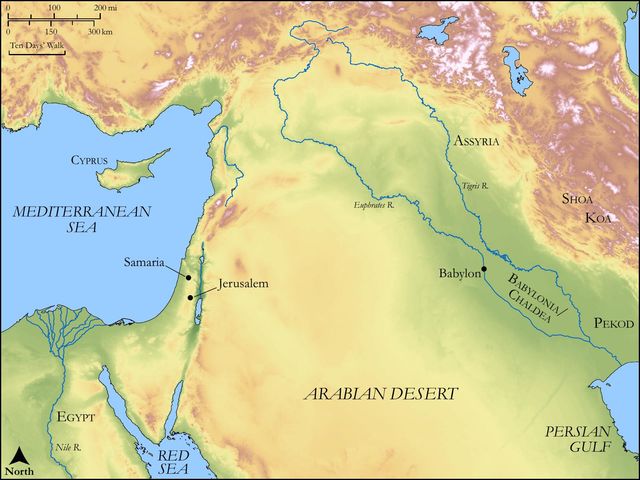
See on the biblical-era map
Study this verse
Public-domain commentary
Matthew Henry
From his Commentary on the Whole Bible. Henry comments on passages, not single verses — this entry covers Ezekiel 23:1–10.
God had often spoken to Ezekiel, and by him to the people, to this effect, but now his word comes again; for God speaks the same thing once, yea, twice, yea, many a time, and all little enough, and too little, for man perceives it not. Note, To convince sinners of the evil of sin, and of their misery and danger by reason of it, there is need of line upon line, so loth we are to know the worst of ourselves. The sinners that are here to be exposed are two women, two kingdoms, sister-kingdoms, Israel and Judah, daughters of one mother, having been for a long time but one people. Solomon's kingdom was so large, so populous, that immediately after his death it divided into two. Observe, 1. Their character when they were one (Eze 23:3): They committed whoredoms in Egypt, for there they were guilty of idolatry, as we read before, Eze 20:8. The representing of those sins which are most provoking to God and most ruining to a people by the sin of whoredom plainly intimates what an exceedingly sinful sin uncleanness is, how offensive, how destructive. Doubtless it is itself one of the worst of sins, for the worst of other sins are compared to it here and often elsewhere, which should increase our detestation and dread of all manner of fleshly lusts, all appearances of them and approaches to them, as warring against the soul, infatuating sinners, bewitching them, alienating their minds from God and all that is good, debauching conscience, rendering them odious in the eyes of the pure and holy God, and drowning them at last in destruction and perdition. 2. Their names when they became two, Eze 23:4. The kingdom of Israel is called the elder sister, because that first made the breach, and separated from the family both of kings and priests that God had appointed - the greater sister (so the word is), for ten tribes belonged to that kingdom and only two to the other. God says of them both, They were mine, for they were the seed of Abraham his friend and of Jacob his chosen; they were in covenant with God, and carried about with them the sign of their circumcision, the seal of the covenant. They were mine; and therefore their apostasy was the highest injustice. It was alienating God's property, it was the basest ingratitude to the best of benefactors, and a perfidious treacherous violation of the most sacred engagements. Note, Those who have been in profession the people of God, but have revolted from him, have a great deal to answer for more than those who never made any such profession. "They were mine; they were espoused tome, and to me they bore sons and daughters;" there were many among them that were devoted to God's honour, and employed in his service, and were the strength and beauty of these kingdoms, as children are of the families they are born in. In this parable Samaria and the kingdom of Israel shall bear the name of Aholah - her own tabernacle, because the places of worship which that kingdom had were of their own devising, their own choosing, and the worship itself was their own invention; God never owned it. Her tabernacle to herself (so some render it); "let her take it to herself, and make her best of it." Jerusalem and the kingdom of Judah bear the name of Aholibah - my tabernacle is in her, because their temple was the place which God himself had chosen to put his name there. He acknowledged it to be his, and honoured them with the tokens of his presence in it. Note, Of those that stand in relation to God, and make profession of his name, some have greater privileges and advantages than others; and, as those who have greater are thereby rendered the more inexcusable if they revolt from God, so those who have less will not thereby be rendered inexcusable. 3. The treacherous departure of the kingdom of Israel from God (Eze 23:5): Aholah played the harlot when she was mine. Though the ten tribes had deserted the house of David, yet God owned them for his still; though Jeroboam, in setting up the golden calves, sinned, and made Israel to sin, yet, as long as they worshipped the God of Israel only, though by images, he did not quite cast them off. But they way of sin is down-hill. Aholah played the harlot, brought in the worship of Baal (Kg1 16:31), set up that other god, that dunghill-god, in competition with Jehovah (Kg1 18:21), as a vile adulteress dotes on her lovers, because they are well dressed and make a figure, because they are young and handsome (Eze 23:6), clothed with blue, captains and rulers, desirable young men, genteel, and that pass for men of honour, so she doted upon her neighbours, particularly the Assyrians, who had extended their conquests near them; she admired their idols and worshipped them, admired the pomp of their courts and their military strength and courted alliances with them upon any terms, as if her own God were not sufficient to be depended upon. We find one of the kings of Israel giving a thousand talents to the king of Assyria, to engage him in his interests, Kg2 15:19. She doted on the chosen men of Assyria, as worthy to be trusted and employed in the service of the state (Eze 23:7), and on all their idols with which she defiled herself. Note, Whatever creature we dote upon, pay homage to, and put a confidence in, we make an idol of that creature; and whatever we make an idol of we defile ourselves with. And now again the conviction looks back as far as the original of their nation: Neither left she her whoredoms which she brought from Egypt, Eze 23:8. Their being idolaters in Egypt was a thing never to be forgotten - that they should be in love with Egypt's idols even when they were continually in fear of Egypt's tyrants and task-masters! But (as some have observed) therefore, at that time, when Satan boasted of his having walked through the earth as all his own, to disprove his pretensions God did not say, Hast thou considered my people Israel in Egypt? (for they had become idolaters, and were not to be boasted of), but, Hast thou considered my servant Job in the land of Uz? And this corrupt disposition in them, when they were first formed into a people, is an emblem of that original corruption which is born with us and is woven into our constitution, a strong bias towards the world and the flesh, like that in the Israelites towards idolatry; it was bred in the bone with them, and was charged upon them long after, that they left not their whoredoms brought from Egypt. It would never out of the flesh, though Egypt had been a house of bondage to them. Thus the corrupt affections and inclinations which we brought into the world with us we have not lost, nor got clear of, but still retain them, though the iniquity we were born in was the source of all the calamities which human life is liable to. 4. The destruction of the kingdom of Israel for their apostasy from God (Eze 23:9, Eze 23:10): I have delivered her into the hand of her lovers. God first justly gave her up to her lust (Ephraim is joined to idols, let him alone), and then gave her up to her lovers. The neighbouring nations, whose idolatries she had conformed to and whose friendship she had confided in, and in both had affronted God, are now made use of as the instruments of her destruction. The Assyrians, on whom she doted, soon spied out the nakedness of the land, discovered her blind side, on which to attack her, stripped her of all her ornaments and all her defences, and so uncovered her, and made her naked and bare, carried her sons and daughters into captivity, slew her with the sword, and quite destroyed that kingdom and put an end to it. We have the story at large Kg2 17:6, etc., where the cause of the ruin of that once flourishing kingdom by the Assyrians is shown to be their forsaking the God of Israel, fearing other gods, and walking in the statutes of the heathen; it was for this that God was very angry with them and removed them out of his sight, Eze 23:18. And that the Assyrians, whom they had been so fond of, should be employed in executing judgments upon them was very remarkable, and shows how God, in a way of righteous judgment, often makes that a scourge to sinners which they have inordinately set their hearts upon. The devil will for ever be a tormentor to those impenitent sinners who now hearken to him and comply with him as a tempter. Thus Samaria became famous among women, or infamous rather; she became a name (so the word is); not only she came to be the subject of discourse, and much talked of, as the desolations of cities and kingdoms fill the newspapers, but she was thus ruined for her idolatries in terrorem - for warning to all people to take heed of doing likewise; as the public execution of notorious malefactors makes them such a name, such an ill name, as may serve to frighten others from those wicked courses which have brought them to a miserable and shameful end. Deu 21:21, All Israel shall hear and fear.
Historical interpretation
Historical reception
4 surviving comments on this verse. Each one is dated, so this reads as a timeline rather than a list.
(Chapter 23, verses 1 onwards) And the word of the Lord came to me, saying: Son of man, there were two women, the daughters of one mother. And they played the harlot in Egypt, in their youth they played the harlot. There their breasts were pressed and their virgin bosoms were broken (or, as it is in the Septuagint, There their breasts fell and there they were deflowered). Their names were Oholah the elder (or, the elder sister), and Oholibah her sister. And I took them (whether they were given to me) and they bore sons and daughters. And their names were Samaria Oolla and Jerusalem Ooliba. Therefore, Oolla prostituted herself with me and she went mad (or went away) to her lovers in Assyria, who approached her, dressed in purple, rulers and officials, all young men, choice horsemen. And she gave her fornications over them, all the elect sons of Assyria, and in all on whom she had been mad upon with her uncleanness (or inventions), she was defiled. Moreover, she did not leave her fornications which she had in Egypt. For they also had slept with her in her youth, and they broke the breasts of her puberty (or they also deflowered her): and they poured their fornication over her. Therefore, I handed her over to the hands of her lovers, to the hands of the sons of Assyria, on whose lust she had gone mad. They uncovered her shame; they took away her sons and daughters, and killed her with the sword. And she became a byword among women; judgments were executed upon her. The Scripture testifies that the twelve tribes of Israel, which were united in Egypt, later divided into two and ten tribes, called Judah and Israel, as recorded in the books of Kings and Chronicles. The tribe of Judah ruled from the line of David, with Rehoboam as the son of Solomon in Jerusalem, where there was a temple and priests, and a large part of the tribe of Levi. But in Samaria, Jeroboam the son of Nabat from the tribe of Ephraim and Joseph ruled over the ten tribes; of which Samaria is now called Oolla, which in our language means tabernacle: but Jerusalem is called Ooliba, which means my tabernacle in it. For indeed, even among the ten tribes, there was a tabernacle not of God, but of idols. For Jeroboam had set up golden calves in Dan and Bethel in order to turn the people away from the worship of God. Let us therefore speak about each. These two women, Samaria and Jerusalem, were daughters of the same mother from the lineage of Israel, and they committed adultery in Egypt during their youth. For they would not have received the Law when they were brought out of Egypt and gathered at Mount Sinai, which prohibited them from worshiping idols, unless they had worshiped Egyptian idols while in Egypt. However, the mother of both could be Chethaea, of whom we read above: Your father was Amorrhaeus, and your mother was Chethaea (Above, XVI, 3). But when it is said: Let each one remove the abominations of Egypt from his sight, it signifies that in Egypt the Israelites worshipped idols and fell there, whether their breasts of virginity were broken or not. And Samaria is said to be greater and older, either because of the multitude of the ten tribes, or because after the death of Moses from the tribe of Ephraim, Joshua the son of Nun led the people: hence we read that Jeroboam, who split them, was from the house of David (3 Kings, XII). And God had them, whether they were made by him, when they groaned from the works of Egypt, serving clay and brick. And afterwards they bore sons and daughters, either in the wilderness or in the promised land. And first Oolla, that is, Samaria, fornicated against God, when she went mad for the Assyrians, who were dressed in her hyacinth garments, not just any people, but leaders and magistrates, not those worn out by age, but all young men, chosen horsemen, from whom she followed idols and from whom she demanded help against the command of God. Those who came and defiled her, did not leave anything that she had done in her youth in Egypt. For even the Egyptians had sexual relations with her in her youth, of whom she worshiped their idols; and there, her virginity was taken and her breasts were broken. And there was such an abundance of fornication, that it is said that they did not fornicate with her, but rather poured out their own fornication upon her. Therefore, she was delivered to her lovers, Phul, Theglathphalassar, and Salmanasar, in whose lust she went mad, and they uncovered her shame, metaphorically, like that of a harlot woman (2 Kings 17 and 18, 1 Chronicles 5). However, the revelation of the city is that it is captured, and they took captive its sons and daughters, and they slaughtered it with the sword, so that it is butchered as an example for all women, and it is celebrated in a negative way by everyone's speech. Those who carried out judgments and vengeance in it, so that they left nothing of salvation in it; but to this day, ten tribes are held captive in the mountains and cities of the Medes, to which they were transferred. We have discussed more fully the allegorical meaning of Joseph, Ephraim, Samaria, Jezreel, and Israel, and how they are contrary to the house of David and Jerusalem, which signifies the Church. The psalm, which is the seventy-seventh, speaks of this: The sons of Ephraim, being armed and carrying bows, turned back in the day of battle (Psalm 77:9). And again: He rejected the tabernacle of Joseph and chose the tribe of Judah (Ibid., 67). For God has chosen the house of confession, which is the Church, and rejected the tabernacle of Joseph, which signifies increase. They, neglecting the Law of God, added golden calves to their worship, and they are called Oolla, which means tabernacle, not of God, but of error and demons. And the elder and older sister, because of the multitude and captivity by the Assyrians, committed fornication against God, for she abandoned the truth of faith and went mad for the leaders of the heretics, who were clothed in hyacinth, promising her lofty and heavenly things; and the climbers, of whom it is said: These are in chariots, and on horses (Ps. XIX, 8), chosen sons of the Assyrians and leaders and magistrates, who promise themselves knowledge and eloquence. But he did this because he had the same fornications that he had in Egypt, that is, before he believed, and he still lived in the world, he also practiced them in heresy. And she was deflowered (or They were deflowered) by Assyrian men who persist in wickedness, whether as avengers. For our adversary, the devil himself, is an enemy and avenger (I Peter V). They shattered the breasts of Samaria; and they destroyed her virginity that she had in the Church. Therefore, they were delivered to their lovers, according to the Apostle who writes: I have delivered them to Satan, so that they may learn not to blaspheme (I Tim. I, 20). And: I have delivered them to the destruction of the flesh, so that the spirit may be saved (I Cor. V, 5). They uncovered the shame of miserable Samaria, and they displayed all its turpitude, leading captive the sons and daughters who were born to it, endowed with knowledge and deceived the simple and inexperienced, and killed it with a spiritual sword. They are celebrated in speech throughout the whole world in a negative light, and they become infamous among all the teachings of the world, so that the depravity of that woman may serve as an example for all.
(Verse 35, 36, and following) And I will bring you into a desert of peoples, and there I will judge you face to face. Just as I contended with your fathers in the desert of the land of Egypt, so I will judge you, says the Lord. And I will subject you to my scepter, and I will bring you into the bonds of the covenant, and I will choose from among you the transgressors and the wicked: from their place of residence I will bring them out, and they will not enter the land of Israel, and you will know that I am the Lord. Thus says the Lord: I will do for you who are in Babylon, and now serve idols, what I did for your ancestors in Egypt. I will lead you into the desert of the peoples, and there I will judge you face to face, just as I contended with them in judgment when they came out of Egypt. And after I have judged you, I will subject you to my scepter and rule, and I will make a covenant with you and bring you into your land with the bonds of love, so that bound by my love, you will never be able to depart from me. But I will choose from among you the transgressors and the wicked, who persist in the hardness of their hearts in evil deeds, not for possession, but for rejection. And I will indeed bring them out of the land of their dwelling, so that when they are brought out, they will not enter the land of Israel; but they will perish in various regions. And by the distinction between good and evil, you shall know that I am the Lord, who judges all things. The rest of the discourse hastens, and we briefly go through each point, in order to provide only the meaning to the readers.
(Ver. 23, 24 onwards) Again, I raised my hand against them in the wilderness, to scatter them among the nations and disperse them in the lands, because they had not performed my judgments, and had rejected my commandments, and had violated my Sabbaths, and their eyes had been after the idols (or thoughts) of their fathers. Therefore, I also gave them statutes that were not good, and judgments in which they would not live, and I defiled them in their offerings (or transgressions), as they offered (or led astray) everything that opens the womb because of their sins (for which the Septuagint translated, to destroy them and what they had overlooked): and they will know that I am the Lord. Where in the Old Testament, against their children, who fell in the wilderness, the Lord lifted up His hand to scatter them among the nations, Scripture does not say; but it is to be believed that this was done in accordance with what is reported here. Or he signifies by this, that after they entered the promised land, they were given over at various times, for many sins, to different nations and kings, and at that time the commandments of the Lord, which were good according to their nature, and the judgments by which believers could live, were made not good for them, since they were in no way able to keep the precepts of the law in captivity, and to do what the divine word commanded. He did not say, 'I gave them evil commandments,' but, 'not good commandments.' For it does not immediately follow that what is not good is evil, as the Apostle teaches, it is good for a man not to touch a woman; but because of incontinence, let each possess his own vessel in sanctification and honor (I Cor. VII). And if he does not do this, it is neither good nor evil. Therefore, God gave them, dispersed among the nations, not good commandments, that is, he allowed them to follow their own thoughts and desires, to do what is not appropriate. And he defiled them in his gifts: just as a Priest separates lepers from the people, and shows that they are defiled; while they offer to idols what they should offer to God. And they pass everything that opens the womb through the fire of Baal, that is, the firstborn; so that after they have deserted God and been handed over to the worship of idols, then they may understand that He is the Lord whom they have provoked to anger by their own fault. Symmachus interpreted this passage more explicitly, treating the future as past. Therefore, I will also give them bad precepts and judgments for which they will not live, and I will defile them because of their gifts, as they consecrate and offer everything that opens the womb, so that I may destroy them, and they will know that I am the Lord. And the meaning is this: because I have seen the sons of the fathers equaling the wickedness of their ancestors and doing the same things for which they offended God, I wanted to divide them into nations and disperse them throughout the whole world, and give them bad precepts and judgments in which they would not live, so that I may defile them with their gifts, for they consecrated everything that opens the womb to idols, and I may destroy them forever, and they will know that I am the Lord. Through which he showed that he had not given them good commandments who dwelt in the wilderness, but to those whom he wanted to scatter among the nations, and to make foreigners in the whole world, he gave them a desire for things that he did not give: so that there they would do good commandments of God, not good because of their own fault, while they exhibited to idols what God had commanded to be exhibited. This can also be said, that before the offense, they received only the Ten Commandments; but after idolatry and blasphemy, they received multiple ceremonies of the law, so that they would offer victims to God rather than to demons, and by comparison with sacrilege, what was not good in itself became lighter, and by no means evil, because it was offered to God, and yet not good, because they offended the author of good.
(Verse 27, 29 onwards) Therefore speak to the house of Israel, son of man, and tell them: Thus says the Lord God: Moreover, your fathers have blasphemed against me and have treated me with contempt, even as they spurned me. And I brought them into the land that I had lifted my hand to give them ((Vulgate adds: that land)): they saw every high hill and every leafy tree, and there they offered their sacrifices and presented there the irritation of their offerings, and they placed there the fragrance of their sweetness, and they poured out their ((Vulgate is silent on this)) libations there. And I said to them, 'What is the high place to which you are going?' And its name was called the High Place until this day. Therefore speak to the house of Israel, son of man, and say to them, 'Thus says the Lord God: As for your fathers, they have provoked Me to anger by their iniquities, by the fact that they have fallen away from Me. So I brought them into the land that I had lifted My hand in an oath to give them.' They saw every high hill and every leafy tree, and there they offered their sacrifices. They also presented there the provocation of their gifts, and they set there their pleasing aroma, and they poured out there their drink offerings. And I said to them: What is abbana, because you enter there? And they called its name abbana until this day. I wanted, he said, to scatter them in the wilderness, and to give them not good precepts, so that they would sacrifice to idols what they should have offered to me, and consecrate all their first-fruits to them by fire, so that I might kill them and destroy them. But when he says, I wanted, he shows that he did not do what he wanted. And that which follows: 'And they shall know that I am the Lord,' is not found in the Septuagint. For it did not seem fitting to them to know after their destruction that he himself is the Lord. But you, son of man, speak again to them, that is, to the elders of the house of Israel, who have come to inquire of you: Your fathers, from whom you have descended, have also blasphemed against me and held me in contempt; after I brought them into the land which I had given them to possess, they turned against me to provoke me. For when they saw every high hill and leafy tree, they would sacrifice on the mountains and in the groves and thickets, and offer victims to the idols, and pour out libations. And when I saw this, I said to them: What is this, Bama? for it is called high: or why do you enter into such a place which you have chosen for yourselves in all the hills, so that even today these places are called Bamoth, and the ancient error retains its original name? Regarding Bama, which we translate as excelsum, there is an error in the Septuagint edition, where it is written as ἀββανὰ, which does not resonate in the Hebrew language. Bama can mean 'in which' if the two syllables are divided into two words, but in the present context, that sense does not fit. However, wherever it is written in the Books of Kings and Chronicles: 'The people still sacrificed and offered incense on the high places,' Bama in the singular and Bamoth in the plural mean 'high places.'
Continue studying Ezekiel 23:8 across the web’s major study libraries — every link below opens this exact verse, chapter, or book on the destination site.
Read & Compare
 BibleGatewayThis verse in more than 200 translations and 70 languages.
 Bible.comThe YouVersion reader — hundreds of translations, reading plans, and highlights.
 ESV.orgCrossway's official English Standard Version reader.
 NET BibleThe NET translation with 60,000+ translators' notes on every rendering decision.
 STEP BibleTyndale House's free study tool — original text, vocabulary, and scholarly resources.
 BibliaLogos Bible Software's free web reader.
 USCCBThe New American Bible (Revised Edition) with the U.S. bishops' study notes.
Commentaries
 BibleHub CommentariesDozens of classic commentaries on this verse, gathered on one page.
 StudyLightMore than 100 commentary sets — the largest collection on the web.
 BibleRefPlain-English commentary on what this verse means, verse by verse.
 Enduring WordDavid Guzik's free commentary on this chapter, widely used by Bible teachers.
 Bible Study ToolsVerse commentary alongside Greek and Hebrew study aids.
Original Language & Research
- BibleHub InterlinearThe verse word by word — original language, transliteration, and English.
- BibleHub LexiconEvery word's original-language definition and Strong's entry.
 Blue Letter BibleDeep-study tools — Strong's numbers, concordance, and word studies.
 SefariaThe Hebrew text with Rashi and centuries of Jewish commentary.
Sermons, Hymns & Audio


TrulyRandomVerse is not affiliated with these sites and doesn’t control their content. They’re linked because they’re genuinely useful.
Summary
Ezekiel 23:8 delivers a searing indictment against Oholibah, representing the Southern Kingdom of Judah, for her entrenched and unyielding spiritual infidelity. Through vivid allegorical language, the verse portrays Judah as a harlot who never abandoned the idolatrous practices and illicit political entanglements that originated during her formative period in Egypt. It powerfully underscores the persistent and deeply rooted nature of her rebellion against Yahweh, highlighting the profound defilement and betrayal of her sacred covenant relationship with God that began in the earliest stages of her national history and continued unabated through generations.
Context
ShowHideLiterary Context
Ezekiel 23 serves as a profound continuation and intensification of the allegorical theme of spiritual harlotry, first introduced and extensively developed in Ezekiel 16, which detailed Jerusalem's profound unfaithfulness. In this chapter, the prophet introduces two sisters, Oholah (symbolizing Samaria, the Northern Kingdom) and Oholibah (representing Jerusalem, the Southern Kingdom), both depicted engaging in illicit sexual acts as a powerful metaphor for their pervasive idolatry and unholy political alliances with pagan nations. Verse 8 specifically zeroes in on Oholibah (Judah), emphasizing that her "whoredoms" were not a recent or transient deviation but were deeply "brought from Egypt," thereby establishing a long and tragic historical lineage of spiritual rebellion. This highlights the ingrained nature of Judah's sin, demonstrating that their current state of profound defilement and impending judgment was the culmination of generations of covenant betrayal, directly linking their present woes to their past choices and persistent refusal to repent and return to Yahweh.
Historical & Cultural Context
The historical backdrop for Ezekiel's prophetic ministry is the harrowing period of the Babylonian exile, a time when the people of Judah were grappling with the devastating consequences of their prolonged unfaithfulness. The reference to Judah's "youth" in Egypt points to the foundational period of Israel's nationhood, encompassing their bondage in Egypt, the miraculous Exodus, and their formative wilderness wanderings. During this crucial era, they were repeatedly exposed to, and often succumbed to, the polytheistic practices and idolatrous influences of Egypt, vividly exemplified by the infamous golden calf incident shortly after their liberation from slavery, as recorded in Exodus 32. The "whoredoms" serve as a potent metaphor for both literal idolatry—the worship of foreign gods—and the formation of treacherous political alliances with pagan nations like Egypt or Assyria. Such alliances were considered a profound betrayal of their exclusive covenant with Yahweh, who demanded singular devotion. In the ancient Near East, treaties often necessitated swearing by and worshipping the gods of the allied nation, making such political entanglements a direct violation of the First Commandment. The graphic sexual imagery, though shocking to modern sensibilities, was a common and powerful prophetic device employed to convey the depth and intimacy of Israel's covenant infidelity, mirroring the exclusivity and fidelity expected within a marital relationship.
Key Themes
ShowHideEzekiel 23:8 profoundly contributes to several major theological and narrative themes woven throughout the book of Ezekiel and the broader prophetic corpus. Foremost among these is the theme of Persistent Idolatry and Covenant Betrayal, vividly illustrating Judah's stubborn and unyielding refusal to abandon the pagan practices and political entanglements that either originated from or were reinforced by their historical ties with Egypt. This was not merely a transient lapse but a deeply entrenched spiritual condition that fundamentally violated their sacred covenant with Yahweh. The stark phrase "neither left she her whoredoms brought from Egypt" powerfully underscores the Historical Continuity of Sin, demonstrating how ancestral sins and the influences of past generations can persist and manifest in deeply rooted patterns of rebellion if not genuinely repented of and forsaken. Furthermore, the disturbing and visceral imagery of defilement powerfully conveys God's Abhorrence of Spiritual Adultery, reflecting the Lord's profound offense, sorrow, and righteous indignation over His chosen people's rejection of Him for false gods and unreliable human alliances. This resonates deeply with other prophetic condemnations of Israel's unfaithfulness, such as those found in Jeremiah 2 and Hosea 4.
Exposition and Analysis
ShowHideKey Word Analysis
ShowHideThis term (H8457), derived from the root zanah (to commit fornication), literally refers to physical prostitution. However, in the prophetic literature, and especially throughout Ezekiel's powerful allegories, it is almost exclusively employed metaphorically. It signifies spiritual unfaithfulness, idolatry, and the grievous breaking of the covenant relationship with Yahweh. It vividly portrays Israel's turning away from their exclusive devotion to God by worshipping foreign deities and forming unholy alliances with pagan nations, thereby betraying their divine "husband."
This primitive root (H5800) carries the meaning "to loosen, i.e. relinquish, permit, etc." In the context of Ezekiel 23:8, it emphatically highlights Judah's deliberate, active, and persistent refusal to abandon her idolatrous practices. It's not merely a passive failure to cease sinning, but an active choice to cling to these "whoredoms" rather than forsake them, underscoring the profound depth of their spiritual stubbornness and their rebellious defiance against God's explicit commands and warnings.
This term (H1331) refers to the state of being a virgin, inherently implying purity, innocence, and untaintedness. Within the allegorical framework of Ezekiel, it powerfully represents Israel's initial purity, consecration, and exclusive devotion to Yahweh at the time of the covenant at Sinai. The phrase "bruised the breasts of her virginity" graphically portrays the violent violation and profound defilement of this pristine covenant relationship, indicating an irreversible loss of spiritual innocence and a deep corruption of their original, consecrated devotion to God.
Verse Breakdown
ShowHide"Neither left she her whoredoms [brought] from Egypt:"
This opening clause immediately establishes the central accusation against Oholibah (Judah/Jerusalem): her unyielding and unrepentant spiritual infidelity. The crucial phrase "brought from Egypt" emphasizes that these idolatrous tendencies and worldly attachments were not a recent deviation but had deep, historical roots, originating from or being significantly reinforced by Israel's formative experiences and prolonged interactions with Egyptian culture and religion. It powerfully highlights a continuous, unbroken pattern of sin that was passed down through generations, demonstrating a persistent refusal to break free from these defiling influences.
"for in her youth they lay with her,"
This clause provides the historical explanation for the enduring nature of Judah's "whoredoms." "Her youth" refers to the nascent stages of Israel's national existence, specifically the period of their sojourn in Egypt and their subsequent wilderness wanderings. "They lay with her" employs graphic sexual imagery to metaphorically describe the profound spiritual defilement that occurred as Israel engaged in idolatry and eagerly adopted the pagan practices of the nations around them, particularly Egypt. This signifies the initial corruption of their covenant purity and the very commencement of their spiritual harlotry, marking the beginning of their departure from exclusive devotion to Yahweh.
"and they bruised the breasts of her virginity,"
This highly evocative and disturbing phrase intensifies the imagery of violation, defilement, and profound damage. "Breasts of her virginity" symbolizes the nation's initial purity, innocence, and the potential for exclusive, unblemished devotion to Yahweh, akin to a bride before her marriage. The verb "bruised" implies a violent, painful, and deeply damaging act, signifying the profound harm and irreversible defilement inflicted upon Israel's spiritual integrity and their sacred covenant relationship with God through their persistent idolatrous practices. It speaks to the tragic loss of their original consecrated state and the violation of their most intimate spiritual bond.
"and poured their whoredom upon her."
This final clause further emphasizes the complete, pervasive, and overwhelming nature of Judah's spiritual corruption. The imagery of "poured their whoredom upon her" suggests an abundant, saturating, and inescapable defilement. It indicates that the idolatry and unfaithfulness were not superficial or incidental but had thoroughly saturated the very fabric of the nation, leaving her utterly polluted and estranged from her divine husband. The active verb "poured" implies the deliberate and willing reception of this spiritual defilement, highlighting Judah's complicity and active participation in her own profound corruption.
Literary Devices
ShowHideEzekiel 23:8 is a profound example of Allegory, where the prophet constructs an extended metaphor of two sisters as harlots to represent the spiritual unfaithfulness of the Northern and Southern Kingdoms of Israel. This allegorical framework allows for a deeply symbolic, emotionally charged, and visceral portrayal of their covenant betrayal. The verse utilizes vivid Personification, treating Judah (Oholibah) as a woman who actively engages in illicit sexual acts, thereby transforming the abstract concept of national idolatry and political apostasy into something concrete, relatable, and tragically human. The language is characterized by striking Graphic Imagery, particularly in phrases such as "bruised the breasts of her virginity" and "poured their whoredom upon her." This disturbing imagery serves to underscore the extreme severity of Israel's sin and the depth of their defilement in God's eyes, conveying the profound offense of their covenant betrayal in a visceral and unforgettable manner. The entire passage functions as a powerful Metaphor for spiritual adultery, where the exclusive covenant relationship between Yahweh and Israel is likened to a sacred marriage, and their idolatry and foreign alliances are depicted as acts of prostitution and infidelity.
Theological and Thematic Connections
ShowHideEzekiel 23:8 profoundly illustrates the theological concept of Israel's covenant unfaithfulness, framing it as spiritual harlotry. This verse underscores that Judah's idolatry was not a recent phenomenon but a deeply ingrained, generational pattern, passed down from their earliest national experiences in Egypt. It highlights God's unwavering expectation of exclusive devotion from His covenant people, viewing any deviation as a profound betrayal akin to marital infidelity. The graphic language reveals the depth of God's sorrow, His righteous anger, and His profound offense over His people's persistent rejection of Him for false gods and unreliable human alliances. This persistent and unrepentant sin ultimately led to the severe judgment of exile, demonstrating that while God is eternally faithful to His covenant promises, His faithfulness does not negate His justice in the face of His people's unrepentant rebellion.
Reflection and Application
ShowHideEzekiel 23:8 serves as a potent spiritual warning for believers today, highlighting the insidious nature of persistent spiritual compromise and the deep-seated roots of unfaithfulness. Just as Judah struggled to break free from the "whoredoms brought from Egypt"—the ingrained idolatry and worldly entanglements from their formative history—we too can be susceptible to deeply ingrained patterns of worldliness, subtle idolatries, or unfaithfulness that subtly erode our exclusive devotion to God. This verse calls us to a radical and honest self-examination, urging us to identify and repent of any "attachments" or "alliances"—whether they be material possessions, career ambitions, cultural norms, personal comforts, or even intellectual pursuits—that compete for the exclusive loyalty owed to Christ. It reminds us that true spiritual purity involves not just avoiding overt, grievous sin but also diligently guarding our hearts against anything that might defile our sacred covenant relationship with our Lord. We are called to cultivate an undivided heart, fully committed to Him who bought us with an immeasurable price, ensuring that the lingering influences of our past or our surrounding culture do not dictate our present devotion or compromise our future walk with God.
Questions for Reflection
ShowHideFAQ
ShowHideWhat does "bruised the breasts of her virginity" mean in this context?
ShowHideThis phrase is a powerful and graphic metaphor within Ezekiel's extended allegory of spiritual harlotry. "Virginity" (Hebrew bᵉthûwlîym) represents Israel's initial purity, innocence, and sacred consecration to God at the time of the Sinai covenant, when they were "betrothed" to Yahweh. "Breasts" (Hebrew dad) symbolize the seat of love, intimacy, and nurturing, often associated with a woman's purity and potential for life. To "bruise" (Hebrew ʻâsâh, used idiomatically here to mean harm or defile) them signifies a violent, painful, and deeply damaging act. Therefore, the phrase collectively means that Israel's engagement in idolatry and illicit foreign alliances profoundly violated, corrupted, and irrevocably damaged her original spiritual purity and the exclusive, intimate covenant relationship she had with Yahweh. It's a visceral image of deep spiritual defilement and the painful betrayal of sacred vows, signifying a tragic loss of spiritual innocence and integrity.
Why is Egypt specifically mentioned as the origin of Judah's "whoredoms"?
ShowHideEgypt is specifically mentioned because it represents a foundational and deeply influential period in Israel's history where they were exposed to, and often succumbed to, pagan influences and a worldly mindset. While God miraculously delivered them from physical bondage in Egypt, the spiritual "whoredoms"—the idolatrous practices, polytheistic beliefs, and reliance on human power—of Egypt continued to exert a powerful and lingering influence on the nation. Examples include the notorious worship of the golden calf shortly after the Exodus (Exodus 32) and, centuries later, Israel's repeated temptation to seek political alliances and security with Egypt rather than placing their trust solely in God's protection (Isaiah 30 and Isaiah 31). Thus, "whoredoms brought from Egypt" signifies a deep-seated, generational pattern of spiritual unfaithfulness, a reliance on human strength and worldly systems rather than divine provision and exclusive devotion, a pattern that continued to plague Judah even centuries later, demonstrating the enduring and destructive legacy of early compromises.
Christ-Centered Fulfillment
ShowHideEzekiel 23:8, with its stark and graphic portrayal of Israel's persistent spiritual harlotry and profound defilement, finds its ultimate fulfillment and resolution in the person and work of Jesus Christ. Israel, as God's chosen bride, repeatedly broke her covenant vows and engaged in spiritual adultery, but Christ, the true and faithful Israel, perfectly fulfilled the covenant in His unwavering obedience and spotless faithfulness. He is the faithful Son who never strayed, unlike the nation depicted as a harlot. The disturbing imagery of "bruised the breasts of her virginity" and "poured their whoredom upon her" speaks powerfully to the profound sinfulness of humanity and the spiritual defilement that utterly estranges us from a holy God. Yet, in Christ, we witness the ultimate answer to this pervasive spiritual brokenness. He came not to condemn the harlot but to redeem her. Through His atoning sacrifice on the cross, Jesus bore the full weight of humanity's spiritual "whoredoms" and defilement, offering a path to true purity, reconciliation, and restoration. The Church, as the bride of Christ, is called to a new covenant of faithfulness, washed clean by His precious blood and presented as a pure virgin to Christ. We are no longer bound by the "whoredoms brought from Egypt"—the slavery to sin, the allure of the world, and reliance on human systems—but are freed to live in exclusive and undivided devotion to our heavenly Bridegroom, empowered by the Spirit to walk in newness of life. In Him, the broken covenant is gloriously restored, and the defiled are made holy, reflecting the ultimate triumph of God's sovereign grace over human unfaithfulness and the promise of a glorious, pure, and eternal union.