


Acts 1:17
- ὅτιhotiforG3754CONJConjunction
- κατηριθμημένοςkatērithmēmenosnumberedG2674V-RPP-NSMVerb Perfect Passive Participle Nominative Singular Masculine
- ἦνēnhe wasG1510V-IAI-3SVerb Imperfect Active Indicative 3rd Singular
- ἐνenamongG1722PREPPreposition
- ἡμῖνhēminusG3165P-1DPPersonal pronoun Dative 1st Plural
- καὶkaiandG2532CONJConjunction
- ἔλαχενelachenwas allottedG2975V-2AAI-3SVerb 2nd Aorist Active Indicative 3rd Singular
- τὸνtontheG3588T-ASMDefinite article Accusative Singular Masculine
- κλῆρονklēronshareG2819N-ASMNoun Accusative Singular Masculine
- τῆςtēsof theG3588T-GSFDefinite article Genitive Singular Feminine
- διακονίαςdiakoniasministryG1248N-GSFNoun Genitive Singular Feminine
- ταύτηςtautēsthisG3778D-GSFDemonstrative pronoun Genitive Singular Feminine
English is a literal word-by-word gloss of the Greek, not the KJV's wording. Why?
This is the original text the KJV's translators worked from — each Greek word with its own literal English meaning in this verse, prepared by scholars at Tyndale House, Cambridge. The KJV translates whole sentences, not word by word, so its wording differs: one Greek word can become several English words, and the KJV may choose “charity” where the gloss reads “love”. Both are faithful — they answer different questions. For the KJV's own rendering, switch to the KJV text.
Details
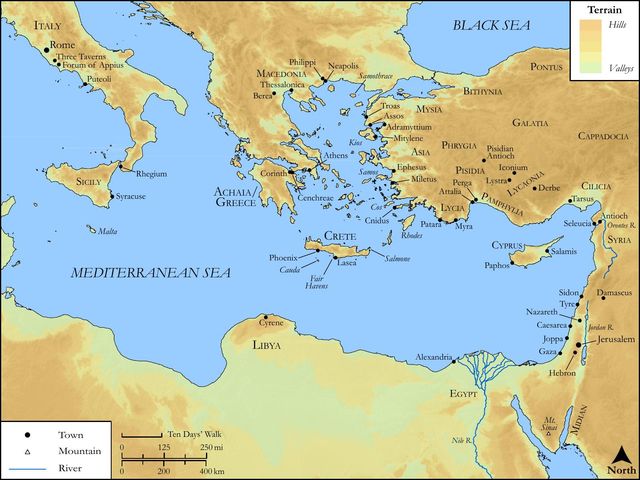
See on the biblical-era map
Study this verse
Public-domain commentary
Matthew Henry
From his Commentary on the Whole Bible. Henry comments on passages, not single verses — this entry covers Acts 1:15–26. His four-level outline is real structure in the source text, so it is rendered as structure.
The sin of Judas was not only his shame and ruin, but it made a vacancy in the college of the apostles. They were ordained twelve, with an eye to the twelve tribes of Israel, descended from the twelve patriarchs; they were the twelve stars that make up the church's crown (Rev 12:1), and for them twelve thrones were designated, Mat 19:28. Now being twelve when they were learners, if they were but eleven when they were to be teachers, it would occasion every one to enquire what had become of the twelfth, and so revive the remembrance of the scandal of their society; and therefore care was taken, before the descent of the Spirit, to fill up the vacancy, of the doing of which we now have an account, our Lord Jesus, probably, having given directions about it, among other things which he spoke pertaining to the kingdom of God. Observe,
I.The persons concerned in this affair.
1.The house consisted of about a hundred and twenty. This was the number of the names, that is, the persons; some think the men only, distinguished from the women. Dr. Lightfoot reckons that the eleven apostles, the seventy disciples, and about thirty-nine more, all of Christ's own kindred, country, and concourse, made up this one hundred and twenty, and that these were a sort of synod, or congregation of ministers, a standing presbytery (Act 4:23), to whom none of the rest durst join themselves (Act 5:13), and that they continued together till the persecution at Stephen's death dispersed them all but the apostles (Act 8:1); but he thinks that besides these there were many hundreds in Jersualem, if not thousands, at this time, that believed; and we have indeed read of many that believed on him there, but durst not confess him, and therefore I cannot think, as he does, that they were now formed into distinct congregations, for the preaching of the word and other acts of worship; nor that there was any thing of this till after the pouring out of the Spirit, and the conversions recorded in the following chapter. Here was the beginning of the Christian church: this hundred and twenty was the grain of mustard-seed that grew into a tree, the leaven that leavened the whole lump.
2.The speaker was Peter, who had been, and still was, the most forward man; and therefore notice is taken of his forwardness and zeal, to show that he had perfectly recovered the ground he lost by his denying his Master, and, Peter being designed to be the apostle of the circumcision, while the sacred story stays among the Jews, he is still brought in, as afterwards, when it comes to speak of the Gentiles, it keeps to the story of Paul.
II.The proposal which Peter made for the choice of another apostle.
He stood up in the midst of the disciples, Act 1:15. He did not sit down, as one that gave laws, or had any supremacy over the rest, but stood up, as one that had only a motion to make, in which he paid a deference to his brethren, standing up when he spoke to them. Now in his speech we may observe,
1.The account he gives of the vacancy made by the death of Judas, in which he is very particular, and, as became one that Christ had breathed upon, takes notice of the fulfilling of the scriptures in it. Here is,
(1.)The power to which Judas had been advanced (Act 1:17): He was numbered with us, and had obtained part of this ministry which we are invested with. Note, Many are numbered with the saints in this world that will not be found among them in the day of separation between the precious and the vile. What will it avail us to be added to the number of Christians, if we partake not of the spirit and nature of Christians? Judas's having obtained part of this ministry was but an aggravation of his sin and ruin, as it will be of theirs who prophesied in Christ's name, and yet were workers of iniquity.
(2.)The sin of Judas, notwithstanding his advancement to this honour. He was guide to those that took Jesus, not only informed Christ's persecutors where they might find him (which they might have done effectually though he had kept out of sight), but he had the impudence to appear openly at the head of the party that seized him. He went before them to the place, and, as if he had been proud of the honour, gave the word of command: That same is he, hold him fast. Note, Ringleaders in sin are the worst of sinners, especially if those that by their office should have been guides to the friends of Christ are guides to his enemies.
(3.)The ruin of Judas by this sin. Perceiving the chief priests to seek the life of Christ and his disciples, he thought to save his by going over to them, and not only so, but to get an estate under them, of which his wages for his service, he hoped, would be but an earnest; but see what came of it.
[1.]He lost his money shamefully enough (Act 1:18): He purchased a field with the thirty pieces of silver, which were the reward of his iniquity. He did not purchase the field, but the wages of his unrighteousness did, and it is very elegantly expressed thus, in derision of his projects to enrich himself by this bargain. He thought to have purchased a field for himself, as Gehazi did with what he got from Naaman by a lie (see Kg2 5:26), but it proved the purchase of a field to bury strangers in; and what was he or any of his the better for this? It was to him an unrighteous mammon, it deceived him; and the reward of his iniquity was the stumbling-block of his iniquity.
[2.]He lost his life m ore shamefully. We were told (Mat 27:5) that he went away in despair, and was suffocated (so the word signifies there, and no more); here it is added (as latter historians add to those who went before) that, being strangled, or choked with grief and horror, he fell headlong, fell on his face (so Dr. Hammond), and partly with the swelling of his own breast, and partly with the violence of the fall, he burst asunder in the midst, so that all his bowels tumbled out. If, when the devil was cast out of a child, he tore him, threw him down, and rent him, and almost killed him (as we find Mar 9:26; Luk 9:42), no wonder if, when he had full possession of Judas, he threw him headlong, and burst him. The suffocation of him, which Matthew relates, would make him swell till he burst, which Peter relates. he burst asunder with a great noise (so Dr. Edwards), which was heard by the neighbours, and so, as it follows, it came to be known (Act 1:19): His bowels gushed out; Luke writes like a physician, understanding all the entrails of the middle and lower ventricle. Bowelling is part of the punishment of traitors. Justly do those bowels gush out that were shut up against the Lord Jesus. And perhaps Christ had an eye to the fate of Judas, when he said of the wicked servant that he would cut him in sunder, Mat 24:51.
(4.)The public notice that was taken of this: It was known to all the dwellers in Jerusalem. It was, as it were, put into the newspapers, and was all the talk of the town, as a remarkable judgment of God upon him that betrayed his Master, Act 1:19. It was not only discoursed of among the disciples, but it was in every body's mouth, and nobody disputed the truth of the fact. It was known, that is, it was known to be true, incontestably so. Now one would think this should have awakened those to repentance that had had any hand in the death of Christ when they saw him that had the first hand thus made an example. But their hearts were hardened, and, as to those of them that were to be softened, it must be done by the word, and the Spirit working with it. Here is one proof of the notoriety of the thing mentioned, that the field which was purchased with Judas's money was called Aceldama - the field of blood, because it was bought with the price of blood, which perpetuated the infamy not only of him that sold that innocent precious blood, but of those that bought it too. Look how they will answer it, when God shall make inquisition for blood.
(5.)The fulfilling of the scriptures in this, which had spoken so plainly of it, that it must needs be fulfilled, Act 1:16. Let none be surprised nor stumble at it, that this should be the exit of one of the twelve, for David had not only foretold his sin (which Christ had taken notice of, Joh 13:18, from Psa 41:9, He that eateth bread with me hath lifted up the heel against me), but had also foretold,
[1.]His punishment (Psa 69:25): Let his habitation be desolate. This Psalm refers to the Messiah. Mention is made but two or three verses before of their giving him gall and vinegar, and therefore the following predictions of the destruction of David's enemies must be applied to the enemies of Christ, and particularly to Judas. Perhaps he had some habitation of his own at Jerusalem, which, upon this, every body was afraid to live in, and so it became desolate. This prediction signifies the same with that of Bildad concerning the wicked man, that his confidence shall be rooted out of his tabernacle, and shall bring him to the king of terrors: it shall dwell in his tabernacle, because it is none of his; brimstone shall be scattered upon his habitation, Job 18:14, Job 18:15.
[2.]The substitution of another in his room. His bishopric, or his office (for so the word signifies in general) shall another take, which is quoted from Psa 109:8. With this quotation Peter very aptly introduces the following proposal. Note, We are not to think the worse of any office that God has instituted (whether magistracy or ministry) either for the wickedness of any that are in that office or for the ignominious punishment of that wickedness; nor will God suffer any purpose of his to be frustrated, any commission of his to be vacated, or any work of his to be undone, for the miscarriages of those that are entrusted therewith. The unbelief of man shall not make the promise of God of no effect. Judas is hanged, but his bishopric is not lost. It is said of his habitation, that no man shall dwell therein, there he shall have no heir; but it is not said so of his bishopric, there he shall not want a successor. It is with the officers of the church as with the members of it, if the natural branches be broken off, others shall be grafted in, Rom 11:17. Christ's cause shall never be lost for want of witnesses.
2.The motion he makes for the choice of another apostle, Act 1:21, Act 1:22. Here observe,
(1.)How the person must be qualified that must fill the vacancy. It must be one of these men, these seventy disciples, that have companied with us, that have constantly attended us, all the time that the Lord Jesus went in and out among us, preaching and working miracles for three years and a half, beginning from the baptism of John, from which the gospel of Christ commenced, unto that same day that he was taken up from us. Those that have been diligent, faithful, and constant, in the discharge of their duty in a lower station, are fittest to be preferred to a higher; those that have been faithful in a little shall be entrusted with more. And none should be employed as ministers of Christ, preachers of his gospel, and rulers in his church, but those that are well acquainted with his doctrine and doings, from first to last. None shall be an apostle but one that has companied with the apostles, and that continually; not that has visited them now and then, but been intimately conversant with them.
(2.)To what work he is called that must fill up the vacancy: He must be a witness with us of his resurrection. By this it appears that others of the disciples were with the eleven when Christ appeared to them, else they could not have been witnesses with them, as competent witnesses as they, of his resurrection. The great thing which the apostles were to attest to the world was Christ's resurrection, for this was the great proof of his being the Messiah, and the foundation of our hope in him. See what the apostles were ordained to, not to a secular dignity and dominion, but to preach Christ, and the power of his resurrection.
III.The nomination of the person that was to succeed Judas in his office as an apostle.
1.Two, who were known to have been Christ's constant attendants, and men of great integrity, were set up as candidates for the place (Act 1:23): They appointed two; not the eleven, they did not take upon them to determine who should be put up, but the hundred and twenty, for to them Peter spoke, and not to the eleven. The two they nominated were Joseph and Matthias, of neither of whom do we read elsewhere, except this Joseph be the same with that Jesus who is called Justus, of whom Paul speaks (Col 4:11), and who is said to be of the circumcision, a native Jew, as this was, and who was a fellow-worker with Paul in the kingdom of God and a comfort to him; and then it is observable that, though he came short of being an apostle, he did not therefore quit the ministry, but was very useful in a lower station; for, Are all apostles? Are all prophets? Some think this Joseph is he that is called Joses (Mar 6:3), the brother of James the less (Mar 15:40), and was called Joses the just, as he was called James the just. Some confound this with that Joses mentioned Act 4:36. But that was of Cyprus, this of Galilee; and, it should seem, to distinguish them, that was called Barnabas - a son of consolation; this Barsabas - a son of the oath. These two were both of them such worthy men, and so well qualified for the office, that they could not tell which of them was the fitter, but all agreed it must be one of these two. They did not propose themselves nor strive for the place, but humbly sat still, and were appointed to it.
2.They applied to God by prayer for direction, not which of the seventy, for none of the rest could stand in competition with these in the opinion of all present, but which of these two? Act 1:24, Act 1:25.
(1.)They appeal to God as the searcher of hearts: "Thou, Lord, who knowest the hearts of all men, which we do not, and better than they know their own." Observe, When an apostle was to be chosen, he must be chosen by his heart, and the temper and disposition of that. Yet Jesus, who knew all men's hearts, for wise and holy ends chose Judas to be one of the twelve. It is comfortable to us, in our prayers for the welfare of the church and its ministers, that the God to whom we pray knows the hearts of all men, and has them not only under his eye, but in his hand, and turns them which way soever he will, can make them fit for his purpose, if he do not find them so, by giving them another spirit.
(2.)They desire to know which of these God had chosen: Lord, show us this, and we are satisfied. It is fit that God should choose his own servants; and so far as he in any way by the disposals of his providence or the gifts of his Spirit, shows whom he hath chosen, or what he hath chosen, for us, we ought to comply with him.
(3.)They are ready to receive him as a brother whom God hath chosen; for they are not contriving to have so much the more dignity themselves, by keeping out another, but desire to have one to take part of this ministry and apostleship, to join with them in the work and share with them in the honour, from which Judas by transgression fell, threw himself, by deserting and betraying his Master, from the place of an apostle, of which he was unworthy, that he might go to his own place, the place of a traitor, the fittest place for him, not only to the gibbet, but to hell - this was his own place. Note, Those that betray Christ, as they fall from the dignity of relation to him, so they fall into all misery. It is said of Balaam (Num 24:25) that he went to his own place, that is, says one of the rabbin, he went to hell. Dr. Whitby quotes Ignatius saying, There is appointed to every man idios topos - a proper place, which imports the same with that of God's rendering to every man according to his works. And our Saviour had said that Judas's own place should be such that it had been better for him that he had never been born (Mat 26:24) - his misery such as to be worse than not being. Judas had been a hypocrite, and hell is the proper place of such; other sinners, as inmates, have their portion with them, Mat 24:51.
(4.)The doubt was determined by lot (Act 1:26), which is an appeal to God, and lawful to be used for determining matters not otherwise determinable, provided it be done in a solemn religious manner, and with prayer, the prayer of faith; for the lot is cast into the lap, but the whole disposal thereof is of the Lord, Pro 16:33. Matthias was not ordained by the imposition of hands, as presbyters were, for he was chosen by lot, which was the act of God; and therefore, as he must be baptized, so he must be ordained, by the Holy Ghost, as they all were not many days after. Thus the number of the apostles was made up, as afterwards, when James, another of the twelve, was martyred, Paul was made an apostle.
Historical interpretation
Eleven Centuries of Reception
4 surviving comments on this verse. Each one is dated, so this reads as a timeline rather than a list.
Select a marker to jump to its quote. Markers stagger vertically where authors wrote within a few decades of each other.
Accordingly, after one of these had been struck off, He commanded the eleven others, on His departure to the Father, to “go and teach all nations, who were to be baptized into the Father, and into the Son, and into the Holy Ghost.” [Matt. 28:19] Immediately, therefore, so did the apostles, whom this designation indicates as “the sent.” Having, on the authority of a prophecy, which occurs in a psalm of David, [Ps. 109:8] chosen Matthias by lot as the twelfth [Acts 1:15-20], into the place of Judas, they obtained the promised power of the Holy Ghost for the gift of miracles and of utterance; and after first bearing witness to the faith in Jesus Christ throughout Judæa, and founding churches (there), they next went forth into the world and preached the same doctrine of the same faith to the nations. They then in like manner founded churches in every city, from which all the other churches, one after another, derived the tradition of the faith, and the seeds of doctrine, and are every day deriving them, that they may become churches. Indeed, it is on this account only that they will be able to deem themselves apostolic, as being the offspring of apostolic churches.
God is no respecter of persons. Even Saul and Judas had been good at one time. How could someone who was not good have a share in the Savior's ministry? In the plan of God it was decided that we would be considered worthy for the time for which he was chosen. It is no wonder that these men were considered good, because all nature is good and no substance is evil, but rather transgression, which arises from the will.
"Concerning Judas," he says, "which was guide." Here again mark the philosophical temper of the man: how he does not mention him with scorn, nor say, "that wretch," "that miscreant:" but simply states the fact; and does not even say, "who betrayed Him," but does what he can to transfer the guilt to others: nor does he animadvert severely even on these: "Which was guide," he says, "to them that took Jesus." Furthermore, before he declares where David had spoken, he relates what had been the case with Judas, that from the things present he may fetch assurance of the things future, and show that this man had already received his due. "For he was numbered," says he, "with us, and had obtained part of this ministry."
"For he was numbered with us," says Peter. On this account it behooves to propose another; to be a witness in his place. And see how he imitates his Master, ever discoursing from the Scriptures, and saying nothing as yet concerning Christ; namely, that He had frequently predicted this Himself. Nor does he mention where the Scripture speaks of the treachery of Judas; for instance, "The mouth of the wicked and the mouth of the deceitful are opened against me"; but where it speaks only of his punishment; for this was most to their advantage. It shows again the benevolence of the Lord: "For he was numbered with us," he says, "and obtained his lot of this ministry." He calls it everywhere "lot," showing that the whole is from God's grace and election, and reminding them of the old times, inasmuch as God chose him into His own lot or portion, as of old He took the Levites.
Therefore, since Judas was one of the twelve, it seems that he was chosen. I answer that one can be chosen in two ways. One is for a present righteousness; and Judas was chosen for this. The other is for final glory; and Judas was not chosen for this. Our Lord chose Judas, whom he knew would become an evil person, so that we could realize that there would be no human society which does not have some evil members: We can also understand from this that if a bishop receives someone into the Church, and this person becomes bad, the bishop should not be blamed.
Continue studying Acts 1:17 across the web’s major study libraries — every link below opens this exact verse, chapter, or book on the destination site.
Read & Compare
 BibleGatewayThis verse in more than 200 translations and 70 languages.
 Bible.comThe YouVersion reader — hundreds of translations, reading plans, and highlights.
 ESV.orgCrossway's official English Standard Version reader.
 NET BibleThe NET translation with 60,000+ translators' notes on every rendering decision.
 STEP BibleTyndale House's free study tool — original text, vocabulary, and scholarly resources.
 BibliaLogos Bible Software's free web reader.
 USCCBThe New American Bible (Revised Edition) with the U.S. bishops' study notes.
Commentaries
 BibleHub CommentariesDozens of classic commentaries on this verse, gathered on one page.
 StudyLightMore than 100 commentary sets — the largest collection on the web.
 BibleRefPlain-English commentary on what this verse means, verse by verse.
 Enduring WordDavid Guzik's free commentary on this chapter, widely used by Bible teachers.
 Bible Study ToolsVerse commentary alongside Greek and Hebrew study aids.
Original Language & Research
- BibleHub InterlinearThe verse word by word — original language, transliteration, and English.
- BibleHub LexiconEvery word's original-language definition and Strong's entry.
 Blue Letter BibleDeep-study tools — Strong's numbers, concordance, and word studies.
 CNTR CollationThe earliest Greek manuscripts of this verse, collated letter by letter.
Sermons, Hymns & Audio


TrulyRandomVerse is not affiliated with these sites and doesn’t control their content. They’re linked because they’re genuinely useful.
Summary
In Acts 1:17, Peter addresses the gathering of disciples following Jesus' ascension, explaining the status of Judas Iscariot. This verse underscores Judas's former, full inclusion among the twelve apostles and his active participation in their shared ministry, setting the stage for the necessity of his replacement to fulfill prophetic Scripture and restore the apostolic number.
Context
ShowHideLiterary Context
Acts 1:17 is embedded within Peter's significant speech to approximately 120 disciples in the upper room, recorded in Acts 1:15-26. This address occurs after Jesus' ascension and before the outpouring of the Holy Spirit on Pentecost. Peter's primary aim is to explain the vacancy left by Judas Iscariot and to initiate the process of selecting a replacement. He frames Judas's betrayal and subsequent death not as an unforeseen tragedy, but as a fulfillment of Old Testament prophecies, particularly those found in the Psalms, which speak of a betrayer and the need for another to take his office. The verse thus serves as a foundational statement affirming Judas's former legitimate standing within the apostolic band, making his fall all the more poignant and the need for succession imperative.
Historical & Cultural Context
The early Christian community, largely composed of Jewish believers, would have deeply understood the significance of the number twelve. This number resonated with the twelve tribes of Israel, symbolizing the foundational structure of God's people. Jesus' deliberate choice of twelve apostles, as detailed in passages like Mark 3:13-19, was a clear signal that they were to be the new spiritual leaders, the foundational pillars of the nascent kingdom of God, mirroring the covenant structure of old Israel. The concept of "ministry" (Greek: diakonia) also carried weight, referring to dedicated service, often public and official, reflecting both practical duties and spiritual authority. The decision to replace Judas, rather than leaving the number at eleven, highlights the early church's commitment to maintaining divine order and the symbolic integrity of the apostolic office as established by Christ.
Key Themes
ShowHideThis verse contributes significantly to several overarching themes within Acts and the broader New Testament. Firstly, it highlights the Apostolic Office and Authority, emphasizing that the apostles were chosen and appointed by Christ for a specific, vital "ministry" of witness, as seen in Acts 1:8. Secondly, it confronts the stark reality of Betrayal and Apostasy, serving as a somber reminder that even those intimately associated with Christ and entrusted with significant roles can fall away, as Judas did, leading to his tragic end described in Acts 1:18-19. Thirdly, the verse underscores Divine Sovereignty and Prophetic Fulfillment. Peter's explanation asserts that Judas's actions, though sinful, did not thwart God's plan but rather fulfilled it, demonstrating God's ultimate control over history and human events, a theme echoed throughout the biblical narrative, from the prophecies concerning the Messiah to the establishment of His church. Lastly, it speaks to the nascent church's concern for Order and Continuity, as they sought to restore the full complement of twelve witnesses before the powerful outpouring of the Holy Spirit on the Day of Pentecost.
Exposition and Analysis
ShowHideKey Word Analysis
ShowHideMeaning "to reckon among." This word emphasizes Judas's full and official inclusion in the apostolic group. It signifies that he was not merely an associate but was formally counted as one of the twelve, indicating a legitimate and recognized position within the inner circle of Jesus' disciples.
Meaning "a portion (as if so secured); by extension, an acquisition (especially a patrimony, figuratively)." In this context, it refers to a divinely allotted share or inheritance. Judas's "part" in the ministry was a specific, assigned portion of the apostolic calling, a sacred trust given by God.
Meaning "attendance (as a servant, etc.); figuratively (eleemosynary) aid, (official) service (especially of the Christian teacher, or technically of the diaconate)." This term highlights the active, service-oriented nature of the apostolic role. It was not merely a title but a demanding work, involving service, administration, and the proclamation of the Gospel.
Verse Breakdown
ShowHide"For he was numbered with us,"
This clause establishes Judas's undeniable past status. Peter emphasizes that Judas was fully and officially counted among the apostles. This was not a casual association but a formal inclusion, signifying his legitimate call and recognition by Jesus Himself as one of the chosen twelve. This statement sets the foundation for understanding the gravity of his subsequent betrayal and the necessity of his replacement.
"and had obtained part"
This phrase highlights that Judas's position was not accidental or self-appointed, but divinely granted. The word "obtained" (from lanchánō) implies receiving something by lot or by divine determination, underscoring that his share in the ministry was a specific, allotted portion. It points to God's sovereign hand in his initial calling, making his fall a profound tragedy of human failure against divine privilege.
"of this ministry."
This final segment specifies the nature of the "part" Judas obtained. It refers to the unique and sacred service entrusted to the apostles – the "ministry" of being witnesses to Jesus' life, death, resurrection, and ascension, and of proclaiming the coming of the Kingdom of God. This was a shared, collective responsibility, and Judas was a full participant in it until his defection.
Literary Devices
ShowHideActs 1:17, while seemingly a straightforward statement, employs several subtle literary devices. There is a strong element of Understatement and Irony present. Peter states Judas's former inclusion without immediately detailing his egregious betrayal, allowing the audience's knowledge of the recent events to fill in the tragic gap. The very fact that Judas "was numbered with us" and "had obtained part of this ministry" stands in stark ironic contrast to his ultimate actions. This highlights the profound Tragedy of his fall from a position of immense privilege and responsibility. Furthermore, the verse functions as a form of Euphemism or Allusion, as it refers to Judas's past without explicitly naming his betrayal, yet the entire context of Peter's speech makes the gravity of his defection clear. The phrase "this ministry" also functions as Metonymy, where "ministry" stands in for the entire apostolic office and its collective duties.
Theological and Thematic Connections
ShowHideActs 1:17 serves as a poignant reminder of the solemnity of divine calling and the potential for human failure, even among those most intimately connected to Christ. It underscores that spiritual privilege does not guarantee faithfulness, and that true ministry is characterized by integrity and enduring commitment, not merely by initial appointment. The verse also implicitly affirms God's unwavering sovereignty; even Judas's betrayal, a profound act of human sin, was incorporated into God's larger redemptive plan, fulfilling ancient prophecies and ultimately paving the way for the ongoing expansion of the Gospel through a restored apostolic witness. This demonstrates that God's purposes cannot be thwarted by human weakness or wickedness, but rather His will prevails through all circumstances.
Reflection and Application
ShowHideActs 1:17 offers profound lessons for believers today, particularly regarding the nature of Christian service and the reality of human fallibility. It challenges us to examine our own commitment to Christ and His calling, reminding us that being "numbered with" God's people or "obtaining part of" His ministry is a sacred trust, not merely a status. Judas's tragic example serves as a sobering warning against hypocrisy, greed, and a lack of genuine faith, even when outwardly engaged in spiritual work. It compels us to cultivate a deep, abiding relationship with Christ, recognizing that true perseverance comes from His sustaining grace, not our own strength or position. Moreover, this verse reassures us that even in the face of betrayal or failure within the church, God's overarching plan for His kingdom will prevail. Our responsibility is to remain faithful to our calling, humbly serving Him with integrity, and trusting in His sovereign hand to accomplish His purposes through us and despite our imperfections.
Questions for Reflection
ShowHideFAQ
ShowHideWhy was it so important for the disciples to replace Judas, rather than continuing with eleven apostles?
ShowHideThe decision to replace Judas, as explained by Peter in Acts 1:15-26, was rooted in both symbolic and prophetic significance. Symbolically, the number twelve represented the twelve tribes of Israel, signifying the foundational structure of God's people. Jesus had deliberately chosen twelve apostles to be the new spiritual leaders of His kingdom, mirroring this ancient covenant structure. Maintaining this number was seen as essential for the integrity and completeness of the apostolic witness to the world. Prophetically, Peter explicitly states that Judas's defection fulfilled Old Testament prophecies, particularly from the Psalms (e.g., Psalm 69:25 and Psalm 109:8), which foretold a betrayer and the need for another to "take his office." Thus, replacing Judas was an act of obedience to Scripture and a recognition of the divinely ordained structure for the early church's mission.
Christ-Centered Fulfillment
ShowHideActs 1:17, while focusing on Judas's former position, ultimately points to the supreme sovereignty of Christ. Even the betrayal by one of His chosen twelve, a profound act of human wickedness, did not derail God's redemptive plan but rather served to fulfill it, demonstrating Christ's ultimate control over all events. Jesus, who "knew from the beginning who it was that would betray him" (John 6:64), allowed Judas to be "numbered with us" and obtain "part of this ministry" to fulfill the Scriptures and to highlight the depth of His own sacrifice. The establishment of the apostolic office, even with its initial flaw, was part of Christ's foundational work for His church. He is the true Cornerstone upon whom the church is built, with the apostles and prophets as its foundation (Ephesians 2:20). The selection of Matthias to replace Judas, guided by prayer and lot, underscores Christ's continued headship over His church, ensuring that His chosen witnesses were in place to receive the Holy Spirit and carry forth the Gospel, fulfilling the Great Commission given by the resurrected Lord (Matthew 28:18-20). Thus, Acts 1:17, though a somber verse, ultimately magnifies Christ's unwavering purpose and His perfect plan for salvation and the establishment of His eternal kingdom.