


2 Samuel 22:40
Bible text: King James Version (1769 Blayney text) · Public domain
Bible text: Berean Standard Bible · Public domain
Bible text: American Standard Version (1901) · Public domain
Bible text: World English Bible, Messianic edition · Public domain
Bible text: Geneva Bible (1599) · Public domain
Bible text: Young's Literal Translation · Public domain
- וַתַּזְרֵנִיva·taz·Re·niand you have girded meH247Conj-w ¦ V-Piel-ConsecImperf-2ms ¦ 1csVerb Piel Consecutive Imperfect 2nd Singular Masculineוַandתַּזְרֵyou have girdedנִיme
- חַיִלCha·yilstrengthH2428N-msNoun Singular Masculine Absolute
- לַמִּלְחָמָהla·mil·cha·Mahfor <the> battleH4421Prep-l ¦ N-fsNoun Singular Feminine Absoluteלַfor <the>מִּלְחָמָהbattle
- תַּכְרִיעַtakh·Ri·a'you make bow downH3766V-Hiphil-Imperf-2msVerb Hiphil Imperfect 2nd Singular Masculine
- קָמַיka·Mai[those who] rise against meH6965V-Qal-Prtcpl-mp ¦ 1csVerb Qal Participle Plural Masculine Constructקָמַ[those who] rise againstיme
- תַּחְתֵּנִיtach·Te·niunder meH8478N-msc ¦ 1csNoun Singular Masculine Constructתַּחְתֵּunderנִיme
English is a literal word-by-word gloss of the Hebrew, not the KJV's wording. Why?
This is the original text the KJV's translators worked from — each Hebrew word with its own literal English meaning in this verse, prepared by scholars at Tyndale House, Cambridge. The KJV translates whole sentences, not word by word, so its wording differs: one Hebrew word can become several English words, and the KJV may choose “the LORD” where the gloss reads “Yahweh”. Both are faithful — they answer different questions. For the KJV's own rendering, switch to the KJV text.
Details
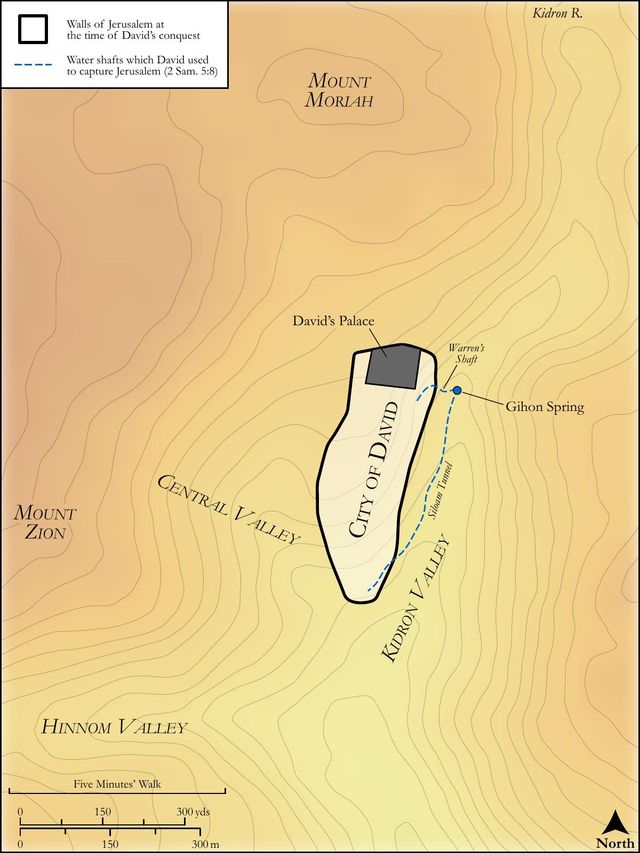
See on the biblical-era map
Study this verse
Public-domain commentary
Matthew Henry
From his Commentary on the Whole Bible. Henry comments on passages, not single verses — this entry covers 2 Samuel 22:2–51. His four-level outline is real structure in the source text, so it is rendered as structure.
Let us observe, in this song of praise,
I.How David adores God, and gives him the glory of his infinite perfections.
There is none like him, nor any to be compared with him (Sa2 22:32): Who is God, save the Lord? All others that are adored as deities are counterfeits and pretenders. None is to be relied on but he. Who is a rock, save our God? They are dead, but the Lord liveth, Sa2 22:47. They disappoint their worshippers when they most need them. But as for God his way is perfect, Sa2 22:31. Men begin in kindness, but end not - promise, but perform not; but God will finish his work, and his word is tried, and what we may trust.
II.How he triumphs in the interest he has in this God, and his relation to him, which he lays down as the foundation of all the benefits he has received from him: He is my God; as such he cries to him (Sa2 22:7), and cleaves to him (Sa2 22:22); "and, if my God, then my rock" (Sa2 22:2), that is, "my strength and my power (Sa2 22:33), the rock under which I take shelter (he who is to me as the shadow of a great rock in a weary land), the rock on which I build my hope," Sa2 22:3. Whatever is my strength and support, it is the God of my rock that makes it so; nay, he is the God of the rock of my salvation (Sa2 22:47): my saving strength is in him and from him. David often hid himself in a rock (Sa1 24:2), but God was his chief hiding-place. "He is my fortress, in which I am safe and think myself so - my high tower, or stronghold, in which I am out of the reach of real evils - the tower of salvation (Sa2 22:51), which can never be sealed nor battered, nor undermined. Salvation itself saves me. Am I in distress? he is my deliverer - struck at, shot at? he is my shield - pursued? he is my refuge - oppressed? he is my saviour, that rescues me out of the hand of those that seek my ruin. Nay, he is the horn of my salvation, by which I am strongly protected, and my enemies are strongly pushed." Christ is spoken of as the horn of salvation in the house of David, Luk 1:69. "Am I burdened, and ready to sink? The Lord is my stay (Sa2 22:19), by whom I am supported. Am I in the dark, benighted, at a loss? Thou art my lamp, O Lord! to show me my way, and thou wilt dispel my darkness," Sa2 22:29. If we sincerely take the Lord for our God, all this, and much more, he will be to us, all we need and can desire.
III.What improvement he makes of his interest in God.
If he be mine, 1. In him will I trust (Sa2 22:3), that is, "I will resign myself to his direction, and then depend upon his power, and wisdom, and goodness, to conduct me well." 2. On him I will call (Sa2 22:4), for he is worthy to be praised. What we have found in God that is worthy to be praised should engage us to pray to him and give glory to him. 3. To him will I give thanks (Sa2 22:50), and that publicly. When he was among the heathen he would neither be afraid nor ashamed to own his obligations to the God of Israel.
IV.The full and large account he keeps for himself, and gives to others, of the great and kind things God had done for him.
This takes up most of the song. He gives God the glory both of his deliverances and of his successes, showing both the perils he was delivered from and the power he was advanced to.
1.He magnifies the great salvations God had wrought for him. God sometimes brings his people into very great difficulties and dangers, that he may have the honour of saving them and they the comfort of being saved by him. He owns, Thou hast saved me from violence (Sa2 22:3), from my enemies (Sa2 22:4), from my strong enemy, meaning Saul, who, if God had not succoured him, would have been too hard for him, Sa2 22:18. Thou hast given me the shield of thy salvation, Sa2 22:36. To magnify the salvation, he observes,
(1.)That the danger was very great and threatening out of which he was delivered. Men rose up against him (Sa2 22:40, Sa2 22:49) that hated him (Sa2 22:41), a violent man (Sa2 22:49) namely, Saul, who was malicious in his designs against him and vigorous in his pursuit. This is expressed figuratively, Sa2 22:5, Sa2 22:6. He was surrounded with death on every side, threatened to be overwhelmed, and saw no way of escape. So violently did the waves of death beat upon him, so strongly did the cords and snares of death hold him, that he could not help himself, any more than a man in the grave can. The floods of Belial, the wicked one, and his wicked instruments, made him afraid; he trembled to see not only earth, but death and hell, in arms against him.
(2.)That his deliverance was an answer to prayer, Sa2 22:7. He has here left us a good example, when we are in distress, to cry unto God with importunity, as children in a fright cry to their parents; and great encouragement to do so, in that he found God ready to answer prayer out of his temple in heaven, where he is continually served and adored.
(3.)That God appeared in a singular and extraordinary manner for him and against his enemies. The expressions are borrowed from the descent of the divine Majesty upon Mount Sinai, Sa2 22:8, Sa2 22:9, etc. We do not find that in any of David's battles God fought for him with thunder (as in Samuel's time), or with hail (as in Joshua's time), or with the stars in their courses (as in Deborah's time); but these lofty metaphors are used,
[1.]To set forth the glory of God, which was manifested in his deliverance. God's wisdom and power, his goodness and faithfulness, his justice and holiness, and his sovereign dominion over all the creatures and all the counsels of men, which appeared in favour of David, were as clear and bright a discovery of God's glory to an eye of faith as such miraculous interpositions would have been to an eye of sense.
[2.]To set forth God's displeasure against his enemies, God so espoused his cause that he showed himself an enemy to all his enemies; his anger is set forth by a smoke out of his nostrils, and fire out of his mouth (Sa2 22:9), coals kindled (Sa2 22:13), arrows, Sa2 22:15. Who knows the power and terror of his wrath?
[3.]To set forth the extraordinary confusion which his enemies were put into, and the consternation that seized them; as if the earth had trembled and the foundations of the world had been discovered, Sa2 22:8, Sa2 22:16. Who can stand before God when he is angry?
[4.]To show how ready God was to help him: He rode upon a cherub and did fly, Sa2 22:11. God hastened to his succour, and came to him with seasonable relief, though he had seemed at a distance; yet he was a God hiding himself (Isa 14:15), for he made darkness his pavilion (Sa2 22:12), for the amazement of his enemies and the protection of his own people.
(4.)That God manifested his particular favour and kindness to him in these deliverances (Sa2 22:20): He delivered me, because he delighted in me. The deliverance came not from common providence, but covenant-love; he was herein treated as a favourite: so he perceived by the communications of divine grace and comfort to his soul with these deliverances, and the communion he had with God in them. Herein he was a type of Christ, whom God upheld because he delighted in him, Isa 42:1, Isa 42:2.
2.He magnifies the great successes God had crowned him with. He had not only preserved but prospered him. He was blessed,
(1.)With liberty and enlargement. He was brought into a large place (Sa2 22:20), where he had room to thrive, and his steps were enlarged under him, so that he had room to stir (Sa2 22:37), being no longer straitened and confined.
(2.)With military skill, and strength, and swiftness. Though he was bred up to the crook, he was well instructed in the arts of war and qualified for the toils and perils of it. God, having called him to fight his battles, qualified him for the service. He made him very ingenious (He teacheth my hands to war, Sa2 22:35. And this ingenuity was as good as strength, for it follows, "so that a bow of steel is broken by my arms," not so much by main force as by dexterity), and very vigorous and valiant. (Thou hast girded me with strength to battle, Sa2 22:40. He gives God the glory of all his courage and ability for service), and very expeditious: He maketh my feet swift like hinds feet (Sa2 22:34), which is of great advantage both in charging and retreating.
(3.)With victory over his enemies, not only Saul and Absalom, but the Philistines, Moabites, Ammonites, Syrians, and other neighbouring nations, whom he subdued and made tributaries to Israel. His wonderful victories are here described, Sa2 22:38-43. They were speedy victories (I turned not again till I had consumed them, Sa2 22:38) and complete victories. The enemies of Israel were wounded, destroyed, consumed, fell under his feet, trampled upon, and disabled to rise, and their necks lay at his mercy. They cried both to earth and heaven for help, but in vain. There was none to save, none that durst appear for them. God answered them, not for they were not on his side, nor did they cry unto him till they were brought to the last extremity. Being thus abandoned, they became an easy prey to David's righteous and victorious sword, so that he beat them as small as the dust of the earth, which is scattered by the wind and trodden on by every foot.
(4.)With advancement to honour and power. To this he was anointed before his troubles began, and at length, post tot discrimina rerum - after all his dangers and disasters, he gained his point. God made his way perfect (Sa2 22:33), gave him success in all his undertakings, set him upon his high places (Sa2 22:34), denoting both safety and dignity. God's gentleness, his grace and tender mercy, made him great (Sa2 22:36), gave him great wealth, and great authority, and a name like that of the great men of the earth. He was kept to be the head of the heathen (Sa2 22:44); his signal preservations evinced that he was designed and reserved for something great - to rule over all Israel, notwithstanding the strivings of the people, and so that those whom he had not known should serve him, many of the nations that lay remote. Thus he was lifted up on high, as high as the throne, above those that rose up against him, Sa2 22:49.
V.The comfortable reflections he makes upon his own integrity, which God, by those wonderful deliverances, had graciously owned and witnessed to, Sa2 22:21-25. He means especially his integrity with reference to Saul and Ishbosheth, Absalom and Sheba, and those who either opposed his coming to the crown or endeavoured to dethrone him. They falsely accused him and misrepresented him, but he had the testimony of this conscience for him that he was not an ambitious aspiring man, a false and bloody man, as they called him, - that he had never taken any indirect unlawful courses to secure or raise himself, but in his whole conduct had kept in the way of his duty, - and that in the whole course of his conversation he had, for the main, made religion his business, so that he could take God's favours to him as the rewards of his righteousness, not of debt, but of grace. God had recompensed him, though not for his righteousness, as if that had merited any thing at the hand of God, yet according to his righteousness, which he was well pleased with, and had an eye to. His conscience witnessed for him,
1.That he had made the word of God his rule, and had kept to it, Sa2 22:23. Wherever he was, God's judgments were before him as his guide; whithersoever he went, he took his religion along with him, and though he was forced to depart from his country, and sent, as it were, to serve other gods, yet as for God's statutes, he did not depart from them, but kept the way of the Lord and walked in it.
2.That he had carefully avoided the bye-paths of sin. He had not wickedly departed from his God. He could not say but that he had taken some false steps, but he had not deserted God, nor forsaken his way. Sins of infirmity he could not acquit himself from, but the grace of God had kept him from presumptuous sins. Though he had sometimes weakly departed from his God. By this it appeared that he was upright before God, or to God (in his sight, and with an eye to him), that he kept himself from his own iniquity, not only from that particular sin of killing Saul when it was in the power of his hand to do it, but, in general, he was afraid of sin and watchful against it, and made conscience of what he said and did. The matter of Uriah is an exception (Kg1 15:5), like that in Hezekiah's character, Ch2 32:31. Note, A careful abstaining from our own iniquity is one of the best evidences of our own integrity; and the testimony of our conscience for us that we have done so will be such a rejoicing as will not only lessen the griefs of an afflicted state, but increase the comforts of a prosperous state. David reflected with more comfort upon his victories over his own iniquity than upon his conquest of Goliath and all the hosts of the uncircumcised Philistines; and the witness of his own heart to his uprightness was sweeter though more silent music than theirs that sang, David has slain his ten thousands. If a great man be a good man, his goodness will be much more his satisfaction than his greatness. Let favour be shown to the upright and his uprightness will sweeten it, will double it.
VI.The comfortable prospects he has of God's further favour.
As he looks back, so he looks forward, with pleasure, and assures himself of the kindness God has in store for all the saints, for himself, and also for his seed.
1.For all good people, Sa2 22:26-28. As God had dealt with him according to his uprightness, so he will with all others. He takes occasion here to lay down the established rules of God's procedure with the children of men: -
(1.)That he will do good to those that are upright in their hearts. As we are found towards God, he will be found towards us.
[1.]God's mercy and grace will be the joy of those that are merciful and gracious. Even the merciful need mercy; and they shall obtain it.
[2.]God's uprightness, his justice and faithfulness, will be the joy of those that are upright, just, and faithful, both towards God and man.
[3.]God's purity and holiness will be the joy of those that are pure and holy, who therefore give thanks at the remembrance thereof. And, if any of these good people be afflicted people, he will save them, either out of their afflictions or by and after them. On the other hand,
(2.)That those who turn aside to crooked ways he will lead forth with the workers of iniquity, as he says in another psalm. With the froward he will wrestle; and those with whom God wrestles are sure to be foiled. Woe unto him that strives with his Maker! God will walk contrary to those that walk contrary to him and be displeased with those that are displeased with him. As for the haughty, his eyes are upon them, marking them out, as it were, to be brought down; for he resists the proud.
2.For himself. He foresaw that his conquests and kingdom would be yet further enlarged, Sa2 22:45, Sa2 22:46. Even the sons of the stranger, that would hear the report of his victories and the tokens of God's presence with him, would be possessed with a fear of him, would be forced to submit to him, though feignedly, and would be obedient to him. The successes which he had had he looked upon as earnests of more and means of more. Who durst oppose him by whom so many had been overcome? Thus the Son of David goes on conquering and to conquer, Rev 6:2. His gospel, which has been victorious, shall be so more and more.
3.For his seed: He showeth mercy to his Messiah (Sa2 22:51), not only to David himself, but to that seed of his for evermore. David was himself anointed of God, not a usurper, but duly called to the government and qualified for it; therefore he doubted not but God would show mercy to him, that mercy which he had promised not to take from him nor from his posterity (Sa2 7:15, Sa2 7:16); on that promise he depends, with an eye to Christ, who alone is his seed for evermore, whose throne and kingdom still continue, and will to the end, whereas the seed and lineage of David are long since extinct. See Psa 89:28, Psa 89:29. Thus all his joys and all his hopes terminate, as ours should, in the great Redeemer.
Continue studying 2 Samuel 22:40 across the web’s major study libraries — every link below opens this exact verse, chapter, or book on the destination site.
Read & Compare
 BibleGatewayThis verse in more than 200 translations and 70 languages.
 Bible.comThe YouVersion reader — hundreds of translations, reading plans, and highlights.
 ESV.orgCrossway's official English Standard Version reader.
 NET BibleThe NET translation with 60,000+ translators' notes on every rendering decision.
 STEP BibleTyndale House's free study tool — original text, vocabulary, and scholarly resources.
 BibliaLogos Bible Software's free web reader.
 USCCBThe New American Bible (Revised Edition) with the U.S. bishops' study notes.
Commentaries
 BibleHub CommentariesDozens of classic commentaries on this verse, gathered on one page.
 StudyLightMore than 100 commentary sets — the largest collection on the web.
 BibleRefPlain-English commentary on what this verse means, verse by verse.
 Enduring WordDavid Guzik's free commentary on this chapter, widely used by Bible teachers.
 Bible Study ToolsVerse commentary alongside Greek and Hebrew study aids.
Original Language & Research
- BibleHub InterlinearThe verse word by word — original language, transliteration, and English.
- BibleHub LexiconEvery word's original-language definition and Strong's entry.
 Blue Letter BibleDeep-study tools — Strong's numbers, concordance, and word studies.
 SefariaThe Hebrew text with Rashi and centuries of Jewish commentary.
Sermons, Hymns & Audio


TrulyRandomVerse is not affiliated with these sites and doesn’t control their content. They’re linked because they’re genuinely useful.
Summary
2 Samuel 22:40 is a powerful declaration from King David's song of deliverance, a profound psalm of thanksgiving offered to the Lord. In this verse, David attributes his military prowess, strategic readiness, and decisive victories not to his own inherent strength or skill, but entirely to God's divine empowerment and active intervention. It stands as a profound testament to the Lord's sovereign power to equip His servants for the challenges of life and to grant them complete triumph over all adversaries, both physical and spiritual.
Context
ShowHideLiterary Context
This verse is an integral part of a lengthy psalm of praise found in 2 Samuel 22, which is almost identically preserved in Psalm 18. Strategically placed near the conclusion of David's life narrative in 2 Samuel, this song serves as a climactic summary of his lifelong experience of God's unwavering deliverance. The introductory verse explicitly states that David sang this song "in the day that the LORD had delivered him out of the hand of all his enemies, and out of the hand of Saul" (2 Samuel 22:1). The psalm unfolds from a declaration of God as David's ultimate refuge and deliverer, through a vivid, almost apocalyptic description of God's powerful intervention on his behalf, to a triumphant celebration of the victories God granted him, culminating in a vision of God's ultimate triumph and worldwide dominion. Verse 40 specifically highlights the practical outworking of God's protective and empowering presence in David's military campaigns, detailing how divine strength translated into tangible victory.
Historical & Cultural Context
David's extensive reign was marked by persistent warfare, a common reality for the kings of that day. From his early days as a fugitive fleeing Saul, through his establishment as king, and throughout his long rule, David faced numerous external enemies such as the Philistines, Ammonites, Arameans, Edomites, and Moabites, alongside internal rebellions like those led by Absalom and Sheba. Among the nations, a king's success in battle was often attributed to the favor of his patron god. David, however, consistently and unequivocally attributed his victories to Yahweh, the God of Israel. The act of "girding" was a common and essential preparation for any strenuous activity in ancient times, including battle. It involved tucking up one's long outer garments into a belt or sash to allow for freedom of movement and maximum exertion. Therefore, God "girding" David with strength implies a direct, active, and supernatural equipping and preparation for the physical and spiritual demands of warfare, emphasizing divine enablement over human effort. The "subduing" of enemies speaks to the absolute nature of ancient conquest, where defeated foes were brought into complete submission, often kneeling or prostrating themselves before the victor.
Key Themes
ShowHideThis verse powerfully contributes to several overarching themes within 2 Samuel and the broader Old Testament narrative. Firstly, it emphatically underscores the theme of Divine Empowerment, portraying God as the ultimate, indispensable source of strength and capability for His chosen servant. David's military prowess is not an inherent quality but a divinely bestowed gift, echoing the profound biblical principle that "the battle is the LORD's" (1 Samuel 17:47). Secondly, it highlights Sovereign Victory, demonstrating God's active, decisive, and overwhelming role in granting triumph over adversaries. David's enemies were not merely defeated; they were "subdued under me," indicating a complete, humiliating, and absolute subjugation orchestrated entirely by God. This reinforces God's absolute sovereignty over all circumstances and opposition, a theme powerfully evident from the Exodus narrative where God triumphs over Pharaoh (Exodus 14) to the prophetic promises of future victory and the ultimate triumph of God's kingdom. Lastly, the verse, within the comprehensive context of the entire psalm, exemplifies Profound Gratitude and Unwavering Trust. It is an outpouring of David's deep thankfulness and unwavering reliance on God as his protector, deliverer, and enabler throughout his tumultuous life, serving as a timeless model for acknowledging divine assistance in all of life's struggles and attributing success solely to God's powerful hand.
Exposition and Analysis
ShowHideKey Word Analysis
ShowHideThis primitive root verb signifies "to belt," "to bind (compass) about," or "to gird (up, with)." In ancient contexts, "girding up one's loins" was an essential preparation for any strenuous activity—whether work, travel, or battle—by tightening one's outer garments around the waist to allow for freedom of movement and exertion. Here, the active voice "thou hast girded me" profoundly signifies that God Himself took the initiative to equip and prepare David, providing him with the necessary readiness, agility, and internal fortitude for the rigors of battle. It speaks of a direct, divine enablement, not merely human effort.
This multifaceted Hebrew word, derived from a root suggesting "force," can refer to physical strength, military might, wealth, or even moral virtue and valor. In this specific context, it primarily denotes military power, valor, and effectiveness in warfare. When God "girds with strength," it implies an infusion of divine power that makes David formidable and capable of overcoming even the most formidable opposition. It encompasses not just physical prowess, but an overall capability, effectiveness, and might in the face of conflict, stemming directly and entirely from God.
This primitive root verb means "to bend the knee," "to sink," "to prostrate," "to bring low," or "to humble." It vividly portrays the complete and utter defeat of David's enemies. God did not merely cause them to retreat or be defeated; He brought them to their knees, signifying total conquest, humiliation, and absolute submission. This emphasizes the decisive and absolute nature of the victory granted by God, where the adversaries are rendered utterly powerless and placed entirely under David's dominion.
Verse Breakdown
ShowHide"For thou hast girded me with strength to battle"
This opening clause immediately establishes the divine source of David's military capability and success. The conjunction "For" (כִּי, kî) indicates that this statement provides the reason or explanation for David's preceding declarations of God's deliverance and his ability to triumph. David explicitly states that his capacity to engage in warfare and achieve success is not inherent within himself but is a direct, active endowment from God. The powerful imagery of being "girded" suggests God personally preparing David, equipping him with the necessary power, readiness, resilience, and spiritual fortitude to face the challenges of combat. This strength is specifically "to battle," indicating a divine provision precisely tailored for the specific purpose of overcoming adversaries.
"them that rose up against me hast thou subdued under me"
This second clause describes the glorious and decisive outcome of God's empowerment: complete victory over all enemies. The phrase "them that rose up against me" refers to all of David's adversaries, encompassing both external foes who threatened his kingdom and internal rebels who challenged his reign or sought his life. The verb "subdued" powerfully conveys the complete and humiliating defeat of these foes. God did not merely defeat them; He brought them into absolute submission, placing them "under me," signifying David's divinely ordained authority and triumph. This underscores God's active role as the Divine Warrior who fights on behalf of His servant, ensuring total conquest and establishing David's dominion and security.
Literary Devices
ShowHide2 Samuel 22:40 employs several potent literary devices to convey its profound message of divine empowerment and victory. The phrase "thou hast girded me with strength to battle" is a powerful metaphor, likening God's act of empowering David to the physical act of a warrior preparing for combat by tightening their belt. This vivid image conveys readiness, agility, and the infusion of robust, supernatural capability, emphasizing God's direct involvement in David's preparation. The enemies are described as "them that rose up against me," which can be seen as a form of personification, giving agency and hostile intent to the abstract concept of opposition and rebellion. This makes the adversaries feel more tangible and threatening, thus magnifying the power of God who overcomes them. The subsequent declaration, "hast thou subdued under me," utilizes hyperbole to emphasize the totality and decisiveness of the victory. While enemies might simply be defeated, to be "subdued under me" suggests an absolute, overwhelming, and humiliating conquest, where all opposition is utterly crushed and brought into complete submission and prostration. This strong imagery serves to magnify God's unparalleled power and David's divinely granted authority and triumph.
Theological and Thematic Connections
ShowHideThis verse profoundly articulates the fundamental biblical truth that God is the ultimate and indispensable source of strength and victory for His people. David's experience is not an isolated incident but exemplifies a recurring theme throughout Scripture: human capability and success are ultimately dependent on divine enablement. It speaks powerfully to God's active, personal, and powerful involvement in the lives of His servants, not merely as a distant observer but as a personal and mighty deliverer. This theological principle extends far beyond physical battles to encompass all forms of struggle—spiritual warfare, emotional turmoil, personal sin, or circumstantial challenges—affirming that God equips and empowers believers to overcome. The complete subjugation of enemies highlights God's absolute sovereignty and His unwavering commitment to establishing justice and order through His chosen instruments, ensuring the triumph of His purposes.
Reflection and Application
ShowHideFor believers today, 2 Samuel 22:40 offers profound encouragement and a timeless framework for understanding our own struggles and victories. We are often called to engage in various "battles"—spiritual warfare against unseen forces, personal struggles with sin or doubt, professional challenges, relational conflicts, or the pursuit of God's calling in a hostile world. This verse serves as a powerful reminder that we are not called to fight these battles in our own limited strength. Just as God "girded" David, He promises to equip us with the necessary spiritual, emotional, and intellectual strength, resilience, and wisdom to face our adversaries. Our victories, whether seemingly large or small, are ultimately His doing, a testament to His power working through our yieldedness and dependence. Cultivating a heart of profound gratitude, like David, for every deliverance and every instance of divine enablement strengthens our faith and deepens our dependence on God. It shifts our focus from self-reliance and anxiety to humble trust, knowing that the God who empowered David and subdued his enemies is the very same God who empowers us to overcome.
Questions for Reflection
ShowHideFAQ
ShowHideWhy is this song of deliverance repeated in both 2 Samuel 22 and Psalm 18?
ShowHideThe repetition of David's song in both 2 Samuel 22 and Psalm 18 highlights its profound theological significance and canonical importance. In 2 Samuel, it serves as a climactic summary of God's unwavering faithfulness to David throughout his tumultuous life, strategically placed at the end of his active reign as a testament to his legacy of reliance on God. It functions as a capstone to his narrative. In the book of Psalms, it functions as a model of individual and corporate thanksgiving and lament, demonstrating how a righteous king, and by extension any believer, should praise God for deliverance from all forms of distress. The slight textual variations between the two versions are common in ancient literary traditions and may reflect different editorial purposes or nuances in oral transmission, but the core message of divine deliverance and empowerment remains consistent and powerful in both canonical placements, underscoring its enduring truth.
What does "girded me with strength" mean for a modern believer?
ShowHideFor a modern believer, "girded me with strength" signifies that God supernaturally equips, empowers, and prepares us for the challenges we face, whether they are spiritual battles, personal trials, difficult callings, or daily responsibilities. Just as an ancient warrior prepared for physical combat by tightening their garments for optimal movement and power, God prepares us for life's struggles. This "girding" can manifest as an infusion of spiritual fortitude, divine wisdom, emotional resilience, physical endurance, or supernatural grace. It means that we are not left to our own limited resources but can draw upon God's infinite power and presence. This concept aligns perfectly with New Testament teachings like Ephesians 6:10, which exhorts believers to "be strong in the Lord and in the strength of his might," reminding us that our true power and capability come solely from Him.
How does David's experience of God subduing his enemies relate to our spiritual battles today?
ShowHideDavid's experience of God subduing his physical enemies serves as a powerful and direct analogy for our spiritual battles today. While believers may not face literal armies, we contend with formidable spiritual adversaries, the temptations of the flesh, and the pervasive pressures of a fallen world. Ephesians 6:12 profoundly reminds us that "we wrestle not against flesh and blood, but against principalities, against powers, against the rulers of the darkness of this world, against spiritual wickedness in high places." Just as God actively fought for David and granted him decisive victory, He promises to fight for us in our spiritual struggles. Our victory over sin, temptation, and the schemes of the enemy is not achieved by our own limited might but by God's omnipotent power working through us, ultimately secured by the triumph of Christ on the cross. We are called to stand firm in faith, trusting that God will ultimately "subdue" our spiritual foes under our feet, as promised in Romans 16:20, granting us victory through Christ.
Christ-Centered Fulfillment
ShowHide2 Samuel 22:40 finds its ultimate and most profound fulfillment in the person and work of Jesus Christ. David, as a divinely appointed king, a mighty warrior, and a deliverer of his people, serves as a significant type of the coming Messiah. While David was "girded with strength to battle" and subdued his earthly enemies through physical conquest, Jesus is the ultimate Divine Warrior, the one truly "clothed with strength, wherewith he hath girded himself" (Psalm 93:1) who came to fight the decisive battle against sin, death, and the devil. His victory was not achieved through physical warfare but through His perfect obedience, His sacrificial death on the cross, and His glorious resurrection. It was through His apparent weakness on the cross that He utterly "subdued" the powers of darkness, triumphing over them and making a public spectacle of them (Colossians 2:15). He is the true King who has been given "all authority in heaven and on earth" (Matthew 28:18), and it is He who will ultimately put all enemies under His feet, reigning until the last enemy, death, is destroyed (1 Corinthians 15:25-26). Furthermore, Christ empowers His followers, "girding" them with the Holy Spirit's strength and power (Acts 1:8) to live victoriously over sin and to participate in His ongoing mission, knowing that in Him, we are more than conquerors through Him who loved us (Romans 8:37).