


1 Kings 2:8
- וְהִנֵּהve·hi·Nehand here!H2009Conj-w ¦ PrtParticle Interjectionוְandהִנֵּהhere!
- עִמְּךָ'I·me·kha[is] with youH5973Prep ¦ 2msPrepositionעִמְּ[is] withךָyou
- שִׁמְעִיshim·'IShimeiH8096N-proper-mNoun Proper Masculine
- בֶןven[the] son ofH1121N-mscNoun Singular Masculine Construct
- גֵּרָאge·Ra'GeraH1617N-proper-mNoun Proper Masculine
- בֶןven[the] Ben-H1145N-mscNoun Gentilic Singular Masculine Construct
- הַיְמִינִיhay·mi·Ni<the> jaminiteH1145Art ¦ N-msNoun Gentilic Singular Masculine Absoluteהַ<the>יְמִינִיjaminite
- מִבַּחֻרִיםmi·ba·chu·Rimfrom BahurimH980Prep-m ¦ N-properNoun Proper LocationמִfromבַּחֻרִיםBahurim
- וְהוּאve·Hu'and heH1931Conj-w ¦ Pro-3msPronoun Personal 3rd Singular Masculineוְandהוּאhe
- קִלְלַנִיki·La·nihe cursed meH7043V-Piel-Perf-3ms ¦ 1csVerb Piel Perfect 3rd Singular Masculineקִלְלַhe cursedנִיme
- קְלָלָהke·la·Laha curseH7045N-fsNoun Singular Feminine Absolute
- נִמְרֶצֶתnim·Re·tzetgrievousH4834V-Niphal-Prtcpl-fsVerb Niphal Participle Singular Feminine Absolute
- בְּיוֹםbe·Yomon [the] dayH3117Prep-b ¦ N-mscNoun Singular Masculine Constructבְּonיוֹם[the] day
- לֶכְתִּיlekh·TiI wentH1980V-Qal-Inf ¦ 1csVerb Qal Infinitive ConstructלֶכְתִּwentיI
- מַחֲנָיִםma·cha·Na·yimMahanaimH4266N-properNoun Proper Location
- וְהוּאve·hu'and heH1931Conj-w ¦ Pro-3msPronoun Personal 3rd Singular Masculineוְandהוּאhe
- יָרַדya·Radhe came downH3381V-Qal-Perf-3msVerb Qal Perfect 3rd Singular Masculine
- לִקְרָאתִיlik·ra·Tito meet meH7122Prep-l ¦ V-Qal-Inf ¦ 1csVerb Qal Infinitive Constructלִtoקְרָאתִmeetיme
- הַיַּרְדֵּןhai·yar·Denthe JordanH3383Art ¦ N-properNoun Proper LocationהַtheיַּרְדֵּןJordan
- וָאֶשָּׁבַעva·'e·Sha·va'and I sworeH7650Conj-w ¦ V-Niphal-ConsecImperf-1csVerb Niphal Consecutive Imperfect 1st Singular common genderוָandאֶשָּׁבַעI swore
- לוֹloto himPrep-l ¦ 3msSuffix Personal 3rd Singular Masculineלtoוֹhim
- בַיהוָהba·Yah·wehby YahwehH3068Prep-b ¦ N-properNoun Proper TitleבַbyיהוָהYahweh
- לֵאמֹרle·Mor<to> sayingH559Prep-l ¦ V-Qal-InfVerb Qal Infinitive Constructלֵ<to>אמֹרsaying
- אִם'imifH518PrtParticle Conditional
- אֲמִיתְךָ'a·mi·te·KhaI will put to death youH4191V-Hiphil-Imperf-1cs ¦ 2msVerb Hiphil Imperfect 1st Singular common genderאֲמִיתְI will put to deathךָyou
- בֶּחָרֶבbe·Cha·revby the swordH2719Prep-b ¦ N-fsNoun Singular Feminine Absoluteבֶּby theחָרֶבsword
English is a literal word-by-word gloss of the Hebrew, not the KJV's wording. Why?
This is the original text the KJV's translators worked from — each Hebrew word with its own literal English meaning in this verse, prepared by scholars at Tyndale House, Cambridge. The KJV translates whole sentences, not word by word, so its wording differs: one Hebrew word can become several English words, and the KJV may choose “the LORD” where the gloss reads “Yahweh”. Both are faithful — they answer different questions. For the KJV's own rendering, switch to the KJV text.
Details
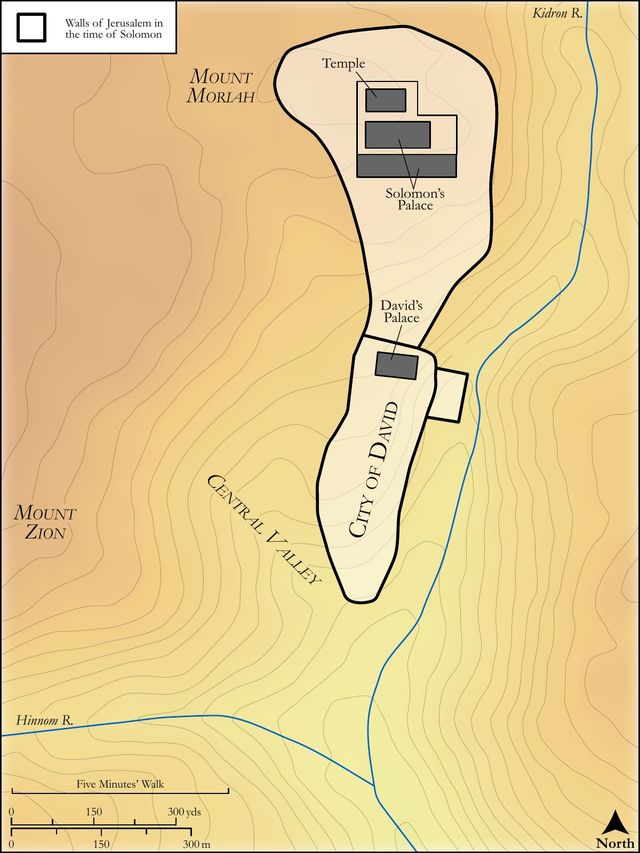
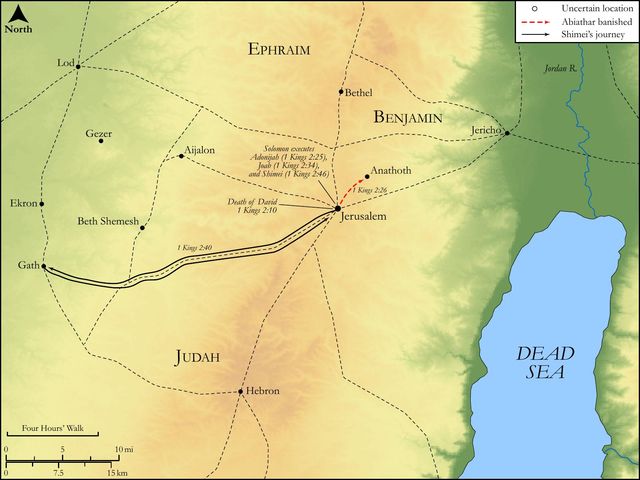
See on the biblical-era maps
Study this verse
Continue studying 1 Kings 2:8 across the web’s major study libraries — every link below opens this exact verse, chapter, or book on the destination site.
Read & Compare
 BibleGatewayThis verse in more than 200 translations and 70 languages.
 Bible.comThe YouVersion reader — hundreds of translations, reading plans, and highlights.
 ESV.orgCrossway's official English Standard Version reader.
 NET BibleThe NET translation with 60,000+ translators' notes on every rendering decision.
 STEP BibleTyndale House's free study tool — original text, vocabulary, and scholarly resources.
 BibliaLogos Bible Software's free web reader.
 USCCBThe New American Bible (Revised Edition) with the U.S. bishops' study notes.
Commentaries
 BibleHub CommentariesDozens of classic commentaries on this verse, gathered on one page.
 StudyLightMore than 100 commentary sets — the largest collection on the web.
 BibleRefPlain-English commentary on what this verse means, verse by verse.
 Enduring WordDavid Guzik's free commentary on this chapter, widely used by Bible teachers.
 Bible Study ToolsVerse commentary alongside Greek and Hebrew study aids.
Original Language & Research
- BibleHub InterlinearThe verse word by word — original language, transliteration, and English.
- BibleHub LexiconEvery word's original-language definition and Strong's entry.
 Blue Letter BibleDeep-study tools — Strong's numbers, concordance, and word studies.
 SefariaThe Hebrew text with Rashi and centuries of Jewish commentary.
Sermons, Hymns & Audio


TrulyRandomVerse is not affiliated with these sites and doesn’t control their content. They’re linked because they’re genuinely useful.
Summary
1 Kings 2:8 records a crucial part of King David's final instructions to his son and successor, Solomon. On his deathbed, David reminds Solomon of Shimei, a Benjamite from Bahurim, who had subjected David to a severe curse during his desperate flight from Absalom's rebellion. David recounts how Shimei later met him at the Jordan River, where David, in a moment of return and reconciliation, swore by the LORD not to put him to death with the sword. This counsel, however, implicitly conveys that Shimei's past treachery was not fully forgotten, leaving Solomon with the responsibility to address this lingering threat to the stability of the monarchy.
Context
ShowHideLiterary Context
This verse is strategically placed within David's deathbed charge to Solomon, forming a critical part of the outgoing king's strategic counsel for consolidating the nascent monarchy. It follows David's directives concerning Joab and Barzillai (1 Kings 2:5-7) and precedes his general exhortation for Solomon to walk in God's ways and observe His statutes (1 Kings 2:2-4). David is systematically addressing key figures from his past, ensuring Solomon understands the political landscape and the unresolved issues that could threaten his reign. The specific mention of Shimei's past actions and David's oath, first recounted in 2 Samuel 19:16-23, serves to frame the narrative for Solomon's decisive and authoritative actions later in the chapter, particularly his judgment and execution of Shimei in 1 Kings 2:36-46. This sequence highlights Solomon's emerging wisdom and his role in establishing a secure and righteous kingdom.
Historical & Cultural Context
Shimei was a member of the tribe of Benjamin, specifically from Bahurim, a village near Jerusalem. His lineage connected him to the deposed house of Saul, making his actions against David deeply rooted in tribal and political animosity. When David fled Jerusalem during Absalom's rebellion, Shimei publicly cursed him, threw stones, and accused him of being a "man of blood" (as detailed in 2 Samuel 16:5-8). This was not merely an insult but a grave act of treason and a public denunciation of the anointed king, designed to undermine his legitimacy and authority. Public curses were believed to invoke divine judgment, making them profoundly serious offenses. David's subsequent oath "by the LORD" at the Jordan River (where Shimei sought pardon upon David's return) was a solemn, divinely-witnessed commitment, made perhaps to prevent further bloodshed and to foster unity during a fragile period of restoration. However, cultural norms often dictated retribution for such offenses, especially from a new monarch seeking to assert unchallenged authority and deter future acts of rebellion.
Key Themes
ShowHideThis verse significantly contributes to several prominent themes within 1 Kings and the broader Deuteronomistic History. First, it underscores the theme of justice and accountability. While David extended mercy and made an oath, the lingering nature of Shimei's grave offense, particularly against the anointed king, meant that true justice had not yet been fully served. It highlights that certain acts of rebellion, even if momentarily pardoned, may still require ultimate resolution for the stability of the kingdom. Second, it showcases David's wisdom and foresight even in his final moments. He balances his personal oath with the long-term security of the throne, entrusting Solomon with a complex political and ethical dilemma. This demonstrates David's commitment to his dynastic legacy, which God had promised in 2 Samuel 7:12-16. Finally, it sets the stage for the crucial theme of Solomon's wisdom and authority. The young king is presented with a test of his discernment and capacity to establish his reign on a firm foundation of righteous judgment, demonstrating his ability to consolidate power and ensure the peace of the kingdom.
Exposition and Analysis
ShowHideKey Word Analysis
ShowHideThis verb, often used in the Piel stem (as here), means to treat lightly, despise, or to curse. In the context of cursing a king, it signifies a profound act of contempt, rebellion, and public dishonor, aiming to diminish the king's authority and standing.
The noun qᵉlâlâh (H7045) means "curse" or "vilification." The adjective "grievous" comes from the root mârats (H4834), meaning "to press," or figuratively, "to be pungent, vehement, or sore." Combined, "grievous curse" emphasizes the extreme bitterness, venom, and malicious intent of Shimei's words. It was not a casual insult but a deeply felt, potent denunciation, designed to inflict spiritual and emotional harm and to undermine David's divine appointment.
This verb means "to swear" or "to take an oath." When accompanied by "by the LORD" (H3068, Yᵉhôvâh), it indicates a solemn, binding covenant made in the presence of God, invoking His name as guarantor. David's oath was thus a sacred commitment, underscoring the tension between his personal vow and the demands of royal justice for the kingdom's security.
Verse Breakdown
ShowHide"And, behold, [thou hast] with thee Shimei the son of Gera, a Benjamite of Bahurim"
David immediately draws Solomon's attention to Shimei, identifying him with precise detail: his name, his father's name (Gera, H1617), his tribal affiliation (Benjamite, H1145, linking him to Saul's lineage), and his hometown (Bahurim, H980). This specific identification underscores the individual's significance and his past actions, ensuring Solomon understands the gravity of the matter David is entrusting to him.
"which cursed me with a grievous curse in the day when I went to Mahanaim"
This clause vividly recalls Shimei's act of defiance during David's most vulnerable moment – his flight to Mahanaim (H4266) from Absalom's rebellion. The phrase "cursed me with a grievous curse" (using qalal H7043, qelalah H7045, and maratz H4834) emphasizes the severity and malice of Shimei's verbal assault, which included throwing stones and dust, and accusing David of being a "man of blood" (2 Samuel 16:5-8). This was a public, deliberate act of disrespect and an attempt to undermine David's legitimacy and divine anointing.
"but he came down to meet me at Jordan, and I sware to him by the LORD, saying, I will not put thee to death with the sword."
This part recounts Shimei's subsequent repentance and David's solemn oath. When David returned to Jerusalem in triumph, Shimei was among the first to seek his favor at the Jordan River (H3383). David, in a display of mercy and perhaps to avoid further civil strife and bloodshed, solemnly swore by the LORD (H3068) not to execute Shimei with the sword (H2719) at that time. This oath granted Shimei an immediate reprieve, but David's present instruction to Solomon indicates that the oath did not negate the underlying offense or Shimei's potential future threat to the stability of the kingdom.
Literary Devices
ShowHideThe passage employs several Literary Devices to convey its message. Foreshadowing is prominently used, as David's specific and pointed instruction regarding Shimei clearly sets the stage for Solomon's eventual judgment and execution of Shimei, as narrated later in 1 Kings 2:36-46. This creates narrative tension and underscores the gravity of the responsibility David places upon his son. There is also a subtle Irony in David, the king known for his mercy and who himself swore an oath of non-retribution, entrusting the execution of justice for a past offense to his son. This highlights the complex interplay between personal vows and the pragmatic demands of statecraft and maintaining royal authority. The detailed recounting of Shimei's actions and David's oath serves as Recapitulation, reminding the reader of the historical context from 2 Samuel 16 and 2 Samuel 19, ensuring the reader fully grasps the gravity and unresolved nature of the situation David is entrusting to Solomon's discerning judgment.
Theological and Thematic Connections
ShowHideThis passage profoundly illustrates the tension between personal forgiveness and the demands of justice, especially within the context of leadership and maintaining societal order. David's oath to Shimei was an act of mercy, demonstrating compassion in a moment of triumph. However, his dying charge to Solomon reveals that certain offenses, particularly those against the anointed king and the stability of the kingdom, carry a lingering weight that may require ultimate accountability. It highlights the biblical principle that while God is merciful and forgiving, sin has consequences, and leaders are often called to administer justice to ensure righteousness and peace within their realm. David's wisdom is seen in his discernment: he honored his oath but did not absolve Shimei of his character or potential future threat, leaving the final judgment to the new king, who would need to establish his authority decisively and uphold the integrity of the throne.
Reflection and Application
ShowHideDavid's instruction concerning Shimei offers profound insights for believers today, particularly regarding the weight of our words, the nature of forgiveness, and the responsibilities of leadership. Shimei's "grievous curse" reminds us that words are not neutral; they carry immense power to wound, to defame, and to incite. The lasting memory of Shimei's actions, even after David's oath, underscores that while forgiveness can be extended, the natural consequences of malicious speech or action may still unfold, and trust, once broken, is not easily restored. Forgiveness, in the biblical sense, does not always negate accountability or the need for justice to maintain order and righteousness. In our own lives, we are called to be careful with our speech, recognizing its potential for both blessing and destruction, and to understand that true reconciliation often involves a restoration of trust through consistent, righteous behavior. For those in positions of leadership, whether in the church, family, or community, this passage highlights the delicate balance between compassion and the unwavering need to uphold justice, ensuring the well-being and stability of those under their care. It also emphasizes the importance of wise counsel and preparing the next generation to handle complex ethical and relational challenges with discernment and integrity.
Questions for Reflection
ShowHideFAQ
ShowHideWas David's instruction to Solomon a contradiction of his oath to Shimei?
ShowHideNo, David's instruction was not a direct contradiction of his oath, but rather a nuanced and strategic fulfillment of it within the context of a new reign. David had sworn "I will not put you to death with the sword" at the Jordan River, as recorded in 2 Samuel 19:23. This oath granted Shimei an immediate reprieve from execution at that specific time, under David's direct rule. However, David's dying charge to Solomon in 1 Kings 2:8 implies that while David personally would not execute Shimei, Shimei's past treachery and potential future threat to the kingdom remained a serious concern. David's subsequent words to Solomon in 1 Kings 2:9, "do not hold him guiltless," and "bring his hoar head down to the grave with blood," indicate that Shimei's actions still warranted justice. Solomon later gave Shimei a specific command not to leave Jerusalem, effectively putting him under house arrest and testing his loyalty. When Shimei violated this command, Solomon executed him, not for the original curse against David, but for breaking the terms of his probation and violating a new oath made to Solomon himself (1 Kings 2:36-46). Thus, David's oath was honored in its immediate context, but Shimei's character and past actions meant he was not entirely absolved from future accountability under the new king, particularly when his actions again threatened the stability of the throne.
Christ-Centered Fulfillment
ShowHideThe narrative of Shimei, David's oath, and Solomon's eventual judgment finds profound Christ-centered fulfillment, illustrating the complex interplay of mercy, justice, and the establishment of an eternal kingdom. David, as king, embodies a tension between extending grace and upholding justice that is perfectly resolved in Christ. Shimei's "grievous curse" against David, the anointed king, foreshadows the ultimate curse of sin and humanity's rebellion against God himself. Humanity, in its fallen state, has grievously cursed its Creator through disobedience and rejection. Yet, just as David extended a temporary reprieve to Shimei, God, in His boundless mercy, did not immediately condemn humanity. However, the ultimate "curse" of sin required a definitive resolution. Jesus Christ, the greater Son of David and the true King, did not merely defer judgment but bore the full weight of the curse of sin on the cross. "Christ redeemed us from the curse of the law by becoming a curse for us" (Galatians 3:13). Unlike Shimei, whose reprieve was conditional and whose past actions still warranted justice, those who are in Christ receive not a temporary reprieve, but a complete and eternal forgiveness, where their sins are remembered no more (Hebrews 8:12). Jesus, the ultimate Solomon, establishes His kingdom not through the execution of those who rebelled against the previous king, but through His own perfect sacrifice, bringing perfect justice and perfect mercy together, securing an eternal peace that no earthly king could achieve (Isaiah 9:6-7). He is the King who both judges righteously and offers complete redemption, fulfilling the deepest longings for both order and grace.