


Psalms 108:5
Bible text: King James Version (1769 Blayney text) · Public domain
Bible text: Berean Standard Bible · Public domain
Bible text: American Standard Version (1901) · Public domain
Bible text: World English Bible, Messianic edition · Public domain
Bible text: Geneva Bible (1599) · Public domain
Bible text: Young's Literal Translation · Public domain
- רוּמָהRu·mahbe exalted !H7311V-Qal-Imp-2ms ¦ SfxVerb Qal Imperative 2nd Singular Masculineרוּמָbe exaltedה!
- עַל'alaboveH5921PrepPreposition
- שָׁמַיִםsha·Ma·yim[the] heavensH8064N-mpNoun Plural Masculine Absolute
- אֱלֹהִים'E·lo·HimO GodH430N-mpNoun Plural Masculine Absolute
- וְעַלve·'Aland [be] overH5921Conj-w ¦ PrepPrepositionוְandעַל[be] over
- כָּלkolallH3605N-mscNoun Singular Masculine Construct
- הָאָרֶץha·'A·retzthe earthH776Art ¦ N-fsNoun Singular Feminine Absoluteהָtheאָרֶץearth
- כְּבוֹדֶךָke·vo·De·khayour gloryH3519N-msc ¦ 2msNoun Singular Masculine Constructכְּבוֹדֶgloryךָyour
English is a literal word-by-word gloss of the Hebrew, not the KJV's wording. Why?
This is the original text the KJV's translators worked from — each Hebrew word with its own literal English meaning in this verse, prepared by scholars at Tyndale House, Cambridge. The KJV translates whole sentences, not word by word, so its wording differs: one Hebrew word can become several English words, and the KJV may choose “the LORD” where the gloss reads “Yahweh”. Both are faithful — they answer different questions. For the KJV's own rendering, switch to the KJV text.
Details
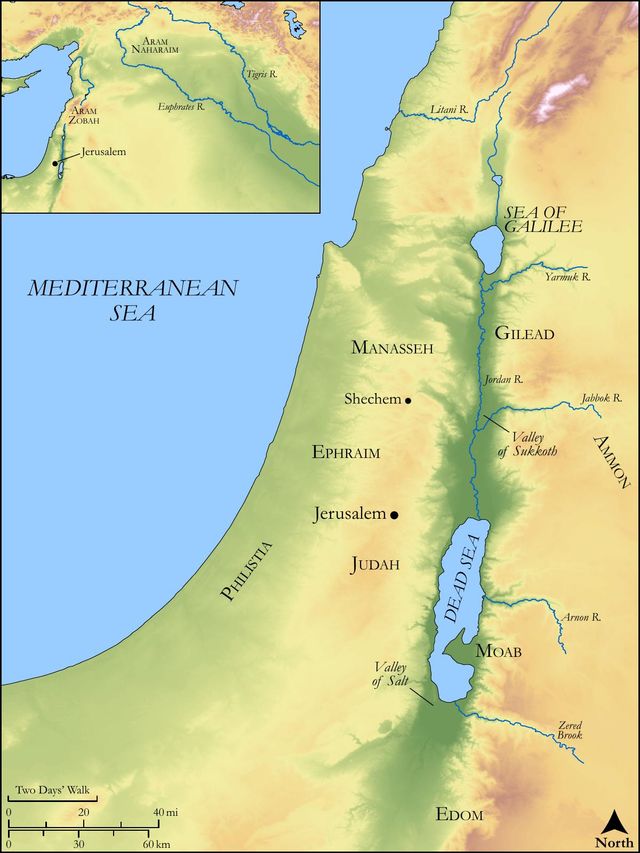
See on the biblical-era map
Study this verse
Public-domain commentary
Matthew Henry
From his Commentary on the Whole Bible. Henry comments on passages, not single verses — this entry covers Psalms 108:1–5.
We may here learn how to praise God from the example of one who was master of the art. 1. We must praise God with fixedness of heart. Our heart must be employed in the duty (else we make nothing of it) and engaged to the duty (Psa 108:1): O God! my heart is fixed, and then I will sing and give praise. Wandering straggling thoughts must be gathered in, and kept close to the business; for they must be told that here is work enough for them all. 2. We must praise God with freeness of expression: I will praise him with my glory, that is, with my tongue. Our tongue is our glory, and never more so than when it is employed in praising God. When the heart is inditing this good matter our tongue must be as the pen of a ready writer, Psa 45:1. David's skill in music was his glory, it made him famous, and this should be consecrated to the praise of God; and therefore it follows, Awake my psaltery and harp. Whatever gift we excel in we must praise God with. 3. We must praise God with fervency of affection, and must stir up ourselves to do it, that it may be done in a lively manner and not carelessly (Psa 108:2): Awake, psaltery and harp; let it not be done with a dull and sleepy tune, but let the airs be all lively. I myself will awake early to do it, with all that is within me, and all little enough. Warm devotions honour God. 4. We must praise God publicly, as those that are not ashamed to own our obligations to him and our thankful sense of his favours, but desire that others also may be in like manner affected with the divine goodness (Psa 108:3): I will praise thee among the people of the Jews; nay, I will sing to thee among the nations of the earth. Whatever company we are in we must take all occasions to speak well of God; and we must not be shy of singing psalms, though our neighbours hear us, for it looks like being ashamed of our Master. 5. We must, in our praises, magnify the mercy and truth of God in a special manner (Psa 108:4), mercy in promising, truth in performing. The heavens are vast, but the mercy of God is more capacious; the skies are high and bright, but the truth of God is more eminent, more illustrious. We cannot see further than the heavens and clouds; whatever we see of God's mercy and truth there is still more to be seen, more reserved to be seen, in the other world. 6. Since we find ourselves so, defective in glorifying God, we must beg of him to glorify himself, to do all, to dispose all, to his own glory, to get himself honour and make himself a name (Psa 108:5): Be thou exalted, O God! above the heavens, higher than the angels themselves can exalt thee with their praises, and let thy glory be spread over all the earth. Father, glorify thy own name. Thou hast glorified it; glorify it again. It is to be our first petition, Hallowed be thy name.
Historical interpretation
Historical reception
2 surviving comments on this verse. Each one is dated, so this reads as a timeline rather than a list.
But, when once they had become submissive after reflecting on that thought, they would find the church promised to all nations, not in slanders and in human fables but in the sacred Books, and they would see it set before their eyes. Then they would not doubt that Christ, as promised in those Books, though unseen, is now above the heavens. Why in the world, then, should I begrudge them salvation, by recalling my colleagues from this sort of fatherly duty, when it is through this that we see many renouncing their former blindness? Yet some who believed, without seeing, that Christ is raised above the heavens, still denied his glory over all the earth, which they did see, although the prophet, with strong significance, included both in one sentence when he said, “Be exalted, O God, above the heavens, and your glory over all the earth.”
Therefore, nothing needs to be said in this place about those who censure and blaspheme Christ (since we are speaking about his glory, by which he was glorified in the world), since the Holy Spirit glorified him with true glory only in the holy catholic church. For elsewhere, that is, either among the heretics or among certain pagans, he cannot be truly glorified on earth, even when he seems to be repeatedly praised. His true glory, therefore, in the catholic church, is sung by the prophet in this way: “Be exalted above the heavens, O God, and above all the earth your glory.” And so, because after his exaltation the Holy Spirit will come and will glorify him, this the sacred psalm, this the Only-Begotten himself promised would happen, which we see fulfilled.
Continue studying Psalms 108:5 across the web’s major study libraries — every link below opens this exact verse, chapter, or book on the destination site.
Read & Compare
 BibleGatewayThis verse in more than 200 translations and 70 languages.
 Bible.comThe YouVersion reader — hundreds of translations, reading plans, and highlights.
 ESV.orgCrossway's official English Standard Version reader.
 NET BibleThe NET translation with 60,000+ translators' notes on every rendering decision.
 STEP BibleTyndale House's free study tool — original text, vocabulary, and scholarly resources.
 BibliaLogos Bible Software's free web reader.
 USCCBThe New American Bible (Revised Edition) with the U.S. bishops' study notes.
Commentaries
 BibleHub CommentariesDozens of classic commentaries on this verse, gathered on one page.
 StudyLightMore than 100 commentary sets — the largest collection on the web.
 BibleRefPlain-English commentary on what this verse means, verse by verse.
 Enduring WordDavid Guzik's free commentary on this chapter, widely used by Bible teachers.
 Bible Study ToolsVerse commentary alongside Greek and Hebrew study aids.
Original Language & Research
- BibleHub InterlinearThe verse word by word — original language, transliteration, and English.
- BibleHub LexiconEvery word's original-language definition and Strong's entry.
 Blue Letter BibleDeep-study tools — Strong's numbers, concordance, and word studies.
 SefariaThe Hebrew text with Rashi and centuries of Jewish commentary.
Sermons, Hymns & Audio


TrulyRandomVerse is not affiliated with these sites and doesn’t control their content. They’re linked because they’re genuinely useful.
Summary
Psalms 108:5 is a fervent and declarative prayer that encapsulates the psalmist's profound trust in God's unparalleled majesty and universal dominion. It proclaims God's supreme position, asserting His inherent splendor and honor not only above the highest celestial realms but also extending over and demanding recognition from the entirety of the earth. This verse serves as a foundational statement of unwavering faith and confidence, preceding and underpinning a subsequent plea for divine intervention and victory.
Context
ShowHideLiterary Context
Psalms 108 is a unique composition, skillfully compiled from two earlier Davidic psalms: Psalm 57:7-11 and Psalm 60:5-12. The psalm opens with a resolute declaration of personal commitment to praise, stating, "My heart is fixed, O God, my heart is fixed: I will sing and give praise" (Psalms 108:1). This unwavering devotion sets the theological stage for the subsequent verses, which transition into an earnest supplication for divine assistance and triumph in battle. Verse 5, positioned early in this structure, functions as the theological bedrock upon which the psalmist's subsequent requests are built. It is a confident assertion of God's inherent greatness and transcendent power that both precedes and undergirds the plea for help, demonstrating that the psalmist's hope and petition are firmly rooted in the immutable character of the God he addresses.
Historical & Cultural Context
Attributed to David, Psalms 108 likely reflects a period of significant national crisis or military conflict, as evidenced by the later verses' fervent pleas for victory against formidable enemies (e.g., Psalms 108:11-13). It was common for kings and nations to invoke their deities before engaging in warfare. However, Israel's monotheistic faith presented a distinctly different perspective. Unlike the localized or limited gods of surrounding nations, Yahweh was understood as the singular Creator and Sovereign over all nations, all peoples, and all creation. The declaration "above the heavens" and "above all the earth" directly challenges any polytheistic notions or attempts to confine God's power or influence to a specific territory. It asserts His universal dominion and absolute transcendence, a core tenet of Israelite theology that profoundly distinguished their God from all others and provided an unparalleled source of confidence in times of national peril.
Key Themes
ShowHideThis verse powerfully articulates several core themes central to the Psalter and broader biblical theology. Firstly, it underscores God's Transcendence and Supremacy, emphasizing His position as infinitely higher and greater than all creation, including the highest celestial bodies. He is not merely part of creation but stands sovereignly over it, a concept reinforced by passages like Psalm 113:4. Secondly, it proclaims Universal Glory, declaring that God's inherent splendor, honor, and reputation are not confined but extend over and should be recognized by all of humanity and throughout the entire world. His glory is meant to be acknowledged universally, as seen in the prophetic vision of Isaiah 6:3. Finally, the verse functions as a fervent call to Worship and Adoration, urging the exaltation of God. It is a declarative act of worship, acknowledging His intrinsic worthiness to receive the highest praise and adoration from all beings, a sentiment powerfully echoed in the heavenly worship described in Revelation 4:11.
Exposition and Analysis
ShowHideKey Word Analysis
ShowHideA primitive root meaning "to be high actively, to rise or raise." When applied to God, this term signifies His inherently elevated position, supreme authority, and majestic nature. It is not a request for God to become something He is not, but rather a declarative recognition and affirmation of His eternal and unchanging state of being supremely high above all things. It often carries the connotation of being lifted up in praise or honor, reflecting the appropriate human response to His divine sovereignty.
The plural of אֱלוֹהַּ, used specifically (especially with the article) of the supreme God. This term emphasizes God's divine power, majesty, and unique status as the one true God, distinct from any lesser deities or human authorities. Its plural form can also denote intensity or the fullness of deity, underscoring the comprehensive nature of the divine being addressed.
Meaning "weight, but only figuratively in a good sense, splendor or copiousness; glory, honour." In a theological context, kâbôwd refers to God's inherent excellent character, His visible manifestation of presence and power, and the honor attributed to Him. It is the radiant expression of His being, His intrinsic worth, and the awe-inspiring display of His attributes. The psalmist declares that this inherent splendor is not confined but extends universally.
The dual of an unused singular, meaning "the sky (as aloft; the dual perhaps alluding to the visible arch in which the clouds move, as well as to the higher ether where the celestial bodies revolve); air, heaven(-s)." This term refers to the celestial spheres, representing the highest reaches of creation. To be "above the heavens" signifies God's transcendence over all created order, even that which is perceived as highest and most distant.
Meaning "the earth (at large, or partitively a land); country, ground, land, world." This term denotes the terrestrial realm, encompassing all land and humanity. To be "above all the earth" signifies God's universal dominion and the global reach of His glory, implying that His honor and renown should be recognized and celebrated by all peoples across the entire globe.
Verse Breakdown
ShowHide"Be thou exalted, O God, above the heavens:"
This opening clause, though phrased as an imperative, functions primarily as a declarative prayer and an act of worshipful affirmation. It is a fervent call for God's inherent supreme position to be recognized, acknowledged, and honored by all creation. The phrase "above the heavens" unequivocally signifies God's absolute transcendence and His unchallengeable sovereignty over all created order, including the celestial spheres. Among the nations, the heavens were often considered the abode of various deities or the ultimate limit of existence; here, the psalmist asserts that the God of Israel is not merely the highest being within creation but is entirely distinct from and infinitely superior to it.
"and thy glory above all the earth;"
This second clause powerfully parallels the first, extending the scope of God's supremacy from the celestial to the terrestrial realm. "Thy glory" refers to God's intrinsic worth, His radiant majesty, and the manifest expression of His divine character and power. The phrase "above all the earth" declares that this inherent glory is not confined to a specific land, people, or temple but is universal in its reach and ought to be universally acknowledged and celebrated. It implies that God's honor, reputation, and manifest presence should be seen, experienced, and proclaimed by all humanity and throughout every aspect of the entire world, permeating all existence.
Literary Devices
ShowHidePsalms 108:5 employs several powerful literary devices to convey its profound theological message with emphasis and poetic beauty. The most prominent is Synonymous Parallelism, where the second line ("and thy glory above all the earth") reiterates and expands upon the thought of the first line ("Be thou exalted, O God, above the heavens"). This repetition with slight variation serves to intensify the message, reinforcing the comprehensive nature of God's supremacy and glory through poetic rhythm and balance. The use of "above the heavens" and "above all the earth" also functions as a form of Merism, a rhetorical device where two contrasting or extreme parts are used to represent the whole. In this case, it signifies that God's exaltation and glory encompass everything from the highest celestial realms to the lowest parts of the terrestrial world, demonstrating His absolute and all-encompassing dominion. Furthermore, the declaration itself functions as a Hymnic Imperative, a command or exhortation that is less about instructing God and more about expressing the psalmist's fervent desire and confident assertion of God's rightful, eternal place of honor. This direct address to God is also an example of Apostrophe, a figure of speech where the speaker directly addresses an absent or imaginary person or an abstract concept, here used to convey profound reverence and direct communion.
Theological and Thematic Connections
ShowHidePsalms 108:5 stands as a powerful testament to the biblical doctrine of God's absolute sovereignty, infinite majesty, and transcendent glory. It is a declaration that frames all human existence, all creation, and all prayer within the reality of a God who is utterly distinct from and infinitely superior to His creation, yet whose glory is meant to pervade and be recognized throughout all of it. This verse reminds us that our worship and petitions must always begin with an acknowledgment of who God is—not merely a powerful being among many, but the supreme, glorious One who stands above all. It connects to the broader biblical narrative of God's unique identity as the only true God, whose worthiness of praise is inherent and universal, serving as the ultimate foundation for faith, the ultimate source of hope, and the ultimate goal of all creation's existence.
Reflection and Application
ShowHidePsalms 108:5 offers a profound and stabilizing anchor for the believer in a world often characterized by chaos, uncertainty, and the relentless pursuit of fleeting glories. By declaring God's exaltation "above the heavens" and His glory "above all the earth," the psalmist invites us to lift our gaze beyond our immediate circumstances, personal struggles, and earthly concerns, and to fix our hearts and minds on the unchanging, sovereign God. This declaration is not merely a theological statement to be assented to, but a profound call to a posture of worship, humility, and unwavering trust. When we truly grasp God's supreme position and universal glory, our personal anxieties and perceived limitations diminish in comparison to His infinite greatness, and our prayers are infused with a deeper confidence, knowing that we are addressing the One who holds all things in His hands and whose power knows no bounds. This truth challenges us to live lives that authentically reflect this reality, allowing God's glory to be manifest through our actions, words, and priorities, thereby making His name known and exalted "above all the earth" in our spheres of influence and beyond.
Questions for Reflection
ShowHideFAQ
ShowHideIs Psalms 108:5 a command for God to become exalted, or a declaration of His existing state?
ShowHideWhile phrased as an imperative ("Be thou exalted"), Psalms 108:5 is primarily a declaration and an act of worship, rather than a command for God to change His inherent state. God is eternally and inherently exalted and glorious; He does not need human commands to become so. The psalmist is not asking God to become something He is not, but rather expressing a fervent desire for God's existing, supreme exaltation and universal glory to be recognized, acknowledged, celebrated, and honored by all creation. It is an affirmation of His unchanging nature and a call for humanity to respond appropriately to His intrinsic majesty. This is similar to how believers pray "Hallowed be your name" in the Lord's Prayer (Matthew 6:9), not because God's name isn't already holy, but because they desire it to be reverenced and treated as holy by all people.
Christ-Centered Fulfillment
ShowHideThe profound declaration of God's exaltation and universal glory in Psalms 108:5 finds its ultimate and most profound fulfillment in the person and redemptive work of Jesus Christ. While the Old Testament longed for the full manifestation of God's glory, it is in Christ that "the glory of God" is most perfectly seen and understood, shining forth "in the face of Jesus Christ" (2 Corinthians 4:6). He is described as the "radiance of God's glory and the exact representation of his being" (Hebrews 1:3), embodying the very essence of the divine. Through His incarnation, His sacrificial death on the cross, His triumphant resurrection, and His glorious ascension, Jesus was supremely exalted by God the Father, receiving "the name that is above every name, that at the name of Jesus every knee should bow, in heaven and on earth and under the earth, and every tongue acknowledge that Jesus Christ is Lord, to the glory of God the Father" (Philippians 2:9-11). Thus, the psalmist's cry for God's glory to be "above all the earth" is realized in the universal Lordship and supremacy of Christ, who is the visible image of the invisible God, and through whom all things were created and in whom all things hold together (Colossians 1:15-17). In Him, the divine glory is not only declared but fully embodied, made accessible, and ultimately displayed, inviting all to acknowledge the exalted God through His Son.