


Numbers 23:27
Bible text: King James Version (1769 Blayney text) · Public domain
Bible text: King James Version with Strong's numbers · Public domain
Bible text: Berean Standard Bible · Public domain
Bible text: American Standard Version (1901) · Public domain
Bible text: World English Bible, Messianic edition · Public domain
Bible text: Geneva Bible (1599) · Public domain
Bible text: Young's Literal Translation · Public domain
- וַיֹּאמֶרvai·Yo·merand he saidH559Conj-w ¦ V-Qal-ConsecImperf-3msVerb Qal Consecutive Imperfect 3rd Singular Masculineוַandיֹּאמֶרhe said
- בָּלָקba·LakBalakH1111N-proper-mNoun Proper Masculine
- אֶל'eltoH413PrepPreposition
- בִּלְעָםbil·'AmBalaamH1109N-proper-mNoun Proper Masculine
- לְכָהle·khahcome !H1980V-Qal-Imp-2ms ¦ SfxVerb Qal Imperative 2nd Singular Masculineלְכָcomeה!
- נָּאna'pleaseH4994PrtParticle Interjection
- אֶקָּחֲךָ'e·Ka·cha·khalet me take youH3947V-Qal-Imperf-1cs ¦ 2msVerb Qal Imperfect 1st Singular common genderאֶקָּחֲlet me takeךָyou
- אֶל'eltoH413PrepPreposition
- מָקוֹםma·Koma placeH4725N-msNoun Singular Masculine Absolute
- אַחֵר'a·CheranotherH312Adj-msAdjective Singular Masculine Absolute
- אוּלַי'u·LaiperhapsH194AdvAdverb
- יִישַׁרyi·Sharit will be pleasingH3474V-Qal-Imperf-3msVerb Qal Imperfect 3rd Singular Masculine
- בְּעֵינֵיbe·'ei·Neiin [the] eyes ofH5869Prep-b ¦ N-fdcNoun Dual Feminine Constructבְּinעֵינֵי[the] eyes of
- הָאֱלֹהִיםha·'E·lo·Him<the> GodH430Art ¦ N-mpNoun Plural Masculine Absoluteהָ<the>אֱלֹהִיםGod
- וְקַבֹּתוֹve·ka·Bo·tovand you will curse itH6895Conj-w ¦ V-Qal-ConsecPerf-2ms ¦ 3msVerb Qal Consecutive Perfect 2nd Singular Masculineוְandקַבֹּתyou will curseוֹit
- לִיlifor <the> mePrep-l ¦ 1csSuffix Personal 1st Singular common genderלִfor <the>יme
- מִשָּׁםmi·Shamfrom thereH8033Prep-m ¦ AdvAdverbמִfromשָּׁםthere
English is a literal word-by-word gloss of the Hebrew, not the KJV's wording. Why?
This is the original text the KJV's translators worked from — each Hebrew word with its own literal English meaning in this verse, prepared by scholars at Tyndale House, Cambridge. The KJV translates whole sentences, not word by word, so its wording differs: one Hebrew word can become several English words, and the KJV may choose “the LORD” where the gloss reads “Yahweh”. Both are faithful — they answer different questions. For the KJV's own rendering, switch to the KJV text.
Details
See on the biblical-era map
Study this verse
Public-domain commentary
Matthew Henry
From his Commentary on the Whole Bible. Henry comments on passages, not single verses — this entry covers Numbers 23:13–30. His four-level outline is real structure in the source text, so it is rendered as structure.
Here is, I. Preparation made the second time, as before, for the cursing of Israel. 1. The place is changed, Num 23:13. Balak fancied that Balaam, having so full a prospect of the whole camp of Israel, from the top of the rocks (Num 23:9), was either so enamoured with the beauty of it that he would not curse them or so affrighted with the terror of it that he durst not; and therefore he would bring him to another place, form which he might see only some part of them, which would appear more despicable, and that part at least which would lie in view he hoped he might obtain leave to curse, and so by degrees he should get ground against them, intending, no doubt, if he had gained this point, to make his attack on that part of the camp of Israel which Balaam now had in his eye, and into which he was to throw the fireballs of his curses. See how restless and unwearied the church's enemies are in their malicious attempts to ruin it; they leave no stone unturned, no project untried, to compass it. O that we were as full of contrivance and resolution in prosecuting good designs for the glory of God! 2. The sacrifices are repeated, new altars are built, a bullock and a ram offered on every altar, and Balak attends his sacrifice as closely as ever, Num 23:14, Num 23:15. Were we thus earnest to obtain the blessing as Balak was to procure a curse (designedly upon Israel, but really upon himself and his people), we should not grudge the return both of the charge and of the labour of religious exercises. 3. Balaam renews his attendance on God, and God meets him the second time, and puts another word into his mouth, not to reverse the former, but to ratify it, Num 23:16, Num 23:17. If God said not to Balaam, Seek in vain, much less will he say so to any of the seed of Jacob, who shall surely find him, not only as Balaam, their instructor and oracle, but their bountiful rewarder. When Balaam returned Balak was impatient to know what message he had: "What hath the Lord spoken? Are there any better tidings yet, any hopes of speeding?" This should be our enquiry when we come to hear the word of God. See Jer 23:35.
II.A second conversion of the curse into a blessing by the overruling power of God; and this blessing is both larger and stronger than the former, and quite cuts off all hopes of altering it. Balak having been so forward to ask what the Lord had spoken (Num 23:17), Balaam now addresses himself particularly to him (Num 23:18): Rise up, Balak, and hear. It was a message from God that he had to deliver, and it is required of Balak, though a king, that he attend (hear and hearken, with a close application of mind, let not a word slip), and also that he attend with reverence: Rise up, and hear. His successor Eglon, when he was to receive a message from God, rose out of his seat, Jdg 3:20.
1.Two things Balaam in this discourse informs Balak of, sorely to his grief and disappointment: -
(1.)That he had no reason to hope that he should ruin Israel.
[1.]It would be to no purpose to attempt to ruin them, and he would deceive himself if he expected it, for three reasons: -
First, Because God is unchangeable: God is not a man that he should lie, Num 23:19. Men change their minds, and therefore break their words; they lie, because they repent. But God does neither. He never changes his mind, and therefore never recalls his promise. Balaam had owned (Num 23:8) that he could not alter God's counsel, and thence he infers here that God himself would not alter it; such is the imperfection of man, and such the perfection of God. It is impossible for God to lie, Heb 6:18. And, when in scripture he is said to repent, it is not meant of any change of his mind (for he is in one mind, and who can turn him?) but only of the change of his way. This is a great truth, that with God there is no variableness nor shadow of turning. Now here, 1. He appeals to Balak himself concerning it: "Hath he said, and shall he not do it? Said it in his own purpose, and shall he not perform it in his providence, according to the counsel of his will? Hath he spoken in his word, in his promise, and shall he not make it good? Can we think otherwise of God than that he is unchangeably one with himself and true to his word? All his decrees are unalterable, and all his promises inviolable." 2. He applies this general truth to the case in hand (Num 23:20): He hath blessed and I cannot reverse it, that is, "I cannot prevail with him to reverse it." Israel were of old a blessed people, a seed that the Lord had blessed; the blessing of Abraham came upon them; they were born under the blessing of the covenant, and born to the blessing of Canaan, and therefore they could not be cursed, unless you could suppose that the God of eternal truth should break his word, and become false to himself and his people.
Secondly, Because Israel are at present unblamable: he has not beheld iniquity in Jacob, Num 23:21. Not but that there was iniquity in Jacob, and God saw it; but, 1. There was not such a degree of iniquity as might provoke God to abandon them and give them up to ruin. As bad as they were, they were not so bad as this. 2. There was no idolatry among them, which is in a particular manner called iniquity and perverseness; we have found nothing of that kind in Israel since the golden calf, and therefore, though they were in other instances very provoking, yet God would not cast them off. Balaam knew that nothing would separate between them and God but sin. While God saw no reigning sin among them, he would send no destroying curse among them; and therefore, as long as they kept in with God, he despaired of ever doing them any mischief. Note, While we keep from sin we keep from harm. Some give another sense of those words; they read it thus: He has not beheld wrong offered to Jacob, nor will he see any grievance done to Israel, that is, "He has not nor will he permit it, or allow it; he will not see Israel injured, but he will right them, and avenge their quarrel." Note, God will not bear to see any injury done to his church and people; for what is done against them he takes as done against himself, and will reckon for it accordingly.
Thirdly, Because the power of both was irresistible. He shows Balak that there was no contending with them, it was to no purpose to attempt it; for, 1. They had the presence of God with them: "The Lord his God is with him in a particular manner, and not provoked to withdraw from him." 2. They had the joy of that presence, and were always made to triumph in it: The shout or alarm of a king is among them. They shout against their enemies, as sure of victory and success, glorying continually in God as their King and conqueror for them. 3. They had had the experience of the benefit of God's presence with them, and his power engaged for them; for God brought them out of Egypt, Num 23:22. The power which had done that could never be restrained, never resisted; and, having begun so gloriously, he would no doubt finish gloriously. 4. While they had God's presence with them they had the strength of a unicorn, able to make head against all that opposed them. See Num 24:8. Such is the strength which the God of Israel gives unto his people.
[2.]From all this he infers that it was to no purpose for him to think of doing them a mischief by all the arts he could use, Num 23:23. First, He owns himself baffled. Surely there is no enchantment against Jacob so as to prevail. The curses of hell can never take place against the blessings of heaven. Not but that attempts of this kind would be made, but they would certainly be fruitless and ineffectual. Some observe that Jacob denotes the church low and afflicted, Israel denotes it prosperous and advanced; but be the church high or low, be her friends few or many, let second causes smile or frown, it comes all to one: no weapon formed against it shall prosper. Note, God easily can, and certainly will, baffle and disappoint all the devices and designs of the powers of darkness against his church, so that they shall not prevail to destroy it. Secondly, He foresees that this would be remembered in time to come. According to this time, that is, with reference to this we are now about, it shall be said concerning Jacob and Israel, and said by them, What hath God wrought! What great things hath God done for his people! It shall be said with wonder, joy, and thankfulness, and a challenge to the neighbouring nations to produce any similar instances of the care of their gods for them. Note, The defeating of the designs of the church's enemies ought to be had in everlasting remembrance to the glory of God. There is none like unto the God of Jeshurun. What Balaam says here concerning the pre-eminence of the God of Israel above all the gods of the Gentiles perhaps Moses refers to when he says (Deu 32:31), Their rock is not as our rock, even our enemies themselves being judges, Balaam particularly. Balak therefore has no hopes of ruining Israel. But,
(2.)Balaam shows him that he had more reason to fear being ruined by them, for they were likely to make bloody work among his neighbours; and, if he and his country escaped, it was not because he was too great for them to meddle with, but because he fell not within their commission Num 23:24. Behold, and tremble; the people that now have lain for some time closely encamped do but repose themselves for a while like a lion couchant, but shortly they shall rise up as a great lion, a lion rampant, that shall not lie down till he eat of the prey, and drink the blood of the slain. This seems to point at the victories he foresaw they would obtain over the Canaanites, that they would never lay down their arms till they had made a complete conquest of the land they had now in view; and, when his neighbour's house was on fire, he had reason to think his own in danger.
2.Now what was the issue of this disappointment?
(1.)Balak and Balaam were both of them sick of the cause.
[1.]Balak is now willing to have his conjurer silenced. Since he cannot say what he would have him, he wishes him to say nothing: "Neither curse them at all nor bless them at all, Num 23:25. If thous canst not curse them, I beseech thee not to bless them. If thou canst no assist and encourage my forces, yet do not oppose and dispirit them" Note, God can make those that depart from him weary of the multitude of their counsels, Isa 47:13; Isa 57:10.
[2.]Balaam is still willing to own himself overruled, and appeals to what he had said in the beginning of this enterprise (Num 22:38): All that the Lord speaketh, that I must do, Num 23:26. This sows, First, In general, that the way of man is not in himself; there are many devices in man's heart, but God's counsels shall stand. Secondly, In particular, that, as no weapon formed against the church shall prosper, so every tongue that rises against her in judgment god will control and condemn, Isa 54:17.
(2.)Yet they resolve to make another attempt. They think it scorn to be baffled, and therefore pursue the design, though it be only to their further confusion. And now the third time,
[1.]They change the place. Balak is at last convinced that it is not Balaam's fault, on whom, before, he had laid the blame, but that really he was under a divine check, and therefore now he hopes to bring him to a place whence God might at least permit him to curse them, v. 27. Probably he and Balaam were the more encouraged thus to repeat their attempt because God had the second time allowed Balaam to go, though he had forbidden him the first time. Since by repeated trials they had carried that point, they hope in like manner to carry this. Thus because sinners are borne with, and sentence against their evil works is not executed speedily, their hearts are the more fully set in them to do evil. The place to which Balak now took Balaam was the top of Peor, the most eminent high place in all his country, where, it is probable, Baal was worshipped, and it was thence called Baal-peor. He chose this place with a hope, either, First, That it being the residence (as he fancied) of Baal, the god of Moab, Jehovah the God of Israel would not, or could not, come hither to hinder the operation; or, Secondly, That, it being a place acceptable to his god, it would be so to the Lord, and there he would be brought into a good humour. Such idle conceits have foolish men of God, and so vain are their imaginations concerning him. Thus the Syrians fancied the Lord to be God of the hills, but not of the valleys (Kg1 20:28), as if he were more powerful in one place than he is in every place.
[2.]They repeat their sacrifice, seven bullocks and seven rams, upon seven altars, v. 29, 30. Thus do they persevere in their expensive oblations, though they had no promise on which to build their hopes of speeding. Let not us therefore, who have a promise that the vision at the end shall speak and not lie, be discouraged by delays, but continue instant in prayer, and not faint, Luk 18:1.
Continue studying Numbers 23:27 across the web’s major study libraries — every link below opens this exact verse, chapter, or book on the destination site.
Read & Compare
 BibleGatewayThis verse in more than 200 translations and 70 languages.
 Bible.comThe YouVersion reader — hundreds of translations, reading plans, and highlights.
 ESV.orgCrossway's official English Standard Version reader.
 NET BibleThe NET translation with 60,000+ translators' notes on every rendering decision.
 STEP BibleTyndale House's free study tool — original text, vocabulary, and scholarly resources.
 BibliaLogos Bible Software's free web reader.
 USCCBThe New American Bible (Revised Edition) with the U.S. bishops' study notes.
Commentaries
 BibleHub CommentariesDozens of classic commentaries on this verse, gathered on one page.
 StudyLightMore than 100 commentary sets — the largest collection on the web.
 BibleRefPlain-English commentary on what this verse means, verse by verse.
 Enduring WordDavid Guzik's free commentary on this chapter, widely used by Bible teachers.
 Bible Study ToolsVerse commentary alongside Greek and Hebrew study aids.
Original Language & Research
- BibleHub InterlinearThe verse word by word — original language, transliteration, and English.
- BibleHub LexiconEvery word's original-language definition and Strong's entry.
 Blue Letter BibleDeep-study tools — Strong's numbers, concordance, and word studies.
 SefariaThe Hebrew text with Rashi and centuries of Jewish commentary.
Sermons, Hymns & Audio


TrulyRandomVerse is not affiliated with these sites and doesn’t control their content. They’re linked because they’re genuinely useful.
Summary
Numbers 23:27 captures the relentless and superstitious determination of King Balak of Moab, who, despite two previous failures, persists in his attempt to induce Balaam to curse the Israelites. This verse marks Balak's third and final strategic relocation of Balaam, driven by a desperate hope that a change of vantage point might finally sway God's disposition or permit the desired malediction against the formidable Israelite encampment. It underscores the profound theological clash between human manipulation and divine, unchangeable sovereignty.
Context
ShowHideLiterary Context
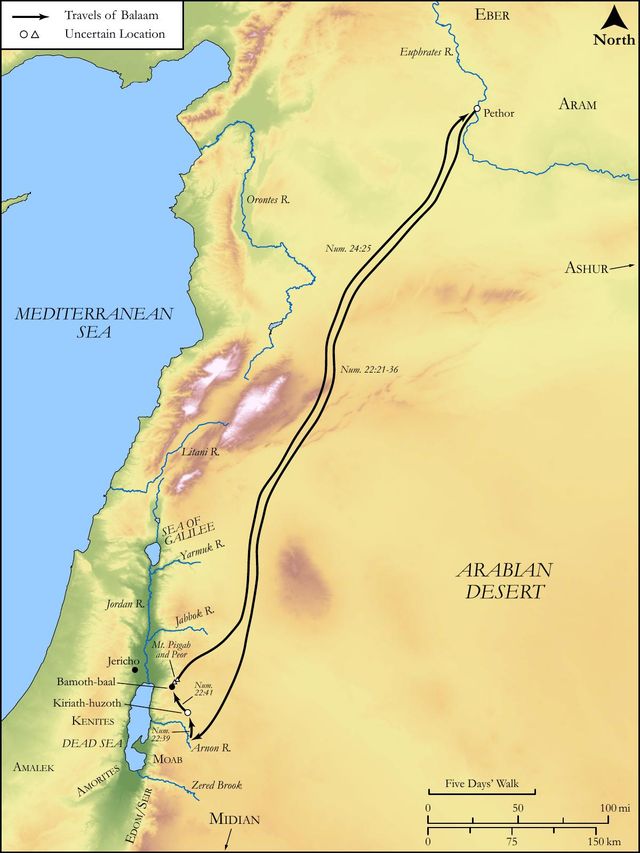
Numbers 23:27 is situated within the larger narrative of Balak and Balaam, which spans Numbers 22 through Numbers 24. Following two divinely orchestrated pronouncements of blessing upon Israel (recorded in Numbers 23:7-10 and Numbers 23:18-24), Balak's frustration reaches a peak, as evidenced in Numbers 23:11 and Numbers 23:25. This verse initiates the third and final attempt to curse Israel, with Balak moving Balaam from the "top of Pisgah" to the "top of Peor," each location offering a different perspective of the Israelite camp. This repeated relocation highlights Balak's escalating desperation and his superstitious belief that geographical positioning could influence the divine will, setting the stage for Balaam's most profound and messianic prophecies.
Historical & Cultural Context
Among the nations, the practice of hiring seers or prophets to invoke curses or blessings was common, as these pronouncements were believed to carry potent spiritual force. Kings like Balak often sought such supernatural intervention to gain military advantage or protect their territories. Moab, fearing the vast Israelite population encamped near their borders (as described in Numbers 22:3-4), resorted to this culturally accepted method of spiritual warfare. Balak's insistence on changing locations reflects a common pagan notion that deities were localized or that certain places possessed different spiritual energies, which could be more conducive to a desired outcome. This stands in stark contrast to the Israelite understanding of Yahweh as a transcendent, omnipresent God whose will is not bound by geographical constraints.
Key Themes
ShowHideThis verse powerfully contributes to several overarching themes within the book of Numbers and the Pentateuch. It vividly illustrates God's Unwavering Sovereignty, demonstrating that His divine plans and purposes for His chosen people cannot be thwarted by human machinations, pagan rituals, or even the intent of a compromised prophet. Balak's Stubborn Persistence in the face of repeated divine reversals underscores the futility of human opposition to God's decree, highlighting a profound misunderstanding of God's immutable character (as articulated in Numbers 23:19). Furthermore, the narrative consistently showcases Divine Protection and Covenant Faithfulness towards Israel. What Balak intended for harm, God consistently turned into blessing, reinforcing His commitment to His covenant promises (a theme echoed in Deuteronomy 23:5).
Exposition and Analysis
ShowHideKey Word Analysis
ShowHideFrom H3474, meaning "to be straight or even; figuratively, to be (causatively, to make) right, pleasant, prosperous." In Balak's desperate plea, this word (used in the phrase "it will please God") reveals his flawed theological premise. He hopes that from a new vantage point, cursing Israel will appear "right" or "agreeable" in God's eyes, treating the divine will as something mutable and subject to external conditions or human persuasion rather than rooted in an unchanging, righteous character.
From H6895, meaning "to scoop out, i.e. (figuratively) to malign or execrate (i.e. stab with words)." This term signifies a formal, potent malediction intended to inflict harm or misfortune. Balak's repeated insistence on this specific action underscores his belief in the power of such a pronouncement to supernaturally undermine Israel's strength, a belief that God consistently frustrates by compelling Balaam to utter blessings instead.
From H4725, meaning "properly, a standing, i.e. a spot; but used widely of a locality (general or specific)." Balak's insistence on moving Balaam to "another place" (with H312 'achêr, "another") highlights his pagan worldview, which often associated divine favor or efficacy with specific geographical locations or viewpoints. He superstitiously believed that a change of location might alter God's perspective or allow a different spiritual influence to prevail, demonstrating a fundamental misunderstanding of the omnipresent and sovereign God of Israel.
Verse Breakdown
ShowHide"And Balak said unto Balaam,"
This opening clause immediately re-establishes the dynamic between the persistent Moabite king and the divinely constrained prophet. It signals Balak's continued initiative and his refusal to accept the previous failures, setting the tone for his renewed attempt to achieve his malevolent objective.
"Come, I pray thee, I will bring thee unto another place;"
Balak's imperative "Come" and the invitation "I will bring thee" demonstrate his control over Balaam's physical movements, even if he cannot control Balaam's words. The phrase "I pray thee" (literally "please") adds a touch of desperate politeness, masking his underlying frustration and fear. The crucial element here is "unto another place," revealing Balak's superstitious conviction that a change of geographical perspective might alter the divine outcome, a stark misunderstanding of God's omnipresence and immutability.
"peradventure it will please God that thou mayest curse me them from thence."
This is the heart of Balak's plea and his theological error. "Peradventure" (Hebrew 'ûlay, "perhaps") expresses his desperate hope, tinged with uncertainty. The idea that it "will please God" (yîṭab bə'ênê hā'ělōhîm) suggests Balak believes God's disposition is fickle or can be manipulated by human strategy and location. His ultimate goal remains unchanged: "that thou mayest curse me them from thence," a direct request for a formal malediction against Israel from this new, supposedly more favorable, vantage point.
Literary Devices
ShowHideThe verse employs several key literary devices that enrich its meaning and underscore the narrative's theological message. Repetition is evident in Balak's persistent attempts to move Balaam and his repeated request for a curse, highlighting his stubborn refusal to accept God's will. This repetition serves to emphasize God's unwavering sovereignty in contrast to human futility. Irony pervades the entire narrative, and specifically this verse, as Balak's desperate efforts to elicit a curse only lead to further, more powerful blessings upon Israel. His actions, intended to harm, inadvertently become the catalyst for divine revelation and affirmation of Israel's destiny. There is also a subtle form of Anthropomorphism in Balak's thinking, as he implicitly attributes human-like fickleness or susceptibility to geographical influence to God, believing that God's "eyes" might be "pleased" by a different view. This contrasts sharply with the biblical portrayal of God as unchanging and absolute.
Theological and Thematic Connections
ShowHideNumbers 23:27 profoundly reinforces the theological truth of God's absolute sovereignty and His unwavering faithfulness to His covenant people. Balak's persistent, yet futile, attempts to manipulate divine will serve as a stark reminder that no human scheme, no matter how desperate or strategically planned, can thwart God's purposes. God's blessings, once pronounced, are irreversible, and His protection over His chosen is inviolable. This passage assures believers that God is actively involved in defending His people, turning intended harm into ultimate good, and that His character is steadfast, not swayed by external circumstances or human machinations. It underscores the security found in belonging to a God who is for His people, making any opposition ultimately powerless.
Reflection and Application
ShowHideNumbers 23:27 offers profound reassurance and a powerful call to trust in God's unshakeable sovereignty. In a world often filled with opposition, challenges, and forces seemingly arrayed against us, this verse reminds us that God's purposes for His people are immutable. Just as Balak's repeated attempts to curse Israel were utterly frustrated by God's unwavering will, so too are the schemes and attacks against believers today ultimately powerless when God is for us. We are called to rest in the confidence that our God is not capricious or manipulable, but steadfast in His promises and powerful in His protection. This should inspire us to persevere in faith, knowing that even when faced with seemingly insurmountable obstacles or malicious intent from others, God remains our ultimate defender and the guarantor of our blessings. Our security is not in our strength or cunning, but in His unchangeable character and sovereign power.
Questions for Reflection
ShowHideFAQ
ShowHideWhy did Balak keep trying to get Balaam to curse Israel, even after two failures?
ShowHideBalak's persistence was driven by intense fear and a profound misunderstanding of God's nature. He was terrified of the vast Israelite population encamped near his borders, viewing them as an existential threat (as seen in Numbers 22:3-4). Among the nations, a powerful curse was believed to weaken an enemy supernaturally. Balak's repeated attempts, including changing locations, stemmed from a superstitious belief that perhaps a different vantage point or a renewed effort would finally "please God" or alter the divine disposition, allowing the curse to take effect. He failed to grasp that the God of Israel was not a localized deity who could be manipulated, but the sovereign Lord of all.
Did Balaam truly want to curse Israel, or was he always compelled by God?
ShowHideBalaam's motivations were complex. While he was a genuine prophet who heard from God, his heart was clearly inclined towards personal gain and the rewards offered by Balak (as hinted in 2 Peter 2:15 and Jude 1:11). He desired to curse Israel to receive Balak's riches. However, God repeatedly intervened, putting His words into Balaam's mouth and compelling him to bless Israel instead of cursing them. So, while Balaam's personal desire was to curse, he was supernaturally restrained and forced to speak God's will, demonstrating God's absolute control over even those who oppose Him.
What does Balak's phrase "peradventure it will please God" reveal about his understanding of God?
ShowHideThis phrase reveals Balak's superficial, superstitious, and anthropomorphic understanding of God. He viewed God as a being who could be swayed by external circumstances, geographical location, or repeated requests, much like a human ruler might be. He believed God's "pleasure" or disposition was subject to change and could be influenced by a different "view" of Israel. This contrasts sharply with the biblical revelation of Yahweh as an immutable, unchangeable God whose counsel stands firm (as declared in Numbers 23:19 and Malachi 3:6). Balak's theology lacked any concept of God's covenant faithfulness or His sovereign, unalterable plan.
Christ-Centered Fulfillment
ShowHideThe relentless futility of Balak's attempts to curse Israel in Numbers 23:27, and God's consistent turning of those curses into blessings, powerfully foreshadows the ultimate triumph of God's redemptive plan in Jesus Christ. Just as God's unwavering purpose for Israel could not be thwarted by human or demonic opposition, so too is God's ultimate purpose for humanity—salvation through His Son—absolutely secure. Christ is the ultimate fulfillment of the blessings pronounced upon Israel; through His perfect life, atoning death, and glorious resurrection, He bore the curse of sin on behalf of humanity, transforming it into eternal blessing (as proclaimed in Galatians 3:13). He is the true Lamb of God who takes away the sin of the world, disarming all principalities and powers that would seek to curse or condemn God's chosen (as seen in Colossians 2:14-15). In Christ, believers are eternally blessed with every spiritual blessing in the heavenly places (as described in Ephesians 1:3), and no weapon formed against them shall prosper, for God is eternally for them in His Son (echoing Romans 8:31-39). The narrative of Balak and Balaam ultimately points to the invincible sovereignty of God, fully realized in the person and work of Christ, who forever secures the blessings of His people.