


Numbers 14:19
Bible text: King James Version (1769 Blayney text) · Public domain
Bible text: King James Version with Strong's numbers · Public domain
Bible text: Berean Standard Bible · Public domain
Bible text: American Standard Version (1901) · Public domain
Bible text: World English Bible, Messianic edition · Public domain
Bible text: Geneva Bible (1599) · Public domain
Bible text: Young's Literal Translation · Public domain
- סְלַחse·lachforgiveH5545V-Qal-Imp-2msVerb Qal Imperative 2nd Singular Masculine
- נָאNa'pleaseH4994PrtParticle Interjection
- לַעֲוֹןla·'a·Von<to> [the] iniquity ofH5771Prep-l ¦ N-mscNoun Singular Masculine Constructלַ<to>עֲוֹן[the] iniquity of
- הָעָםha·'Amthe peopleH5971Art ¦ N-msNoun Singular Masculine Absoluteהָtheעָםpeople
- הַזֶּהha·Zeh<the> thisH2088Art ¦ PrtParticle Demonstrativeהַ<the>זֶּהthis
- כְּגֹדֶלke·Go·delaccording to [the] greatness ofH1433Prep-k ¦ N-mscNoun Singular Masculine Constructכְּaccording toגֹדֶל[the] greatness of
- חַסְדֶּךָchas·De·khayour covenant loyaltyH2617N-msc ¦ 2msNoun Singular Masculine Constructחַסְדֶּcovenant loyaltyךָyour
- וְכַאֲשֶׁרve·kha·'a·Sherand just asH834Conj-w ¦ Prep-k ¦ RelParticle Relativeוְandכַjustאֲשֶׁרas
- נָשָׂאתָהna·Sa·tahyou have forgivenH5375V-Qal-Perf-2msVerb Qal Perfect 2nd Singular Masculine
- לָעָםla·'Am<to> the peopleH5971Prep-l ¦ N-msNoun Singular Masculine Absoluteלָ<to> theעָםpeople
- הַזֶּהha·Zeh<the> thisH2088Art ¦ PrtParticle Demonstrativeהַ<the>זֶּהthis
- מִמִּצְרַיִםmi·mitz·Ra·yimfrom EgyptH4714Prep-m ¦ N-properNoun Proper LocationמִfromמִּצְרַיִםEgypt
- וְעַדve·'adand untilH5704Conj-w ¦ PrepPrepositionוְandעַדuntil
- הֵנָּהHe·nahnowH2008AdvAdverb
English is a literal word-by-word gloss of the Hebrew, not the KJV's wording. Why?
This is the original text the KJV's translators worked from — each Hebrew word with its own literal English meaning in this verse, prepared by scholars at Tyndale House, Cambridge. The KJV translates whole sentences, not word by word, so its wording differs: one Hebrew word can become several English words, and the KJV may choose “the LORD” where the gloss reads “Yahweh”. Both are faithful — they answer different questions. For the KJV's own rendering, switch to the KJV text.
Details
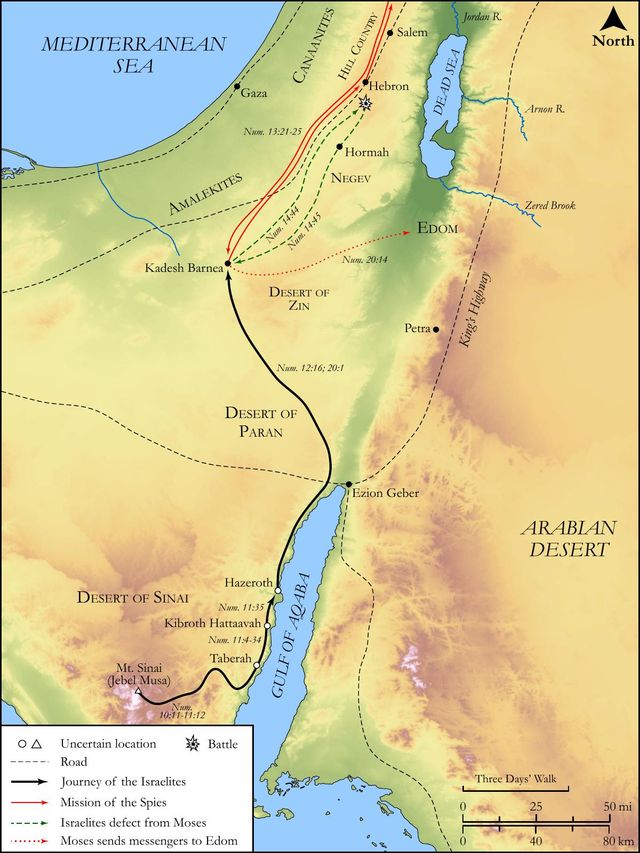
See on the biblical-era map
Study this verse
Public-domain commentary
Matthew Henry
From his Commentary on the Whole Bible. Henry comments on passages, not single verses — this entry covers Numbers 14:11–19. His four-level outline is real structure in the source text, so it is rendered as structure.
Here is, I. The righteous sentence which God gave against Israel for their murmuring and unbelief, which, though afterwards mitigated, showed what was the desert of their sin and the demand of injured justice, and what would have been done if Moses had not interposed. When the glory of the Lord appeared in the tabernacle we may suppose that Moses took it for a call to him immediately to come and attend there, as before the tabernacle was erected he went up to the mount in a similar case, Exo 32:30. Thus, while the people were studying to disgrace him, God publicly put honour upon him, as the man of his counsel. Now here we are told what God said to him there.
1.He showed him the great evil of the people's sin, Num 14:11. What passed between God and Israel went through the hands of Moses: when they were displeased with God they told Moses of it (Num 14:2); when God was displeased with them he told Moses too, revealing his secret to his servant the prophet, Amo 3:7. Two things God justly complains of to Moses: - (1.) Their sin. They provoke me, or (as the word signifies) they reject, reproach, despise me, for they will not believe me. This was the bitter root which bore the gall and wormwood. It was their unbelief that made this a day of provocation in the wilderness, Heb 3:8. Note, Distrust of God, of his power and promise, is itself a very great provocation, and at the bottom of many other provocations. Unbelief is a great sin (Jo1 5:10), and a root sin, Heb 3:12. (2.) Their continuance in it: How long will they do so? Note, The God of heaven keeps an account how long sinners persist in their provocations; and the longer they persist the more he is displeased. The aggravations of their sin were, [1.] Their relation to God: This people, a peculiar people, a professing people. The nearer any are to God in name and profession, the more he is provoked by their sins, especially their unbelief. [2.] The experience they had had of God's power and goodness, in all the signs which he had shown among them, by which, one would think, he had effectually obliged them to trust him and follow him. The more God has done for us the greater is the provocation if we distrust him.
2.He showed him the sentence which justice passed upon them for it, Num 14:12. "What remains now but that I should make a full end of them? It will soon be done. I will smite them with the pestilence, not leave a man of them alive, but wholly blot out their name and race, and so disinherit them, and be no more troubled with them. Ah, I will ease me of my adversaries. They wish to die; and let them die, and neither root nor branch be left of them. Such rebellious children deserve to be disinherited." And if it be asked, "What will become of God's covenant with Abraham then?" here is an answer, "I shall be preserved in the family of Moses: I will make of thee a greater nation." Thus,
(1.)God would try Moses, whether he still continued that affection for Israel which he formerly expressed upon a like occasion, in preferring their interests before the advancement of his own family; and it is proved that Moses was still of the same public spirit, and could not bear the thought of raising his own name upon the ruin of the name of Israel.
(2.)God would teach us that he will not be a loser by the ruin of sinners. If Adam and Eve had been cut off and disinherited, he could have made another Adam and another Eve, and have glorified his mercy in them, as here he could have glorified his mercy in Moses, though Israel had been ruined.
II.The humble intercession Moses made for them.
Their sin had made a fatal breach in the wall of their defence, at which destruction would certainly have entered if Moses had not seasonably stepped in and made it good. Here he was a type of Christ, who interceded for his persecutors, and prayed for those that despitefully used him, leaving us an example to his own rule, Mat 5:44.
1.The prayer of his petition is, in one word, Pardon, I beseech thee, the iniquity of this people (Num 14:19), that is, "Do not bring upon them the ruin they deserve." This was Christ's prayer for those that crucified him, Father forgive them. The pardon of a national sin, as such, consists in the turning away of the national punishment; and that is it for which Moses is here so earnest.
2.The pleas are many, and strongly urged.
(1.)He insists most upon the plea that is taken from the glory of God, Num 14:13-16. With this he begins, and somewhat abruptly, taking occasion from that dreadful word, I will disinherit them. Lord (says he), then the Egyptians shall hear it. God's honour lay nearer to his heart than any interests of his own. Observe how he orders this cause before God. He pleads,
[1.]That the eyes both of Egypt and Canaan were upon them, and great expectations were raised concerning them. They could not but have heard that thou, Lord, art among this people, Num 14:14. The neighbouring countries rang of it, how much this people were the particular care of heaven, so as never any people under the sun were.
[2.]That if they should be cut off great notice would be taken of it. "The Egyptians will hear it (Num 14:13), for they have their spies among us, and they will tell it to the inhabitants of the land" (Num 14:14); for there was great correspondence between Egypt and Canaan, although not by the way of this wilderness. "If this people that have made so great a noise be all consumed, if their mighty pretensions come to nothing, and their light go out in a snuff, it will be told with pleasure in Gath, and published in the streets of Askelon; and what construction will the heathen put upon it? It will be impossible to make them understand it as an act of God's justice, and as such redounding to God's honour; brutish men know not this (Psa 92:6): but they will impute it to the failing of God's power, and so turn it to his reproach, Num 14:16. They will say, He slew them in the wilderness because he was not able to bring them to Canaan, his arm being shortened, and his stock of miracles being spent. Now, Lord, let not one attribute be glorified at the expense of another; rather let mercy rejoice against judgment than that almighty power should be impeached." Note, The best pleas in prayer are those that are taken from God's honour; for they agree with the first petition of the Lord's Prayer, Hallowed be thy name. Do not disgrace the throne of thy glory. God pleads it with himself (Deu 32:27), I feareth the wrath of the enemy; and we should use it as an argument with ourselves to walk so in every thing as to give no occasion to the enemies of the Lord to blaspheme, Ti1 6:1.
(2.)He pleads God's proclamation of his name at Horeb (Num 14:17, Num 14:18): Let the power of the Lord be great. Power is here put for pardoning mercy; it is his power over his own anger. If he should destroy them, God's power would be questioned; if he should continue and complete their salvation, notwithstanding the difficulties that arose, not only from the strength of their enemies, but from their own provocations, this would greatly magnify the divine power: what cannot he do who could make so weak a people conquerors and such an unworthy people favourites? The more danger there is of others reproaching God's power the more desirous we should be to see it glorified. To enforce this petition, he refers to the word which God had spoken: The Lord is long-suffering and of great mercy. God's goodness had there been spoken of as his glory; God gloried in it, Exo 34:6, Exo 34:7. Now here he prays that upon this occasion he would glorify it. Note, We must take our encouragement in prayer from the word of God, upon which he has caused us to hope, Psa 119:49. "Lord, be and do according as thou hast spoken; for hast thou spoken, and wilt thou not make it good?" Three things God had solemnly made a declaration of, which Moses here fastens upon, and improves for the enforcing of his petition: - [1.] The goodness of God's nature in general, that he is long-suffering, or slow to anger, and of great mercy; not soon provoked, but tender and compassionate towards offenders. [2.] His readiness in particular to pardon sin: Forgiving iniquity and transgression, sins of all sorts. [3.] His unwillingness to proceed to extremity, even when he does punish. For in this sense the following words may be read: That will by no means make quite desolate, in visiting the iniquity of the fathers upon the children. God had indeed said in the second commandment that he would thus visit, but here he promises not to make a full end of families, churches, and nations, at once; and so it is very applicable to this occasion, for Moses cannot beg that God would not at all punish this sin (it would be too great an encouragement to rebellion if he should set no mark of his displeasure upon it), but that he would not kill all this people as one man, Num 14:15. He does not ask that they may not be corrected, but that they may not be disinherited. And this proclamation of God's name was the more apposite to his purpose because it was made upon occasion of the pardoning of their sin in making the golden calf. This sin which they had now fallen into was bad enough, but it was not idolatry.
(3.)He pleads past experience: As thou hast forgiven this people from Egypt, Num 14:19. This seemed to make against him. Why should those be forgiven any more who, after they had been so often forgiven, revolted yet more and more, and seemed hardened and encouraged in their rebellion by the lenity and patience of their God, and the frequent pardons they had obtained? Among men it would have been thought impolitic to take notice of such a circumstance in a request of this nature, as it might operate to the prejudice of the petitioner: but, as in other things so in pardoning sin, God's thoughts and ways are infinitely above ours, Isa 55:9. Moses looks upon it as a good plea, Lord, forgive, as thou hast forgiven. It will be no more a reproach to thy justice, nor any less the praise of thy mercy, to forgive now, than it has been formerly. Therefore the sons of Jacob are not consumed, because they have to do with a God that changes not, Mal 3:6.
Continue studying Numbers 14:19 across the web’s major study libraries — every link below opens this exact verse, chapter, or book on the destination site.
Read & Compare
 BibleGatewayThis verse in more than 200 translations and 70 languages.
 Bible.comThe YouVersion reader — hundreds of translations, reading plans, and highlights.
 ESV.orgCrossway's official English Standard Version reader.
 NET BibleThe NET translation with 60,000+ translators' notes on every rendering decision.
 STEP BibleTyndale House's free study tool — original text, vocabulary, and scholarly resources.
 BibliaLogos Bible Software's free web reader.
 USCCBThe New American Bible (Revised Edition) with the U.S. bishops' study notes.
Commentaries
 BibleHub CommentariesDozens of classic commentaries on this verse, gathered on one page.
 StudyLightMore than 100 commentary sets — the largest collection on the web.
 BibleRefPlain-English commentary on what this verse means, verse by verse.
 Enduring WordDavid Guzik's free commentary on this chapter, widely used by Bible teachers.
 Bible Study ToolsVerse commentary alongside Greek and Hebrew study aids.
Original Language & Research
- BibleHub InterlinearThe verse word by word — original language, transliteration, and English.
- BibleHub LexiconEvery word's original-language definition and Strong's entry.
 Blue Letter BibleDeep-study tools — Strong's numbers, concordance, and word studies.
 SefariaThe Hebrew text with Rashi and centuries of Jewish commentary.
Sermons, Hymns & Audio


TrulyRandomVerse is not affiliated with these sites and doesn’t control their content. They’re linked because they’re genuinely useful.
Summary
Numbers 14:19 captures Moses' fervent and pivotal intercessory prayer for the rebellious Israelites, appealing not to their merit or any inherent goodness, but solely to the boundless character of God. This plea arises after the nation's catastrophic failure of faith, expressed through their desire to return to Egypt following the disheartening report of ten spies, which provoked God's righteous anger and threat of disinheritance. In this critical moment, Moses stands as a mediator, passionately pleading for divine pardon based on the "greatness of thy mercy" and God's consistent faithfulness in forgiving His people "from Egypt even until now," thereby safeguarding God's divine reputation among the nations.
Context
ShowHideLiterary Context
This verse serves as the climactic petition within Moses' profound intercessory prayer, recorded in Numbers 14:13-19. It immediately follows a moment of profound national crisis: the Israelites, having heard the negative report from ten of the twelve spies sent into Canaan, succumbed to fear and unbelief. They openly grumbled against the Lord, Moses, and Aaron, even proposing to appoint a new leader to guide them back to Egypt (Numbers 14:1-4). This egregious act of distrust and rejection of God's promise ignited the Lord's righteous anger, leading Him to threaten to strike the nation with pestilence and disinherit them, promising instead to make a greater nation from Moses (Numbers 14:11-12). Moses' prayer is a direct, courageous, and selfless response to this divine judgment, demonstrating his unwavering commitment to the covenant people despite their severe sin.
Historical & Cultural Context
The Israelites at this juncture were a nascent nation, recently liberated from centuries of slavery in Egypt and having received the Law at Mount Sinai. They were positioned at the threshold of the Promised Land, yet their journey through the wilderness had been punctuated by repeated episodes of grumbling, testing God, and a nostalgic longing for the perceived security of Egypt, despite God's miraculous provision and palpable presence. Among the nations, the honor and reputation of a god were intrinsically linked to the success, power, and fate of his people. Moses' strategic appeal to God's reputation among the nations (Numbers 14:13-16) was a culturally potent argument, emphasizing that the destruction of Israel would diminish the Lord's glory in the eyes of surrounding peoples who had witnessed His mighty acts in Egypt and at the Red Sea. The concept of a mediator or intercessor was also well-understood, with individuals (such as priests or prophets) acting as advocates on behalf of a community before their deity.
Key Themes
ShowHideThe passage powerfully underscores several core theological themes. First, the sovereignty and holiness of God are vividly displayed in His righteous anger against sin and His inherent power to execute judgment. Second, the persistent rebellion and profound unbelief of humanity are starkly portrayed through the Israelites' repeated grumbling and their outright rejection of God's promise, despite overwhelming evidence of His faithfulness. This narrative serves as a potent warning about the dangers of a hardened heart, a theme powerfully echoed in Hebrews 3:7-19. Third, the indispensable role of intercession is championed by Moses' selfless and bold prayer, as he strategically positions himself between God's impending wrath and the people's egregious sin. Finally, and most profoundly, the boundless mercy and unwavering faithfulness of God are revealed as the ultimate basis for pardon. Moses' appeal to "the greatness of thy mercy" and God's consistent forgiveness "from Egypt even until now" emphasizes that divine pardon is rooted solely in God's unchanging character and covenant loyalty, rather than in any human merit or performance, echoing the profound self-revelation of God's character in Exodus 34:6-7.
Exposition and Analysis
ShowHideKey Word Analysis
ShowHideThis verb specifically means "to forgive," "to pardon," or "to remit punishment." It is almost exclusively used in the Old Testament to describe God's act of forgiving sin, never human forgiveness of another. This emphasizes that forgiveness for sin against God is a divine prerogative and a unilateral act of grace. Moses is not asking God to overlook their sin, but to actively remit the deserved punishment, an act only God can perform.
This term refers to perversity, moral evil, or fault. It denotes the twistedness or distortion of human actions that deviate from God's righteous standards, leading to guilt and deserving of punishment. In this context, it specifically refers to the Israelites' rebellion, their profound unbelief, and their open defiance against God's will and covenant. Moses acknowledges the gravity and moral culpability of their actions.
This is a rich and multifaceted term, often translated as "mercy," "lovingkindness," "steadfast love," or "covenant loyalty." It denotes a loyal, unwavering love that is active in fulfilling obligations within a relationship, especially a covenantal one. When Moses appeals to the "greatness of thy mercy," he is invoking God's inherent character of loyal love and faithfulness to His covenant promises, even when Israel has been profoundly unfaithful. It's a love that goes beyond mere pity, actively seeking the well-being and restoration of the beloved party.
Verse Breakdown
ShowHide"Pardon, I beseech thee, the iniquity of this people"
Moses' opening plea is direct, urgent, and deeply personal. The imperative "Pardon" (סְלַח, selach) is a humble yet bold request for God to forgive. "I beseech thee" (נָא, na) adds a tone of earnest entreaty and desperation. The "iniquity" (עָוֹן, avon) refers to the people's profound guilt, their perversity, and the moral distortion of their actions, specifically their rebellion and unbelief in the face of God's promises. Moses does not minimize their sin but acknowledges its gravity while pleading for divine intervention to avert the deserved judgment.
"according unto the greatness of thy mercy"
This clause forms the theological core of Moses' argument and the foundation of his plea. He does not appeal to the people's repentance (which was notably absent) or their inherent worthiness, but solely to the magnanimity and vastness of God's character. The "greatness" (גֹּדֶל, gôdel) emphasizes the immense scale and abundance of God's mercy (chesed). This highlights that divine forgiveness is an act of sovereign grace, flowing purely from God's intrinsic nature, not from any human merit or condition. It is a profound declaration that God's capacity for compassion and loyal love far exceeds the depth of human sin.
"and as thou hast forgiven this people, from Egypt even until now"
Moses grounds his plea in God's consistent historical precedent and unchanging nature. He reminds God of His own past actions, citing a long and unbroken history of divine patience and forgiveness. "From Egypt" recalls the initial, foundational act of redemption from slavery and the numerous instances where God overlooked their grumbling and rebellion (e.g., at the Red Sea, Marah, Rephidim, Sinai). "Even until now" encompasses their most recent failures, including the golden calf incident and countless previous complaints in the wilderness. This appeals to God's unchanging nature and His covenant faithfulness, implying that to cease forgiving now would be inconsistent with His established character and His past dealings with His people, thereby providing a powerful basis for hope despite their present unworthiness.
Literary Devices
ShowHideMoses' prayer in Numbers 14:19 is a masterful example of Intercession, where a chosen mediator courageously stands between an offended divine party (God) and an offending human party (Israel) to plead for mercy and avert judgment. He employs a powerful Rhetorical Appeal to God's character and reputation, implicitly arguing that divine judgment on Israel would undermine God's glory and standing among the nations who had witnessed His mighty acts (Numbers 14:13-16). The phrase "from Egypt even until now" is a potent instance of Recollection or Historical Allusion, serving as a vivid reminder of God's consistent faithfulness and patience throughout Israel's tumultuous journey. This also functions as an Argument from Character, asserting that God's established nature as merciful and forgiving, demonstrated repeatedly through history, should prevail over His righteous anger, thereby providing a profound basis for hope for the undeserving.
Theological and Thematic Connections
ShowHideNumbers 14:19 stands as a profound testament to the immutable character of God, revealing His inherent readiness to pardon even the most egregious sin when His own character is appealed to. It powerfully underscores that God's mercy is not a weakness or a compromise of justice, but rather a magnificent attribute of His greatness, flowing from His boundless love and unwavering covenant faithfulness. This passage highlights the profound tension between God's justice, which justly demands punishment for sin, and His mercy, which graciously offers forgiveness. Moses' intercession, deeply rooted in God's self-revelation at Sinai as "the Lord, the Lord, a God merciful and gracious, slow to anger, and abounding in steadfast love and faithfulness, forgiving iniquity and transgression and sin" (Exodus 34:6-7), demonstrates that humanity's true hope for reconciliation and pardon lies not in human merit, but solely in God's inherent compassion and His covenant promises. The persistent rebellion of Israel, consistently met with God's persistent mercy through a divinely appointed mediator, foreshadows the ultimate need for a perfect mediator and a greater, definitive act of divine forgiveness.
Reflection and Application
ShowHideNumbers 14:19 offers a powerful and enduring anchor for our faith, profoundly reminding us that God's capacity for mercy is truly "great" beyond human comprehension. In a world where our failures, sins, and shortcomings often lead to despair and self-condemnation, this verse resoundingly proclaims that pardon is available, not because we have earned it or because we are inherently worthy, but solely because God is inherently merciful and faithful to His character. It challenges us to embrace a theology of radical grace, understanding that our ultimate hope for forgiveness and reconciliation with God rests entirely on His unchanging character and boundless compassion, not on our performance, our level of repentance in a given moment, or our perceived goodness. This profound truth should cultivate within us a deep sense of humility, overwhelming gratitude, and unwavering trust. Furthermore, Moses' example serves as a profound and compelling call to intercessory prayer. Just as Moses courageously stood in the gap for a rebellious and undeserving people, we too are called to pray fervently and consistently for others, especially those who are lost, struggling, hardened in sin, or facing divine judgment. Our prayers, like Moses', should be bold, persistent, and rooted in an appeal to God's known character and His demonstrated past faithfulness, trusting that His mercy endures "from Egypt even until now," and indeed, forevermore.
Questions for Reflection
ShowHideFAQ
ShowHideWhy did Moses appeal to God's mercy and not the people's repentance?
ShowHideMoses appealed to God's mercy because, at this critical juncture, the people were not repentant. Instead, they were consumed by grumbling, rebellion, and even planned to appoint a new leader to guide them back to Egypt (Numbers 14:1-4). Their hearts were hardened by unbelief. Moses, understanding the depth of their sin and their immediate spiritual state, knew that their only hope lay in God's inherent character of mercy and steadfast love (chesed), not in any merit or immediate change of heart from the people. This highlights that God's forgiveness is ultimately an act of His sovereign grace, not contingent on human worthiness, though it often calls for a later response of repentance and renewed obedience.
How does this passage reconcile God's mercy with His justice?
ShowHideThis passage vividly presents the tension between God's justice, which demands punishment for Israel's severe rebellion and unbelief (as seen in His threat in Numbers 14:11-12), and His mercy, which Moses appeals to. While God does pardon the immediate threat of complete destruction and disinheritance, His justice is still profoundly upheld through a different, severe judgment: the entire generation of grumblers (those 20 years and older, excluding Caleb and Joshua) is condemned to die in the wilderness, unable to enter the Promised Land (Numbers 14:29-35). Thus, God's mercy provides a path to continued existence for the nation and the fulfillment of His covenant promises through the next generation, but His justice ensures that sin still carries severe, inevitable consequences, demonstrating that He is both perfectly just and the gracious justifier of those who trust in Him (Romans 3:26).
What is the significance of "from Egypt even until now"?
ShowHideThis phrase serves as a powerful historical reminder and a compelling appeal to God's consistent, unchanging character. "From Egypt" refers to the initial, miraculous act of redemption from slavery, where God powerfully demonstrated His sovereign power, faithfulness, and compassion in delivering His people. "Even until now" encompasses the entire tumultuous journey through the wilderness, marked by numerous instances of Israel's grumbling, rebellion, and God's repeated acts of patience, miraculous provision, and gracious forgiveness (e.g., the Golden Calf incident in Exodus 32, the complaints at Taberah and Kibroth-hattaavah, the lack of water at Rephidim). Moses is essentially arguing that God's consistent pattern of mercy and covenant faithfulness throughout history should continue, appealing to God's unchanging nature and His steadfast loyalty, which has been demonstrated time and again despite Israel's persistent failures and unworthiness.
Christ-Centered Fulfillment
ShowHideNumbers 14:19, with Moses' powerful intercession for a rebellious people based on the "greatness of thy mercy," profoundly foreshadows the ultimate and perfect work of Jesus Christ. Moses, acting as a divinely appointed mediator, bravely stands in the gap between a righteous God and a sinful people, appealing to God's character to avert deserved judgment. This crucial mediating role finds its fullest and most glorious fulfillment in Christ, who is the one true and perfect mediator between God and humanity (1 Timothy 2:5). The "greatness of thy mercy" that Moses appeals to finds its most profound and costly expression in the cross, where God's boundless love, unwavering steadfastness, and covenant faithfulness are perfectly demonstrated through the sacrificial death of His own Son. It is through Christ's atoning work that God can be both "just and the justifier of the one who has faith in Jesus" (Romans 3:26). Just as God graciously forgave Israel "from Egypt even until now" through Moses' heartfelt plea, so too does God offer complete and eternal pardon for all our iniquities—past, present, and future—through the shed blood of the Lamb of God, who takes away the sin of the world (Colossians 2:13-14). Christ is our compassionate High Priest, who "always lives to make intercession for them" (Hebrews 7:25), ensuring that God's great mercy continues to flow to His people, not based on our fleeting merits or imperfect repentance, but solely on His perfect, eternal, and all-sufficient sacrifice.