


Mark 2:13
Bible text: King James Version (1769 Blayney text) · Public domain
Bible text: Berean Standard Bible · Public domain
Bible text: American Standard Version (1901) · Public domain
Bible text: World English Bible, Messianic edition · Public domain
Bible text: Geneva Bible (1599) · Public domain
Bible text: Young's Literal Translation · Public domain
- ΚαὶKaiAndG2532CONJConjunction
- ἐξῆλθενexēlthenHe went forthG1831V-2AAI-3SVerb 2nd Aorist Active Indicative 3rd Singular
- πάλινpalinagainG3825ADVAdverb
- παρὰparabesideG3844PREPPreposition
- τὴνtēntheG3588T-ASFDefinite article Accusative Singular Feminine
- θάλασσανthalassanseaG2281N-ASFNoun Accusative Singular Feminine
- καὶkaiandG2532CONJConjunction
- πᾶςpasallG3956A-NSMAdjective Nominative Singular Masculine
- ὁhotheG3588T-NSMDefinite article Nominative Singular Masculine
- ὄχλοςochloscrowdG3793N-NSMNoun Nominative Singular Masculine
- ἤρχετοērchetowas comingG2064V-INI-3SVerb Imperfect Middle Or Passive Deponent Indicative 3rd Singular
- πρὸςprostoG4314PREPPreposition
- αὐτόνautonHimG846P-ASMPersonal pronoun Accusative Singular Masculine
- καὶkaiandG2532CONJConjunction
- ἐδίδασκενedidaskenHe was teachingG1321V-IAI-3SVerb Imperfect Active Indicative 3rd Singular
- αὐτούςautousthemG846P-APMPersonal pronoun Accusative Plural Masculine
English is a literal word-by-word gloss of the Greek, not the KJV's wording. Why?
This is the original text the KJV's translators worked from — each Greek word with its own literal English meaning in this verse, prepared by scholars at Tyndale House, Cambridge. The KJV translates whole sentences, not word by word, so its wording differs: one Greek word can become several English words, and the KJV may choose “charity” where the gloss reads “love”. Both are faithful — they answer different questions. For the KJV's own rendering, switch to the KJV text.
Details
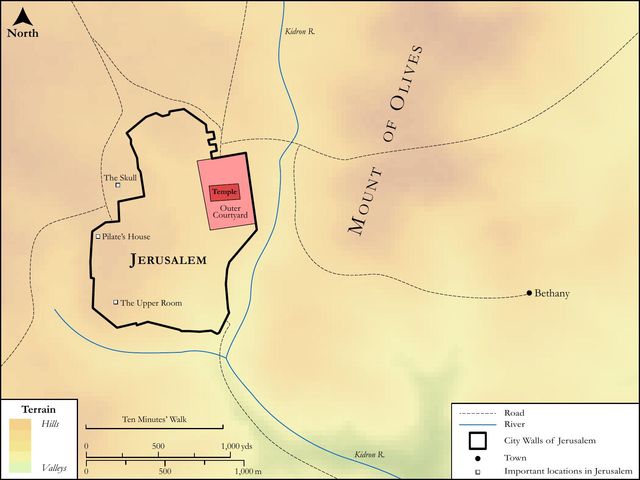
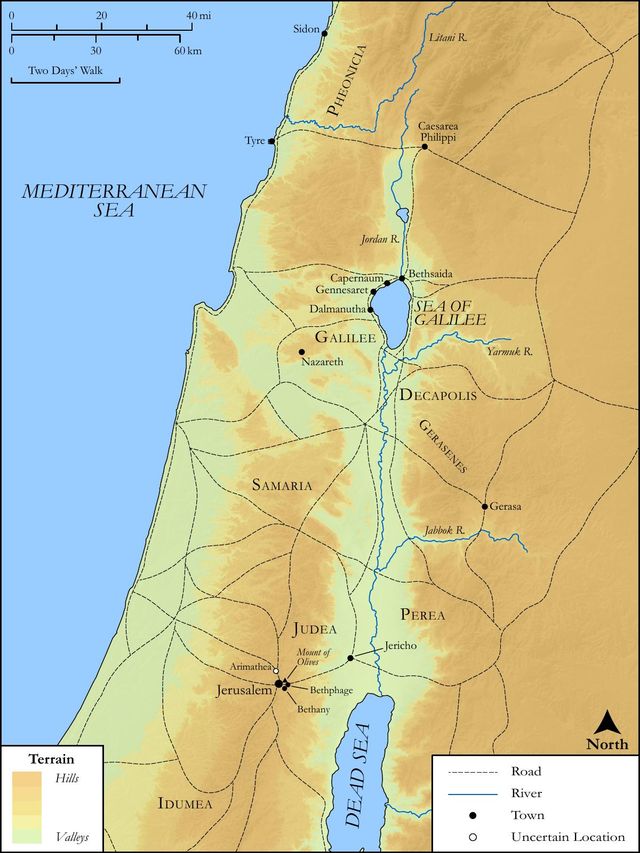
See on the biblical-era maps

Study this verse
Public-domain commentary
Matthew Henry
From his Commentary on the Whole Bible. Henry comments on passages, not single verses — this entry covers Mark 2:13–17. His three-level outline is real structure in the source text, so it is rendered as structure.
Here is,
I.Christ preaching by the sea-side (Mar 2:13), whither he went for room, because he found, upon second trial, no house or street large enough to contain his auditory; but upon the strand there might come as many as would. It should seem by this, that our Lord Jesus had a strong voice, and could and did speak loud; for wisdom crieth without in the places of concourse. Wherever he goes, though it be to the sea-side, multitudes resort to him. Wherever the doctrine of Christ is faithfully preached, though it be driven into corners or into deserts, we must follow it.
II.His calling Levi; the same with Matthew, who had a place in the custom-house at Capernaum, from which he was denominated a publican; his place fixed him by the water-side, and thither Christ went to meet with him, and to give him an effectual call. This Levi is here said to be the son of Alpheus or Cleophas, husband to that Mary who was sister or near kinswoman to the virgin Mary and if so, he was own brother to James the less, and Jude, and Simon the Canaanite, so that there were four brothers of them apostles, It is probable that Matthew was but a loose extravagant young man, or else, being a Jew, he would never have been a publican. However, Christ called him to follow him. Paul, though a Pharisee, had been one of the chief of sinners, and yet was called to be an apostle. With God, through Christ, there is mercy to pardon the greatest sins, and grace to sanctify the greatest sinners. Matthew, that had been a publican, became an evangelist, the first that put pen to paper, and the fullest in writing the life of Christ. Great sin and scandal before conversion, are no bar to great gifts, graces, and advancements, after; nay, God may be the more glorified. Christ prevented him with this call; in bodily cures, ordinarily, he was sought unto, but in these spiritual cures, he was found of them that sought him not. For this is the great evil and peril of the disease of sin, that those who are under it, desire not to be made whole.
III.His familiar converse with publicans and sinners, Mar 2:15. We are here told,
1.That Christ sat at meat in Levi's house, who invited him and his disciples to the farewell-feast he made to his friends, when he left all to attend on Christ: such a feast he made, as Elisha did (Kg1 19:21), to show, not only with what cheerfulness in himself, but with what thankfulness to God, he quitted all, in compliance with Christ's call. Fitly did he make the day of his espousals to Christ a festival day. This was also to testify his respect to Christ, and the grateful sense he had of his kindness, in snatching him from the receipt of custom as a brand out of the burning.
2.That many publicans and sinners sat with Christ in Levi's house (for there were many belonging to that custom-house); and they followed him. They followed Levi; so some understand it, supposing that, like Zaccheus, he was chief among the publicans, and was rich; and for that reason, the inferior sort of them attended him for what they could get. I rather take it, that they followed Jesus because of the report they had heard of him. They did not for conscience-sake leave all to follow him, but for curiosity-sake they came to Levi's feast, to see him; whatever brought them thither, they were sitting with Jesus and his disciples. The publicans are here and elsewhere ranked with sinners, the worst of sinners.
(1.)Because commonly they were such; so general were the corruptions in the execution of that office, oppressing, exacting, and taking bribes or fees to extortion, and accusing falsely, Luk 3:13, Luk 3:14. A faithful fair-dealing publican was so rare, even at Rome, that one Sabinus, who kept a clean reputation in that office, was, after his death, honoured with this inscription, Kalōs telōnēsanti - Here lies an honest publican.
(2.)Because the Jews had a particular antipathy to them and their office, as an affront to the liberty of their nation and a badge of their slavery, and therefore put them into an ill name, and thought it scandalous to be seen in their company. Such as these our blessed Lord was pleased to converse with, when he appeared in the likeness of sinful flesh.
IV.The offence which the scribes and Pharisees took at this, Mar 2:16.
They would not come to hear him preach, which they might have been convinced the edified by; but they would come themselves to see him sit with publicans and sinners, which they would be provoked by. They endeavoured to put the disciples out of conceit with their Master, as a man not of such sanctity and severe morals as became his character; and therefore put the question to them. How is it, that he eateth and drinketh with publicans and sinners? Note, It is no new thing for that which is both well-done, and well-designed, to be misrepresented, and turned to the reproach of the wisest and best of men.
V.Christ's justification of himself in it, Mar 2:17.
He stood to what he did, and would not withdraw, though the Pharisees were offended, as Peter afterwards did, Gal 2:12. Note, Those are too tender of their own good name, who, to preserve it with some nice people, will decline a good work. Christ would not do so. They thought the publicans were to be hated. "No," saith Christ, "they are to be pitied, they are sick and need a physician; they are sinners, and need a Saviour." They thought Christ's character should separate him from them; "No," saith Christ, "my commission directs me to them; I came not to call the righteous, but sinners to repentance. If the world had been righteous, there had been no occasion for my coming, either to preach repentance, or to purchase remission. It is to a sinful world that I am sent, and therefore my business lies most with those that are the greatest sinners in it." Or thus; "I am not come to call the righteous, the proud Pharisees that think themselves righteous, that ask, Wherein shall we return? (Mal 3:7), Of what shall we repent? But poor publicans, that own themselves to be sinners, and are glad to be invited and encouraged to repent." It is good dealing with those that there is hope of; now there is more hope of a fool than of one that is wise in his own conceit, Pro 26:12.
Historical interpretation
Four Centuries of Reception
3 surviving comments on this verse. Each one is dated, so this reads as a timeline rather than a list.
Select a marker to jump to its quote. Markers stagger vertically where authors wrote within a few decades of each other.
Thus then Levi, which means Appointed, followed from the custom-house of human affairs, the Word, Who says, He who doth not quit all that he has, cannot be my disciple.
(ubi sup.) After that the Lord taught at Capernaum, He went to the sea, that He might not only set in order the life of men in towns, but also might preach the Gospel of the kingdom to those who dwelt near the sea, and might teach them to despise the restless motions of those things which pass away like the waves of the sea, and to overcome them by the firmness of faith; wherefore it is said, And he went forth again to the sea, and all the multitude, &c.
(i. 11. in Marc.) So also the same person is called Levi and Matthew; but Luke and Mark, on account of their reverence and the honour of the Evangelist, are unwilling to put the common name, while Matthew is a just accuser of himself, (Prov. 18. Vulg.) and calls himself Matthew and publican. He wishes to show to his hearers that no one who is converted should despair of his salvation, since he himself was suddenly changed from a publican into an Apostle. But he says that he was sitting at the 'teloneum,' that is, the place where the customs are looked after and administered. For 'telos' in Greek is the same as 'vectigal,' customs, in Latin.
(ubi sup.) Now to follow is to imitate, and therefore in order to imitate the poverty of Christ, in the feeling of his soul even more than in outward condition, he who used to rob his neighbour's wealth, now leaves his own. And not only did he quit the gain of the customs, but he also despised the peril, which might come from the princes of this world, because he left the accounts of the customs imperfect and unsettled. For the Lord Himself, Who externally, by human language, called Him to follow, inflamed him inwardly by divine inspiration to follow Him the moment that He called him.
(in Marc. i. 12) The persons here called publicans are those who exact the public customs, or men who farm the customs of the exchequer or of republics; moreover, those also, who follow after the gain of this world by business, are called by the same name. They who had seen that the publican, converted from his sins to better things, had found a place of pardon, even for this reason themselves also do not despair of salvation. And they come to Jesus, not remaining in their former sins, as the Pharisees and Scribes complain, but in penitence, as the following words of the Evangelist show, saying, For there were many who followed him. For the Lord went to the feasts of sinners, that he might have an opportunity of teaching them, and might set before his entertainers spiritual meats, which also is carried on in mystical figures. For he who receives Christ into his inward habitation is fed with the highest delights of overflowing pleasures. Therefore the Lord enters willingly, and takes up His abode in the affection of him who hath believed on Him; and this is the spiritual banquet of good works, which the rich cannot have, and on which the poor feast.
(ubi sup.) If by the election of Matthew and calling of the publicans, the faith of the Gentiles is expressed, who formerly were intent on the gains of this world; certainly the haughtiness of the Scribes and Pharisees intimates the envy of the Jewish people, who are vexed at the salvation of the Gentiles. It goes on: When Jesus heard it, he saith unto them, They that are whole need not the physician, but they that are sick. He aims at the Scribes and Pharisees, who, thinking themselves righteous, refused to keep company with sinners. He calls Himself the physician, Who, by a strange mode of healing, was wounded on account of our iniquities, and by His wound we are healed. And He calls those whole and righteous, who, wishing to establish their own righteousness, are not subject to the righteousness of God. Moreover He calls those rich and sinners, who, overcome by the consciousness of their own frailty, and seeing that they cannot be justified by the Law, submit their necks to the grace of Christ by repentance. Wherefore it is added, For I came not to call the righteous, but sinners, &c.
Or else, after the miracle, He goes to the sea, as if wishing to be alone, but the crowd runs to Him again, that thou mightest learn, that the more thou fliest from glory, the more she herself pursues thee; but if thou followest her, she will fly from thee. The Lord passing on from thence called Matthew; wherefore there follows, And as he passed by, he saw Levi the son of Alphæus sitting, &c.
For he sat at the receipt of custom, either, as is often done, exacting from some, or making up accounts, (λογοπραγῶν apud Theo.) or doing some actions of that sort, which publicans are wont to do in their abodes, yea this man, who was raised on high from this state of life that he might leave all things and follow Christ. Wherefore it goes on, And he saith to him, Follow me, &c.
But he who used to plot against others becomes so benevolent, that he invites many persons to eat with him. Wherefore it goes on; And it came to pass, that as Jesus sat at meat in his house.
But the Pharisees blame this, making themselves pure. Whence there follows: And when the Scribes and Pharisees saw him eat, &c.
Not indeed that they should continue sinners, but be converted to that repentance.
Continue studying Mark 2:13 across the web’s major study libraries — every link below opens this exact verse, chapter, or book on the destination site.
Read & Compare
 BibleGatewayThis verse in more than 200 translations and 70 languages.
 Bible.comThe YouVersion reader — hundreds of translations, reading plans, and highlights.
 ESV.orgCrossway's official English Standard Version reader.
 NET BibleThe NET translation with 60,000+ translators' notes on every rendering decision.
 STEP BibleTyndale House's free study tool — original text, vocabulary, and scholarly resources.
 BibliaLogos Bible Software's free web reader.
 USCCBThe New American Bible (Revised Edition) with the U.S. bishops' study notes.
Commentaries
 BibleHub CommentariesDozens of classic commentaries on this verse, gathered on one page.
 StudyLightMore than 100 commentary sets — the largest collection on the web.
 BibleRefPlain-English commentary on what this verse means, verse by verse.
 Enduring WordDavid Guzik's free commentary on this chapter, widely used by Bible teachers.
 Bible Study ToolsVerse commentary alongside Greek and Hebrew study aids.
Original Language & Research
- BibleHub InterlinearThe verse word by word — original language, transliteration, and English.
- BibleHub LexiconEvery word's original-language definition and Strong's entry.
 Blue Letter BibleDeep-study tools — Strong's numbers, concordance, and word studies.
 CNTR CollationThe earliest Greek manuscripts of this verse, collated letter by letter.
Sermons, Hymns & Audio


TrulyRandomVerse is not affiliated with these sites and doesn’t control their content. They’re linked because they’re genuinely useful.
Summary
Mark 2:13 serves as a pivotal transitional verse, depicting Jesus's continued public ministry by the Sea of Galilee, where he once again engaged with large crowds. Following a significant confrontation with religious authorities in the preceding verses, this passage highlights Jesus's unwavering commitment to teaching, reaffirming his role as a divine instructor and revealing the widespread popular appeal of his message among the common people. It sets the stage for further developments in his ministry, emphasizing the accessibility of his presence and the authority of his words.
Context
ShowHideLiterary Context
This verse immediately follows the dramatic account of Jesus healing a paralytic and declaring his sins forgiven in Mark 2:1-12. That episode culminated in a direct challenge to Jesus's authority by the scribes, who questioned his right to forgive sins. Mark 2:13 acts as a bridge, moving Jesus from a private setting (a house) and a contentious encounter back into the public sphere. The phrase "went forth again" suggests a return to a familiar pattern of ministry, indicating that despite opposition, Jesus's mission to reach and teach the masses remained paramount. It transitions into the calling of Levi and further controversies that continue to explore Jesus's authority and the nature of his kingdom in Mark 2:14-28.
Historical & Cultural Context
The "sea side" almost certainly refers to the shore of the Sea of Galilee, a vibrant hub of economic and social activity in first-century Galilee. Towns like Capernaum, where Jesus often based his ministry, were situated along its shores, making it a natural gathering place for people from diverse backgrounds—fishermen, tax collectors, and merchants. Public teaching in open spaces was a common practice for itinerant teachers and rabbis of the time, allowing large numbers of people to gather without the constraints of synagogue space. The "multitude" (Greek: ochlos) typically comprised the common people, often those despised or overlooked by the religious elite, highlighting Jesus's ministry to all strata of society, particularly those hungry for spiritual truth and healing.
Key Themes
ShowHideMark 2:13 powerfully contributes to several overarching themes in the Gospel of Mark. Firstly, it underscores the Accessibility of Jesus's Ministry. Jesus consistently goes to the people, meeting them where they are, whether in homes, synagogues, or by the sea, demonstrating his inclusive and outward-focused approach to ministry, as seen throughout his early Galilean ministry described in Mark 1. Secondly, the verse emphasizes the Compelling Appeal of Jesus. The immediate and overwhelming response of "all the multitude" to "resort unto him" reveals the profound spiritual hunger among the populace and Jesus's unique ability to draw people to himself through his authoritative teaching and miraculous works. This popular appeal stands in stark contrast to the growing opposition from religious leaders, a tension that will intensify throughout the Gospel. Finally, the verse highlights the Primacy of Jesus's Teaching. Despite his healing ministry, Mark explicitly states that Jesus "taught them," affirming his central role as a divine prophet and instructor. His teaching was not merely informative but transformative, carrying an authority that surpassed that of the scribes, as noted in Mark 1:22.
Exposition and Analysis
ShowHideKey Word Analysis
ShowHideThis verb signifies a purposeful departure or movement out from a place. In this context, it emphasizes Jesus's active initiative to leave the confines of the house (where the paralytic was healed) and return to the public sphere by the sea. It suggests a deliberate continuation of his public ministry, not a retreat, despite the recent controversy.
This term refers to a large, often unorganized crowd, the common people, or the masses. Its use here highlights the broad, popular appeal of Jesus, indicating that his ministry was not confined to a select few but attracted a diverse and numerous following from all walks of life, including those often disregarded by the religious establishment.
This word denotes the act of instructing, explaining, or imparting knowledge. It signifies Jesus's primary role as a teacher, one who systematically communicates truth and spiritual insights. The emphasis on teaching underscores that Jesus's ministry was not solely about performing miracles but fundamentally about proclaiming the truths of God's kingdom and transforming understanding.
Verse Breakdown
ShowHide"¶ And he went forth again by the sea side;"
This clause describes Jesus's intentional movement from the previous scene (likely a house in Capernaum) back to the familiar and accessible setting of the Sea of Galilee's shore. The adverb "again" (Greek: pálin) indicates a return to a customary pattern of ministry, suggesting that teaching by the sea was a regular practice for him. This act demonstrates Jesus's proactive approach to reaching people where they naturally gathered.
"and all the multitude resorted unto him,"
This segment highlights the immediate and overwhelming response to Jesus's presence. The phrase "all the multitude" conveys the vast number of people drawn to him, indicating his widespread popularity and the deep spiritual hunger that existed. The verb "resorted" (Greek: érchomai) implies that the crowds actively came to him, demonstrating their eagerness to be near him and hear his words, signifying a compelling draw that Jesus exerted over the populace.
"and he taught them."
This final, concise clause states the primary activity Jesus engaged in once the crowd had gathered. Despite the preceding miracles and controversies, Mark emphasizes that Jesus's core mission was to teach. This teaching was authoritative, insightful, and foundational to his ministry, aiming to impart divine truth and shape the understanding and lives of his listeners. It was through his words that the nature of the Kingdom of God was revealed.
Literary Devices
ShowHideMark 2:13 employs several literary devices to convey its meaning. The use of Setting is significant, as the "sea side" is a recurring and symbolic location in Mark's Gospel, often associated with calling disciples, teaching large crowds, and demonstrating Jesus's authority over creation. It represents an open, accessible space for ministry, contrasting with the more confined and often contentious settings of synagogues or houses. The phrase "went forth again" suggests Repetition and Pattern, establishing Jesus's consistent and deliberate engagement with the public, despite the rising opposition. This reinforces his unwavering commitment to his mission. There is also an implicit Contrast between the private, confrontational encounter with the scribes in the preceding verses and Jesus's immediate return to open, public teaching of the masses. This highlights Jesus's resilience and the broad scope of his ministry beyond the confines of religious institutions. Finally, the verse functions as a Transition, bridging the narrative from the intense theological debate of the paralytic's healing to the subsequent events of Jesus's public ministry, including the calling of Levi, preparing the reader for further revelations of Jesus's identity and authority.
Theological and Thematic Connections
ShowHideMark 2:13 underscores the profound theological truth that God, in Christ, actively seeks out humanity, making himself accessible and revealing divine truth through authoritative teaching. Jesus's willingness to go "forth again by the sea side" demonstrates a divine initiative to meet people where they are, rather than expecting them to come to a specific, exclusive location. This open-air, public teaching to "all the multitude" highlights the inclusive nature of God's grace and the universal call to hear and respond to the gospel. It reveals Jesus not just as a miracle worker, but as the ultimate revealer of God's will and the Kingdom's truths, whose words carry inherent divine authority, transforming hearts and minds.
Reflection and Application
ShowHideMark 2:13 offers a powerful model for both personal spiritual growth and the mission of the church. Jesus's consistent return to public teaching by the sea reminds us of the importance of regularly seeking out and immersing ourselves in God's Word. Just as the multitude "resorted unto him," we are called to actively pursue spiritual nourishment and draw near to the source of truth. In a world filled with distractions and competing voices, this verse encourages us to prioritize listening to Jesus's teaching, allowing His authoritative words to shape our understanding, values, and actions. Furthermore, Jesus's willingness to go to the people, meeting them in their everyday environments, serves as a profound challenge for believers today. It calls us to embody the accessibility of the Gospel, to step outside our comfort zones and share the transformative message of Christ with those who need it most, meeting them where they are, just as Jesus did. It underscores that the power lies not in our methods, but in the divine truth of the Word itself.
Questions for Reflection
ShowHideFAQ
ShowHideWhy did Jesus often teach by the sea side, and what is its significance?
ShowHideJesus frequently taught by the sea side, particularly the Sea of Galilee, for several practical and symbolic reasons. Practically, it was an ideal location for large gatherings. The natural topography of the shore, often with gentle slopes, created an amphitheater-like effect, allowing his voice to carry to "all the multitude" (as seen in Mark 2:13). It was also a central and accessible area, a hub of daily life for fishermen, merchants, and travelers, ensuring that his message reached a diverse audience. Symbolically, the sea in biblical literature can represent the chaotic, untamed world, and Jesus's presence and authoritative teaching by its shores, as well as his power over the sea itself (e.g., Mark 4:35-41), underscore his sovereignty over all creation and his mission to bring order and truth to a disordered world. It also highlights his ministry to the common people, those on the "fringes" of society, rather than just the religious elite.
Christ-Centered Fulfillment
ShowHideMark 2:13, with Jesus "going forth again by the sea side" to teach "all the multitude," profoundly foreshadows and embodies the Christ-centered fulfillment of God's redemptive plan. Jesus's role as the authoritative teacher points directly to his identity as the ultimate Prophet, foretold in Deuteronomy 18:15, who would speak God's very words. His teaching ministry by the sea is a tangible expression of the "Word made flesh" (John 1:14), bringing divine truth directly to humanity. The accessibility of his teaching, reaching "all the multitude" in open spaces, prefigures the universal offer of salvation through his atoning work, available to all who believe, regardless of social status or background (Romans 10:12-13). His authoritative teaching, which astonished even his listeners (Matthew 7:28-29), reveals his divine nature and the inherent power of his words to transform lives, pointing to his ultimate authority as Lord and Savior. Ultimately, this scene by the sea side anticipates the Great Commission, where the resurrected Christ commands his followers to "go and make disciples of all nations, teaching them to obey everything I have commanded you" (Matthew 28:19-20), extending his teaching ministry through his church to the ends of the earth.