


Mark 13:33
Bible text: King James Version (1769 Blayney text) · Public domain
Bible text: Berean Standard Bible · Public domain
Bible text: American Standard Version (1901) · Public domain
Bible text: World English Bible, Messianic edition · Public domain
Bible text: Geneva Bible (1599) · Public domain
Bible text: Young's Literal Translation · Public domain
- ΒλέπετεBlepetedo take heedG991V-PAM-2PVerb Present Active Imperative 2nd Plural
- ἀγρυπνεῖτεagrupneitedo watchG69V-PAM-2PVerb Present Active Imperative 2nd Plural
- καὶkaiandG2532CONJConjunction
- προσεύχεσθε·proseuchesthedo prayG4336V-PNM-2PVerb Present Middle Or Passive Deponent Imperative 2nd Plural
- οὐκouknotG3756PRT-NNegative Particle Negative
- οἴδατεoidateyou knowG1492V-RAI-2PVerb Perfect Active Indicative 2nd Plural
- γὰρgarforG1063CONJConjunction
- πότεpotewhenG4219PRT-IInterrogative Particle Interrogative
- ὁhotheG3588T-NSMDefinite article Nominative Singular Masculine
- καιρόςkairostimeG2540N-NSMNoun Nominative Singular Masculine
- ἐστινestinisG1510V-PAI-3SVerb Present Active Indicative 3rd Singular
English is a literal word-by-word gloss of the Greek, not the KJV's wording. Why?
This is the original text the KJV's translators worked from — each Greek word with its own literal English meaning in this verse, prepared by scholars at Tyndale House, Cambridge. The KJV translates whole sentences, not word by word, so its wording differs: one Greek word can become several English words, and the KJV may choose “charity” where the gloss reads “love”. Both are faithful — they answer different questions. For the KJV's own rendering, switch to the KJV text.
Details
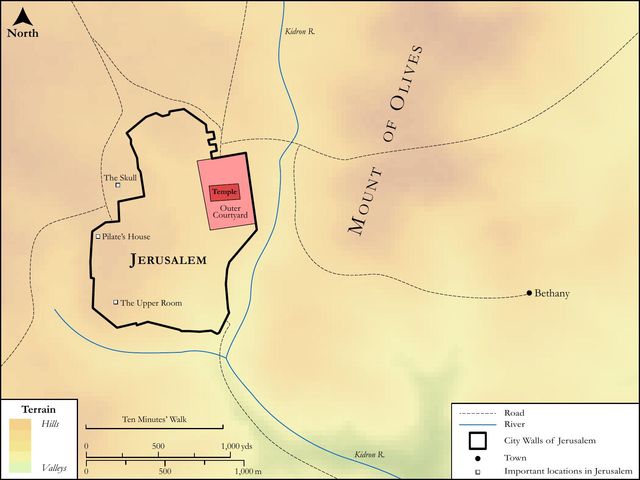
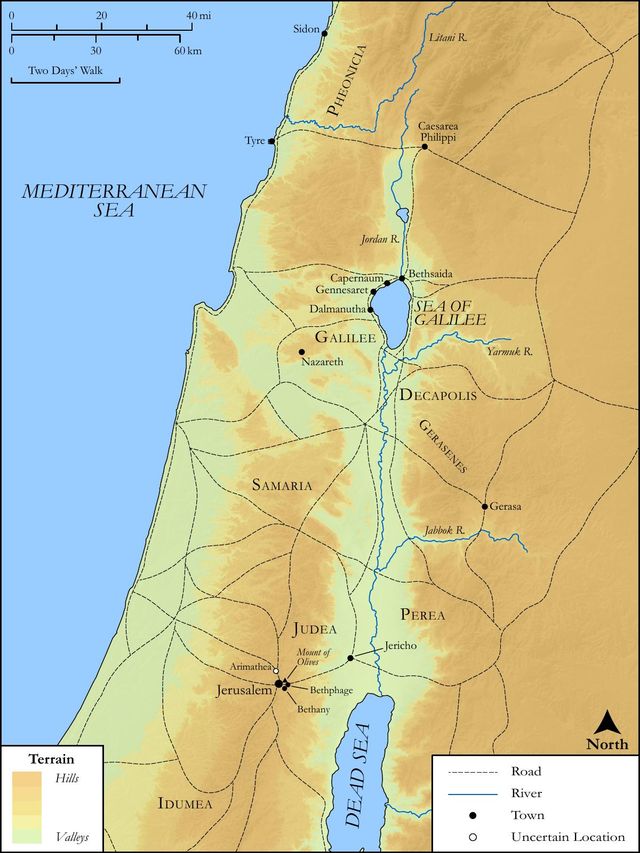
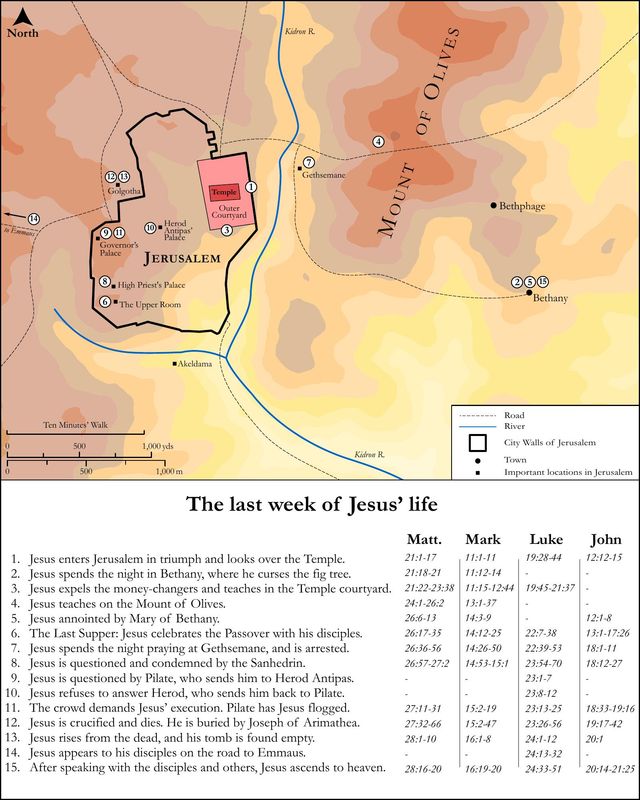
See on the biblical-era maps
Study this verse
Public-domain commentary
Matthew Henry
From his Commentary on the Whole Bible. Henry comments on passages, not single verses — this entry covers Mark 13:28–37. His three-level outline is real structure in the source text, so it is rendered as structure.
We have here the application of this prophetical sermon; now learn to look forward in a right manner.
I."As to the destruction of Jerusalem, expect it to come very shortly; as when the branch of the fig-tree becomes soft, and the leaves sprout forth, ye expect that summer will come shortly, Mar 13:28. When second causes begin to work, ye expect their effects in their proper order and time. So when ye see these things come to pass, when ye see the Jewish nation embroiled in wars, distracted by false Christs and prophets, and drawing upon them the displeasure of the Romans, especially when ye see them persecuting you for your Master's sake, and thereby standing to what they did when they put him to death, and repeating it, and so filling up the measure of their iniquity, then say that their ruin is nigh, even at the door, and provide for yourselves accordingly." The disciples themselves were indeed all of them, except John, taken away from the evil to come, but the next generation whom they were to train up, would live to see it; and by these instructions which Christ left behind him would be kept from sharing in it; "This generation that is now rising up, shall not all be worn off before all these things come to pass, which I have told you of, relating to Jerusalem, and they shall begin to take effect now shortly. And as this destruction is near and within ken, so it is sure. The decree is gone forth, it is a consummation determined," Dan 9:27. Christ doth not speak these things, merely to frighten them; no, they are declarations of God's fixed purpose; "Heaven and earth shall pass away, at the end of time; but my words shall not pass away (Mar 13:31), not one of these predictions shall fail of a punctual accomplishment."
II."As to the end of the world, do not enquire when it will come, for it is not a question fit to be asked, for of that day, and that hour, knoweth no man; it is a thing at a great distance; the exact time is fixed in the counsel of God, but is not revealed by any word of God, either to men on earth, or to angels in heaven; the angels shall have timely notice to prepare to attend in that day, and it shall be published, when it comes to the children of men, with sound of trumpet; but, at present, men and angels are kept in the dark concerning the precise time of it, that they may both attend to their proper services in the present day." But it follows, neither the Son; but is there any thing which the Son is ignorant of? We read indeed of a book which was sealed, till the Lamb opened the seals; but did not he know what was in it, before the seals were opened? Was not he privy to the writing of it? There were those in the primitive times, who taught from this text, that there were some things that Christ, as man, was ignorant of; and from these were called Agnoetae; they said, "It was no more absurd to say so, than to say that his human soul suffered grief and fear;" and many of the orthodox fathers approved of this. Some would evade it, by saying that Christ spoke this in a way of prudential economy, to divert the disciples from further enquiry: but to this one of the ancients answers, It is not fit to speak too nicely in this matter - ou dei panu akribologein, so Leontius in Dr. Hammond, "It is certain (says Archbishop Tillotson) that Christ, as God, could not be ignorant of any thing; but the divine wisdom which dwelt in our Saviour, did communicate itself to his human soul, according to the divine pleasure, so that his human nature might sometimes not know some things; therefore Christ is said to grow in wisdom (Luk 2:52), which he could not be said to do, if the human nature of Christ did necessarily know all things by virtue of its union with the divinity." Dr. Lightfoot explains it thus; Christ calls himself the Son, as Messiah. Now the Messiah, as such, was the father's servant (Isa 42:1), sent and deputed by him, and as such a one he refers himself often to his Father's will and command, and owns he did nothing of himself (Joh 5:19); in like manner he might be said to know nothing of himself. The revelation of Jesus Christ was what God gave unto him, Rev 1:1. He thinks, therefore, that we are to distinguish between those excellencies and perfections of his, which resulted from the personal union between the divine and human nature, and those which flowed from the anointing of the Spirit; from the former flowed the infinite dignity of his perfect freedom from all sin; but from the latter flowed his power of working miracles, and his foreknowledge of things to come. What therefore (saith he) was to be revealed by him to his church, he was pleased to take, not from the union of the human nature with the divine, but from the revelation of the Spirit, by which he yet knew not this, but the Father only knows it; that is, God only, the Deity; for (as Archbishop Tillotson explains it) it is not used here personally, in distinction from the Son and the Holy Ghost, but as the Father is, Fons et Principium Deitatis - The Fountain of Deity.
III."As to both, your duty is to watch and pray.
Therefore the time is kept a secret, that you may be engaged to stand always upon your guard (Mar 13:33); Take ye heed of every thing that would indispose you for your Master's coming, and would render your accounts perplexed, and your spirits so too; watch for his coming, that it may not at any time be a surprise to you, and pray for that grace which is necessary to qualify you for it, for ye know not when the time is; and you are concerned to be ready for that every day, which may come any day." This he illustrates, in the close, by a parable.
1.Our Master is gone away, and left us something in trust, in charge, which we must give account of, Mar 13:34. He is as a man taking a far journey; for he is gone to be away a great while, he has left his house on earth, and left his servants in their offices, given authority to some, who are to be overseers, and work to others, who are to be labourers. They that have authority given them, in that had work assigned them, for those that have the greatest power have the most business; and to them to whom he gave work, he gave some sort of authority, to do that work. And when he took his last leave, he appointed the porter to watch, to be sure to be ready to open to him at his return; and in the mean time to take care to whom he opened his gates, not to thieves and robbers, but only to his Master's friends and servants. Thus our Lord Jesus, when he ascended on high, left something for all his servants to do, expecting they should all do him service in his absence, and be ready to receive him at his return. All are appointed to work, and some authorized to rule.
2.We ought to be always upon our watch, in expectation of his return, Mar 13:35-37.
(1.)Our Lord will come, and will come as the Master of the house, to take account of his servants, of their work, and of the improvement they have made.
(2.)We know not when he will come; and he has very wisely kept us at uncertainty, that we might all be always ready. We know not when he will come, just at what precise time; the Master of the house perhaps will come at even, at nine at night; or it may be at midnight, or a cock-crowing, at three in the morning, or perhaps not until six. This is applicable to his coming to us in particular, at our death, as well as to the general judgment. Our present life is a night, a dark night, compared with the other life; we know not in which watch of the night our Master will come, whether in the days of youth, or middle age, or old age; but, as soon as we are born, we begin to die, and therefore, as soon as we are capable of expecting any thing, we must expect death.
(3.)Our great care must be, that, whenever our Lord comes, he do not find us sleeping, secure in ourselves, off our guard, indulging ourselves in ease and sloth, mindless of our work and duty, and thoughtless of our Lord's coming; ready to say, He will not come, and unready to meet him.
(4.)His coming will indeed be coming suddenly; it will be a great surprise and terror to those that are careless, and asleep, it will come upon them as a thief in the night.
(5.)It is therefore the indispensable duty of all Christ's disciples, to watch, to be awake, and keep awake; "What I say unto you four (Mar 13:37), I say unto all the twelve, or rather to you twelve, I say unto all my disciples and followers; what I say to you of this generation, I say to all that shall believe in men, through your word, in every age, Watch, watch, expect my second coming, prepare for it, that you may be found in peace, without spot, and blameless."
Historical interpretation
Nine Centuries of Reception
11 surviving comments on this verse. Each one is dated, so this reads as a timeline rather than a list.
Select a marker to jump to its quote. Markers stagger vertically where authors wrote within a few decades of each other.
For we must needs watch with our souls before the death of the body.
For he who sleeps applies not his mind to real bodies, but to phantoms, and when he awakes, he possesses not what he had seen; so also are those, whom the love of this world seizes upon in this life; they quit after this life what they dreamed was real.
He thus concludes His discourse, that the last should hear from those who come first this precept which is common to all; wherefore He adds, But what I say unto you I say unto all, Watch.
As, therefore, when the wild olive has been engrafted, if it remain in its former condition, viz., a wild olive, it is "cut off, and cast into the fire;" but if it takes kindly to the graft, and is changed into the good olive-tree, it becomes a fruit-bearing olive, planted, as it were, in a king's paradise: so likewise men, if they do truly progress by faith towards better things, and receive the Spirit of God, and bring forth the fruit thereof, shall be spiritual, as being planted in the paradise of God. For when men sleep, the enemy sows the material of tares; and for this cause did the Lord command His disciples to be on the watch.
How useless is the advice of those simplistic moralists who teach that after death rewards and punishments fall with lighter weight! That is, if any judgment at all awaits the soul! Rather it ought to be assumed that judgment will be weightier at the end of life than during it. For nothing is more telling and complete than that which comes at the very end. So no judgment could be more complete than God’s. Accordingly, God’s judgment will be incomparably radical and comprehensive, because it will be pronounced at the very last, in an eternal irrevocable sentence, both of punishment and of consolation. Then souls will not conveniently dissolve into senselessness, but will return into their own proper bodies. All this occurs once for all, on “that day, too, of which the Father only knows,” in order that a full trial be made of faith, and of faith’s concerned sincerity which awaits in trembling expectation, keeping her gaze ever fixed on that day, in her perpetual ignorance of when it will arrive, daily trembling at that for which she yet daily hopes.
(de Trin. ix) This ignorance of the day and hour is urged against the Only-Begotten God, as if, God born of God had not the same perfection of nature as God. But first, let common sense decide whether it is credible that He, who is the cause that all things are, and are to be, should be ignorant of any out of all these things. For how can it be beyond the knowledge of that nature, by which and in which that which is to be done is contained? And can He be ignorant of that day, which is the day of His own Advent? Human substances foreknow as far as they can what they intend to do, and the knowledge of what is to be done, follows upon the will to act. How then can the Lord of glory, from ignorance of the day of His coming, be believed to be of that imperfect nature, which has on it a necessity of coming, and has not attained to the knowledge of its own advent? But again, how much more room for blasphemy will there be, if a feeling of envy is ascribed to God the Father, in that He has withheld the knowledge of His beatitude from Him to whom He gave a foreknowledge of His death. But if there are in Him all the treasures of knowledge, He is not ignorant of this day; rather we ought to remember that the treasures of wisdom in Him are hidden; His ignorance therefore must be connected with the hiding of the treasures of wisdom, which are in Him. (Col. 2:3) For in all cases, in which God declares Himself ignorant, He is not under the power of ignorance, but either it is not a fit time for speaking, or it is an economy of not acting. But if God is said then to have known that Abraham loved Him, when He did not hide that His knowledge from Abraham, it follows, that the Father is said to know the day, because He did not hide it from the Son. (Gen. 22:12) If therefore the Son knew not the day, it is a Sacrament of His being silent, as on the contrary the Father alone is said to know, because He is not silent. But God forbid that any new and bodily changes should be ascribed to the Father or the Son. Lastly, lest He should be said to be ignorant from weakness, He has immediately added, Take ye heed, watch and pray, for ye know not when the time is.
The end of all things is concealed from us. For in the end of all is the end of each, and in the end of each is the end of all [on the last day]. Whereas this time is uncertain and always in prospect, we may advance day by day as if summoned, reaching forward to the things before us and forgetting the things behind. For who, if they knew the day of the end, would not disregard the interval? But if ignorant, would they not be more ready day by day? It was on this account that the Savior said: “Watch; for you do not know when the time will come.”
A person does not go wrong when he knows that he does not know something, but only when he thinks he knows something which he does not know.
(Epist. 199, 3) For He not only speaks to those in whose hearing He then spake, but even to all who came after them, before our time, and even to us, and to all after us, even to His last coming. But shall that day find all living, or will any man say that He speaks also to the dead, when He says, Watch, lest when he cometh he find you sleeping? Why then does He say to all, what only belongs to those who shall then be alive, if it be not that it belongs to all, as I have said? For that day comes to each man when his day comes for departing from this life such as he is to be, when judged in that day, and for this reason every Christian ought to watch, lest the Advent of the Lord find him unprepared; but that day shall find him unprepared, whom the last day of his life shall find unprepared.
(Hom. in Evan. 9) For the earth is properly the place for the flesh, which was as it were carried away to a far country, when it was placed by our Redeemer in the heavens. And he gave his servants power over every work, when, by giving to His faithful ones the grace of the Holy Ghost, He gave them the power of serving every good work. He has also ordered the porter to watch, because He commanded the order of pastors to have a care over the Church committed to them. Not only, however, those of us who rule over Churches, but all are required to watch the doors of their hearts, lest the evil suggestions of the devil enter into them, and lest our Lord find us sleeping. Wherefore concluding this parable He adds, Watch ye therefore: for ye know not when the master of the house cometh, at even, or at midnight, or at cockcrow, or in the morning: lest coming suddenly he find you sleeping.
Watch, therefore, and pray. For you do not know when the time is. Like a man who, traveling abroad, leaves his house and gives authority to his servants, etc. The Lord clearly shows why He said: "Of that day or hour no one knows, neither the angels in heaven, nor the Son, but only the Father." Because it is not expedient for the apostles to know, so that in the uncertainty of the hanging expectation they may always believe Him to be coming, whom they do not know when He will come. And He did not say, because we do not know at what hour the Lord will come, but you do not know. And, having given the example of the householder, He more clearly teaches why He conceals the day of consummation, saying:
(ubi sup.) The man who taking a far journey left his house is Christ, who ascending as a conqueror to His Father after the resurrection, left His Church, as to His bodily presence, but has never deprived her of the safeguard of His Divine presence.
The Lord wishing to prevent His disciples from asking about that day and hour, says, But of that day and that hour knoweth no man, no, not the angels which are in heaven, neither the Son, but the Father. For if He had said, I know, but I will not reveal it to you, He would have saddened them not a little; but He acted more wisely, and prevents their asking such a question, lest they should importune Him, by saying, neither the Angels nor I.
But He teaches us two things, watching and prayer; for many of us watch, but watch only to pass the night in wickedness; He now follows this up with a parable, saying, For the Son of man is as a man taking a far journey, who left his house, and gave his servants power over every work, and commanded the porter to watch.
See again that He has not said, I know not when the time will be, but, Ye know not. For the reason why He concealed it was that it was better for us; for if, now that we know not the end, we are careless, what should we do if we knew it? We should keep on our wickednesses even unto the end. Let us therefore attend to His words; for the end comes at even, when a man dies in old age; at midnight, when he dies in the midst of his youth; and at cockcrow, when our reason is perfect within us; for when a child begins to live according to his reason, then the cock cries loud within him, rousing him from the sleep of sense; but the age of childhood is the morning. Now all these ages must look out for the end; for even a child must be watched, lest he die unbaptized.
Continue studying Mark 13:33 across the web’s major study libraries — every link below opens this exact verse, chapter, or book on the destination site.
Read & Compare
 BibleGatewayThis verse in more than 200 translations and 70 languages.
 Bible.comThe YouVersion reader — hundreds of translations, reading plans, and highlights.
 ESV.orgCrossway's official English Standard Version reader.
 NET BibleThe NET translation with 60,000+ translators' notes on every rendering decision.
 STEP BibleTyndale House's free study tool — original text, vocabulary, and scholarly resources.
 BibliaLogos Bible Software's free web reader.
 USCCBThe New American Bible (Revised Edition) with the U.S. bishops' study notes.
Commentaries
 BibleHub CommentariesDozens of classic commentaries on this verse, gathered on one page.
 StudyLightMore than 100 commentary sets — the largest collection on the web.
 BibleRefPlain-English commentary on what this verse means, verse by verse.
 Enduring WordDavid Guzik's free commentary on this chapter, widely used by Bible teachers.
 Bible Study ToolsVerse commentary alongside Greek and Hebrew study aids.
Original Language & Research
- BibleHub InterlinearThe verse word by word — original language, transliteration, and English.
- BibleHub LexiconEvery word's original-language definition and Strong's entry.
 Blue Letter BibleDeep-study tools — Strong's numbers, concordance, and word studies.
 CNTR CollationThe earliest Greek manuscripts of this verse, collated letter by letter.
Sermons, Hymns & Audio


TrulyRandomVerse is not affiliated with these sites and doesn’t control their content. They’re linked because they’re genuinely useful.
Summary
Mark 13:33 serves as a profound and urgent exhortation from Jesus, calling His disciples to a state of continuous spiritual alertness and fervent prayer. This imperative arises from the divinely ordained uncertainty surrounding the exact timing of future eschatological events, particularly His glorious return. The verse underscores that since the precise moment remains unknown, believers are to live in a constant posture of readiness, demonstrating faithfulness and vigilance in anticipation of the Lord's appointed time.
Context
ShowHideLiterary Context
Mark 13:33 is a pivotal verse within Jesus' Olivet Discourse, a significant eschatological teaching delivered on the Mount of Olives. This discourse, prompted by the disciples' questions about the destruction of the Temple and the signs of the end of the age (Mark 13:4), occupies the entirety of Mark chapter 13. Jesus describes various signs and tribulations, including false Christs, wars, earthquakes, famines, and persecutions, culminating in the signs in the sun, moon and stars preceding His glorious return (Mark 13:24-27). Crucially, immediately preceding verse 33, Jesus states that "of that day and that hour knoweth no man, no, not the angels which are in heaven, neither the Son, but the Father" (Mark 13:32). Therefore, verse 33 functions as the direct, practical application and imperative conclusion to this declaration of divine uncertainty, transitioning from prophetic description to personal responsibility. It is a call to action flowing directly from the preceding revelation.
Historical & Cultural Context
The Olivet Discourse was delivered to a small group of disciples, likely still steeped in Jewish apocalyptic expectations concerning the Messiah's coming and the establishment of His kingdom. They anticipated a dramatic, visible intervention by God. The destruction of the Second Temple, which Jesus prophesies (Mark 13:1-2), was an unimaginable catastrophe for first-century Jews, deeply intertwined with their understanding of the end times. The command to "watch" would have resonated with the common practice of night watchmen in ancient cities, who had to remain awake and alert for dangers or the arrival of a master. The cultural understanding of "time" (Greek kairos) as a divinely appointed moment, rather than mere chronological duration, would have underscored the urgency and significance of Jesus' warning, emphasizing that the "time" of His return is not just any moment, but the decisive, opportune moment.
Key Themes
ShowHideMark 13:33 powerfully encapsulates several overarching themes present in the Olivet Discourse and throughout the New Testament. The primary theme is Vigilance and Watchfulness, emphasizing a continuous state of spiritual alertness and readiness for the Lord's return, as further illustrated by the parable of the doorkeeper in Mark 13:34-37. Closely linked is the theme of Prayer as Preparedness, highlighting prayer as an indispensable spiritual discipline for maintaining communion with God, seeking discernment, and finding strength to persevere through trials and uncertainty. The explicit statement "for ye know not when the time is" underscores the Uncertainty of Timing, a crucial theological point that shifts focus from speculative date-setting to consistent, faithful living. This uncertainty is not meant to induce fear or anxiety but to motivate Personal Responsibility and a lifestyle of active expectation, ensuring that believers are found faithful whenever the appointed kairos arrives.
Exposition and Analysis
ShowHideKey Word Analysis
ShowHideThis verb (G991) means "to look at (literally or figuratively); behold, beware, lie, look (on, to), perceive, regard, see, sight, take heed." In this imperative context, it conveys a strong warning to be mindful, to pay close attention, and to exercise caution. It implies not just passive observation but an active, discerning awareness of one's spiritual state and surroundings.
Derived from a negative particle and hypnos (sleep), this verb (G69) literally means "to be sleepless, i.e., keep awake." It signifies a state of wakefulness, vigilance, and alertness, particularly in the face of potential danger or an important event. It goes beyond merely "taking heed" by emphasizing sustained, active wakefulness, contrasting with spiritual slumber or complacency.
This noun (G2540) refers to "an occasion, i.e., set or proper time; opportunity, (convenient, due) season, (due, short, while) time, a while." Unlike chronos (chronological time), kairos denotes a qualitative, opportune, or divinely appointed moment. In Mark 13:33, it refers to the specific, decisive, and divinely determined moment of the Lord's return, the exact timing of which remains unknown to humanity.
Verse Breakdown
ShowHide"Take ye heed, watch and pray:"
This opening clause contains three powerful, interconnected imperatives that form the core command of the verse. "Take ye heed" (blépō) is a call to intellectual and spiritual discernment, urging disciples to be aware and cautious. "Watch" (agrypnéō) intensifies this, demanding active, sustained vigilance, like a guard on duty who must not fall asleep. "And pray" (proseúchomai) adds the spiritual dimension, indicating that true watchfulness is not merely human effort but is empowered and sustained through communion with God. Prayer is presented as an essential means of spiritual readiness, strength, and alignment with God's will. These three commands together form a comprehensive call to active, spiritually engaged preparedness.
"for ye know not when the time is."
This second clause provides the crucial rationale and motivation for the preceding commands. The conjunction "for" (G1063, gár) introduces the reason: the disciples (and all believers) "know not" (G1492, eídō, to know, G3756, ou, not) the precise "time" (G2540, kairós) of the Lord's return. This divine uncertainty, explicitly stated by Jesus in the preceding verse (Mark 13:32), is not a cause for anxiety or paralysis but serves as the ultimate impetus for continuous vigilance and prayer. Since the specific "opportune moment" is undisclosed, every moment must be lived in a state of readiness.
Literary Devices
ShowHideMark 13:33 employs several potent literary devices to convey its urgent message. The most prominent is the Imperative Mood, seen in "Take ye heed," "watch," and "pray." These are direct commands, not suggestions, emphasizing the non-negotiable nature of spiritual preparedness. The use of three distinct but related verbs creates a sense of Emphasis through accumulation, reinforcing the multifaceted nature of readiness. There is also a subtle Contrast between the known (the commands to watch and pray) and the unknown (the precise timing of the Lord's return). This contrast highlights the human responsibility to respond faithfully to what is revealed, rather than speculating on what is hidden. Finally, Symbolism is at play, where "watching" symbolizes a broader spiritual state of alertness, moral uprightness, and active anticipation, rather than merely physical wakefulness.
Theological and Thematic Connections
ShowHideMark 13:33 is a cornerstone of New Testament eschatology and discipleship, deeply embedding the concept of living in light of Christ's certain return, despite the unknown timing. Theologically, it underscores God's sovereignty over time and history, revealing that the Father alone holds the knowledge of the "day and hour" (Mark 13:32). This divine prerogative removes the burden of speculative date-setting from believers, redirecting their focus to faithful living. The command to "watch and pray" transforms eschatological expectation from a passive waiting into an active, spiritual discipline. It implies that true readiness involves a continuous, intimate relationship with God through prayer and a vigilant awareness of spiritual dangers and opportunities, ensuring that one's life aligns with the Lord's will at all times. This verse resonates with the broader biblical call to live purposefully and righteously, understanding that our ultimate hope is in Christ's return and the consummation of His kingdom.
Reflection and Application
ShowHideFor believers today, Mark 13:33 serves as a timeless and urgent call to spiritual vitality. It challenges us to cultivate a lifestyle of active faith, rather than passive waiting or anxious speculation. To "take heed" means to be discerning about the spiritual climate, aware of temptations, and mindful of our walk with God. To "watch" implies a continuous state of readiness, not just for Christ's return, but for His presence and leading in our daily lives. This involves cultivating spiritual disciplines, guarding our hearts, and living with integrity. To "pray" is to acknowledge our dependence on God, seeking His strength, wisdom, and guidance in every circumstance. This verse encourages us to live each day as if it were the day of the Lord's return, not out of fear, but out of a hopeful and loving expectation. It calls us to be found faithful in our responsibilities, diligent in sharing the Gospel, and fervent in our love for God and neighbor, ensuring that our lives reflect the values of His coming kingdom.
Questions for Reflection
ShowHideFAQ
ShowHideWhat is the difference between chronos and kairos in the context of "time"?
ShowHideIn biblical Greek, chronos (χρόνος) refers to chronological, sequential time—the measurable duration of moments, hours, and days. It is quantitative. Kairos (καιρός), on the other hand, refers to a qualitative, opportune, or divinely appointed "time" or season. It signifies a specific, decisive moment or a period characterized by a particular event or purpose. In Mark 13:33, when Jesus says "ye know not when the time is," He uses kairos, emphasizing that the exact, divinely appointed moment of His return is unknown, not merely a specific chronological hour. This distinction highlights that while we live within chronos, we must be ready for the decisive kairos of His coming, which is in God's sovereign hands.
Does Mark 13:33 discourage studying biblical prophecy or eschatology?
ShowHideNo, Mark 13:33 does not discourage the study of biblical prophecy or eschatology. Rather, it redirects the focus of such study. Jesus Himself provides extensive prophetic details in the Olivet Discourse, indicating that understanding these signs is important for discernment. The prohibition is against knowing or speculating about the precise "day and hour" (Mark 13:32), which is reserved for the Father. The purpose of prophecy, as seen in this verse, is not to enable date-setting but to motivate vigilance, prayer, and faithful living. Studying prophecy should deepen our understanding of God's plan, increase our hope, and spur us to greater obedience and evangelism, rather than leading to idle speculation.
Christ-Centered Fulfillment
ShowHideMark 13:33, with its urgent call to "take ye heed, watch and pray," finds its ultimate fulfillment and deepest meaning in the person and work of Jesus Christ. The "time" (kairos) that remains unknown is precisely the time of His glorious second coming, when He will return as the Son of Man in power and great glory (Mark 13:26). Our watchfulness is not merely for an abstract event, but for the return of our Lord, who first came to redeem humanity as the Lamb of God who takes away the sin of the world. He is the one who, in His first advent, demonstrated perfect watchfulness and submission to the Father's will, even praying in agony in Gethsemane, "not what I will, but what you will" (Mark 14:36). His life of perfect obedience, culminating in His atoning death and resurrection, secures the hope of His return. Therefore, our "watching and praying" is an active participation in the ongoing mission of His kingdom, living in light of His accomplished work and His promised return. We watch for the one who has already conquered sin and death, and we pray for the consummation of His reign, knowing that "He who testifies to these things says, 'Surely I am coming soon.' Amen. Come, Lord Jesus!"