


Mark 12:23
Bible text: King James Version (1769 Blayney text) · Public domain
Bible text: Berean Standard Bible · Public domain
Bible text: American Standard Version (1901) · Public domain
Bible text: World English Bible, Messianic edition · Public domain
Bible text: Geneva Bible (1599) · Public domain
Bible text: Young's Literal Translation · Public domain
- ἐνenInG1722PREPPreposition
- τῇtēatheG3588T-DSFDefinite article Dative Singular Feminine
- οὖνounthereforeG3767CONJConjunction
- ἀναστάσειanastaseiresurrectionG386N-DSFNoun Dative Singular Feminine
- ὅτανhotanwhenG3752PREPPreposition
- ἀναστῶσινanastōsinthey may riseG450V-2AAS-3PVerb 2nd Aorist Active Subjunctive 3rd Plural
- τίνοςtinosof whichG5101I-GSMInterrogative pronoun Genitive Singular Masculine
- αὐτῶνautōnof themG846P-GPMPersonal pronoun Genitive Plural Masculine
- ἔσταιestaiwill she beG1510V-FDI-3SVerb Future Middle Deponent Indicative 3rd Singular
- γυνή;gunēwife?G1135N-NSFNoun Nominative Singular Feminine
- οἱhoi<the>G3588T-NPMDefinite article Nominative Plural Masculine
- γὰρgarForG1063CONJConjunction
- ἑπτὰheptathe sevenG2033A-NUIAdjective
- ἔσχονeschonhadG2192V-2AAI-3PVerb 2nd Aorist Active Indicative 3rd Plural
- αὐτὴνautēnherG846P-ASFPersonal pronoun Accusative Singular Feminine
- γυναῖκαgunaikaas wifeG1135N-ASFNoun Accusative Singular Feminine
English is a literal word-by-word gloss of the Greek, not the KJV's wording. Why?
This is the original text the KJV's translators worked from — each Greek word with its own literal English meaning in this verse, prepared by scholars at Tyndale House, Cambridge. The KJV translates whole sentences, not word by word, so its wording differs: one Greek word can become several English words, and the KJV may choose “charity” where the gloss reads “love”. Both are faithful — they answer different questions. For the KJV's own rendering, switch to the KJV text.
Details
See on the biblical-era maps
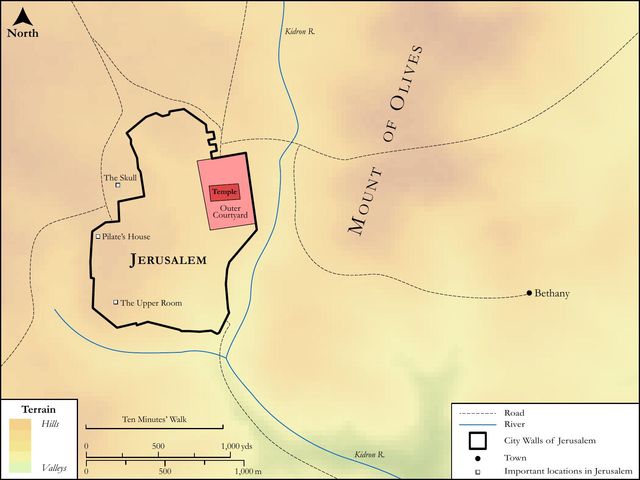
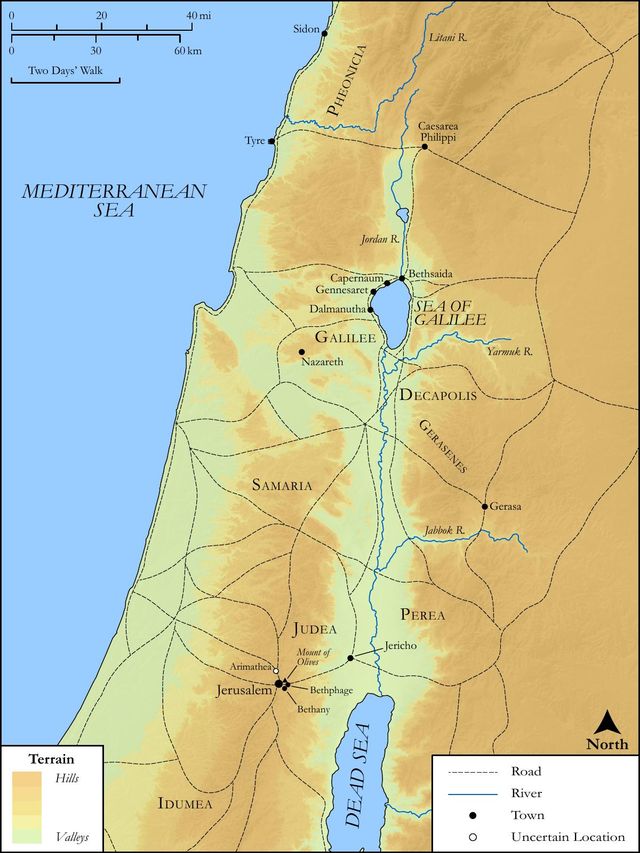
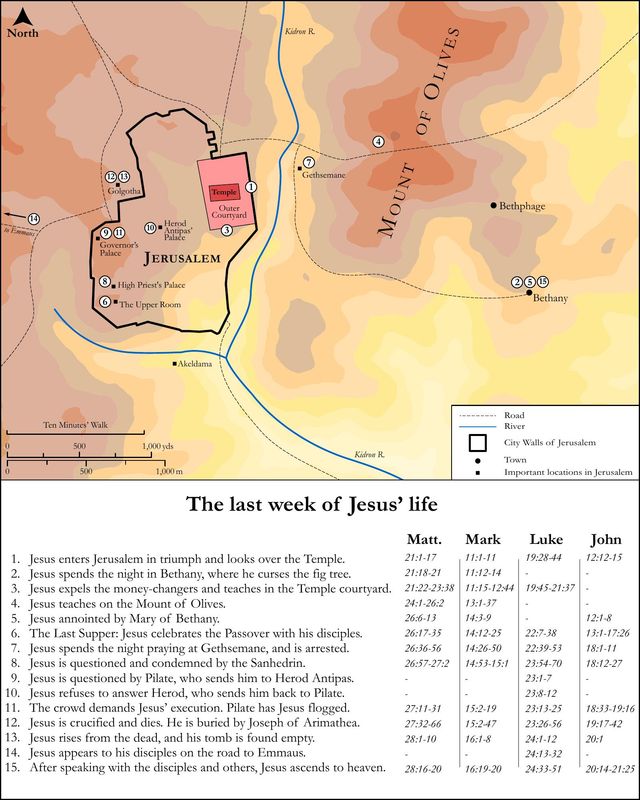
Study this verse
Public-domain commentary
Matthew Henry
From his Commentary on the Whole Bible. Henry comments on passages, not single verses — this entry covers Mark 12:18–27. His three-level outline is real structure in the source text, so it is rendered as structure.
The Sadducees, who were the deists of that age, here attack our Lord Jesus, it should seem, not as the scribes, and Pharisees, and chief-priests, with any malicious design upon his person; they were not bigots and persecutors, but sceptics and infidels, and their design was upon his doctrine, to hinder the spreading of that: they denied that there was any resurrection, and world of spirits, any state of rewards and punishments on the other side of death: now those great and fundamental truths which they denied, Christ had made it his business to establish and prove, and had carried the notion of them much further that ever it was before carried; and therefore they set themselves to perplex his doctrine.
I.See here the method they take to entangle it; they quote the ancient law, by which, if a man died without issue, his brother was obliged to marry his widow, Mar 12:19. They suppose a case to happen that, according to that law, seven brothers were, successively, the husbands of one woman, Mar 12:20. Probably, these Sadducees, according to their wonted profaneness, intended hereby to ridicule that law, and so to bring the whole frame of the Mosaic institution into contempt, as absurd and inconvenient in the practice of it. Those who deny divine truths, commonly set themselves to disparage divine laws and ordinances. But this was only by the by; their design was to expose the doctrine of the resurrection; for they suppose that if there be a future state, it must be such a one as this, and then the doctrine, they think, is clogged either with this invincible absurdity, that a woman in that state must have seven husbands, or else with this insolvable difficulty, whose wife must she be. See with what subtlety these heretics undermine the truth; they do not deny it, nor say, There can be no resurrection; nay, they do not seem to doubt of it, nor say, If there be a resurrection, whose wife shall she be? as the devil to Christ, If thou be the Son of God. But, as though these beasts of the field were more subtle than the serpent himself, they pretend to own the truth, as if they were not Sadducees, no not they; who said that they denied the resurrection? They take it for granted that there is a resurrection, and would be thought to desire instruction concerning it, when really they are designing to give a fatal stab, and think that they shall do it. Note, It is the common artifice of heretics and Sadducees to perplex and entangle the truth, which they have not the impudence to deny.
II.See here the method Christ takes to clear and establish this truth, which they attempted to darken, and give a shock to.
This was a matter of moment, and therefore Christ does not pass it over lightly, but enlarges upon it, that, if they should not be reclaimed, yet others might be confirmed.
1.He charges the Sadducees with error, and charges that upon their ignorance. They who banter the doctrine of the resurrection as some do in our age, would be thought the only knowing men, because the only free thinkers, when really they are the fools in Israel, and the most enslaved and, prejudiced thinkers in the world. Do ye not therefore err? Ye cannot but be sensible of it yourselves, and that the cause of your error is,
(1.)Because ye do not know the scriptures. Not but that the Sadducees had read the scriptures, and perhaps were ready in them; yet they might be truly said not to know the scriptures, because they did not know the sense and meaning of them, but put false constructions upon them; or they did not receive the scriptures as the word of God, but set up their own corrupt reasonings in opposition to the scripture, and would believe nothing but what they could see. Note, A right knowledge of the scripture, as the fountain whence all revealed religion now flows, and the foundation on which it is built, is the best preservative against error. Keep the truth, the scripture-truth, and it shall keep thee.
(2.)Because ye know not the power of God. They could not but know that God is almighty, but they would not apply that doctrine to this matter, but gave up the truth to the objections of the impossibility of it, which would all have been answered, if they had but stuck to the doctrine of God's omnipotence, to which nothing is impossible. This therefore which God hath spoken once, we are concerned to hear twice, to hear and believe, to hear and apply - that power belongs to God, Psa 62:11; Rom 4:19-21. The same power that made soul and body and preserved them while they were together, can preserve the body safe, and the soul active, when they are parted, and can unite them together again; for behold, the Lord's arm is not shortened. The power of God, seen in the return of the spring (Psa 104:30), in the reviving of the corn (Joh 12:24), in the restoring of an abject people to their prosperity (Eze 37:12-14), in the raising of so many to life, miraculously, both in the Old Testament and in the New, and especially in the resurrection of Christ (Eph 1:19, Eph 1:20), are all earnests of our resurrection by the same power (Phi 3:21); according to the mighty working whereby he is able to subdue all things to himself.
2.He sets aside all the force of their objection, by setting the doctrine of the future state in a true light (Mar 12:25); When they shall rise from the dead, they neither marry, nor are given in marriage. It is a folly to ask, Whose wife shall she be of the seven? For the relation between husband and wife, though instituted in the earthly paradise, will not be known in the heavenly one. Turks and infidels expect sensual pleasures in their fools' paradise, but Christians know better things - that flesh and blood shall not inherit the kingdom of God (Co1 15:50); and expect better things - even a full satisfaction in God's love and likeness (Psa 17:15); they are as the angels of God in heaven, and we know that they have neither wives nor children. It is no wonder if we confound ourselves with endless absurdities, when we measure our ideas of the world of spirits by the affairs of this world of sense.
III.He builds the doctrine of the future state, and of the blessedness of the righteous in that state, upon the covenant of God with Abraham, which God was pleased to own, being after Abraham's death, Mar 12:26, Mar 12:27. He appeals to the scriptures; Have ye not read in the book of Moses? We have some advantage in dealing with those that have read the scriptures, though many that have read them, wrest them, as these Sadducees did, to their own destruction. Now that which he refers them to is, what God says to Moses at the bush, I am the God of Abraham; not only, I was so, but I am so; I am the portion and happiness of Abraham, a God all-sufficient to him. Note, It is absurd to think that God's relation to Abraham should be continued, and thus solemnly recognised, if Abraham was annihilated, or that the living God should be the portion and happiness of a man that is dead, and must be for ever so; and therefore you must conclude,
1.That Abraham's soul exists and acts as a state of separation from the body.
2.That therefore, some time or other, the body must rise again; for there is such an innate inclination in a human soul towards its body, as would make a total and everlasting separation inconsistent with the ease and repose, much more with the bliss and joy of those souls that have the Lord for their God. Upon the whole matter, he concludes, Ye therefore do greatly err. Those that deny the resurrection, greatly err, and ought to be told so.
Historical interpretation
Eleven Centuries of Reception
6 surviving comments on this verse. Each one is dated, so this reads as a timeline rather than a list.
Select a marker to jump to its quote. Markers stagger vertically where authors wrote within a few decades of each other.
But in a mystical sense: what can this woman, leaving no seed of seven brothers, and last of all dying, mean except the Jewish synagogue, deserted by the seven-fold Spirit, which filled those seven patriarchs, who did not leave to her the seed of Abraham, that is, Jesus Christ? For although a Son was born to them, nevertheless He was given to us Gentiles. This woman was dead to Christ, nor shall she be joined in the resurrection to any patriarch of the seven; for by the number seven is meant the whole company of the faithful. Thus it is said contrariwise by Isaiah, Seven women shall take hold of one man; (Is. 4:1) that is, the seven Churches, which the Lord loves, reproves, and chastises, adore Him with one faith. Wherefore it goes on: And Jesus answering, said unto them, Do ye not therefore err, not knowing the Scripture, neither the power of God?
Thus then they do not understand the Scripture, in that in the resurrection, men shall be as the Angels of God, that is, no man there dies, no one is born, no infant is there, no old man.
But 1 say, in the bush, in which is an image of you; for in it the fire was kindled, but it did not consume its thorns; so my words set you on fire, but do not burn off your thorns, which have grown under the curse.
But when He says, The God of Abraham, the God of Isaac, and the God of Jacob; by naming God thrice, He implied the Trinity. But when He says, He is not the God of the dead, by naming again the One God, he implies One Substance. But they live who make good the portion, which they had chosen; and they are dead, who have lost what they had made good. Ye therefore do greatly err.
To Christians, after their departure from this world, no restoration of the carnal aspect of marriage is promised in the day of the resurrection, translated as they will be into the condition and sanctity of angels. In the day of resurrection no dilemma arising from sexual jealousy will injure any of her so many husbands, even in the case of her whom they chose to represent as having been married to seven brothers successively.
In the resurrection, when they rise again, to which of them will the woman be wife? For the seven had her as a wife. They use the absurdity of the story to deny the truth of the resurrection; but mystically, these seven brothers who died without children are like all the wicked, who, throughout the entire span of this life which revolves in seven days, are barren of good works. To each of them who is taken by a miserable death, ultimately worldly living itself, which they wasted without producing any vital work, will pass away like a barren wife.
(ubi sup.) And fitly do they frame such a fable in order to prove the madness of those who assert the resurrection of the body. Such a thing however might really have happened at some time or other among them.
(ubi sup.) We must here consider that the Latin custom does not answer to the Greek idiom. For properly 1different words are used for the marriage of men, and that of women; but here we may simply understand that, marry is meant of men, and given in marriage of women.
(ubi sup.) Or else; because after proving that the soul remained after death, (for God could not be God of those who did not exist at all,) the resurrection of the body also might be inferred as a consequence, since it had done good and evil with the soul.
A certain heretical sect of the Jews called Sadducees denied the resurrection, and said that there was neither angel nor spirit. These then coming to Jesus, craftily proposed to Him a certain tale, in order to show that no resurrection should take place, or had taken place; and therefore there is added, And they asked him, saying, Master. And in this tale they lay down that seven men had married one woman, in order to make men draw back from belief in the resurrection.
As if He had said, Ye understand not what sort of a resurrection the Scriptures announce; for ye believe that there will be a restoration of our bodies, such as they are now, but it shall not be so. Thus then ye know not the Scriptures; neither again do ye know the power of God; for ye consider it as a difficult thing, saying, How can the limbs, which have been scattered, be united together and joined to the soul? But this in respect of the Divine power is as nothing. There follows: For when they shall rise from the dead, they neither marry, nor are given in marriage; but are as the angels which are in heaven; as if He had said, There will be a certain heavenly and angelic restoration to life, when there shall be no more decay, and we shall remain unchanged; and for this reason marriage shall cease. For marriage now exists on account of our decay, that we may be carried on by succession of our race, and not fail; but then we shall be as the Angels, who need no succession by marriage, and never come to an end.
In another way also they are deceived, not understanding the Scriptures; for if they had understood them, they should also have understood how by the Scriptures the resurrection of the dead may be proved; wherefore He adds, And as touching the dead, that they rise, have ye not read in the book of Moses, how in the bush God spake unto him, saying, I am the God of Abraham, and the God of Isaac, and the God of Jacob?
But I say, I am the God of Abraham, the God of Isaac, and the God of Jacob. As if He had said, The God of the living, wherefore He adds, He is not the God of the dead, but of the living; for He did not say, I have been, but I am, as if they had been present. But some one perhaps will say, that God spake this only of the soul of Abraham, not of his body; to which I answer, that Abraham implies both, that is, soul and body, so that He also is the God of the body, and the body lives with God, that is, in God's ordinance.
(non occ.) After that our Lord has prudently escaped the crafty temptation of the Pharisees, it is shown how He also confounds the Sadducees, who tempt Him; wherefore it is said: Then come unto him the Sadducees, which say there is no resurrection.
(non occ.) That is, because they contradicted the Scriptures, and derogated from the power of God.
Continue studying Mark 12:23 across the web’s major study libraries — every link below opens this exact verse, chapter, or book on the destination site.
Read & Compare
 BibleGatewayThis verse in more than 200 translations and 70 languages.
 Bible.comThe YouVersion reader — hundreds of translations, reading plans, and highlights.
 ESV.orgCrossway's official English Standard Version reader.
 NET BibleThe NET translation with 60,000+ translators' notes on every rendering decision.
 STEP BibleTyndale House's free study tool — original text, vocabulary, and scholarly resources.
 BibliaLogos Bible Software's free web reader.
 USCCBThe New American Bible (Revised Edition) with the U.S. bishops' study notes.
Commentaries
 BibleHub CommentariesDozens of classic commentaries on this verse, gathered on one page.
 StudyLightMore than 100 commentary sets — the largest collection on the web.
 BibleRefPlain-English commentary on what this verse means, verse by verse.
 Enduring WordDavid Guzik's free commentary on this chapter, widely used by Bible teachers.
 Bible Study ToolsVerse commentary alongside Greek and Hebrew study aids.
Original Language & Research
- BibleHub InterlinearThe verse word by word — original language, transliteration, and English.
- BibleHub LexiconEvery word's original-language definition and Strong's entry.
 Blue Letter BibleDeep-study tools — Strong's numbers, concordance, and word studies.
 CNTR CollationThe earliest Greek manuscripts of this verse, collated letter by letter.
Sermons, Hymns & Audio


TrulyRandomVerse is not affiliated with these sites and doesn’t control their content. They’re linked because they’re genuinely useful.
Summary
Mark 12:23 captures the Sadducees' challenging question to Jesus concerning the nature of resurrection life, specifically regarding marital status. They present a hypothetical scenario based on levirate marriage, where a woman sequentially marries seven brothers who all die childless. Their query, "In the resurrection therefore, when they shall rise, whose wife shall she be of them? for the seven had her to wife," is designed to expose what they perceive as an absurdity in the concept of a bodily resurrection, thereby undermining Jesus' teachings and the very doctrine of an afterlife.
Context
ShowHideLiterary Context
This verse is situated within a series of confrontations Jesus experiences in Jerusalem during the Passion Week, immediately following His parable of the wicked tenants and preceding His discourse on the greatest commandment. The Sadducees, a Jewish sect that rejected the resurrection, angels, and spirits (as noted in Acts 23:8), approach Jesus with a hypothetical case designed to ridicule the concept of resurrection. Their question in Mark 12:23 serves as the climax of their elaborate scenario, setting the stage for Jesus' profound and authoritative response in Mark 12:24-27, where He corrects their theological error by appealing to both the power of God and the Scriptures.
Historical & Cultural Context
The Sadducees were a powerful priestly and aristocratic group in first-century Judaism, deeply entrenched in the Temple system. Unlike the Pharisees, they only accepted the Torah (the first five books of Moses) as authoritative Scripture and denied doctrines not explicitly stated within it, including the resurrection of the dead, angels, and the afterlife. Their question regarding the woman married to seven brothers is a direct application of the Mosaic Law of levirate marriage, found in Deuteronomy 25:5-6. This law stipulated that if a man died childless, his brother was obligated to marry the widow to raise up an heir for the deceased, thus preventing the family line and inheritance from dying out. The Sadducees' scenario, while extreme, was intended to highlight what they saw as an unresolvable problem if resurrection were true, thereby discrediting the doctrine and Jesus' affirmation of it.
Key Themes
ShowHideMark 12:23 encapsulates several key themes central to the chapter and broader Gospel. Firstly, it highlights a profound misunderstanding of the resurrection by the Sadducees, who project earthly, temporal relationships onto an eternal, transformed reality. Their question reveals a limited view of God's power and the nature of future existence. Secondly, it underscores the authority of Jesus to interpret and reveal divine truth, as He masterfully dismantles their faulty premise. Thirdly, the verse directly precedes Jesus' teaching on the transformed nature of resurrected life, where earthly institutions like marriage do not carry over in the same form, as people "neither marry, nor are given in marriage; but are as the angels which are in heaven" (Mark 12:25). This interaction also implicitly emphasizes the importance of knowing and correctly interpreting Scripture and the power of God (Mark 12:24), which the Sadducees evidently lacked.
Exposition and Analysis
ShowHideKey Word Analysis
ShowHideDerived from anístēmi (G450), meaning "to stand up again" or "to rise up." In this context, it specifically refers to the rising of the dead, a central tenet of Jewish eschatology that the Sadducees rejected. The Sadducees' question hinges on their literal, earthly understanding of this "standing up again," failing to grasp the transformed nature of resurrected existence.
This term refers to a woman, specifically a wife. The Sadducees' entire argument revolves around the continuation of the marital relationship in the afterlife, assuming that the earthly institution of marriage, with its legal and social implications, would persist unchanged in the resurrection. Their question, "whose wife shall she be," directly challenges the logical coherence of resurrection if earthly marital bonds remain.
This particle introduces a reason or explanation. Here, it precedes the clause "the seven had her to wife," providing the justification or premise for the Sadducees' challenging question. It signals that the preceding query ("whose wife shall she be?") is directly necessitated by the complex marital history of the woman in their hypothetical scenario.
Verse Breakdown
ShowHide"In the resurrection therefore, when they shall rise"
This opening phrase sets the scene, explicitly stating the context of the Sadducees' inquiry. They are pressing Jesus on the very concept they deny – a future state of "standing up again" from death. The "therefore" (G3767, oûn) logically connects their question to the premise of resurrection, which Jesus taught. The phrase "when they shall rise" (G3752, hótan and G450, anístēmi) emphasizes the future event of rising from the dead, which is the core of their theological dispute.
"whose wife shall she be of them?"
This is the Sadducees' direct question, framed as a dilemma. It highlights their fundamental misunderstanding of the nature of resurrected life. They assume that earthly relationships, particularly the legal and social bonds of marriage, would continue in the afterlife in the same form, creating an absurd situation where one woman would be simultaneously married to seven men. This question is designed to expose a perceived flaw in the doctrine of resurrection.
"for the seven had her to wife."
This clause provides the justification for their question, detailing the hypothetical scenario. It explains that the woman in question had been married sequentially to all seven brothers according to the levirate marriage law, each dying without issue. This specific detail is crucial to their argument, as it creates the complex relational problem they believe the resurrection doctrine cannot resolve.
Literary Devices
ShowHideThe Sadducees employ a Hypothetical Question or Case Study as a primary literary device. They construct an elaborate, albeit extreme, scenario involving levirate marriage to create a perceived theological paradox. This is then presented as a Rhetorical Question ("whose wife shall she be?") which they believe has no satisfactory answer, thus intending to discredit the doctrine of resurrection and Jesus' teaching. There is also an element of Irony, as the Sadducees, who pride themselves on their knowledge of the Law, are about to be exposed by Jesus for their profound ignorance, not only of the Scriptures they claim to uphold but also of the very power of God. Their attempt to trap Jesus ultimately serves to illuminate their own theological blindness.
Theological and Thematic Connections
ShowHideMark 12:23, though a question from Jesus' adversaries, profoundly contributes to the New Testament's understanding of resurrection. It highlights that the Sadducees' error stemmed from a limited view of God's power and a misinterpretation of Scripture, failing to grasp that resurrected life transcends earthly limitations and relationships. The passage teaches that while marriage is a sacred institution in this life, it is a temporal covenant that serves purposes related to the present age, such as procreation and companionship. In the resurrection, existence is transformed, characterized by a direct, unmediated relationship with God, akin to angels, where the need for earthly marital bonds ceases, not because they are diminished, but because they are superseded by a greater, eternal reality. This understanding corrects anthropocentric projections onto divine eschatology, emphasizing God's transformative power.
Reflection and Application
ShowHideThe Sadducees' misguided question in Mark 12:23 serves as a powerful reminder for believers today to avoid imposing human limitations and earthly paradigms onto divine truth. We are often tempted to confine God's plans and future realities within the boundaries of our current understanding or experience. This passage challenges us to expand our vision of God's power and the glorious, transformed nature of the life to come. While earthly relationships, including marriage, are precious gifts from God and vital for this present age, they are not ultimate. Our ultimate hope and joy lie in a direct, perfected relationship with God in eternity, a reality that will transcend and fulfill all earthly longings. This should encourage us to hold earthly blessings with an open hand, prioritizing our eternal citizenship and the spiritual realities revealed in Scripture. Furthermore, Jesus' rebuke to the Sadducees for not knowing the Scriptures or the power of God underscores the critical importance of diligent and humble engagement with God's Word, allowing it to shape our understanding of foundational doctrines like the resurrection, rather than relying on human logic or skepticism.
Questions for Reflection
ShowHideFAQ
ShowHideWhat was the Sadducees' primary theological error in asking this question?
ShowHideThe Sadducees' primary error was twofold, as Jesus points out in Mark 12:24: they did not know the Scriptures and they did not know the power of God. They failed to grasp that God's power is sufficient to raise the dead into a transformed state, and they misinterpreted the Scriptures by projecting earthly marital customs onto the eternal, spiritual reality of the resurrection, assuming that human institutions would persist unchanged in the afterlife.
Why did the Sadducees present such an extreme hypothetical scenario?
ShowHideThey presented this extreme scenario, involving a woman married to seven brothers under the law of levirate marriage, to expose what they considered an absurdity in the doctrine of resurrection. Their intention was to trap Jesus in a logical dilemma that would discredit His teachings on the afterlife and the very concept of a bodily resurrection, which they vehemently denied. They believed their convoluted case would prove the resurrection to be an illogical and impractical idea.
Christ-Centered Fulfillment
ShowHideMark 12:23, though a question posed by skeptics, ultimately points to the profound reality of Christ's victory over death and His centrality to the doctrine of resurrection. The Sadducees' flawed understanding of resurrection is definitively corrected by Jesus, who Himself is the embodiment of resurrection life. His own triumph over the grave, as described in Mark 16:6, fundamentally validates the concept of a bodily resurrection and demonstrates God's limitless power. Jesus declares, "I am the resurrection, and the life: he that believeth in me, though he were dead, yet shall he live" (John 11:25). The transformed nature of resurrected life, where earthly marital bonds are superseded, finds its ultimate fulfillment in our eternal union with Christ. In Him, believers are promised a future resurrection into a glorious, imperishable body, free from the limitations and sorrows of this age (1 Corinthians 15:42-44). Our ultimate identity and relationships in eternity will be perfectly centered on Christ, the Lamb of God, and our participation in His eternal kingdom, a reality far grander than any earthly institution could contain (Revelation 21:3-4).