


Luke 4:10
Bible text: King James Version (1769 Blayney text) · Public domain
Bible text: Berean Standard Bible · Public domain
Bible text: American Standard Version (1901) · Public domain
Bible text: World English Bible, Messianic edition · Public domain
Bible text: Geneva Bible (1599) · Public domain
Bible text: Young's Literal Translation · Public domain
- γέγραπταιgegraptaiIt has been writtenG1125V-RPI-3SVerb Perfect Passive Indicative 3rd Singular
- γὰρgarforG1063CONJConjunction
- ὅτιhotithatG3754CONJConjunction
- τοῖςtoisTo theG3588T-DPMDefinite article Dative Plural Masculine
- ἀγγέλοιςangeloisangelsG32N-DPMNoun Dative Plural Masculine
- αὐτοῦautouof HimG846P-GSMPersonal pronoun Genitive Singular Masculine
- ἐντελεῖταιenteleitaiHe will give ordersG1781V-FNI-3SVerb Future Middle Or Passive Deponent Indicative 3rd Singular
- περὶpericoncerningG4012PREPPreposition
- σοῦsouYouG4771P-2GSPersonal pronoun Genitive 2nd Singular
- τοῦtou<the>G3588T-GSNDefinite article Genitive Singular Neuter
- διαφυλάξαιdiaphulaxaito guardG1314V-AANVerb Aorist Active Infinitive
- σε·seYouG4771P-2ASPersonal pronoun Accusative 2nd Singular
English is a literal word-by-word gloss of the Greek, not the KJV's wording. Why?
This is the original text the KJV's translators worked from — each Greek word with its own literal English meaning in this verse, prepared by scholars at Tyndale House, Cambridge. The KJV translates whole sentences, not word by word, so its wording differs: one Greek word can become several English words, and the KJV may choose “charity” where the gloss reads “love”. Both are faithful — they answer different questions. For the KJV's own rendering, switch to the KJV text.
Details
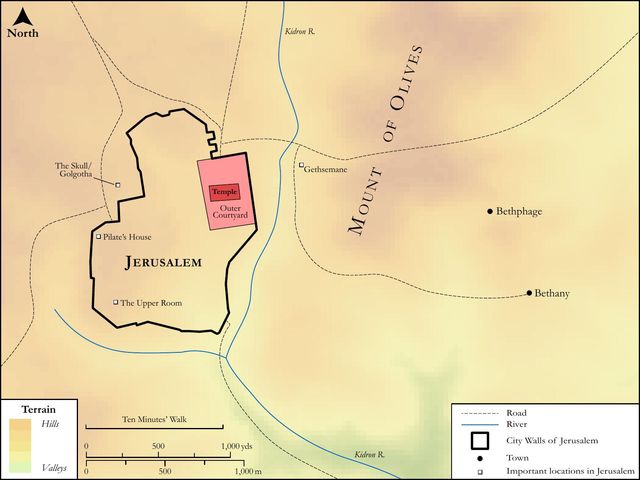
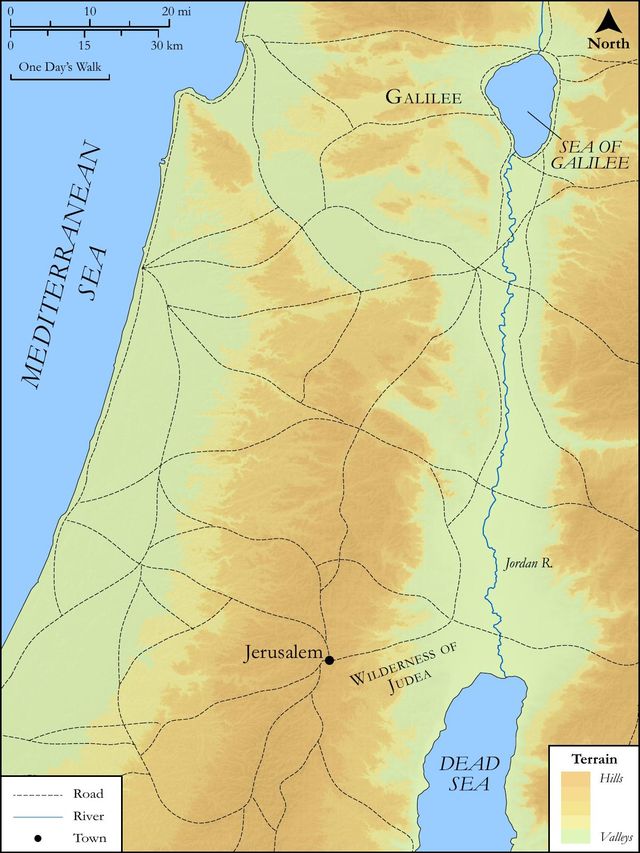
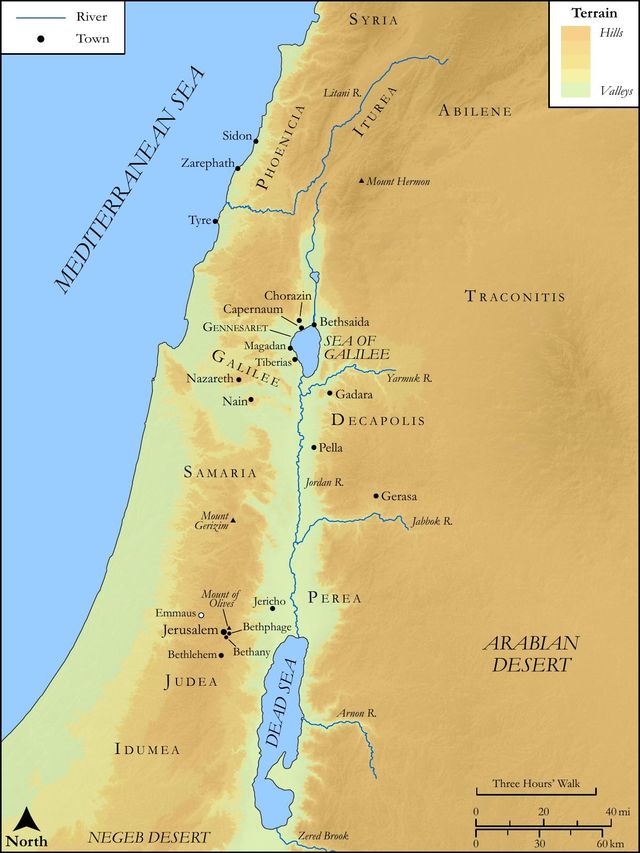
See on the biblical-era maps
Study this verse
Public-domain commentary
Matthew Henry
From his Commentary on the Whole Bible. Henry comments on passages, not single verses — this entry covers Luke 4:1–13. His four-level outline is real structure in the source text, so it is rendered as structure.
The last words of the foregoing chapter, that Jesus was the Son of Adam, bespeak him to be the seed of the woman; being so, we have here, according to the promise, breaking the serpent's head, baffling and foiling the devil in all his temptations, who by one temptation had baffled and foiled our first parents. Thus, in the beginning of the war, he made reprisals upon him, and conquered the conqueror.
In this story of Christ's temptation, observe,
I.How he was prepared and fitted for it.
He that designed him the trial furnished him accordingly; for though we know not what exercises may be before us, nor what encounters we may be reserved for, Christ did, and was provided accordingly; and God doth for us, and we hope will provide accordingly.
1.He was full of the Holy Ghost, who had descended on him like a dove. He had now greater measures of the gifts, graces, and comforts, of the Holy Ghost than ever before. Note, Those are well armed against the strongest temptations that are full of the Holy Ghost.
2.He was newly returned from Jordan, where he was baptized, and owned by a voice from heaven to be the beloved Son of God; and thus he was prepared for this combat. Note, When we have had the most comfortable communion with God, and the clearest discoveries of his favour to us, we may expect that Satan will set upon us (the richest ship is the pirate's prize), and that God will suffer him to do so, that the power of his grace may be manifested and magnified.
3.He was led by the Spirit into the wilderness, by the good Spirit, who led him as a champion into the field, to fight the enemy that he was sure to conquer. His being led into the wilderness,
(1.)Gave some advantage to the tempter; for there he had him alone, no friend with him, by whose prayers and advice he might be assisted in the hour of temptation. Woe to him that is alone! He might give Satan advantage, who knew his own strength; we may not, who know our own weakness.
(2.)He gained some advantage to himself, during his forty days' fasting in the wilderness. We may suppose that he was wholly taken up in proper meditation, and in consideration of his own undertaking, and the work he had before him; that he spent all his time in immediate, intimate, converse with his Father, as Moses in the mount, without any diversion, distraction, or interruption. Of all the days of Christ's life in the flesh, these seem to come nearest to the angelic perfection and the heavenly life, and this prepared him for Satan's assaults, and hereby he was fortified against them.
4.He continued fasting (Luk 4:2): In those days he did eat nothing. This fast was altogether miraculous, like those of Moses and Elijah, and shows him to be, like them, a prophet sent of God. It is probable that it was in the wilderness of Horeb, the same wilderness in which Moses and Elijah fasted. As by retiring into the wilderness he showed himself perfectly indifferent to the world, so by his fasting he showed himself perfectly indifferent to the body; and Satan cannot easily take hold of those who are thus loosened fRom. and dead to, the world and the flesh. The more we keep under the body, and bring it into subjection, the less advantage Satan has against us.
II.How he was assaulted by one temptation after another, and how he defeated the design of the tempter in every assault, and became more than a conqueror. During the forty days, he was tempted of the devil (Luk 4:2), not by an inward suggestion, for the prince of this world had nothing in Christ by which to inject any such, but by outward solicitations, perhaps in the likeness of a serpent, as he tempted our first parents. But at the end of the forty days he came nearer to him, and did as it were close with him, when he perceived that he was hungry, Luk 4:2. Probably, our Lord Jesus then began to look about among the trees, to see if he could find any thing that was eatable, whence the devil took occasion to make the following proposal to him.
1.He tempted him to distrust his Father's care of him, and to set up for himself, and shift for provision for himself in such a way as his Father had not appointed for him (Luk 4:3): If thou be the Son of God, as the voice from heaven declared, command this stone to be made bread. (1.) "I counsel thee to do it; for God, if he be thy Father, has forgotten thee, and it will be long enough ere he sends either ravens or angels to feed thee." If we begin to think of being our own carvers, and of living by our own forecast, without depending upon divine providence, of getting wealth by our might and the power of our hands, we must look upon it as a temptation of Satan's, and reject it accordingly; it is Satan's counsel to think of an independence upon God. (2.) "I challenge thee to do it, if thou canst; if thou dost not do it, I will say thou art not the Son of God; for John Baptist said lately, God is able of stones to raise up children to Abraham, which is the greater; thou therefore hast not the power of the Son of God, if thou dost not of stones make bread for thyself, when thou needest it, which is the less." Thus was God himself tempted in the wilderness: Can he furnish a table? Can he give bread? Psa 78:19, Psa 78:20.
Now, [1.] Christ yielded not to the temptation; he would not turn that stone into bread; no, though he was hungry; First, Because he would not do what Satan bade him do, for that would have looked as if there had been indeed a compact between him and the prince of the devils. Note, We must not do any thing that looks like giving place to the devil. Miracles were wrought for the confirming of faith, and the devil had no faith to be confirmed, and therefore he would not do it for him. He did his signs in the presence of his disciples (Joh 20:30), and particularly the beginning of his miracles, turning water into wine, which he did, that his disciples might believe on him (Joh 2:11); but here in the wilderness he had no disciples with him. Secondly, He wrought miracles for the ratification of his doctrine, and therefore till he began to preach he would not begin to work miracles. Thirdly, He would not work miracles for himself and his own supply, lest he should seem impatient of hunger, whereas he came not to please himself, but to suffer grief, and that grief among others; and because he would show that he pleased not himself, he would rather turn water into wine, for the credit and convenience of his friends, than stones into bread, for his own necessary supply. Fourthly, He would reserve the proof of his being the Son of God for hereafter, and would rather be upbraided by Satan with being weak, and not able to do it, than be persuaded by Satan to do that which it was fit for him to do; thus he was upbraided by his enemies as if he could not save himself, and come down from the cross, when he could have come down, but would not, because it was not fit that he should. Fifthly, He would not do any thing that looked like distrust of his Father, or acting separately from him, or any thing disagreeable to his present state. Being in all things made like unto his brethren, he would, like the other children of God, live in a dependence upon the divine Providence and promise, and trust him either to send him a supply into the wilderness or to lead him to a city of habitation where there was a supply, as he used to do (Psa 107:5-7), and in the mean time would support him, though he was hungry, as he had done these forty days past.
[2.]He returned a scripture-answer to it (Luk 4:4): It is written. This is the first word recorded as spoken by Christ after his instalment in his prophetical office; and it is a quotation out of the Old Testament, to show that he came to assert and maintain the authority of the scripture as uncontrollable, even by Satan himself. And though he had the Spirit without measure, and had a doctrine of his own to preach and a religion to found, yet it agreed with Moses and the prophets, whose writings he therefore lays down as a rule to himself, and recommends to us as a reply to Satan and his temptations. The word of God is our sword, and faith in that word is our shield; we should therefore be mighty in the scriptures, and go in that might, go forth, and go on, in our spiritual warfare, know what is written, for it is for our learning, for our use. The text of scripture he makes use of is quoted from Deu 8:3 : "Man shall not live by bread alone. I need not turn the stone into bread, for God can send manna for my nourishment, as he did for Israel; man can live by every word of God, by whatever God will appoint that he shall live by." How had Christ lived, lived comfortably, these last forty days? Not by bread, but by the word of God, by meditation upon that word, and communion with it, and with God in and by it; and in like manner he could live yet, though now he began to be hungry. God has many ways of providing for his people, without the ordinary means of subsistence; and therefore he is not at any time to be distrusted, but at all times to be depended upon, in the way of duty. If meat be wanting, God can take away the appetite, or give such degrees of patience as will enable a man even to laugh at destruction and famine (Job 5:22), or make pulse and water more nourishing than all the portion of the king's meat (Dan 1:12, Dan 1:13), and enable his people to rejoice in the Lord, when the fig-tree doth not blossom, Hab 3:17. She was an active believer who said that she had made many a meal's meat of the promises when she wanted bread.
2.He tempted him to accept from him the kingdom, which, as the Son of God, he expected to receive from his Father, and to do him homage for, Luk 4:5-7. This evangelist puts this temptation second, which Matthew had put last, and which, it should seem, was really the last; but Luke was full of it, as the blackest and most violent, and therefore hastened to it. In the devil's tempting of our first parents, he presented to them the forbidden fruit, first as good for food, and then as pleasant to the eyes; and they were overpowered by both these charms. Satan here first tempted Christ to turn the stones into bread, which would be good for food, and then showed him the kingdoms of the world and the glory of them, which were pleasant to the eyes; but in both these he overpowered Satan, and perhaps with an eye to that, Luke changes the order. Now observe,
(1.)How Satan managed this temptation, to prevail with Christ to become a tributary to him, and to receive his kingdom by delegation from him.
[1.]He gave him a prospect of all the kingdoms of the world in a moment of time, an airy representation of them, such as he thought most likely to strike the fancy, and seem a real prospect. To succeed the better, he took him up for this purpose into a high mountain; and, because we next after the temptation find Christ on the other side Jordan, some think it probable that it was to the top of Pisgah that the devil took him, whence Moses has a sight of Canaan. That it was but a phantasm that the devil here presented our Saviour with, as the prince of the power of the air, is confirmed by that circumstance which Luke here takes notice of, that it was done in a moment of time; whereas, if a man take a prospect of but one country, he must do it successively, must turn himself round, and take a view first of one part and then of another. Thus the devil thought to impose upon our Saviour with a fallacy - a deceptio visus; and, by making him believe that he could show him all the kingdoms of the world, would draw him into an opinion that he could give him all those kingdoms.
[2.]He boldly alleged that these kingdoms were all delivered to him that he had power to dispose of them and all their glory, and to give them to whomsoever he would, Luk 4:6. Some think that herein he pretended to be an angel of light, and that, as one of the angels that was set over the kingdoms, he had out-bought, or out-fought, all the rest, and so was entrusted with the disposal of them all, and, in God's name, would give them to him, knowing they were designed for him; but clogged with this condition, that he should fall down and worship him, which a good angel would have been so far from demanding that he would not have admitted it, no, not upon showing much greater things than these, as appears, Rev 19:10; Rev 22:9. But I rather take it that he claimed this power as Satan, and as delivered to him not by the Lord, but by the kings and people of these kingdoms, who gave their power and honour to the devil, Eph 2:2. Hence he is called the god of this world, and the prince of this world. It was promised to the Son of God that he should have the heathen for his inheritance, Psa 2:8. "Why," saith the devil, "the heathen are mine, are my subjects and votaries; but, however, they shall be thine, I will give them thee, upon condition that thou worship me for them, and say that they are the rewards which I have given thee, as others have done before thee (Hos 2:12), and consent to have and hold them by, fRom. and under, me."
[3.]He demanded of him homage and adoration: If thou wilt worship me, all shall be thine, Luk 4:7. First, He would have him worship him himself. Perhaps he does not mean so as never to worship God, but let him worship him in conjunction with God; for the devil knows, if he can but once come in a partner, he shall soon be sole proprietor. Secondly, He would indent with him, that when, according to the promise made to him, he had got possession of the kingdoms of this world, he should make no alteration of religions in them, but permit and suffer the nations, as they had done hitherto, to sacrifice to devils (Co1 10:20); that he should still keep up demon-worship in the world, and then let him take all the power and glory of the kingdoms if he pleased. Let who will take the wealth and grandeur of this earth, Satan has all he would have if he can but have men's hearts, and affections, and adorations, can but work in the children of disobedience; for then he effectually devours them.
(2.)How our Lord Jesus triumphed over this temptation. He gave it a peremptory repulse, rejected it with abhorrence (Luk 4:8): "Get thee behind me, Satan, I cannot bear the mention of it. What! worship the enemy of God whom I came to serve? and of man whom I came to save? No, I will never do it." Such a temptation as this was not to be reasoned with, but immediately refused; it was presently knocked on the head with one word, It is written, Thou shalt worship the Lord thy God; and not only so, but him only, him and no other. And therefore Christ will not worship Satan, nor, when he has the kingdoms of the world delivered to him by his Father, as he expects shortly to have, will he suffer any remains of the worship of the devil to continue in them. No, it shall be perfectly rooted out and abolished, wherever his gospel comes. He will make no composition with him. Polytheism and idolatry must go down, as Christ's kingdom gets up. Men must be turned from the power of Satan unto God, from the worship of devils to the worship of the only living and true God. This is the great divine law that Christ will re-establish among men, and by his holy religion reduce men to the obedience of, That God only is to be served and worshipped; and therefore whoever set up any creature as the object of religious worship, though it were a saint or an angel, or the virgin Mary herself, they directly thwart Christ's design, and relapse into heathenism.
3.He tempted him to be his own murderer, in a presumptuous confidence of his Father's protection, such as he had no warrant for. Observe,
(1.)What he designed in this temptation: If thou be the Son of God, cast thyself down, Luk 4:9.
[1.]He would have him seek for a new proof of his being the Son of God, as if that which his Father had given him by the voice from heaven, and the descent of the Spirit upon him, were not sufficient, which would have been a dishonour to God, as if he had not chosen the most proper way of giving him the assurance of it; and it would have argued a distrust of the Spirit's dwelling in him, which was the great and most convincing proof to himself of his being the Son of God, Heb 1:8, Heb 1:9.
[2.]He would have him seek a new method of proclaiming and publishing this to the world. The devil, in effect, suggests that it was in an obscure corner that he was attested to be the Son of God, among a company of ordinary people, who attended John's baptism, that his honours were proclaimed; but if he would now declare from the pinnacle of the temple, among all the great people who attend the temple-service, that he was the Son of God, and then, for proof of it, throw himself down unhurt, he would presently be received by every body as a messenger sent from heaven. Thus Satan would have him seek honours of his devising (in contempt of those which God had put on him), and manifest himself in the temple at Jerusalem; whereas God designed he should be more manifest among John's penitents, to whom his doctrine would be more welcome than to the priests.
[3.]It is probable he had some hopes that, though he could not throw him down, to do him the least mischief, yet, if he would but throw himself down, the fall might be his death, and then he should have got him finely out of the way.
(2.)How he backed and enforced this temptation. He suggested, It is written, Luk 4:10. Christ had quoted scripture against him; and he thought he would be quits with him, and would show that he could quote scripture as well as he. It has been usual with heretics and seducers to pervert scripture, and to press the sacred writings into the service of the worst of wickednesses. He shall give his angels charge over thee, if thou be his Son, and in their hands they shall bear thee up. And now that he was upon the pinnacle of the temple he might especially expect this ministration of angels; for, if he was the Son of God, the temple was the proper place for him to be in (Luk 2:46); and, if any place under the sun had a guard of angels constantly, it must needs be that, Psa 68:17. It is true, God has promised the protection of angels, to encourage us to trust him, not to tempt him; as far as the promise of God's presence with us, so far the promise of the angels' ministration goes, but no further: "They shall keep thee when thou goest on the ground, where thy way lies, but not if thou wilt presume to fly in the air."
(3.)How he was baffled and defeated in the temptation, Luk 4:12. Christ quoted Deu 6:16, where it is said, Thou shalt not tempt the Lord thy God, by desiring a sign for the proof of divine revelation, when he has already given that which is sufficient; for so Israel did, when they tempted God in the wilderness, saying, He gave us water out of the rock; but can he give flesh also? This Christ would be guilty of if he should say, "He did indeed prove me to be the Son of God, by sending the Spirit upon me, which is the greater; but can he also give his angels a charge concerning me, which is the less?"
III.What was the result and issue of this combat, Luk 4:13.
Our victorious Redeemer kept his ground, and came off a conqueror, not for himself only, but for us also.
1.The devil emptied his quiver: He ended all the temptation. Christ gave him opportunity to say and do all he could against him; he let him try all his force, and yet defeated him. Did Christ suffer, being tempted, till all the temptation was ended? And must not we expect also to pass all our trials, to go through the hour of temptation assigned us?
2.He then quitted the field: He departed from him. He saw it was to no purpose to attack him; he had nothing in him for his fiery darts to fasten upon; he had no blind side, no weak or unguarded part in his wall, and therefore Satan gave up the cause. Note, If we resist the devil, he will flee from us.
3.Yet he continued his malice against him, and departed with a resolution to attack him again; he departed but for a season, achri kairou - till a season, or till the season when he was again to be let loose upon him, not as a tempter, to draw him to sin, and so to strike at his head, which was what he now aimed at and was wholly defeated in; but as a persecutor, to bring him to suffer by Judas and the other wicked instruments whom he employed, and so to bruise his heel, which it was told him (Gen 3:15) he should have to do, and would do, though it would be the breaking of his own head. He departed now till that season came which Christ calls the power of darkness (Luk 22:53), and when the prince of this world would again come, Joh 14:30.
Historical interpretation
Nine Centuries of Reception
14 surviving comments on this verse. Each one is dated, so this reads as a timeline rather than a list.
Select a marker to jump to its quote. Markers stagger vertically where authors wrote within a few decades of each other.
Whence knowest thou, Satan, that those things are written? Hast thou read the Prophets, or the oracles of God? Thou hast read them indeed, but not that thyself mightest be the better for the reading, but that from the mere letter thou mightest slay them who are friends to the letter. (2 Cor. 3:6.) Thou knowest that if thou wert to speak from His other books, thou wouldest not deceive.
But mark how wily he is even in this testimony. For he would fain throw a slur upon the glory of the Saviour, as though He needed the assistance of angels, and would stumble were He not supported by their hands. But this was said not of Christ, but of the saints generally; He needs not the aid of angels, Who is greater than angels. But let this teach thee, Satan, that the angels would stumble did not God sustain them; and thou stumblest, because thou refusest to believe in Jesus Christ the Son of God. But why art thou silent as to what follows, Thou shalt walk upon the asp and the basilisk, (Ps. 91:13.) except that thou art the basilisk, thou art the dragon and the lion?
Therefore let us see what the devil says to the Lord from the Scriptures. "Scripture says, 'He gave his angels a command concerning you that they should raise you up in their hands, lest perhaps you strike your foot against a stone.' " See how crafty he is, even in the texts he quotes. For he wishes to diminish the Savior's glory, as if the Savior needed the help of angels. It is as if he would strike his foot unless he were supported by their hands. The devil takes his verse from Scripture and applies it to Christ. Yet it is written not of Christ but about the saints in general. Freely and in total confidence I contradict the devil. This passage cannot be applied to the person of Christ, for Christ does not need the help of angels. He is greater than the angels and obtained a better name than they by inheritance. "God never said to any of the angels, 'You are my Son; today I have begotten you.'"
(non occ.) The devil entered not into a contest with God, (for he durst not, and therefore said, If thou art the Son of God,) but he contended with man whom once he had power to deceive.
(non occ.) The enemy came to Him as man, but not finding in Him the marks of his ancient seed, he departed.
[Satan] set [Jesus] up on the pinnacle of the temple. Satan wanted him to suppose that he who was a man could become God, by means of the godly house, just as Satan had once made Adam suppose that he could become God by means of that tree. He brought him up to the mountain, as though he were in need. “To you will I give the kingdoms, if you will adore me.” When he changed his mode of cunning, he did not change the true One with it. In the beginning God made him, and, when complete, he was in need and a worshiper. But Satan became blind in the arrogance of his worship, because of all that he had acquired, and for this reason he was punished even more. Because Satan did not recognize the One who knew him intimately, our Lord addressed him by his name, Satan. But he did not know how he should address our Lord.Therefore he said to him, “Fall down from here, for it is written, ‘They will guard you lest you stumble.’ ” Tempter, if it is concerning him that the psalm is fulfilled, is it not also written there, “With his wings, that he may deliver you”? It is not possible for a bird to fall, for the air beneath its wings is like the earth. Is it not also written, “You will tread on the serpent and the lion"? Satan studied only those passages from Scriptures that were convenient to him and omitted those which were harmful to him. The heretics are like this too. They appropriate from Scripture those passages that suit their erroneous teaching and omit those that refute their errors, thereby demonstrating that they are disciples of this master.
(ubi sup.) In lawful contests the battle is terminated either when the adversary surrenders of his own accord to the conqueror, or is defeated in three falls, according to the rules of the art of fighting. Hence it follows, And all the temptation being completed, &c.
You see, ancient errors are undone in Christ’s footprints, and the snares, first of the stomach, second of sexual sin, and third of ambition, are loosed. For Adam was enticed by food. Because he willingly transgressed in the matter of the forbidden tree, he also was charged with heedless ambition, for he desired to be like the Godhead. Therefore the Lord first remitted the debt of the ancient wrong, in order that, having shaken off the yoke of captivity, we may learn to overcome our faults with the help of the Scriptures.… The devil shakes the whole world with cunning deceit, in order to corrupt people, and fights with all the enticements of this age. You must beware of his flattery all the more. Food had not persuaded Eve, nor had the forgetfulness of the commands deprived her. If she had been willing to worship the Lord alone, she would not have sought what was not due to her. So a remedy is given, which blunts the dart of ambition, so that we serve the Lord alone. Pious devotion lacks ambition.
The next weapon he uses is that of boasting, which always causes the offender to fall down; for they who love to boast of the glory of their virtue descend from the stand and vantage ground of their good deeds. Hence it is said, And he led him to Jerusalem.
It is the fate of boasting, that while a man thinks he is climbing higher, he is by his pretension to lofty deeds brought low. Hence it follows, And he said unto him, If thou art the Son of God, throw thyself down.
That is truly the devil's language, which seeks to cast down the soul of man from the high ground of its good deeds, while he shows at the same time both his weakness and malice, for he can injure no one that does not first cast himself down. For he who forsaking heavenly things pursues earthly, rushes as it were wilfully down the self-sought precipice of a falling life. As soon then as the devil perceived his dart blunted, he who had subdued all men to his own power, began to think he had to deal with more than man. But Satan transforms himself into an angel of light, and often from the Holy Scriptures weaves his mesh for the faithful: hence it follows, It is written, He shall give, &c.
Let not the heretic entrap thee by bringing examples from the Scriptures. The devil makes use of the testimony of the Scriptures not to teach but to deceive.
But the Lord, to prevent the thought that those things which had been prophesied of Him were fulfilled according to the devil's will, and not by the authority of His own divine power, again so foils his cunning, that he who had alleged the testimony of Scripture, should by Scripture himself be overthrown. Hence it follows, And Jesus answering said, It is said, Thou shalt not tempt the Lord thy God.
He would not have said that all the temptation was ended, had there not been in the three temptations which have been described the materials for every crime; for the causes of temptations are the causes of desire, namely, the delight of the flesh, the pomp of vain-glory, greediness of power.
You see then that the devil is not obstinate on the field, is wont to give way to true virtue; and if he ceases not to hate, he yet dreads to advance, for so he escapes a more frequent defeat. As soon then as he heard the name of God, he retired (it is said) for a season, for afterwards he comes not to tempt, but to fight openly.
For it is of the devil to cast one's self into dangers, and try whether God will rescue us.
But mark how the Lord, instead of being troubled, condescends to dispute from the Scriptures with the wicked one, that thou, as far as thou art able, mightest become like Christ. The devil knew the arms of Christ, beneath which he sunk. Christ took him captive by meekness, He overcame him by humility. Do thou also, when thou seest a man who has become a devil coming to meet thee, subdue him in like manner. Teach thy soul to conform its words to those of Christ. For as a Roman judge, who on the bench refuses to hear the reply of one who knows not how to speak as he does; so also Christ, except thou speakest after His manner, will neither hear thee nor protect thee.
Still the pinnacle stands, outlasting the temple’s destruction,
For the corner raised up from that stone which the builders rejected
Will remain throughout all ages forever and ever.
Now it is head of the temple and holds the new stones together.
He tempts through vainglory when he says: "If you are the Son of God, cast yourself down from hence." By the same means by which the ancient enemy tempted our first parent through vainglory when he said "You shall be as gods," so he now tempts the second Adam: but by the same means by which he boasted of having conquered the first man, he is conquered by the second man.
(lib. ad. piet. ex. 12.) Or the devil had prompted Christ in the desert to prefer the things of the world to the love of God. The Lord commanded him to leave Him, (which itself was a mark of Divine love.) It was afterwards then enough to make Christ appear the false advocate of love to His neighbours, and therefore while He was teaching the paths of life, the devil stirred up the Gentiles and Pharisees to lay traps for Him that He might be brought to hate them. But the Lord, from the feeling of love which He had towards them, exhorted, reproved, ceased not to bestow mercy upon them.
(ut sup.) But the reason why one Evangelist places this event first, and another that, is because vain-glory and covetousness give birth in turn to one another.
But some one may ask how this injunction agrees with the word of the Apostle, which says, Beloved, serve one another. (Gal. 5:13.) In the Greek, δουλεία signifies a common service, (i. e. given either to God or man,) according to which we are bid to serve one another; but λατρεία is the service due to the worship of the Deity, with which we are bid to serve God alone.
For it is written that he has commanded his angels concerning you, to keep you, and that they will lift you up in their hands, so that you will not strike your foot against a stone. We read this in the ninetieth Psalm. Indeed, the prophecy there is not about Christ, but about a holy person. Therefore, the devil interprets the Scriptures wrongly. Certainly, if he had truly known it was written about the Savior, he should have quoted what follows in the same Psalm against himself: “You will tread on the asp and the basilisk, and you will trample the lion and the dragon” (Psalm XC). He speaks of the help of angels as if to a weak person, but he is silent about the trampling of himself, like a trickster.
Or, having tempted Him in the desert with pleasure, he retires from Him until the crucifixion, when he was about to tempt Him with sorrow.
Continue studying Luke 4:10 across the web’s major study libraries — every link below opens this exact verse, chapter, or book on the destination site.
Read & Compare
 BibleGatewayThis verse in more than 200 translations and 70 languages.
 Bible.comThe YouVersion reader — hundreds of translations, reading plans, and highlights.
 ESV.orgCrossway's official English Standard Version reader.
 NET BibleThe NET translation with 60,000+ translators' notes on every rendering decision.
 STEP BibleTyndale House's free study tool — original text, vocabulary, and scholarly resources.
 BibliaLogos Bible Software's free web reader.
 USCCBThe New American Bible (Revised Edition) with the U.S. bishops' study notes.
Commentaries
 BibleHub CommentariesDozens of classic commentaries on this verse, gathered on one page.
 StudyLightMore than 100 commentary sets — the largest collection on the web.
 BibleRefPlain-English commentary on what this verse means, verse by verse.
 Enduring WordDavid Guzik's free commentary on this chapter, widely used by Bible teachers.
 Bible Study ToolsVerse commentary alongside Greek and Hebrew study aids.
Original Language & Research
- BibleHub InterlinearThe verse word by word — original language, transliteration, and English.
- BibleHub LexiconEvery word's original-language definition and Strong's entry.
 Blue Letter BibleDeep-study tools — Strong's numbers, concordance, and word studies.
 CNTR CollationThe earliest Greek manuscripts of this verse, collated letter by letter.
Sermons, Hymns & Audio


TrulyRandomVerse is not affiliated with these sites and doesn’t control their content. They’re linked because they’re genuinely useful.
Summary
Luke 4:10, a pivotal verse in the wilderness temptation narrative, records the devil's manipulative quotation of Scripture to entice Jesus to presumptuously test God's protection. This moment underscores the cunning nature of spiritual deception, the absolute authority of God's Word, and the critical distinction between genuine faith and reckless presumption, setting the stage for Jesus' unwavering obedience to the Father.
Context
ShowHideLiterary Context
This verse is situated within the second of three temptations Jesus faces from the devil in the wilderness, immediately following the devil's first failed attempt to tempt Jesus with food after His forty-day fast in Luke 4:1-4. Having failed to tempt Jesus through physical hunger, the devil shifts tactics, now challenging Jesus' divine Sonship by urging Him to perform a spectacular public display of power. The temptation to cast Himself down from the temple pinnacle, relying on divine intervention, is a direct assault on Jesus' trust and obedience, culminating in Jesus' definitive counter-quote from Deuteronomy 6:16 in Luke 4:12, which exposes the devil's distortion of Scripture and reaffirms Jesus' commitment to honoring God.
Historical & Cultural Context
The setting for this temptation is the pinnacle of the Jerusalem temple, a highly visible and sacred site. For a Jewish Messiah, a miraculous descent from such a prominent location would have been a profoundly significant and persuasive sign, potentially fulfilling popular expectations of a Messiah who would perform wonders. The devil's quote from Psalm 91 would have been familiar to Jesus and His Jewish audience, as it speaks of God's protective care over those who trust in Him. However, the devil's selective quotation and misapplication of the Psalm reflect a common rabbinic practice of quoting Scripture, but here it is twisted to serve a deceptive purpose, highlighting the importance of understanding the full context and intent of the biblical text.
Key Themes
ShowHideLuke 4:10 contributes significantly to several overarching themes in Luke's Gospel and the broader biblical narrative. It highlights the theme of Jesus' Obedience and Authority, demonstrating His unwavering commitment to God's will despite intense temptation, contrasting sharply with Israel's failures in the wilderness (e.g., Numbers 14). It also powerfully illustrates the Nature of Temptation and Spiritual Warfare, revealing the devil's insidious strategy of twisting truth and appealing to pride or self-glorification, a theme echoed in other New Testament warnings against deception (e.g., 2 Corinthians 11:14). Furthermore, the passage underscores the Supremacy and Proper Interpretation of Scripture, as Jesus' victory over temptation is achieved by rightly wielding the Word of God against its misuse, emphasizing the need for diligent study and contextual understanding of divine revelation (2 Timothy 3:16-17).
Exposition and Analysis
ShowHideKey Word Analysis
ShowHideThis verb, in its perfect passive indicative form (gegraptai), signifies an action completed in the past with continuing results. It underscores the enduring authority and established truth of Scripture. When the devil says "it is written," he acknowledges the divine origin and power of the text, even as he attempts to pervert its meaning. This phrase is consistently used by Jesus throughout His ministry to appeal to the settled, unchangeable truth of God's Word.
Derived from "en" (in) and a root meaning "end" or "purpose," this word means "to enjoin," "to command," or "to give a charge." It conveys the idea of a specific instruction or commission. Here, it highlights that angels are not autonomous agents but operate under divine directive. God gives them a specific "charge" or command regarding the protection of His people, implying a purposeful, ordered, and authoritative ministry, not a random or unconditional one.
This compound verb, formed from "dia" (through, thoroughly) and "phylassō" (to guard, watch), means "to guard thoroughly" or "to protect completely." It emphasizes a comprehensive and vigilant form of preservation. The devil uses this word to imply an absolute, unconditional protection, suggesting that no harm could possibly come to Jesus if He were to jump, thus presuming upon God's thorough guardianship outside of His will.
Verse Breakdown
ShowHide"For it is written,"
This introductory phrase, "For it is written" (γέγραπται γάρ, gegraptai gar), is the devil's direct quotation of Psalm 91:11. The Greek perfect tense of "written" (γέγραπται) implies a past action with continuing, authoritative results, indicating that the Scripture stands as an unchangeable and binding truth. The devil uses this phrase to lend an air of divine authority to his temptation, attempting to cloak his deception in the guise of biblical truth.
"He shall give his angels charge over thee,"
This clause states that God (implied subject, "He") will issue a command or commission (enteleitai) to His angels (angelous) concerning Jesus ("over thee"). The phrase affirms the reality of angelic ministry, where angels are dispatched by God to fulfill His purposes. The devil quotes this to suggest that Jesus is entitled to special, miraculous intervention and protection simply because He is the Son of God, implying that God's protection is a blank check for any action, however reckless.
"to keep thee:"
This final phrase, "to keep thee" (diaphylaxai se), specifies the purpose of the angelic charge: to thoroughly guard and protect Jesus. The verb diaphylaxai (from diaphylássō) implies a complete and thorough safeguarding. By quoting this, the devil attempts to convince Jesus that He is immune to harm, even if He were to deliberately put Himself in danger. However, the devil strategically omits the qualifying phrase from Psalm 91:11-12 ("in all thy ways"), which implies protection within the bounds of God's will and obedient living, not for presumptuous acts.
Literary Devices
ShowHideThe primary literary device at play in Luke 4:10 is Quotation, specifically the devil's quotation of Psalm 91:11. However, this is not a straightforward quotation but a powerful example of Misquotation or Distortion, as the devil deliberately omits the crucial qualifying phrase "in all thy ways" from Psalm 91:11 and entirely skips Psalm 91:12, which speaks of angels bearing one up "lest thou dash thy foot against a stone." By removing the context of walking in God's "ways" (i.e., obedience), the devil transforms a promise of providential care into an invitation for presumptuous testing. This highlights the Irony of the devil using God's own Word against Him, attempting to undermine faith through a twisted appeal to it. The entire interaction serves as a Temptation Narrative, showcasing the cunning and deceptive nature of evil, which often cloaks itself in spiritual language and appeals to legitimate desires (like divine protection) in illegitimate ways.
Theological and Thematic Connections
ShowHideLuke 4:10 stands as a profound theological statement on the nature of divine protection and the proper use of Scripture. While God unequivocally promises to guard His faithful, this verse clarifies that such protection is not a license for reckless or presumptuous acts that test God's faithfulness. The devil's manipulation of Psalm 91 underscores the critical importance of understanding the full counsel of God's Word, rather than isolating verses to support a predetermined agenda. True faith trusts God's sovereignty and timing, submitting to His will rather than demanding miraculous intervention for self-serving or prideful purposes. This temptation reveals that even the most sacred texts can be weaponized by spiritual adversaries if not handled with integrity and discernment.
Reflection and Application
ShowHideLuke 4:10 offers timeless lessons for believers navigating the complexities of faith and life. In an age where information is abundant and often decontextualized, the devil's tactic of misquoting Scripture remains a potent warning. We are called not merely to know verses but to understand their context, the broader narrative of redemption, and the character of God they reveal. This requires diligent study, humble submission to the Holy Spirit's guidance, and a community of discerning believers. Furthermore, this passage challenges us to examine our own motives when we seek God's intervention. Do we genuinely trust His wisdom and timing, or do we subtly attempt to manipulate Him, demanding a sign or a specific outcome? True faith is not about testing God, but about resting in His sovereign care, even when His ways are not our ways. It reminds us that while God is our protector, we are not to create unnecessary dangers or act recklessly, presuming upon His grace. Instead, we are to walk in obedience, trusting that His protection covers us in "all our ways" that align with His will.
Questions for Reflection
ShowHideFAQ
ShowHideWhy did the devil quote Scripture if he intended to deceive Jesus?
ShowHideThe devil quoted Scripture precisely because he intended to deceive Jesus. By using the authoritative Word of God, he sought to lend credibility to his temptation, making it appear as if his challenge was divinely sanctioned or even a logical extension of God's promises. This tactic is a classic form of spiritual deception: twisting truth to promote falsehood. The devil knew Jesus honored the Scriptures, so he attempted to use them as a weapon, hoping to trick Jesus into presuming upon God's protection rather than trusting Him in obedience. This highlights the insidious nature of temptation, which often cloaks itself in spiritual language and appeals to legitimate desires (like divine protection) but with illegitimate motives or applications, as seen in 2 Corinthians 11:14.
Christ-Centered Fulfillment
ShowHideLuke 4:10, though spoken by the deceiver, ultimately foreshadows and highlights the perfect obedience of Christ, which stands in stark contrast to the devil's manipulative intent. While the devil sought to tempt Jesus into a presumptuous act of self-glorification, Jesus' ultimate victory over temptation, not just here but throughout His life, culminates in His perfect submission to the Father's will, even unto death on the cross. The "charge" given to angels to "keep" Him, as quoted by the devil, finds its deepest fulfillment not in a miraculous rescue from a temple leap, but in the Father's providential care for His Son through suffering and death, leading to resurrection. Jesus did not need to test God; He perfectly trusted God. His refusal to demand a sign or to force God's hand demonstrates His profound faith and humility, setting the pattern for all who would follow Him. The true "keeping" of Jesus was not by avoiding the path of suffering, but by enduring it, knowing that the Father would ultimately raise Him up, fulfilling the greater promise of salvation for humanity (Philippians 2:8-9). His steadfastness in the face of this temptation is a testament to His divine nature and His unwavering commitment to His mission as the obedient Son, who came not to be served, but to serve, and to give His life as a ransom for many (Mark 10:45).