


John 6:19
Bible text: King James Version (1769 Blayney text) · Public domain
Bible text: King James Version with Strong's numbers · Public domain
Bible text: Berean Standard Bible · Public domain
Bible text: American Standard Version (1901) · Public domain
Bible text: World English Bible, Messianic edition · Public domain
Bible text: Geneva Bible (1599) · Public domain
Bible text: Young's Literal Translation · Public domain
- ἐληλακότεςelēlakotesHaving rowedG1643V-RAP-NPMVerb Perfect Active Participle Nominative Plural Masculine
- οὖνounthereforeG3767CONJConjunction
- ὡςhōsaboutG5613PRTParticle or Disjunctive
- σταδίουςstadiousstadiaG4712N-APMNoun Accusative Plural Masculine
- εἴκοσιeikositwentyG1501A-NUIAdjective
- πέντεpentefiveG4002A-NUIAdjective
- ἢēorG2228CONJConjunction
- τριάκονταtriakontathirtyG5144A-NUIAdjective
- θεωροῦσινtheōrousinthey seeG2334V-PAI-3PVerb Present Active Indicative 3rd Plural
- τὸνton<the>G3588T-ASMDefinite article Accusative Singular Masculine
- ἸησοῦνIēsounJesusG2424N-ASM-PNoun Accusative Singular Masculine Individual
- περιπατοῦνταperipatountawalkingG4043V-PAP-ASMVerb Present Active Participle Accusative Singular Masculine
- ἐπὶepionG1909PREPPreposition
- τῆςtēstheG3588T-GSFDefinite article Genitive Singular Feminine
- θαλάσσηςthalassēsseaG2281N-GSFNoun Genitive Singular Feminine
- καὶkaiandG2532CONJConjunction
- ἐγγὺςengusnearG1451PREPPreposition
- τοῦtoutheG3588T-GSNDefinite article Genitive Singular Neuter
- πλοίουploiouboatG4143N-GSNNoun Genitive Singular Neuter
- γινόμενονginomenoncomingG1096V-PNP-ASMVerb Present Middle Or Passive Deponent Participle Accusative Singular Masculine
- καὶkaiandG2532CONJConjunction
- ἐφοβήθησανephobēthēsanthey were frightenedG5399V-AOI-3PVerb Aorist Passive Deponent Indicative 3rd Plural
English is a literal word-by-word gloss of the Greek, not the KJV's wording. Why?
This is the original text the KJV's translators worked from — each Greek word with its own literal English meaning in this verse, prepared by scholars at Tyndale House, Cambridge. The KJV translates whole sentences, not word by word, so its wording differs: one Greek word can become several English words, and the KJV may choose “charity” where the gloss reads “love”. Both are faithful — they answer different questions. For the KJV's own rendering, switch to the KJV text.
Details
See on the biblical-era maps
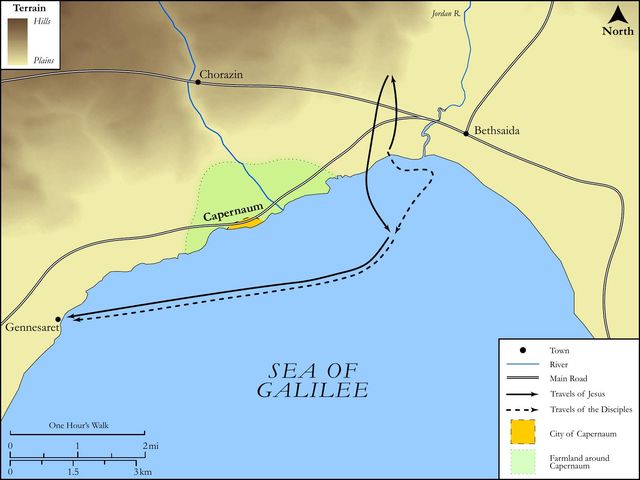
Study this verse
Public-domain commentary
Matthew Henry
From his Commentary on the Whole Bible. Henry comments on passages, not single verses — this entry covers John 6:15–21. His four-level outline is real structure in the source text, so it is rendered as structure.
Here is, I. Christ's retirement from the multitude.
1.Observe what induced him to retire; because he perceived that those who acknowledged him to be that prophet that should come into the world would come, and take him by force, to make him a king, Joh 6:15. Now here we have an instance,
(1.)Of the irregular zeal of some of Christ's followers; nothing would serve but they would make him a king. Now,
[1.]This was an act of zeal for the honour of Christ, and against the contempt which the ruling part of the Jewish church put upon him. They were concerned to see so great a benefactor to the world so little esteemed in it; and therefore, since royal titles are counted the most illustrious, they would make him a king, knowing that the Messiah was to be a king; and if a prophet, like Moses, then a sovereign prince and lawgiver, like him; and, if they cannot set him up upon the holy hill of Zion, a mountain in Galilee shall serve for the present. Those whom Christ has feasted with the royal dainties of heaven should, in return for his favour, make him their king, and set him upon the throne in their souls: let him that has fed us rule us. But,
[2.]It was an irregular zeal; for First, It was grounded upon a mistake concerning the nature of Christ's kingdom, as if it were to be of this world, and he must appear with outward pomp, a crown on his head, and an army at his foot; such a king as this they would make him, which was as great a disparagement to his glory as it would be to lacquer gold or paint a ruby. Right notions of Christ's kingdom would keep us to right methods for advancing it. Secondly, It was excited by the love of the flesh; they would make him their king who could feed them so plentifully without their toil, and save them from the curse of eating their bread in the sweat of their face. Thirdly, It was intended to carry on a secular design; they hoped this might be a fair opportunity of shaking off the Roman yoke, of which they were weary. If they had one to head them who could victual an army cheaper than another could provide for a family, they were sure of the sinews of the war, and could not fail of success, and the recovery of their ancient liberties. Thus is religion often prostituted to a secular interest, and Christ is served only to serve a turn, Rom 16:18. Vix quaritur Jesus properter Jesusm, sed propter aliud - Jesus is usually sought after for something else, not for his own sake. - Augustine. Nay, Fourthly, It was a tumultuous, seditious attempt, and a disturbance of the public peace; it would make the country a seat of war, and expose it to the resentments of the Roman power. Fifthly, It was contrary to the mind of our Lord Jesus himself; for they would take him by force, whether he would or no. Note, Those who force honours upon Christ which he has not required at their hands displease him, and do him the greatest dishonour. Those that say I am of Christ, in opposition to those that are of Apollos and Cephas (so making Christ the head of a party), take him by force, to make him a king, contrary to his own mind.
(2.)Here is an instance of the humility and self-denial of the Lord Jesus, that, when they would have made him a king, he departed; so far was he from countenancing the design that he effectually quashed it. Herein he has left a testimony,
[1.]Against ambition and affectation of worldly honour, to which he was perfectly mortified, and has taught us to be so. Had they come to take him by force and make him a prisoner, he could not have been more industrious to abscond than he was when they would make him a king. Let us not then covet to be the idols of the crowd, nor be desirous of vainglory.
[2.]Against faction and sedition, treason and rebellion, and whatever tends to disturb the peace of kings and provinces. By this it appears that he was no enemy to Caesar, nor would have his followers be so, but the quiet in the land; that he would have his ministers decline every thing that looks like sedition, or looks towards it, and improve their interest only for their work's sake.
2.Observe whither he retired: He departed again into a mountain, eis to oros - into the mountain, the mountain where he had preached (Joh 6:3), whence he came down into the plain, to feed the people, and then returned to it alone, to be private. Christ, though so useful in the places of concourse, yet chose sometimes to be alone, to teach us to sequester ourselves from the world now and then, for the more free converse with God and our own souls; and never less alone, says the serious Christian, than when alone. Public services must not jostle out private devotions.
II.Here is the disciples' distress at sea.
They that go down to the sea in ships, these see the works of the Lord, for he raiseth the stormy wind, Psa 107:23, Psa 107:24. Apply this to these disciples.
1.Here is their going down to the sea in a ship (Joh 6:16, Joh 6:17): When even was come, and they had done their day's work, it was time to look homeward, and therefore they went aboard, and set sail for Capernaum. This they did by particular direction from their Master, with design (as it should seem) to get them out of the way of the temptation of countenancing those that would have made him a king.
2.Here is the stormy wind arising and fulfilling the word of God. They were Christ's disciples, and were now in the way of their duty, and Christ was now in the mount praying for them; and yet they were in this distress. The perils and afflictions of this present time may very well consist with our interest in Christ and his intercession. They had lately been feasted at Christ's table; but after the sun-shine of comfort expect a storm.
(1.)It was now dark; this made the storm the more dangerous and uncomfortable. Sometimes the people of God are in trouble, and cannot see their way out; in the dark concerning the cause of their trouble, concerning the design and tendency of it, and what the issue will be.
(2.)Jesus was not come to them. When they were in that storm (Mat 8:23, etc.) Jesus was with them; but now their beloved had withdrawn himself, and was gone. The absence of Christ is the great aggravation of the troubles of Christians.
(3.)The sea arose by reason of a great wind. It was calm and fair when they put to sea (they were not so presumptuous as to launch out in a storm), but it arose when they were at sea. In times of tranquillity we must prepare for trouble, for it may arise when we little think of it. Let it comfort good people, when they happen to be in storms at sea, that the disciples of Christ were so; and let the promises of a gracious God balance the threats of an angry sea. Though in a storm, and in the dark, they are no worse off than Christ's disciples were. Clouds and darkness sometimes surround the children of the light, and of the day.
3.Here is Christ's seasonable approach to them when they were in this peril, Joh 6:19. They had rowed (being forced by the contrary winds to betake themselves to their oars) about twenty-five or thirty furlongs. The Holy Spirit that indicted this could have ascertained the number of furlongs precisely, but this, being only circumstantial, is left to be expressed according to the conjecture of the penman. And, when they were got off a good way at sea, they see Jesus walking on the sea. See here,
(1.)The power Christ has over the laws and customs of nature, to control and dispense with them at his pleasure. It is natural for heavy bodies to sink in water, but Christ walked upon the water as upon dry land, which was more than Moses's dividing the water and walking through the water.
(2.)The concern Christ has for his disciples in distress: He drew nigh to the ship; for therefore he walked upon the water, as he rides upon the heavens, for the help of his people, Deu 33:26. He will not leave them comfortless when they seem to be tossed with tempests and not comforted. When they are banished (as John) into remote places, or shut up (as Paul and Silas) in close places, he will find access to them, and will be nigh them.
(3.)The relief Christ gives to his disciples in their fears. They were afraid, more afraid of an apparition (for so they supposed him to be) than of the winds and waves. It is more terrible to wrestle with the rulers of the darkness of this world than with a tempestuous sea. When they thought a demon haunted them, and perhaps was instrumental to raise the storm, they were more terrified than they had been while they saw nothing in it but what was natural. Note,
[1.]Our real distresses are often much increased by our imaginary ones, the creatures of our own fancy.
[2.]Even the approaches of comfort and deliverance are often so misconstrued as to become the occasions of fear and perplexity. We are often not only worse frightened than hurt, but then most frightened when we are ready to be helped. But, when they were in this fright, how affectionately did Christ silence their fears with that compassionate word (Joh 6:20), It is I, be not afraid! Nothing is more powerful to convince sinners than that word, I am Jesus whom thou persecutest; nothing more powerful to comfort saints than this, "I am Jesus whom thou lovest; it is I that love thee, and seek thy good; be not afraid of me, nor of the storm." When trouble is nigh Christ is nigh.
4.Here is their speedy arrival at the port they were bound for, Joh 6:17.
(1.)They welcomed Christ into the ship; they willingly received him. Note, Christ's absenting himself for a time is but so much the more to endear himself, at his return, to his disciples, who value his presence above any thing; see Sol 3:4.
(2.)Christ brought them safely to the shore: Immediately the ship was at the land whither they went. Note,
[1.]The ship of the church, in which the disciples of Christ have embarked themselves and their all, may be much shattered and distressed, yet it shall come safe to the harbour at last; tossed at sea, but not lost; cast down, but not destroyed; the bush burning, but not consumed.
[2.]The power and presence of the church's King shall expedite and facilitate her deliverance, and conquer the difficulties which have baffled the skill and industry of all her other friends. The disciples had rowed hard, but could not make their point till they had got Christ in the ship, and then the work was done suddenly. If we have received Christ Jesus the Lord, have received him willingly, though the night be dark and the wind high, yet we may comfort ourselves with this, that we shall be at shore shortly, and are nearer to it than we think we are. Many a doubting soul is fetched to heaven by a pleasing surprise, or ever it is aware.
Historical interpretation
Seven Centuries of Reception
10 surviving comments on this verse. Each one is dated, so this reads as a timeline rather than a list.
Select a marker to jump to its quote. Markers stagger vertically where authors wrote within a few decades of each other.
The Jews under the guidance of Moses passed over the Red Sea, but that case is widely different from this. He did all with prayer and as a servant, but Christ with absolute power. There when the south wind blew, the water yielded so as to make them pass over on dry land, but here the miracle was greater. For the sea retaining its proper nature so bare its Lord upon its surface, thus testifying to the Scripture which saith, "Who walketh upon the sea as upon a pavement." (Job ix. 8.)
(Hom. xlii. 3) See what the belly can do. They care no more for the violation of the Sabbath; all their zeal for God is fled, now that their bellies are filled: Christ has become a Prophet, and they wish to enthrone Him as king. But Christ makes His escape; to teach us to despise the dignities of the world. He dismisses His disciples, and goes up into the mountain.— (Hom. xliii. 1). These, when their Master had left them, went down in the evening to the sea; as we read; And when even was now come, His disciples went down unto the sea. They waited till evening, thinking He would come to them; and then, as He did not come, delayed no longer searching for Him, but in the ardour of love, entered into a ship, and went over the sea toward Capernaum. They went to Capernaum thinking they should find Him there.
(Hom. xlii. 1) The mention of the time is not accidental, but meant to show the strength of their love. They did not mate excuses, and say, It is evening now, and night is coming on, but in the warmth of their love went into the ship. And now many things alarm them: the time, And it was now dark; and the weather, as we read next, And the sea arose by reason of a great wind that blew; their distance from land, So when they had rowed about five and twenty or thirty furlongs.
(Hom. xliii. 1) And at last He appears quite unexpectedly: They see Jesus walking upon the sea, drawing nigh. He reappears after His retirement, teaching them what it is to be forsaken, and stirring them to greater love; His reappearance manifesting His power. They were disturbed, were afraid, it is said. Our Lord comforts them: But He saith unto them, It is I, be not afraid.
(Hom. xliii. s. 1) He appeared to them in this way, to show His power; for He immediately calmed the tempest: Then they wished to receive Him into the ship; and immediately the ship was at the land, whither they went. So great was the calm, He did not even enter the ship, in order to work a greater miracle, and to show his Divinity more clearlyg.
(Hom. xliii. 1) Jesus does not show Himself to the crowd walking on the sea, such a miracle being too much for them to hear. Nor even to the disciples did He show Himself long, but disappeared immeditately.
(Hom. xliii. 1) Or take another explanation. This miracle seems to me to be a different one, from the one given in Matthew: for there they do not receive Him into the ship immediately, whereas here they doh: and there the storm lasts for some time, whereas here as soon as He speaks, there is a calm. He often repeats the same miracle in order to impress it on men's minds.
Wherefore then doth Christ let them go, and not show Himself? And again, wherefore doth He show Himself walking alone upon the sea? By the first He teacheth them how great an evil it is to be forsaken by Him, and maketh their longing greater; by the second, again, He showeth forth His power. For as in His teaching they heard not all in common with the multitude, so in the case of the miracles they saw them not all with the mass of people, since it was needful that they who were about to receive in charge the presidency of the world, should have somewhat more than the rest.
He allowed the storm to arise, that they might ever seek Him; He stilled the storm, that He might make known to them His power; He went not up into the ship, that He might make the marvel greater.
To the multitude He showeth not Himself walking upon the sea, for the miracle was too great to suit their infirmity. Indeed, even by the disciples He was not seen long doing this, but He appeared, and at once retired.
Christ does not appear to those in the boat immediately after they set sail or at the onset of danger but only when they are far away from the shore. For the grace of our Savior does not come to us when our tribulations begin but when our fear is at its height and the danger shows itself to be great—when we are found, so to say, in the midst of the waves of affliction. Then, Christ appears unexpectedly and removes our fear and frees us from all danger. By his ineffable power he changes horror into joy, and as it were, calms the storm.… When Christ appears and looks on us, we shall effortlessly succeed even against our hope. And we who are in danger because of our distance from Christ shall no longer have to labor to accomplish what is helpful for us when he is present. Christ is our deliverance from all danger and the accomplishment of achievements beyond hope to those who receive him.
It can also be asked why, when the disciples were laboring on the sea, the Lord stood on the shore after His resurrection, though before His resurrection He had walked on the waves of the sea before His disciples. The reason for this matter is quickly understood if the cause that was then present is considered. For what does the sea signify except the present age, which dashes itself against the tumults of affairs and the waves of corruptible life? What is figured by the solidity of the shore except that perpetuity of eternal rest? Because the disciples were still amid the waves of mortal life, they were laboring on the sea. But because our Redeemer had already passed beyond the corruption of the flesh, after His resurrection He was standing on the shore.
(in v. cap. Joan.) The way of speaking we use, when we are in doubt; about five and twenty, we say, or thirty.
This ship, however, does not carry an idle crew; they are all stout rowers; i. e. in the Church not the idle and effeminate, but the strenuous and persevering in good works, attain to the harbour of everlasting salvation.
He says only “I am.” He trusts that they will easily recognize his voice, which was so familiar to them. Or, more probably, he shows that he was the same who said to Moses, “Say to the children of Israel, the one who is has sent me to you.”
Observe the three miracles here; the first, His walking on the sea; the second, His stilling the waves; the third, His putting them immediately on shore, which they were some distance off, when our Lord appeared.
When either men or devils try to terrify us, let us hear Christ saying, It is I, be not afraid, i. e. I am ever near you, God unchangeable, immoveable; let not any false fears destroy your faith in Me. Observe too our Lord did not come when the danger was beginning, but when it was ending. He suffers us to remain in the midst of dangers and tribulations, that we may be proved thereby, and flee for succour to Him Who is able to give us deliverance when we least expect it. When man's understanding can no longer help him, then the Divine deliverance comes. If we are willing also to receive Christ into the ship, i. e. to live in our hearts, we shall find ourselves immediately in the place, where we wish to be, i. e. heaven.
Continue studying John 6:19 across the web’s major study libraries — every link below opens this exact verse, chapter, or book on the destination site.
Read & Compare
 BibleGatewayThis verse in more than 200 translations and 70 languages.
 Bible.comThe YouVersion reader — hundreds of translations, reading plans, and highlights.
 ESV.orgCrossway's official English Standard Version reader.
 NET BibleThe NET translation with 60,000+ translators' notes on every rendering decision.
 STEP BibleTyndale House's free study tool — original text, vocabulary, and scholarly resources.
 BibliaLogos Bible Software's free web reader.
 USCCBThe New American Bible (Revised Edition) with the U.S. bishops' study notes.
Commentaries
 BibleHub CommentariesDozens of classic commentaries on this verse, gathered on one page.
 StudyLightMore than 100 commentary sets — the largest collection on the web.
 BibleRefPlain-English commentary on what this verse means, verse by verse.
 Enduring WordDavid Guzik's free commentary on this chapter, widely used by Bible teachers.
 Bible Study ToolsVerse commentary alongside Greek and Hebrew study aids.
Original Language & Research
- BibleHub InterlinearThe verse word by word — original language, transliteration, and English.
- BibleHub LexiconEvery word's original-language definition and Strong's entry.
 Blue Letter BibleDeep-study tools — Strong's numbers, concordance, and word studies.
 CNTR CollationThe earliest Greek manuscripts of this verse, collated letter by letter.
Sermons, Hymns & Audio


TrulyRandomVerse is not affiliated with these sites and doesn’t control their content. They’re linked because they’re genuinely useful.
Summary
John 6:19 vividly portrays a pivotal moment in Jesus' ministry on the Sea of Galilee, immediately following the miraculous feeding of the five thousand. This verse captures the disciples' profound encounter with Jesus walking on the tumultuous water, a breathtaking display of His divine authority, sovereignty over creation, and compassionate presence in the midst of their struggle and fear. It serves as a powerful revelation of Jesus' identity, challenging human understanding and inviting a response of awe and trust.
Context
ShowHideLiterary Context
This verse is situated within a crucial section of John's Gospel, specifically after Jesus has miraculously fed over five thousand people with five barley loaves and two small fish (John 6:1-14). The crowd, recognizing a great prophet, attempts to make Jesus king by force (John 6:15). To avoid this political misunderstanding and to spend time in prayer, Jesus sends His disciples ahead in a boat across the Sea of Galilee while He withdraws to a mountain alone. The subsequent events, including the disciples' struggle against the wind and Jesus' miraculous appearance, serve as a prelude to Jesus' "Bread of Life" discourse in John 6:22-59, where He reveals Himself as the true spiritual sustenance, far surpassing the physical bread He provided. This miracle of walking on water also finds parallels in the Synoptic Gospels (Matthew 14:22-33 and Mark 6:45-52), underscoring its profound theological significance across the early Christian tradition.
Historical & Cultural Context
The Sea of Galilee, also known as Lake Tiberias or Gennesaret, was a vital body of water in ancient Israel, supporting a thriving fishing industry and connecting various towns. It is known for its sudden, violent storms, caused by cold air sweeping down from the surrounding hills and colliding with the warmer air over the lake. For first-century Jewish people, the sea often symbolized chaos, danger, and the untamed forces of nature, over which only God had ultimate control (e.g., Psalm 89:9). The disciples, seasoned fishermen, would have been acutely aware of the perils of such a storm, making their struggle against the wind and waves a common, yet terrifying, experience. The distance mentioned, "five and twenty or thirty furlongs" (approximately 3 to 3.75 miles), indicates they were far from shore and deep into their arduous journey, highlighting the severity of their plight and the unexpected nature of Jesus' arrival.
Key Themes
ShowHideThis verse powerfully contributes to several overarching themes within John's Gospel and the broader biblical narrative. Firstly, it emphatically showcases Jesus' Divine Power and Authority over creation. His ability to walk on the tumultuous sea, defying natural laws, demonstrates His inherent sovereignty, echoing Old Testament portrayals of Yahweh's control over the waters (Job 9:8 and Psalm 77:19). Secondly, the event underscores Jesus' Presence in Adversity. Even when the disciples are struggling and far from shore, Jesus comes to them, illustrating His constant awareness of His followers' needs and His willingness to intervene in their deepest difficulties. This theme resonates with the promise of God's abiding presence in times of trouble (Isaiah 43:2). Finally, the disciples' reaction of being "afraid" highlights the theme of Human Fear and Awe in the face of the supernatural. This fear is not merely terror but a profound reverence born from encountering the divine, a common response throughout scripture when humanity encounters God's unmediated power and glory.
Exposition and Analysis
ShowHideKey Word Analysis
ShowHideThis verb signifies to "push" or "drive," often implying strenuous effort, as by wind, oars, or even a daemonical power. Here, it vividly portrays the disciples' exhaustive and difficult labor against the strong headwind and waves. Their "rowing" emphasizes their human limitation and the futility of their own strength in overcoming the natural forces arrayed against them, setting the stage for Jesus' supernatural intervention.
While commonly meaning "to walk about" or "to live," in this context, peripatéō describes Jesus' extraordinary act of treading upon the surface of the sea. This action transcends physical limitations, asserting divine control over the very elements that threatened the disciples. It is a deliberate, calm movement that contrasts sharply with the disciples' frantic rowing, signifying Jesus' effortless dominion over the chaotic forces of nature.
Derived from phóbos (fear), this verb means "to frighten" or, in the passive, "to be alarmed" or "to be in awe of." The disciples' fear is not merely a reaction to a ghost or an unknown figure, but a profound, almost reverential, terror in the face of an inexplicable, supernatural phenomenon. It underscores the awe-inspiring and overwhelming nature of encountering divine power manifested in such an unexpected and dramatic way.
Verse Breakdown
ShowHide"So when they had rowed about five and twenty or thirty furlongs,"
This clause establishes the setting and the disciples' predicament. The "furlongs" (Greek: stadia), a unit of distance roughly 600 feet or 1/8 of a Roman mile, indicate they had covered a significant distance (approximately 3 to 3.75 miles) and were far from shore. The phrase "five and twenty or thirty" suggests an estimation, emphasizing the duration and arduousness of their struggle against the strong winds and waves. They were exhausted and making little progress, highlighting their vulnerability and the severity of the storm.
"they see Jesus walking on the sea,"
This is the climactic moment of divine revelation. After hours of struggle, the disciples "see" (Greek: theōréō, implying a careful, discerning observation) Jesus approaching them, not in another boat, but miraculously walking on the very surface of the turbulent sea. This act immediately signifies Jesus' supernatural power and His unique authority over creation, an attribute traditionally ascribed only to God.
"and drawing nigh unto the ship:"
This phrase indicates Jesus' active approach towards their vessel. The verb "drawing nigh" (Greek: ginomai combined with engys) conveys a sense of becoming near or coming into being close to them. Jesus is not merely present but actively moving towards their point of need, demonstrating His intentional and compassionate intervention in their distress.
"and they were afraid."
This final clause describes the disciples' immediate and profound reaction. Their fear is a natural human response to the inexplicable and the supernatural, especially under such frightening circumstances. It is a mixture of terror at the unknown and awe at the display of divine power, underscoring the profound impact of witnessing Jesus' unparalleled authority.
Literary Devices
ShowHideJohn 6:19 employs several powerful literary devices to heighten the drama and theological impact of the scene. The use of Hyperbole or Approximation in "five and twenty or thirty furlongs" emphasizes the significant distance the disciples had covered and the prolonged nature of their struggle, amplifying the miraculous nature of Jesus' sudden appearance. Symbolism is profoundly at play, with the "sea" often representing chaos, danger, and the untamed forces of the world. Jesus' act of "walking on the sea" thus symbolizes His absolute Sovereignty and control over all chaotic elements, both natural and spiritual. The entire narrative also functions as a powerful Contrast between human limitation and divine power: the disciples, exhausted and struggling against the storm in their fragile boat, are juxtaposed with Jesus, who effortlessly walks upon the very forces that threaten them. This contrast highlights Jesus' unique divine nature and His transcendence over the natural order.
Theological and Thematic Connections
ShowHideJohn 6:19 is a profound theological statement, revealing Jesus' identity not merely as a prophet or teacher, but as the divine Son of God who holds ultimate authority over creation. His ability to walk on the water echoes Old Testament descriptions of God's dominion over the sea, a powerful symbol of chaos and untamed forces (Job 9:8; Psalm 77:19). This miracle asserts Jesus' inherent deity, demonstrating that He is not subject to the laws of nature but is their very author. Furthermore, His coming to the disciples in their moment of greatest need underscores His compassionate presence and providential care for His people, even amidst life's most terrifying storms. The disciples' fear, though natural, ultimately gives way to awe and recognition of His divine power, serving as a model for how believers should respond to the revelation of God's majesty.
Reflection and Application
ShowHideThe scene in John 6:19 offers immense spiritual nourishment and practical application for believers today. Just as the disciples found themselves in a terrifying storm, far from shore, and struggling against overwhelming forces, we too often face "storms" in our lives—periods of intense difficulty, fear, and uncertainty where our own strength proves insufficient. This verse serves as a powerful reminder that even in our deepest distress, when we feel most alone and vulnerable, Jesus is aware of our plight and actively comes to us. His miraculous walk on the water assures us that He possesses ultimate authority over every circumstance, every fear, and every seemingly insurmountable obstacle. Our initial reaction might be fear, just like the disciples, but the invitation is to move beyond that fear to a profound trust in His sovereign presence and power. It encourages us to fix our eyes on Him, recognizing that He is the one who can calm our storms, both external and internal, and bring us safely to our desired destination. This passage calls us to surrender our anxieties, knowing that the God who walks on water is with us, ready to intervene and sustain us through every trial.
Questions for Reflection
ShowHideFAQ
ShowHideWhat is the significance of Jesus walking on the sea?
ShowHideThe significance of Jesus walking on the sea is multi-layered. Firstly, it is a profound demonstration of His divine nature and absolute sovereignty over creation. In ancient Jewish thought, only God had the power to control the turbulent waters (Job 9:8; Psalm 77:19). By walking on the sea, Jesus unmistakably asserts His identity as God. Secondly, it symbolizes His victory over chaos and the forces of evil. The sea often represented chaos and danger, and Jesus' effortless dominion over it signifies His ultimate authority over all hostile powers. Thirdly, it is an act of compassionate intervention. Jesus comes to His disciples in their moment of greatest fear and struggle, demonstrating His active presence and care for His followers in their distress. It foreshadows His power to rescue and save.
Why did the disciples react with fear when they saw Jesus?
ShowHideThe disciples' fear was a natural and understandable human reaction to encountering the supernatural in such a dramatic and unexpected way. Their fear stemmed from several factors:
Christ-Centered Fulfillment
ShowHideThe miraculous event of Jesus walking on the Sea of Galilee in John 6:19 is a profound Christ-centered fulfillment, revealing His divine nature and foreshadowing His ultimate triumph. This act is not merely a display of power but a direct manifestation of God's sovereignty over creation, an attribute uniquely belonging to the Creator (as seen in Colossians 1:16). Jesus' effortless stroll upon the chaotic waters signifies His absolute dominion over the forces of nature, sin, and death, echoing the Old Testament's portrayal of Yahweh treading upon the waves (Job 9:8). This foreshadows His ultimate victory over the grave in His resurrection, where He definitively conquers death, the ultimate chaos (1 Corinthians 15:54-57). Furthermore, Jesus' compassionate approach to His struggling disciples, bringing calm to their storm, prefigures His role as the Good Shepherd who seeks and saves His lost and distressed sheep (John 10:11). He is the one who, by His very presence, brings peace to the troubled soul and assurance in the midst of life's most terrifying storms, ultimately leading His followers to their eternal haven (Hebrews 4:9-11). Thus, John 6:19 powerfully declares Jesus as the divine Lord, the conqueror of chaos, and the ever-present Savior who draws near to us in our deepest fears, offering not just physical rescue but the profound peace that only He can give (Philippians 4:7).