


John 6:16
- ὩςHōsWhenG5613PRTParticle or Disjunctive
- δὲdenowG1161CONJConjunction
- ὀψίαopsiaeveningG3798A-NSFAdjective Nominative Singular Feminine
- ἐγένετοegenetoit becameG1096V-2ADI-3SVerb 2nd Aorist Middle Deponent Indicative 3rd Singular
- κατέβησανkatebēsanwent downG2597V-2AAI-3PVerb 2nd Aorist Active Indicative 3rd Plural
- οἱhoitheG3588T-NPMDefinite article Nominative Plural Masculine
- μαθηταὶmathētaidisciplesG3101N-NPMNoun Nominative Plural Masculine
- αὐτοῦautouof HimG846P-GSMPersonal pronoun Genitive Singular Masculine
- ἐπὶepitoG1909PREPPreposition
- τὴνtēntheG3588T-ASFDefinite article Accusative Singular Feminine
- θάλασσανthalassanseaG2281N-ASFNoun Accusative Singular Feminine
English is a literal word-by-word gloss of the Greek, not the KJV's wording. Why?
This is the original text the KJV's translators worked from — each Greek word with its own literal English meaning in this verse, prepared by scholars at Tyndale House, Cambridge. The KJV translates whole sentences, not word by word, so its wording differs: one Greek word can become several English words, and the KJV may choose “charity” where the gloss reads “love”. Both are faithful — they answer different questions. For the KJV's own rendering, switch to the KJV text.
Details
See on the biblical-era map
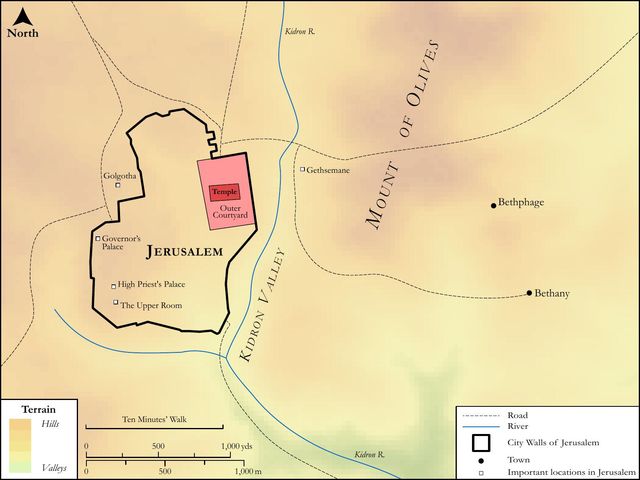
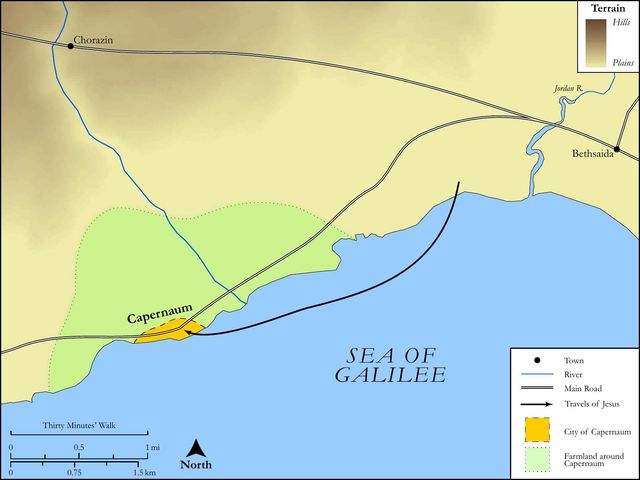
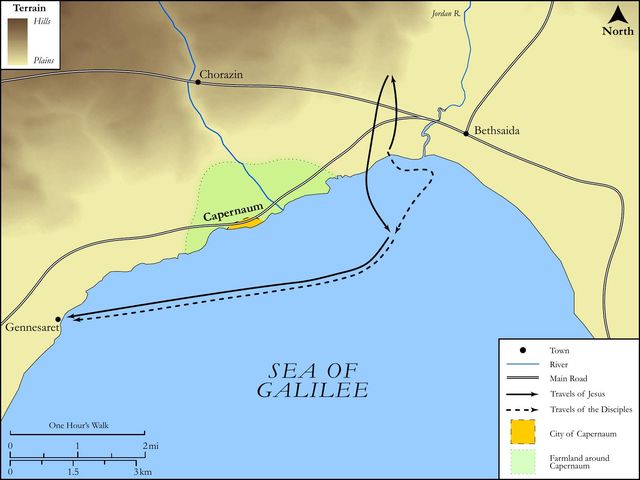
Study this verse
Public-domain commentary
Matthew Henry
From his Commentary on the Whole Bible. Henry comments on passages, not single verses — this entry covers John 6:15–21. His four-level outline is real structure in the source text, so it is rendered as structure.
Here is, I. Christ's retirement from the multitude.
1.Observe what induced him to retire; because he perceived that those who acknowledged him to be that prophet that should come into the world would come, and take him by force, to make him a king, Joh 6:15. Now here we have an instance,
(1.)Of the irregular zeal of some of Christ's followers; nothing would serve but they would make him a king. Now,
[1.]This was an act of zeal for the honour of Christ, and against the contempt which the ruling part of the Jewish church put upon him. They were concerned to see so great a benefactor to the world so little esteemed in it; and therefore, since royal titles are counted the most illustrious, they would make him a king, knowing that the Messiah was to be a king; and if a prophet, like Moses, then a sovereign prince and lawgiver, like him; and, if they cannot set him up upon the holy hill of Zion, a mountain in Galilee shall serve for the present. Those whom Christ has feasted with the royal dainties of heaven should, in return for his favour, make him their king, and set him upon the throne in their souls: let him that has fed us rule us. But,
[2.]It was an irregular zeal; for First, It was grounded upon a mistake concerning the nature of Christ's kingdom, as if it were to be of this world, and he must appear with outward pomp, a crown on his head, and an army at his foot; such a king as this they would make him, which was as great a disparagement to his glory as it would be to lacquer gold or paint a ruby. Right notions of Christ's kingdom would keep us to right methods for advancing it. Secondly, It was excited by the love of the flesh; they would make him their king who could feed them so plentifully without their toil, and save them from the curse of eating their bread in the sweat of their face. Thirdly, It was intended to carry on a secular design; they hoped this might be a fair opportunity of shaking off the Roman yoke, of which they were weary. If they had one to head them who could victual an army cheaper than another could provide for a family, they were sure of the sinews of the war, and could not fail of success, and the recovery of their ancient liberties. Thus is religion often prostituted to a secular interest, and Christ is served only to serve a turn, Rom 16:18. Vix quaritur Jesus properter Jesusm, sed propter aliud - Jesus is usually sought after for something else, not for his own sake. - Augustine. Nay, Fourthly, It was a tumultuous, seditious attempt, and a disturbance of the public peace; it would make the country a seat of war, and expose it to the resentments of the Roman power. Fifthly, It was contrary to the mind of our Lord Jesus himself; for they would take him by force, whether he would or no. Note, Those who force honours upon Christ which he has not required at their hands displease him, and do him the greatest dishonour. Those that say I am of Christ, in opposition to those that are of Apollos and Cephas (so making Christ the head of a party), take him by force, to make him a king, contrary to his own mind.
(2.)Here is an instance of the humility and self-denial of the Lord Jesus, that, when they would have made him a king, he departed; so far was he from countenancing the design that he effectually quashed it. Herein he has left a testimony,
[1.]Against ambition and affectation of worldly honour, to which he was perfectly mortified, and has taught us to be so. Had they come to take him by force and make him a prisoner, he could not have been more industrious to abscond than he was when they would make him a king. Let us not then covet to be the idols of the crowd, nor be desirous of vainglory.
[2.]Against faction and sedition, treason and rebellion, and whatever tends to disturb the peace of kings and provinces. By this it appears that he was no enemy to Caesar, nor would have his followers be so, but the quiet in the land; that he would have his ministers decline every thing that looks like sedition, or looks towards it, and improve their interest only for their work's sake.
2.Observe whither he retired: He departed again into a mountain, eis to oros - into the mountain, the mountain where he had preached (Joh 6:3), whence he came down into the plain, to feed the people, and then returned to it alone, to be private. Christ, though so useful in the places of concourse, yet chose sometimes to be alone, to teach us to sequester ourselves from the world now and then, for the more free converse with God and our own souls; and never less alone, says the serious Christian, than when alone. Public services must not jostle out private devotions.
II.Here is the disciples' distress at sea.
They that go down to the sea in ships, these see the works of the Lord, for he raiseth the stormy wind, Psa 107:23, Psa 107:24. Apply this to these disciples.
1.Here is their going down to the sea in a ship (Joh 6:16, Joh 6:17): When even was come, and they had done their day's work, it was time to look homeward, and therefore they went aboard, and set sail for Capernaum. This they did by particular direction from their Master, with design (as it should seem) to get them out of the way of the temptation of countenancing those that would have made him a king.
2.Here is the stormy wind arising and fulfilling the word of God. They were Christ's disciples, and were now in the way of their duty, and Christ was now in the mount praying for them; and yet they were in this distress. The perils and afflictions of this present time may very well consist with our interest in Christ and his intercession. They had lately been feasted at Christ's table; but after the sun-shine of comfort expect a storm.
(1.)It was now dark; this made the storm the more dangerous and uncomfortable. Sometimes the people of God are in trouble, and cannot see their way out; in the dark concerning the cause of their trouble, concerning the design and tendency of it, and what the issue will be.
(2.)Jesus was not come to them. When they were in that storm (Mat 8:23, etc.) Jesus was with them; but now their beloved had withdrawn himself, and was gone. The absence of Christ is the great aggravation of the troubles of Christians.
(3.)The sea arose by reason of a great wind. It was calm and fair when they put to sea (they were not so presumptuous as to launch out in a storm), but it arose when they were at sea. In times of tranquillity we must prepare for trouble, for it may arise when we little think of it. Let it comfort good people, when they happen to be in storms at sea, that the disciples of Christ were so; and let the promises of a gracious God balance the threats of an angry sea. Though in a storm, and in the dark, they are no worse off than Christ's disciples were. Clouds and darkness sometimes surround the children of the light, and of the day.
3.Here is Christ's seasonable approach to them when they were in this peril, Joh 6:19. They had rowed (being forced by the contrary winds to betake themselves to their oars) about twenty-five or thirty furlongs. The Holy Spirit that indicted this could have ascertained the number of furlongs precisely, but this, being only circumstantial, is left to be expressed according to the conjecture of the penman. And, when they were got off a good way at sea, they see Jesus walking on the sea. See here,
(1.)The power Christ has over the laws and customs of nature, to control and dispense with them at his pleasure. It is natural for heavy bodies to sink in water, but Christ walked upon the water as upon dry land, which was more than Moses's dividing the water and walking through the water.
(2.)The concern Christ has for his disciples in distress: He drew nigh to the ship; for therefore he walked upon the water, as he rides upon the heavens, for the help of his people, Deu 33:26. He will not leave them comfortless when they seem to be tossed with tempests and not comforted. When they are banished (as John) into remote places, or shut up (as Paul and Silas) in close places, he will find access to them, and will be nigh them.
(3.)The relief Christ gives to his disciples in their fears. They were afraid, more afraid of an apparition (for so they supposed him to be) than of the winds and waves. It is more terrible to wrestle with the rulers of the darkness of this world than with a tempestuous sea. When they thought a demon haunted them, and perhaps was instrumental to raise the storm, they were more terrified than they had been while they saw nothing in it but what was natural. Note,
[1.]Our real distresses are often much increased by our imaginary ones, the creatures of our own fancy.
[2.]Even the approaches of comfort and deliverance are often so misconstrued as to become the occasions of fear and perplexity. We are often not only worse frightened than hurt, but then most frightened when we are ready to be helped. But, when they were in this fright, how affectionately did Christ silence their fears with that compassionate word (Joh 6:20), It is I, be not afraid! Nothing is more powerful to convince sinners than that word, I am Jesus whom thou persecutest; nothing more powerful to comfort saints than this, "I am Jesus whom thou lovest; it is I that love thee, and seek thy good; be not afraid of me, nor of the storm." When trouble is nigh Christ is nigh.
4.Here is their speedy arrival at the port they were bound for, Joh 6:17.
(1.)They welcomed Christ into the ship; they willingly received him. Note, Christ's absenting himself for a time is but so much the more to endear himself, at his return, to his disciples, who value his presence above any thing; see Sol 3:4.
(2.)Christ brought them safely to the shore: Immediately the ship was at the land whither they went. Note,
[1.]The ship of the church, in which the disciples of Christ have embarked themselves and their all, may be much shattered and distressed, yet it shall come safe to the harbour at last; tossed at sea, but not lost; cast down, but not destroyed; the bush burning, but not consumed.
[2.]The power and presence of the church's King shall expedite and facilitate her deliverance, and conquer the difficulties which have baffled the skill and industry of all her other friends. The disciples had rowed hard, but could not make their point till they had got Christ in the ship, and then the work was done suddenly. If we have received Christ Jesus the Lord, have received him willingly, though the night be dark and the wind high, yet we may comfort ourselves with this, that we shall be at shore shortly, and are nearer to it than we think we are. Many a doubting soul is fetched to heaven by a pleasing surprise, or ever it is aware.
Historical interpretation
Historical reception
9 surviving comments on this verse. Each one is dated, so this reads as a timeline rather than a list.
Select a marker to jump to its quote. Markers stagger vertically where authors wrote within a few decades of each other.
(Hom. xlii. 3) See what the belly can do. They care no more for the violation of the Sabbath; all their zeal for God is fled, now that their bellies are filled: Christ has become a Prophet, and they wish to enthrone Him as king. But Christ makes His escape; to teach us to despise the dignities of the world. He dismisses His disciples, and goes up into the mountain.— (Hom. xliii. 1). These, when their Master had left them, went down in the evening to the sea; as we read; And when even was now come, His disciples went down unto the sea. They waited till evening, thinking He would come to them; and then, as He did not come, delayed no longer searching for Him, but in the ardour of love, entered into a ship, and went over the sea toward Capernaum. They went to Capernaum thinking they should find Him there.
(Hom. xlii. 1) The mention of the time is not accidental, but meant to show the strength of their love. They did not mate excuses, and say, It is evening now, and night is coming on, but in the warmth of their love went into the ship. And now many things alarm them: the time, And it was now dark; and the weather, as we read next, And the sea arose by reason of a great wind that blew; their distance from land, So when they had rowed about five and twenty or thirty furlongs.
(Hom. xliii. 1) And at last He appears quite unexpectedly: They see Jesus walking upon the sea, drawing nigh. He reappears after His retirement, teaching them what it is to be forsaken, and stirring them to greater love; His reappearance manifesting His power. They were disturbed, were afraid, it is said. Our Lord comforts them: But He saith unto them, It is I, be not afraid.
(Hom. xliii. s. 1) He appeared to them in this way, to show His power; for He immediately calmed the tempest: Then they wished to receive Him into the ship; and immediately the ship was at the land, whither they went. So great was the calm, He did not even enter the ship, in order to work a greater miracle, and to show his Divinity more clearlyg.
(Hom. xliii. 1) Jesus does not show Himself to the crowd walking on the sea, such a miracle being too much for them to hear. Nor even to the disciples did He show Himself long, but disappeared immeditately.
(Hom. xliii. 1) Or take another explanation. This miracle seems to me to be a different one, from the one given in Matthew: for there they do not receive Him into the ship immediately, whereas here they doh: and there the storm lasts for some time, whereas here as soon as He speaks, there is a calm. He often repeats the same miracle in order to impress it on men's minds.
Christ provideth for the good of his disciples not only when He is present in the body, but also when far away; for having abundance of means and of skill, He effecteth one and the same end by contrary actions. Observe, for instance, what He hath done here. He leaveth His disciples, and goeth up into a mountain; and they, when even was come, went down unto the sea. They waited for Him until evening, expecting that He would come unto them; but when even was come, they could no longer endure not to seek their Master; so great a love possessed them. They said not, "It is now evening, and night hath overtaken us, whither shall we depart? the place is dangerous, the time unsafe"; but, goaded by their longing, they entered into the ship. For it is not without a cause that the Evangelist hath declared the time also, but by it to show the warmth of their love.
Wherefore then doth Christ let them go, and not show Himself? And again, wherefore doth He show Himself walking alone upon the sea? By the first He teacheth them how great an evil it is to be forsaken by Him, and maketh their longing greater; by the second, again, He showeth forth His power. For as in His teaching they heard not all in common with the multitude, so in the case of the miracles they saw them not all with the mass of people, since it was needful that they who were about to receive in charge the presidency of the world, should have somewhat more than the rest.
He allowed the storm to arise, that they might ever seek Him; He stilled the storm, that He might make known to them His power; He went not up into the ship, that He might make the marvel greater.
There is no inconsistency between Matthew and John. Matthew has told us first how Jesus commanded his disciples to embark in the little ship and to go before him to the other side of the lake until he sent the multitudes away, and then he informs us that after the multitudes were sent away [Jesus] went up into a mountain alone to pray. John mentions first that he departed to a mountain alone and then proceeds to say, “And when it became late, his disciples came down to the sea; and when they had entered into a ship, etc.” For who will not perceive that in recapitulating the facts, John has spoken of something as actually done at a later point by the disciples that Jesus had already charged them to do before his own departure to the mountain?
What saith the apostle of the Lord Himself? "Who was made a priest for ever after the order of Melchisedec." Melchisedec was a priest, and blessed Abraham. And who was this Melchisedec? "King of Salem." Salem was afterwards called Jerusalem. Therefore before the Jews reigned there, Melchisedec was there a priest of the most high God; of whom in Genesis very great mysteries are spoken. This Melchisedec went out to meet Abraham, and blessed him. He was a priest, for he offered bread and wine to those that had returned from the smiting of the enemy: and there Abraham gave to him tithes. Lo, our Lord, a priest for ever after the order of Melchisedec, because He on earth hath offered that oblation.
Behold, Jesus is on the mountain, and the disciples are in the ship. He on the mountain is on high, and they on the sea are on the low level. And yet He left them not who was at a distance from them: just as also He leaves not us (for with Him is our hope), even in that we are delayed in this body, until the end of the world come. And with the ship on the sea the blast rose mightily, and they were tormented by the tossing. It cannot be that the faith of Christ is without tempest in this world. Much presumption truly is there in a man if he thinks to live without temptation.
The first sign having been miraculously accomplished, His flight and withdrawal are economically found to be the root again and occasion of another, and the Wonderworker proceeds, as it is written, from might to might. For since He was being sought as King by them who were astonished at that great miracle, and was Himself refusing worldly honours according to the preceding account; it was altogether necessary that He should depart from the place, yea, rather from their whole country. In order then that He might seem to have sailed away, and might relax somewhat the intensity of the seekers, He orders the disciples to depart before Him, but Himself stays, advancing opportunely unto the next miracle. For it was His most earnest endeavour, by every occasion and act, to confirm the mind of the Apostles in their faith to Himward. For since they were to be teachers of the earth, and to shine forth as lights in the world, as Paul saith, He necessarily led them to all things that would profit them. For this was to show kindness not on them alone, but to those also who should be led by them unto the unerring apprehension of Him.
But why (will some one perchance say) after that miracle, is the Power of Jesus to walk on the very sea immediately introduced? Such an one shall hear a very credible cause. For when He desired to feed the multitudes, Philip and Andrew supposed that He would be powerless thereto, the one saying that no small sum of money would barely suffice them for just a little enjoyment, the other telling that five loaves and two small fishes were found with one of the lads, nay that what was found was nothing to so great a multitude; and from all (so to speak) their words, they thought that He could do nothing out of the due course of our affairs:----needs, in order that He might free Himself from so petty a conception, and might bring the still feeble mind of the Apostles to learn, that He doth all things wondrously which He willeth, unrestrained by the nature of things, the necessary order of things not hampering Him in the least, does He place under His Feet the humid nature of the waters, albeit unpractised to lie under the bodies of men, for all things were possible, as to God. Evening then being now come, and the time abating the vigilance of those who were seeking for Him, the choir of the holy disciples goes down to the sea, and began to sail away immediately, obeying in all things their God and Teacher, and that without delay.
In order, then, that he might seem to have sailed away and thus diffuse the intensity of those who were looking for him, he orders the disciples to leave before him; but he stays, providing the opportunity for the next miracle. For his primary concern was to use every occasion to confirm the mind of the apostles in their faith toward him.… And so, when evening came and enough time had passed so that those who were seeking him gave up, the choir of holy disciples goes down to the sea and began to sail away immediately, obeying their God and teacher in everything without delay.
Continue studying John 6:16 across the web’s major study libraries — every link below opens this exact verse, chapter, or book on the destination site.
Read & Compare
 BibleGatewayThis verse in more than 200 translations and 70 languages.
 Bible.comThe YouVersion reader — hundreds of translations, reading plans, and highlights.
 ESV.orgCrossway's official English Standard Version reader.
 NET BibleThe NET translation with 60,000+ translators' notes on every rendering decision.
 STEP BibleTyndale House's free study tool — original text, vocabulary, and scholarly resources.
 BibliaLogos Bible Software's free web reader.
 USCCBThe New American Bible (Revised Edition) with the U.S. bishops' study notes.
Commentaries
 BibleHub CommentariesDozens of classic commentaries on this verse, gathered on one page.
 StudyLightMore than 100 commentary sets — the largest collection on the web.
 BibleRefPlain-English commentary on what this verse means, verse by verse.
 Enduring WordDavid Guzik's free commentary on this chapter, widely used by Bible teachers.
 Bible Study ToolsVerse commentary alongside Greek and Hebrew study aids.
Original Language & Research
- BibleHub InterlinearThe verse word by word — original language, transliteration, and English.
- BibleHub LexiconEvery word's original-language definition and Strong's entry.
 Blue Letter BibleDeep-study tools — Strong's numbers, concordance, and word studies.
 CNTR CollationThe earliest Greek manuscripts of this verse, collated letter by letter.
Sermons, Hymns & Audio


TrulyRandomVerse is not affiliated with these sites and doesn’t control their content. They’re linked because they’re genuinely useful.
Summary
Following the miraculous feeding of the five thousand and Jesus' subsequent withdrawal from the crowds who sought to make him king by force, John 6:16 marks a significant transition in the narrative. As evening descended, Jesus' disciples, in obedience to his implicit or explicit instruction, departed from the shore and began their journey across the Sea of Galilee, setting the stage for the dramatic events that would unfold under the cover of night.
Context
ShowHideLiterary Context
This verse immediately follows two pivotal events in John's Gospel: the feeding of the five thousand and Jesus' withdrawal from the multitude. In John 6:1-15, Jesus miraculously provides for a vast crowd, demonstrating His divine power and compassion. However, the crowd's response, attempting to seize Him and make Him king by force (John 6:15), reveals a misunderstanding of His true messianic mission. Jesus' withdrawal to the mountain alone underscores His rejection of earthly kingship and His focus on His spiritual purpose. John 6:16, therefore, initiates the next phase of the narrative, separating the disciples from the crowds and from Jesus' immediate physical presence, thus preparing them for a unique encounter that will further reveal His divine nature.
Historical & Cultural Context
The setting is the Sea of Galilee, a large freshwater lake surrounded by hills, known for sudden, violent storms. "When even was now come" refers to the time after sunset, when darkness would have begun to settle over the water. In Jewish reckoning, there were often two evenings: the first around 3 PM and the second closer to sunset. This verse likely refers to the latter, indicating that the disciples were embarking on their journey in the encroaching darkness. Travel by boat across the lake was common, but doing so at night, especially without Jesus' physical presence, would have presented challenges and potential dangers, a common experience for fishermen in that region. This nocturnal setting enhances the sense of isolation and vulnerability for the disciples.
Key Themes
ShowHideThis verse introduces several key themes that resonate throughout John 6 and the broader Gospel. It signals a transition and separation, as the disciples leave the crowds and Jesus, embarking on a journey that will test their faith. Their action of "going down unto the sea" implies obedience and expectation, as they are likely following Jesus' instructions to cross to the other side, even if His immediate presence is absent. This separation also subtly foreshadows challenge and divine revelation, preparing the reader for the impending storm and Jesus' miraculous appearance walking on water (John 6:17-21), a profound demonstration of His power over creation and His sovereign control even in moments of perceived absence.
Exposition and Analysis
ShowHideKey Word Analysis
ShowHideThis term, derived from opsé (late), refers specifically to the late afternoon or evening, typically the period after sunset when darkness begins to fall. Its use here emphasizes the time of day, setting a somber and potentially perilous atmosphere for the disciples' journey, contrasting with the daylight miracle of the feeding.
A compound verb meaning "to descend" or "to go down." This precise word choice indicates a movement from a higher elevation (the land where they had been with Jesus) to a lower one (the shore of the sea). It signifies a deliberate action of boarding a boat and embarking on a journey, physically separating them from their previous location and the multitude.
This refers to the Sea of Galilee, a significant geographical feature in the Gospels. Beyond its literal meaning, the "sea" often functions as a symbolic realm of chaos, danger, and the unknown in biblical literature, particularly in contrast to the stability of land. The disciples' journey "unto the sea" thus sets the stage for a confrontation with the elements and a demonstration of divine authority over them.
Verse Breakdown
ShowHide"And when even was [now] come"
This clause establishes the temporal setting for the subsequent events. The arrival of "even" (late evening/nightfall) is a crucial detail, indicating not just the time of day but also setting a mood of increasing darkness and isolation. This timing is essential for understanding the disciples' subsequent struggle and Jesus' miraculous intervention under the cover of night.
"his disciples went down unto the sea"
This part of the verse describes the immediate action of the disciples. Their descent "unto the sea" implies their intention to cross it, likely in response to Jesus' prior instruction (implied by parallel accounts and the narrative flow). This action signifies their separation from Jesus, who had withdrawn, and their embarkation on a journey that would test their faith and lead to a deeper revelation of His power.
Literary Devices
ShowHideThe verse effectively employs Setting to establish the atmosphere and foreshadow upcoming events. The mention of "even" or nightfall immediately creates a sense of encroaching darkness, isolation, and potential danger, contrasting sharply with the earlier daylight miracle of the feeding. This use of setting contributes to Foreshadowing, subtly hinting at the storm and the disciples' struggle that will follow, as well as the dramatic appearance of Jesus walking on water. The "sea" itself can be seen as a Symbol of the unknown, the chaotic, and the realm where human limitations are exposed, setting the stage for a divine demonstration of power over these forces.
Theological and Thematic Connections
ShowHideJohn 6:16, though brief, serves as a crucial bridge, transitioning from the physical miracle of the bread to a profound spiritual lesson about faith and divine presence in absence. It highlights the disciples' obedience even when the path is unclear and the Lord's immediate physical presence is withdrawn. This moment of separation and impending darkness prepares them for a deeper revelation of Jesus' identity, not merely as a provider of physical sustenance, but as the sovereign Lord over creation, capable of transcending natural laws. It underscores that even after experiencing great blessings, periods of testing and perceived absence are integral to the journey of faith, designed to deepen reliance on Christ's unseen power.
Reflection and Application
ShowHideJohn 6:16 offers a powerful, albeit subtle, lesson for the contemporary believer. Just as the disciples, fresh from witnessing a profound miracle, were sent into the encroaching darkness and onto the turbulent sea without the immediate physical presence of Jesus, so too do we experience seasons in our spiritual lives. There are times when, despite past blessings and revelations, we find ourselves in situations that feel uncertain, isolated, or even perilous. This verse reminds us that discipleship often involves stepping out in faith, even when the "even" has come and the path ahead is obscured. It's in these moments of perceived absence that our faith is truly refined and deepened, preparing us to recognize Christ's power and presence in ways we might not have expected, often through His unexpected interventions that demonstrate His sovereignty over our circumstances. Our willingness to "go down unto the sea" in obedience, even when we don't fully understand the journey, is a testament to our trust in His guiding hand.
Questions for Reflection
ShowHideFAQ
ShowHideWhy did the disciples go down to the sea at night, especially after such a significant event?
ShowHideThe text indicates "when even was now come," meaning late afternoon or early evening, signaling the onset of night. While the Gospel of John doesn't explicitly state Jesus' command for them to cross, parallel accounts in Matthew 14:22 and Mark 6:45 confirm that Jesus "constrained" or "urged" His disciples to get into the boat and go ahead of Him to the other side. This suggests they were acting in obedience to His directive. Jesus' immediate withdrawal to the mountain to pray (John 6:15) meant He would not be joining them immediately. Their departure at this time, though seemingly late, was part of His divine plan to orchestrate the subsequent miraculous encounter on the water.
Christ-Centered Fulfillment
ShowHideJohn 6:16, while seemingly a simple transitional verse, subtly points to Christ's sovereign control and His unique relationship with His disciples, foreshadowing deeper theological truths fulfilled in His person. The disciples' journey into the evening darkness on the sea, seemingly alone, sets the stage for Jesus' dramatic appearance walking on the water (John 6:19). This act is not merely a display of power, but a profound revelation of His divine nature, echoing God's mastery over chaos in creation (Genesis 1:2) and His presence with His people in the midst of their trials (Psalm 107:29). Jesus' ability to walk on the very element that threatened His disciples demonstrates His ultimate authority, identifying Him as the "I AM" who transcends natural limitations, a theme powerfully developed throughout John's Gospel (John 8:58). This event, initiated by the disciples' departure in John 6:16, ultimately serves to reveal Christ as the one who calms the storms of life, both literal and metaphorical, and is ever-present with His people, even when unseen, providing ultimate security and guidance, a truth that finds its ultimate expression in His promise to be with us always, even to the end of the age (Matthew 28:20).