


Job 28:16
Bible text: King James Version (1769 Blayney text) · Public domain
Bible text: Berean Standard Bible · Public domain
Bible text: American Standard Version (1901) · Public domain
Bible text: World English Bible, Messianic edition · Public domain
Bible text: Geneva Bible (1599) · Public domain
Bible text: Young's Literal Translation · Public domain
- לֹאlo'notH3808NegParticle Negative
- תְסֻלֶּהTe·su·lehit will be paidH5541V-Pual-Imperf-3fsVerb Pual Imperfect 3rd Singular Feminine
- בְּכֶתֶםbe·Khe·temin [the] gold ofH3800Prep-b ¦ N-mscNoun Singular Masculine Constructבְּinכֶתֶם[the] gold of
- אוֹפִיר'o·FirOphirH211N-properNoun Proper Location
- בְּשֹׁהַםbe·Sho·hamin onyxH7718Prep-b ¦ N-msNoun Singular Masculine Absoluteבְּinשֹׁהַםonyx
- יָקָרya·KarpreciousH3368Adj-msAdjective Singular Masculine Absolute
- וְסַפִּירve·sa·Pirand sapphireH5601Conj-w ¦ N-msNoun Singular Masculine Absoluteוְandסַפִּירsapphire
English is a literal word-by-word gloss of the Hebrew, not the KJV's wording. Why?
This is the original text the KJV's translators worked from — each Hebrew word with its own literal English meaning in this verse, prepared by scholars at Tyndale House, Cambridge. The KJV translates whole sentences, not word by word, so its wording differs: one Hebrew word can become several English words, and the KJV may choose “the LORD” where the gloss reads “Yahweh”. Both are faithful — they answer different questions. For the KJV's own rendering, switch to the KJV text.
Details
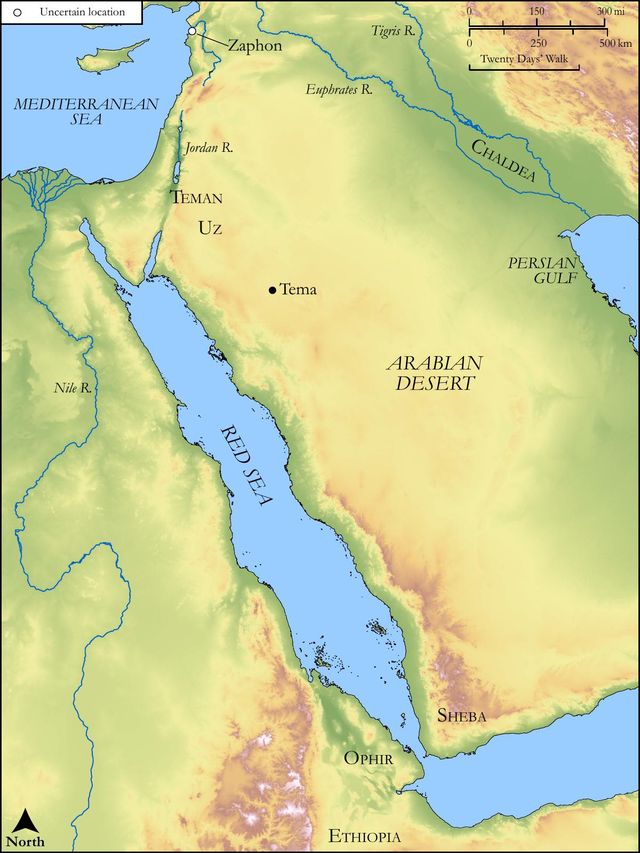
See on the biblical-era map
Study this verse
Public-domain commentary
Matthew Henry
From his Commentary on the Whole Bible. Henry comments on passages, not single verses — this entry covers Job 28:12–19. His three-level outline is real structure in the source text, so it is rendered as structure.
Job, having spoken of the wealth of the world, which men put such a value upon and take so much pains for, here comes to speak of another more valuable jewel, and that is, wisdom and understanding, the knowing and enjoying of God and ourselves. Those that found out all those ways and means to enrich themselves thought themselves very wise; but Job will not own theirs to be wisdom. He supposes them to gain their point, and to bring to light what they sought for (Job 28:11), and yet asks, "Where is wisdom? for it is not here." This their way is their folly. We must therefore seek it somewhere else, and it will be found nowhere but in the principles and practices of religion. There is more true knowledge, satisfaction, and happiness, in sound divinity, which shows us the way to the joys of heaven, than in natural philosophy or mathematics, which help us to find a way into the bowels of the earth. Two things cannot be found out concerning this wisdom: -
I.The price of it, for that is inestimable; its worth is infinitely more than all the riches in this world: Man knows not the price thereof (Job 28:13), that is,
1.Few put a due value upon it. Men know not the worth of it, its innate excellency, their need of it, and of what unspeakable advantage it will be to them; and therefore, though they have many a price in their hand to get this wisdom, yet they have no heart to it, Pro 17:16. The cock in the fable knew not the value of the precious stone he found in the dunghill, and therefore would rather have lighted on a barley-corn. Men know not the worth of grace, and therefore will take no pains to get it.
2.None can possibly give a valuable consideration for it, with all the wealth this world can furnish them with. This Job enlarges upon Job 28:15, etc., where he makes an inventory of the bona notabilia - the most valuable treasures of this world. Gold is five times mentioned; silver comes in also; and then several precious stones, the onyx and sapphire, pearls and rubies, and the topaz of Ethiopia. These are the things that are highest prized in the world's markets: but if a man would give, not only these, heaps of these, but all the substance of his house, all he is worth in the world, for wisdom, it would utterly be contemned. These may give a man some advantage in seeking wisdom, as they did to Solomon, but there is no purchasing wisdom with these. It is a gift of the Holy Ghost, which cannot be bought with money, Act 8:20. As it does not run in the blood, and so come to us by descent, so it cannot be got for money, nor does it come to us by purchase. Spiritual gifts are conferred without money and without price, because no money can be a price for them. Wisdom is likewise a more valuable gift to him that has it, makes him richer and happier, than gold or precious stones. It is better to get wisdom than gold. Gold is another's, wisdom our own; gold is for the body and time, wisdom for the soul and eternity. Let that which is most precious in God's account be so in ours. See Pro 3:14, etc.
II.The place of it, for that is undiscoverable. Where shall wisdom be found? Job 28:12. He asks this,
1.As one that truly desired to find it. This is a question we should all put. While the most of men are asking, "Where shall money be found?" we should ask, Where may wisdom be found? that we may seek it and find it, not vain philosophy, or carnal policy, but true religion; for that is the only true wisdom, that is it which best improves our faculties and best secures our spiritual and eternal welfare. This is that which we should cry after and dig for, Pro 2:3, Pro 2:4.
2.As one that utterly despaired of finding it any where but in God, and any way but by divine revelation: It is not found in this land of the living, Job 28:13. We cannot attain to a right understanding of God and his will, of ourselves and our duty and interest, by reading any books or men, but by reading God's book and the men of God. Such is the degeneracy of human nature that there is no true wisdom to be found with any but those who are born again, and who, through grace, partake of the divine nature. As for others, even the most ingenious and industrious, they can tell us no tidings of this lost wisdom.
(1.)Ask the miners, and by them the depth will say, It is not in me, Job 28:14. Those who dig into the bowels of the earth, to rifle the treasures there, cannot in these dark recesses find this rare jewel, nor with all their art make themselves masters of it.
(2.)Ask the mariners, and by them the sea will say, It is not in me. It can never be got either by trading on the waters or diving into them, can never be sucked from the abundance of the seas or the treasures hidden in the sand. Where there is a vein for the silver there is no vein for wisdom, none for grace. Men can more easily break through the difficulties they meet with in getting worldly wealth than through those they meet with in getting heavenly wisdom, and they will take more pains to learn how to live in this world than how to live for ever in a better world. So blind and foolish has man become that it is in vain to ask him, Where is the place of wisdom, and which is the road that leads to it?
Historical interpretation
Historical reception
1 surviving comment on this verse from the historical church.
74. For what is meant by India, which furnishes a black people, saving this world, wherein the life of man is engendered dark in respect of sin? Now ‘the dyed colours of India’ are the wise ones of this world, who though in respect of infidelity, and oftentimes in respect of behaviour, they be foul, yet before the eyes of men are stained with the hue of overlaid honourableness. But the coeternal Wisdom of God is not ‘compared to the dyed colours of India,’ in that he, who really takes It in, discovers how widely it differs from those human beings whom the world has worshipped for wise ones. And the very words of His precepts differ from the wise ones of this world, in that while they strain after eloquence, their sayings appear as if fair in show and in the staining of the dye, and while they lack the power of realities, feign themselves to be something else than what they are by combination of words as by overcoated colours. But on the other hand the instruction of Wisdom is at once fair by preaching and shining by unadulterated truth, nor does it by deceit set itself forth one thing outwardly, and retain another thing inwardly, nor in its sayings aim to appear fair by brilliancy of speech, but by uncorruptness of truth. Therefore in its precepts the Wisdom of God is not ‘compared to the dyed colours of India,’ since whereas it has not the stained adornments of eloquence, it pleases like a robe without dye. Which staining of the dye Paul rightly despised, when he said, Which things also we speak not in the words that man’s wisdom teacheth, but which the Holy Ghost teacheth. For he chose rather to display this ‘Wisdom’ by the simple transparency of truth alone, but not to stain it with thy dyeing of speech.
Nor to the most precious sardonyx stone, nor to the sapphire.
75. That the sardonyx and sapphire are not precious stones, who would be ignorant? And whereas there be many other precious stones, which immeasurably exceed these in the account of greatness, why is the sapphire or the sardonyx especially called precious, when either stone by comparison with other stones is most contemptible? except that those stones which are described as precious, when we know not to be precious, we look out for some other thing in the meaning of them. For the sardonyx bears the likeness of red earth, but the sapphire has an aereal appearance. And so it may be that in the sardonyx by the red earth human beings are denoted, in the sapphire by the aereal appearance the Angels are denoted. For whereas the sardonyx stone bears the appearance of red earth, it not improperly denotes man; because ‘Adam’ himself, who was created the first, is called in the Latin tongue ‘Red earth.’ What does it mean then that it is said that this Wisdom is not ‘compared to the sardonyx nor to the sapphire,’ but that He, Who is the ‘Power of God and the Wisdom of God,’ i.e. the Mediator between God and man, the Man Christ Jesus, surpasses all things by such preeminent greatness that neither the first man on the earth, nor the Angels in heaven, can be compared to Him. And hence it is said by the Psalmist, Who in the heaven can be compared unto the Lord? Who among the sons of God [‘Sons of God’ was a common expression for Angels] can be likened unto the Lord?
76. But it is possible that by the sardonyx stone the Fathers of the Old Testament, while by the sapphire the Preachers of the New Testament, are set forth. For the first, though they maintained an extraordinary life of righteousness, yet lent themselves to carnal procreation. Therefore whereas it is plain that they did some things of an earthly kind, they are not inappropriately denoted by the sardonyx stone, which as we before said bears the appearance of ‘red earth.’ But by the sapphire, which is of an ethereal blue, we suitably understand the Preachers of the New Testament, who laying aside the desires of carnal gendering, followed after the things of heaven alone. And hence the Prophet beholding the holy Apostles mounting above all the desires of the flesh with spiritual fervency, being struck with admiration, saith, Who are these that fly as clouds? [Is. 60, 8] As though he expressed it in plain speech; ‘We go along by the way of earth, in that we are still involved in marryings and employ acts of the flesh upon the propagating offspring; but these walk not on earth, but they ‘fly as clouds,’ who whilst they aim at heavenly things touch nought connected with earthly desires.’ Therefore he says that the Wisdom of God is not ‘compared to the sardonyx or the sapphire stone.’ As though he told in plain terms, saying, ‘To Him, Who is seen Man among men, neither any in the old Fathers nor any in the new is equalled, in that from His Godhead He derives it that in His Manhood He hath not any like to Him.’
Continue studying Job 28:16 across the web’s major study libraries — every link below opens this exact verse, chapter, or book on the destination site.
Read & Compare
 BibleGatewayThis verse in more than 200 translations and 70 languages.
 Bible.comThe YouVersion reader — hundreds of translations, reading plans, and highlights.
 ESV.orgCrossway's official English Standard Version reader.
 NET BibleThe NET translation with 60,000+ translators' notes on every rendering decision.
 STEP BibleTyndale House's free study tool — original text, vocabulary, and scholarly resources.
 BibliaLogos Bible Software's free web reader.
 USCCBThe New American Bible (Revised Edition) with the U.S. bishops' study notes.
Commentaries
 BibleHub CommentariesDozens of classic commentaries on this verse, gathered on one page.
 StudyLightMore than 100 commentary sets — the largest collection on the web.
 BibleRefPlain-English commentary on what this verse means, verse by verse.
 Enduring WordDavid Guzik's free commentary on this chapter, widely used by Bible teachers.
 Bible Study ToolsVerse commentary alongside Greek and Hebrew study aids.
Original Language & Research
- BibleHub InterlinearThe verse word by word — original language, transliteration, and English.
- BibleHub LexiconEvery word's original-language definition and Strong's entry.
 Blue Letter BibleDeep-study tools — Strong's numbers, concordance, and word studies.
 SefariaThe Hebrew text with Rashi and centuries of Jewish commentary.
Sermons, Hymns & Audio


TrulyRandomVerse is not affiliated with these sites and doesn’t control their content. They’re linked because they’re genuinely useful.
Summary
Job 28:16, embedded within a profound poetic interlude, powerfully asserts the incomparable and immeasurable worth of true wisdom. This verse declares that wisdom transcends the value of the most coveted and precious earthly treasures known in that day, including the legendary gold of Ophir, the exquisite onyx, and the rare sapphire. It serves as a climactic statement within a chapter that meticulously details humanity's relentless pursuit of material wealth, only to pivot and reveal that genuine understanding and divine insight are of a completely different, superior order of value, unattainable through human effort or material exchange.
Context
ShowHideLiterary Context
Chapter 28 of Job stands as a unique and breathtaking poetic interlude, often referred to as a "Hymn to Wisdom," distinct from the preceding and succeeding dialogues between Job and his friends. It commences by describing humanity's remarkable ingenuity and tireless efforts in mining the earth's deepest recesses for precious metals and stones, illustrating their mastery over the physical world and its hidden riches, as detailed in Job 28:1-11. However, the chapter then introduces a pivotal rhetorical question in Job 28:12: "But where shall wisdom be found? And where is the place of understanding?" This profound inquiry sets the stage for a stark contrast. Verses 15-19 then systematically list various valuable commodities—gold, silver, and an array of precious stones—each emphatically declared insufficient to purchase or even adequately value wisdom. Job 28:16, with its specific mention of "the gold of Ophir," the "precious onyx," and the "sapphire," serves as a powerful reinforcement of wisdom's incomparable superiority to all earthly riches, culminating in the profound declaration that true wisdom is known only to God.
Historical & Cultural Context
In that day, gold, silver, and precious stones were not merely commodities but fundamental measures of wealth, status, and power. The mention of "the gold of Ophir" is particularly significant, as Ophir was a legendary, often distant, land renowned for producing the finest and purest gold, frequently associated with King Solomon's immense wealth and grand building projects, as seen in 1 Kings 9:28 and 1 Kings 10:11. This reference signifies the absolute pinnacle of material value in that day. Onyx and sapphire were also highly prized gemstones. Onyx was not only beautiful but held ritual significance, notably used in the priestly garments, where two onyx stones bore the names of the tribes of Israel on the ephod (Exodus 28:9-12). Sapphire, with its deep blue hue, was often associated with the heavens and divine majesty, even described as the pavement beneath God's feet or the likeness of His throne in profound theological visions (Exodus 24:10 and Ezekiel 1:26). Thus, the verse deliberately chooses the most esteemed, valuable, and even sacred commodities of the era to underscore wisdom's unparalleled worth, contrasting the tangible, finite nature of earthly wealth with the intangible, infinite nature of divine wisdom.
Key Themes
ShowHideThe overarching theme of Job 28 is the Inestimable Value of Wisdom, which far surpasses all material possessions. Unlike gold or jewels, which can be mined, traded, and exhausted, true wisdom is portrayed as divinely originated and beyond human acquisition or commercial transaction. This theme is a cornerstone of biblical wisdom literature, resonating powerfully with passages like Proverbs 3:15, which declares wisdom "more precious than rubies," and Proverbs 8:11, stating that "wisdom is better than rubies; and all the things that may be desired are not to be compared to it." Another crucial theme is the Divine Origin of True Wisdom. While humanity can ingeniously unearth hidden treasures from the earth, the path to wisdom is explicitly stated to be hidden from all living creatures and even from the birds of the air (Job 28:21). The chapter emphatically concludes that "God understands the way thereof, and he knoweth the place thereof" (Job 28:23). This emphasizes that genuine wisdom is not a product of human ingenuity, exploration, or intellectual prowess, but rather a profound gift and revelation from the Almighty, accessible only through His sovereign will and grace. The verse also highlights a stark Contrast Between Earthly Riches and Spiritual Insight. It vividly juxtaposes the tangible, exhaustible, and ultimately transient nature of material wealth with the intangible, inexhaustible, and eternal nature of true wisdom. This challenges the common human tendency to prioritize the accumulation of physical assets, status, or fleeting pleasures over the pursuit of deeper understanding, discernment, and spiritual truth. The chapter, and Job 28:16, calls for a radical re-evaluation of what truly constitutes ultimate value and lasting security in life.
Exposition and Analysis
ShowHideKey Word Analysis
ShowHideThe Hebrew verb סָלָה (çâlâh), here in the passive voice, literally means "to hang up" or "to weigh," and by extension, "to estimate" or "to appraise." Its use in Job 28:16 conveys that wisdom "cannot be weighed" or "cannot be appraised" against any material standard. This signifies an inestimable quality, something beyond any conceivable price tag or material equivalent. The very act of attempting to value it with gold or precious stones is rendered futile by its transcendent nature, indicating its worth is absolute and beyond human scales.
Ophir was a legendary, perhaps mythical, land renowned in the days of Solomon for its exceptionally high-quality and abundant gold. References in the Old Testament, such as 1 Kings 9:28 and 1 Kings 10:11, associate it with King Solomon's vast wealth, indicating its status as the ultimate source of pure, coveted gold. By explicitly mentioning "the gold of Ophir," the text sets the highest possible benchmark for material wealth, only to declare wisdom superior to it, emphasizing wisdom's supreme and unparalleled value.
The onyx stone was a highly prized gemstone in Israel and among the nations, often used in elaborate jewelry, royal regalia, and especially in sacred contexts. For instance, onyx stones were prominently featured on the ephod of the high priest, bearing the names of the tribes of Israel (Exodus 28:9-12). While its precise identification can be debated (sometimes associated with beryl), its inclusion alongside gold and sapphire underscores its status as a valuable and esteemed commodity, further emphasizing the vast array of precious items that collectively fall short of wisdom's true worth.
Verse Breakdown
ShowHide"It cannot be valued"
The pronoun "it" refers directly to wisdom, the central subject of the preceding verses in Job 28. This phrase immediately establishes wisdom's transcendent nature, asserting that no human system of appraisal or economic exchange can ascertain its true worth. It is beyond price, beyond measure, and beyond human acquisition through conventional means. The inherent value of wisdom is portrayed as absolute and incommensurable with any earthly commodity, setting it apart as uniquely priceless.
"with the gold of Ophir"
This clause introduces the first and most potent comparison, setting the highest possible standard for material wealth. As the purest and most sought-after gold, originating from the legendary land of Ophir, it represents the zenith of material riches and human desire. By stating that wisdom cannot be "valued with" or "purchased by" even this ultimate form of wealth, the text powerfully elevates wisdom to a realm of worth far exceeding the most coveted earthly possessions. It signifies that wisdom is not merely expensive, but utterly priceless, existing on an entirely different plane of value.
"with the precious onyx, or the sapphire"
These two highly esteemed gemstones further reinforce the argument, broadening the scope of the comparison beyond gold. The "precious onyx" (שֹׁהַם יָקָר, shôham yāqâr) and the "sapphire" (סַפִּיר, sappîr) were rare, beautiful, and valuable commodities, often associated with royalty, divine presence, and sacred artifacts. Their inclusion demonstrates that not just gold, but the entire spectrum of highly prized jewels, falls short in valuing wisdom. The cumulative effect is to declare wisdom's value as universally superior to all forms of material wealth, regardless of their rarity, beauty, or perceived worth.
Literary Devices
ShowHideJob 28:16 masterfully employs several literary devices to convey its profound message regarding the inestimable value of wisdom. The primary device is Hyperbole, an intentional exaggeration used to emphasize the immeasurable worth of wisdom. By comparing wisdom to the "gold of Ophir," "precious onyx," and "sapphire"—the most esteemed and valuable treasures of that day—the text asserts that wisdom's worth is not just greater, but infinitely beyond any earthly measure. This exaggeration powerfully underscores its transcendent nature, making it clear that wisdom operates on a different plane of value. Closely related is Contrast, as the verse sharply juxtaposes the tangible, finite, and ultimately exhaustible nature of material wealth with the intangible, infinite, and divinely sourced nature of wisdom. This stark comparison highlights the radical difference in their respective values, challenging human perceptions of what constitutes true riches. Furthermore, the selection of specific, highly symbolic items (gold, onyx, sapphire) functions as Symbolism, where these objects represent the pinnacle of human desire and material accumulation. Their inadequacy to value wisdom thus symbolizes the futility of seeking ultimate fulfillment or security in worldly possessions, powerfully redirecting the reader towards a higher, spiritual pursuit.
Theological and Thematic Connections
ShowHideJob 28:16 contributes significantly to the biblical theology of wisdom, aligning it not merely as intellectual acumen but as a divine attribute and a gift from God. Theologically, it posits that true wisdom is not a commodity to be acquired through human effort or wealth, but rather a profound revelation. This challenges anthropocentric views of knowledge and emphasizes divine sovereignty over understanding. It connects to the broader biblical theme that God alone is the source of all true wisdom, and humanity's access to it is contingent upon His gracious disclosure. The verse also implicitly critiques the human tendency to idolize material wealth, redirecting focus from temporal riches to eternal truth. It underscores the spiritual principle that what is truly valuable in God's economy often defies human valuation systems, demanding a reorientation of priorities from the visible and perishable to the invisible and eternal.
Reflection and Application
ShowHideIn a world that incessantly promotes the accumulation of wealth, status, and material possessions as the ultimate markers of success and happiness, Job 28:16 serves as a profound and counter-cultural challenge. It compels us to critically re-evaluate our priorities and consider what we truly value. Are we investing our time, energy, and resources primarily in that which is perishable and fleeting, or in that which is eternal and truly enriching? This verse encourages a radical shift in perspective, urging us to pursue wisdom—which encompasses discernment, understanding, and godly insight—above all else. True enrichment, it suggests, does not come from what we accumulate in our earthly treasuries, but from how we understand and navigate life with divine guidance and spiritual depth. This pursuit of wisdom is not a one-time transaction but a lifelong journey of seeking God's mind and heart, leading to an enduring richness that cannot be stolen, diminished, or compared to any earthly treasure. It calls us to cultivate a heart that values spiritual truth over material gain, recognizing that genuine security and fulfillment are found in knowing God and His ways, a treasure that transcends all earthly measures.
Questions for Reflection
ShowHideFAQ
ShowHideWhat is the significance of "the gold of Ophir" in this verse?
ShowHide"The gold of Ophir" refers to a legendary source of exceptionally pure and high-quality gold in the days of Solomon. It was synonymous with the ultimate standard of material wealth and luxury, famously associated with King Solomon's immense riches (1 Kings 9:28). By mentioning it, Job 28:16 sets the highest possible benchmark for earthly value, only to declare that wisdom far surpasses even this most coveted treasure. Its inclusion emphasizes wisdom's unparalleled and inestimable worth, placing it beyond any material valuation or human acquisition.
Why does Job 28 focus so much on wisdom, seemingly interrupting the dialogue with his friends?
ShowHideChapter 28 serves as a profound poetic interlude, often seen as the climax of the wisdom theme in the Book of Job. While it interrupts the direct dialogue, it provides a crucial theological perspective that undergirds the entire book. It shifts the focus from Job's personal suffering and the friends' flawed theological arguments to the ultimate source of all understanding: God Himself. This chapter establishes that true wisdom is not found through human exploration or intellectual debate, but is revealed by God alone (Job 28:23). It prepares the reader for God's eventual appearance and His sovereign pronouncements, highlighting that only divine wisdom can truly comprehend the mysteries of suffering, justice, and the ways of the Almighty.
Christ-Centered Fulfillment
ShowHideWhile Job 28:16 declares that wisdom cannot be valued with earthly treasures, the New Testament reveals that this ultimate wisdom is not merely an abstract concept but is gloriously personified in Jesus Christ. He is not simply wise, but is Himself "the wisdom of God" (1 Corinthians 1:24) and "the power of God." In Christ, "are hid all the treasures of wisdom and knowledge" (Colossians 2:3), making Him the very embodiment of the divine insight that humanity tirelessly seeks but cannot purchase. What humanity could not find or acquire with the gold of Ophir, God freely offers in His Son, a gift of immeasurable value. Jesus, through His perfect life, atoning death, and triumphant resurrection, embodies the perfect understanding of God's will and the ultimate path to true life and reconciliation. He is the one who teaches us to "seek first the kingdom of God and His righteousness" (Matthew 6:33), implicitly valuing spiritual truth over material pursuits, much like the wisdom described in Job. To "gain Christ" is to gain the very essence of divine wisdom, a treasure "more precious than rubies" (Proverbs 3:15) and infinitely more valuable than any earthly possession, for in Him we find eternal life and true understanding of God (John 17:3). He is the ultimate fulfillment of the wisdom that Job sought, a wisdom that brings reconciliation with God and true spiritual riches that endure forever.