


Jeremiah 43:1
Bible text: King James Version (1769 Blayney text) · Public domain
Bible text: King James Version with Strong's numbers · Public domain
Bible text: Berean Standard Bible · Public domain
Bible text: American Standard Version (1901) · Public domain
Bible text: World English Bible, Messianic edition · Public domain
Bible text: Geneva Bible (1599) · Public domain
Bible text: Young's Literal Translation · Public domain
- וַיְהִיvay·Hiand it wasH1961Conj-w ¦ V-Qal-ConsecImperf-3msVerb Qal Consecutive Imperfect 3rd Singular Masculineוַandיְהִיit was
- כְּכַלּוֹתke·kha·Lotwhen had finishedH3615Prep-k ¦ V-Piel-InfVerb Piel Infinitive Constructכְּwhenכַלּוֹתhad finished
- יִרְמְיָהוּyir·me·Ya·huJeremiahH3414N-proper-mNoun Proper Masculine
- לְדַבֵּרle·da·Berto speakH1696Prep-l ¦ V-Piel-InfVerb Piel Infinitive Constructלְtoדַבֵּרspeak
- אֶל'eltoH413PrepPreposition
- כָּלkolallH3605N-mscNoun Singular Masculine Construct
- הָעָםha·'Amthe peopleH5971Art ¦ N-msNoun Singular Masculine Absoluteהָtheעָםpeople
- אֶת'et<obj.>H853DirObjMParticle Object Indicator
- כָּלkolallH3605N-mscNoun Singular Masculine Construct
- דִּבְרֵיdiv·Rei[the] words ofH1697N-mpcNoun Plural Masculine Construct
- יְהוָהYah·wehYahwehH3068N-properNoun Proper Title
- אֱלֹהֵיהֶם'e·lo·hei·Hemtheir GodH430N-mpc ¦ 3mpNoun Plural Masculine ConstructאֱלֹהֵיGodהֶםtheir
- אֲשֶׁר'a·SherwhichH834RelParticle Relative
- שְׁלָחוֹshe·la·Chohe had sent himH7971V-Qal-Perf-3ms ¦ 3msVerb Qal Perfect 3rd Singular Masculineשְׁלָחhe had sentוֹhim
- יְהוָהYah·wehYahwehH3068N-properNoun Proper Title
- אֱלֹהֵיהֶם'e·lo·hei·Hemtheir GodH430N-mpc ¦ 3mpNoun Plural Masculine ConstructאֱלֹהֵיGodהֶםtheir
- אֲלֵיהֶם'a·lei·Hemto themH413Prep ¦ 3mpPreposition Definiteאֲלֵיtoהֶםthem
- אֵת'et<obj.>H853DirObjMParticle Object Indicator
- כָּלkolallH3605N-mscNoun Singular Masculine Construct
- הַדְּבָרִיםha·de·va·Rimthe wordsH1697Art ¦ N-mpNoun Plural Masculine Absoluteהַtheדְּבָרִיםwords
- הָאֵלֶּהha·'E·leh<the> theseH428Art ¦ PrtParticle Demonstrativeהָ<the>אֵלֶּהthese
English is a literal word-by-word gloss of the Hebrew, not the KJV's wording. Why?
This is the original text the KJV's translators worked from — each Hebrew word with its own literal English meaning in this verse, prepared by scholars at Tyndale House, Cambridge. The KJV translates whole sentences, not word by word, so its wording differs: one Hebrew word can become several English words, and the KJV may choose “the LORD” where the gloss reads “Yahweh”. Both are faithful — they answer different questions. For the KJV's own rendering, switch to the KJV text.
Details
See on the biblical-era map
Study this verse
Public-domain commentary
Matthew Henry
From his Commentary on the Whole Bible. Henry comments on passages, not single verses — this entry covers Jeremiah 43:1–7. His two-level outline is real structure in the source text, so it is rendered as structure.
What God said to the builders of Babel may be truly said of this people that Jeremiah is now dealing with: Now nothing will be restrained from them which they have imagined to do, Gen 11:6. They have a fancy for Egypt, and to Egypt they will go, whatever God himself says to the contrary. Jeremiah made them hear all he had to say, though he saw them uneasy at it; it was what the Lord their God had sent him to speak to them, and they shall have it all. And now let us see what they have to say to it.
I.They deny it to be a message from God:
Johanan, and all the proud men, said to Jeremiah, Thou speakest falsely, Jer 43:2. See here,
1.What was the cause of their disobedience - it was pride; only by that comes contention both with God and man. They were proud men that gave the lie to the prophet. They could not bear the contradiction of their sentiments and the control of their designs, no, not by the divine wisdom, by the divine will itself. Pharaoh said, Who is the Lord, that I should obey him? Exo 5:2. The proud unhumbled heart of man is one of the most daring enemies God has on this side hell.
2.What was the colour for their disobedience. They would not acknowledge it to be the word of God: The Lord hath not sent thee on this errand to us. Either they were not convinced that what was said came from God or (which I rather think) though they were convinced of it they would not own it. The light shone strongly in their face, but they either shut their eyes against it or would not confess that they saw it. Note, The reason why men deny the scriptures to be the word of God is because they are resolved not to conform to scripture-rules, and so an obstinate infidelity is made the sorry subterfuge of a wilful disobedience. If God had spoken to them by an angel, or as he did from Mount Sinai, they would have said that it was a delusion. Had they not consulted Jeremiah as a prophet? Had he not waited to receive instructions from God what to say to them? Had not what he said all the usual marks of prophecy upon it? Was not the prophet himself embarked in the same bottom with them? What interests could he have separate from theirs? Had he not always approved himself an Israelite indeed? And had not God proved him a prophet indeed? Had any of his words ever fallen to the ground? Why, truly, they had some good thoughts of Jeremiah, but they suggest (Jer 43:3), Baruch sets thee on against us. A likely thing, that Baruch should be in a plot to deliver them into the hands of the Chaldeans; and what would he get by that? If Jeremiah and he had been so well affected to the Chaldeans as they would represent them, they would have gone away at first with Nebuzaradan, when he courted them, to Babylon, and not have staid to take their lot with this despised ungrateful remnant. But the best services are no fences against malice and slander. Or, if Baruch had been so ill disposed, could they think Jeremiah would be so influenced by him as to make God's name an authority to patronise so villainous a purpose? Note, Those that are resolved to contradict the great ends of the ministry are industrious to bring a bad name upon it. When men will persist in sin they represent those that would turn them from it as designing men for themselves, nay, as ill-designing men against their neighbours. It is well for persons who are thus misrepresented that their witness is in heaven and their record on high.
II.They determine to go to Egypt notwithstanding.
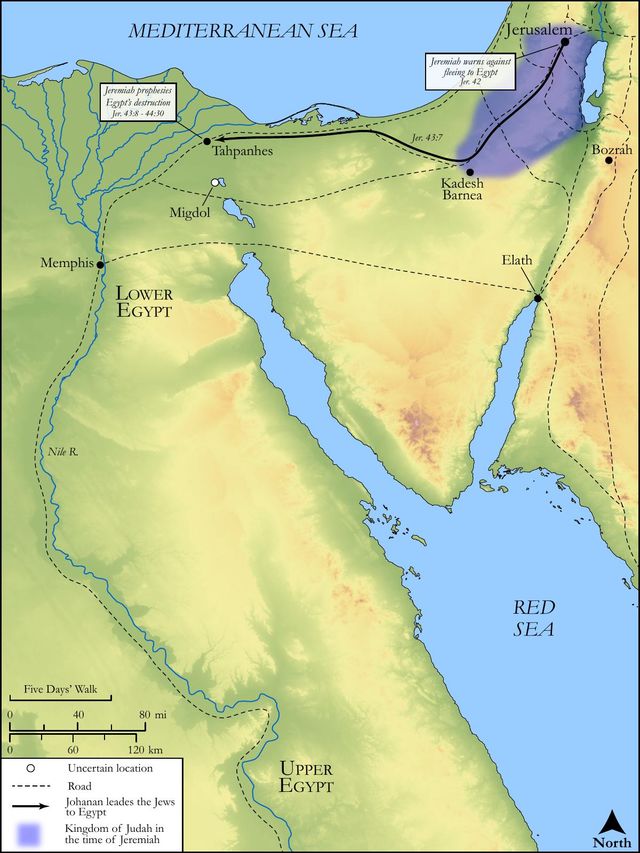
They resolve not to dwell in the land of Judah, as God had ordered them (Jer 43:4), but to go themselves with one consent and to take all that they had under their power along with them to Egypt. Those that came from all the nations whither they had been driven, to dwell in the land of Judah, out of a sincere affection to that land, they would not leave to their liberty, but forced them to go with them into Egypt (Jer 43:5), men, women, and children (Jer 43:6), a long journey into a strange country, an idolatrous country, a country that had never been kind of faithful to Israel; yet thither they would go, though they deserted their own land and threw themselves out of God's protection. It is the folly of men that they know not when they are well off, and often ruin themselves by endeavouring to better themselves; and it is the pride of great men to force those they have under their power to follow them, though ever so much against their duty and interest. These proud men compelled even Jeremiah the prophet and Baruch his scribe to go along with them to Egypt; they carried them away as prisoners, partly to punish them (and a greater punishment they could not inflict upon them than to force them against their consciences; theirs is the worst of tyranny who say to men's souls, even to good men's souls, Bow down, that we may go over), partly to put some reputation upon themselves and their own way. Though the prophets were under a force, they would make the world believe that they were voluntary in going along with them; and who could have blamed them for acting contrary to the word of the Lord if the prophets themselves had acted so? They came to Tahpanhes, a famous city of Egypt (so called from a queen of that name, Kg1 11:19), the same with Hanes (Isa 30:4); it was now the metropolis, for Pharaoh's house was there, Jer 43:9. No place could serve these proud men to settle in but the royal city and near the court, so little mindful were they of Joseph's wisdom, who would have his brethren settle in Goshen. If they had had the spirit of Israelites, they would have chosen rather to dwell in the wilderness of Judah than in the most pompous populous cities of Egypt.
Continue studying Jeremiah 43:1 across the web’s major study libraries — every link below opens this exact verse, chapter, or book on the destination site.
Read & Compare
 BibleGatewayThis verse in more than 200 translations and 70 languages.
 Bible.comThe YouVersion reader — hundreds of translations, reading plans, and highlights.
 ESV.orgCrossway's official English Standard Version reader.
 NET BibleThe NET translation with 60,000+ translators' notes on every rendering decision.
 STEP BibleTyndale House's free study tool — original text, vocabulary, and scholarly resources.
 BibliaLogos Bible Software's free web reader.
 USCCBThe New American Bible (Revised Edition) with the U.S. bishops' study notes.
Commentaries
 BibleHub CommentariesDozens of classic commentaries on this verse, gathered on one page.
 StudyLightMore than 100 commentary sets — the largest collection on the web.
 BibleRefPlain-English commentary on what this verse means, verse by verse.
 Enduring WordDavid Guzik's free commentary on this chapter, widely used by Bible teachers.
 Bible Study ToolsVerse commentary alongside Greek and Hebrew study aids.
Original Language & Research
- BibleHub InterlinearThe verse word by word — original language, transliteration, and English.
- BibleHub LexiconEvery word's original-language definition and Strong's entry.
 Blue Letter BibleDeep-study tools — Strong's numbers, concordance, and word studies.
 SefariaThe Hebrew text with Rashi and centuries of Jewish commentary.
Sermons, Hymns & Audio


TrulyRandomVerse is not affiliated with these sites and doesn’t control their content. They’re linked because they’re genuinely useful.
Summary
Jeremiah 43:1 serves as a pivotal transitional verse, definitively marking the conclusion of Jeremiah's faithful delivery of God's comprehensive message to the remnant of Judah. Following an intense period of divine communication and the people's solemn promise to obey, this verse underscores the prophet's unwavering commitment to his divine commission, having fully discharged the weighty responsibility of conveying every word that the LORD their God had sent him to speak, thereby setting the stage for the remnant's subsequent, and tragically disobedient, decision.
Context
ShowHideLiterary Context
Jeremiah 43:1 immediately follows the detailed account in Jeremiah 42 where the remnant of Judah, having survived the destruction of Jerusalem and the Babylonian siege, sought divine counsel from Jeremiah. They had solemnly promised to obey whatever the LORD commanded, declaring, "whether it be good, or whether it be evil" (Jeremiah 42:6). After a ten-day wait, Jeremiah delivered God's explicit instruction: remain in the land, and God would protect them; go to Egypt, and they would perish by sword, famine, and pestilence (Jeremiah 42:17). This verse, then, acts as the concluding statement to that prophetic interaction, emphasizing that Jeremiah had now fully and completely conveyed the divine will, leaving no room for ambiguity before the people's fateful response.
Historical & Cultural Context
The historical backdrop is the immediate aftermath of the fall of Jerusalem to Babylon in 586 BC. The city lay in ruins, the temple destroyed, and the majority of the population deported. A small, vulnerable remnant remained in Judah, fearful of Babylonian reprisals and uncertain of their future. In this climate of profound instability and trauma, the prospect of seeking refuge in Egypt, a historically powerful nation and a traditional ally (though often a source of temptation away from God's covenant), would have been culturally appealing to many. The people's request for Jeremiah's word, and their subsequent rejection of it, highlights a recurring theme in Israel's history: a tendency to trust in human alliances and perceived safety rather than in God's explicit commands, even when those commands seem counter-intuitive or dangerous.
Key Themes
ShowHideThis verse contributes significantly to several overarching themes in the book of Jeremiah. Firstly, it highlights the theme of Prophetic Faithfulness, showcasing Jeremiah's unwavering obedience to God's command to speak "all the words," regardless of the personal cost or the message's unpopularity. Secondly, it underscores the Completeness and Authority of God's Word, emphasizing that the divine message delivered through Jeremiah was exhaustive and unambiguous, leaving the people without excuse. Thirdly, its placement immediately before the account of the people's disobedience in Jeremiah 43:2-7 powerfully sets up the theme of Human Rebellion Against Divine Counsel. It creates a dramatic tension, foreshadowing the tragic irony of a people who earnestly sought God's word but ultimately chose to disregard it when it contradicted their own desires and plans, a pattern seen throughout Israel's history, from the wilderness wanderings recounted in Numbers to the exile itself, as detailed in books like 2 Kings.
Exposition and Analysis
ShowHideKey Word Analysis
ShowHideMeaning "Jah will rise." This name is deeply significant for the prophet, as his ministry often involved declaring God's rising judgment against Judah's sin, but also the eventual rising of a remnant and the establishment of a new covenant. In this verse, the mention of his name grounds the prophetic message in the person of God's chosen and faithful messenger.
A primitive root meaning "to end, whether intransitive (to cease, be finished, perish) or transitived (to complete, prepare, consume)." Here, it signifies the absolute completion of Jeremiah's speaking task. It conveys a sense of finality and thoroughness, indicating that nothing was held back, and the divine communication was fully discharged.
Meaning "a word; by implication, a matter (as spoken of) or thing." The repetition of "all the words" (H1697) following "speaking" (H1696, dâbar, the verbal form from the same root) emphatically highlights the comprehensive nature of the message. It was not merely a general idea, but specific, detailed instructions given by God, encompassing every aspect of His will for the remnant.
Verse Breakdown
ShowHide"And it came to pass, that when Jeremiah had made an end of speaking unto all the people"
This opening clause establishes the precise moment and setting, marking the completion of a significant prophetic event. The phrase "made an end of speaking" highlights the finality and thoroughness of Jeremiah's address, indicating that the prophetic discourse was exhaustive and delivered to the entire gathered remnant.
"all the words of the LORD their God,"
This crucial phrase emphasizes both the divine origin and the comprehensive nature of the message. It was not Jeremiah's personal opinion or counsel, but the direct, complete revelation from "the LORD their God"—Yahweh, their covenant God. The repetition of "all the words" underscores that no part of the divine counsel was omitted or altered.
"for which the LORD their God had sent him to them, even all these words,"
This concluding segment powerfully reinforces Jeremiah's role as a divinely commissioned messenger. His authority derived entirely from the LORD, who "sent him to them" with this specific and complete message. The final reiteration of "all these words" serves as a powerful summary, leaving no doubt about the totality and divine imperative of the instruction delivered.
Literary Devices
ShowHideThe verse employs several significant literary devices to underscore its message. Emphasis is powerfully achieved through Repetition, particularly the phrase "all the words," which appears twice within the short verse. This repetition underscores the completeness and exhaustive nature of the divine message delivered by Jeremiah, leaving no room for misunderstanding or partial obedience. Furthermore, the verse functions as a subtle yet potent moment of Foreshadowing. By explicitly stating that Jeremiah had finished speaking "all the words," the text subtly prepares the reader for the subsequent narrative of the people's disobedience. The meticulous completion of Jeremiah's duty stands in stark contrast to the people's impending failure to heed the very words they had promised to obey, creating a dramatic Irony that permeates the following chapters.
Theological and Thematic Connections
ShowHideJeremiah 43:1 profoundly illustrates the divine economy of revelation and human responsibility. It underscores God's faithfulness in providing clear, complete, and authoritative guidance to His people, even in their most desperate circumstances. The thoroughness of Jeremiah's delivery reflects God's own comprehensive nature in communicating His will, leaving no ambiguity for those who genuinely seek to obey. The theological weight of "all the words of the LORD their God" is immense; it signifies that God's counsel is sufficient, comprehensive, and demands a full response, not a selective one. This verse sets the stage for the tragic reality that even when God speaks plainly, human will often chooses its own path, revealing the persistent tension between divine sovereignty and human freedom, and the profound consequences of rejecting revealed truth.
Reflection and Application
ShowHideJeremiah 43:1 serves as a powerful mirror for both those who speak God's word and those who hear it. For those entrusted with proclaiming divine truth, it is a solemn reminder of the imperative to deliver "all the words" faithfully, without addition, subtraction, or compromise, regardless of the audience's receptivity or the personal cost. It calls for integrity, courage, and unwavering commitment to the full counsel of God. For those who listen, this verse is a profound challenge to genuine obedience. It highlights the danger of seeking God's guidance with a pre-determined outcome in mind, or of promising obedience only to disregard it when the divine will conflicts with personal desires, comfort, or perceived safety. Our response to God's complete revelation is the ultimate test of our faith and the true posture of our hearts. Do we truly desire God's will, or merely confirmation of our own?
Questions for Reflection
ShowHideFAQ
ShowHideWhat is the significance of the phrase "all the words" in this verse?
ShowHideThe repeated phrase "all the words" (Hebrew: dâbâr) is highly significant because it emphasizes the completeness, comprehensiveness, and finality of the message Jeremiah delivered. It underscores that Jeremiah held nothing back; every instruction, warning, and promise that "the LORD their God had sent him to them" was fully communicated. This precision highlights the divine origin and authority of the message, leaving the remnant without excuse for their subsequent disobedience, as detailed in Jeremiah 43:2-7. It signifies that God's revelation was sufficient and clear, demanding a full and unreserved response.
Christ-Centered Fulfillment
ShowHideJeremiah 43:1, with its emphasis on the complete and faithful delivery of God's word by His prophet, finds its ultimate fulfillment in Jesus Christ. Jeremiah was a faithful messenger, but Christ is the very embodiment and culmination of God's word. As John 1:1 declares, He is "the Word" made flesh, the perfect revelation of God. While Jeremiah delivered "all the words" from the LORD, Jesus is "all the words" of God, fully revealing the Father (John 14:9). Just as Jeremiah was "sent" by the LORD (Jeremiah 43:1), Jesus repeatedly affirms that He was "sent" by the Father to accomplish His will (John 5:36). Jeremiah's completed message was rejected by many, leading to judgment; similarly, Jesus' perfect revelation of truth was rejected, leading to His crucifixion, yet through His perfect obedience, He secured salvation for all who would believe (Philippians 2:8). Thus, Jeremiah's faithfulness foreshadows Christ's ultimate and perfect obedience in fully revealing and accomplishing God's redemptive plan.