


Jeremiah 39:17
Bible text: King James Version (1769 Blayney text) · Public domain
Bible text: Berean Standard Bible · Public domain
Bible text: American Standard Version (1901) · Public domain
Bible text: World English Bible, Messianic edition · Public domain
Bible text: Geneva Bible (1599) · Public domain
Bible text: Young's Literal Translation · Public domain
- וְהִצַּלְתִּיךָve·hi·tzal·Ti·khaand I will deliver youH5337Conj-w ¦ V-Hiphil-ConsecPerf-1cs ¦ 2msVerb Hiphil Consecutive Perfect 1st Singular common genderוְandהִצַּלְתִּיI will deliverךָyou
- בַיּוֹםvai·yomon the dayH3117Prep-b ¦ N-msNoun Singular Masculine Absoluteבַon theיּוֹםday
- הַהוּאha·Hu'<the> thatH1931Art ¦ Pro-3msPronoun Personal 3rd Singular Masculineהַ<the>הוּאthat
- נְאֻםne·'um[the] utterance ofH5002N-mscNoun Singular Masculine Construct
- יְהוָהYah·wehYahwehH3068N-properNoun Proper Title
- וְלֹאve·Lo'and notH3808Conj-w ¦ NegParticle Negativeוְandלֹאnot
- תִנָּתֵןti·na·Tenyou will be givenH5414V-Niphal-Imperf-2msVerb Niphal Imperfect 2nd Singular Masculine
- בְּיַדbe·Yadin [the] hand ofH3027Prep-b ¦ N-cscNoun Singular common gender Constructבְּinיַד[the] hand of
- הָאֲנָשִׁיםha·'a·na·Shimthe peopleH582Art ¦ N-mpNoun Plural Masculine Absoluteהָtheאֲנָשִׁיםpeople
- אֲשֶׁר'a·SherwhomH834RelParticle Relative
- אַתָּה'a·TahyouH859Pro-2msPronoun Personal 2nd Singular Masculine
- יָגוֹרya·Gor[are] fearfulH3016Adj-msAdjective Singular Masculine Absolute
- מִפְּנֵיהֶםmi·pe·nei·Hemof <before> themH6440Prep-m ¦ N-mpc ¦ 3mpNoun Plural Masculine Constructמִofפְּנֵי<before>הֶםthem
English is a literal word-by-word gloss of the Hebrew, not the KJV's wording. Why?
This is the original text the KJV's translators worked from — each Hebrew word with its own literal English meaning in this verse, prepared by scholars at Tyndale House, Cambridge. The KJV translates whole sentences, not word by word, so its wording differs: one Hebrew word can become several English words, and the KJV may choose “the LORD” where the gloss reads “Yahweh”. Both are faithful — they answer different questions. For the KJV's own rendering, switch to the KJV text.
Details
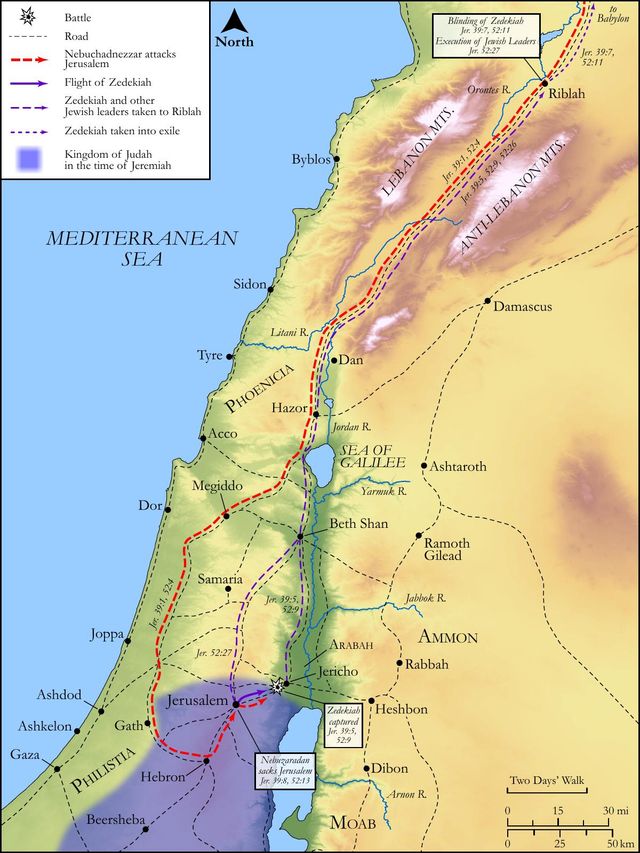
See on the biblical-era map
Study this verse
Public-domain commentary
Matthew Henry
From his Commentary on the Whole Bible. Henry comments on passages, not single verses — this entry covers Jeremiah 39:11–18. His two-level outline is real structure in the source text, so it is rendered as structure.
Here we must sing of mercy, as in the former part of the chapter we sang of judgment, and must sing unto God of both. We may observe here,
I.A gracious providence concerning Jeremiah.
When Jerusalem was laid in ruins, and all men's hearts failed them for fear, then might he lift up his head with comfort, knowing that his redemption drew nigh, as Christ's followers when the second destruction of Jerusalem was hastening on, Luk 21:28. Nebuchadnezzar had given particular orders that care should be taken of him, and that he should be in all respects well used, Jer 39:11, Jer 39:12. Hebuzar-adan and the rest of the king of Babylon's princes observed these orders, discharged him out of prison, and did every thing to make him easy, Jer 39:13, Jer 39:14. Now we may look upon this,
1.As a very generous act of Nebuchadnezzar, who, though he was a haughty potentate, yet took cognizance of this poor prophet. Doubtless he had received information concerning him from the deserters, that he had foretold the king of Babylon's successes against Judah and other countries, that he had pressed his prince and people to submit to him, and that he had suffered very hard things for so doing; and in consideration of all this (though perhaps he might have heard also that he had foretold the destruction of Babylon at length) he gave him these extraordinary marks of his favour. Note, It is the character of a great soul to take notice of the services and sufferings of the meanest. It was honourably done of the king to give this charge even before the city was taken, and of the captains to observe it even in the heat of action, and it is recorded for imitation.
2.As a reproach to Zedekiah and the princes of Israel. They put him in prison, and the king of Babylon and his princes took him out. God's people and ministers have often found fairer and kinder usage among strangers and infidels than among those that call themselves of the holy city. Paul found more favour and justice with king Agrippa than with Ananias the high priest.
3.As the performance of God's promise to Jeremiah, in recompence for his services. I will cause the enemy to treat thee well in the day of evil, Jer 15:11. Jeremiah had been faithful to his trust as a prophet, and now God approves himself faithful to him and the promise he had made him. Now he is comforted according to the time wherein he had been afflicted, and sees thousands fall on each hand and himself safe. The false prophets fell by those judgments which they said should never come (Jer 14:15), which made their misery the more terrible to them. The true prophet escaped those judgments which he said would come, and that made his escape the more comfortable to him. The same that were the instruments of punishing the persecutors were the instruments of relieving the persecuted; and Jeremiah thought never the worse of his deliverance for its coming by the hand of the king of Babylon, but saw the more of the hand of God in it. A fuller account of this matter we shall meet with in the next chapter.
II.A gracious message to Ebed-melech, to assure him of a recompence for his kindness to Jeremiah.
This message was sent to him by Jeremiah himself, who, when he returned him thanks for his kindness to him, thus turned him over to God to be his paymaster. He relieved a prophet in the name of a prophet, and thus he had a prophet's reward. This message was delivered to him immediately after he had done that kindness to Jeremiah, but it is mentioned here after the taking of the city, to show that, as God was kind to Jeremiah at that time, so he was to Ebed-melech for his sake; and it was a token of special favour to both, and they ought so to account it, that they were not involved in any of the common calamities. Jeremiah is directed to tell him,
1.That God would certainly bring upon Jerusalem the ruin that had been long and often threatened; and, for his further satisfaction in having been kind to Jeremiah, he should see him abundantly proved a true prophet, Jer 39:16.
2.That God took notice of the fear he had of the judgments coming. Though he was bravely bold in the service of God, yet he was afraid of the rod of God. The enemies were men of whom he was afraid, Note, God knows how to adapt and accommodate his comforts to the fears and griefs of his people, for he knows their souls in adversity.
3.That he shall be delivered from having a share in the common calamity: I will deliver thee; I will surely deliver thee. He had been instrumental to deliver God's prophet out of the dungeon, and now God promises to deliver him; for he will be behind-hand with none for any service they do, directly or indirectly, for his name: "Thou has saved Jeremiah's life, that was precious to thee, and therefore thy life shall be given thee for a prey." 4. The reason given for this distinguishing favour which God had in store for him is because thou hast put thy trust in me, saith the Lord. God, in recompensing men's services, has an eye to the principle they go upon in those services, and rewards according to those principles; and there is no principle of obedience that will be more acceptable to God, nor have a greater influence upon us, than a believing confidence in God. Ebed-melech trusted in God that he would own him, and stand by him, and then he was not afraid of the face of man. And those who trust God, as this good man did, in the way of duty, will find that their hope shall not make them ashamed in times of the greatest danger.
Historical interpretation
Historical reception
1 surviving comment on this verse from the historical church.
[Daniel 7:1] "In the first year of Belshazzar, King of Babylon, Daniel beheld a dream. And a vision of his head upon his bed. And when he wrote the dream down, he comprehended it in a few words and gave a brief summary of it, saying..." This section which we now undertake to explain, and also the subsequent section which we are going to discuss, is historically prior to the two previous sections. For this present section and that which follows it are recorded to have taken place in the first and third years of the reign of King Belshazzar (Jeremiah 39) [Jerome's citation of Jeremiah 39 seems quite pointless in this connection]. But the section which we read previously to the one just preceding this, is recorded to have taken place in the last year, indeed on the final day, of Belshaz-zar's reign. And we meet this phenomenon not only in Daniel but also in Jeremiah [cf. Jeremiah 35 and Jeremiah 34] and Ezekiel (Ezekiel 17), as we shall be able to show, if life spares us that long. But in the earlier portion of the book, the historical order has been followed, namely the events which occurred in the time of Nebuchadnezzar, and Belshazzar, and Darius or Cyrus. But in the passages now before us an account is given of various visions which were beheld on particular occasions and of which only the prophet himself was aware, and which therefore lacked any importance as signs or revelations so far as the barbarian nations were concerned. But they were written down only that a record of the things beheld might be preserved for posterity.
Continue studying Jeremiah 39:17 across the web’s major study libraries — every link below opens this exact verse, chapter, or book on the destination site.
Read & Compare
 BibleGatewayThis verse in more than 200 translations and 70 languages.
 Bible.comThe YouVersion reader — hundreds of translations, reading plans, and highlights.
 ESV.orgCrossway's official English Standard Version reader.
 NET BibleThe NET translation with 60,000+ translators' notes on every rendering decision.
 STEP BibleTyndale House's free study tool — original text, vocabulary, and scholarly resources.
 BibliaLogos Bible Software's free web reader.
 USCCBThe New American Bible (Revised Edition) with the U.S. bishops' study notes.
Commentaries
 BibleHub CommentariesDozens of classic commentaries on this verse, gathered on one page.
 StudyLightMore than 100 commentary sets — the largest collection on the web.
 BibleRefPlain-English commentary on what this verse means, verse by verse.
 Enduring WordDavid Guzik's free commentary on this chapter, widely used by Bible teachers.
 Bible Study ToolsVerse commentary alongside Greek and Hebrew study aids.
Original Language & Research
- BibleHub InterlinearThe verse word by word — original language, transliteration, and English.
- BibleHub LexiconEvery word's original-language definition and Strong's entry.
 Blue Letter BibleDeep-study tools — Strong's numbers, concordance, and word studies.
 SefariaThe Hebrew text with Rashi and centuries of Jewish commentary.
Sermons, Hymns & Audio


TrulyRandomVerse is not affiliated with these sites and doesn’t control their content. They’re linked because they’re genuinely useful.
Summary
Jeremiah 39:17 delivers a singular, profound promise of divine protection and deliverance to Ebed-melech the Ethiopian, an official in King Zedekiah's court, amidst the catastrophic fall of Jerusalem to the Babylonians. This oracle, delivered through the prophet Jeremiah, assures Ebed-melech that he would be spared from the impending destruction and from the very individuals whose power he feared, a direct reward for his courageous and compassionate act of rescuing Jeremiah from the miry pit. It stands as a powerful testament to God's meticulous care for those who demonstrate faithfulness and kindness, even when the broader nation faces severe judgment.
Context
ShowHideLiterary Context
This specific oracle to Ebed-melech (Jeremiah 39:15-18) is strategically placed within the narrative of Jerusalem's final moments before its destruction and the subsequent exile. Immediately preceding this, Jeremiah 39:1-14 details the breaching of Jerusalem's walls, the capture of King Zedekiah, and the subsequent treatment of Jeremiah by the Babylonian officials. The promise to Ebed-melech serves as a striking counterpoint to the widespread judgment described, highlighting God's particular attention to individual righteousness even amidst collective consequences. It directly follows the account of Ebed-melech's heroic intervention to save Jeremiah's life from the hostile Judean officials who had thrown him into a cistern to die, as recorded in Jeremiah 38:7-13. This divine promise thus functions as a direct, divinely-mandated reward for Ebed-melech's compassionate and courageous act.
Historical & Cultural Context
The historical backdrop is the climactic siege and fall of Jerusalem to Nebuchadnezzar's Babylonian forces in 586 BC. This period was marked by immense political instability, famine, and despair within the besieged city. King Zedekiah, a puppet king installed by Babylon, had rebelled, leading to the final siege. Within this volatile environment, Ebed-melech, an Ethiopian eunuch and an official in the royal palace, demonstrated remarkable courage. As a eunuch, he likely held a position of trust and influence, possibly overseeing the king's household or treasury. His act of appealing directly to the king to save Jeremiah, who was widely considered a traitor for prophesying Jerusalem's fall and advocating surrender, put his own life and position at extreme risk. The "men of whom thou art afraid" likely refers to the pro-Egyptian, anti-Jeremiah officials who had sought Jeremiah's death, or even the invading Chaldean soldiers, whose brutality was well-known.
Key Themes
ShowHideJeremiah 39:17 powerfully underscores several key themes prevalent throughout the book of Jeremiah and the broader biblical narrative. Firstly, it emphasizes Divine Sovereignty and Individual Deliverance, demonstrating God's absolute control over historical events and His capacity to provide specific protection for His faithful servants, even when an entire nation is under judgment. This contrasts sharply with the fate of the unrepentant nation, underscoring that God's justice is precise. Secondly, the verse highlights the theme of Reward for Righteousness and Compassion. Ebed-melech's deliverance is explicitly linked to his courageous act of kindness towards Jeremiah, illustrating the principle that God "is not unrighteous to forget your work and labor of love" found in Hebrews 6:10. Thirdly, it addresses Overcoming Fear through Divine Assurance, as God directly confronts Ebed-melech's apprehension, promising protection from those he dreaded. This theme resonates with God's repeated call to His people not to fear, as seen in passages like Isaiah 41:10. Finally, the story of Ebed-melech, a foreigner, showcases God's Universal Grace and Impartiality, revealing that His favor extends beyond ethnic or national boundaries to all who demonstrate faith and obedience, echoing the broader message of salvation for all nations found in Genesis 12:3.
Exposition and Analysis
ShowHideKey Word Analysis
ShowHideThis verb (H5337) signifies to "snatch away," "rescue," or "pluck out," often implying a forceful and decisive act of salvation by a superior power. It conveys more than mere preservation; it suggests an active intervention to remove someone from a dangerous situation or the grasp of an enemy. In this context, it underscores God's direct and powerful intervention to extricate Ebed-melech from the imminent peril of Jerusalem's fall and the hands of his adversaries.
The noun (H3027) "hand" is a primitive word with a vast semantic range, often used figuratively to denote power, control, authority, or possession. When someone is "given into the hand" of another, it means they are placed under their control, power, or judgment. Here, it vividly portrays the feared scenario of Ebed-melech falling under the dominion or vengeance of his enemies, emphasizing the totality of the protection promised by the LORD.
Derived from the root meaning "to fear," this adjective (H3016) describes Ebed-melech's state of being "fearful" or "dreading." It points to a deep, personal apprehension concerning specific individuals or circumstances. The divine promise directly addresses this internal state, assuring Ebed-melech that his deepest anxieties regarding his safety would not be realized, highlighting God's intimate knowledge of and response to the fears of His servants.
Verse Breakdown
ShowHide"But I will deliver thee in that day, saith the LORD"
This opening clause immediately establishes the divine speaker ("saith the LORD") and the personal nature of the promise. "That day" refers to the specific, calamitous day of Jerusalem's fall and destruction, a time of widespread judgment and peril. The verb "deliver" (Hebrew: nâtsal) signifies a forceful snatching away from danger, emphasizing God's active and decisive intervention on Ebed-melech's behalf, contrasting his fate with that of the city's inhabitants.
"and thou shalt not be given into the hand of the men of whom thou [art] afraid"
This second clause specifies the nature of the deliverance. Ebed-melech's fear was not abstract; it was directed towards "the men" who sought Jeremiah's life and, by extension, those who might harm anyone associated with him or seen as disloyal to the besieged city's leadership. The phrase "given into the hand" denotes falling under their power, control, or vengeful judgment. The promise directly negates this feared outcome, assuring Ebed-melech of complete immunity from their grasp, a direct consequence of God's protective decree.
Literary Devices
ShowHideJeremiah 39:17 is rich in Divine Oracle, explicitly stating "saith the LORD," which authenticates the promise as a direct, authoritative word from God, imbuing it with absolute certainty and power. There is a profound Contrast at play: while Jerusalem and its inhabitants face utter devastation and capture, Ebed-melech is singled out for deliverance. This highlights God's selective justice and mercy, distinguishing between the righteous and the rebellious. The verse also employs Assurance, as God directly addresses Ebed-melech's known fear ("men of whom thou art afraid") with a definitive negation, providing comfort and dispelling anxiety. The phrase "into the hand of" functions as Metonymy, where "hand" represents the power, control, and authority of the feared men, making the threat and the promised deliverance tangible and immediate.
Theological and Thematic Connections
ShowHideThis verse powerfully illustrates God's meticulous justice and unwavering faithfulness to those who honor Him, even amidst widespread national apostasy and judgment. It demonstrates that God's covenant loyalty extends to individuals who act righteously, regardless of their background, and that no act of faith or compassion, however small or risky, goes unnoticed or unrewarded by Him. Ebed-melech's story serves as a beacon of hope, assuring believers that even in the darkest times, God is capable of providing specific, personal deliverance and protection, often in ways that defy human expectation or logic. This divine intervention affirms God's sovereignty over all circumstances and His intimate knowledge of the fears and needs of His children.
Reflection and Application
ShowHideJeremiah 39:17 offers profound encouragement for believers navigating their own "days of trouble" or facing difficult choices. It reminds us that God is intimately aware of our fears and our acts of faithfulness, even those performed in obscurity or at great personal cost. Ebed-melech's courage in assisting Jeremiah, a prophet reviled by many, was not in vain; it secured divine favor and protection. This should inspire us to act with compassion and integrity, particularly towards those who are overlooked or persecuted for their faith, trusting that our efforts are seen and valued by God. In moments of fear or uncertainty, this verse calls us to anchor our hope in God's specific promise of deliverance, knowing that He has the power to rescue us from any "hand" that seeks to harm us, whether it be physical danger, spiritual oppression, or overwhelming anxiety. Our faithfulness, expressed through obedience and love, positions us to experience God's unique and personal protection, even when the world around us seems to be collapsing.
Questions for Reflection
ShowHideFAQ
ShowHideWho was Ebed-melech, and why was he singled out for this promise?
ShowHideEbed-melech was an Ethiopian eunuch, likely a high-ranking official in King Zedekiah's royal court in Jerusalem. He was singled out for this extraordinary promise of deliverance because of his courageous and compassionate act of intervening to save the prophet Jeremiah's life. When Jeremiah was thrown into a miry cistern by hostile officials who sought his death, Ebed-melech boldly appealed to King Zedekiah and orchestrated Jeremiah's rescue (see Jeremiah 38:7-13). This act of kindness and faith, performed when it was dangerous to help God's prophet, did not go unnoticed by the LORD, who explicitly rewarded his faithfulness with a promise of personal safety amidst the city's destruction.
What does "in that day" refer to in Jeremiah 39:17?
ShowHide"In that day" refers specifically to the day of Jerusalem's catastrophic fall to the Babylonians, a time of immense violence, destruction, and capture for its inhabitants. It signifies the very period of intense peril and judgment that Ebed-melech and the entire city were experiencing. The promise means that even amidst this widespread calamity, God would ensure Ebed-melech's personal safety and deliverance, contrasting his fate with the general destruction that befell the city and its leadership. This highlights God's ability to provide individual salvation even when collective judgment is being executed.
Christ-Centered Fulfillment
ShowHideJeremiah 39:17, with its promise of individual deliverance amidst national judgment, finds its ultimate and most profound fulfillment in Jesus Christ. Ebed-melech's rescue from the "hand of the men of whom he was afraid" foreshadows the far greater spiritual deliverance offered by Christ. Just as Ebed-melech was saved from physical death and the power of his enemies, so too does Christ deliver humanity from the ultimate enemies: sin, death, and the power of Satan. He is the ultimate Deliverer, who, through His crucifixion and resurrection, "has delivered us from the domain of darkness and transferred us to the kingdom of his beloved Son" (see Colossians 1:13). Ebed-melech's compassionate act towards Jeremiah, a prophet of God, is a beautiful type of the compassion and obedience of Christ, who, though innocent, willingly offered Himself as the ultimate sacrifice to rescue us. The fear Ebed-melech experienced is a human echo of the profound fear and agony Christ faced in Gethsemane, yet unlike Ebed-melech, Christ was not delivered from the "hand" of suffering and death, but embraced it to secure our eternal deliverance (see Luke 22:42). Thus, the promise to Ebed-melech points to the greater promise of salvation and eternal security found in the person and work of Jesus, who is "the Lamb of God, who takes away the sin of the world!" (see John 1:29). In Christ, all who place their faith in Him are delivered from the "hand" of eternal judgment and brought into the glorious freedom of God's children (see Romans 8:1-2).