


Isaiah 29:22
Bible text: King James Version (1769 Blayney text) · Public domain
Bible text: Berean Standard Bible · Public domain
Bible text: American Standard Version (1901) · Public domain
Bible text: World English Bible, Messianic edition · Public domain
Bible text: Geneva Bible (1599) · Public domain
Bible text: Young's Literal Translation · Public domain
- לָכֵןla·Khen<to> thereforeH3651Prep-l ¦ AdvAdverbלָ<to>כֵןtherefore
- כֹּהkohthusH3541AdvAdverb
- אָמַר'a·Marhe saysH559V-Qal-Perf-3msVerb Qal Perfect 3rd Singular Masculine
- יְהוָהYah·wehYahwehH3068N-properNoun Proper Title
- אֶל'eltoH413PrepPreposition
- בֵּיתbeit[the] house ofH1004N-mscNoun Singular Masculine Construct
- יַעֲקֹבya·'a·KoJacobH3290N-proper-mNoun Proper Masculine
- אֲשֶׁר'a·SherwhoH834RelParticle Relative
- פָּדָהpa·Dahhe redeemedH6299V-Qal-Perf-3msVerb Qal Perfect 3rd Singular Masculine
- אֶת'et<obj.>H853DirObjMParticle Object Indicator
- אַבְרָהָם'av·ra·HamAbrahamH85N-proper-mNoun Proper Masculine
- לֹאlo'notH3808NegParticle Negative
- עַתָּה'a·TahnowH6258AdvAdverb
- יֵבוֹשׁye·Vo·oshit will be ashamedH954V-Qal-Imperf-3msVerb Qal Imperfect 3rd Singular Masculine
- יַעֲקֹבya·'a·KoJacobH3290N-proper-mNoun Proper Masculine
- וְלֹאve·Lo'and notH3808Conj-w ¦ NegParticle Negativeוְandלֹאnot
- עַתָּה'a·TahnowH6258AdvAdverb
- פָּנָיוpa·Navits faceH6440N-mpc ¦ 3msNoun Plural Masculine Constructפָּנָיfaceוits
- יֶחֱוָרוּye·che·Va·ruthey will grow paleH2357V-Qal-Imperf-3mpVerb Qal Imperfect 3rd Plural Masculine
English is a literal word-by-word gloss of the Hebrew, not the KJV's wording. Why?
This is the original text the KJV's translators worked from — each Hebrew word with its own literal English meaning in this verse, prepared by scholars at Tyndale House, Cambridge. The KJV translates whole sentences, not word by word, so its wording differs: one Hebrew word can become several English words, and the KJV may choose “the LORD” where the gloss reads “Yahweh”. Both are faithful — they answer different questions. For the KJV's own rendering, switch to the KJV text.
Details
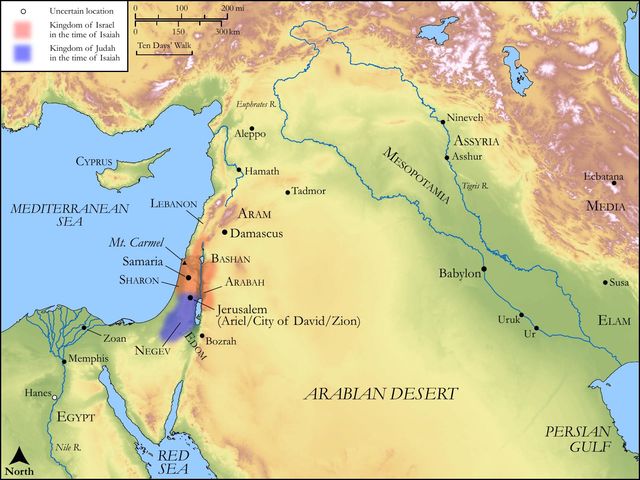
See on the biblical-era map
Study this verse
Public-domain commentary
Matthew Henry
From his Commentary on the Whole Bible. Henry comments on passages, not single verses — this entry covers Isaiah 29:17–24. His three-level outline is real structure in the source text, so it is rendered as structure.
Those that thought to hide their counsels from the Lord were said to turn things upside down (Isa 29:16), and they intended to do it unknown to God; but God here tells them that he will turn things upside down his way; and let us see whose word shall stand, his or theirs. They disbelieve Providence: "Wait awhile," says God, "and you shall be convinced by ocular demonstration that there is a God who governs the world, and that he governs it and orders all the changes that are in it for the good of his church." The wonderful revolution here foretold may refer primarily to the happy settlement of the affairs of Judah and Jerusalem after the defeat of Sennacherib's attempt, and the repose which good people then enjoyed, when they were delivered from the alarms of the sword both of war and persecution. But it may look further, to the rejection of the Jews at the first planting of the gospel (for their hypocrisy and infidelity were here foretold, Isa 29:13) and the admission of the Gentiles into the church.
I.In general, it is a great and surprising change that is here foretold, Isa 29:17.
Lebanon, that was a forest, shall be turned into a fruitful field; and Carmel, that was a fruitful field, shall become a forest. It is a counterchange. Note, Great changes, both for the better and for the worse, are often made in a very little while. It was a sign given them of the defeat of Sennacherib that the ground should be more than ordinarily fruitful (Isa 37:30): You shall eat this year such as grows of itself; food for man shall be (as food for beasts is) the spontaneous product of the soil. Then Lebanon became a fruitful field, so fruitful that that which used to be reckoned a fruitful field in comparison with it was looked upon but as a forest. When a great harvest of souls was gathered in to Christ from among the Gentiles then the wilderness was turned into a fruitful field; and the Jewish church, that had long been a fruitful field, became a desolate and deserted forest, Isa 54:1.
II.In particular,
1.Those that were ignorant shall become intelligent, Isa 29:18. Those that understood not this prophecy (but it was to them as a sealed book, Isa 29:11) shall, when it is accomplished, understand it, and shall acknowledge, not only the hand of God in the event, but the voice of God in the prediction of it: The deaf shall then hear the words of the book. The fulfilling of prophecy is the best exposition of it. The poor Gentiles shall then have divine revelation brought among them; and those that sat in darkness shall see a great light, those that were blind shall see out of obscurity; for the gospel was sent to them to open their eyes, Act 26:18. Observe, In order to the making of men fruitful in good affections and actions, the course God's grace takes with them is to open their understandings and make them hear the words of God's book.
2.Those that were erroneous shall become orthodox (Isa 29:24): Those that erred in spirit, that were under mistakes and misapprehensions concerning the words of the book and the meaning of them, shall come to understanding, to a right understanding of things; the Spirit of truth shall rectify their mistakes and lead them into all truth. This should encourage us to pray for those that have erred and are deceived, that God can, and often does, bring such to understanding. Those that murmured at the truths of God as hard sayings, and loved to pick quarrels with them, shall learn the true meaning of these doctrines, and then they will be better reconciled to them. Those that erred concerning the providence of God as to public affairs, and murmured at the disposals of it, when they shall see the issue of things shall better understand them and be aware of what God was designing in all, Hos 14:9.
3.Those that were melancholy shall become cheerful and pleasant (Isa 29:19): The meek also shall increase their joy in the Lord. Those who are poor in the world and poor in spirit, who, being in affliction, accommodate themselves to their affliction, are purely passive and not passionate, when they see God appearing for them, they shall add, or repeat, joy in the Lord. This intimates that even in their distress they kept up their joy in the Lord, but now they increased it. Note, Those who, when they are in trouble, can truly rejoice in God, shall soon have cause given them greatly to rejoice in him. When joy in the world is decreasing and fading joy in God is increasing and getting round. This shining light shall shine more and more; for that which is aimed at is that this joy may be full. Even the poor among men may rejoice in the Holy One of Israel, and their poverty needs not deprive them of that joy, Hab 3:17, Hab 3:18. And the meek, the humble, the patient, and dispassionate, shall grow in this joy. Note, The grace of meekness will contribute very much to the increase of our holy joy.
4.The enemies, that were formidable, shall become despicable. Sennacherib, that terrible one, and his great army, that put the country into such a consternation, shall be brought to nought (Isa 29:20), shall be quite disabled to do any further mischief. The power of Satan, that terrible one indeed, shall be broken by the prevalency of Christ's gospel; and those that were subject to bondage through fear of him that had the power of death shall be delivered, Heb 2:14, Heb 2:15.
5.The persecutors, that were vexatious, shall be quieted, and so those they were troublesome to shall be quiet from the fear of them. To complete the repose of God's people, not only the terrible one from abroad shall be brought to nought, but the scorners at home too shall be consumed and cut off by Hezekiah's reformation. Those are a happy people, and likely to be so, who, when God gives them victory and success against their terrible enemies abroad, take care to suppress vice, and profaneness, and the spirit of persecution, those more dangerous enemies at home. Or, They shall be consumed and cut off by the judgments of God, shall be singled out to be made examples of. Or, They shall insensibly waste away, being put to confusion by the fulfilling of those predictions which they had made a jest of. Observe what had been the wickedness of these scorners, for which they should be cut off. They had been persecutors of God's people and prophets, probably of the prophet Isaiah particularly, and therefore he complains thus feelingly of them and of their subtle malice. Some as informers and persecutors, others as judges, did all they could to take away his life, or at least his liberty. And this is very applicable to the chief priests and Pharisees, who persecuted Christ and his apostles, and for that sin they and their nation of scorners were cut off and consumed.
(1.)They ridiculed the prophets and the serious professors of religion; they despised them, and did their utmost to bring them into contempt; they were scorners, and sat in the seat of the scornful.
(2.)They lay in wait for an occasion against them. By their spies they watch for iniquity, to see if they can lay hold of any thing that is said or done that may be called an iniquity. Or they themselves watch for an opportunity to do mischief, as Judas did to betray our Lord Jesus.
(3.)They took advantage against them for the least slip of the tongue; and, if a thing were ever so little said amiss, it served them to ground an indictment upon. They made a man, though he were ever so wise and good a man, though he were a man of God, an offender for a word, a word mischosen or misplaced, when they could not but know that it was well meant, Isa 29:21. They cavilled at every word that the prophets spoke to them by way of admonition, though ever so innocently spoken, and without any design to affront them. They put the worst construction upon what was said, and made it criminal by strained innuendoes. Those who consider how apt we all are to speak unadvisedly, and to mistake what we hear, will think it very unjust and unfair to make a man an offender for a word.
(4.)They did all they could to bring those into trouble that dealt faithfully with them and told them of their faults. Those that reprove in the gates, reprovers by office, that were bound by the duty of their place, as prophets, as judges, and magistrates, to show people their transgressions, they hated these, and laid snares for them, as the Pharisees' emissaries, who were sent to watch our Saviour that they might entangle him in his talk (Mat 22:15), that they might have something to lay to his charge which might render him odious to the people or obnoxious to the government. So persecuted they the prophets; and it is next to impossible for the most cautious to place their words so warily as to escape such snares. See how base wicked people are, who bear ill-will to those who, out of good-will to them, seek to save their souls from death; and see what need reprovers have both of courage to do their duty and of prudence to avoid the snare.
(5.)They pervert judgment, and will never let an honest man carry an honest cause: They turn aside the just for a thing of nought; they condemn him, or give the cause against him, upon no evidence, no colour or pretence whatsoever. They run a man down, and misrepresent him, by all the little arts and tricks they can devise, as they did our Saviour. We must not think it strange if we see the best of men thus treated; the disciple is not greater than his Master. But wait awhile, and God will not only bring forth their righteousness, but cut off and consume these scorners.
6.Jacob, who was made to blush by the reproaches, and made to tremble by the threatenings, of his enemies, shall now be relieved both against his shame and against his fear, by the rolling away of those reproaches and the defeating of those threatenings (Isa 29:22): Thus the Lord saith who redeemed Abraham, that is, called him out of Ur of the Chaldees, and so rescued him from the idolatry of his fathers and plucked him as a brand out of the fire. He that redeemed Abraham out of his snares and troubles will redeem all that are by faith his genuine seed out of theirs. He that began his care of his church in the redemption of Abraham, when it and its Redeemer were in his loins, will not now cast off the care of it. Because the enemies of his people are so industrious both to blacken them and to frighten them, therefore he will appear for the house of Jacob, and they shall not be ashamed as they have been, but shall have wherewith to answer those that reproach them, nor shall their faces now wax pale; but they shall gather courage, and look their enemies in the face without change of countenance, as those have reason to do who have the God of Abraham on their side.
7.Jacob, who thought his family would be extinct and the entail of religion quite cut off, shall have the satisfaction of seeing a numerous progeny devoted to God for a generation, Isa 29:23.
(1.)He shall see his children, multitudes of believers and praying people, the spiritual seed of faithful Abraham and wrestling Jacob. Having his quiver full of these arrows, he shall not be ashamed (Isa 29:22) but shall speak with his enemy in the gate, Psa 127:5. Christ shall not be ashamed (Isa 50:7), for he shall see his seed (Isa 53:10); he sees some, and foresees more, in the midst of him, flocking to the church, and residing there.
(2.)His children are the work of God's hands; being formed by him, they are formed for him, his workmanship, created unto good works. It is some comfort to parents to think that their children are God's creatures, the work of the hands of his grace.
(3.)He and his children shall sanctify the name of God as their God, as the Holy One of Jacob, and shall fear and worship the God of Israel. This is opposed to his being ashamed and waxing pale; when he is delivered from his contempts and dangers he shall not magnify himself, but sanctify the Holy One of Jacob. If God make our condition easy, we must endeavour to make his name glorious. Parents and children are ornaments and comforts indeed to each other when they join in sanctifying the name of God. When parents give up their children, and children give up themselves, to God, to be to him for a name and a praise, then the forest will soon become a fruitful field.
Historical interpretation
Historical reception
1 surviving comment on this verse from the historical church.
(Verses 22 onwards) Therefore, the Lord says to the house of Jacob, who redeemed Abraham: Jacob will not only be ashamed, but his face will also turn red. But when he sees his children, the works of my hands, in their midst sanctifying my name, they will sanctify the Holy Jacob, and they will proclaim the God of Israel. And those who wander in spirit will gain understanding, and murmurers will learn the Law. (LXX: Therefore, the Lord says about the house of Jacob, whom he overcame from Abraham: Jacob will not only be ashamed, but his face will not change now; but when he sees his children, my works, they will sanctify my name because of me, and they will sanctify the Holy Jacob, and they will fear the God of Israel, and those who wander in spirit will gain understanding, and murmurers will learn obedience, and what follows ÷ and those with stammering tongues will learn to speak peace. ** Note: marked with an obelus.) When the deaf hear, says he, the words of the book, and the eyes of the blind see: the Lebanus has been turned into Charmel, and Charmel is regarded as a forest, so that the meek and the poor rejoice in the Lord, and the proud and the scoffers are overcome: then Jacob, who now is not yet ashamed, will be put to shame. But this refers to the times of Isaiah. And his face will blush, so that blushing and confusion may be the occasion of salvation, especially when he sees his sons, that is, the Apostles and apostolic men, who were from the race of the Jews, performing miracles in the midst of the nations of the Lord, and preaching the name of Christ to the Gentiles, and saying: Our Father, who art in heaven, hallowed be thy name (Matt. 6:9). For they shall sanctify the Holy One who was born of Jacob, and they shall teach the God of Israel among the nations, so that, the idols being abandoned, they may say: how false were the idols that our fathers possessed, and there is no power in them; and then those who now wander in spirit will understand the knowledge of God, and those who once murmured against the Lord in the wilderness will learn the Law, of which they previously had no knowledge. For if they had received Moses, they would have also received the Lord Jesus Christ, because Moses spoke of him. What we have translated in the beginning of the chapter according to the Hebrew: This is what the Lord says to the house of Jacob, who once redeemed Abraham, and brought him out from the Chaldeans, and led him into the promised land (Gen. XI), is clearly evident. However, what the Seventy translated: This is what the Lord says about the house of Jacob, which he separated from Abraham, can be understood as meaning that he has separated the Scribes and Pharisees, who blasphemed the Lord, from Abraham, who saw the day of the Lord and rejoiced (John VIII). For if they were the children of Abraham, they would do the works of Abraham. And the Apostle argues that those who have the likeness of the faith of Abraham, that is, the people of the Gentiles, who are called children of Abraham not by works but by faith (Hebrews XI).
Continue studying Isaiah 29:22 across the web’s major study libraries — every link below opens this exact verse, chapter, or book on the destination site.
Read & Compare
 BibleGatewayThis verse in more than 200 translations and 70 languages.
 Bible.comThe YouVersion reader — hundreds of translations, reading plans, and highlights.
 ESV.orgCrossway's official English Standard Version reader.
 NET BibleThe NET translation with 60,000+ translators' notes on every rendering decision.
 STEP BibleTyndale House's free study tool — original text, vocabulary, and scholarly resources.
 BibliaLogos Bible Software's free web reader.
 USCCBThe New American Bible (Revised Edition) with the U.S. bishops' study notes.
Commentaries
 BibleHub CommentariesDozens of classic commentaries on this verse, gathered on one page.
 StudyLightMore than 100 commentary sets — the largest collection on the web.
 BibleRefPlain-English commentary on what this verse means, verse by verse.
 Enduring WordDavid Guzik's free commentary on this chapter, widely used by Bible teachers.
 Bible Study ToolsVerse commentary alongside Greek and Hebrew study aids.
Original Language & Research
- BibleHub InterlinearThe verse word by word — original language, transliteration, and English.
- BibleHub LexiconEvery word's original-language definition and Strong's entry.
 Blue Letter BibleDeep-study tools — Strong's numbers, concordance, and word studies.
 SefariaThe Hebrew text with Rashi and centuries of Jewish commentary.
Sermons, Hymns & Audio


TrulyRandomVerse is not affiliated with these sites and doesn’t control their content. They’re linked because they’re genuinely useful.
Summary
Isaiah 29:22 delivers a powerful divine declaration of hope and restoration for the "house of Jacob," contrasting sharply with the preceding pronouncements of judgment and spiritual blindness. Through the authoritative voice of the LORD, who faithfully redeemed Abraham, a future is promised where Jacob—representing the nation of Israel—will no longer experience the humiliation of shame or the paralyzing grip of fear, signifying a profound reversal of their current state of spiritual and national distress. This verse underscores God's unwavering commitment to His covenant people, assuring them of eventual honor, security, and spiritual renewal grounded in His unchanging character and historical faithfulness.
Context
ShowHideLiterary Context
Isaiah 29 is a complex chapter that initially focuses on God's judgment against Jerusalem, referred to as "Ariel," for its spiritual dullness, hypocrisy, and reliance on human wisdom rather than divine revelation. Verses like Isaiah 29:9-10 describe the people as being in a deep spiritual slumber, blind and deaf to God's truth, while Isaiah 29:13-14 condemn their worship as mere lip service, devoid of genuine heart devotion. However, the chapter pivots dramatically in verses Isaiah 29:17-21, promising a radical transformation where the deaf will hear, the blind will see, and the humble will rejoice. Verse 22 then builds upon this promise of future spiritual and national revival, providing a specific assurance of deliverance from shame and fear, firmly rooted in God's historical faithfulness to their patriarch.
Historical & Cultural Context
The prophecies in Isaiah were delivered during a tumultuous period in Judah's history, marked by the rising power of the Assyrian Empire. Judah faced constant threats of invasion and political instability, often leading them to seek alliances with foreign powers rather than trusting in the LORD. Spiritually, the nation was largely apostate, adopting pagan practices and exhibiting widespread oppression, despite maintaining outward religious rituals. The concept of "shame" (Hebrew bûwsh) was deeply significant in Israel, often associated with public disgrace, defeat, or the failure to live up to societal or covenantal expectations. To "wax pale" (Hebrew châvar) vividly describes the physical manifestation of terror or confusion, reflecting a state of utter helplessness and fear in the face of overwhelming threats. Isaiah's message, therefore, addresses a people living under the shadow of both external political threats and internal spiritual decay, offering a vision of divine intervention that would reverse their dire circumstances.
Key Themes
ShowHideThis verse contributes significantly to several major theological and narrative themes within Isaiah and the broader prophetic literature. Firstly, it highlights Divine Faithfulness and Covenant Keeping, grounding God's future promise in His past redemptive acts, specifically His deliverance of Abraham. This emphasizes God's unwavering commitment to His covenant people despite their failures. Secondly, it powerfully illustrates the theme of Reversal of Shame and Fear, promising a future state of honor, security, and confidence for Israel, a stark contrast to their present humiliation and terror. This reversal is a hallmark of God's redemptive work, transforming a people from disgrace to glory. Lastly, the verse underscores the overarching theme of Restoration and Hope, pointing to a profound spiritual and national revival for Israel, where God's presence brings true peace and security, fulfilling His ultimate purposes for His chosen nation, as also seen in passages like Isaiah 43.
Exposition and Analysis
ShowHideKey Word Analysis
ShowHideThis is the personal, covenantal name of God, often translated "Jehovah" or "the Lord." It signifies "the self-Existent or Eternal," emphasizing God's unchanging, sovereign nature and His active presence in history. The use of this name here reinforces the absolute authority and reliability of the promise, as it comes from the One who eternally exists and fulfills His word.
This primitive root means "to sever, i.e. ransom; gener. to release, preserve." It implies an act of deliverance, often involving a price or a powerful intervention to set free from bondage or peril. By stating that the LORD "redeemed Abraham," the prophet invokes God's historical acts of liberation and protection, establishing a powerful precedent for His future redemption of Jacob.
This root properly means "to pale," and by implication, "to be ashamed," also carrying the sense of being disappointed or confounded. In the context of Isaiah 29:22, it refers to the humiliation, public disgrace, or profound disappointment Israel would experience due to their unfaithfulness, military defeats, or spiritual blindness. The promise of "not now be ashamed" signifies a complete reversal of this state, encompassing freedom from the physical manifestations of terror or dismay, such as a face that "waxes pale."
Verse Breakdown
ShowHide"Therefore thus saith the LORD, who redeemed Abraham"
This opening clause establishes the divine authority and the historical precedent for the promise. "Thus saith the LORD" is a classic prophetic formula, indicating that the following words are not human opinion but a direct revelation from the sovereign God, Yahweh. The parenthetical phrase "who redeemed Abraham" serves as a powerful reminder of God's consistent character as a deliverer and covenant-keeper. It grounds the future promise in God's past faithfulness, specifically His acts of rescuing and protecting Abraham from various perils and establishing His covenant with him.
"concerning the house of Jacob, Jacob shall not now be ashamed"
The promise is specifically directed to "the house of Jacob," which is a metaphorical reference to the nation of Israel, Abraham's descendants. The repetition of "Jacob" emphasizes the direct and personal nature of the promise to the collective people. The core promise here is that Israel will no longer experience "shame." This shame could stem from their idolatry, their military defeats, their spiritual blindness, or their unfaithfulness to God. The divine declaration promises a reversal of this disgrace, implying restoration to honor, dignity, and a right standing before God and the nations.
"neither shall his face now wax pale"
This phrase further elaborates on the state of future security and confidence. To "wax pale" signifies being struck with terror, fear, or confusion, causing a physical change in countenance. The negation of this state means that Israel will be free from paralyzing fear, anxiety, or dismay in the face of their enemies or challenging circumstances. It speaks to a profound inner peace and outward composure that comes from divine protection and assurance.
Literary Devices
ShowHideIsaiah 29:22 employs several potent literary devices to convey its message of hope and divine intervention. The most prominent is Divine Oracle, signaled by the phrase "Thus saith the LORD," which immediately establishes the absolute authority and certainty of the ensuing promise. This formula elevates the message from human conjecture to divine decree. Historical Allusion is central to the verse through the reference to "who redeemed Abraham." This allusion serves as a powerful reminder of God's past faithfulness and provides a foundational assurance that the God who acted decisively for the patriarch will also act for his descendants. Furthermore, the verse uses Parallelism in the concluding clauses: "Jacob shall not now be ashamed, neither shall his face now wax pale." This synonymous parallelism reinforces the central promise of deliverance from both humiliation and fear, using two distinct but related expressions to amplify the message. Finally, Metonymy is present in "his face now wax pale," where "face" stands in for the person's emotional state, vividly depicting the internal terror through its outward physical manifestation.
Theological and Thematic Connections
ShowHideIsaiah 29:22 stands as a testament to God's enduring covenant faithfulness and His redemptive character, echoing themes found throughout the biblical narrative. It reveals a God who remembers His promises, even when His people are unfaithful, and who has the power to reverse their deepest shames and fears. The promise of freedom from shame and terror is rooted in God's historical act of redemption for Abraham, establishing a pattern of divine intervention for His chosen lineage. This verse points forward to a comprehensive restoration, not merely political, but spiritual and existential, where the very identity of Jacob is transformed from one marked by disgrace to one characterized by divine favor and security. It underscores that true peace and honor come not from human effort or alliances, but solely from the LORD's redemptive work.
Reflection and Application
ShowHideIsaiah 29:22 offers profound encouragement for believers today, reminding us that the God who faithfully redeemed Abraham and promised restoration to Jacob is the same God who works in our lives. In a world often characterized by shame, fear, and insecurity, this verse provides a divine anchor. It assures us that our identity and security are not defined by our past failures or present anxieties, but by God's unchanging character and His redemptive power. Just as Jacob was promised a reversal of fortune, we too can experience freedom from the burdens of guilt, regret, and paralyzing fear through God's grace. This promise calls us to trust in God's faithfulness even when circumstances seem bleak, knowing that He is able to transform our shame into honor and our fear into peace. It invites us to live with confidence, not in our own strength, but in the unwavering love and redemptive work of our faithful God.
Questions for Reflection
ShowHideFAQ
ShowHideWhat is the significance of God being described as "who redeemed Abraham" in this verse?
ShowHideThe phrase "who redeemed Abraham" is highly significant because it grounds the promise to Jacob in God's historical and consistent character as a faithful deliverer. It serves as a powerful reminder of God's past acts of liberation and preservation for the patriarch Abraham, such as rescuing him from Ur of the Chaldees (Genesis 11:31), protecting him from Pharaoh (Genesis 12:17-20), and delivering him from the kings in Genesis 14). By invoking this precedent, Isaiah assures Israel that the same God who acted powerfully for their ancestor will also act to redeem and restore them, demonstrating His unwavering commitment to His covenant people across generations.
What does "the house of Jacob" refer to in this context?
ShowHide"The house of Jacob" is a common biblical idiom referring to the nation of Israel, the descendants of Jacob (who was renamed Israel). In this prophetic context, it represents the collective people of God—both the northern kingdom (Israel) and the southern kingdom (Judah)—who are the recipients of this divine promise. While the immediate audience might have been Judah, the promise extends to the entire covenant people, signifying a comprehensive restoration for the nation as a whole. It emphasizes their identity as God's chosen family, despite their current state of spiritual and national decline.
Is this promise of "not being ashamed" and "not waxing pale" only for ancient Israel, or does it apply to believers today?
ShowHideWhile the immediate historical context of Isaiah 29:22 is ancient Israel, the theological principles embedded within the promise have timeless application for believers today. The God who "redeemed Abraham" and promised to deliver Jacob from shame and fear is the same God who saves and sustains His people in every generation. Through Christ, believers become part of the spiritual "seed of Abraham" and the "Israel of God" (Galatians 3:29 and Galatians 6:16). Therefore, the promise of freedom from shame (through forgiveness and new identity in Christ, as seen in Romans 5:5) and fear (through God's presence and power, as promised in Isaiah 41:10) resonates deeply with the Christian experience. It assures us that in Christ, we have a secure hope and a divine Helper who banishes our deepest anxieties and frees us from the disgrace of sin.
Christ-Centered Fulfillment
ShowHideIsaiah 29:22 finds its ultimate and most profound fulfillment in Jesus Christ, who is the true redeemer and the one through whom all of God's promises find their "Yes" and "Amen" (2 Corinthians 1:20). The LORD, who "redeemed Abraham" through His covenant faithfulness, has now, in Christ, accomplished the ultimate redemption for all who believe. The "house of Jacob" in its fullest sense refers not just to ethnic Israel, but to all who are brought into God's family through faith in Jesus, becoming the spiritual Israel (Galatians 3:7). Through Christ's atoning sacrifice on the cross, the deepest shame of humanity—our sin and rebellion against God—has been fully removed, so that those who trust in Him "shall not be put to shame" (Romans 10:11). Moreover, the fear that causes one's "face to wax pale," whether it be the fear of judgment, death, or the unknown, is conquered by Christ's victory over sin and the grave (Hebrews 2:14-15). In Him, believers receive a spirit of adoption, not of fear (Romans 8:15), and are granted perfect peace that casts out all fear (1 John 4:18). Thus, the promise to Jacob of freedom from shame and fear is fully realized in the new covenant established by Christ, extending to all who are united with Him.