


Isaiah 18:6
- יֵעָזְבוּye·'a·ze·Vuthey will be abandonedH5800V-Niphal-Imperf-3mpVerb Niphal Imperfect 3rd Plural Masculine
- יַחְדָּוyach·DavalikeH3162AdvAdverb
- לְעֵיטle·'Eitto bird[s] of prey ofH5861Prep-l ¦ N-mscNoun Singular Masculine Constructלְtoעֵיטbird[s] of prey of
- הָרִיםha·Rim[the] mountainsH2022N-mpNoun Plural Masculine Absolute
- וּלְבֶהֱמַתu·le·ve·he·Matand to [the] animal[s] ofH929Conj-w ¦ Prep-l ¦ N-fscNoun Singular Feminine Constructוּandלְtoבֶהֱמַת[the] animal[s] of
- הָאָרֶץha·'A·retzthe earthH776Art ¦ N-fsNoun Singular Feminine Absoluteהָtheאָרֶץearth
- וְקָץve·Katzand it will pass [the] summerH6972Conj-w ¦ V-Qal-ConsecPerf-3msVerb Qal Consecutive Perfect 3rd Singular Masculineוְandקָץit will pass [the] summer
- עָלָיו'a·Lavon itH5921Prep ¦ 3msPrepositionעָלָיonוit
- הָעַיִטha·'A·yitthe bird[s] of preyH5861Art ¦ N-msNoun Singular Masculine Absoluteהָtheעַיִטbird[s] of prey
- וְכָלve·kholand everyH3605Conj-w ¦ N-mscNoun Singular Masculine Constructוְandכָלevery
- בֶּהֱמַתbe·he·Mat<the> animal ofH929N-fscNoun Singular Feminine Construct
- הָאָרֶץha·'A·retzthe earthH776Art ¦ N-fsNoun Singular Feminine Absoluteהָtheאָרֶץearth
- עָלָיו'a·Lavon itH5921Prep ¦ 3msPrepositionעָלָיonוit
- תֶּחֱרָףte·che·Rafit will pass [the] winterH2778V-Qal-Imperf-3fsVerb Qal Imperfect 3rd Singular Feminine
English is a literal word-by-word gloss of the Hebrew, not the KJV's wording. Why?
This is the original text the KJV's translators worked from — each Hebrew word with its own literal English meaning in this verse, prepared by scholars at Tyndale House, Cambridge. The KJV translates whole sentences, not word by word, so its wording differs: one Hebrew word can become several English words, and the KJV may choose “the LORD” where the gloss reads “Yahweh”. Both are faithful — they answer different questions. For the KJV's own rendering, switch to the KJV text.
Details
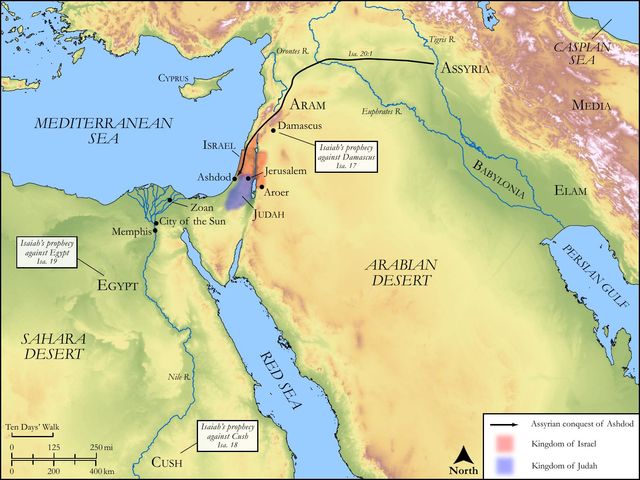
See on the biblical-era map
Study this verse
Public-domain commentary
Matthew Henry
From his Commentary on the Whole Bible. Henry comments on passages, not single verses — this entry covers Isaiah 18:1–7. His three-level outline is real structure in the source text, so it is rendered as structure.
Interpreters are very much at a loss where to find this land that lies beyond the rivers of Cush. Some take it to be Egypt, a maritime country, and full of rivers, and which courted Israel to depend upon them, but proved broken reeds; but against this it is strongly objected that the next chapter is distinguished from this by the title of the burden of Egypt. Others take it to be Ethiopia, and read it, which lies near, or about, the rivers of Ethiopia, not that in Africa, which lay south of Egypt, but that which we call Arabia, which lay east of Canaan, which Tirhakah was now king of. He thought to protect the Jews, as it were, under the shadow of his wings, by giving a powerful diversion to the king of Assyria, when he made a descent upon his country, at the time that he was attacking Jerusalem, Kg2 19:9. But though by his ambassadors he bade defiance to the king of Assyria, and encouraged the Jews to depend upon him, God by the prophet slights him, and will not go forth with him; he may take his own course, but God will take another course to protect Jerusalem, while he suffers the attempt of Tirhakah to miscarry and his Arabian army to be ruined; for the Assyrian army shall become a present or sacrifice to the Lord of hosts, and to the place of his name, by the hand of an angel, not by the hand of Tirhakah king of Ethiopia, Isa 18:7. This is a very probable exposition of this chapter. But from a hint of Dr. Lightfoot's, in his Harmony of the Old Testament, I incline to understand this chapter as a prophecy against Assyria, and so a continuation of the prophecy in the last three verses of the foregoing chapter, with which therefore this should be joined. That was against the army of the Assyrians which rushed in upon Judah; this is against the land of Assyria itself, which lay beyond the rivers of Arabia, that is, the rivers Euphrates and Tigris, which bordered on Arabia Deserta. And in calling it the land shadowing with wings he seems to refer to what he himself had said of it (Isa 8:8), that the stretching out of his wings shall fill the breadth of thy land, O Immanuel! The prophet might perhaps describe the Assyrians by such dark expressions, not naming them, for the same reason that St. Paul, in his prophecy, speaks of the Roman empire by a periphrasis: He who now letteth, Th2 2:7. Here is,
I.The attempt made by this land (whatever it is) upon a nation scattered and peeled, Isa 18:2.
Swift messengers are sent by water to proclaim war against them, as a nation marked by Providence, and meted out, to be trodden under foot. Whether this refer to the Ethiopians waging war with the Assyrians, or the Assyrians with Judah, it teaches us,
1.That a people which have been terrible from their beginning, have made a figure and borne a mighty sway, may yet become scattered and peeled, and may be spoiled even by their own rivers, that should enrich both the husbandman and the merchant. Nations which have been formidable, and have kept all in awe about them, may by a concurrence of accidents become despicable and an easy prey to their insulting neighbours.
2.Princes and states that are ambitious of enlarging their territories will always have some pretence or other to quarrel with those whose countries they have a mind to. "It is a nation that has been terrible, and therefore we must be revenged on it; it is now a nation scattered and peeled, meted out and trodden down, and therefore it will be an easy prey for us." Perhaps it was not brought so low as they represented it. God's people are trampled on as a nation scattered and peeled; but whoever think to swallow them up may find them still as terrible as they have been from their beginning; they are cast down, but not deserted, not destroyed.
II.The alarm sounded to the nations about, by which they are summoned to take notice of what God is about to do, Isa 18:3.
The Ethiopians and Assyrians have their counsels and designs, which they have laid deep, and promise themselves much from, and, in prosecution of them, send their ambassadors and messengers from place to place; but let us now enquire what the great God says to all this.
1.He lifts up an ensign upon the mountains, and blows a trumpet, by which he proclaims war against the enemies of his church, and calls in all her friends and well-wishers into her service, Isa 18:3. He gives notice that he is about to do some great work, as Lord of hosts.
2.All the world is bidden to take notice of it; all the dwellers on earth must see the ensign and hear the trumpet, must observe the motions of the divine providence and attend the directions of the divine will. Let all enlist under God's banner, and be on his side, and hearken to the trumpet of his word, which gives not an uncertain sound.
III.The assurance God gives to his prophet, by him to be given to his people, that, though he might seem for a time to sit by as an unconcerned spectator, yet he would certainly and seasonably appear for the comfort of his people and the confusion of his and their enemies (Isa 18:4): So the Lord said unto me. Men will have their saying, but God also will have his; and, as we may be sure his word shall stand, so he often whispers it in the ears of his servants the prophets. When he says, I will take my rest, it is not as if he were weary of governing the world, of as if he either needed or desired to retire from it and repose himself; but it intimates that the great God has a perfect, undisturbed, enjoyment of himself, in the midst of all the agitations and changes of this world (the Lord sits even upon the floods unshaken; the Eternal Mind is always easy), and, though he may sometimes seem to his people as if he took not wonted notice of what is done in this lower world (they are tempted to think he is as one asleep, or as one astonished, Psa 44:23; Jer 14:9), yet even then he knows very well what men are doing and what he himself will do.
1.He will take care of his people, and be a shelter to them. He will regard his dwelling-place; his eye and his heart are, and shall be, upon it for good continually. Zion is his rest for ever, where he will dwell; and he will look after it (so some read it); he will lift up the light of his countenance upon it, will consider over it what is to be done, and will be sure to do all for the best. He will adapt the comforts and refreshments he provides for his people to the exigencies of their case; and they will therefore be acceptable, because seasonable.
(1.)Like a clear heat after rain (so the margin), which is very reviving and pleasant, and makes the herbs to flourish.
(2.)Like a dew and a cloud in the heat of harvest, which are very welcome, the dew to the ground and the cloud to the labourers. Note, There is that in God which is a shelter and refreshment to his people in all weathers and arms them against the inconveniences of every change. Is the weather cool? There is that in his favour which will warm them. Is it hot? There is that in his favour which will cool them. Great men have their winter-house and their summer-house (Amo 3:15); but those that are at home with God have both in him.
2.He will reckon with his and their enemies, Isa 18:5, Isa 18:6. When the Assyrian army promises itself a plentiful harvest in the taking of Jerusalem and the plundering of that rich city, when the bud of that project is perfect, before the harvest is gathered in, while the sour grape of their enmity to Hezekiah and his people is ripening in the flower and the design is just ready to be put in execution, God shall destroy that army as easily as the husbandman cuts off the sprigs of the vine with pruning hooks, or because the grape is sour and good for nothing, and will not be cured, takes away and cuts down the branches. This seems to point at the overthrow of the Assyrian army by a destroying angel, when the dead bodies of the soldiers were scattered like the branches and sprigs of a wild vine, which the husbandman has cut to pieces. And they shall be left to the fowls of the mountains, and the beasts of the earth, to prey upon, both winter and summer; for as God's people are protected all seasons of the year, both in cold and heat (Isa 18:4), so their enemies are at all seasons exposed; birds and beasts of prey shall both summer and winter upon them, till they are quite ruined.
IV.The tribute of praise which should be brought to God from all this (Isa 18:7):
In that time, when this shall be accomplished, shall the present be brought unto the Lord of hosts.
1.Some understand this of the conversion of the Ethiopians to the faith of Christ in the latter days, of which we have the specimen and beginning in Philip's baptizing the Ethiopian eunuch, Act 8:27, etc. Those that were a people scattered and peeled, meted out, and trodden down (Isa 18:2), shall be a present to the Lord: and, though they seem useless and worthless, they shall be an acceptable present to him who judges of men by the sincerity of their faith and love, not by the pomp and prosperity of their outward condition. Therefore the gospel was ministered to the Gentiles that the offering up of the Gentiles might be acceptable, Rom 15:16. It is prophesied (Psa 68:31) that Ethiopia shall soon stretch out her hands unto God.
2.Others understand it of the spoil of Sennacherib's army, out of which, as usual, presents were brought to the Lord of hosts, Num 31:50. It was the present of a people scattered and peeled.
(1.)It was won from the Assyrians, who were now themselves reduced to such a condition as they scornfully described Judah to be in, Isa 18:1. Those that unjustly trample upon others shall themselves be justly trampled upon.
(2.)It was offered by the people of God, who were, in disdain, called a people scattered and peeled. God will put honour upon his people, though men put contempt upon them. Lastly, Observe, The present that is brought to the Lord of hosts must be brought to the place of the name of the Lord of hosts; what is offered to God must be offered in the way that he has appointed; we must be sure to attend him, and expect him to meet us, where he records his name.
Historical interpretation
Historical reception
2 surviving comments on this verse. Each one is dated, so this reads as a timeline rather than a list.
(Vs. 4 and following) Because this is what the Lord says to me, I will rest and observe in my place: just as the bright midday light is, and like the clouds of dew in the day of harvest. Before the harvest, the whole field has blossomed, and the immature perfection will sprout, and its branches will be cut off by the sickle: and what has been left behind will be cut off, shaken off. And they will be left to the birds of the mountains, and to the animals of the earth, and in perpetual summer, birds will be above it, and all the animals of the earth will winter over it. In that time the gift of the Lord of hosts will be brought by the scattered and torn people, by the dreadful and desecrated people, by the waiting and trampled people, whose rivers they have plundered, to the place of the name of the Lord of hosts, Mount Zion. God rests and contemplates in His place, or near the Eagle, in the firmament, that is, in the Church, of which the Apostle Paul speaks: Pillar and foundation of truth (I Tim. III, 15). But the things that happen in the Church are contemplated; and just as the clear midday light illuminates everything, so it surveys the whole: according to what is said in the eighteenth Psalm in the mystical sense about the sun of justice: There is none that can hide himself from its heat. And just as the clouds of dew in the day of harvest, and in the scorching heat of summer are most welcome, so the Lord refreshes the inhabitants of His Church, in whose presence all things flourish. And before the time of consummation comes, because now we know in part and we prophesy in part, many perfect ones will be found, of whom the Apostle speaks: As many as are perfect, let us think this way (I Cor. XIII; Phil. III, 15). But the useless branches will be cut off by the sickles, as the Savior says in the Gospel: I am the true vine, and my Father is the vinedresser. Every branch in me that does not bear fruit, he will take it away; and every branch that bears fruit, he will prune it, that it may bear more fruit (John XV, 2). And those things which have been cut off will be left for the birds of the mountains and the beasts of the earth. For the birds, which are sown along the way, will be preyed upon, and for the beasts, to whom the soul is delivered, not confessing God, so that he who has been cut off and rejected by the Lord, and separated from his body, which is the Church, may find his dwelling among birds and beasts both in summer and winter, that is, in prosperity and adversity. And just as those who are useless and unfruitful in the Church are pruned and cast out, lest a little yeast corrupt the whole mass: so, on the contrary, it can happen that those who were deceived by heretical error, and torn away from the Lord and lacerated, and terrifying for their blasphemy, and waiting in vain for lies, and trampled by demons, and scattered in various parts by rivers, when they have remembered their God, and have abandoned their many teachers, offer a gift to the Lord of hosts, nowhere else but on Mount Zion, and in the watchtower, which is interpreted as the Church. We will be brief, because we have already discussed many things in the book of historical explanation.
(Verse 5, 6.) For before the harvest it had flowered entirely, and immature perfection had sprouted, and its small branches will be cut with sickles, and whatever has been left behind will be cut off and shaken off. And they will be left with the birds of the mountains and the animals of the earth, and they will have perpetual summer over them, and all the animals of the earth will winter upon it. Because he had said of the south wind, and had sent a cloud of dew before summer and harvest, and had taken produce from the field, he will preserve it in the remains, describing the pride of Egypt and the devastation of its people, and the corpses throughout the province, which will be devoured by the birds. For just as the crops that spring up before maturity quickly perish, and the sprouts that germinate are useless before the proper time of growth comes; so, he says, the Egyptian people are cut down like useless branches with the sickle, and all their offspring will be stripped bare. And lest you think that he is speaking of the vineyard and not of men, he turns the metaphor into historical truth: And they shall be abandoned together to the birds of the mountains and to the beasts of the earth. For birds and beasts do not eat the severed branches of trees, but rather devour corpses. Let us read more fully Ezekiel, where he prophesies against Pharaoh and against Egypt: and all these things we will find written very clearly (Ezek. XXIX). And he says: In perpetual summer, birds shall be above him, and all beasts shall winter upon him; either this signifies a multitude of those who will be slain, or by the same interpretation it shows that he will be laid waste by all nations.
Continue studying Isaiah 18:6 across the web’s major study libraries — every link below opens this exact verse, chapter, or book on the destination site.
Read & Compare
 BibleGatewayThis verse in more than 200 translations and 70 languages.
 Bible.comThe YouVersion reader — hundreds of translations, reading plans, and highlights.
 ESV.orgCrossway's official English Standard Version reader.
 NET BibleThe NET translation with 60,000+ translators' notes on every rendering decision.
 STEP BibleTyndale House's free study tool — original text, vocabulary, and scholarly resources.
 BibliaLogos Bible Software's free web reader.
 USCCBThe New American Bible (Revised Edition) with the U.S. bishops' study notes.
Commentaries
 BibleHub CommentariesDozens of classic commentaries on this verse, gathered on one page.
 StudyLightMore than 100 commentary sets — the largest collection on the web.
 BibleRefPlain-English commentary on what this verse means, verse by verse.
 Enduring WordDavid Guzik's free commentary on this chapter, widely used by Bible teachers.
 Bible Study ToolsVerse commentary alongside Greek and Hebrew study aids.
Original Language & Research
- BibleHub InterlinearThe verse word by word — original language, transliteration, and English.
- BibleHub LexiconEvery word's original-language definition and Strong's entry.
 Blue Letter BibleDeep-study tools — Strong's numbers, concordance, and word studies.
 SefariaThe Hebrew text with Rashi and centuries of Jewish commentary.
Sermons, Hymns & Audio


TrulyRandomVerse is not affiliated with these sites and doesn’t control their content. They’re linked because they’re genuinely useful.
Summary
Isaiah 18:6 vividly portrays the grim aftermath of divine judgment upon a proud and distant nation, likely Cush (ancient Ethiopia/Sudan). The verse describes the bodies of the vanquished left unburied and exposed, becoming carrion for the birds of prey and wild beasts throughout all seasons. This stark imagery underscores the completeness and permanence of God's sovereign judgment, revealing the utter desolation and profound disgrace awaiting those who oppose His will or rely on their own strength rather than His divine authority. It serves as a powerful testament to the inescapable consequences of rebellion against the Almighty.
Context
ShowHideLiterary Context
Isaiah 18 is an oracle of judgment, often titled "Woe to the Land of Buzzing Wings" (Isaiah 18:1). It is situated within a larger section of Isaiah's prophecies (chapters 13-23) that pronounce judgment against various foreign nations. Following a description of a powerful, swift-moving nation (Isaiah 18:2), possibly seeking an alliance with Judah against Assyria, God declares His intention to intervene decisively. Verses 4-5 use agricultural metaphors, comparing God's quiet observation to the heat of the day, followed by a sudden, decisive action—like pruning branches and cutting down vines before the harvest. This sets the stage for verse 6, which graphically details the outcome of this divine intervention: the bodies of the defeated will not receive proper burial but will become food for scavengers, a sign of ultimate humiliation and destruction. The oracle serves as a warning against trusting in human alliances over God's sovereignty, a recurring theme throughout Isaiah's prophetic book.
Historical & Cultural Context
The "land of buzzing wings" is widely identified as Cush (ancient Ethiopia/Sudan), a powerful kingdom south of Egypt, known for its formidable military and diplomatic reach. At the time of Isaiah, the Assyrian Empire was the dominant superpower, threatening both Judah and its neighbors. Cush may have been attempting to forge an alliance with Judah or other nations to resist Assyria. In the ancient Near East, a proper burial was paramount, signifying respect, dignity, and a peaceful transition to the afterlife. To be left unburied and exposed to scavengers was considered the ultimate curse and a profound disgrace, stripping the deceased of all honor and condemning their memory. This fate was often reserved for the most despised enemies or those under divine curse, as seen in various biblical and extra-biblical texts. The imagery of birds and beasts consuming bodies also reflects the harsh realities of warfare and its devastating consequences in the ancient world, where such a fate was a common, dreaded outcome for the vanquished.
Key Themes
ShowHideThis verse powerfully contributes to several overarching themes in Isaiah. Foremost is Divine Sovereignty and Judgment, emphasizing God's absolute control over the destinies of nations and His unwavering commitment to execute justice. No human power, however mighty or distant, can thwart His ultimate purposes, as He declares His quiet observation before decisive action in Isaiah 18:4. Another key theme is Utter Desolation and Disgrace, vividly portrayed by the imagery of unburied bodies. This signifies a complete and irreversible defeat, stripping the vanquished of all dignity and hope, and serving as a stark warning against defying the Almighty. Finally, the context implies the theme of Futility of Human Reliance, as the judgment falls upon a nation that perhaps relied on its own strength or political maneuvering rather than acknowledging the supremacy of the Lord. This resonates with broader prophetic messages in Isaiah 2 that critique human pride and self-sufficiency, urging a reliance on God alone.
Exposition and Analysis
ShowHideKey Word Analysis
ShowHideMeaning "to loosen, relinquish, permit, forsake, leave (destitute, off)." In this context, it powerfully conveys the idea of abandonment and utter desertion. The bodies are not merely "remaining" but are actively "left behind," forsaken by any who would honor them with burial, highlighting the complete and deliberate nature of their disgrace and exposure to the elements and scavengers. This emphasizes the lack of any human intervention or mercy.
Referring specifically to "a hawk or other bird of prey; ravenous bird." This is not a generic term for birds but points to predatory, scavenging birds. The choice of this word intensifies the gruesome imagery, emphasizing that the bodies will be consumed by creatures associated with death, decay, and the wilderness, further underscoring the indignity and finality of the judgment. These are the birds that descend upon carrion, making the scene even more horrifying.
Meaning "to spend the winter." This word, paired implicitly with the concept of "summer" (from qûwts in the KJV text), emphasizes the continuous, year-round exposure and consumption of the bodies. It signifies that the desolation is not temporary but enduring, lasting through all seasons, underscoring the thoroughness and permanence of God's judgment. The judgment is not a fleeting moment but a prolonged, inescapable reality.
Verse Breakdown
ShowHide"They shall be left together unto the fowls of the mountains, and to the beasts of the earth:"
This clause presents the initial, shocking image of the unburied dead. "They" refers to the defeated people of the nation under judgment. "Left together" suggests their bodies are piled or scattered, abandoned en masse, a collective disgrace. The destination of these bodies is specified: "unto the fowls of the mountains" (birds of prey that dwell in rugged, desolate places, descending to feed) and "to the beasts of the earth" (wild, predatory animals that would also scavenge). This imagery immediately conveys a profound indignity and the complete absence of human care or proper burial, which was culturally devastating in the ancient world, signifying a complete and utter defeat.
"and the fowls shall summer upon them, and all the beasts of the earth shall winter upon them."
This second clause intensifies the horror by emphasizing the prolonged and inescapable nature of the desolation. The "fowls shall summer upon them" means the birds will feed on the bodies throughout the warm, active season when carcasses decay rapidly. Similarly, "all the beasts of the earth shall winter upon them" means the wild animals will continue their scavenging through the cold season, when food might be scarcer. This signifies that the judgment and its gruesome consequences are not fleeting but enduring, lasting through all cycles of nature, symbolizing a comprehensive, permanent, and utterly humiliating destruction that leaves no hope of recovery or honor.
Literary Devices
ShowHideIsaiah 18:6 is replete with powerful Imagery, painting a vivid and gruesome picture of the consequences of divine judgment. The description of bodies left unburied, consumed by "fowls of the mountains" and "beasts of the earth," evokes a visceral sense of horror, desolation, and profound disgrace. This imagery functions as potent Symbolism: the unburied bodies symbolize ultimate defeat, dishonor, and a complete lack of human dignity, while the scavenging animals symbolize the thoroughness and finality of God's judgment, reducing the proud to mere carrion. The mention of "summer" and "winter" serves as a form of Merism, where two opposing parts (seasons) are used to represent the whole (all year round, perpetually). This emphasizes the relentless, enduring, and inescapable nature of the judgment, suggesting that the desolation is not temporary but a lasting condition. The verse's stark realism and unflinching portrayal of divine wrath create a powerful, unsettling effect, underscoring the gravity of defying God's sovereign will and the futility of human resistance.
Theological and Thematic Connections
ShowHideIsaiah 18:6 serves as a profound theological statement on God's absolute sovereignty over all nations and His unwavering commitment to justice. It demonstrates that no human power, however formidable or distant, can escape His judgment when it stands in opposition to His divine purposes. The utter desolation depicted underscores the severe consequences of pride, self-reliance, and the failure to acknowledge God's supreme authority. This judgment is not merely punitive but also redemptive in its broader context, clearing the way for God's ultimate plan of salvation and establishing His kingdom. The imagery of bodies left unburied for scavengers is a recurring motif in prophetic literature, signifying a complete and humiliating defeat, often linked to covenant curses and divine wrath against disobedience. It highlights the severity of God's righteous anger against sin and rebellion.
Reflection and Application
ShowHideIsaiah 18:6, though depicting a grim scene of judgment, offers profound insights for contemporary reflection and application. It serves as a stark reminder that God's sovereignty is not limited to spiritual matters but extends to the rise and fall of nations, the course of history, and the ultimate destiny of all humanity. For believers, this passage reinforces the call to humble reliance on God rather than trusting in fleeting human power, political alliances, or material strength. It challenges us to examine where our ultimate security lies and to align our lives, and indeed our nations, with God's righteous will. The severity of the judgment also highlights the gravity of sin and rebellion against a holy God, prompting a deeper appreciation for His grace and mercy. While the immediate context is national judgment, the underlying principle is a call to humility, repentance, and trust in the One who holds all things in His hands, recognizing that true security is found only in Him, not in human endeavors or alliances.
Questions for Reflection
ShowHideFAQ
ShowHideWho are "they" in Isaiah 18:6, and why are they being judged?
ShowHide"They" refers to the people of the "land of buzzing wings," widely understood to be Cush (ancient Ethiopia/Sudan). While the specific reason for their judgment isn't explicitly detailed in this verse, the broader context of Isaiah 18 suggests it's a consequence of their pride, their reliance on their own strength, or their attempt to forge alliances apart from God's will, possibly against the Assyrian threat. God is demonstrating His ultimate sovereignty over all nations, cutting down human plans that do not align with His purposes, as seen in Isaiah 18:4-5.
What is the significance of bodies being left unburied and consumed by scavengers in ancient culture?
ShowHideIn the ancient Near East, a proper burial was of immense cultural and religious importance, signifying honor, dignity, and a peaceful rest for the deceased. To be left unburied and exposed to birds of prey and wild animals was considered the ultimate curse, a profound disgrace, and a sign of utter defeat and abandonment. It meant the deceased would not receive the customary rites, and their memory would be utterly dishonored, a fate often reserved for the most despised enemies or those under divine judgment, as also depicted in Jeremiah 8:2. This imagery powerfully conveyed the completeness of the judgment.
Why does the verse mention "summer" and "winter" in relation to the fowls and beasts?
ShowHideThe mention of "summer" and "winter" (or harvest season) is a literary device called merism, where two extremes represent the whole. It signifies that the bodies will be exposed and consumed by scavengers continuously, throughout all seasons of the year, without respite or proper burial. This emphasizes the thoroughness, permanence, and inescapable nature of the divine judgment, indicating that the desolation is not temporary but an enduring state of disgrace and destruction, lasting year-round.
Christ-Centered Fulfillment
ShowHideWhile Isaiah 18:6 vividly portrays the severe judgment of God upon a rebellious nation, its ultimate Christ-centered fulfillment lies in how it foreshadows the comprehensive nature of God's judgment and, paradoxically, the depth of His redemptive work through Jesus Christ. The scene of utter desolation and the consumption of the unburied by scavengers points to the ultimate consequence of sin and rebellion against God, a spiritual death and separation that is far more profound than physical demise. However, in Christ, we see the Lamb of God who willingly became the object of divine wrath, bearing the judgment that humanity deserved (as prophesied in Isaiah 53:5). His sacrifice on the cross was the ultimate act of being "left" and forsaken by God, crying out, "My God, my God, why have you forsaken me?" so that those who believe in Him might never be abandoned to the ravenous jaws of spiritual death. Furthermore, Christ's victory over sin and death ensures that for believers, there is no ultimate desolation; rather, there is the promise of resurrection and eternal life (as celebrated in 1 Corinthians 15:54-57). Thus, this grim Old Testament prophecy, while speaking of earthly judgment, ultimately magnifies the unparalleled grace and triumph found in the person and work of Jesus, who delivers us from the ultimate judgment and disgrace, offering life and honor instead.