


Isaiah 17:4
- וְהָיָהve·ha·Yahand it will beH1961Conj-w ¦ V-Qal-ConsecPerf-3msVerb Qal Consecutive Perfect 3rd Singular Masculineוְandהָיָהit will be
- בַּיּוֹםbai·Yomin the dayH3117Prep-b ¦ N-msNoun Singular Masculine Absoluteבַּin theיּוֹםday
- הַהוּאha·Hu'<the> thatH1931Art ¦ Pro-3msPronoun Personal 3rd Singular Masculineהַ<the>הוּאthat
- יִדַּלyi·Dalit will become lowH1809V-Qal-Imperf-3msVerb Qal Imperfect 3rd Singular Masculine
- כְּבוֹדke·Vod[the] glory ofH3519N-mscNoun Singular Masculine Construct
- יַעֲקֹבya·'a·KoJacobH3290N-proper-mNoun Proper Masculine
- וּמִשְׁמַןu·mish·Manand [the] fatness ofH4924Conj-w ¦ N-mscNoun Singular Masculine Constructוּandמִשְׁמַן[the] fatness of
- בְּשָׂרוֹbe·sa·Roits fleshH1320N-msc ¦ 3msNoun Singular Masculine Constructבְּשָׂרfleshוֹits
- יֵרָזֶהye·ra·Zehit will be made leanH7329V-Niphal-Imperf-3msVerb Niphal Imperfect 3rd Singular Masculine
English is a literal word-by-word gloss of the Hebrew, not the KJV's wording. Why?
This is the original text the KJV's translators worked from — each Hebrew word with its own literal English meaning in this verse, prepared by scholars at Tyndale House, Cambridge. The KJV translates whole sentences, not word by word, so its wording differs: one Hebrew word can become several English words, and the KJV may choose “the LORD” where the gloss reads “Yahweh”. Both are faithful — they answer different questions. For the KJV's own rendering, switch to the KJV text.
Details
See on the biblical-era map
Study this verse
Public-domain commentary
Matthew Henry
From his Commentary on the Whole Bible. Henry comments on passages, not single verses — this entry covers Isaiah 17:1–5.
We have here the burden of Damascus; the Chaldee paraphrase reads it, The burden of the cup of the curse to drink to Damascus in; and, the ten tribes being in alliance, they must expect to pledge Damascus in this cup of trembling that is to go round. 1. Damascus itself, the head city of Syria, must be destroyed; the houses, it is likely, will be burnt, as least the walls, and gates, and fortifications demolished, and the inhabitants carried away captive, so that for the present it is taken away from being a city, and is reduced not only to a village, but to a ruinous heap, Isa 17:1. Such desolating work as this does sin make with cities. 2. The country towns are abandoned by their inhabitants, frightened or forced away by the invaders: The cities of Aroer (a province of Syria so called) are forsaken (Isa 17:2); the conquered dare not dwell in them, and the conquerors have no occasion for them, nor did they seize them for want, but wantonness; so that the places which should be for men to live in are for flocks to lie down in, which they may do, and none will disturb nor dislodge them. Stately houses are converted into sheep-cotes. It is strange that great conquerors should pride themselves in being common enemies to mankind. But, how unrighteous soever they are, God is righteous in causing those cities to spue out their inhabitants, who by their wickedness had made themselves vile; it is better that flocks should lie down there than that they should harbour such as are in open rebellion against God and virtue. 3. The strongholds of Israel, the kingdom of the ten tribes, will be brought to ruin: The fortress shall cease from Ephraim (Isa 17:3), that in Samaria, and all the rest. They had joined with Syria in invading Judah very unnaturally; and now those that had been partakers in sin should be made partakers in ruin, and justly. When the fortress shall cease from Ephraim, by which Israel will be weakened, the kingdom will cease from Damascus, by which Syria will be ruined. The Syrians were the ring-leaders in that confederacy against Judah, and therefore they are punished first and sorest; and, because they boasted of their alliance with Israel, now that Israel is weakened they are upbraided with those boasts: "The remnant of Syria shall be as the glory of the children of Israel; those few that remain of the Syrians shall be in as mean and despicable a condition as the children of Israel are, and the glory of Israel shall be no relief or reputation to them." Sinful confederacies will be no strength, no stay, to the confederates, when God's judgments come upon them. See here what the glory of Jacob is when God contends with him, and what little reason Syria will have to be proud of resembling the glory of Jacob. (1.) It is wasted like a man in a consumption, Isa 17:4. The glory of Jacob was their numbers, that they were as the sand of the sea for multitude; but this glory shall be made thin, when many are cut off, and few left. Then the fatness of their flesh, which was their pride and security, shall was lean, and the body of the people shall become a perfect skeleton, nothing but skin and bones. Israel died of a lingering disease; the kingdom of the ten tribes wasted gradually; God was to them as a moth, Hos 5:12. Such is all the glory of this world: it soon withers, and is made thin; but thee is a far more exceeding and external weight of glory designed for the spiritual seed of Jacob, which is not subject to any such decay - fatness of God's house, which will not wax lean. (2.) It is all gathered and carried away by the Assyrian army, as the corn is carried out of the field by the husbandmen, Isa 17:5. The corn is the glory of the fields (Psa 65:13); but, when it is reaped and gone, where is the glory? The people had by their sins made themselves ripe for ruin, and their glory was as quickly, as easily, as justly, and as irresistibly, cut down and taken away, as the corn is out of the field by the husbandman. God's judgments are compared to the thrusting in of the sickle when the harvest is ripe, Rev 14:15. And the victorious army, like the careful husbandmen in the valley of Rephaim, where the corn was extraordinary, would not, if they could help it, leave an ear behind, would lose nothing that they could lay their hands on.
Historical interpretation
Four Centuries of Reception
4 surviving comments on this verse. Each one is dated, so this reads as a timeline rather than a list.
Select a marker to jump to its quote. Markers stagger vertically where authors wrote within a few decades of each other.
By this it is clearly promised that the glory of Israel and all her riches will be taken away, and only a few, who like the few berries on an olive branch can be counted easily, will be left. These are the ones who believe in the Lord. Just after this there is a prophecy of the entire human race turning away from the error of idolatry and recognizing the God of Israel.
(Verse 4.) And it shall come to pass in that day, the glory of Jacob shall be diminished, and his fatness shall wither away. When, he says, Damascus is captured, and the city ceases to exist, and such glory crowns it, as crowns Israel, that is, the ten tribes: then all defense, and the fattest flesh, and refuge shall wither away from Jacob: for he will not have anything with which to devastate Jerusalem. We read above that Rezin, the king of Syria, and Pekah, the son of Remaliah, the king of Israel, went up to Jerusalem to fight against it: and it was announced to the house of David: Syria has rested upon Ephraim, of whom the Prophet speaks to Ahaz: Do not fear, and let not your heart be afraid of these two smoldering stumps, of these smoky tails, in the furious wrath of Rezin, the king of Syria, and the son of Remaliah, because he has plotted evil against you, both Syria, the worst enemy, Ephraim, and the son of Remaliah.
(Verse 4-6) And in that day, the glory of Jacob shall fade, and the fat of his flesh shall waste away. And it shall be like the gleaning of a harvest, what remains, and his arm shall gather the ears of grain, and it shall be like one seeking grain in the valley of Rephaim. And he shall be left like a cluster of grapes, like the shaking of an olive tree, with two or three berries on the top of the branch, or four or five on its fruitful branches, says the Lord God of Israel. After the remnants of Syria had been, just as once had been the glory of the sons of Israel, and their salvation had been given to the nations by their transgression, then all the glory of the Jews will be diminished, with which they were glorious in the entire world, and their plump flesh will waste away, lacking prophets, signs and wonders, the present help of God, and the dignity of the priesthood: but the whole body of their nation will wither away and be reduced to nothing. And when it is said of the calling of the Gentiles, 'The harvest is great, but the laborers are few' (Matthew 9), those poor people will gather the remnants of the harvest, which have been saved through the Apostles, and will gather the very rare grains, not from mountains and high places, but in the valley of Raphaim, that is, in the lowliness of letters. And consider that Raphaim, which is interpreted as giants, means the Pharisees and Scribes, just as Ephraim means above. Finally, the Seventy translated the valley of Raphaim as the hard valley, in order to express the hardness of the Jewish heart. Those who are chosen because of their humility are like grain on the threshing floor and grapes in the vineyard, that are saved: and like the shaking of the olive tree, whether two, three, four or five olives. For when the stroke of the Jewish people came, that olive tree of the people of Israel, which under Moses had six hundred thousand armed men (Num. 26), and under David, counted by Joab, an innumerable people (2 Sam. 24), could hardly offer a few fruits to the Lord and Savior: Paul and Barnabas two olives, and Peter and James, and John (Acts 13), who also saw the transfigured Lord on the mountain and deserved to go with the Lord to the house of the synagogue official's daughter (Matt. 17). But four and five olives make up the remaining nine Apostles, in whom Matthias took the place of the treacherous Judas, who, for some unknown reason, was separated into four and five olives, in order to demonstrate the number of the Gospels and the volumes of the Law within themselves, as if they were proclaimers of both Instruments (Acts 1).
Those who trust in idols are foolish. Idols are their own creations, things they made with their own hands, but they turn around and say, “These idols are our creators.” How can these people say that something they made is their creator? Moreover, they guard their idols, so that they will not be stolen by thieves. What foolishness! If idols cannot guard and protect themselves, how can they guard and save others?
Continue studying Isaiah 17:4 across the web’s major study libraries — every link below opens this exact verse, chapter, or book on the destination site.
Read & Compare
 BibleGatewayThis verse in more than 200 translations and 70 languages.
 Bible.comThe YouVersion reader — hundreds of translations, reading plans, and highlights.
 ESV.orgCrossway's official English Standard Version reader.
 NET BibleThe NET translation with 60,000+ translators' notes on every rendering decision.
 STEP BibleTyndale House's free study tool — original text, vocabulary, and scholarly resources.
 BibliaLogos Bible Software's free web reader.
 USCCBThe New American Bible (Revised Edition) with the U.S. bishops' study notes.
Commentaries
 BibleHub CommentariesDozens of classic commentaries on this verse, gathered on one page.
 StudyLightMore than 100 commentary sets — the largest collection on the web.
 BibleRefPlain-English commentary on what this verse means, verse by verse.
 Enduring WordDavid Guzik's free commentary on this chapter, widely used by Bible teachers.
 Bible Study ToolsVerse commentary alongside Greek and Hebrew study aids.
Original Language & Research
- BibleHub InterlinearThe verse word by word — original language, transliteration, and English.
- BibleHub LexiconEvery word's original-language definition and Strong's entry.
 Blue Letter BibleDeep-study tools — Strong's numbers, concordance, and word studies.
 SefariaThe Hebrew text with Rashi and centuries of Jewish commentary.
Sermons, Hymns & Audio


TrulyRandomVerse is not affiliated with these sites and doesn’t control their content. They’re linked because they’re genuinely useful.
Summary
Isaiah 17:4 stands as a solemn prophetic pronouncement foretelling the severe judgment awaiting the Northern Kingdom of Israel, often identified as Jacob or Ephraim. Employing potent agricultural and physiological metaphors, the verse vividly describes a divinely ordained and comprehensive decline in the nation's prosperity, strength, and population. What was once robust, abundant, and indicative of God's favor and covenant blessings would be reduced to a state of emaciation and diminishment, a direct and inevitable consequence of Israel's spiritual apostasy and their misplaced reliance on human alliances rather than on the sovereign Lord.
Context
ShowHideLiterary Context
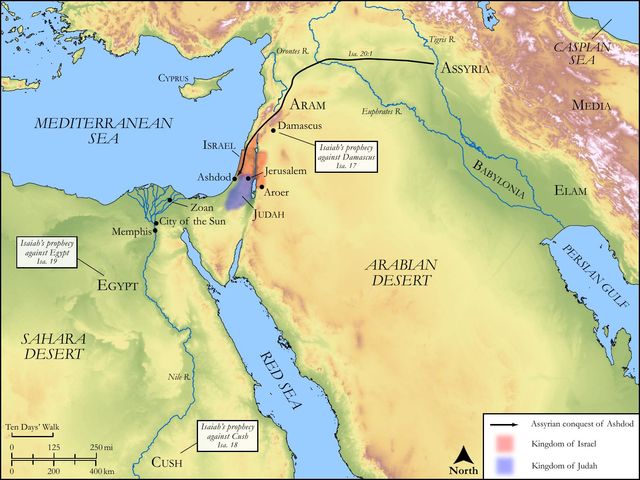
Isaiah 17 is strategically placed within a larger collection of "burdens" or oracles (Isaiah 13-23), which underscore Yahweh's universal sovereignty over all nations, not just Israel. Specifically, this chapter focuses on the impending judgment of Damascus (Syria) and Ephraim (the Northern Kingdom of Israel), highlighting their interconnected destinies. The preceding verses (Isaiah 17:1-3) detail the complete desolation of Damascus, predicting its transformation from a vibrant city into a ruin. Isaiah 17:4 then seamlessly transitions the prophetic focus, linking Israel's fate to that of its allied neighbor. This transition emphasizes that even God's covenant people are not exempt from divine judgment when they abandon their covenant obligations and trust in foreign powers. The subsequent verses (Isaiah 17:5-6) continue to elaborate on Israel's desolation, utilizing the poignant imagery of a harvested field and gleaned olive tree, reinforcing the themes of severe reduction, loss, and a remnant. This entire oracle is deeply rooted in the historical events surrounding the Syro-Ephraimite War (c. 734-732 BC), where Syria and Israel formed an ill-fated alliance against Judah, prompting King Ahaz of Judah to seek Assyrian intervention—a decision sharply condemned by Isaiah in his earlier prophecies, particularly in Isaiah 7.
Historical & Cultural Context
The prophecy in Isaiah 17:4 unfolds against the formidable backdrop of the ascendant Assyrian Empire, a dominant military and political force in the ancient Near East during Isaiah's 8th-century BC ministry. Both Damascus and Israel, with its capital Samaria, found themselves ensnared in complex geopolitical struggles, frequently attempting to resist Assyrian expansion or forming alliances that ultimately proved futile. The vivid imagery of "glory" and "fatness" would have resonated profoundly with an agrarian society where national prosperity was intrinsically linked to fertile land, abundant harvests, healthy livestock, and a thriving population. These elements collectively symbolized national well-being, demographic strength, and military might. For Israel, "Jacob" was far more than a historical patriarch; he was a living symbol of their national identity, their unique covenant relationship with Yahweh, and the rich blessings promised to Abraham's descendants. Therefore, the impending "thinning" and "waxing lean" would signify a catastrophic reversal of these covenant blessings, directly attributable to their persistent idolatry, spiritual apostasy, and misguided political maneuvering, especially their reliance on foreign powers like Syria rather than placing their trust in God's protective hand, a sin explicitly condemned in Isaiah 30.
Key Themes
ShowHideThis verse powerfully contributes to several overarching themes that permeate the book of Isaiah and the broader prophetic corpus. Firstly, it emphatically underscores the theme of Divine Judgment, demonstrating God's unwavering righteousness and wrath against sin, even when committed by His covenant people. When Israel abandons Him for idolatry and unfaithfulness, judgment is inevitable. Secondly, it vividly illustrates the Consequences of Disobedience, showing that turning away from God inevitably leads to a loss of divine favor, protection, and prosperity, echoing the covenant curses detailed in Deuteronomy 28. The stark imagery of "thinning" and "leaning" powerfully portrays the Loss of Prosperity and Strength, emphasizing that true national security and well-being are rooted not in material wealth or military alliances, but in an obedient and faithful relationship with God. Finally, the passage subtly yet profoundly points to the theme of God's Sovereignty, asserting His ultimate and absolute control over the destinies of all nations, including Israel. It highlights His prerogative to use foreign powers, such as Assyria, as instruments of His righteous judgment, a concept further developed and explored in Isaiah 10.
Exposition and Analysis
ShowHideKey Word Analysis
ShowHideDerived from a root meaning "heavy" or "weighty," this term primarily denotes splendor, honor, reputation, and substantiality. In a national context, it encompasses a nation's wealth, power, population, and the visible manifestation of God's presence and blessing. For Jacob (Israel), their "glory" was inextricably linked to their unique covenant relationship with Yahweh, their status as a chosen people, and the prosperity and strength that flowed from His favor. To have this "glory" made thin implies a profound and humiliating reduction in all these aspects, signifying a loss of divine favor and national standing.
A primitive root meaning "to slacken or be feeble," "to be oppressed," or "to be brought low." This word vividly conveys a state of emaciation, depletion, or impoverishment. When applied to "glory," it suggests a weakening, a fading, or a diminishing of what was once substantial and impressive. The use of this term emphasizes a process of decline, not a sudden collapse, but a gradual wasting away of strength, vitality, and substance, leading to a state of feebleness and oppression.
From a root meaning "to be fat," this word literally refers to physical fatness, but figuratively and concretely, it denotes richness, abundance, fertility (of a field), or robustness (of a person). In the context of a nation, "fatness" symbolizes prosperity, health, and a flourishing state. It represents the material well-being, physical strength, and demographic robustness of the people and the land. Its loss signifies a reversal of blessings, leading to scarcity and weakness.
Verse Breakdown
ShowHide"And in that day it shall come to pass"
This introductory phrase, "in that day" (H3117, yôwm), is a characteristic prophetic marker in Isaiah, signaling a specific, divinely appointed future time when God's judgment or salvation will be decisively enacted. Here, it points to a definite historical moment when the predicted events will unfold, specifically referring to the impending Assyrian invasion and its devastating impact on the Northern Kingdom of Israel. It emphasizes the certainty and inevitability of the prophecy.
"that the glory of Jacob shall be made thin"
"Jacob" (H3290, Yaʻăqôb) here serves as a synecdoche for the nation of Israel, particularly the Northern Kingdom of Ephraim, which was the dominant tribal entity. Their "glory" (H3519, kâbôwd), encompassing their honor, wealth, population, and the visible manifestation of divine favor, is depicted as being "made thin" (H1809, dâlal). This powerful metaphor signifies a severe reduction in their national substance, a fading of their former splendor and strength, and a profound loss of the blessings that had marked them as God's chosen people. It speaks to a comprehensive diminishment of their national identity and standing.
"and the fatness of his flesh shall wax lean"
This clause provides a parallel and reinforcing image, intensifying the meaning of the first. "His flesh" (H1320, bâsâr) refers to the physical body of Jacob, representing the nation's physical well-being, its population, and its material prosperity. Their "fatness" (H4924, mashmân), symbolizing their abundance, robustness, and flourishing state, will "wax lean" (H7329, râzâh), indicating a process of emaciation, depletion, and severe decline. This vivid physiological metaphor underscores the comprehensive nature of the judgment, affecting every aspect of national life, from its demographic strength to its agricultural resources and overall vitality.
Literary Devices
ShowHideIsaiah 17:4 is profoundly enriched by its masterful use of Imagery, particularly vivid Metaphor and Personification, to convey its dire message of impending judgment. The nation of Israel, symbolically represented by the patriarch "Jacob," is strikingly personified as a physical body undergoing a process of severe wasting away. The abstract concept of "glory" is given a tangible, physical attribute, being "made thin," while "fatness"—representing national prosperity, health, and strength—is described as "waxing lean." This deliberate employment of physiological and agricultural terms (thinning, leaning, fatness) draws deeply on the audience's immediate understanding of physical health, decay, and agricultural abundance, making the spiritual and national decline intensely palpable and impactful. Furthermore, the verse employs a powerful instance of Synonymous Parallelism, where the second clause ("and the fatness of his flesh shall wax lean") reiterates, amplifies, and intensifies the meaning of the first clause ("the glory of Jacob shall be made thin"). This poetic structure not only emphasizes the certainty and totality of the predicted desolation but also creates a memorable and haunting image of a once-flourishing entity reduced to a state of emaciation and depletion.
Theological and Thematic Connections
ShowHideIsaiah 17:4 profoundly illustrates the theological principle that God's covenant people, though uniquely chosen, are not exempt from His righteous judgment when they persist in disobedience and idolatry. The "thinning" of Jacob's glory and the "leaning" of his fatness represent the withdrawal of divine blessing and protection, which were always contingent upon faithfulness to the covenant. This passage serves as a sobering reminder that true prosperity and national strength are not found in material abundance, military might, or political alliances, but in a vibrant, obedient, and trusting relationship with God. It highlights the severe consequences of spiritual apostasy, where the pursuit of worldly security and the embrace of foreign gods inevitably leads to a state of spiritual and often tangible emaciation. Ultimately, it demonstrates God's unwavering commitment to His holiness and justice, even when it necessitates the painful discipline of His own beloved people.
Reflection and Application
ShowHideIsaiah 17:4, though rooted in an ancient prophecy of judgment, offers profound and timeless lessons for contemporary believers and communities. The striking imagery of "glory" becoming "thin" and "fatness" waxing "lean" serves as a powerful metaphor for spiritual decline and the consequences of misplaced trust. It challenges us to deeply examine the foundation of our own "glory" and "fatness"—our sense of well-being, security, identity, and flourishing. Are we, like ancient Israel, placing our ultimate trust in worldly achievements, material possessions, human systems, or even our own abilities, rather than in the living God? When we neglect our spiritual disciplines, compromise our convictions, or seek fulfillment and security apart from Christ, our spiritual vitality can indeed begin to "wax lean," leading to a profound sense of emptiness and loss, even amidst outward appearances of success. This verse is a poignant call to introspection, urging us to recognize that genuine, lasting prosperity—whether for an individual, a family, or a church—stems exclusively from faithfulness to God and a vibrant, dependent relationship with Him. It reminds us that spiritual health is the indispensable foundation for all other forms of well-being, and neglecting it inevitably leads to a profound diminishment of true life.
Questions for Reflection
ShowHideFAQ
ShowHideWho is "Jacob" in this verse, and why is his "glory" described this way?
ShowHideIn Isaiah 17:4, "Jacob" refers to the nation of Israel, specifically the Northern Kingdom of Ephraim, which was the dominant tribe and often synonymous with Israel as a whole in prophetic literature. This usage links the nation back to its patriarchal founder, emphasizing its covenant identity. His "glory" (Hebrew: kâbôwd) represents the nation's honor, prosperity, strength, population, and the visible manifestation of God's blessing and presence. The description of this glory being "made thin" and its "fatness" waxing "lean" employs vivid physiological and agricultural metaphors to predict a severe decline in national well-being, population, and military might. It signifies a reversal of the covenant blessings due to Israel's unfaithfulness and idolatry, a theme consistently highlighted throughout the book of Isaiah.
What does the imagery of "glory made thin" and "fatness waxing lean" truly convey?
ShowHideThis powerful and evocative imagery conveys a comprehensive and devastating decline. "Glory made thin" suggests a profound loss of honor, reputation, and substantial power, indicating that Israel's former splendor and influence would diminish significantly. "Fatness waxing lean" reinforces this, symbolizing a severe reduction in material prosperity, agricultural abundance, and even the physical population. In an agrarian society, "fatness" was the quintessential sign of health, wealth, and divine favor, while "leanness" indicated scarcity, famine, and hardship. Together, these metaphors paint a stark picture of a nation brought to the brink of desolation, stripped of its vitality and resources, as a direct consequence of divine judgment. This imagery is consistent with the covenant curses for disobedience found in passages like Deuteronomy 28:15-44.
Is this prophecy only relevant to ancient Israel, or does it have broader implications?
ShowHideWhile the immediate historical context of Isaiah 17:4 is undeniably the judgment upon ancient Israel and Syria, its underlying theological principles and powerful imagery possess timeless and universal implications. It serves as an enduring warning that any nation, community, or individual that turns away from God and places its ultimate trust in worldly securities will inevitably experience a spiritual, and often tangible, decline. The "thinning" of glory and "leaning" of fatness can metaphorically represent the loss of true purpose, joy, peace, and spiritual vitality when one's foundation is not firmly established in God. It underscores the enduring truth that true and lasting prosperity, whether spiritual or material, flows directly from faithfulness to the Creator, a principle applicable across all generations and cultures, as exemplified in the teachings of Jesus in Matthew 6:33.
Christ-Centered Fulfillment
ShowHideIsaiah 17:4, with its somber prophecy of Jacob's glory being made thin and his flesh waxing lean, finds a profound and paradoxically glorious fulfillment in the person and redemptive work of Jesus Christ. Israel's glory, rooted in its covenant, temple, and land, was indeed "made thin" by its persistent unfaithfulness, ultimately leading to exile and a diminished state. Yet, in Christ, the true Israelite, the ultimate glory of God is revealed, not in worldly power or material "fatness," but in humble incarnation and sacrificial love. John 1:14 declares that the Word became flesh and "dwelt among us, and we beheld His glory, the glory as of the only begotten of the Father, full of grace and truth." This glory, however, was not one of earthly abundance but one that embraced the "leanness" of human suffering and sin. Isaiah 53:2-3 prophetically describes the Suffering Servant, who had "no beauty or majesty to attract us to him, nothing in his appearance that we should desire him." Jesus willingly became poor (spiritually "lean" in the sense of taking on humanity's sin and its devastating consequences) that we, through His sacrifice, might become spiritually rich (spiritually "fat" with His righteousness and eternal life), as taught in 2 Corinthians 8:9. His crucifixion, the ultimate act of self-emptying, represented the "thinning" of His physical glory, yet it paradoxically led to the "fatness" of spiritual abundance for all who believe, ushering in a new covenant of enduring glory that far surpasses the fading glory of the old, as powerfully articulated in 2 Corinthians 3:7-11. Through Christ, the true "fatness" is found in spiritual life, eternal communion with God, and the indwelling of the Holy Spirit—a glory that will never "wax lean" but will eternally flourish in the new heavens and new earth, where the Lamb himself is the light and the everlasting glory (Revelation 21:23).