


Genesis 37:24
- וַיִּקָּחֻהוּvai·Yi·ka·Chu·huand they took himH3947Conj-w ¦ V-Qal-ConsecImperf-3mp ¦ 3msVerb Qal Consecutive Imperfect 3rd Plural Masculineוַandיִּקָּחֻthey tookהוּhim
- וַיַּשְׁלִכוּvai·yash·Li·khuand they threwH7993Conj-w ¦ V-Hiphil-ConsecImperf-3mpVerb Hiphil Consecutive Imperfect 3rd Plural Masculineוַandיַּשְׁלִכוּthey threw
- אֹתוֹ'o·To<obj.> himH853DirObjM ¦ 3msParticle Object Indicatorאֹת<obj.>וֹhim
- הַבֹּרָהha·Bo·rahthe pit towardsH953Art ¦ N-ms ¦ SfxNoun Singular Masculine Absoluteהַtheבֹּרָpitהtowards
- וְהַבּוֹרve·ha·Borand the pitH953Conj-w ¦ Art ¦ N-msNoun Singular Masculine Absoluteוְandהַtheבּוֹרpit
- רֵקRek[was] emptyH7386Adj-msAdjective Singular Masculine Absolute
- אֵין'einthere notH369N-mscNoun Singular Masculine Construct
- בּוֹboin <the> itPrep-b ¦ 3msSuffix Personal 3rd Singular Masculineבּin <the>וֹit
- מָיִםMa·yim[was] waterH4325N-mpNoun Plural Masculine Absolute
English is a literal word-by-word gloss of the Hebrew, not the KJV's wording. Why?
This is the original text the KJV's translators worked from — each Hebrew word with its own literal English meaning in this verse, prepared by scholars at Tyndale House, Cambridge. The KJV translates whole sentences, not word by word, so its wording differs: one Hebrew word can become several English words, and the KJV may choose “the LORD” where the gloss reads “Yahweh”. Both are faithful — they answer different questions. For the KJV's own rendering, switch to the KJV text.
Details
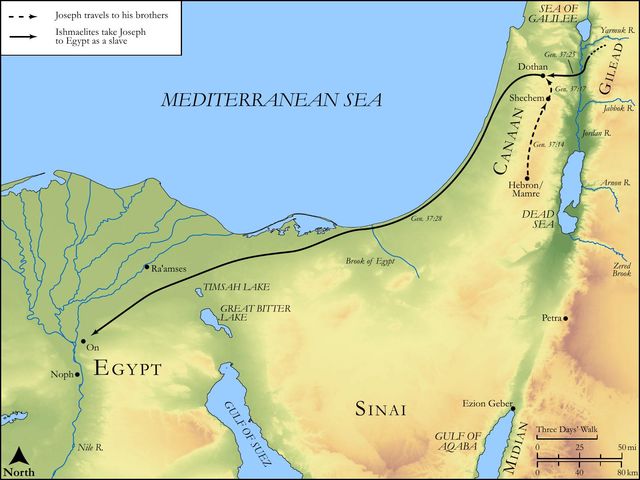
See on the biblical-era map


Study this verse
Public-domain commentary
Matthew Henry
From his Commentary on the Whole Bible. Henry comments on passages, not single verses — this entry covers Genesis 37:23–30.
We have here the execution of their plot against Joseph. 1. They stripped him, each striving to seize the envied coat of many colours, Gen 37:23. Thus, in imagination, they degraded him from the birthright, of which perhaps this was the badge, grieving him, affronting their father, and making themselves sport, while they insulted over him. "Now, Joseph, where is the fine coat?" Thus our Lord Jesus was stripped of his seamless coat, and thus his suffering saints have first been industriously divested of their privileges and honours, and then made the off-scouring of all things. 2. They went about to starve him, throwing him into a dry pit, to perish there with hunger and cold, so cruel were their tender mercies, Gen 37:24. Note, Where envy reigns pity is banished, and humanity itself is forgotten, Pro 27:4. So full of deadly poison is malice that the more barbarous any thing is the more grateful it is. Now Joseph begged for his life, in the anguish of his soul (Gen 42:21), entreated, by all imaginable endearments, that they would be content with his coat and spare his life. He pleads innocence, relation, affection, submission; he weeps and makes supplication, but all in vain. Reuben alone relents and intercedes for him, Gen 42:22. But he cannot prevail to save Joseph from the horrible pit, in which they resolve he shall die by degrees, and be buried alive. Is this he to whom his brethren must do homage? Note, God's providences often seem to contradict his purposes, even then they are serving them, and working at a distance towards the accomplishment of them. 3. They slighted him when he was in distress, and were not grieved for the affliction of Joseph; for when he was pining away in the pit, bemoaning his own misery, and with a languishing cry calling to them for pity, they sat down to eat bread, Gen 37:25. (1.) They felt no remorse of conscience for the sin; if they had, it would have spoiled their appetite for their meat, and the relish of it. Note, A great force put upon conscience commonly stupefies it, and for the time deprives it both of sense and speech. Daring sinners are secure ones. But the consciences of Joseph's brethren, though asleep now, were roused long afterwards, Gen 42:21. (2.) They were now pleased to think how they were freed from the fear of their brother's dominion over them, and that, on the contrary, they had turned the wheel upon him. They made merry over him, as the persecutors over the two witnesses that had tormented them, Rev 11:10. Note, Those that oppose God's counsels may possibly prevail so far as to think they have gained their point, and yet be deceived. 4. They sold him. A caravan of merchants very opportunely passed by (Providence so ordering it), and Judah made the motion that they should sell Joseph to them, to be carried far enough off into Egypt, where, in all probability, he would be lost, and never heard of more. (1.) Judah proposed it in compassion to Joseph (Gen 37:26): "What profit is it if we slay our brother? it will be less guilt, and more gain, to sell him." Note, When we are tempted to sin, we should consider the unprofitableness of it. It is what there is nothing to be got by. (2.) They acquiesced in it, because they thought that if he were sold for a slave he would never be a lord, if sold into Egypt he would never be their lord; yet all this was working towards it. Note, The wrath of man shall praise God, and the remainder of wrath he will restrain, Psa 76:10. Joseph's brethren were wonderfully restrained from murdering him, and their selling him was as wonderfully turned to God's praise. As Joseph was sold by the contrivance of Judah for twenty pieces of silver, so was our Lord Jesus for thirty, and by one of the same name too, Judas. Reuben (it seems) had gone away from his brethren, when they sold Joseph, intending to come round some other way to the pit, and to help Joseph out of it, and return him safely to his father. This was a kind project, but, if it had taken effect, what had become of God's purpose concerning his preferment in Egypt? Note, There are many devices in man's heart, many devices of the enemies of God's people to destroy them and of their friends to help them, which perhaps are both disappointed, as these were; but the counsel of the Lord, that shall stand. Reuben thought himself undone, because the child was sold: I, whither shall I go? Gen 37:30. He being the eldest, his father would expect from him an accounts of Joseph; but, as it proved, they would all have been undone if he had not been sold.
Historical interpretation
Historical reception
1 surviving comment on this verse from the historical church.
Every kind of honour and happiness was bestowed upon you, and then was fulfilled that which is written, "My beloved ate and drank, and was enlarged and became fat, and kicked." [Deuteronomy 32:15] Hence flowed emulation and envy, strife and sedition, persecution and disorder, war and captivity. So the worthless rose up against the honoured, those of no reputation against such as were renowned, the foolish against the wise, the young against those advanced in years. For this reason righteousness and peace are now far departed from you, inasmuch as every one abandons the fear of God, and has become blind in His faith, neither walks in the ordinances of His appointment, nor acts a part becoming a Christian, but walks after his own wicked lusts, resuming the practice of an unrighteous and ungodly envy, by which death itself entered into the world. [Wisdom 2:24]
For thus it is written: "And it came to pass after certain days, that Cain brought of the fruits of the earth a sacrifice unto God; and Abel also brought of the firstlings of his sheep, and of the fat thereof. And God had respect to Abel and to his offerings, but Cain and his sacrifices He did not regard. And Cain was deeply grieved, and his countenance fell. And God said to Cain, Why are you grieved, and why is your countenance fallen? If you offer rightly, but do not divide rightly, have you not sinned? Be at peace: your offering returns to yourself, and you shall again possess it. And Cain said to Abel his brother, Let us go into the field. And it came to pass, while they were in the field, that Cain rose up against Abel his brother, and slew him." [Genesis 4:3-8] You see, brethren, how envy and jealousy led to the murder of a brother. Through envy, also, our father Jacob fled from the face of Esau his brother [Genesis 27:41-45]. Envy made Joseph be persecuted unto death, and to come into bondage. [Genesis 37:18-28] Envy compelled Moses to flee from the face of Pharaoh king of Egypt, when he heard these words from his fellow-countryman, "Who made you a judge or a ruler over us? Will you kill me, as you killed the Egyptian yesterday?" [Exodus 2:14] On account of envy, Aaron and Miriam had to make their abode without the camp. [Numbers 12:14-15] Envy brought down Dathan and Abiram alive to Hades, through the sedition which they excited against God's servant Moses. [Numbers 16:33] Through envy, David not only underwent the hatred of foreigners, but was also persecuted by Saul king of Israel. [1 Samuel 21:10-15]
Continue studying Genesis 37:24 across the web’s major study libraries — every link below opens this exact verse, chapter, or book on the destination site.
Read & Compare
 BibleGatewayThis verse in more than 200 translations and 70 languages.
 Bible.comThe YouVersion reader — hundreds of translations, reading plans, and highlights.
 ESV.orgCrossway's official English Standard Version reader.
 NET BibleThe NET translation with 60,000+ translators' notes on every rendering decision.
 STEP BibleTyndale House's free study tool — original text, vocabulary, and scholarly resources.
 BibliaLogos Bible Software's free web reader.
 USCCBThe New American Bible (Revised Edition) with the U.S. bishops' study notes.
Commentaries
 BibleHub CommentariesDozens of classic commentaries on this verse, gathered on one page.
 StudyLightMore than 100 commentary sets — the largest collection on the web.
 BibleRefPlain-English commentary on what this verse means, verse by verse.
 Enduring WordDavid Guzik's free commentary on this chapter, widely used by Bible teachers.
 Bible Study ToolsVerse commentary alongside Greek and Hebrew study aids.
Original Language & Research
- BibleHub InterlinearThe verse word by word — original language, transliteration, and English.
- BibleHub LexiconEvery word's original-language definition and Strong's entry.
 Blue Letter BibleDeep-study tools — Strong's numbers, concordance, and word studies.
 SefariaThe Hebrew text with Rashi and centuries of Jewish commentary.
Sermons, Hymns & Audio


TrulyRandomVerse is not affiliated with these sites and doesn’t control their content. They’re linked because they’re genuinely useful.
Summary
Genesis 37:24 chronicles the pivotal moment of Joseph's abandonment by his brothers, detailing their cruel act of casting him into a dry pit. This immediate confinement, marked by the absence of water, powerfully underscores both the depth of fraternal betrayal and the subtle yet profound operation of divine preservation, setting the stage for Joseph's arduous journey of suffering, testing, and eventual elevation within God's overarching redemptive plan for his family and the nations.
Context
ShowHideLiterary Context
This verse is the dramatic climax of the initial confrontation between Joseph and his brothers, immediately following their stripping him of his distinctive tunic in Genesis 37:23. It marks the fulfillment of their murderous intent, tempered only by Reuben's intervention in Genesis 37:21-22. The act of casting Joseph into the pit is a direct precursor to his sale into slavery, as detailed in Genesis 37:28, which then propels the narrative forward into his experiences in Egypt. The pit itself serves as a symbolic liminal space, a transition point from favored son to abandoned victim, foreshadowing his later descent into prison and subsequent rise to power.
Historical & Cultural Context
In the arid regions of the ancient Near East, pits (Hebrew: bôwr) were commonly dug as cisterns to collect and store precious rainwater, or sometimes as dry wells. These were typically deep, often bottle-shaped excavations, making escape difficult without assistance. The act of casting someone into such a pit, especially a dry one, was a form of severe punishment or abandonment, intended to leave the victim to die of exposure or starvation, or to be retrieved later. This practice highlights the harsh realities of survival and justice (or injustice) in the period. The brothers' actions reflect a deep-seated cultural animosity often seen in sibling rivalries, exacerbated by Jacob's blatant favoritism, which was culturally understood but often led to significant family strife.
Key Themes
ShowHideGenesis 37:24 contributes significantly to several overarching themes in the book of Genesis and biblical theology. It powerfully illustrates the destructive power of sin, particularly envy and hatred, demonstrating how these emotions can lead to profound acts of betrayal and familial brokenness, as seen in the brothers' animosity towards Joseph, fueled by his dreams and Jacob's favoritism (Genesis 37:4-8). Simultaneously, the verse subtly introduces the theme of divine sovereignty and providence, as the pit's emptiness, seemingly a minor detail, proves crucial for Joseph's survival, indicating God's unseen hand at work even amidst human malice (Genesis 50:20). Furthermore, it initiates the theme of suffering as preparation for purpose, where Joseph's descent into the pit marks the beginning of a transformative journey through adversity that ultimately prepares him for his role as a deliverer.
Exposition and Analysis
ShowHideKey Word Analysis
ShowHideThis primitive root signifies "to take" in a wide variety of applications, encompassing actions like seizing, receiving, or carrying away. In this context, it emphasizes the brothers' deliberate and forceful seizure of Joseph, stripping him of his agency and possessions before the violent act of casting him into the pit. It highlights their collective, decisive action against him.
This verb means "to throw out, down, or away," whether literally or figuratively. Here, it denotes a violent, decisive act of rejection and abandonment. The brothers did not gently place Joseph; they hurled him into the pit, signifying their desire to be rid of him completely and their utter contempt for him. This action is a physical manifestation of their emotional and spiritual rejection.
Derived from a root implying "to bore," this noun refers to a "pit hole," specifically one used as a cistern or a prison. It is distinct from a natural cave. The use of bôwr here emphasizes a man-made, confined, and often desolate space, typically deep and difficult to escape. It functions as both a grave-like enclosure and a temporary prison, underscoring Joseph's immediate vulnerability and the brothers' intent to isolate him.
Verse Breakdown
ShowHide"And they took him, and cast him into a pit"
This opening clause describes the brothers' immediate and violent execution of their plan. The plural "they" emphasizes the collective nature of the betrayal, highlighting that Joseph was overwhelmed by the combined force of his ten older brothers. The actions "took" and "cast" convey the brutality and decisiveness of their act, stripping Joseph of his dignity and agency as he is forcibly thrown into a subterranean chamber, a place of confinement and despair.
"and the pit [was] empty"
This seemingly simple descriptive phrase carries immense theological weight. The explicit declaration that the pit was "empty" means it was devoid of its primary function (holding water) and, crucially, devoid of water that would have drowned Joseph. This detail immediately signals a crucial element of divine providence, indicating that even in a moment of extreme human malice, circumstances were being subtly orchestrated for Joseph's preservation.
"[there was] no water in it"
This reiteration of the pit's emptiness serves to emphasize and confirm the life-saving condition. It removes any ambiguity about Joseph's immediate peril. Had there been water, Joseph's life would have been immediately imperiled by drowning, potentially ending the narrative prematurely. The absence of water highlights God's unseen hand at work, ensuring Joseph's survival despite his brothers' cruel intentions, setting the stage for God's larger redemptive purposes to unfold through Joseph's life.
Literary Devices
ShowHideThe narrative in Genesis 37:24 employs several powerful literary devices. Irony is evident in the brothers' attempt to thwart Joseph's dreams of superiority by casting him down, an act that paradoxically sets in motion the very events that will lead to their eventual bowing before him. The pit itself functions as potent Symbolism, representing Joseph's descent into suffering, betrayal, and a metaphorical death, a precursor to his later experiences in prison and slavery. It also symbolizes the depths of human depravity driven by envy. Furthermore, the detail "the pit was empty, there was no water in it" serves as a crucial instance of Foreshadowing and Divine Providence, subtly hinting at God's protective hand over Joseph. This seemingly minor detail is vital for the continuation of the narrative, suggesting that Joseph's survival is not accidental but part of a larger, divinely guided plan, which will be revealed through his subsequent trials and ultimate elevation.
Theological and Thematic Connections
ShowHideGenesis 37:24 is a foundational text for understanding the intricate interplay between human sin and divine sovereignty. The brothers' act of casting Joseph into the pit is a stark demonstration of unchecked human depravity, fueled by envy and hatred, leading to familial betrayal and attempted murder. Yet, precisely within this act of profound evil, God's providential care is unmistakably at work. The pit's emptiness, a detail explicitly highlighted, is not coincidental but divinely orchestrated, ensuring Joseph's survival against all human odds. This narrative powerfully illustrates that even the most malicious human intentions cannot ultimately thwart God's sovereign plan, but rather, God can redeem and repurpose human evil for His ultimate good, transforming suffering into a pathway for blessing and salvation.
Reflection and Application
ShowHideThe narrative of Joseph being cast into the pit in Genesis 37:24 offers profound and enduring lessons for believers today. It serves as a powerful reminder that even in moments of profound betrayal, abandonment, or seemingly hopeless circumstances, God remains sovereign and actively involved in our lives. Just as He providentially ensured the pit was empty for Joseph, He can orchestrate circumstances for our protection and ultimate good, often working through the very trials that seem to threaten our existence or derail our purpose. This passage also provides a stark warning against the corrosive power of envy, bitterness, and unchecked anger, urging us to confront these destructive emotions before they lead to actions that harm ourselves and others. Furthermore, Joseph's suffering in the pit marks the beginning of a long period of trials that ultimately shaped his character and prepared him for his divine calling. This illustrates that our most difficult experiences, when surrendered to God, are often integral to His divine plan, serving as a crucible for character formation, humility, and the development of the wisdom necessary for His service. We are called to trust in God's unseen hand, even when our circumstances feel like a desolate pit, knowing that He is always working for our good and His glory.
Questions for Reflection
ShowHideFAQ
ShowHideWhy is the detail "the pit [was] empty, [there was] no water in it" so significant?
ShowHideThis detail is profoundly significant because it highlights God's precise and providential care for Joseph. Had there been water in the pit, Joseph would almost certainly have drowned, bringing an immediate and premature end to his life and, consequently, to God's unfolding plan for him and his family. The explicit mention of the pit being "empty" and having "no water" underscores that even in a moment of extreme human cruelty and abandonment, God was subtly and miraculously at work, preserving Joseph's life for a greater purpose. It signifies that Joseph's survival was not accidental but divinely orchestrated, a testament to God's ability to protect His chosen instruments even in the most perilous situations.
What does the Hebrew word "bôwr" (בּוֹר) imply about the nature of the pit?
ShowHideThe Hebrew word bôwr (בּוֹר) typically refers to a cistern or a dry well, which were common man-made excavations in the ancient Near East, dug to collect rainwater during the wet season. Unlike a natural cave, a bôwr was often deep, narrow at the top, and wider at the bottom, making escape without assistance virtually impossible. In this context, it emphasizes that the "pit" was a place of intentional confinement and despair, a desolate prison. While it was a place of great distress, the crucial detail that it was dry (as opposed to being full of water) becomes a key element of divine intervention, ensuring Joseph's survival and allowing the narrative of God's redemptive plan to continue through him.
Christ-Centered Fulfillment
ShowHideJoseph's unjust suffering, betrayal by his own brothers, and his subsequent descent into the pit and later slavery, profoundly prefigure the life and redemptive work of Jesus Christ. Like Joseph, Jesus was rejected and betrayed by His own people, even by one of His closest disciples (John 13:21). He suffered unjustly, was "cast down" into the depths of death through crucifixion, and laid in a tomb, a metaphorical pit. Yet, just as Joseph was providentially preserved in the pit and ultimately elevated to a position of power to save his family and countless others from famine, Christ was raised from the dead, triumphing over death, and exalted to the right hand of God (Philippians 2:9-11), becoming the ultimate source of spiritual salvation and sustenance for all humanity. Joseph's journey from pit to palace, from suffering to sovereignty, mirrors Christ's path from the cross to the crown, fulfilling God's eternal plan for redemption through suffering, demonstrating that God can use the deepest acts of human evil to accomplish His greatest good (Acts 2:23-24).