


Ezra 8:27
Bible text: King James Version (1769 Blayney text) · Public domain
Bible text: Berean Standard Bible · Public domain
Bible text: American Standard Version (1901) · Public domain
Bible text: World English Bible, Messianic edition · Public domain
Bible text: Geneva Bible (1599) · Public domain
Bible text: Young's Literal Translation · Public domain
- וּכְפֹרֵיu·khe·fo·Reiand bowls ofH3713Conj-w ¦ N-mpcNoun Plural Masculine Constructוּandכְפֹרֵיbowls of
- זָהָבza·HavgoldH2091N-msNoun Singular Masculine Absolute
- עֶשְׂרִים'es·RimtwentyH6242Adj-mpAdjective Numerical Plural Masculine Absolute
- לַאֲדַרְכֹנִיםla·'a·dar·kho·Nimof daricsH150Prep-l ¦ N-mpNoun Plural Masculine Absoluteלַofאֲדַרְכֹנִיםdarics
- אָלֶף'A·lefa thousandH505Adj-csAdjective Numerical Singular common gender Absolute
- וּכְלֵיu·khe·Leiand vessels ofH3627Conj-w ¦ N-mpcNoun Plural Masculine Constructוּandכְלֵיvessels of
- נְחֹשֶׁתne·Cho·shetbronzeH5178N-fsNoun Singular Feminine Absolute
- מֻצְהָבmutz·HavgleamingH6668V-Hophal-PassPrtcpl-msVerb Hophal Participle Passive Singular Masculine Absolute
- טוֹבָהto·VahfineH2896Adj-fsAdjective Singular Feminine Absolute
- שְׁנַיִםshe·Na·yimtwoH8147Adj-cdAdjective Numerical Dual common gender Absolute
- חֲמוּדֹתcha·mu·DotpreciousH2530N-fpNoun Plural Feminine Absolute
- כַּזָּהָבka·za·Havlike <the> goldH2091Prep-k ¦ N-msNoun Singular Masculine Absoluteכַּlike <the>זָּהָבgold
English is a literal word-by-word gloss of the Hebrew, not the KJV's wording. Why?
This is the original text the KJV's translators worked from — each Hebrew word with its own literal English meaning in this verse, prepared by scholars at Tyndale House, Cambridge. The KJV translates whole sentences, not word by word, so its wording differs: one Hebrew word can become several English words, and the KJV may choose “the LORD” where the gloss reads “Yahweh”. Both are faithful — they answer different questions. For the KJV's own rendering, switch to the KJV text.
Details
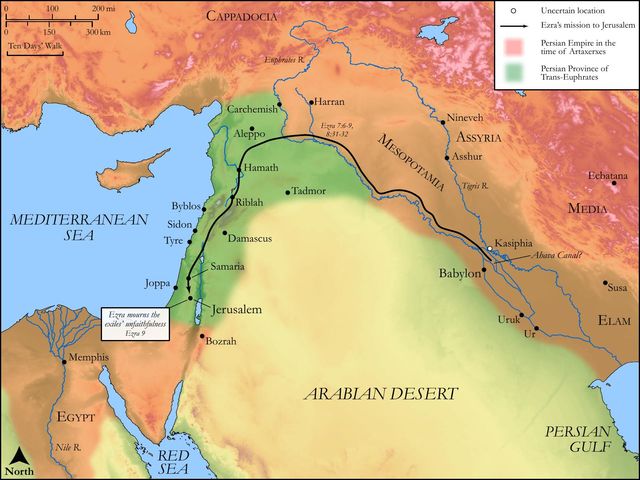
See on the biblical-era map
Study this verse
Public-domain commentary
Matthew Henry
From his Commentary on the Whole Bible. Henry comments on passages, not single verses — this entry covers Ezra 8:24–30.
We have here an account of the particular care which Ezra took of the treasure he had with him, that belonged to God's sanctuary, Observe, 1. Having committed the keeping of it to God, he committed the keeping of it to proper men, whose business it was to watch it, though without God they would have waked in vain. Note, Our prayers must always be seconded with our endeavours; the care of Christ's gospel, his church, and ordinances, must not be so left with him but that it must also be committed to faithful men, Ti2 2:2. 2. Having prayed to God to preserve all the substance they had with them, he shows himself especially solicitous for that part of it which belonged to the house of God and was an offering to him. Do we expect that God should, by his providence, keep that which belongs to us? Let us, by his grace, keep that which belongs to him. Let God's honour and interest be our care; and then we may expect that our lives and comforts will be his. Observe, (1.) The persons to whom he delivered the offerings of the house of God. Twelve chief priests, and as many Levites, he appointed to this trust (Ezr 8:24, Ezr 8:30), who were bound by their office to take care of the things of God, and were in a particular manner to have the benefit of these sacred treasures. Ezra tells them why he put those things into their hands (Ezr 8:28): You are holy unto the Lord, the vessels are holy also; and who so fit to take care of holy things as holy persons? Those that have the dignity and honour of the priesthood must take along with them the trust and duty of it. The prophet is foretelling the return of God's people and ministers out of Babylon, when he gives the solemn charge (Isa 52:11), Be you clean that bear the vessels of the Lord. (2.) The great exactness with which he lodged this trust in their hands: He weighed to them the silver, the gold, and the vessels (Ezr 8:25), because he expected to have it from them again by weight. In all trust, but especially sacred ones, we ought to be punctual, and preserve a right understanding on both sides. In Zerubbabel's time the vessels were delivered by number, here by weight, that all might be forth-coming and it might easily appear if any were missing, to intimate that such as are entrusted with holy things (as all the stewards of the mysteries of God are) are concerned to remember, both in receiving their trust and in discharging it, that they must shortly give a very particular account of it, that they may be faithful to it and so give up their account with joy. (3.) The charge he have them with these treasures (Ezr 8:29): "Watch you, and keep them, that they be not lost, nor embezzled, nor mingled with the other articles. Keep them together; keep them by themselves; keep them safely, till you weigh them in the temple, before the great men there," hereby intimating how much it was their concern to be careful and faithful and how much it would be their honour to be found so. Thus when Paul charges Timothy with the gospel treasure he bids him keep it until the appearing of Jesus Christ, and his appearing before him to give account of his trust, when his fidelity would be his crown.
Continue studying Ezra 8:27 across the web’s major study libraries — every link below opens this exact verse, chapter, or book on the destination site.
Read & Compare
 BibleGatewayThis verse in more than 200 translations and 70 languages.
 Bible.comThe YouVersion reader — hundreds of translations, reading plans, and highlights.
 ESV.orgCrossway's official English Standard Version reader.
 NET BibleThe NET translation with 60,000+ translators' notes on every rendering decision.
 STEP BibleTyndale House's free study tool — original text, vocabulary, and scholarly resources.
 BibliaLogos Bible Software's free web reader.
 USCCBThe New American Bible (Revised Edition) with the U.S. bishops' study notes.
Commentaries
 BibleHub CommentariesDozens of classic commentaries on this verse, gathered on one page.
 StudyLightMore than 100 commentary sets — the largest collection on the web.
 BibleRefPlain-English commentary on what this verse means, verse by verse.
 Enduring WordDavid Guzik's free commentary on this chapter, widely used by Bible teachers.
 Bible Study ToolsVerse commentary alongside Greek and Hebrew study aids.
Original Language & Research
- BibleHub InterlinearThe verse word by word — original language, transliteration, and English.
- BibleHub LexiconEvery word's original-language definition and Strong's entry.
 Blue Letter BibleDeep-study tools — Strong's numbers, concordance, and word studies.
 SefariaThe Hebrew text with Rashi and centuries of Jewish commentary.
Sermons, Hymns & Audio


TrulyRandomVerse is not affiliated with these sites and doesn’t control their content. They’re linked because they’re genuinely useful.
Summary
Ezra 8:27 meticulously inventories a portion of the invaluable offerings entrusted to Ezra and his companions for their perilous return journey from Babylonian exile to Jerusalem. This verse specifically details twenty gold basins, weighing a substantial thousand drams, alongside two distinct vessels crafted from exceptionally refined copper, whose remarkable quality and artistry rendered them as precious as gold. These consecrated items were designated for the restoration of the Temple and its sacrificial worship, profoundly underscoring the deep dedication and abundant generosity of both the Persian king and the returning Jewish exiles towards re-establishing the worship of Yahweh in Jerusalem.
Context
ShowHideLiterary Context
Ezra 8:27 is situated within a detailed and crucial inventory of sacred treasures (Ezra 8:24-30) that Ezra, with immense care and spiritual foresight, selected and entrusted to twelve leading priests and Levites. This meticulous accounting immediately follows Ezra's profound act of faith: calling for a fast at the river Ahava (Ezra 8:21-23) to seek divine protection for the dangerous journey, having boldly declared his confidence in God's "good hand" upon all who earnestly seek Him (Ezra 8:22). The precise enumeration of these precious items, including the specific quantities of gold and the uniquely described "fine copper" in this verse, serves to underscore the immense responsibility placed upon the exiles and the inherently sacred nature of the Temple offerings. The narrative arc of this passage culminates with the safe arrival in Jerusalem and the careful weighing of these treasures in the Temple precincts (Ezra 8:33-34), powerfully demonstrating God's unwavering faithfulness to protect His people and their consecrated gifts, validating Ezra's trust.
Historical & Cultural Context
The events recounted in Ezra 8 unfold during the critical post-exilic period, specifically in the seventh year of the reign of King Artaxerxes I of Persia (circa 458 BC). Following decades of Babylonian captivity, a significant wave of Jewish exiles had returned under Zerubbabel, but Ezra's expedition represented a second, equally vital return, primarily focused on the religious and legal restoration of the community in Judah. The offerings, which included lavish contributions from the Persian king himself (Ezra 7:15-16) and generous donations from the exiles, reflect the vast wealth and sophisticated administrative capabilities of the Persian Empire. Furthermore, they highlight the enduring reverence for the Jerusalem Temple, even among foreign rulers, who recognized its significance to the Jewish people. The journey from Babylon to Jerusalem was notoriously long and fraught with dangers from bandits and hostile tribes, making Ezra's decision to forgo a military escort (Ezra 8:22) a profound act of spiritual conviction, relying solely on divine protection rather than human might. The "dram" (daric) was a widely circulated and recognized Persian gold coin, serving as a standard unit of currency and weight throughout the empire, providing a clear measure of the immense value of the offerings.
Key Themes
ShowHideThis verse significantly contributes to several overarching themes woven throughout the book of Ezra. Firstly, it powerfully illustrates the theme of Divine Provision and Protection, as God sovereignly orchestrates the generosity of the powerful Persian king and meticulously safeguards the immense wealth entrusted to Ezra's care. This demonstrates His "good hand" upon His people, a recurring motif that permeates Ezra's narrative, as seen in passages like Ezra 7:6 and Ezra 7:9. Secondly, the detailed inventory underscores the theme of Dedication and Generosity towards God's house. Both foreign rulers and returning exiles contribute lavishly to the Temple's restoration, emphasizing the paramount importance of worship and the physical space dedicated to it. Thirdly, the intriguing mention of "fine copper, precious as gold" speaks directly to the theme of Excellence in Worship and Offering. This suggests that only the very best, even if not intrinsically the most valuable material, was deemed suitable for the Lord's service, echoing the ancient principles found in the Mosaic Law regarding unblemished and perfect sacrifices for the Lord, as mandated in Leviticus 22:21.
Exposition and Analysis
ShowHideKey Word Analysis
ShowHideThis term refers to a daric, a Persian gold coin. In this context, it functions as a unit of weight for the gold basins, indicating a substantial quantity. The mention of "a thousand drams" signifies the immense material value and weight of the gold, underscoring the considerable wealth being transported for the Temple's restoration. This detail highlights the generosity of the donors and the sacred trust placed in Ezra's company.
Meaning "to shimmer," this word refers to the precious metal gold. Its inclusion emphasizes the intrinsic value and sacred nature of the items. Gold was consistently used for the most sacred objects in the Tabernacle and Temple, symbolizing purity, divinity, and enduring worth. The presence of twenty gold basins signifies a significant contribution of highly valuable vessels dedicated to divine service.
Meaning "delight" or "desire," this word describes the "fine copper" vessels. While copper is typically less valuable than gold, the use of "precious" here indicates an extraordinary quality. This suggests the copper was either exceptionally refined, a rare alloy, or that the vessels themselves were of such exquisite craftsmanship and artistic merit that their value rivaled that of gold, making them highly desirable and suitable for sacred use.
Verse Breakdown
ShowHide"Also twenty basons of gold, of a thousand drams"
This opening clause details a significant portion of the Temple offerings. The "twenty basons" (or bowls/goblets) indicate a substantial number of vessels, likely intended for various ritual functions within the restored Temple, such as collecting blood, holding water, or libations. The qualification "of gold" immediately establishes their high intrinsic value and sacred purpose. The phrase "of a thousand drams" further quantifies this value, specifying their collective weight in Persian gold darics. This detail not only emphasizes the immense material wealth being transported but also subtly highlights the great responsibility entrusted to Ezra and his companions to safeguard such valuable and consecrated objects for God's house.
"and two vessels of fine copper, precious as gold."
This second clause introduces a fascinating and unique element to the inventory. While only two vessels are mentioned, their material is described as "fine copper," a term that implies a quality far superior to ordinary copper. This "fine" quality could refer to a particularly pure form of copper, a special and rare bronze alloy, or copper that had been meticulously refined or polished to a brilliant sheen. The crucial addition "precious as gold" elevates their status considerably. This comparison suggests that these vessels, despite being made of copper, were considered equivalent to gold in their value for the Temple, perhaps due to their exceptional rarity, unparalleled craftsmanship, or unique aesthetic beauty. This detail underscores that value for divine service was not solely determined by the raw material's intrinsic worth but also by its purity, rarity, and the skill and dedication invested in its creation.
Literary Devices
ShowHideEzra 8:27 effectively employs Hyperbole and Symbolism. The phrase "precious as gold" when describing copper is a clear instance of Hyperbole. While copper is intrinsically less valuable than gold, this expression is used to emphasize the extraordinary quality, rarity, or exquisite craftsmanship of these specific copper vessels. It conveys that their worth, in the context of sacred offerings, was elevated to a level comparable to that of gold, transcending the typical material hierarchy. This hyperbole serves to highlight the exceptional nature of the gifts dedicated to God. Furthermore, the entire inventory of precious metals and finely crafted vessels in this passage functions as powerful Symbolism. These items symbolize the profound dedication, reverence, and generosity of both the Persian king and the returning Jewish community towards God and the restoration of His worship. They represent the offering of the "best" to the Lord, reflecting the ancient principle of giving God our choicest possessions and efforts as an act of devotion and faith.
Theological and Thematic Connections
ShowHideEzra 8:27, situated within the broader narrative of the Temple's restoration, powerfully illustrates the theological principle that God's people are called to offer Him their very best. The meticulous accounting and description of these valuable items—gold basins and uniquely refined copper vessels—underscore the seriousness and reverence with which sacred offerings were regarded in ancient Israel. It speaks to a profound theology of stewardship, wherein material wealth is consecrated for divine purposes, and a theology of excellence in worship, where only the purest, most valuable, or most exquisitely crafted items are deemed fitting for God's house. This verse also implicitly reinforces the overarching theme of God's sovereign provision, as He graciously moved the hearts of both the powerful Persian king and the returning Jewish exiles to contribute so lavishly and willingly to His sacred work, demonstrating His faithfulness to His covenant people.
Reflection and Application
ShowHideEzra 8:27 serves as a profound challenge for contemporary believers, prompting us to deeply examine the quality, intention, and spirit behind our own offerings to God. Just as the "fine copper, precious as gold" was valued not merely for its base material but for its purity, rarity, or the artistry invested in its creation, so too are our contributions to God's kingdom measured by more than their superficial or monetary value. Whether it is our precious time, unique talents, material resources, or indeed, our very lives, the Lord desires our "finest"—that which is offered with a pure heart, a dedicated purpose, and an unyielding spirit of excellence. This verse powerfully reminds us that true worship involves sacrificial giving, trusting implicitly that God will protect, bless, and multiply what is consecrated to Him, even when the journey ahead appears daunting or fraught with peril. It calls us to cultivate a heart characterized by radical generosity and an unwavering commitment to excellence in all that we undertake for the glory of God, recognizing that our offerings are not mere transactions but profound expressions of deep devotion, unwavering trust, and profound gratitude for His protective and guiding hand in our lives.
Questions for Reflection
ShowHideFAQ
ShowHideWhat was a "dram" and how much was "a thousand drams" worth?
ShowHideA "dram" in this biblical context refers to the Persian gold daric (Hebrew: ʼădarkôn), which was a standard and widely circulated gold coin of the Achaemenid Persian Empire. Each daric typically weighed around 8.4 grams (approximately 0.296 ounces) of pure gold. Therefore, "a thousand drams" would equate to roughly 8.4 kilograms (or about 18.5 pounds) of gold. This was an extraordinarily large and valuable quantity, emphasizing the immense wealth being dedicated to the Temple's restoration and the significant trust placed in Ezra and his companions to transport it safely. This substantial offering highlights the profound generosity of the Persian king and the returning exiles, underscoring their unwavering commitment to God's house and the re-establishment of worship in Jerusalem, as seen in the broader context of Ezra 8:24-30.
Why was "fine copper" considered "precious as gold"?
ShowHideThe description "fine copper, precious as gold" suggests that these were not ordinary copper vessels. While copper was a common metal, the term "fine" (from the Hebrew root tsâhab, meaning "to glitter" or "be golden in color") indicates a highly refined quality, possibly a special alloy of bronze, or copper that had undergone a unique purification or artistic process resulting in an exceptional luster. The phrase "precious as gold" is likely an idiomatic expression or a form of hyperbole, emphasizing their extraordinary value due to their rarity, exceptional craftsmanship, or perhaps a unique aesthetic quality that made them highly prized for sacred use. It implies that their worth transcended the intrinsic value of the raw material, elevating them to a status comparable to gold in terms of their significance for Temple service. This highlights that value for God's service is not solely tied to the material's intrinsic worth but also to its purity, rarity, or the skill and dedication involved in its creation, a principle echoed in the quality of offerings prescribed in Leviticus 1:3.
Christ-Centered Fulfillment
ShowHideEzra 8:27, with its meticulous focus on precious material offerings for the earthly Temple, finds its ultimate fulfillment and profound transformation in the person and work of Jesus Christ. The gold basins and "fine copper, precious as gold" were consecrated for the worship of God within a physical sanctuary, serving as tangible shadows pointing forward to a greater, spiritual reality. Jesus Christ Himself is the true and perfect offering, the Lamb of God who takes away the sin of the world, whose singular, infinitely precious sacrifice utterly supersedes any material offering or animal sacrifice. Furthermore, Christ is the ultimate Temple, the very place where God truly dwells among humanity, as He declared, "Destroy this temple, and in three days I will raise it up" referring to His body. In Him, the need for animal sacrifices and elaborate material offerings for atonement is completely superseded, for by His one perfect sacrifice, He has forever perfected those who are being sanctified (Hebrews 10:14). Consequently, the "offerings" believers are called to bring today are spiritual: our very lives presented as living, holy, and pleasing sacrifices to God (Romans 12:1), the fruit of our lips giving continuous praise and thanks to His name (Hebrews 13:15), and acts of generous sharing and doing good to others, for with such sacrifices God is well pleased (Hebrews 13:16). The excellence demanded for the Old Testament Temple foreshadows the incomparable excellence of Christ's perfect redemptive work and the subsequent call for believers to live lives worthy of the gospel, reflecting the glory of the One who is infinitely more precious than gold or the finest copper.