


Ezekiel 39:5
Bible text: King James Version (1769 Blayney text) · Public domain
Bible text: Berean Standard Bible · Public domain
Bible text: American Standard Version (1901) · Public domain
Bible text: World English Bible, Messianic edition · Public domain
Bible text: Geneva Bible (1599) · Public domain
Bible text: Young's Literal Translation · Public domain
- עַל'alonH5921PrepPreposition
- פְּנֵיpe·Nei[the] surface ofH6440N-mpcNoun Plural Masculine Construct
- הַשָּׂדֶהha·sa·Dehthe fieldH7704Art ¦ N-msNoun Singular Masculine Absoluteהַtheשָּׂדֶהfield
- תִּפּוֹלti·Polyou will fallH5307V-Qal-Imperf-2msVerb Qal Imperfect 2nd Singular Masculine
- כִּיkiforH3588PrtParticle Conditional
- אֲנִי'a·NiIH589Pro-1csPronoun Personal 1st Singular common gender
- דִבַּרְתִּיdi·Bar·tiI have spokenH1696V-Piel-Perf-1csVerb Piel Perfect 1st Singular common gender
- נְאֻםne·'Um[the] utterance ofH5002N-mscNoun Singular Masculine Construct
- אֲדֹנָי'a·do·Nai[the] LordH136N-properNoun Proper Title
- יְהוִהYah·wehYahwehH3069N-properNoun Proper Title
English is a literal word-by-word gloss of the Hebrew, not the KJV's wording. Why?
This is the original text the KJV's translators worked from — each Hebrew word with its own literal English meaning in this verse, prepared by scholars at Tyndale House, Cambridge. The KJV translates whole sentences, not word by word, so its wording differs: one Hebrew word can become several English words, and the KJV may choose “the LORD” where the gloss reads “Yahweh”. Both are faithful — they answer different questions. For the KJV's own rendering, switch to the KJV text.
Details
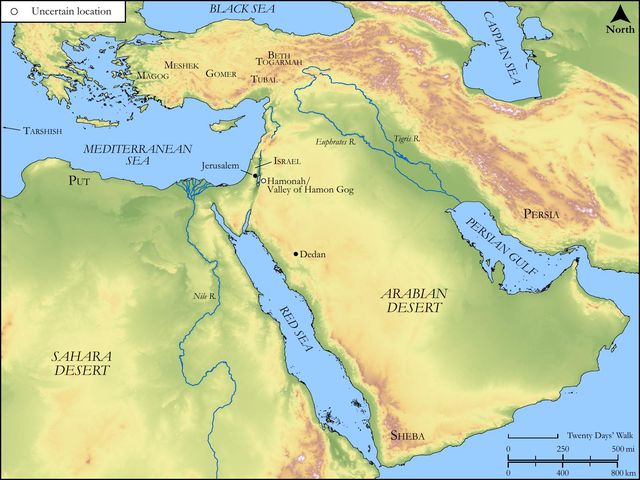
See on the biblical-era map
Study this verse
Public-domain commentary
Matthew Henry
From his Commentary on the Whole Bible. Henry comments on passages, not single verses — this entry covers Ezekiel 39:1–7.
This prophecy begins as that before (Eze 38:3, Eze 38:4, I am against thee, and I will turn thee back); for there is need of line upon line, both for the conviction of Israel's enemies and the comfort of Israel's friends. Here, as there, it is foretold that God will bring this enemy from the north parts, as formerly the Chaldeans were fetched from the north, Jer 1:14 (Omne malum ab aquilone - Every evil comes from the north), and, long after, the Roman empire was overrun by the northern nations, that he will bring him upon the mountains of Israel (Eze 39:2), first as a place of temptation, where the measures of his iniquity shall be filled up, and then as a place of execution, where his ruin shall be completed. And that is it which is here enlarged upon. 1. His soldiers shall be disarmed and so disabled to carry on their enterprise. Though the men of might may find their hands, yet to what purpose, when they find it is put out of their power to do mischief, when God shall smite their bow out of their left hand and their arrow out of their right? Eze 39:3. Note, The weapons formed against Zion shall not prosper. 2. He and the greatest part of his army shall be slain in the field of battle (Eze 39:4): Thou shalt fall upon the mountains of Israel; there they sinned, and there they shall perish, even upon the holy mountains of Israel, for there broke he the arrows of the bow, Psa 76:3. The mountains of Israel shall be moistened, and fattened, and made fruitful, with the blood of the enemies. "Thou shalt fall upon the open field (Eze 39:5) and shalt not be able even there to make thy escape." Even upon the mountains he shall not find a pass that he shall be able to maintain, and upon the open field he shall not find a road that he shall be able to make his escape by. He and his bands; his regular troops, and the people that are with him that follow the camp to share in the plunder, shall all fall with him. Note, Those that cast in their lot among wicked people (Pro 1:14), that they may have one purse with them, must expect to take their lot with them, and fare as they fare, taking the worse with the better. There shall be such a general slaughter made that but a sixth part shall be left (Eze 39:2), the other five shall all be cut off. Never was army so totally routed as this. And, for its greater infamy and reproach, their bodies shall be a feast to the birds of prey, Eze 39:4. Compare Eze 39:17, Thou shalt fall, for I have spoken it. Note, Rather shall the most illustrious princes (Antiochus was called Epiphanes - the illustrious) and the most numerous armies fall to the ground than any word of God; for he that has spoken will make it good. 3. His country also shall be made desolate: I will send a fire on Magog (Eze 39:6) and among those that dwell carelessly, or confidently, in the isles, that is, the nations of the Gentiles. He designed to destroy the land of Israel, but shall not only be defeated in that design, but shall have his own destroyed by some fire, some consuming judgment or other. Note, Those who invade other people's rights justly lose their own. 4. God will by all this advance the honour of his own name, (1.) Among his people Israel; they shall hereby know more of God's name, of his power and goodness, his care of them, his faithfulness to them. His providence concerning them shall lead them into a better acquaintance with him; every providence should do so, as well as every ordinance: I will make my holy name known in the midst of my people. In Judah is God known; but those that know much of God should know more of him; we should especially increase in the knowledge of his name as a holy name. They shall know him as a God of perfect purity and rectitude and that hates all sin, and then it follows, I will not let them pollute my holy name any more. Note, Those that rightly know God's holy name will not dare to profane it; for it is through ignorance of it that men make light of it and make bold with it. And this is God's method of dealing with men, first to enlighten their understandings, and by that means to influence the whole man; he first makes us to know his holy name, and so keeps us from polluting it and engages us to honour it. And this is here the blessed effect of God's glorious appearances on the behalf of his people. Thus he completes his favours, thus he sanctifies them, thus he makes them blessings indeed; by them he instructs his people and reforms them. When the Almighty scattered kings for her she was white as snow in Salmon, Psa 68:14. (2.) Among the heathen; those that never knew it, or would not own it, shall know that I am the Lord, the Holy One in Israel. They shall be made to know by dear bought experience that he is a God of power, and his people's God and Saviour; and it is in vain for the greatest potentates to contend with him; none ever hardened their heart against him and prospered.
Historical interpretation
Historical reception
1 surviving comment on this verse from the historical church.
(Chapter 39, Verse 1 onwards) "But you, son of man, prophesy against Gog and say: 'This is what the Sovereign Lord says: I am against you, O Gog, chief prince of Meshek and Tubal. I will turn you around and drag you along. I will bring you from the far north and send you against the mountains of Israel. Then I will strike your bow from your left hand and make your arrows drop from your right hand. On the mountains of Israel you will fall, you and all your troops and the nations with you.' I have given you as food to the wild animals, birds, and all flying creatures, and to the animals of the earth. You will fall on the face of the field (or the plain): for I have spoken, says the Lord God. And I will send fire on Magog, and on those who dwell securely on the islands (or the coastlands): and they will know that I am the Lord. And I will make my holy name known in the midst of my people Israel, and I will not allow my holy name to be profaned (or polluted) anymore; and the nations will know that I am the holy Lord of Israel. Behold, it comes, and it will happen (or you will know that it will be), says the Lord (Vulgate adds God): this is the day of which I spoke. And the inhabitants of the cities (Vulgate: of the cities) of Israel will go out and burn weapons, shields, spears (or bucklers and thrusting spears), bows and arrows, staffs of the hands (Vulgate: of the hands), and spears (or lances): and they will set them on fire for seven years. And they will not gather (or take) wood from the fields (or the plains), nor cut down from the forests: for they will burn the weapons with fire, and those who had been their plunder will plunder them; and they will loot their looters, says the Lord God. And it shall come to pass in that day, that I will give to Gog a place for burial in Israel, the valley of the travelers east of the sea, which will cause those passing by to marvel. (Or the πολυάνδριον of those who come to the sea, and they will build around the mouth of the valley; and there Gog and all his multitude will be buried; and the valley (or Ge ) will be called the multitude of Gog. And the house of Israel will bury them there, to cleanse the land (or so that the land will be cleansed) for seven months. But the whole population of the earth will bury them (Vulg. they are silent) and there will be a day named for them, in which I have been glorified, says the Lord God. And they will continuously appoint men, traversing (or encircling) the earth, who will bury and seek out those who remain (Vulg. remained) upon the face of the earth, to cleanse it. But after seven months they will begin to search. And they will go around exploring the earth: and when they see the bone of a man, they will set up a marker next to it, until the embalmers in the Valley (or Ge ) of the multitude of Gog bury it. The name of the city is Amona (or Polyandrion): and the earth will be cleansed (or will be cleansed). And these are the heirs of the Jewish tradition and the disciples of endless fables, who contend that after a thousand years of reign, Gog, the prince of Ros, Mosoch, and Thubal will be killed in the borders of Israel; and they will be devoured by all the birds and beasts: and the inhabitants of the cities of Israel will not use wood for seven years, but instead will use the weapons of Gog, namely shields and spears, arrows and clubs or poles: but Gog himself will be buried in a valley called Ge in Hebrew, and his tomb will be called polyandrion; where, indeed, a multitude of men will be buried. But he must be buried for seven months from the house of Israel, so that the land may be cleansed. And a glorious day will come when Gog is killed, and those who diligently search for and bury the bones must be appointed, so that nothing remains unburied on the land. After the months have passed, or rather after seven months have passed, a great expanse of land must be traversed; and wherever they see a human bone, they must mark it with a nearby sign, so that it can be buried later by those in charge of this task. And the city must be named Amona, which is called πολυάνδριον in Greek, meaning a multitude of buried men; and thus the land will be cleansed. They said this to him. But we, starting the explanation, will discuss each thing that we proposed, keeping the meaning. Gog himself has his own Trinity: Ros, Mosoch, and Thubal; head, namely, and insanity, and everything; so that there is no vice that does not consist in the possession of Gog. This [person] will be educated, whether revolving or being touched, and whether suckled or caressed: so that, hoping for victory, he may be led to battle to be killed. And he will ascend from the sides, or from the farthest parts of the North, from where evil is ignited upon all the earth (Jeremiah 1). And he shall be led by the same over the mountains of Israel, whom we must understand to be the apostles and apostolic men and ecclesiastics, so that after he has been led to the mountains of Israel, the bow in his left hand and the arrows held in his right hand may be struck. And he himself, in order to kill those whom he has deceived, imitates having weapons in both his left and right hands, through good and bad reputation. These are the arrows and javelins of which the Psalmist speaks: For behold sinners have bent the bow, they have prepared their arrows in a quiver, to shoot in the dark at the upright of heart (Psalm 10:2). The fiery darts of the devil must be extinguished by the shield of faith (Ephesians 6). Moreover, Gog, who had ascended over the mountains of Israel, will fall and be cast down on those same mountains with all his army and all his troops. And he will be food for the wild beasts, birds, and all the flying creatures and beasts of the earth, namely the adversarial powers that devour the seed along the way and the bloodthirsty beasts. For just as it is written about the dragon, 'You have given him as food to the peoples of Ethiopia' (Psalm 73:14), so those deceived by heretics are food for demons. But Gog, whether in the breadth of the field or in the cultivated land, which is cared for by the farmers of God. For it cannot be that the words of the Lord are in vain. Then fire will be sent upon Magog, that is, upon those who have accepted the teachings of Gog, and upon those who are beaten by the waves of the world like the likeness of islands, and think that they should be secure. That fire of which the Lord speaks: I came to send fire upon the earth; and how I wish that it should burn! (Luke XII, 49); that all may know and understand that I am the Lord, and that the name of my holiness may be made known among my people, who are in no way deceived by the authority of Gog: nor is my name defiled in heretics by the occasion of false knowledge; and that the nations, which are around, may know that I am the Lord. But what follows is said about the judgment of Christ: Behold, he is coming, and it shall be done, the Lord says: He who is coming will come, and he will not delay (Hab. 2:3). And this is the day of punishment and vengeance, of which the Lord spoke through all the prophets. And the inhabitants of the cities of Israel will go out, the people who believe: but by the cities of Israel we understand the Churches of the right faith. And they will set on fire and burn the weapons, of which it is also written in another place: He will break the bow, and shatter the weapons, and burn the shields and spears with fire (Ps. 43:10), shields and spears, bows and arrows, staves of their hands, with which they celebrated the perverted Passover: lances or poles, with which they inflicted wide and incurable wounds of false doctrines: shields, bows and arrows, of which it has been said above. And what follows: And seven years later they will perish by fire, as is explained in Exodus and Leviticus (Exod. XXI; Levit. XXV), in which the Law prescribes that in the seventh year of release, when freedom is restored to the Hebrew slaves and all debts are paid, and the ancient possession is returned to the masters, and rest is given to the land, and all produce is forgiven to the poor, so that in the sacred and perfect number of seven years the armor of the heretics may disappear, and the men of the Church may not cut wood from the fields and regions, and the forests and woods of the nations, which they most desire to save rather than to destroy; but from the heretics whom they have conquered, with shields, spears, arrows, staves, and lances. For they also have various weapons to attack the Church of Christ, which must be ignited by learned men with the fire of the Holy Spirit; namely, the ecclesiastical word, which whoever possesses can say: Was not our heart burning within us while He was opening the Scriptures to us? (Luke 24:32) We cannot have full peace and confidence of habitation unless we plunder all the belongings of our adversaries, so that all may perish and be turned to ashes; and let us plunder those who had previously plundered us, and let us devastate those who had previously devastated the Church. In Hebrw, in the clear light of preaching, he says, 'I will give Gog a named place, a tomb in Israel; according to the Hebrew, a valley of travelers to the east of the sea, which astonishes passers-by. The meaning of this statement is that the tomb of Gog will not be in the mountains, but in the low valleys and in rugged places, which are called Ge in Hebrew. The heretics, although they are in the West, claim that these places are in the East, in order to deceive travelers, namely those who pass through this world and are not residents but strangers, saying that prophetic verse: I am a stranger and a sojourner, like all my fathers (Ps. 38:12).' For who among those passing by, of whom it is written: 'And those who pass by did not say, the blessing of the Lord be upon you' (Ps. 128:8), does not marvel and stand amazed when he sees the valley of travelers, which appears as a valley to travelers but as a mountain to its inhabitants? This is according to the Hebrew. However, the Septuagint translated it as the polyandrion of those who come to the sea; and they shall build around the entrance of the valley. For it is the labor of those who go out from the cities of Israel to close and enclose every entrance and exit of heretical corruption from those who come to the sea, and they delighted in its bitterness, and with the crashing waves and the cruelty of shipwreck, they shall close and enclose, and bury in the depths of the earth, so that they may no longer go out and deceive others with their deceit. Therefore, there they will bury Gog and his entire multitude, which always delights the heretics. And the name of that valley where Gog is buried will be called the Valley of the Multitude, or πολυάνδριον, that is, the tomb of a very large multitude. And as we said above, the weapons of the adversaries will be burned for seven years: thus, for seven months, the land will be cleansed of the filth of the heretics. For from the first month, when we celebrate the Passover of the Lord and avoid the destroyer of Egypt, the lamb with the blood on our doorposts, until the end of the year, that is, until the seventh month when we pitch our tents and are protected among the other branches of palm trees, in order to demonstrate a complete victory against the enemies. We fulfill all the festivals among the people: not only the teachers, but also the entire population will do this eagerly, to bury Gog and cover the land, and by no means allow the free air to be shared. But after the killing and destruction, or the burial of Gog, Ecclesiastical men shall be chosen, who have this study, so that nothing of the former impurities remains in the land of Israel, nor anything of death. They shall search the land, and seek the dead, and bury them, so that the land of the Church may be cleansed. But if, after seven months, when everything should be cleansed, those who go through and surround the land find in any place the bone of a man, that is, the hardness of heretical corruption, or anything of the previous doctrine of death, they shall place it beside that, or they shall build a monument: so that once those who are of this kind have been marked, then they shall either be cleansed or buried with Gog, and cast into the tomb ((or crowd)) of his burial. The name of the city, where the victory of the Lord's servants is, and the adversaries lie down, and the whole multitude of its enemies is prostrated, will be called Amona, or Polyandrion, so that it may be the end of all things, the restoration of purity. Finally, it follows: And they shall cleanse the earth; no doubt those of whom it is written above will begin to seek, and will go around the earth.
Continue studying Ezekiel 39:5 across the web’s major study libraries — every link below opens this exact verse, chapter, or book on the destination site.
Read & Compare
 BibleGatewayThis verse in more than 200 translations and 70 languages.
 Bible.comThe YouVersion reader — hundreds of translations, reading plans, and highlights.
 ESV.orgCrossway's official English Standard Version reader.
 NET BibleThe NET translation with 60,000+ translators' notes on every rendering decision.
 STEP BibleTyndale House's free study tool — original text, vocabulary, and scholarly resources.
 BibliaLogos Bible Software's free web reader.
 USCCBThe New American Bible (Revised Edition) with the U.S. bishops' study notes.
Commentaries
 BibleHub CommentariesDozens of classic commentaries on this verse, gathered on one page.
 StudyLightMore than 100 commentary sets — the largest collection on the web.
 BibleRefPlain-English commentary on what this verse means, verse by verse.
 Enduring WordDavid Guzik's free commentary on this chapter, widely used by Bible teachers.
 Bible Study ToolsVerse commentary alongside Greek and Hebrew study aids.
Original Language & Research
- BibleHub InterlinearThe verse word by word — original language, transliteration, and English.
- BibleHub LexiconEvery word's original-language definition and Strong's entry.
 Blue Letter BibleDeep-study tools — Strong's numbers, concordance, and word studies.
 SefariaThe Hebrew text with Rashi and centuries of Jewish commentary.
Sermons, Hymns & Audio


TrulyRandomVerse is not affiliated with these sites and doesn’t control their content. They’re linked because they’re genuinely useful.
Summary
Ezekiel 39:5 delivers a potent divine decree concerning the catastrophic end of Gog and his vast invading forces, declaring, "Thou shalt fall upon the open field: for I have spoken [it], saith the Lord GOD." This verse serves as a concise yet profoundly emphatic statement of God's absolute sovereignty and the unalterable certainty of His judgment, underscoring that the prophesied annihilation of Israel's enemies is not merely a possibility but a divinely ordained and irreversible outcome, meticulously designed to vindicate God's holy name before all nations.
Context
ShowHideLiterary Context
Ezekiel 39:5 is strategically positioned within the dramatic climax of the extended prophetic oracle against Gog, the formidable leader from the land of Magog, and his massive confederacy, detailed across Ezekiel 38 and Ezekiel 39. Following the initial, overwhelming invasion described in Ezekiel 38, this verse precisely articulates the ignominious and public demise of these formidable forces. The preceding verses in Ezekiel 39 depict God's direct, multi-faceted intervention—through natural disasters, internal strife, and overwhelming military defeat—culminating in the utter annihilation of Gog's army. Specifically, Ezekiel 39:4 states that Gog and his hordes will fall upon the mountains of Israel, setting the immediate stage for the declaration in verse 5 regarding their unburied state in the open field, a stark symbol of complete dishonor and devastation. This segment of Ezekiel's prophecy ultimately culminates in the purification of the land and the profound recognition of God's holiness by both the restored nation of Israel and the gentile nations.
Historical & Cultural Context
In Israel, the proper burial of the dead was a deeply significant cultural and religious practice, considered essential for honor, dignity, and spiritual peace. To "fall upon the open field" and be left unburied was the ultimate disgrace, a severe curse, and a public spectacle of total defeat, abandonment, and the loss of human dignity. Bodies left exposed were typically consumed by carrion birds and wild animals, a fate universally regarded as abhorrent and a clear sign of divine judgment, as explicitly warned in the Mosaic Law (Deuteronomy 28:26). The phrase "open field" (Hebrew: peneh hasadeh, literally "face of the field") powerfully emphasizes the public, exposed, and inescapable nature of this humiliation. This prophecy would have resonated profoundly with Ezekiel's original audience, who intimately understood the devastating cultural and spiritual implications of such a fate. The invocation of "the Lord GOD" (Adonai Yahweh) further underscores that this judgment is not arbitrary but a righteous act from the sovereign, covenant-keeping God of Israel, who is faithful to His people and just in His dealings with those who oppose His divine will.
Key Themes
ShowHideThis verse powerfully contributes to several overarching themes pervasive within the book of Ezekiel and the broader prophetic tradition. Firstly, it emphatically highlights Divine Sovereignty and Omnipotence, as God explicitly declares, "for I have spoken [it], saith the Lord GOD," asserting His absolute control over all historical events and the unyielding certainty of His prophetic word. This theme is foundational throughout scripture, powerfully echoed in passages such as Isaiah 46:10-11, where God proclaims His purpose will stand and He will accomplish all His pleasure. Secondly, the verse unequivocally underscores the Certainty and Severity of Divine Judgment against those who defiantly oppose God and His chosen people. The ignominious end in the "open field" signifies a complete, public, and irreversible defeat, serving as a stark and terrifying warning to all who dare to defy the Almighty. Lastly, and crucially, it reinforces the theme of God's Vindication and Glorification. The spectacular destruction of Gog's forces serves as a dramatic and undeniable demonstration of God's supreme power, meticulously intended to reveal His holiness and glory to both the nation of Israel and the gentile nations, ensuring that "they shall know that I am the Lord" (e.g., Ezekiel 39:7).
Exposition and Analysis
ShowHideKey Word Analysis
ShowHideThis primitive root is remarkably versatile, signifying a wide range of applications from literal falling to ceasing, perishing, or being overthrown. In the context of Ezekiel 39:5, it denotes a catastrophic, definitive defeat and death, specifically implying being struck down in battle and left lifeless. The choice of this verb emphasizes not just the act of dying, but a humiliating, public, and irreversible demise, contrasting sharply with an honorable death or a dignified burial. It speaks to the utter collapse and destruction of Gog's forces.
Derived from H1696, this root verb means "to speak" or "to arrange," but when applied to God, it profoundly carries the weight of a divine decree, an authoritative command, or a performative utterance. When God "speaks," it is far more than a mere suggestion or a prediction; it is a creative and causative act that brings about what it declares. Here, it underscores the absolute certainty, divine authority, and irresistible power behind the judgment against Gog, implying that the outcome is already determined and cannot be thwarted by any earthly power.
This compound divine title, formed from H136 (ʼĂdônây) and H3069 (Yᵉhôvih), is profoundly significant. ʼĂdônây ("Lord," my Lord) emphasizes God's absolute sovereignty, mastery, and supreme authority, often used in contexts of worship, reverence, and submission. Yᵉhôvih (a variation of YHWH, the ineffable covenant name of God, often pronounced Yahweh or Jehovah) highlights God's personal, covenantal faithfulness, His self-existent nature, and His unwavering commitment to His promises. The combination "Lord GOD" powerfully stresses both His supreme authority over all creation and His unwavering commitment to His covenant promises, rendering His pronouncements unchallengeable and His judgments absolutely certain.
Verse Breakdown
ShowHide"Thou shalt fall upon the open field"
This opening clause directly addresses Gog, the leader of the invading coalition, prophesying his inevitable and catastrophic demise. The verb "fall" denotes a violent, complete overthrow, leading directly to death. The phrase "upon the open field" precisely specifies the location of this defeat: a public, exposed, and unhallowed place. This detail signifies not only the totality of their destruction but also the profound dishonor and humiliation of being left unburied, their bodies exposed to carrion, a fate considered the ultimate curse in Israel.
"for I have spoken [it]"
This is the divine rationale, the unshakeable guarantee, and the ultimate source of authority for the preceding declaration. The emphatic phrase "I have spoken" underscores God's active, intentional role as the author, initiator, and executor of this judgment. It signifies a divine decree that is unchangeable, irresistible, and inherently performative, ensuring the absolute and certain fulfillment of the prophecy. This is not a mere prediction but a statement of divine will that intrinsically brings about its own reality.
"saith the Lord GOD"
This concluding phrase serves as the ultimate authentication and divine signature for the entire declaration, explicitly identifying the speaker as the supreme and ultimate authority. The combined title "The Lord GOD" (Adonai Yahweh) powerfully reinforces God's supreme sovereignty over all creation, His unwavering covenant faithfulness to His people, and His absolute power to bring to pass everything He declares. It serves as an emphatic seal, solidifying the certainty of the prophecy and underscoring the divine origin and inevitability of Gog's complete and utter defeat.
Literary Devices
ShowHideEzekiel 39:5 employs several potent literary devices to convey its message with maximum impact and theological weight. The most prominent is Divine Fiat, where God's declaration itself acts as the causative agent, bringing about the reality it proclaims. The phrase "for I have spoken [it], saith the Lord GOD" is a quintessential example of God's word being performative, ensuring the absolute certainty and inevitability of the judgment. There is also powerful Symbolism embedded in "the open field," which represents not merely a physical location but a profound state of utter public disgrace, dishonor, and vulnerability. In Israel, being left unburied was a severe curse, and the "open field" symbolizes this ultimate humiliation and the complete lack of respect or dignity afforded to the defeated. The entire verse functions as a direct Prophetic Declaration, an authoritative and unalterable pronouncement of future events, emphasizing the prophet's crucial role as a faithful mouthpiece for God's unyielding and sovereign will.
Theological and Thematic Connections
ShowHideEzekiel 39:5 profoundly articulates God's absolute sovereignty and the unwavering certainty of His word. It teaches that when God declares a thing, it is as good as done, regardless of the might, number, or perceived invincibility of opposing forces. This divine decree serves as a powerful reminder that God is the ultimate orchestrator of history, meticulously bringing about His purposes through both judgment and salvation. The ignominious fall of Gog in the "open field" not only signifies a complete military defeat but also a profound theological statement about the utter futility and certain doom of resisting the Almighty. This judgment is ultimately for the grand vindication of God's holy name, ensuring that both the restored nation of Israel and the gentile nations will recognize and acknowledge His unique power, holiness, and unwavering faithfulness.
Reflection and Application
ShowHideEzekiel 39:5 offers profound spiritual reassurance for believers and a solemn, inescapable warning for all. For those who trust in God, it reinforces the unshakeable truth of His absolute sovereignty and the infallible nature of His word. In a world often characterized by chaos, daunting threats, and seemingly overwhelming manifestations of evil, this verse serves as a powerful anchor, reminding us that God remains firmly on His throne, orchestrating all events, even the most cataclysmic, according to His perfect and unchangeable will. We can therefore rest secure in the knowledge that His promises of protection for His people and ultimate victory over all opposition are absolutely certain, precisely because He has "spoken it." This truth should cultivate a deep, abiding trust in God's overarching plan, even when immediate circumstances appear dire, and inspire courageous faith to live obediently according to His divine decrees. Conversely, for those who defiantly set themselves against God and His righteous purposes, this verse serves as a stark and sobering warning. It reveals with chilling clarity that defiance of the Almighty leads to certain, public, and ignominious judgment. It calls for profound humility, sincere repentance, and a reverent submission to the One whose word cannot be broken and whose perfect justice will ultimately prevail over all.
Questions for Reflection
ShowHideFAQ
ShowHideWho is "Thou" in Ezekiel 39:5, and what is the significance of their "fall"?
ShowHideIn Ezekiel 39:5, "Thou" refers directly and emphatically to Gog, the formidable leader from the land of Magog, who serves as the primary antagonist of the detailed prophecy found in Ezekiel 38 and Ezekiel 39. Gog leads a vast, international coalition of nations in a climactic invasion of Israel. His "fall" signifies a complete, catastrophic, and divinely orchestrated military defeat, resulting in the death and utter destruction of him and his immense armies. The specific detail of falling "upon the open field" is profoundly significant; it emphasizes the public, humiliating, and unburied nature of their demise, which in Israel was considered the ultimate disgrace and a clear sign of divine curse and abandonment. This detail powerfully highlights the totality, finality, and public spectacle of God's judgment against those who defiantly rise up against His people and His sovereign purposes.
What is the theological implication of God stating, "for I have spoken [it], saith the Lord GOD"?
ShowHideThis phrase is a profoundly powerful declaration of divine sovereignty, absolute authority, and the unshakeable certainty of God's word. When God declares, "I have spoken it," it means that the event is not merely a prediction or a possibility but a divinely decreed and unalterable reality. God's word is inherently performative; it possesses the intrinsic power to bring into existence precisely what it declares. This emphatic phrase underscores that the judgment upon Gog is not a random occurrence, a fortunate turn of events, or a mere human victory, but a direct, intentional, and irresistible act of God's sovereign will. It unequivocally assures the reader that God's plans cannot be thwarted, His prophecies will be perfectly fulfilled, and His authority is supreme and unchallenged. It reinforces the foundational theological theme that God is in complete and meticulous control of history, and that His ultimate purposes will prevail, leading to the grand vindication of His holy name before all nations, as consistently emphasized throughout Ezekiel 39.
Christ-Centered Fulfillment
ShowHideWhile Ezekiel 39:5 directly concerns the eschatological judgment of Gog, its underlying theological principles find profound and ultimate Christ-centered fulfillment. The unwavering certainty of God's word, His absolute sovereignty over all creation, and the ultimate triumph over all forces of evil are perfectly embodied, accomplished, and brought to their glorious zenith in the person and work of Jesus Christ. Just as God's "spoken" word ensured Gog's catastrophic fall, so too did God's eternal Word, Jesus Christ, accomplish the definitive and ultimate victory over sin, death, and the spiritual powers of darkness. Christ's sacrificial death on the cross, though outwardly appearing as a defeat, was in fact God's pre-ordained and sovereign means of triumph, as He disarmed the spiritual rulers and authorities, making a public spectacle of them (Colossians 2:15). His glorious resurrection from the dead is the ultimate, irrefutable demonstration that God's word of salvation, new life, and eternal victory is immutable and all-powerful, ensuring that all who believe in Him will not "fall" into eternal condemnation but receive everlasting life and triumph (John 3:16). Furthermore, the future judgment of all who defiantly oppose God, as prophesied in Ezekiel, finds its ultimate and comprehensive fulfillment in Christ's role as the righteous Judge of all the earth, who will one day return in power and glory to establish His kingdom fully and bring final, perfect justice to every foe (Revelation 19:11-16). Thus, the divine fiat in Ezekiel 39:5 powerfully foreshadows the comprehensive and certain victory secured by the Lamb of God, who alone is worthy to execute God's perfect judgment and establish His eternal, unshakeable reign.