


Ezekiel 30:26
Bible text: King James Version (1769 Blayney text) · Public domain
Bible text: Berean Standard Bible · Public domain
Bible text: American Standard Version (1901) · Public domain
Bible text: World English Bible, Messianic edition · Public domain
Bible text: Geneva Bible (1599) · Public domain
Bible text: Young's Literal Translation · Public domain
- וַהֲפִצוֹתִיva·ha·fi·tzo·Tiand I will scatterH6327Conj-w ¦ V-Hiphil-ConsecPerf-1csVerb Hiphil Consecutive Perfect 1st Singular common genderוַandהֲפִצוֹתִיI will scatter
- אֶת'et<obj.>H853DirObjMParticle Object Indicator
- מִצְרַיִםmitz·Ra·yimEgyptH4714N-properNoun Proper Location
- בַּגּוֹיִםba·go·Yimamong the nationsH1471Prep-b ¦ N-mpNoun Plural Masculine Absoluteבַּamong theגּוֹיִםnations
- וְזֵרִיתִיve·ze·ri·Tiand I will disperseH2219Conj-w ¦ V-Piel-ConsecPerf-1csVerb Piel Consecutive Perfect 1st Singular common genderוְandזֵרִיתִיI will disperse
- אוֹתָם'o·Tam<obj.> themH853DirObjM ¦ 3mpParticle Object Indicatorאוֹתָ<obj.>םthem
- בָּאֲרָצוֹתba·'a·ra·Tzotamong the landsH776Prep-b ¦ N-fpNoun Plural Feminine Absoluteבָּamong theאֲרָצוֹתlands
- וְיָדְעוּve·ya·de·'Uand they will knowH3045Conj-w ¦ V-Qal-ConsecPerf-3cpVerb Qal Consecutive Perfect 3rd Plural common genderוְandיָדְעוּthey will know
- כִּיkithatH3588PrtParticle Conditional
- אֲנִי'a·NiIH589Pro-1csPronoun Personal 1st Singular common gender
- יְהוָהYah·weh[am] YahwehH3068N-properNoun Proper Title
English is a literal word-by-word gloss of the Hebrew, not the KJV's wording. Why?
This is the original text the KJV's translators worked from — each Hebrew word with its own literal English meaning in this verse, prepared by scholars at Tyndale House, Cambridge. The KJV translates whole sentences, not word by word, so its wording differs: one Hebrew word can become several English words, and the KJV may choose “the LORD” where the gloss reads “Yahweh”. Both are faithful — they answer different questions. For the KJV's own rendering, switch to the KJV text.
Details
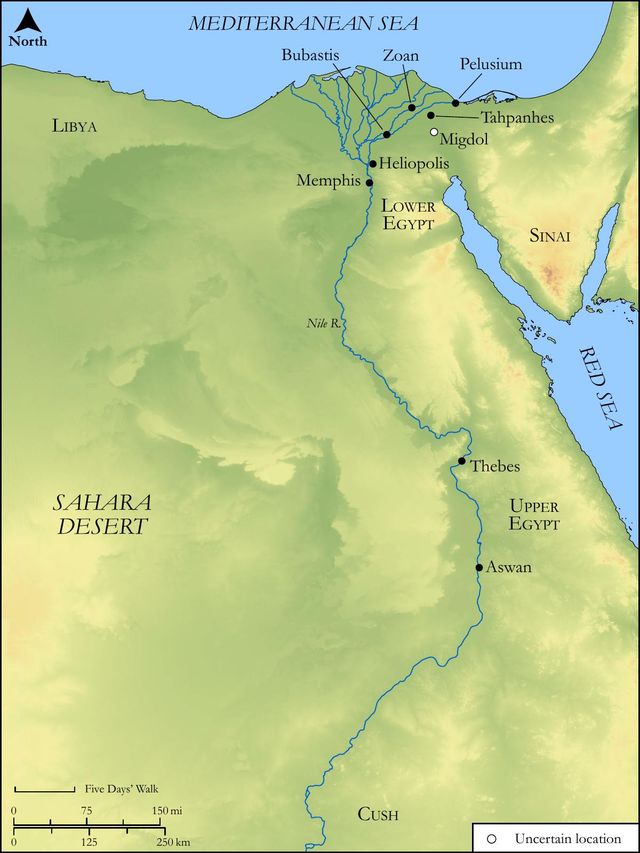
See on the biblical-era map
Study this verse
Public-domain commentary
Matthew Henry
From his Commentary on the Whole Bible. Henry comments on passages, not single verses — this entry covers Ezekiel 30:20–26. His three-level outline is real structure in the source text, so it is rendered as structure.
This short prophecy of the weakening of the power of Egypt was delivered about the time that the army of the Egyptians, which attempted to raise the siege of Jerusalem, was frustrated in its enterprises, and returned re infect - without accomplishing their purpose; whereupon the king of Babylon renewed the siege and carried his point. The kingdom of Egypt was very ancient, and had been for many ages considerable. That of Babylon had but lately arrived at its great pomp and power, being built upon the ruins of the kingdom of Assyria. Now it is with them as it is with families and states, some are growing up, others are declining and going back; one must increase and the others must of course decrease.
I.It is here foretold that the king of Egypt shall grow weaker and weaker.
The extent of his territories shall be abridged, his wealth and power shall be diminished, and he shall become less able than ever to help either himself or his friend.
1.This was in part done already (Eze 30:21): I have broken the arm of Pharaoh, some time ago. One arm of that kingdom might well be reckoned broken when the king of Babylon routed the forces of Pharaoh-Necho at Carchemish (Jer 46:2), and made himself master of all that pertained to Egypt from the river of Egypt to Euphrates, Kg2 24:7. Egypt had been long in gathering strength and extending its dominions, and therefore, that there may be a proportion observed in providence, it loses its strength slowly and by degrees. It was soon after the king of Egypt slew good king Josiah, and in the same reign, that its arm was thus broken, and it received that fatal blow which it never recovered. Before Egypt's heart and neck were broken its arm was. God's judgments come upon a people by steps, that they may meet him repenting. When the arm of Egypt is broken it shall not be bound up to be healed, for none can heal the wounds that God gives but he himself. Those whom he disarms, whom he disables, cannot again hold the sword.
2.This was to be done again. One arm was broken before, and something was done towards the setting of it, towards the healing of the deadly wound that was given to the beast. But now (Eze 30:22), I am against Pharaoh, and will break both his arms, both the strong and that which was broken and set again. Note, If less judgments do not prevail to humble and reform sinners, God will send greater. Now God will cause the sword to fall out of his hand, which he caught hold of as thinking himself strong enough to hold it. It is repeated (Eze 30:24), I will break Pharaoh's arms. He had been a cruel oppressor to the people of God formerly, and of late the staff of a broken rod to them; and now God by breaking his arms reckons with him for both. God justly breaks that power which is abused either to put wrongs upon people or to put cheats upon them. But this is not all;
(1.)The king of Egypt shall be dispirited when he finds himself in danger of the king of Babylon's forces: he shall groan before him with the groaning of a deadly wounded man. Note, It is common for those that are most elated in their prosperity to be most dejected and disheartened in their adversity. Pharaoh, even before the sword touches him, shall groan as if he had received his death's wound.
(2.)The people of Egypt shall be dispersed (Eze 30:23 and again Eze 30:26): I will scatter them among the nations. Other nations had mingled with them (Eze 30:5); now they shall be mingled with other nations, and seek shelter in them, and so be made to know that the Lord is righteous.
II.It is here foretold that the king of Babylon shall grow stronger and stronger, Eze 30:24, Eze 30:25.
Put strength into the king of Babylon's arms, that he may be able to go through the service he is designed for. 2. That he will put a sword, his sword, into the king of Babylon's hand, which signified his giving him a commission and furnishing him with arms for carrying on a war, particularly against Egypt. Note, As judges on the bench, like Pilate (Joh 19:11), so generals in the field, like Nebuchadnezzar, have no power but what is given them from above.
Historical interpretation
Historical reception
2 surviving comments on this verse. Each one is dated, so this reads as a timeline rather than a list.
(Verse 35, 36, and following) And I will bring you into a desert of peoples, and there I will judge you face to face. Just as I contended with your fathers in the desert of the land of Egypt, so I will judge you, says the Lord. And I will subject you to my scepter, and I will bring you into the bonds of the covenant, and I will choose from among you the transgressors and the wicked: from their place of residence I will bring them out, and they will not enter the land of Israel, and you will know that I am the Lord. Thus says the Lord: I will do for you who are in Babylon, and now serve idols, what I did for your ancestors in Egypt. I will lead you into the desert of the peoples, and there I will judge you face to face, just as I contended with them in judgment when they came out of Egypt. And after I have judged you, I will subject you to my scepter and rule, and I will make a covenant with you and bring you into your land with the bonds of love, so that bound by my love, you will never be able to depart from me. But I will choose from among you the transgressors and the wicked, who persist in the hardness of their hearts in evil deeds, not for possession, but for rejection. And I will indeed bring them out of the land of their dwelling, so that when they are brought out, they will not enter the land of Israel; but they will perish in various regions. And by the distinction between good and evil, you shall know that I am the Lord, who judges all things. The rest of the discourse hastens, and we briefly go through each point, in order to provide only the meaning to the readers.
(Verse 20 and following) And it came to pass in the eleventh year, in the first month (Vulgate adds 'of the month'), in the seventh month, the word of the Lord came to me, saying: Son of man, I have broken the arm of Pharaoh king of Egypt, and behold it is not bound up, to be healed, that it may be tied with bandages, and clothed with strips (or to receive a healing plaster): and having taken hold of strength, he might hold the sword. Therefore thus says the Lord God: Behold, I am against Pharaoh king of Egypt, and I will break his strong arm, and shall cause the sword to fall out of his hand, and I will scatter (or scatter abroad) Egypt among the nations, and disperse them (or winnow them) into the lands (Vulgate: 'countries'). And I will strengthen the arms of the king of Babylon, and I will place my sword in his hand, and he will break the arms of Pharaoh, and they will groan with the groans of the slain before him. (or as it is in the Septuagint: And he will bring a sword over Egypt, and he will plunder its spoils, and take its plunder. It follows:) And I will strengthen the arms of the king of Babylon, and the arms of Pharaoh will fall, and they will know that I am the Lord, when I give my sword into the hand of the king of Babylon, and he extends it over the land of Egypt, and I will scatter Egypt among the nations, and disperse them into the lands, and they will know that I am the Lord. He returns to the order of prophecy; for after the twenty-seventh year he now places the eleventh. This question is also addressed in the previous passages. For when the word of the Lord was spoken against Tyre in the eleventh year, which was mentioned earlier, in the subsequent passages He speaks to Pharaoh in the tenth year. And again, He places the twenty-seventh year, as we have said, and now the eleventh. Leaving aside the other things that are contained in the order of the Psalms: the question is, how is the third Psalm placed before these Psalms in which David changed his appearance before Abimelech, and about Doeg the Edomite, and when he was found in the cave, and the fiftieth of penitence, in whose title it is shown that he came to Bathsheba, the wife of Uriah, although these previous Psalms come before the third, in which it is noted that he fled from the face of his son Absalom. But in the Psalms the response is simple, for it is a lyric poem, and in such a work the order of history is not sought; rather, it is the songs of individual events. But in history, it must be said that those things which have been said about one thing at different times should not be divided by speech, but concluded by the narrative of one place. For example, so that those things which have been said about Egypt at different times may be known in one order of reading. When we have said these things, nevertheless the question remains: Why in this same place was the word of the Lord to Pharaoh first spoken in the eleventh year, and later in the twenty-seventh, and then in the tenth year, when certainly according to the order, the eleventh year should have been first, the twenty-seventh second, and the tenth year third, and each prophecy should have been designated by year? To which we can respond: O the depth of the riches of the wisdom and knowledge of God! How inscrutable are his judgments and how unsearchable are his ways! (Romans 11:33). And in another place: Who can search out the depths of knowledge? (Sirach 1:2-3). However, we can say this, that the order of history is not observed in the prophets, at least not in all cases, for they do not narrate the past, but they foretell the future, according to the will of the Holy Spirit. But in history, the books of Moses, Joshua, Judges, Ruth, Esther, Samuel, Malachi, Chronicles, and Ezra, together with Nehemiah, do not contain a chronological account. Let it suffice to say this about the order of years. Now let us examine the prophecies against Pharaoh or concerning Pharaoh. It is said that God broke his arm and it was not bound up or healed, nor did he receive any ointment, according to what is written: 'There is no ointment to be applied, nor oil, nor bandages' (Isaiah 1, sec. 70). But if it had happened that, with courage regained, he could hold the sword and proceed to war. Therefore, God, who is merciful and compassionate, once again shattered his arm or arms, so that the sword may completely fall from his hand, and be scattered among the people of Egypt, and be dispersed among the nations. But in your arm, receive strength and courage, as the Scripture says: 'Break the arm of the sinner and the evildoer' (Psalm 9:15). This arm is broken in our adversaries, when they pursue us, but cannot overcome us. And for the salvation of the servants of God against Pharaoh, the king of Babylon often rises up to oppress the powerful oppressor, and the wicked are handed over to the more wicked, with God strengthening the arms of the worst, so that the one who is set free may know that He is the Lord. Indeed, it is an achievement of virtue to know that He is the Lord. On the contrary, we can say: The sons of Eli, the sons of pestilence, not knowing God (1 Samuel 2:22). And concerning the good kings who did what was right in the sight of God, it is written that they may know the Lord. But that which is said in the Septuagint: 'I will break his strong and appointed arms', which in Greek is said 'τεταγμένα', has been corrupted by the fault of copyists. For they interpreted it not as 'τεταγμένα', but as 'τεταμένα', which means not appointed, but stretched out. For this reason, according to their custom, other interpreters have put 'exalted' instead.
Continue studying Ezekiel 30:26 across the web’s major study libraries — every link below opens this exact verse, chapter, or book on the destination site.
Read & Compare
 BibleGatewayThis verse in more than 200 translations and 70 languages.
 Bible.comThe YouVersion reader — hundreds of translations, reading plans, and highlights.
 ESV.orgCrossway's official English Standard Version reader.
 NET BibleThe NET translation with 60,000+ translators' notes on every rendering decision.
 STEP BibleTyndale House's free study tool — original text, vocabulary, and scholarly resources.
 BibliaLogos Bible Software's free web reader.
 USCCBThe New American Bible (Revised Edition) with the U.S. bishops' study notes.
Commentaries
 BibleHub CommentariesDozens of classic commentaries on this verse, gathered on one page.
 StudyLightMore than 100 commentary sets — the largest collection on the web.
 BibleRefPlain-English commentary on what this verse means, verse by verse.
 Enduring WordDavid Guzik's free commentary on this chapter, widely used by Bible teachers.
 Bible Study ToolsVerse commentary alongside Greek and Hebrew study aids.
Original Language & Research
- BibleHub InterlinearThe verse word by word — original language, transliteration, and English.
- BibleHub LexiconEvery word's original-language definition and Strong's entry.
 Blue Letter BibleDeep-study tools — Strong's numbers, concordance, and word studies.
 SefariaThe Hebrew text with Rashi and centuries of Jewish commentary.
Sermons, Hymns & Audio


TrulyRandomVerse is not affiliated with these sites and doesn’t control their content. They’re linked because they’re genuinely useful.
Summary
Ezekiel 30:26 serves as a potent divine declaration of impending judgment against Egypt, foretelling its comprehensive scattering and dispersion across various nations and lands. This prophetic act, orchestrated by the sovereign hand of the LORD, is presented not merely as punitive action against Egypt's pride and unfaithfulness, but as a profound and undeniable revelation of God's absolute authority over all earthly powers. The ultimate and overarching purpose of this severe judgment is to compel both the Egyptians themselves and the surrounding world to experientially acknowledge the unique, unparalleled identity and supreme dominion of Yahweh, the God of Israel.
Context
ShowHideLiterary Context
Ezekiel 30:26 is strategically positioned within a series of extensive prophecies specifically targeting Egypt, which span from Ezekiel 29 through Ezekiel 32. These chapters constitute a significant segment of Ezekiel's broader oracles against foreign nations, commencing in Ezekiel 25. The prophecies concerning Egypt meticulously detail its imminent downfall at the hands of Nebuchadnezzar, the King of Babylon, often portraying Egypt as a "broken reed" that proved to be an unreliable source of support for Judah, leading to its downfall (Ezekiel 29:6-7). This particular verse, Ezekiel 30:26, underscores the comprehensive nature of God's judgment, extending beyond mere military defeat to a complete dismantling of Egypt's national identity through widespread dispersion, a fate frequently reserved for rebellious Israel itself (e.g., Ezekiel 12:15).
Historical & Cultural Context
During the time of Ezekiel's prophetic ministry (early 6th century BCE), ancient Egypt stood as a formidable regional power, celebrated for its immense wealth, military prowess, and deeply rooted civilization. Throughout the Old Testament narrative, Egypt frequently symbolizes worldly power and often represents a persistent temptation for Israel to place its trust in human alliances rather than in the divine (e.g., Isaiah 30:1-7). At this juncture, Judah found itself precariously caught between the ascendant Babylonian empire and the still-potent, though declining, Egyptian power. Many within Judah unwisely looked to Egypt for deliverance from Babylon, a misplaced trust that God repeatedly and emphatically condemned. The judgment of scattering and dispersion was considered an exceptionally severe form of punishment among the nations, meticulously designed to dismantle a nation's social, political, and religious structures, thereby stripping it of its distinct identity and power. This particular fate was especially humiliating for a proud nation like Egypt, which had long believed itself to be divinely protected by its extensive pantheon of gods.
Key Themes
ShowHideThe central themes intricately woven throughout Ezekiel 30:26 and the broader prophecies against Egypt include Divine Judgment and Sovereignty. God's unequivocal declaration, "I will scatter the Egyptians," resoundingly asserts His active role and absolute control over the destinies of all nations, demonstrating with undeniable clarity that no earthly power can ultimately withstand His sovereign will. Another crucial theme is Dispersion as Punishment, which signifies a profound and devastating loss of national cohesion, identity, and security, powerfully echoing the judgment experienced by Israel itself (Deuteronomy 28:64). Finally, the recurring and climactic phrase, "and they shall know that I [am] the LORD," highlights the overarching theme of God's Self-Revelation. This judgment, though undeniably severe, serves a profound redemptive purpose: to compel both the Egyptians and the watching nations to experientially acknowledge the unique power, identity, and holiness of Yahweh, the one true God (Ezekiel 36:23).
Exposition and Analysis
ShowHideKey Word Analysis
ShowHideThis primitive root (H6327) signifies to "dash in pieces," "break," or "disperse." It conveys a violent and complete breaking apart, not merely a gentle spreading. In the context of nations, it implies the destruction of their unity and cohesion, leading to a forced disintegration and wide distribution of its people. The use of this strong verb emphasizes the decisive, destructive, and irreversible nature of God's judgment upon Egypt.
This term (H1471) refers to a foreign nation, often used in contrast to Israel. While it can simply mean "people" or "country," in prophetic contexts, especially when associated with divine judgment, it frequently carries the connotation of "Gentile" or "heathen," highlighting their status outside of God's covenant people. The Egyptians are to be scattered among these foreign entities, losing their distinct national identity and becoming indistinguishable from other peoples.
This verb (H3045) is a primitive root meaning "to know," but its semantic range extends far beyond mere intellectual understanding. It implies an experiential, relational, and often compelled recognition. In Ezekiel, the phrase "to know that I am the LORD" means to experientially acknowledge God's unique deity, supreme power, and absolute sovereignty through His mighty acts, whether of judgment or salvation. This "knowing" is not optional; it is the inevitable and divinely ordained outcome of God's intervention in history.
Verse Breakdown
ShowHide"And I will scatter the Egyptians among the nations,"
This opening clause immediately establishes God as the active and sovereign agent of judgment. The divine "I will" underscores His unilateral initiative and irresistible power. The scattering of the Egyptians signifies a complete dismantling of their national unity and presence within their own land, forcing them into foreign territories. This is presented as a direct consequence of their pride, idolatry, and consistent opposition to God's divine purposes and His covenant people.
"and disperse them among the countries;"
This second clause functions as a powerful synonymous parallelism, reinforcing and intensifying the meaning of the first. "Disperse" (from H2219 zârâh) carries a similar meaning to "scatter" but can also imply a winnowing or spreading out, suggesting a thorough and widespread distribution that leaves no part untouched. The repetition emphasizes the totality, irreversibility, and comprehensive nature of the judgment, ensuring that no remnant of their former national power or centralized identity remains.
"and they shall know that I [am] the LORD."
This concluding phrase is the theological climax and ultimate purpose of the entire judgment. It is a recurring and foundational refrain throughout the book of Ezekiel, signifying that God's actions, however devastating or seemingly destructive, are ultimately revelatory. Through the profound and humbling experience of dispersion and the loss of their perceived security and national gods, the Egyptians (and by extension, other watching nations and even rebellious Israel) would be undeniably forced to acknowledge the unique, self-existent, and sovereign identity of Yahweh (H3068), the God of Israel, who alone controls the destinies of all peoples.
Literary Devices
ShowHideEzekiel 30:26 powerfully employs several literary devices to convey its profound message of divine judgment and revelation. Parallelism is prominently evident in the two clauses describing the dispersion: "I will scatter the Egyptians among the nations, and disperse them among the countries." This synonymous parallelism intensifies the message, emphasizing the thoroughness and totality of the judgment, leaving no doubt as to its comprehensive nature. The verse also functions as a clear Divine Oracle, a direct and authoritative declaration from God Himself, unmistakably marked by the authoritative "I will." This highlights God's absolute sovereignty, personal agency, and unwavering commitment to His word in history. Finally, the concluding phrase, "and they shall know that I [am] the LORD," serves as a profound and recurring statement of Theophany or Self-Revelation. This motif, central to Ezekiel's message, transforms the act of judgment into a potent means of divine disclosure, revealing God's immutable character, irresistible power, and unique identity not just to Egypt, but to all who witness or hear of His mighty acts.
Theological and Thematic Connections
ShowHideEzekiel 30:26 powerfully articulates God's unwavering sovereignty over all nations and His steadfast commitment to revealing His unique identity through both judgment and, ultimately, salvation. It underscores the profound theological truth that no earthly power, however mighty, proud, or self-assured, stands outside the purview of divine accountability. The dispersion of Egypt serves as a stark and enduring reminder that God's justice will inevitably prevail, and His ultimate purpose is to ensure that His unique identity as the LORD (Yahweh) is acknowledged by all creation. This "knowing" is not merely intellectual assent to a theological proposition but an experiential recognition compelled by His mighty acts in history, demonstrating that even in the midst of severe punishment, God's ultimate aim is self-disclosure and the vindication of His holy name before all peoples.
Reflection and Application
ShowHideEzekiel 30:26 offers profound and enduring insights for believers navigating a world often characterized by geopolitical instability, the dramatic rise and fall of empires, and the pervasive allure of worldly power. It serves as a timeless and foundational reminder that God remains absolutely sovereign over all human affairs, orchestrating the destinies of nations and individuals alike according to His immutable divine plan. This profound truth should instill within us a deep and abiding sense of peace and trust, knowing that our ultimate security rests not in fleeting political alliances, fluctuating economic strength, or transient military might, but in the unshakeable power, perfect wisdom, and unfailing faithfulness of the LORD. Furthermore, the verse challenges us to recognize God's redemptive purpose even in seemingly destructive or chaotic events; His judgments are never merely punitive but are always designed to bring about a deeper, more experiential knowledge of His identity and character. As we witness global events unfold, we are called to discern God's sovereign hand at work, trusting that He is continually unfolding His eternal purposes and drawing all creation to acknowledge Him as the one true and living God. This perspective encourages us to pray fervently for nations, to live as faithful ambassadors of His eternal kingdom, and to place our ultimate hope and allegiance in His eternal reign, rather than in the shifting sands of human power and ambition.
Questions for Reflection
ShowHideFAQ
ShowHideWhy does God scatter nations, and what is the purpose of such a severe judgment?
ShowHideGod scatters nations as a severe form of judgment, as vividly depicted with Egypt in Ezekiel 30:26 and also extensively with Israel (e.g., Deuteronomy 28:64). The primary purpose of such an act is to dismantle their national identity, power, and cohesion, often as a direct consequence of their profound pride, pervasive idolatry, or persistent opposition to God's divine will and His covenant people. For nations like Egypt, it was a just judgment for their arrogance, their oppression, and for leading God's people astray through false promises of alliance. However, beyond mere punishment, a crucial redemptive and revelatory purpose profoundly underpins these acts: "and they shall know that I am the LORD." God strategically uses these devastating events to reveal His absolute sovereignty, irresistible power, and unique identity to the nations, compelling them to acknowledge Him as the one true and living God. It is an undeniable demonstration that no earthly power, however mighty, can ultimately stand against His supreme authority.
What does the phrase "they shall know that I am the LORD" signify in Ezekiel?
ShowHideThis profound phrase, appearing over 60 times throughout the book of Ezekiel, is a cornerstone of the prophet's entire message and the theological climax of many of his oracles. It signifies an experiential, compelled, and transformative recognition of God's unique identity, His covenant faithfulness, and His absolute authority, rather than just a superficial intellectual understanding. Through His mighty and often awe-inspiring acts of judgment or restoration, God forces both His own people (Israel) and the surrounding nations to acknowledge that He alone is Yahweh, the self-existent, covenant-keeping God, who is utterly distinct from all false deities. For Egypt, their scattering would be an undeniable and devastating demonstration of His power, proving unequivocally that their own pantheon of gods was powerless and that the God of Israel was supreme and sovereign over all. It is a declaration of divine vindication, a testament to His holiness, and a compelling call to acknowledge His singular deity (e.g., Ezekiel 36:23).
Christ-Centered Fulfillment
ShowHideWhile Ezekiel 30:26 directly concerns God's judgment and self-revelation to ancient Egypt, its underlying theological themes find profound and ultimate Christ-centered fulfillment. The ultimate "knowing" of God, which was the foundational purpose of His judgments and interventions in the Old Testament, is fully and perfectly realized in the person of Jesus Christ. He is the complete, perfect, and final revelation of God's character and nature, for as John 1:18 declares, "No one has ever seen God; the only God, who is at the Father's side, he has made him known." In Christ, the scattered peoples of the earth, encompassing both Jew and Gentile, are miraculously brought together, not through judgment and dispersion, but through the glorious work of reconciliation and unity achieved in His body, the Church (Ephesians 2:14-18). Furthermore, the absolute sovereignty of God, so powerfully demonstrated in the scattering of Egypt, is now fully vested in Christ, who has been given "all authority in heaven and on earth" (Matthew 28:18). Ultimately, the prophecy of universal acknowledgment will culminate when "every knee will bow and every tongue confess that Jesus Christ is Lord, to the glory of God the Father" (Philippians 2:9-11). Thus, the Old Testament prophecies of God's self-revelation through acts of judgment foreshadow the ultimate and gracious revelation of His glory and power through the redemptive person and atoning work of His Son, Jesus, who gathers rather than scatters those who believe and brings them into His eternal kingdom.