


Ezekiel 3:19
Bible text: King James Version (1769 Blayney text) · Public domain
Bible text: King James Version with Strong's numbers · Public domain
Bible text: Berean Standard Bible · Public domain
Bible text: American Standard Version (1901) · Public domain
Bible text: World English Bible, Messianic edition · Public domain
Bible text: Geneva Bible (1599) · Public domain
Bible text: Young's Literal Translation · Public domain
- וְאַתָּהve·'a·Tahand youH859Conj-w ¦ Pro-2msPronoun Personal 2nd Singular Masculineוְandאַתָּהyou
- כִּיkiifH3588PrtParticle Conditional
- הִזְהַרְתָּhiz·Har·tayou have warnedH2094V-Hiphil-Perf-2msVerb Hiphil Perfect 2nd Singular Masculine
- רָשָׁעra·Sha'a wicked [person]H7563N-msNoun Singular Masculine Absolute
- וְלֹאve·lo'and notH3808Conj-w ¦ NegParticle Negativeוְandלֹאnot
- שָׁבshavhe has turned awayH7725V-Qal-Perf-3msVerb Qal Perfect 3rd Singular Masculine
- מֵרִשְׁעוֹme·rish·'Ofrom his wickednessH7562Prep-m ¦ N-msc ¦ 3msNoun Singular Masculine Constructמֵfromרִשְׁעwickednessוֹhis
- וּמִדַּרְכּוֹu·mi·dar·Koand from his wayH1870Conj-w ¦ Prep-m ¦ N-csc ¦ 3msNoun Singular common gender Constructוּandמִfromדַּרְכּwayוֹhis
- הָרְשָׁעָהha·re·sha·'Ah<the> wickedH7563Art ¦ N-fsNoun Singular Feminine Absoluteהָ<the>רְשָׁעָהwicked
- הוּאhu'heH1931Pro-3msPronoun Personal 3rd Singular Masculine
- בַּעֲוֹנוֹba·'a·vo·Nofor his iniquityH5771Prep-b ¦ N-msc ¦ 3msNoun Singular Masculine Constructבַּforעֲוֹנiniquityוֹhis
- יָמוּתya·Muthe will dieH4191V-Qal-Imperf-3msVerb Qal Imperfect 3rd Singular Masculine
- וְאַתָּהve·'a·Tahand youH859Conj-w ¦ Pro-2msPronoun Personal 2nd Singular Masculineוְandאַתָּהyou
- אֶת'et<obj.>H853DirObjMParticle Object Indicator
- נַפְשְׁךָnaf·she·Khayour lifeH5315N-fsc ¦ 2msNoun Singular Feminine Constructנַפְשְׁlifeךָyour
- הִצַּלְתָּhi·Tzal·tayou have deliveredH5337V-Hiphil-Perf-2msVerb Hiphil Perfect 2nd Singular Masculine
English is a literal word-by-word gloss of the Hebrew, not the KJV's wording. Why?
This is the original text the KJV's translators worked from — each Hebrew word with its own literal English meaning in this verse, prepared by scholars at Tyndale House, Cambridge. The KJV translates whole sentences, not word by word, so its wording differs: one Hebrew word can become several English words, and the KJV may choose “the LORD” where the gloss reads “Yahweh”. Both are faithful — they answer different questions. For the KJV's own rendering, switch to the KJV text.
Details
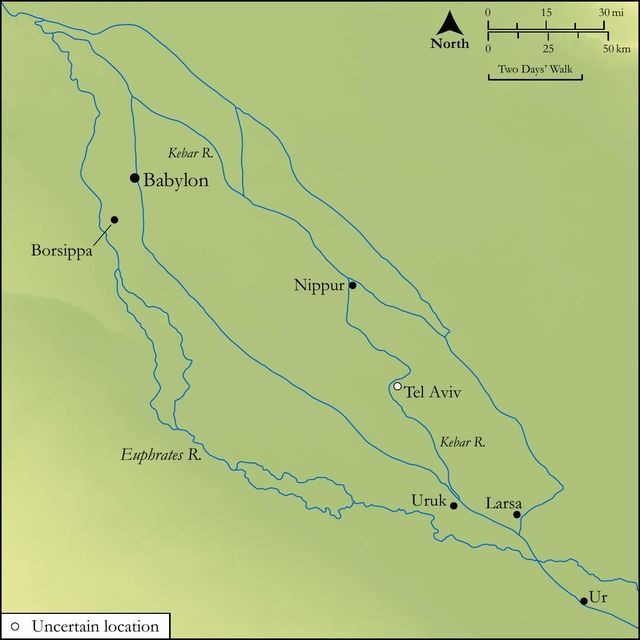
See on the biblical-era map
Study this verse
Public-domain commentary
Matthew Henry
From his Commentary on the Whole Bible. Henry comments on passages, not single verses — this entry covers Ezekiel 3:16–21. His four-level outline is real structure in the source text, so it is rendered as structure.
These further instructions God gave to the prophet at the end of seven days, that is, on the seventh day after the vision he had; and it is very probably that both that and this were on the sabbath day, which the house of Israel, even in their captivity, observed as well as they could in those circumstances. We do not find that their conquerors and oppressors tied them to any constant service, as their Egyptian task-masters had formerly done, but that they might observe the sabbath-rest for a sign to distinguish between them and their neighbours; but for the sabbath-work they had not the convenience of temple or synagogue, only it should seem they had a place by the river side where prayer was wont to be made (as Act 16:13); there they met on the sabbath day; there their enemies upbraided them with the songs of Zion (Psa 137:1, Psa 137:3); there Ezekiel met them, and the word of the Lord then and there came to him. He that had been musing and meditating on the things of God all the week was fit to speak to the people in God's name on the sabbath day, and disposed to hear God speak to him. This sabbath day Ezekiel was not so honoured with visions of the glory of God as he had been the sabbath before; but he is plainly, and by a very common similitude, told his duty, which he is to communicate to the people. Note, Raptures and transports of joy are not the daily bread of God's children, however they may upon special occasions be feasted with them. We must not deny but that we have truly communion with God (Jo1 1:3) though we have it not always so sensibly as at some times. And, though the mysteries of the kingdom of heaven may sometimes be looked into, yet ordinarily it is plain preaching that is most for edification. God here tells the prophet what his office was, and what the duty of that office; and this (we may suppose) he was to tell the people, that they might attend to what he said and improve it accordingly. Note, It is good for people to know and consider what a charge their ministers have of them and what an account they must shortly give of that charge. Observe,
I.What the office is to which the prophet is called:
Son of man, I have made thee a watchman to the house of Israel, Eze 3:17. The vision he saw astonished him: he knew not what to make of that, and therefore God used this plain comparison, which served better to lead him to the understanding of his work and so to reconcile him to it. he sat among the captives, and said little, but God comes to him, and tells him that will not do; he is a watchman, and has something to say to them; he is appointed to be as a watchman in the city, to guard against fire, robbers, and disturbers of the peace, as a watchman over the flock, to guard against thieves and beasts of prey, but especially as a watchman in the camp, in an invaded country or a besieged town, that is to watch the motions of the enemy, and to sound an alarm upon the approach, nay, upon the first appearance, of danger. This supposes the house of Israel to be in a military state, and exposed to enemies, who are subtle and restless in their attempts upon it; yea, and each of the particular members of that house to be in danger and concerned to stand upon their guard. Note, Ministers are watchmen on the church's walls (Isa 62:6), watchmen that go about the city, Sol 3:3. It is a toilsome office. Watchmen must keep awake, be they ever so sleepy, and keep abroad, be it ever so cold; they must stand all weathers upon the watch-tower, Isa 21:8; Gen 31:40. It is a dangerous office. Sometimes they cannot keep their post, but are in peril of death from the enemy, who gain their point if they kill the sentinel; and yet they dare not quit their post upon pain of death from their general. Such a dilemma are the church's watchmen in; men will curse them if they be faithful, and God will curse them if they be false. But it is a needful office; the house of Israel cannot be safe without watchmen, and yet, except the Lord keep it, the watchman waketh but in vain, Psa 127:1, Psa 127:2.
II.What is the duty of this office. The work of a watchman is to take notice and to give notice.
1.The prophet, as a watchman, must take notice of what God said concerning this people, not only concerning the body of the people, to which the prophecies of Jeremiah and other prophets had most commonly reference, but concerning particular persons, according as their character was. He must not, as other watchmen, look round to spy danger and gain intelligence, but he must look up to God, and further he need not look: Hear the word at my mouth, Eze 3:17. Note, Those that are to preach must first hear; for how can those teach others who have not first learned themselves?
2.He must give notice of what he heard. As a watchman must have eyes in his head, so he must have a tongue in his head; if he be dumb, it is as bad as if he were blind, Isa 56:10. Thou shalt give them warning from me, sound an alarm in the holy mountain; not in his own name, or as from himself, but in God's name, and from him. Ministers are God's mouth to the children of men. The scriptures are written for our admonition. By them is thy servant warned, Psa 19:11. But, because that which is delivered viv voce - by the living voice, commonly makes the deepest impression, God is pleased, by men like ourselves, who are equally concerned, to enforce upon us the warnings of the written word. Now the prophet, in his preaching, must distinguish between the wicked and the righteous, the precious and the vile, and in his applications must suit his alarms to each, giving every one his portion; and, if he did this, he should have the comfort of it, whatever the success was, but, if not, he was accountable.
(1.)Some of those he had to do with were wicked, and he must warn them not to go on in their wickedness, but to turn from it, Eze 3:18, Eze 3:19. We may observe here,
[1.]That the God of heaven has said, and does say, to every wicked man, that if he go on still in his trespasses he shall surely die. His iniquity shall undoubtedly be his ruin; it tends to ruin and will end in ruin. Dying thou shalt die, thou shalt die so great a death, shalt die eternally, be ever dying, but never dead. The wicked man shall die in his iniquity, shall fie under the guilt of it, die under the dominion of it.
[2.]That if a wicked man turn from his wickedness, and from his wicked way, he shall live, and the ruin he is threatened with shall be prevented; and, that he may do so, he is warned of the danger he is in. The wicked man shall die if he go on, but shall live if he repent. Observe, he is to turn from his wickedness and from his wicked way. It is not enough for a man to turn from his wicked way by an outward reformation, which may be the effect of his sins leaving him rather than of his leaving his sins, but he must turn from his wickedness, from the love of it and the inclination to it, by an inward regeneration; if he do not so much as turn from his wicked way, there is little hope that he will turn from his wickedness.
[3.]That it is the duty of ministers both to warn sinners of the danger of sin and to assure them of the benefit of repentance, to set before them how miserable they are if they go on in sin, and how happy they may be if they will but repent and reform. Note, The ministry of the word is concerning matters of life and death, for those are the things it sets before us, the blessing and the curse, that we may escape the curse and inherit the blessing.
[4.]That, though ministers do not warn wicked people as they ought of their misery and danger, yet that shall not be admitted as an excuse for those that go on still in their trespasses; for, though the watchman did not give them warning, yet they shall die in their iniquity, for they had sufficient warning given them by the providence of God and their own consciences; and, if they would have taken it, they might have saved their lives.
[5.]That if ministers be not faithful to their trust, if they do not warn sinners of the fatal consequences of sin, but suffer them to go on unreproved, the blood of those that perish through their carelessness will be required at their hand. It shall be charged upon them in the day of account that it was owing to their unfaithfulness that such and such precious souls perished in sin; for who knows but if they had had fair warning given them they might have fled in time from the wrath to come? And, if it contract so heinous a guilt as it does to be accessory to the murder of a dying body, what is it to be accessory to the ruin of an immortal soul?
[6.]That if ministers do their duty in giving warning to sinners, though the warning be not taken, yet they may have this satisfaction, that they are clear from their blood, and have delivered their own souls, though they cannot prevail to deliver theirs. Those that are faithful shall have their reward, though they be not successful.
(2.)Some of those he had to deal with were righteous, at least he had reason to think, in a judgment of charity, that they were so; and he must warn them not to apostatize and turn away from their righteousness, Eze 3:20, Eze 3:21. We may observe here,
[1.]That the best men in the world have need to be warned against apostasy, and to be told of the danger they are in of it and the danger they are in by it. God's servants must be warned (Psa 19:11) that they do not neglect his work and quit his service. One good means to keep us from falling is to keep up a holy fear of falling, Heb 4:1. Let us therefore fear; and (Rom 11:20) even those that stand by faith must not be high-minded, but fear, and must therefore be warned.
[2.]There is a righteousness which a man may turn from, a seeming righteousness, and, if men turn from this, it thereby appears that it was never sincere, how passable, nay, how plausible soever it was; for, if they had been of us, they would no doubt have continued with us, Jo1 2:19. There are many that begin in the spirit, but end in the flesh, that set their faces heavenward, but look back; that had a first love, but have lost it, and turned from the holy commandment.
[3.]When men turn from their righteousness they soon learn to commit iniquity. When they grow careless and remiss in the duties of God's worship, neglect them, or a re negligent in them, they become an easy prey to the tempter. Omissions make way for commissions.
[4.]When men turn from their righteousness, and commit iniquity, it is just with God to lay stumbling-blocks before them, that they may grow worse and worse, till they are ripened for destruction. When Pharaoh hardened his heart God hardened it. When sinners turn their back upon God, desert his service, and so cast a reproach upon it, he does, in a way of righteous judgment, not only withdraw his restraining grace and give them up to their own hearts' lusts, but order them by his providence into such circumstances as occasion their sin and hasten their ruin. There are those to whom Christ himself is a stone of stumbling and a rock of offence, Pe1 2:8.
[5.]The righteousness which men relinquish shall never be remembered to their honour or comfort; it will stand them in no stead in this world or the other. Apostates lose all that they have wrought; their services and sufferings are all in vain, and shall never be brought to an account, because not continued in. It is a rule in the law, Factum non dicitur, quod non perseverat - We are said to do only that which we do perseveringly, Gal 3:3, Gal 3:4.
[6.]If ministers do no give fair warning, as they ought, of the weakness of the best, their aptness to stumble and fall, the particular temptations they are in and the fatal consequences of apostasy, the ruin of those that do apostatize will be laid at their door, and they shall answer for it. Not but that there are those who are warned against it, and yet turn from their righteousness; but that case is not put here, as was concerning the wicked man, but, on the contrary, that a righteous man, being warned, takes the warning and does not sin (Eze 3:21); for, if you give instruction to a wise man, he will be yet wiser. We must not only not flatter the wicked, but not flatter even the righteous as if they were perfectly safe any where on this side heaven.
[7.]If ministers give warning, and people take it, it is well for both. Nothing is more beautiful than a wise reprover upon an obedient ear; the one shall live because he is warned and the other has delivered his soul. What can a good minister desire more than to save himself and those that hear him? Ti1 4:16.
Historical interpretation
Two Centuries of Reception
4 surviving comments on this verse. Each one is dated, so this reads as a timeline rather than a list.
Select a marker to jump to its quote. Markers stagger vertically where authors wrote within a few decades of each other.
We learn from Ezekiel that, provided the guardian gives warning as to what it is necessary to avoid and it is necessary to choose, he delivers his own soul, even if no one pays any attention to him.
(Verse 18, 19.) If I say to the wicked, 'You will surely die,' and you do not warn him or speak out to warn him from his wicked way that he may live, that wicked person shall die for his iniquity, but his blood I will require at your hand. But if you warn the wicked, and he does not turn from his wickedness or from his wicked way, he shall die for his iniquity, but you will have delivered your soul. There are two wicked or iniquitous persons, as the Septuagint has translated. One who hears nothing as a viewer, and dies in his impiety; whose blood is sought by the hands of the viewer. Another, to whom the viewer announces, and he, despising to hear, dies due to his own fault: in such a way that the viewer is innocent of the fault. From which we understand that the Lord threatens the impious one, and says: 'You will die by death', so that he may turn away from his impious way, and live. For the threat is not against humans, but against sins, and not against those who turn away from vices, but against those who persist in sin. And there is a great danger in keeping silent on the words of God for three reasons: either out of fear, or out of laziness, or out of flattery. Hence Isaiah says: Woe is me, for I have kept silent (Isaiah 6:5). And what follows, You have freed your soul, signifies the same as the saying of the Apostle: If anyone's work burns, he will suffer loss, but he himself will be saved, but as through fire (1 Corinthians 3:14), so as to prove whether an external observer was the cause of his death or whether he was guilty. For the work of the master is the well-being of the disciple.
If he does this, he goes out from there, not by physical withdrawal but defended by his behavior; he has done what he had to do, even if the other person did not heed the warning he should have heeded.
For then your subject dies without you, when in the cause of death he has endured you as one who does not speak against it. For you are joined to the death which you do not oppose. And it should be noted what things ought to be preached by the watchman, namely faith and works. For he says: "But if you have announced to the wicked man, and he has not been converted from his wickedness and from his wicked way." For wickedness pertains to unbelief, but the wicked way pertains to depraved action. And every watchman ought to have this zeal: that he first draw people to the piety of faith, and afterward to the pious way, that is, to good action.
But since the discussion has turned to exhortation, we ought briefly to make known how great should be the order and consideration of speech in the mouth of a pastor. For a teacher ought to weigh what he speaks, to whom he speaks, when he speaks, how he speaks, and how much he speaks. For if one of these is lacking, the speech will not be fitting. Indeed it is written: "If you offer rightly, but do not divide rightly, you have sinned." We offer rightly when we do a good work with good zeal; but we do not divide rightly if we neglect to have discretion in the good work. For we ought to consider what we speak, so that according to Paul's words, "Let our speech always be seasoned with grace as with salt."
We must consider to whom we are speaking, because often a word of rebuke that one person accepts, another does not accept. And often the same person becomes different according to their deed. Hence Nathan the prophet struck David after his adultery with a strong sentence of rebuke. When he spoke about the one who seized the sheep, saying "The man who did this is a son of death," he immediately responded to him, saying: "You are that man." Yet when he spoke to him about Solomon's kingdom, because there was no fault, he humbly prostrated himself before him in adoration. Therefore in one and the same person, because the circumstances were different, the prophetic discourse was also different.
When we ought to speak must also be considered, because often even if reproof is delayed, it is afterwards kindly received. And sometimes it grows weak, if it has lost the time when it ought to have been brought forth earlier. For the wise woman also, seeing Nabal drunk, did not wish to reprove him for the fault of his avarice, but when the wine was digested she profitably struck him with the words of her reproof. And the Prophet announces that the tongues of flatterers are not to be deferred to a subsequent time, who says: "Let them immediately be confounded with shame who say to me, Well done, well done." For flattery, if it is patiently endured even for a time, increases, and little by little soothes the mind, so that it grows soft from the rigor of its rectitude in the delight of speech. But lest it should increase, it must be struck immediately and without delay.
We must also consider how we speak. For often the words that call one person back to salvation wound another. Hence the apostle Paul, who admonishes Titus, saying: "Rebuke with all authority," exhorts Timothy, saying: "Reprove, entreat, rebuke with all patience and teaching." Why does he prescribe authority to one and patience to the other, unless because he perceived that the one was of a gentler spirit, while the other was of a more fervent spirit? Upon the gentle one, severity of speech had to be enjoined through the authority of command, but he who burned with fervor of spirit needed to be tempered through patience, lest if he grew more heated than was right, he would not lead the wounded back to salvation, but would wound the healthy.
We must also be careful how much we speak, lest if we draw out a word of exhortation or reproof too long for one who cannot bear much, we lead our hearer to weariness. Hence the same excellent preacher speaks to the Hebrews, saying: "I beseech you, brethren, that you bear with the word of consolation, for I have written to you in very few words." This is especially fitting for the weak, that they hear few things indeed, and things they are able to grasp, but things that pierce their mind with the sorrow of repentance. For if a lengthy discourse of exhortation is spoken to them all at once, because they cannot retain many things, they lose everything together. Hence physicians of bodies also apply cloths to ailing stomachs with suitable medicine, but they apply it thinly, lest if they are filled with much medicine, they not help the weakness of the stomach by strengthening it, but burden it by oppressing it.
It should be known, however, that even if at times a rather lengthy discourse exceeds its proper measure, this is not dangerous for the hearers. But if how something is said, and to whom it is said, is not carefully considered, it is very dangerous. For modest minds, if they have perhaps committed some faults, should be reproved gently, because if they are rebuked too harshly, they are broken rather than instructed. On the other hand, harsh and shameless minds, if they are reproved gently, are provoked by that very gentleness to greater faults.
We learn this well in the same distinguished preacher, who when he knew that the Corinthians were divided into schism out of love for personalities, being considerate of their modesty, began his speech to them with thanksgiving and praises, saying: "I give thanks to my God always for you in the grace of God, which was given to you in Christ Jesus, because in all things you have been made rich in him, in all speech and in all knowledge, just as the testimony of Christ has been confirmed in you." He adds further and says: "So that you lack nothing in any grace, as you await the revelation of our Lord Jesus Christ." I ask you, Paul, if they already lack nothing, why do you weary yourself writing to them? Why do you speak while positioned at a distance? Let us consider then, dearest brothers, how much he praises them. Behold, he asserts that the grace of God was given to them, he says they were made rich in all things in all speech and in all knowledge; he declares that the testimony of Christ, that is, what he testified about himself by dying and rising, has been confirmed in their life, and he attests that they lack nothing in any grace. Who, I ask, would believe that shortly after he rebukes those whom he praises so much? For after other things he adds: "But I beseech you, brothers, by the name of our Lord Jesus Christ, that you all say the same thing, and that there be no schisms among you." For how could schism creep in among those so perfect and so praiseworthy? "For it has been signified to me about you, my brothers, by those who are of Chloe, that there are contentions among you. But this I say, that each one of you says: 'I indeed am of Paul, but I am of Apollo, but I am of Cephas, but I am of Christ.'" Behold, those whom he had praised in all speech and in all knowledge, those whom he had said lacked nothing in any grace, speaking a little while, coming gently to rebuke, he reproves as divided among themselves; and those whose health he had first described, he afterward laid open their wounds. For a skilled physician, seeing a wound that must be cut, but perceiving the patient to be fearful, stroked it for a long time, and suddenly struck. First he placed the soothing hand of praise, and afterward he drove in the blade of rebuke. For unless modest minds are reproved with gentle stroking, so that they hear from other matters what they might take for consolation, through rebuke they immediately fall into despair.
But did Paul lie, so that he first said they lacked nothing in all grace, when afterward he was going to say they lacked unity? Far be it: who, even if foolish, would believe such things of him? But because there were among the Corinthians some filled with all grace, and there were some cut off by favoritism toward persons, he began with praises of the perfect, so that by modest rebuke he might arrive at reproof of the weak. And in this too he drew upon the practice of bodily medicine for the healing of the heart. For when a physician looks at a wound to be treated, he first touches those parts around the wound that are healthy, so that afterward he may gently reach by touching those that are wounded. Therefore when Paul praised the perfect among the Corinthians, he touched the healthy parts near the wound; but when he reproved the weak for their division, he struck the wound in the body.
Let us see, however, how this same man who is led with such modesty and gentleness to correct the Corinthians conducts himself against the Galatians, who had departed from the faith. For without any patience of modesty offered beforehand, without any sweetness of speech granted in advance, those whom he knew had departed from the faith he rebukes with invective from the very beginning of his epistle. For after the greeting, he began thus: "I marvel that you are so quickly being transferred from him who called you in the grace of Christ." To whom also, after other things, he adds in open rebuke: "O foolish Galatians, who has bewitched you?" For hard minds, unless they were struck with open rebuke, would in no way recognize the evil they had done. For often those who are shameless feel they have sinned only to the degree that they are rebuked for the sins they have committed, so that they consider their faults to be lesser when a lesser invective chastises them, and those which they see are vehemently reproved they perceive to be greater. Hence it is necessary that the speech of the preacher must always be formed according to the quality of the hearers, lest he speak harshly to the modest or gently to the shameless. But what is surprising if the dispenser of God's word does this, when even the farmer who casts seeds into the ground first considers beforehand the quality of the soil, which seeds it seems suited for, and after he has considered the quality beforehand, then he scatters the seeds? But because we have drawn out the discussion about the quality of teaching too long, it is fitting that we return to the order of exposition which we had begun.
Continue studying Ezekiel 3:19 across the web’s major study libraries — every link below opens this exact verse, chapter, or book on the destination site.
Read & Compare
 BibleGatewayThis verse in more than 200 translations and 70 languages.
 Bible.comThe YouVersion reader — hundreds of translations, reading plans, and highlights.
 ESV.orgCrossway's official English Standard Version reader.
 NET BibleThe NET translation with 60,000+ translators' notes on every rendering decision.
 STEP BibleTyndale House's free study tool — original text, vocabulary, and scholarly resources.
 BibliaLogos Bible Software's free web reader.
 USCCBThe New American Bible (Revised Edition) with the U.S. bishops' study notes.
Commentaries
 BibleHub CommentariesDozens of classic commentaries on this verse, gathered on one page.
 StudyLightMore than 100 commentary sets — the largest collection on the web.
 BibleRefPlain-English commentary on what this verse means, verse by verse.
 Enduring WordDavid Guzik's free commentary on this chapter, widely used by Bible teachers.
 Bible Study ToolsVerse commentary alongside Greek and Hebrew study aids.
Original Language & Research
- BibleHub InterlinearThe verse word by word — original language, transliteration, and English.
- BibleHub LexiconEvery word's original-language definition and Strong's entry.
 Blue Letter BibleDeep-study tools — Strong's numbers, concordance, and word studies.
 SefariaThe Hebrew text with Rashi and centuries of Jewish commentary.
Sermons, Hymns & Audio


TrulyRandomVerse is not affiliated with these sites and doesn’t control their content. They’re linked because they’re genuinely useful.
Summary
Ezekiel 3:19 articulates the solemn duty of the prophet as God's watchman and profoundly establishes the principle of individual moral accountability. It declares that while the prophet is divinely commanded to deliver a warning of impending judgment to the wicked, the ultimate responsibility for their spiritual fate rests entirely upon their personal response to that warning. The verse powerfully underscores that faithful obedience in delivering God's message absolves the messenger of guilt for the recipient's unrepentant sin, thereby ensuring the prophet's own spiritual preservation and integrity before God.
Context
ShowHideLiterary Context
This verse is a direct and crucial continuation of God's commission to Ezekiel, which begins in Ezekiel 3:17. The preceding verses establish Ezekiel's role as a "watchman" for the house of Israel, explicitly mandating him to deliver God's warnings. Ezekiel 3:18 outlines the severe consequences if the watchman fails to warn the wicked, making the watchman accountable for their blood. Ezekiel 3:19 then presents the inverse, yet equally critical, scenario: what transpires when the warning is faithfully given but disregarded by the recipient. It completes the conditional framework regarding the watchman's responsibility and the wicked's ultimate destiny, setting the stage for the subsequent divine directives concerning Ezekiel's prophetic speech or silence.
Historical & Cultural Context
Ezekiel's prophetic ministry unfolded during the traumatic period of the Babylonian exile (circa 593-571 BC). The Jewish people, deported from their homeland after the siege of Jerusalem, grappled with profound national crisis and spiritual disorientation, struggling to reconcile their suffering with God's covenant promises. A prevalent cultural belief, reflected in passages like Lamentations 5:7, emphasized corporate responsibility, where the sins of one generation were thought to be visited upon the next. Ezekiel's message, particularly in chapters like Ezekiel 18, significantly challenged this notion, advocating for individual accountability for sin. The concept of a "watchman" was a well-understood and vital role in Israel, referring to an individual posted on city walls or strategic points to warn of approaching danger, a position that carried immense responsibility for the community's safety and survival.
Key Themes
ShowHideThe central themes woven throughout Ezekiel 3 and the broader book include divine sovereignty, the nature of sin, God's justice, and critically, individual accountability. This verse powerfully contributes to the theme of individual accountability, asserting that despite a corporate context of judgment, each person's eternal destiny is inextricably linked to their personal response to God's truth. It also highlights the prophet's responsibility as a faithful messenger, emphasizing that obedience to the divine commission is paramount, regardless of the outcome. The concept of spiritual deliverance for the obedient messenger is also prominent, reassuring Ezekiel that his faithfulness secures his own soul, even if others refuse to repent and face judgment, a principle echoed and expanded upon later in Ezekiel 33:1-9.
Exposition and Analysis
ShowHideKey Word Analysis
ShowHideMeaning "to gleam; figuratively, to enlighten (by caution); admonish, shine, teach, (give) warn(-ing)." This word conveys the active, illuminating effort of the prophet to make clear the danger and the path to safety. It is not a passive suggestion but a deliberate, authoritative declaration intended to bring understanding, expose truth, and provoke a decisive response.
Meaning "to turn back (hence, away) transitively or intransitively, literally or figuratively (not necessarily with the idea of return to the starting point); generally to retreat; often adverbial, again." This is a pivotal term, denoting a fundamental change of direction, a spiritual repentance. The very purpose of the warning is to elicit this "turning" from a wicked way of life. The absence of this turning signifies a deliberate, volitional rejection of God's call to repentance and a persistence in rebellion.
Meaning "to snatch away, whether in a good or a bad sense; [idiom] at all, defend, deliver (self), escape, [idiom] without fail, part, pluck, preserve, recover, rescue, rid, save, spoil, strip, [idiom] surely, take (out)." In this specific context, it signifies rescue, salvation, or preservation. By faithfully delivering the warning, the prophet "snatches away" or rescues his own life and moral integrity from the guilt and judgment that would otherwise fall upon him for the wicked person's demise. It underscores his absolution before God.
Verse Breakdown
ShowHide"Yet if thou warn the wicked,"
This opening clause establishes the prophet's faithful execution of his divinely appointed duty. It presumes that Ezekiel has diligently fulfilled his mandate to admonish, enlighten, and clearly articulate God's truth, including the gravity of sin and its impending consequences, to those who are morally corrupt.
"and he turn not from his wickedness, nor from his wicked way,"
This phrase profoundly highlights the wicked person's defiant refusal to repent. Despite receiving a clear, divine warning, they choose to persist in their sinful state ("wickedness") and their chosen sinful course of action ("wicked way"). This emphasizes their personal culpability, active rebellion, and the exercise of their free will in rejecting God's gracious call to change.
"he shall die in his iniquity;"
This declares the inevitable and just consequence of unrepentant sin. The "death" referred to encompasses not only physical demise but, more significantly, spiritual separation from God, culminating in eternal judgment. This outcome is directly attributed to their own "iniquity" – their moral perversity, their guilt, and the punishment that justly results from their unconfessed and unrepented sin. Their demise is not the prophet's fault but the direct, righteous consequence of their own choices.
"but thou hast delivered thy soul."
This provides the divine assurance and complete absolution for the obedient messenger. By faithfully delivering the warning, Ezekiel has "snatched away" or rescued his own life, his moral standing, and his spiritual being from the guilt and judgment that would otherwise fall upon him for the wicked person's demise. His responsibility is fulfilled, and he stands clear before God, regardless of the recipient's ultimate, self-determined response.
Literary Devices
ShowHideEzekiel 3:19 is rich with potent literary devices that amplify its message. The primary structure is a Conditional Statement, presented as a clear "if-then" proposition. This precise, almost legalistic, framing meticulously outlines the cause-and-effect relationship between the prophet's action, the wicked's response, and the resulting consequences for both parties, thereby underscoring the divine justice at play. There is a stark Contrast drawn between the dire fate of the wicked (death in iniquity) and the prophet's deliverance, highlighting the divergent outcomes based on human choices of obedience or persistent rebellion. The subtle yet impactful Repetition of "wicked" (רָשָׁע, râshâʻ) and "wickedness" (רֶשַׁע, reshaʻ) emphasizes the pervasive nature of the sin being warned against and the deliberate, entrenched choice to remain in that state. Finally, the overarching imagery of the "watchman," established in the preceding verses, functions as an Extended Metaphor, powerfully portraying the prophet's vital and weighty role in guarding the spiritual well-being of the people and the profound responsibility associated with that sacred task.
Theological and Thematic Connections
ShowHideEzekiel 3:19 profoundly articulates the dual principles of divine justice and human responsibility, which are foundational to biblical theology. It underscores that God, in His perfect righteousness, will hold individuals fully accountable for their choices, particularly their response to His revealed truth and warnings. The prophet's role is strictly to faithfully deliver this truth, not to compel belief or repentance, as that remains the sphere of individual volition. This verse establishes a critical theological precedent: the messenger's culpability is tied solely to their faithfulness in delivering the message, not to the recipient's reception or rejection of it. This principle is foundational for understanding the nature of evangelism, prophetic ministry, and discipleship throughout Scripture, emphasizing that while God genuinely desires all to come to repentance, He respects human free will and holds individuals ultimately responsible for their eternal decisions.
Reflection and Application
ShowHideEzekiel 3:19 offers a powerful, sobering, and ultimately liberating reflection for believers today, especially those engaged in sharing the Gospel, teaching God's Word, or ministering truth in any capacity. It serves as a profound reminder that our primary duty is one of faithful proclamation and clear warning. We are called to "warn the wicked," which entails articulating the stark reality of sin, the inevitable consequences of rebellion against God, and the urgent, gracious call to repentance and faith. This requires not only courage and clarity but also an unwavering commitment to God's Word, even when the message is unpopular, challenging, or met with indifference or outright resistance. The profound comfort and spiritual freedom embedded in this verse lie in the assurance that our own spiritual integrity and standing before God are preserved when we have diligently fulfilled our divine mandate. We are not, and cannot be, responsible for the choices of others, nor can we force their repentance or belief. Our "soul is delivered" when we have faithfully sown the seed of truth, irrespective of whether it falls on fertile ground, stony soil, or among thorns. This liberating truth frees us from the crushing burden of outcome-based anxiety and allows us to rest securely in God's sovereign plan and the individual's ultimate, personal accountability before Him.
Questions for Reflection
ShowHideFAQ
ShowHideWhat does it mean for the wicked to "die in his iniquity"?
ShowHideTo "die in his iniquity" signifies that the wicked person's demise—encompassing both physical death and, more significantly, spiritual separation from God—is a direct, just, and inevitable consequence of their unrepentant sin and inherent moral perversity. It means their death is not an arbitrary act of divine wrath but a righteous judgment for their deliberate choice to persist in rebellion against God, despite having been clearly warned. This phrase underscores their personal responsibility for their sinful state and the resulting judgment, as powerfully articulated in Ezekiel 18:4.
How does this verse relate to the concept of free will?
ShowHideThis verse strongly affirms and highlights the concept of human free will. The critical phrase "if... he turn not" clearly indicates that the wicked individual possesses the inherent capacity and the volitional choice to respond to the warning. Their failure to "turn from his wickedness" is presented as a deliberate, volitional act for which they are held fully accountable. God's warning is extended as a gracious invitation to repentance, but the ultimate decision to accept or reject that invitation rests entirely with the individual, thereby emphasizing the profoundly personal nature of accountability before a righteous God.
Does this verse imply that the messenger is responsible for someone's salvation?
ShowHideNo, quite the opposite. This verse explicitly states that the messenger "hast delivered thy soul" if the warning is faithfully given, regardless of the wicked person's response. This means the messenger's responsibility is limited to the faithful and clear proclamation of God's truth, but not for the recipient's salvation or condemnation. Salvation is ultimately God's sovereign work, received through individual faith and repentance, which are personal choices. The prophet's role is to be a faithful conduit of God's message, not the guarantor of its reception or the determinant of its outcome, a vital point reiterated in the New Testament by figures like the Apostle Paul in Acts 20:26.
Christ-Centered Fulfillment
ShowHideEzekiel 3:19, while rooted in the Old Testament prophetic commission, finds its profound Christ-centered fulfillment in the person and redemptive work of Jesus Christ and the ongoing mission of His church. Jesus Himself is the ultimate and perfect "watchman," the faithful and true witness who flawlessly delivered God's warning and gracious invitation to humanity. He came proclaiming the imminent kingdom of God and issuing the urgent call to "Repent, for the kingdom of heaven is at hand" (Matthew 4:17). He unequivocally warned of judgment for those who would not believe, declaring that "whoever believes in him is not condemned, but whoever does not believe is condemned already" (John 3:18). Yet, despite His perfect warning, His flawless life, and His ultimate demonstration of God's sacrificial love on the cross, many did not turn from their wicked ways, leading to their condemnation—not because of any failure on His part, but due to their own willful rejection. Just as Ezekiel delivered his soul by faithfully speaking, Jesus, by perfectly fulfilling the Father's will even unto death on the cross, delivered His own soul and, more importantly, secured eternal salvation for all who would believe in Him. The church, as Christ's redeemed body and continuing presence in the world, carries on this watchman ministry, called to "go therefore and make disciples of all nations" (Matthew 28:19), faithfully proclaiming the good news of salvation and warning against the consequences of sin, thereby delivering their own souls by faithfully bearing witness to the Lamb of God who takes away the sin of the world.