


Ezekiel 28:26
Bible text: King James Version (1769 Blayney text) · Public domain
Bible text: King James Version with Strong's numbers · Public domain
Bible text: Berean Standard Bible · Public domain
Bible text: American Standard Version (1901) · Public domain
Bible text: World English Bible, Messianic edition · Public domain
Bible text: Geneva Bible (1599) · Public domain
Bible text: Young's Literal Translation · Public domain
- וְיָשְׁבוּve·ya·she·Vuand they will dwellH3427Conj-w ¦ V-Qal-ConsecPerf-3cpVerb Qal Consecutive Perfect 3rd Plural common genderוְandיָשְׁבוּthey will dwell
- עָלֶיהָ'a·lei·Haon itH5921Prep ¦ 3fsPrepositionעָלֶיonהָit
- לָבֶטַחla·ve·Tachto securityH983Prep-l ¦ N-msNoun Singular Masculine Absoluteלָtoבֶטַחsecurity
- וּבָנוּu·va·Nuand they will buildH1129Conj-w ¦ V-Qal-ConsecPerf-3cpVerb Qal Consecutive Perfect 3rd Plural common genderוּandבָנוּthey will build
- בָתִּיםva·TimhousesH1004N-mpNoun Plural Masculine Absolute
- וְנָטְעוּve·na·te·'Uand they will plantH5193Conj-w ¦ V-Qal-ConsecPerf-3cpVerb Qal Consecutive Perfect 3rd Plural common genderוְandנָטְעוּthey will plant
- כְרָמִיםkhe·ra·MimvineyardsH3754N-mpNoun Plural Masculine Absolute
- וְיָשְׁבוּve·ya·she·Vuand they will dwellH3427Conj-w ¦ V-Qal-ConsecPerf-3cpVerb Qal Consecutive Perfect 3rd Plural common genderוְandיָשְׁבוּthey will dwell
- לָבֶטַחla·Ve·tachto securityH983Prep-l ¦ N-msNoun Singular Masculine Absoluteלָtoבֶטַחsecurity
- בַּעֲשׂוֹתִיba·'a·so·Tiwhen I bring aboutH6213Prep-b ¦ V-Qal-Inf ¦ 1csVerb Qal Infinitive Constructבַּwhenעֲשׂוֹתִbring aboutיI
- שְׁפָטִיםshe·fa·TimjudgmentsH8201N-mpNoun Plural Masculine Absolute
- בְּכֹלbe·Kholon allH3605Prep-b ¦ N-mscNoun Singular Masculine Constructבְּonכֹלall
- הַשָּׁאטִיםha·sha·Timthose [who] despiseH7590Art ¦ V-Qal-Prtcpl-mpVerb Qal Participle Plural Masculine Absoluteהַthoseשָּׁאטִים[who] despise
- אֹתָם'o·Tam<obj.> themH853DirObjM ¦ 3mpParticle Object Indicatorאֹתָ<obj.>םthem
- מִסְּבִיבוֹתָםmi·se·Vi·vo·Tamfrom around themH5439Prep-m ¦ N-fpc ¦ 3mpNoun Plural Feminine Constructמִfromסְּבִיבוֹתָaroundםthem
- וְיָדְעוּve·Ya·de·'Uand they will knowH3045Conj-w ¦ V-Qal-ConsecPerf-3cpVerb Qal Consecutive Perfect 3rd Plural common genderוְandיָדְעוּthey will know
- כִּיkithatH3588PrtParticle Conditional
- אֲנִי'a·NiIH589Pro-1csPronoun Personal 1st Singular common gender
- יְהוָהYah·weh[am] YahwehH3068N-properNoun Proper Title
- אֱלֹהֵיהֶם'e·lo·hei·Hemtheir GodH430N-mpc ¦ 3mpNoun Plural Masculine ConstructאֱלֹהֵיGodהֶםtheir
English is a literal word-by-word gloss of the Hebrew, not the KJV's wording. Why?
This is the original text the KJV's translators worked from — each Hebrew word with its own literal English meaning in this verse, prepared by scholars at Tyndale House, Cambridge. The KJV translates whole sentences, not word by word, so its wording differs: one Hebrew word can become several English words, and the KJV may choose “the LORD” where the gloss reads “Yahweh”. Both are faithful — they answer different questions. For the KJV's own rendering, switch to the KJV text.
Details
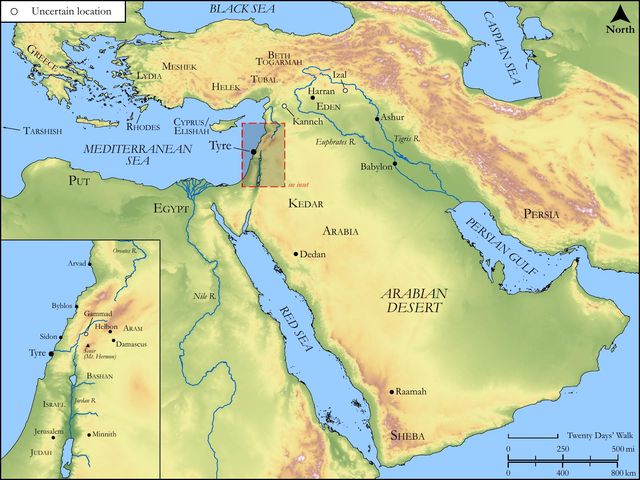
See on the biblical-era map
Study this verse
Public-domain commentary
Matthew Henry
From his Commentary on the Whole Bible. Henry comments on passages, not single verses — this entry covers Ezekiel 28:20–26.
God's glory is his great end, both in all the good and in all the evil which proceed out of the mouth of the Most High; so we find in these verses. 1. God will be glorified in the destruction of Zidon, a city that lay near to Tyre, was more ancient, but not so considerable, had a dependence upon it and stood and fell with it. God says here, I am against thee, O Zidon! and I will be glorified in the midst of thee, Eze 28:22. And again, "Those that would not know be gentler methods shall be made to know that I am the Lord, and I alone, and that I am a just and jealous God, when I shall have executed judgments in her, destroying judgments, when I shall have done execution according to justice and according to the sentence passed, and so shall be sanctified in her." The Zidonians, it should seem, were more addicted to idolatry than the Tyrians were, who, being men of business and large conversation, were less under the power of bigotry and superstition. The Zidonians were noted for the worship of Ashtaroth; Solomon introduced it, Kg1 11:5. Jezebel was daughter to the king of Zidon, who brought the worship of Baal into Israel (Kg1 16:31); so that God had been much dishonoured by the Zidonians. Now, says he, I will be glorified, I will be sanctified. The Zidonians were borderers upon the land of Israel, where God was known, and where they might have got the knowledge of him and have learned to glorify him; but, instead of that, they seduced Israel to the worship of their idols. Note, When God is sanctified he is glorified, for his holiness is his glory; and those whom he is not sanctified and glorified by he will be sanctified and glorified upon, by executing judgments upon them, which declare him a just avenger of his own and his people's injured honour. The judgments that shall be executed upon Zidon are war and pestilence, two wasting depopulating judgments, Eze 28:23. They are God's messengers, which he sends on his errands, and they shall accomplish that for which he sends them. Pestilence and blood shall be sent into her streets; there the dead bodies of those shall lie who perished, some by the plague, occasioned perhaps through ill diet when the city was besieged, and some by the sword of the enemy, most likely the Chaldean armies, when the city was taken, and all were put to the sword. Thus the wounded shall be judged; when they are dying of their wounds they shall judge themselves, and others shall say, They justly fall. Or, as some read it, They shall be punished by the sword, that sword which has commission to destroy on every side. It is God that judges, and he will overcome. Nor is it Tyre and Zidon only on which God would execute judgments, but on all those that despised his people Israel, and triumphed in their calamities; for this was now God's controversy with the nations that were round about them, Eze 28:26. Note, When God's people are under his correcting hand for their faults he takes care, as he did concerning malefactors that were scourged, that they shall not seem vile to those that are about them, and therefore takes it ill of those who despise them and so help forward the affliction when he is but a little displeased, Zac 1:15. God regards them even in their low estate; and therefore let not men despise them. 2. God will be glorified in the restoration of his people to their former safety and prosperity. God had been dishonoured by the sins of his people, and their sufferings too had given occasion to the enemy to blaspheme (Isa 52:5); but God will now both cure them of their sins and ease them of their troubles, and so will be sanctified in them in the sight of the heathen, will recover the honour of his holiness, to the satisfaction of all the world, Eze 28:25. For, (1.) They shall return to the possession of their own land again: I will gather the house of Israel out of their dispersions, in answer to that prayer (Psa 106:27), Save us, O Lord our God! and gather us from among the heathen; and in pursuance of that promise (Deu 30:4), Thence will the Lord thy God gather thee. Being gathered, they shall be brought in a body, to dwell in the land that I have given to my servant Jacob. God had an eye to the ancient grant, in bringing them back, for that remained in force, and the discontinuance of the possession was not a defeasance of the right. He that gave it will again give it. (2.) They shall enjoy great tranquillity there. When those that have been vexatious to them are taken off they shall live in quietness; there shall be no more a pricking brier nor a grieving thorn, Eze 28:24. They shall have a happy settlement, for they shall build houses, and plant vineyards; and they shall enjoy a happy security and serenity there; they shall dwell safely, shall dwell with confidence, and there shall be none to disquiet them or make them afraid, Eze 28:26. This never had full accomplishment in the body of that people, for after their return out of captivity they were ever and anon molested by some bad neighbour or other. Nor has the gospel-church been ever quite free from pricking briers and grieving thorns; yet sometimes the church has rest, and believers always dwell safely under the divine protection and may be quiet from the fear of evil. But the full accomplishment of this promise is reserved for the heavenly Canaan, when all the saints shall be gathered together, and every thing that offends shall be removed, and all griefs and fears for ever banished.
Historical interpretation
Historical reception
3 surviving comments on this verse. Each one is dated, so this reads as a timeline rather than a list.
(Verse 20 and following) And the word of the Lord came to me, saying: Son of man, set your face against Sidon and prophesy against it, and say: Thus says the Lord God: Behold, I am against you, Sidon, and I will be glorified in you. And they shall know that I am the Lord when I execute judgments in her and am sanctified in her. And I will send pestilence upon her and blood in her streets, and the slain shall fall in her midst, by the sword all around, and they shall know that I am the Lord. And there will no longer be a stumbling block of bitterness and a thorn inflicting pain in every direction for the house of Israel (or those who have insulted them). And they will know that I am the Lord their God. Thus says the Lord God: When I gather the house of Israel from the peoples (or from the nations) among whom they are scattered, I will be sanctified in them before the nations. And they will dwell in their own land, which I gave to my servant Jacob, and they will dwell there securely (or in hope). And they will build houses and plant vineyards, and they will dwell confidently (or in hope) when I execute judgments on all who oppose them (or have insulted them) on every side. And they will know that I am the Lord their God. And what follows, according to the Septuagint: And you, the God of their fathers, is not found in Hebrew. Furthermore, after Tyre, the speech turns to Sidon; for both cities are part of the same province. And in the Gospel, Tyre and Sidon are mentioned together: If the miracles which were done in you were done in Tyre and Sidon (Matthew 11:21). Therefore, even the Canaanite woman, whose daughter was possessed by a demon, because she came from the region of Tyre and Sidon, obtained what she had asked for (ibid., 15). But the divine word predicts that it will be taken captive by the Babylonians, and it will know the weight of its evils, that He Himself is the Lord: when He has judged it, and has been sanctified in it, and has consumed it with hunger and pestilence, and with the sword: so that it falls in its streets, and no longer becomes a stumbling block to the people of God, nor does it frequently attack them. But when this has been done, the people of Israel, whom He had dispersed into various nations, will return to their own land, and they will be sanctified in them, not for evil, as in Sidon, but for good, when He has shown mercy to them, and they will dwell in the land which He gave to their father Jacob, and they will dwell securely, and in the Lord they will trust, and they will build houses, and plant vineyards, when He has fulfilled His promises to them: and then they will know that He Himself is the Lord, whose promises are most firm. Many refer to the time of Zerubbabel, Ezra, and Nehemiah, when the people of Israel returned and lived in the land of Judah. Others, however, hope for its fulfillment in the last time and in a thousand years. Moreover, according to spiritual understanding, this seems to have a symbolic meaning for us. Sidonians are interpreted as hunters, about whom it is also written in the Psalms: Our soul has been rescued like a bird from the snare of the hunters (Psalm 124:7). And in Proverbs: The eye of a harlot is the snare of a sinner (Prov. XXIII, 27). But there are also hunters on the good side, of whom Jeremiah writes: Behold, I will send fishermen and hunters, who will hunt you down from every hill and mountain (Jerem. XVI, 16): whom the Lord also sends to fish, and makes them fishers of men (Matth. IV). Hence the village of Peter and Andrew is called by this name: For Bethsaida in our language means 'the house of hunters'. Against these wretched hunters, the word of God is directed, and the prophet is commanded to set his face against Sidon and not waver in the wind of doctrine, but stand firm in the truth and destroy his hunters. So what is it that the Lord threatens against Sidon? Behold, I myself will come to you and be glorified in you when I destroy you, and all who live will know that I am the Lord when I repay you according to what you deserve. And I will send pestilence and blood into your streets. And rightly are they called streets of Sidon: for it is a wide and spacious road that leads to death (Matt. 7). And the slain will fall, those who stood evilly by the sword in a circle: by that sword which the Lord came to send upon the earth, so that He may separate what is improperly joined, and so that those who remain may know that He Himself is the Lord. And when they have ceased, there will no longer be any stumbling block of bitterness, nor a thorn that pierces and wounds the people of God. But all these things are said against the opposing powers, that they may be destroyed in the end time, and there may be eternal security when the Lord gathers the house of Israel, those who perceive God with understanding. And he will be sanctified in them, and that which is written will be fulfilled: Be holy, for I am holy (Leviticus 19:2). And they will dwell in their own land, as we read elsewhere: I believe in seeing the good things of the Lord in the land of the living (Psalm 16:13). What Jacob gave, who had supplanted his brother earlier, and earned the primacy for himself. And they will dwell in it securely, either in hope, and they will build houses, plant vineyards, and dwell confidently in hope, according to what is read in Isaiah: Those who have been weaned from milk, those who have been taken away from the breast, expect tribulation upon tribulation, and hope upon hope (Isa. 60). But they will build houses, as also built in the Gospel, who established foundations not on sand, but on rock (Matt. 7). Of which it is written: Unless the Lord builds the house, they labor in vain who build it (Ps. 127:1). And in Exodus, according to the Septuagint: Because the midwives feared the Lord, they built houses for themselves (Exod. 1:21), and many such things. But when the Lord executes judgment against those who oppose or inflict insults on Israel, all creatures will know that He is the Lord, whose judgments are true and justified in themselves.
(Verse 35, 36, and following) And I will bring you into a desert of peoples, and there I will judge you face to face. Just as I contended with your fathers in the desert of the land of Egypt, so I will judge you, says the Lord. And I will subject you to my scepter, and I will bring you into the bonds of the covenant, and I will choose from among you the transgressors and the wicked: from their place of residence I will bring them out, and they will not enter the land of Israel, and you will know that I am the Lord. Thus says the Lord: I will do for you who are in Babylon, and now serve idols, what I did for your ancestors in Egypt. I will lead you into the desert of the peoples, and there I will judge you face to face, just as I contended with them in judgment when they came out of Egypt. And after I have judged you, I will subject you to my scepter and rule, and I will make a covenant with you and bring you into your land with the bonds of love, so that bound by my love, you will never be able to depart from me. But I will choose from among you the transgressors and the wicked, who persist in the hardness of their hearts in evil deeds, not for possession, but for rejection. And I will indeed bring them out of the land of their dwelling, so that when they are brought out, they will not enter the land of Israel; but they will perish in various regions. And by the distinction between good and evil, you shall know that I am the Lord, who judges all things. The rest of the discourse hastens, and we briefly go through each point, in order to provide only the meaning to the readers.
(Verse 27, 29 onwards) Therefore speak to the house of Israel, son of man, and tell them: Thus says the Lord God: Moreover, your fathers have blasphemed against me and have treated me with contempt, even as they spurned me. And I brought them into the land that I had lifted my hand to give them ((Vulgate adds: that land)): they saw every high hill and every leafy tree, and there they offered their sacrifices and presented there the irritation of their offerings, and they placed there the fragrance of their sweetness, and they poured out their ((Vulgate is silent on this)) libations there. And I said to them, 'What is the high place to which you are going?' And its name was called the High Place until this day. Therefore speak to the house of Israel, son of man, and say to them, 'Thus says the Lord God: As for your fathers, they have provoked Me to anger by their iniquities, by the fact that they have fallen away from Me. So I brought them into the land that I had lifted My hand in an oath to give them.' They saw every high hill and every leafy tree, and there they offered their sacrifices. They also presented there the provocation of their gifts, and they set there their pleasing aroma, and they poured out there their drink offerings. And I said to them: What is abbana, because you enter there? And they called its name abbana until this day. I wanted, he said, to scatter them in the wilderness, and to give them not good precepts, so that they would sacrifice to idols what they should have offered to me, and consecrate all their first-fruits to them by fire, so that I might kill them and destroy them. But when he says, I wanted, he shows that he did not do what he wanted. And that which follows: 'And they shall know that I am the Lord,' is not found in the Septuagint. For it did not seem fitting to them to know after their destruction that he himself is the Lord. But you, son of man, speak again to them, that is, to the elders of the house of Israel, who have come to inquire of you: Your fathers, from whom you have descended, have also blasphemed against me and held me in contempt; after I brought them into the land which I had given them to possess, they turned against me to provoke me. For when they saw every high hill and leafy tree, they would sacrifice on the mountains and in the groves and thickets, and offer victims to the idols, and pour out libations. And when I saw this, I said to them: What is this, Bama? for it is called high: or why do you enter into such a place which you have chosen for yourselves in all the hills, so that even today these places are called Bamoth, and the ancient error retains its original name? Regarding Bama, which we translate as excelsum, there is an error in the Septuagint edition, where it is written as ἀββανὰ, which does not resonate in the Hebrew language. Bama can mean 'in which' if the two syllables are divided into two words, but in the present context, that sense does not fit. However, wherever it is written in the Books of Kings and Chronicles: 'The people still sacrificed and offered incense on the high places,' Bama in the singular and Bamoth in the plural mean 'high places.'
Continue studying Ezekiel 28:26 across the web’s major study libraries — every link below opens this exact verse, chapter, or book on the destination site.
Read & Compare
 BibleGatewayThis verse in more than 200 translations and 70 languages.
 Bible.comThe YouVersion reader — hundreds of translations, reading plans, and highlights.
 ESV.orgCrossway's official English Standard Version reader.
 NET BibleThe NET translation with 60,000+ translators' notes on every rendering decision.
 STEP BibleTyndale House's free study tool — original text, vocabulary, and scholarly resources.
 BibliaLogos Bible Software's free web reader.
 USCCBThe New American Bible (Revised Edition) with the U.S. bishops' study notes.
Commentaries
 BibleHub CommentariesDozens of classic commentaries on this verse, gathered on one page.
 StudyLightMore than 100 commentary sets — the largest collection on the web.
 BibleRefPlain-English commentary on what this verse means, verse by verse.
 Enduring WordDavid Guzik's free commentary on this chapter, widely used by Bible teachers.
 Bible Study ToolsVerse commentary alongside Greek and Hebrew study aids.
Original Language & Research
- BibleHub InterlinearThe verse word by word — original language, transliteration, and English.
- BibleHub LexiconEvery word's original-language definition and Strong's entry.
 Blue Letter BibleDeep-study tools — Strong's numbers, concordance, and word studies.
 SefariaThe Hebrew text with Rashi and centuries of Jewish commentary.
Sermons, Hymns & Audio


TrulyRandomVerse is not affiliated with these sites and doesn’t control their content. They’re linked because they’re genuinely useful.
Summary
Ezekiel 28:26 presents a profound vision of Israel's future restoration and security, a direct consequence of God's sovereign judgment upon their hostile surrounding nations. This verse paints a vivid picture of a people dwelling in profound peace and confidence, re-establishing their lives through building and planting, culminating in a deep, experiential knowledge of the LORD as their faithful God. It encapsulates the eschatological hope of a secure dwelling for God's covenant people, founded upon divine justice and leading to intimate communion with their Creator.
Context
ShowHideLiterary Context
Ezekiel 28:26 serves as a climactic counterpoint to the preceding prophecies of judgment, particularly against Tyre and Sidon (Ezekiel 28:1-26). The chapter opens with a scathing indictment of Tyre's king, who, in his pride and self-sufficiency, declared himself a god (Ezekiel 28:2). This hubris, rooted in commercial prosperity and perceived invincibility, is met with divine condemnation and a promise of utter destruction. Following this, a lamentation for the king of Tyre (Ezekiel 28:11-19) further underscores the fall from a state of perfection due to iniquity. The prophecy then briefly turns to Sidon (Ezekiel 28:20-23), promising judgment to demonstrate God's holiness. Verse 26, therefore, provides a stark and hopeful contrast, shifting from the downfall of proud Gentile nations to the promised restoration and secure dwelling of Israel, highlighting God's ultimate faithfulness to His covenant people amidst the chaos of international politics and judgment. It is part of a larger prophetic arc in Ezekiel that moves from judgment on Israel and the nations to the glorious promise of Israel's spiritual and physical restoration, culminating in the vision of the new temple and land.
Historical & Cultural Context
The prophecies in Ezekiel were delivered during the Babylonian exile, a period of immense national trauma for Israel. The people had been dispossessed of their land, their temple destroyed, and their national identity severely challenged. Surrounding nations, like Tyre and Sidon, often took advantage of Israel's vulnerability, sometimes actively participating in their oppression or gloating over their downfall (Ezekiel 25:6). In Israel, security, the ability to build houses, and plant vineyards were fundamental indicators of peace, stability, and divine blessing. Conversely, exile, displacement, and the inability to cultivate one's land were signs of judgment and national defeat. The promise in Ezekiel 28:26 directly addresses these deep-seated anxieties of the exiles, offering a vision of a future where they are not only back in their land but are also protected from external threats, free to rebuild their lives and enjoy the fruit of their labor without fear. This vision of undisturbed peace and prosperity was the ultimate aspiration of Israel, signifying the favor and protection of the LORD their God.
Key Themes
ShowHideThis verse powerfully encapsulates several overarching themes prevalent in Ezekiel and the broader prophetic literature. First, it underscores Divine Sovereignty and Justice, demonstrating that God is not only sovereign over Israel but also over all nations, executing His righteous judgment on those who oppose His people and His purposes. Second, it highlights Covenant Faithfulness and Restoration, affirming God's unwavering commitment to His covenant with Israel, promising their return to the land and a secure dwelling despite their past unfaithfulness and current exile. This theme is echoed in other prophetic books, such as Isaiah 43:5-6 and Jeremiah 30:3. Third, the phrase "build houses, and plant vineyards" speaks to Eschatological Peace and Prosperity, a recurring motif in prophetic visions of the messianic age, where God's people live in undisturbed shalom, enjoying the fruit of their labor (e.g., Isaiah 65:21-23). Finally, the declaration "they shall know that I am the LORD their God" emphasizes the theme of Experiential Knowledge of God, which is the ultimate goal of God's redemptive work. Through these acts of judgment and restoration, God reveals His true identity and power, leading His people into a deeper, more intimate understanding and acknowledgment of His unique divine authority and covenant relationship, a theme frequently repeated throughout the book of Ezekiel.
Exposition and Analysis
ShowHideKey Word Analysis
ShowHideThis primitive root properly means "to sit down," but broadly implies "to dwell," "to remain," or "to settle." In this context, it conveys a sense of permanent, undisturbed habitation, contrasting sharply with the transient, insecure existence of exiles. It speaks not merely of physical presence but of established, secure residency, implying stability and peace.
Derived from the root meaning "to trust," this word signifies safety, security, and assurance. It encompasses both a physical place of refuge and an abstract feeling of trust. The repetition of "dwell safely" and "dwell with confidence" emphasizes a profound, divinely-granted inner and outer security, a state free from anxiety and fear.
This verb denotes a deep, experiential knowledge, not merely intellectual assent. It implies recognition, understanding, and an intimate relationship, often acquired through observation and experience. When applied to knowing God, it refers to a transformative, covenantal understanding of His character, power, and faithfulness, demonstrated through His actions in history. It is the ultimate outcome of God's redemptive work.
Verse Breakdown
ShowHide"And they shall dwell safely therein, and shall build houses, and plant vineyards;"
This clause paints a vivid picture of profound peace and stability. To "dwell safely" (literally "sit in security") implies freedom from external threats and internal anxieties. The ability to "build houses" and "plant vineyards" signifies long-term investment in the land, a stark contrast to the insecurity of exile where one could not settle or enjoy the fruit of their labor. These actions are fundamental markers of a settled, prosperous, and secure society, indicating a complete reversal of their previous state of displacement and oppression.
"yea, they shall dwell with confidence, when I have executed judgments upon all those that despise them round about them;"
This reiterates the theme of secure dwelling, emphasizing "confidence" (inner assurance) as a key component of their peace. Crucially, this security is not self-generated but is contingent upon God's active intervention. The phrase "when I have executed judgments" highlights divine justice as the prerequisite for Israel's peace. God will deal definitively with the surrounding nations who "despise" Israel, meaning those who treated them with contempt, gloated over their suffering, and actively opposed them. This underscores God's role as the protector and vindicator of His people.
"and they shall know that I [am] the LORD their God."
This is the ultimate theological climax and purpose of God's actions. The judgments on the nations and the restoration of Israel are not ends in themselves but means to a greater end: that Israel (and by extension, the nations) would come to "know" God in a deep, experiential way. The divine self-revelation "I am the LORD their God" (Hebrew: ani YHWH Elohehem) is a powerful covenant formula, affirming God's unique identity, His sovereign power (YHWH), and His intimate, covenantal relationship with Israel (their God). This knowledge is born out of observing God's mighty acts of judgment and salvation.
Literary Devices
ShowHideEzekiel 28:26 employs several significant literary devices that enhance its prophetic message. Imagery is central, with vivid descriptions of "building houses" and "planting vineyards" evoking a pastoral ideal of peace, prosperity, and settled life, directly contrasting the desolation and transience of exile. The Repetition of "dwell safely" and "dwell with confidence" serves to emphasize the profound and multifaceted nature of the security God promises—encompassing both external protection from enemies and internal assurance of heart. The phrase "I am the LORD their God" is a powerful Covenant Formula or Divine Recognition Formula, frequently used throughout Ezekiel and other prophetic books to underscore God's sovereign identity and His unique relationship with His people, a relationship that is reaffirmed and deepened through His acts of judgment and salvation. Finally, the verse functions as a dramatic Contrast to the preceding prophecies of judgment against Tyre and Sidon, highlighting God's dual nature as both a just judge of the wicked and a faithful redeemer of His covenant people.
Theological and Thematic Connections
ShowHideEzekiel 28:26 stands as a testament to God's unwavering faithfulness and His ultimate plan for His people. It connects deeply with the broader biblical narrative of divine justice, where God actively intervenes in history to right wrongs and establish His righteous rule. This verse foreshadows the eschatological hope of a future age where peace is not merely the absence of war but a holistic well-being (shalom) rooted in God's presence and protection. It reiterates the truth that true security comes not from human strength or alliances, but from God alone, who both judges the proud and restores the humble. The ultimate goal of God's redemptive work, as seen here, is a profound, experiential knowledge of His identity and character, leading to a renewed and intimate covenant relationship.
Reflection and Application
ShowHideEzekiel 28:26 offers profound comfort and challenge to believers today. In a world often marked by insecurity, conflict, and uncertainty, this verse reminds us that our ultimate safety and peace are found in the sovereign hand of God. Just as He promised to execute judgment on Israel's oppressors to secure His people, so too can we trust that God is actively working in history to bring about His righteous purposes, even amidst global turmoil. Our "building houses" and "planting vineyards" in life—our daily work, our relationships, our ministries—can be undertaken with confidence, knowing that God is our ultimate protector and provider. This confidence is not naive optimism but a deep, Spirit-given assurance that transcends circumstances, rooted in our experiential knowledge of God as "the LORD our God." It calls us to trust His timing for justice and to rest in His unfailing love, knowing that He is meticulously working all things for the good of those who love Him and are called according to His purpose.
Questions for Reflection
ShowHideFAQ
ShowHideIs this prophecy of Israel's restoration fulfilled?
ShowHideThe fulfillment of Ezekiel 28:26 is understood in multiple layers. Historically, there was a partial return from Babylonian exile, where some Jews did return to the land and began to rebuild (e.g., under Ezra and Nehemiah). However, this historical return did not fully embody the complete and undisturbed security, prosperity, and universal knowledge of God envisioned in this and other prophetic passages. The prophecy points to an ultimate, eschatological fulfillment, often seen by theologians as finding its consummation in the millennial reign of Christ or the eternal state, where God's people truly dwell in perfect safety and know Him fully, with all enemies subdued. Many also see a spiritual fulfillment in the Church, where believers experience spiritual security in Christ, but the literal, national aspect for Israel remains a point of theological discussion concerning future events.
What does "know that I am the LORD their God" mean for us today?
ShowHideFor believers today, "knowing that I am the LORD their God" signifies a profound, personal, and transformative relationship with God. It's not merely intellectual assent to His existence but an experiential understanding of His character, power, and faithfulness, revealed supremely in Jesus Christ. This knowledge comes through His Word, through the work of the Holy Spirit, and through observing His hand at work in our lives and in the world. It means acknowledging His sovereignty, trusting His promises, and living in obedience to His will. It's a dynamic, deepening relationship that provides true security and purpose, knowing that the God who judges evil and restores His people is our God, intimately involved in our lives. This deep knowledge is a hallmark of the New Covenant, where God's law is written on hearts, and all will know Him.
How does God's judgment on enemies relate to His love?
ShowHideGod's judgment, as seen in Ezekiel 28:26, is an expression of His perfect justice and holiness, which are integral to His love. While it may seem harsh, God's judgment on those who "despise" His people and oppose His righteous order is necessary to protect the innocent, vindicate His name, and ultimately establish true peace and righteousness. It demonstrates His unwavering commitment to His covenant promises and His people. Without justice for evil, God's love would be incomplete, as it would fail to address the suffering caused by sin and oppression. Therefore, God's judgment is not a contradiction of His love but a demonstration of His comprehensive character, ensuring that His love can ultimately flourish in a world free from the destructive forces of sin and rebellion. It clears the way for the peace and security that His people are meant to enjoy.
Christ-Centered Fulfillment
ShowHideEzekiel 28:26 finds its ultimate and most profound fulfillment in Jesus Christ and His Kingdom. While the prophecy speaks of a physical restoration for Israel, its deepest spiritual realities are realized in the new covenant established through Christ. The "safety" and "confidence" promised here are supremely found in Christ, who is our true refuge and the source of our eternal security. He is the one who has "executed judgments" not only upon hostile nations but, more significantly, upon sin and death themselves through His atoning sacrifice on the cross, thereby disarming the principalities and powers (Colossians 2:15). Through Him, believers are enabled to "build houses" (spiritually, as living stones in God's temple, cf. 1 Peter 2:5) and "plant vineyards" (bearing fruit for His glory, cf. John 15:5). The ultimate "dwelling with confidence" is found in the peace Christ gives, a peace that the world cannot give (John 14:27). Most significantly, the promise "they shall know that I am the LORD their God" is fully realized in Christ, who is the perfect revelation of God (John 14:9) and through whom the Holy Spirit enables believers to intimately know the Father. In Him, we receive the Spirit who writes God's law on our hearts, fulfilling the New Covenant promise that "all will know me, from the least of them to the greatest" (Hebrews 8:10-12). Thus, Ezekiel 28:26 points forward to the comprehensive peace, security, and intimate knowledge of God that is uniquely found in salvation through Jesus Christ and will be consummated in His eternal Kingdom (Revelation 21:3-4).