


Daniel 7:19
Bible text: King James Version (1769 Blayney text) · Public domain
Bible text: King James Version with Strong's numbers · Public domain
Bible text: Berean Standard Bible · Public domain
Bible text: American Standard Version (1901) · Public domain
Bible text: World English Bible, Messianic edition · Public domain
Bible text: Geneva Bible (1599) · Public domain
Bible text: Young's Literal Translation · Public domain
- אֱדַיִן'e·Da·yinthenH116AdvAdverb
- צְבִיתtze·VitI desiredH6634V-Peal-Perf-1csVerb Peal Perfect 1st Singular common gender
- לְיַצָּבָאle·ya·tza·Va'to make certainH3321Prep-l ¦ V-Piel-InfVerb Piel Infinitive Constructלְtoיַצָּבָאmake certain
- עַל'alconcerningH5922PrepPreposition
- חֵיוְתָאchei·ve·Ta'beast theH2423N-fs ¦ ArtNoun Singular Feminine Definiteחֵיוְתָbeastאthe
- רְבִיעָיְתָאre·vi·'A·ye·Ta'<the> fourthH7244Adj-fs ¦ ArtAdjective Numerical Position Singular Feminine Definiteרְבִיעָיְתָ<the>אfourth
- דִּיdiwhichH1768ConjConjunction
- הֲוָתha·Vatit wasH1934V-Peal-Perf-3fsVerb Peal Perfect 3rd Singular Feminine
- שָׁנְיָהsha·ne·YahdifferentH8133V-Peal-Prtcpl-fsVerb Peal Participle Singular Feminine Absolute
- מִןminfromH4481PrepPreposition
- כָּלְּהֵיןka·le·honall of themH3606N-csc ¦ 3fpNoun Singular common gender Constructכָּלְּall ofהֵיןthem
- דְּחִילָהde·chi·Lah[it was] terribleH1763V-Peil-Prtcpl-fsVerb Peil Participle Singular Feminine Absolute
- יַתִּירָהya·Ti·rahexceedinglyH3493Adj-fsAdjective Singular Feminine Absolute
- שִׁנַּהּshi·nai·yahits toothH8128N-csc ¦ 3fsNoun Singular common gender Constructשִׁנַּtoothהּits
- דִּיdiofH1768ConjConjunction
- פַרְזֶלfar·ZelironH6523N-csNoun Singular common gender Absolute
- וְטִפְרַיהּve·tif·Raihand its clawsH2953Conj-w ¦ N-csc ¦ 3fsNoun Singular common gender Constructוְandטִפְרַיclawsהּits
- דִּיdiofH1768ConjConjunction
- נְחָשׁne·ChashbronzeH5174N-csNoun Singular common gender Absolute
- אָכְלָה'a·khe·Lah[it was] devouringH399V-Peal-Prtcpl-fsVerb Peal Participle Singular Feminine Absolute
- מַדֲּקָהma·da·Kah[it was] shatteringH1855V-Haphel-Prtcpl-fsVerb Haphel Participle Singular Feminine Absolute
- וּשְׁאָרָאu·she·'a·Ra'and rest theH7606Conj-w ¦ N-cs ¦ ArtNoun Singular common gender Definiteוּandשְׁאָרָrestאthe
- בְּרַגְלַיהּbe·rag·Laihwith its feetH7271Prep-b ¦ N-mpc ¦ 3fsNoun Plural Masculine Constructבְּwithרַגְלַיfeetהּits
- רָפְסָהRa·fe·Sah[it was] tramplingH7512V-Peal-Prtcpl-fsVerb Peal Participle Singular Feminine Absolute
English is a literal word-by-word gloss of the Hebrew, not the KJV's wording. Why?
This is the original text the KJV's translators worked from — each Hebrew word with its own literal English meaning in this verse, prepared by scholars at Tyndale House, Cambridge. The KJV translates whole sentences, not word by word, so its wording differs: one Hebrew word can become several English words, and the KJV may choose “the LORD” where the gloss reads “Yahweh”. Both are faithful — they answer different questions. For the KJV's own rendering, switch to the KJV text.
Details
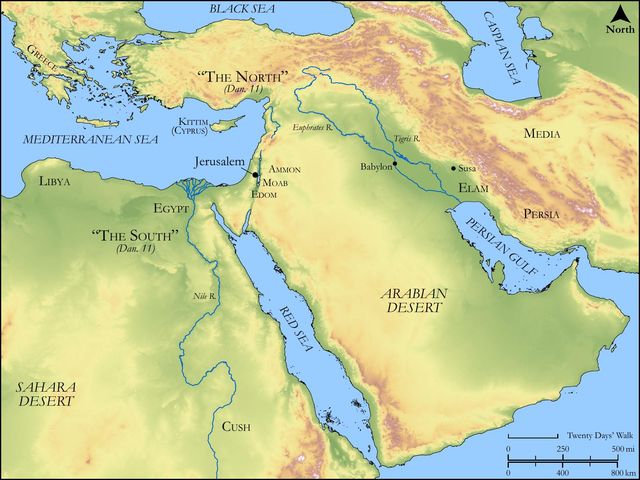
See on the biblical-era map
Study this verse
Public-domain commentary
Matthew Henry
From his Commentary on the Whole Bible. Henry comments on passages, not single verses — this entry covers Daniel 7:15–28. His four-level outline is real structure in the source text, so it is rendered as structure.
Here we have, I. The deep impressions which these visions made upon the prophet. God in them put honour upon him, and gave him satisfaction, yet not without a great allay of pain and perplexity (Dan 7:15): I Daniel was grieved in my spirit, in the midst of my body. The word here used for the body properly signifies a sheath or scabbard, for the body is no more to the soul; that is the weapon; it is that which we are principally to take care of. The visions of my head troubled me, and again (Dan 7:28), my cogitations much troubled me. The manner in which these things were discovered to him quite overwhelmed him, and put his thoughts so much to the stretch that his spirits failed him, and the trance he was in tired him and made him faint. The things themselves that were discovered amazed and astonished him, and put him into a confusion, till by degrees he recollected and conquered himself, and set the comforts of the vision over against the terrors of it.
II.His earnest desire to understand the meaning of them (Dan 7:16):
I came near to one of those that stood by, to one of the angels that appeared attending the Son of man in his glory, and asked him the truth (the true intent and meaning) of all this. Note, It is a very desirable thing to take the right and full sense of what we see and hear from God; and those that would know must ask by faithful and fervent prayer and by accomplishing a diligent search.
III.The key that was given him, to let him into the understanding of this vision.
The angel told him, and told him so plainly that he made him know the interpretation of the thing, and so made him somewhat more easy.
1.The great beasts are great kings and their kingdoms, great monarchs and their monarchies, which shall arise out of the earth, as those beasts did out of the sea, Dan 7:17. They are but terraefilii - from beneath; they savour of the earth, and their foundation is in the dust; they are of the earth earthy, and they are written in the dust, and to the dust they shall return.
2.Daniel pretty well understands the first three beasts, but concerning the fourth he desires to be better informed, because it differed so much from the rest, and was exceedingly dreadful, and not only so, but very mischievous, or it devoured and broke in pieces, Dan 7:19. Perhaps it was this that put Daniel into such a fright, and this part of the visions of his head troubled him more than any of the rest. But especially he desired to know what the little horn was, that had eyes, and a mouth that spoke very great things, and whose countenance was more fearless and formidable than that of any of his fellows, Dan 7:20. And this he was most inquisitive about because it was this horn that made war with the saints, and prevailed against them, Dan 7:21. While no more is intimated than that the children of men make war with one another, and prevail against one another, the prophet does not show himself so much concerned (let the potsherds strive with the potsherds of the earth, and be dashed in pieces one against another); but when they make war with the saints, when the precious sons of Zion, comparable to fine gold, are broken as earthen pitchers, it is time to ask, "What is the meaning of this? Will the Lord cast off his people? Will he suffer their enemies to trample upon them and triumph over them? What is this same horn that shall prevail so far against the saints?" To this his interpreter answers (Dan 7:23-25) that this fourth beast is a fourth kingdom, that shall devour the whole earth, or (as it may be read) the whole land. That the ten horns are ten kings, and the little horn is another king that shall subdue three kings, and shall be very abusive to God and his people, shall act,
(1.)Very impiously towards God. He shall speak great words against the Most High, setting him, and his authority and justice, at defiance.
(2.)Very imperiously towards the people of God. He shall wear out the saints of the Most High; he will not cut them off at once, but wear them out by long oppressions and a constant course of hardships put upon them, ruining their estates and weakening their families. The design of Satan has been to wear out the saints of the Most High, that they may be no more in remembrance; but the attempt is vain, for while the world stands God will have a church in it. He shall think to change times and laws, to abolish all the ordinances and institutions of religion, and to bring every body to say and do just as he would have them. He shall trample upon laws and customs, human and divine. Diruit, aedificut, mutat quadrata rotundis - He pulls down, he builds, he changes square into round, as if he meant to alter even the ordinances of heaven themselves. And in these daring attempts he shall for a time prosper and have success; they shall be given into his hand until time, times, and half a time (that is, for three years and a half), that famous prophetical measure of time which we meet with in the Revelation, which is sometimes called forty-two months, sometimes 1260 days, which come all to one. But at the end of that time the judgment shall sit and take away his dominion (v. 26), which he expounds (v. 11) of the beast being slain and his body destroyed. And (as Mr. Mede reads v. 12) as to the rest of the beast, the ten horns, especially the little ruffling horn (as he calls it), they had their dominion taken away. Now the question is, Who is this enemy, whose rise, reign, and ruin, are foretold? Interpreters are not agreed. Some will have the fourth kingdom to be that of the Seleucidae, and the little horn to be Antiochus, and show the accomplishment of all this in the history of the Maccabees; so Junius, Piscator, Polanus, Broughton, and many others: but others will have the fourth kingdom to be that of the Romans, and the little horn to be Julius Caesar, and the succeeding emperors (says Calvin), the antichrist, the papal kingdom (says Mr. Joseph Mede), that wicked one, which, as this little horn, is to be consumed by the brightness of Christ's second coming. The pope assumes a power to change times and laws, potestas autokratorikē - an absolute and despotic power, as he calls it. Others make the little horn to be the Turkish empire; so Luther, Vatablus, and others. Now I cannot prove either side to be wrong; and therefore, since prophecies sometimes have many fulfillings, and we ought to give scripture its full latitude (in this as in many other controversies), I am willing to allow that they are both in the right, and that this prophecy has primary reference to the Syrian empire, and was intended for the encouragement of the Jews who suffered under Antiochus, that they might see even these melancholy times foretold, but might foresee a glorious issue of them at last, and the final overthrow of their proud oppressors; and, which is best of all, might foresee, not long after, the setting up of the kingdom of the Messiah in the world, with the hopes of which it was usual with the former prophets to comfort the people of God in their distresses. But yet it has a further reference, and foretels the like persecuting power and rage in Rome heathen, and no less in Rome papal, against the Christian religion, that was in Antiochus against the pious Jews and their religion. And St. John, in his visions and prophecies, which point primarily at Rome, has plain reference, in many particulars, to these visions of Daniel.
3.He has a joyful prospect given him of the prevalency of God's kingdom among men, and its victory over all opposition at last. And it is very observable that in the midst of the predictions of the force and fury of the enemies this is brought in abruptly (Dan 7:18 and again Dan 7:22), before it comes, in the course of the vision, to be interpreted, Dan 7:26, Dan 7:27. And this also refers,
(1.)To the prosperous days of the Jewish church, after it had weathered the storm under Antiochus, and the power which the Maccabees obtained over their enemies.
(2.)To the setting up of the kingdom of the Messiah in the world by the preaching of his gospel. For judgment Christ comes into this world, to rule by his Spirit, and to make all his saints kings and priests to their God.
(3.)To the second coming of Jesus Christ, when the saints shall judge the world, shall sit down with him on his throne and triumph in the complete downfall of the devil's kingdom. Let us see what is here foretold.
[1.]The Ancient of days shall come, Dan 7:22. God shall judge the world by his Son, to whom he has committed all judgment, and, as an earnest of that, he comes for the deliverance of his oppressed people, comes for the setting up of his kingdom in the world.
[2.]The judgment shall sit, Dan 7:26. God will make it appear that he judges in the earth, and will, both in wisdom and in equity, plead his people's righteous cause. At the great day he will judge the world in righteousness by that man whom he has ordained.
[3.]The dominion of the enemy shall be taken away, Dan 7:26. All Christ's enemies shall be made his footstool, and shall be consumed and destroyed to the end: these were the apostle uses concerning the man of sin, Th2 2:8. He shall be consumed with the spirit of Christ's mouth and destroyed with the brightness of his coming.
[4.]Judgment is given to the saints of the Most High. The apostles are entrusted with the preaching of a gospel by which the world shall be judged. All the saints by their faith and obedience condemn an unbelieving disobedient world; in Christ their head they shall judge the world, shall judge the twelve tribes of Israel, Mat 19:28. See what reason we have to honour those that fear the Lord; how mean and despicable soever the saints now appear in the eye of the world, and how much contempt soever is poured upon them; they are the saints of the Most High; they are near and dear to God, and he owns them for his, and judgment is given to them.
[5.]That which is most insisted upon is that the saints of the Most High shall take the kingdom, and possess the kingdom for ever, Dan 7:18. And again (Dan 7:22), The time came that the saints possessed the kingdom. And again (Dan 7:27), The kingdom and dominion, and the greatness of the kingdom under the whole heavens, shall be given to the people of the saints of the Most High. Far be it from us to infer hence that dominion is founded on grace, or that this will warrant any, under pretence of saintship, to usurp kingship. No; Christ's kingdom is not of this world; but this intimates the spiritual dominion of the saints over their own lusts and corruptions, their victories over Satan and his temptations, and the triumphs of the martyrs over death and its terrors. It likewise promises that the gospel kingdom shall be set up, a kingdom of grace, the privileges and comforts of which now, under the heavens, shall be the earnest and first-fruits of the kingdom of glory in the heavens. When the empire became Christian, and princes used their power for the defence and advancement of Christianity, then the saints possessed the kingdom. The saints rule by the Spirit's ruling in them (and this is the victory overcoming the world, even their faith) and by making the kingdoms of this world to become Christ's kingdom. But the full accomplishment of this will be in the everlasting happiness of the saints, the kingdom that cannot be moved, which we, according to his promise, look for (that is the greatness of the kingdom), the crown of glory that fades not away - that is the everlasting kingdom. See what an emphasis is laid upon this (Dan 7:18): The saints shall possess the kingdom for ever, even for ever and ever; and the reason is because he whose saints they are is the Most High and his kingdom is an everlasting kingdom, Dan 7:27. He is so, and therefore theirs shall be so. Because I live, you shall live also, Joh 14:19. His kingdom is theirs; they reckon themselves exalted in his exaltation, and desire no greater honour and satisfaction to themselves than that all dominions should serve and obey him, as they shall do, Dan 7:27. They shall either be brought into subjection to his golden sceptre or brought to destruction by his iron rod.
Daniel, in the close, when he ends that matter, tells us what impressions this vision made upon him; it overwhelmed his spirits to such a degree that his countenance was changed, and it made him look pale; but he kept the matter in his heart. Note, The heart must be the treasury and store-house of divine things; there we must hide God's word, as the Virgin Mary kept the sayings of Christ, Luk 2:51. Daniel kept the matter in his heart, with a design, not to keep it from the church, but to keep it for the church, that what he had received from the Lord he might fully and faithfully deliver to the people. Note, It concerns God's prophets and ministers to treasure up the things of God in their minds, and there to digest them well. If we would have God's word ready in our mouths when we have occasion for it, we must keep it in our hearts at all times.
Historical interpretation
Three Centuries of Reception
5 surviving comments on this verse. Each one is dated, so this reads as a timeline rather than a list.
Select a marker to jump to its quote. Markers stagger vertically where authors wrote within a few decades of each other.
But if so great a power is shown to have followed and to be still following the dispensation of His suffering, how great shall that be which shall follow His glorious advent! For He shall come on the clouds as the Son of man, so Daniel foretold, and His angels shall come with Him. These are the words: [quotes Daniel 7:9-28]
"And I inquired about the fourth beast." It is to the fourth kingdom, of which we have already spoken, that he here refers: that kingdom, than which no greater kingdom of like nature has arisen upon the earth; from which also ten horns are to spring, and to be apportioned among ten crowns. And amid these another little horn shall rise, which is that of Antichrist. And it shall pluck by the roots the three others before it; that is to say, he shall subvert the three kings of Egypt, Libya, and Ethiopia, with the view of acquiring for himself universal dominion. And after conquering the remaining seven horns, he will at last begin, inflated by a strange and wicked spirit, to stir up war against the saints, and to persecute all everywhere, with the aim of being glorified by all, and being worshipped as God.
1. In speaking of a "lioness from the sea," he meant the rising of the kingdom of Babylon, and that this was the "golden head of the image." And in speaking of its "eagle wings," be meant that king Nebuchadnezzar was exalted and that his glory was lifted up against God. Then he says "its wings were plucked off," i.e., that his glory was destroyed; for he was driven out of his kingdom. And the words, "A man's heart was given it, and it was made stand upon the feet of a man," mean that he came to himself again, and recognised that he was but a man, and gave the glory to God. Then after the lioness he sees a second beast, "like a bear," which signified the Persians. For after the Babylonians the Persians obtained the power. And in saying that "it had three ribs in its mouth," he pointed to the three nations, Persians, Medes, and Babylonians, which were expressed in the image by the silver after the gold. Then comes the third beast, "a leopard," which means the Greeks; for after the Persians, Alexander of Macedon had the power, when Darius was overthrown, which was also indicated by the brass in the image. And in saying that the beast "had four wings of a fowl, and four heads," he showed most clearly how the kingdom of Alexander was parted into four divisions. For in speaking of four heads, he meant the four kings that arose out of it. For Alexander, when dying, divided his kingdom into four parts. Then he says, "The fourth beast (was) dreadful and terrible: it had iron teeth, and claws of brass." Who, then, are meant by this but the Romans, whose kingdom, the kingdom that still stands, is expressed by the iron? "for," says he, "its legs are of iron."
2. After this, then, what remains, beloved, but the toes of the feet of the image, in which "part shall be of iron and part of clay mixed together? "By the toes of the feet he meant, mystically, the ten kings that rise out of that kingdom. As Daniel says, "I considered the beast; and, lo, (there were) ten horns behind, among which shall come up another little horn springing from them; "by which none other is meant than the antichrist that is to rise; and he shall set up the kingdom of Judah. And in saying that "three horns" were "plucked up by the roots" by this one, he indicates the three kings of Egypt, Libya, and Ethiopia, whom this one will slay in the array of war. And when he has conquered all, he will prove himself a terrible and savage tyrant, and will cause tribulation and persecution to the saints, exalting himself against them. And after him, it remains that "the stone" shall come from heaven which "smote the image" and shivered it, and subverted all the kingdoms, and gave the kingdom to the saints of the Most High. This "became a great mountain, and filled the whole earth."
3. As these things, then, are destined to come to pass, and as the toes of the image turn out to be democracies, and the ten horns of the beast are distributed among ten kings, let us look at what is before us more carefully, and scan it, as it were, with open eye. The "golden head of the image" is identical with the "lioness," by which the Babylonians were represented. "The golden shoulders and the arms of silver" are the same with the "bear," by which the Persians and Medes are meant. "The belly and thighs of brass" are the "leopard," by which the Greeks who ruled from Alexander onwards are intended. The "legs of iron" are the "dreadful and terrible beast," by which the Romans who hold the empire now are meant. The "toes of clay and iron" are the "ten horns" which are to be. The "one other little horn springing up in their midst" is the "antichrist." The stone that "smites the image and breaks it in pieces," and that filled the whole earth, is Christ, who comes from heaven and brings judgment on the world.
4. But that we may not leave our subject at this point undemonstrated, we are obliged to discuss the matter of the times, of which a man should not speak hastily, because they are a light to him. For as the times are noted from the foundation of the world, and reckoned from Adam, they set clearly before us the matter with which our inquiry deals. For the first appearance of our Lord in the flesh took place in Bethlehem, under Augustus, in the year 5500; and He suffered in the thirty-third year. And 6,000 years must needs be accomplished, in order that the Sabbath may come, the rest, the holy day "on which God rested from all His works." For the Sabbath is the type and emblem of the future kingdom of the saints, when they "shall reign with Christ," when He comes from heaven, as John says in his Apocalypse: for "a day with the Lord is as a thousand years." Since, then, in six days God made all things, it follows that 6,000 years must be fulfilled. And they are not yet fulfilled, as John says: "five are fallen; one is," that is, the sixth; "the other is not yet come."
5. In mentioning the "other," moreover, he specifies the seventh, in which there is rest. But some one may be ready to say, How will you prove to me that the Saviour was born in the year 5500? Learn that easily, O man; for the things that took place of old in the wilderness, under Moses, in the case of the tabernacle, were constituted types and emblems of spiritual mysteries, in order that, when the truth came in Christ in these last days, you might be able to perceive that these things were fulfilled. For He says to him, "And thou shalt make the ark of imperishable wood, and shalt overlay it with pure gold within and without; and thou shalt make the length of it two cubits and a half, and the breadth thereof one cubit and a half, and a cubit and a half the height;" which measures, when summed up together, make five cubits and a half, so that the 5500 years might be signified thereby.
6. At that time, then, the Saviour appeared and showed His own body to the world, (born) of the Virgin, who was the "ark overlaid with pure gold," with the Word within and the Holy Spirit without; so that the truth is demonstrated, and the "ark" made manifest. From the birth of Christ, then, we must reckon the 500 years that remain to make up the 6000, and thus the end shall be. And that the Saviour appeared in the world, bearing the imperishable ark, His own body, at a time which was the fifth and half, John declares: "Now it was the sixth hour," he says, intimating by that, one-half of the day. But a day with the Lord is 10000 years; and the half of that, therefore, is 500 years. For it was not meet that He should appear earlier, for the burden of the law still endured, nor yet when the sixth day was fulfilled (for the baptism is changed), but on the fifth and half, in order that in the remaining half time the gospel might be preached to the whole world, and that when the sixth day was completed He might end the present life.
7. Since, then, the Persians held the mastery for 330 years, and after them the Greeks, who were yet more glorious, held it for 300 years, of necessity the fourth beast, as being strong and mightier than all that were before it, will reign 500 years. When the times are fulfilled, and the ten horns spring from the beast in the last (times), then Antichrist will appear among them. When he makes war against the saints, and persecutes them, then may we expect the manifestation of the Lord from heaven.
8. The prophet having thus instructed us with all exactness as to the certainty of the things that are to be, broke off from his present subject, and passed again to the kingdom of the Persians and Greeks, recounting to us another vision which took place, and was fulfilled in its proper time; in order that, by establishing our belief in this, he might be able to present us to God as readier believers in the things that are to be. Accordingly, what he had narrated in the first vision, he again recounts in detail for the edification of the faithful. For by the "ram pushing westward, and northward, and southward," he means Darius, the king of the Persians, who overcame all the nations; "for," says he, "these beasts shall not stand before him." And by the "he-goat that came from the west," he means Alexander the Macedonian, the king of the Greeks; and in that he "came against that very ram, and was moved with choler, and smote him upon the face, and shivered him, and cast him upon the ground, and stamped upon him," this expresses just what has happened.
9. For Alexander waged war against Darius, and overcame him, and made himself master of the whole sovereignty, after routing and destroying his camp. Then, after the exaltation of the he-goat, his horn-the great one, namely-was broken; and there arose four horns under it, toward the four winds of heaven. For, when Alexander had made himself master of all the land of Persia, and had reduced its people into subjection, he thereupon died, after dividing his kingdom into four principalities, as has been shown above. And from that time "one horn was exalted, and waxed great, even to the power of heaven; and by him the sacrifice," he says, "was disturbed, and righteousness cast down to the ground."
10. For Antiochus arose, surnamed Epiphanes, who was of the line of Alexander. And after he had reigned in Syria, and brought under him all Egypt, he went up to Jerusalem, and entered the sanctuary, and seized all the treasures in the house of the Lord, and the golden candlestick, and the table, and the altar, and made a great slaughter in the land; even as it is written: "And the sanctuary shall be trodden under foot, unto evening and unto morning, a thousand and three hundred days." For it happened that the sanctuary remained desolate during that period, three years and a half, that the thousand and three hundred days might be fulfilled; until Judas Maccabaeus arose after the death of his father Matthias, and withstood him, and destroyed the encampment of Antiochus, and delivered the city, and recovered the sanctuary, and restored it in strict accordance with the law.
11. Since, then, the angel Gabriel also recounted these things to the prophet, as they have been understood by us, as they have also taken place, and as they have been all clearly described in the books of the Maccabees, let us see further what he says on the other weeks. For when he read the book of Jeremiah the prophet, in which it was written that the sanctuary would be desolate seventy years, he made confession with fastings and supplications, and prayed that the people might return sooner from their captivity to the city Jerusalem. Thus, then, he speaks in his account: "In the first year of Darius the son of Ahasuerus, of the seed of the Medes, who was king over the realm of the Chaldeans, I Daniel understood in the books the number of the years, as the word of the Lord had come to Jeremiah the prophet, for the accomplishment of the desolation of Jerusalem in seventy years," etc.
12. After his confession and supplication, the angel says to him, "Thou art a man greatly beloved: "for thou desirest to see things of which thou shalt be informed by me; and in their own time these things will be fulfilled; and he touched me, saying, "Seventy weeks are determined upon thy people, and upon the holy city, to seal up sins and to blot out transgressions, and to seal up vision and prophet, and to anoint the Most Holy; and thou shalt know and understand, that from the going forth of words for the answer, and for the building of Jerusalem, unto Christ the Prince, shall be seven weeks, and threescore and two weeks."
13. Having mentioned therefore seventy weeks, and having divided them into two parts, in order that what was spoken by him to the prophet might be better understood, he proceeds thus, "Unto Christ the Prince shall be seven weeks," which make forty-nine years. It was in the twenty-first year that Daniel saw these things in Babylon. Hence, the forty-nine years added to the twenty-one, make up the seventy years, of which the blessed Jeremiah spake: "The sanctuary shall be desolate seventy years from the captivity that befell them under Nebuchadnezzar; and after these things the people will return, and sacrifice and offering will be presented, when Christ is their Prince."
14. Now of what Christ does he speak, but of Jesus the son of Josedech, who returned at that time along with the people, and offered sacrifice according to the law, in the seventieth year, when the sanctuary was built? For all the kings and priests were styled Christs, because they were anointed with the holy oil, which Moses of old prepared. These, then, bore the name of the Lord in their own persons, showing aforetime the type, and presenting the image until the perfect King and Priest appeared from heaven, who alone did the will of the Father; as also it is written in Kings: "And I will raise me up a faithful priest, that shall do all things according to my heart."
15. In order, then, to show the time when He is to come whom the blessed Daniel desired to see, he says, "And after seven weeks there are other threescore and two weeks," which period embraces the space of 434 years. For after the return of the people from Babylon under the leadership of Jesus the son of Josedech, and Ezra the scribe, and Zerubbabel the son of Salathiel, of the tribe of David, there were 434 years unto the coming of Christ, in order that the Priest of priests might be manifested in the world, and that He who taketh away the sins of the world might be evidently set forth, as John speaks concerning Him: "Behold the Lamb of God, that taketh away the sin of the world!" And in like manner Gabriel says: "To blot out transgressions, and make reconciliation for sins." But who has blotted out our transgressions? Paul the apostle teaches us, saying, "He is our peace who made both one;" and then, "Blotting out the handwriting of sins that was against us."
16. That transgressions, therefore, are blotted out, and that reconciliation is made for sins, is shown by this. But who are they who have reconciliation made for their sins, but they who believe on His name, and propitiate His countenance by good works? And that after the return of the people from Babylon there was a space of 434 years, until the time of the birth of Christ, may be easily understood. For, since the first covenant was given to the children of Israel after a period of 434 years, it follows that the second covenant also should be defined by the same space of time, in order that it might be expected by the people and easily recognised by the faithful.
17. And for this reason Gabriel says: "And to anoint the Most Holy." And the Most Holy is none else but the Son of God alone, who, when He came and manifested Himself, said to them, "The Spirit of the Lord is upon me, because He has anointed me; " and so forth. Whosoever, therefore, believed on the heavenly Priest, were cleansed by that same Priest, and their sins were blotted out. And whosoever believe it not on Him, despising Him as a man, had their sins sealed, as those which could not be taken away; whence the angel, foreseeing that not all should believe on Him, said, "To finish sins, and to seal up sins." For as many as continued to disbelieve Him, even to the end, had their sins not finished, but sealed to be kept for judgment. But as many as will believe on Him as One able to remit sins, have their sins blotted out. Wherefore he says: "And to seal up vision and prophet."
18. For when He came who is the fulfilling of the law and of the prophets (for the law and the prophets were till John), it was necessary that the things spoken by them should be confirmed (sealed), in order that at the coming of the Lord all things loosed should be brought to light, and that things bound of old should now be loosed by Him, as the Lord said Himself to the rulers of the people, when they were indignant at the cure on the Sabbath-day: "Ye hypocrites, doth not each one of you loose his ox or his ass from the stall, and lead him away to watering? and ought not this woman, being a daughter of Abraham, whom Satan hath bound these eighteen years, be loosed on the Sabbath-day? " Whomsoever, therefore, Satan bound in chains, these did the Lord on His coming loose from the bonds of death, having bound our strong adversary and delivered humanity. As also Isaiah says: "Then will He say to those in chains, Go forth; and to them that are in darkness, Show yourselves."
19. And that the things spoken of old by the law and the prophets were all sealed, and that they were unknown to men, Isaiah declares when he says: "And they will deliver the book that is sealed to one that is learned, and will say to him, Read this; and he will say, I cannot read it, for it is sealed." It was meet and necessary that the things spoken of old by the prophets should be sealed to the unbelieving Pharisees, who thought that they understood the letter of the law, and be opened to the believing. The things, therefore, which of old were sealed, are now by the grace of God the Lord all open to the saints.
20. For He was Himself the perfect Seal, and the Church is the key: "He who openeth, and no man shutteth; and shutteth, and no man openeth," as John says. And again, the same says: "And I saw, on the right hand of Him that sat on the throne, a book written within and without, sealed with seven seals; and I saw an angel proclaiming with a loud voice, Who is worthy to open the book, and to loose the seals thereof? "and so forth. "And I beheld in the midst of the throne, and of the four beasts, a Lamb standing slain, having seven horns, and seven eyes, which are the seven Spirits of God sent forth into all the earth. And He came and took the book out of the right hand of Him that sat upon the throne. And when He had taken the book, the four beasts and four-and-twenty elders fell down before the Lamb, having harps and golden vials full of incense, which is the prayers of the saints. And they sing a new song, saying, Thou art worthy to take the book, and to open the seals thereof: for Thou wast slain, and hast redeemed us to God by Thy blood." He took the book, therefore, and loosed it, in order that the things spoken concerning Him of old in secret, might now be proclaimed with boldness upon the house-tops.
21. For this reason, then, the angel says to Daniel, "Seal the words, for the vision is until the end of the time." But to Christ it was not said "seal," but "loose" the things bound of old; in order that, by His grace, we might know the will of the Father, and believe upon Him whom He has sent for the salvation of men, Jesus our Lord. He says, therefore, "They shall return, and the street shall be built, and the wall; "which in reality took place. For the people returned and built the city, and the temple, and the wall round about. Then he says: "After threescore and two weeks the times will be fulfilled, and one week will make a covenant with many; and in the midst (half) of the week sacrifice and oblation will be removed, and in the temple will be the abomination of desolations."
22. For when the threescore and two weeks are fulfilled, and Christ is come, and the Gospel is preached in every place, the times being then accomplished, there will remain only one week, the last, in which Elias will appear, and Enoch, and in the midst of it the abomination of desolation will be manifested, viz., Antichrist, announcing desolation to the world. And when he comes, the sacrifice and oblation will be removed, which now are offered to God in every place by the nations. These things being thus recounted, the prophet again describes another vision to us. For he had no other care save to be accurately instructed in all things that are to be, and to prove himself an instructor in such.
23. He says then: "In the third year of Cyrus king of Persia, a word was revealed unto Daniel, whose name was Belshazzar; and the word was true, and great power and understanding were given him in the vision. In those days I Daniel was mourning three weeks of days. I ate no pleasant bread, neither came flesh nor wine into my mouth, neither did I anoint myself at all, till three weeks of days were fulfilled. On the fourth day of the first month I humbled myself," says he, "one and twenty days," praying to the living God, and asking of Him the revelation of the mystery. And the Father in truth heard me, and sent His own Word, to show what should happen by Him. And that took place, indeed, by the great river. For it was meet that the Son should be manifested there, where also He was to remove sins.
24. "And I lifted up mine eyes," he says, "and, behold, a man clothed in linen." In the first vision he says, "Behold, the angel Gabriel (was) sent." Here, however, it is not so; but he sees the Lord, not yet indeed as perfect man, but with the appearance and form of man, as he says: "And, behold, a man clothed in linen." For in being clothed in a various-coloured coat, he indicated mystically the variety of the graces of our calling. For the priestly coat was made up of different colours, as various nations waited for Christ's coming, in order that we might be made up (as one body) of many colours. "And his loins were girded with the gold of Ophaz."
25. Now the word "Ophaz," which is a word transferred from Hebrew to Greek, denotes pure gold. With a pure girdle, therefore, he was girded round the loins. For the Word was to bear us all, binding us like a girdle round His body, in His own love. The complete body was His, but we are members in His body, united together, and sustained by the Word Himself. "And his body was like Tharses." Now "Tharses," by interpretation, is "Ethiopians." For that it would be difficult to recognise Him, the prophet had thus already announced beforehand, intimating that He would be manifested in the flesh in the world, but that many would find it difficult to recognise Him. "And his face as lightning, and his eyes as lamps of fire; "for it was meet that the fiery and judicial power of the Word should be signified aforetime, in the exercise of which He will cause the fire (of His judgment) to light with justice upon the impious, and consume them.
26. He added also these words: "And his arms and his feet like polished brass; "to denote the first calling of men, and the second calling like unto it, viz. of the Gentiles. "For the last shall be as the first; for I will set thy rulers as at the beginning, and thy leaders as before. And His voice was as the voice of a great multitude." For all we who believe on Him in these days utter things oracular, as speaking by His mouth the things appointed by Him.
27. And after a little He says to him: "Knowest thou wherefore I come unto thee? And now will I return to fight with the prince of Persia. But I will show thee that which is noted in the Scripture of truth: and there is none that holdeth with me in these things but Michael your prince, and I left him there. For from the day that thou didst give thy countenance to be afflicted before the Lord thy God, thy prayer was heard, and I was sent to fight with the prince of Persia: "for a certain counsel was formed not to send the people away: "that therefore thy prayer might be speedily granted, I withstood him, and left Michael there."
28. And who was he that spake, but the angel who was given to the people, as he says in the law of Moses: "I will not go with you, because the people is stiff-necked; but my angel shall go before along with you? " This (angel) withstood Moses at the inn, when he was bringing the child uncircumcised into Egypt. For it was not allowed Moses, who was the eider (or legate) and mediator of the law, and who proclaimed the covenant of the fathers, to introduce a child uncircumcised, lest he should be deemed a false prophet and deceiver by the people. "And now," says he, "will I show the truth to thee." Could the Truth have shown anything else but the truth?
29. He says therefore to him: "Behold, there shall stand up three kings in Persia: and the fourth shall be far richer than they all; and when he has got possession of his riches, he shall stand up against all the realms of Grecia. And a mighty king shall stand up, and shall rule with great dominion, and do according to his will; and when his kingdom stands, it shall be broken, and shall be divided toward the four winds of heaven." These things we have already discussed above, when we discoursed upon the four beasts. But since Scripture now again sets them forth explicitly, we must also discourse upon them a second time, that we may not leave Scripture unused and unexplained.
30. "There shall stand up yet three kings," he says, "in Persia; and the fourth shall be far richer than they all." This has been fulfilled. For after Cyrus arose Darius, and then Artaxerxes. These were the three kings; (and) the Scripture is fulfilled. "And the fourth shall be far richer than they all." Who is that but Darius, who reigned and made himself glorious,-who was rich, and assailed all the realms of Greece? Against him rose Alexander of Macedon, who destroyed his kingdom; and after he had reduced the Persians, his own kingdom was divided toward the four winds of heaven. For Alexander at his death divided his kingdom into four principalities. "And a king shall stand up, and shall enter into the fortress of the king of Egypt."
31. For Antiochus became king of Syria. He held the sovereignty in the 107th year of the kingdom of the Greeks. And in those same times indeed he made war against Ptolemy king of Egypt, and conquered him, and won the power. On returning from Egypt he went up to Jerusalem, in the 103d year, and carrying off with him all the treasures of the Lord's house, he marched to Antioch. And after two years of days the king sent his raiser of taxes into the cities of Judea, to compel the Jews to forsake the laws of their fathers, and submit to the decrees of the king. And he came, and tried to compel them, saying, "Come forth, and do the commandment of the king, and ye shall live."
32. But they said, "We will not come forth: neither will we do the king's commandment; we will die in our innocency: and he slew of them a thousand souls." The things, therefore, which were spoken to the blessed Daniel are fulfilled: "And my servants shall be afflicted, and shall fall by famine, and by sword, and by captivity." Daniel, however, adds: "And they shall be holpen with a little help." For at that time Matthias arose, and Judas Maccabaeus, and helped them, and delivered them from the hand of the Greeks.
33. That therefore was fulfilled which was spoken in the Scripture. He proceeds then thus: "And the (king's) daughter of the South shall come to the king of the North to make an agreement with him; and the arms of him that bringeth her shall not stand; and she, too, shall be smitten, and shall fall, and he that bringeth her." For this was a certain Ptolemais queen of Egypt. At that time indeed she went forth with her two sons, Ptolemy and Philometor, to make an agreement with Antiochus king of Syria; and when she came to Scythopolis, she was slain there. For he who brought her betrayed her. At that same time, the two brothers made war against each other, and Philometor was slain, and Ptolemy gained the power.
34. War, then, was again made by Ptolemy against Antiochus, (and) Antiochus met him. For thus saith the Scripture: "And the king of the South shall stand up against the king of the North, and her seed shall stand up against him." And what seed but Ptolemy, who made war with Antiochus? And Antiochus having gone forth against him, and having failed to overcome him, had to flee, and returned to Antioch, and collected a larger host. Ptolemy accordingly took his whole equipment, and carried it into Egypt. And the Scripture is fulfilled, as Daniel says: And he shall carry off into Egypt their gods, and their cast-works, and all their precious (vessels of) gold.
35. And after these things Antiochus went forth a second time to make war against him, and overcome Ptolemy. And after these events Antiochus commenced hostilities again against the children of Israel, and despatched one Nicanor with a large army to subdue the Jews, at the time when Judas, after the death of Matthias, ruled the people; and so forth, as is written in the Maccabees. These events having taken place, the Scripture says again: "And there shall stand up another king, and he shall prevail upon the earth; and the king of the South shall stand up, and he shall obtain his daughter to wife."
36. For it happened that there arose a certain Alexander, son of Philip. He withstood Antiochus at that time, and made war upon him, and cut him off, and gained possession of the kingdom. Then he sent to Ptolemy king of Egypt, saying, Give me thy daughter Cleopatra to wife. And he gave her to Alexander to wife. And thus the Scripture is fulfilled, when it says: "And he shall obtain his daughter to wife." And it says further: "And he shall corrupt her, and she shall not be his wife." This also has been truly fulfilled. For after Ptolemy had given him his daughter, he returned, and saw the mighty and glorious kingdom of Alexander. And coveting its possession, he spoke falsely to Alexander, as the Scripture says: "And the two kings shall speak lies at (one) table." And, in sooth, Ptolemy betook himself to Egypt, and collected a great army, and attacked the city at the time when Alexander had marched into Cilicia.
37. Ptolemy then invaded the country, and established garrisons throughout the cities; and on making himself master of Judea, set out for his daughter, and sent letters to Demetrius in the islands, saying, Come and meet me here, and I will give thee my daughter Cleopatra to wife, for Alexander has sought to kill me. Demetrius came accordingly, and Ptolemy received him, and gave him her who had been destined for Alexander. Thus is fulfilled that which is written: "And he shall corrupt her, and she shall not be his wife." Alexander was slain. Then Ptolemy wore two crowns, that of Syria and that of Egypt, and died the third day after he had assumed them. Thus is fulfilled that which is written in Scripture: "And they shall not give him the glory of the kingdom." For he died, and received not honour from all as king.
38. The prophet then, after thus recounting the things which have taken place already, and been fulfilled in their times, declares yet another mystery to us, while he points out the last times. For he says: "And there shall rise up another shameless king; and he shall exalt himself above every god, and shall magnify himself, and shall speak marvellous things, and shall prosper till the indignation be accomplished; "anti so forth. "And these shall escape out of his hand, Edom, and Moab, and the chief (or principality) of the children of Ammon. And he shall stretch forth his hand upon the land; and the land of Egypt shall not escape. And he shall have power over the secret treasures of gold and silver, and over all the precious things of Egypt and of the Libyans, and the Ethiopians in their strongholds."
39. Thus, then, does the prophet set forth these things concerning the Antichrist, who shall be shameless, a war-maker, and despot, who, exalting himself above all kings and above every god, shall build the city of Jerusalem, and restore the sanctuary. Him the impious will worship as God, and will bend to him the knee, thinking him to be the Christ. He shall cut off the two witnesses and forerunners of Christ, who proclaim His glorious kingdom from heaven, as it is said: "And I will give (power) unto my two witnesses, and they shall prophesy a thousand two hundred and threescore days, clothed in sackcloth." As also it was announced to Daniel: "And one week shall confirm a covenant with many; and in the midst of the week it shall be that the sacrifice and oblation shall be removed"-that the one week might be shown to be divided into two. The two witnesses, then, shall preach three years and a half; and Antichrist shall make war upon the saints during the test of the week, and desolate the world, that what is written may be fulfilled: "And they shall make the abomination of desolation for a thousand two hundred and ninety days."
40. Daniel has spoken, therefore, of two abominations; the one of destruction, and the other of desolation. What is that of destruction, but that which Antiochus established there at the time? And what is that of desolation, but that which shall be universal when Antichrist comes? "And there shall escape out of his hand, Edom, and Moab, and the chief of the children of Ammon." For these are they who ally themselves with him on account of their kinship, and first address him as king. Those of Edom are the sons of Esau, who inhabit Mount Seir. And Moab and Ammon are they who are descended from his two daughters, as Isaiah also says: "And they shall fly (extend themselves) in the ships of strangers, and they shall also plunder the sea; and those from the east, and from the west, and the north, shall give them honour: and the children of Ammon shall first obey them." He shall be proclaimed king by them, and shall be magnified by all, and shall prove himself an abomination of desolation to the world, and shall reign for a thousand two hundred and ninety days. "Blessed is he that waiteth, and cometh to the thousand three hundred and five and thirty days; "for when the abomination cometh and makes war upon the saints, whosoever shall survive his days, and reach the forty-five days, while the other period of fifty days advances, to him the kingdom of heaven comes. Antichrist, indeed, enters even into part of the fifty days, but the saints shall inherit the kingdom along with Christ.
41. These things being thus narrated, Daniel proceeds: "And, behold, there stood two men, the one on this side of the bank of the river, and the other on that side; and they made answer to the man that stood upon the bank of the river, and said to him, How long shall it be to the end of these wonderful words which thou hast spoken? And I heard the man clothed in linen, who was upon the water of the river; and he lifted up his right hand and his left hand unto heaven, and sware by Him that liveth for ever, that it shall be for a time, times, and an half; and they shall know all these things when the dispersion is accomplished,"
42. Who, then, were the two men who stood on the bank of the river, but the law and the prophets? And who was he who stood upon the water, but He concerning whom they prophesied of old, who in the last times was to be borne witness to by the Father at the Jordan, and to be declared to the people boldly by John, "who wore the casty of the scribe about his loins, and was clothed with a linen coat of various colours? "These, therefore, interrogate Him, knowing that to Him were given all government and power, in order to learn accurately of Him when He will bring the judgment on the world, and when the things spoken by Him will be fulfilled. And He, desiring by all means to convince them, lifted His right hand and His left hand to heaven, and sware by Him that liveth for ever. Who is He that swore, and by whom sware He? Manifestly the Son by the Father, saying, The Father liveth for ever, but in a time, and times, and an half, when the dispersion is accomplished, they shall know all these things.
43. By the stretching forth of His two hands He signified His passion; and by mentioning "a time, and times, and an half, when the dispersion is accomplished," He indicated the three years and a half of Antichrist. For by "a time" He means a year, and by "times" two years, and by an "half time" half a year. These are the thousand two hundred and ninety days of which Daniel prophesied for the finishing of the passion, and the accomplishment of the dispersion when Antichrist comes. In those days they shall know all these things. And from the time of the removal of the continuous sacrifice there are also reckoned one thousand two hundred and ninety days. (Then) iniquity shall abound, as the Lord also says: "Because iniquity shall abound, the love of many shall wax cold."
44. And that divisions will arise when the falling away takes place, is without doubt. And when divisions arise, love is chilled. The words, "Blessed is he that waiteth and cometh to the thousand three hundred and five and thirty days," have also their value, as the Lord said: "But he that shall endure unto the end, the same shall be saved." Wherefore let us by no means admit the falling away, lest iniquity abound, and the abomination of desolation-that is, the adversary-overtake us. And He said to him, "unto evening"-that is, unto the consummation" and morning." What is "morning? "The day of resurrection. For that is the beginning of another age, as the morning is the beginning of the day. And the thousand and four hundred days are the light of the world. For on the appearing of the light in the world (as He says, "I am the light of the world"), the sanctuary shall be purged, as he said, (of) the adversary. For it cannot by any means be purged but by his destruction.
“Then I desired to know the truth concerning the fourth beast and the other horn,” which was seen while attacking and harshly afflicting the holy ones with his arms. This is Antiochus, who, as the angel reveals, would have made war and submitted the holy ones and the priests and the righteous ones.
Take note of the iron teeth and the bronze claws that are mentioned. The kingdom of the Romans took tribute from all nations; thus he says that it had iron teeth. And since many of those who had started out in the Macedonian kingdom were enlisted into its soldiery, and since claws serve the same function for a beast that soldiers do for an empire, he rightly speaks of Rome’s bronze claws, just as he called the third kingdom a bronze kingdom.
Continue studying Daniel 7:19 across the web’s major study libraries — every link below opens this exact verse, chapter, or book on the destination site.
Read & Compare
 BibleGatewayThis verse in more than 200 translations and 70 languages.
 Bible.comThe YouVersion reader — hundreds of translations, reading plans, and highlights.
 ESV.orgCrossway's official English Standard Version reader.
 NET BibleThe NET translation with 60,000+ translators' notes on every rendering decision.
 STEP BibleTyndale House's free study tool — original text, vocabulary, and scholarly resources.
 BibliaLogos Bible Software's free web reader.
 USCCBThe New American Bible (Revised Edition) with the U.S. bishops' study notes.
Commentaries
 BibleHub CommentariesDozens of classic commentaries on this verse, gathered on one page.
 StudyLightMore than 100 commentary sets — the largest collection on the web.
 BibleRefPlain-English commentary on what this verse means, verse by verse.
 Enduring WordDavid Guzik's free commentary on this chapter, widely used by Bible teachers.
 Bible Study ToolsVerse commentary alongside Greek and Hebrew study aids.
Original Language & Research
- BibleHub InterlinearThe verse word by word — original language, transliteration, and English.
- BibleHub LexiconEvery word's original-language definition and Strong's entry.
 Blue Letter BibleDeep-study tools — Strong's numbers, concordance, and word studies.
 SefariaThe Hebrew text with Rashi and centuries of Jewish commentary.
Sermons, Hymns & Audio


TrulyRandomVerse is not affiliated with these sites and doesn’t control their content. They’re linked because they’re genuinely useful.
Summary
Daniel 7:19 captures the prophet Daniel's intense and urgent desire for a precise understanding of the fourth beast revealed in his apocalyptic vision. This particular entity, distinct from the preceding three, profoundly disturbs Daniel due to its unparalleled ferocity, comprehensive destructive capacity, and enigmatic nature. Having witnessed its terrifying appearance and actions, Daniel is compelled to seek explicit clarification from his angelic guide, signaling a critical moment in the narrative where the prophet, acting as a divine interpreter, seeks to unravel the true identity and far-reaching implications of this exceedingly dreadful and unique power.
Context
ShowHideLiterary Context
Daniel 7:19 is situated within Daniel's pivotal vision of four great beasts arising from the sea, a sequence that commences in Daniel 7:3. While the initial three beasts—resembling a lion with eagle's wings, a bear, and a leopard with four wings and four heads—are described with distinct characteristics, the fourth beast, first introduced in Daniel 7:7, is presented as utterly unique and terrifying beyond conventional description. Daniel's immediate reaction to this fourth beast in Daniel 7:7-8 highlights its immense iron teeth, bronze claws, and the emergence of a "little horn." The prophet's intense focus on this particular beast in verse 19, following the general overview of the vision and the depiction of the Ancient of Days and the Son of Man, underscores its singular importance and the deep apprehension it evokes in him. He is not merely observing but actively seeking interpretive truth, indicating that the initial, vivid revelation was insufficient to quell his profound concern regarding this unprecedented power.
Historical & Cultural Context
The book of Daniel, particularly chapters 7-12, is written predominantly in Aramaic, reflecting the lingua franca of the Persian Empire during the exilic and post-exilic periods. The visions in Daniel 7, much like Nebuchadnezzar's dream in Daniel 2, are widely understood to depict a succession of world empires. While the first three beasts are commonly associated with Babylon, Medo-Persia, and Greece (under Alexander the Great), the fourth beast has been a subject of extensive scholarly debate, most frequently linked to the Roman Empire due to its unparalleled strength, widespread dominion, and subsequent fragmentation. Daniel's vision, therefore, speaks directly to the historical realities of imperial power, conquest, and oppression that characterized the kingdoms of this world, offering a divine perspective on these earthly kingdoms and their ultimate fate in relation to God's sovereign plan.
Key Themes
ShowHideThis verse powerfully contributes to several key themes within Daniel and biblical prophecy. First, it emphasizes the unprecedented terror and power of the final earthly kingdom. The description "exceeding dreadful" and its metallic attributes of iron teeth and brass nails resonate strongly with the iron kingdom in Nebuchadnezzar's dream in Daniel 2:40, signifying an unyielding, oppressive, and utterly destructive dominion. Second, the actions "devoured, brake in pieces, and stamped the residue with his feet" vividly portray the devastating impact and absolute subjugation this beast would inflict, leaving nothing untouched in its path. This highlights the brutal reality of human empires apart from divine rule. Finally, Daniel's earnest desire to "know the truth" highlights the theme of divine revelation sought and granted. His persistent questioning models a diligent pursuit of God's understanding of His unfolding plans, assuring readers that God graciously provides further detail about this beast, particularly its interpretation in Daniel 7:23 and subsequent verses, demonstrating God's ultimate sovereignty over history.
Exposition and Analysis
ShowHideKey Word Analysis
ShowHideThis Aramaic term (H8133) means "to alter" or "to change," implying that which is fundamentally different or distinct. In the context of the fourth beast, it emphasizes that this empire was not merely another powerful kingdom but possessed a nature and mode of operation that set it apart from all previous empires. It was qualitatively unique in its form of governance, its methods of conquest, and its enduring impact, signifying an unprecedented level of terror and control.
The Aramaic word (H1763) conveys a sense of being formidable, causing fear, or being terrible. It suggests an overwhelming and awe-inspiring terror, not just a casual fear. When applied to the fourth beast, it underscores its monstrous and terrifying nature, highlighting the profound impact it had on Daniel and its capacity to inspire widespread terror among its subjects and those it conquered.
This Aramaic verb (H399) literally means "to eat," but is used figuratively here to signify consumption, destruction, or complete subjugation. In the context of the beast's actions, it portrays a ravenous and insatiable appetite for conquest and control, leaving nothing intact. It speaks to the comprehensive and brutal manner in which this empire would absorb and obliterate other nations, leaving no room for independent existence.
Verse Breakdown
ShowHide"Then I would know the truth of the fourth beast,"
Daniel expresses an intense, almost desperate, desire for accurate and complete understanding. The phrase "the truth" (Aramaic yᵉtsab, H3321) indicates a longing for firm, reliable, and definitive knowledge about this particular entity that has so profoundly disturbed him. He seeks not just information, but the authoritative interpretation of its nature and purpose.
"which was diverse from all the others,"
This clause reiterates the unique and unparalleled nature of the fourth beast. Unlike the previous three, which shared some animalistic characteristics and could be somewhat categorized, this one defied easy categorization and was fundamentally distinct in its form, power, and destructive capacity, setting it apart as an entity of singular terror and unprecedented character.
"exceeding dreadful,"
This intensifier highlights the extraordinary level of fear and awe inspired by the beast. The Aramaic word yattîyr (H3493, "exceeding") coupled with dᵉchal (H1763, "dreadful") conveys a sense of overwhelming terror, suggesting that this beast's ferocity and power surpassed anything Daniel had previously seen or imagined, making it truly formidable.
"whose teeth [were of] iron, and his nails [of] brass;"
These physical attributes symbolize the beast's immense strength and destructive capability. Iron (Aramaic parzel, H6523), known for its hardness and crushing power, echoes the iron kingdom of Daniel 2:40. Brass (Aramaic nᵉchâsh, H5174), though slightly less hard than iron, still represents formidable strength and durability. Together, these metals signify an empire of unyielding, brutal, and widespread dominion, capable of tearing apart and holding onto its prey with an unbreakable grip.
"[which] devoured, brake in pieces, and stamped the residue with his feet;"
This tripartite description vividly portrays the beast's comprehensive and utterly destructive actions. "Devoured" (Aramaic ʼăkal, H399) speaks to its insatiable hunger for conquest and absorption; "brake in pieces" (Aramaic dᵉqaq, H1855) emphasizes its ability to shatter and pulverize opposition; and "stamped the residue with his feet" (Aramaic rᵉphaç, H7512, with rᵉgal, H7271 for "feet") illustrates its complete subjugation and utter contempt for what remains, leaving nothing but crushed remnants. These actions underscore the absolute and brutal dominance of this final earthly kingdom.
Literary Devices
ShowHideDaniel 7:19 is rich in Imagery and Symbolism, which are central to apocalyptic literature. The vivid description of the beast's "teeth of iron" and "nails of brass" creates a powerful mental picture of its crushing power and unyielding grip. These metallic attributes are not literal but deeply symbolic, echoing the materials in Nebuchadnezzar's statue in Daniel 2 and reinforcing the idea of a formidable, unyielding kingdom that would dominate with brutal strength. The actions "devoured, brake in pieces, and stamped the residue with his feet" employ potent verbs of destruction that evoke a sense of total annihilation and subjugation, emphasizing the beast's comprehensive and merciless conquest. The phrase "exceeding dreadful" functions as a form of hyperbole, underscoring the unparalleled terror and monstrous nature of this beast, distinguishing it sharply from all others in the vision. The entire passage functions as a prophetic vision, using symbolic language to convey profound theological truths about the nature of earthly power and divine sovereignty.
Theological and Thematic Connections
ShowHideDaniel's intense inquiry in Daniel 7:19 underscores a profound theological truth: while human history is often marked by the rise of terrifying, oppressive powers, God's people are not left in ignorance or despair. The very act of Daniel seeking and receiving divine interpretation affirms God's sovereign control over all earthly kingdoms and His willingness to reveal His overarching plan. This beast, with its unparalleled destructive capacity, represents the epitome of human rebellion and the brutal nature of worldly power apart from God. Yet, its detailed description, far from inducing hopelessness, serves to prepare God's people for understanding the spiritual battles they face and to anchor their hope in the ultimate triumph of God's eternal kingdom. It highlights the stark contrast between the fleeting, destructive nature of human empires and the enduring, righteous reign of God, assuring believers that divine justice will ultimately prevail.
Reflection and Application
ShowHideDaniel's earnest desire to "know the truth" about the terrifying fourth beast serves as a powerful model for believers in every age. In a world often characterized by overwhelming evil, political turmoil, and systems that seem to devour and crush, it is natural to feel perplexed or even overwhelmed. This verse encourages us not to shy away from grappling with the difficult realities of suffering and oppression, but rather to bring our deepest questions and anxieties before God, trusting that He will provide clarity and understanding according to His perfect will. It reminds us that even the most dreadful earthly powers are ultimately finite and subject to God's sovereign plan. Our hope is not in the strength of human institutions but in the enduring kingdom of God, which will ultimately prevail over all forms of evil. Therefore, we are called to discern the spiritual forces at play in the world, to pray for justice, and to live with an unwavering faith in God's ultimate victory, even when the present realities seem bleak and the forces of darkness appear overwhelming.
Questions for Reflection
ShowHideFAQ
ShowHideWhat does the "fourth beast" represent in Daniel's vision?
ShowHideWhile the book of Daniel does not explicitly name the empires, biblical scholars widely interpret the four beasts as representing a succession of powerful world empires that would rule over the nations. The first three are generally understood to be Babylon, Medo-Persia, and Greece. The fourth beast, described as "diverse from all the others" and "exceeding dreadful," is most commonly identified with the Roman Empire. Its iron teeth and actions of devouring and crushing reflect Rome's unparalleled military might, its vast conquests, and its brutal subjugation of nations. This interpretation aligns with the "iron kingdom" of Nebuchadnezzar's dream in Daniel 2, which also points to a powerful, unyielding dominion that would break in pieces and crush all others.
Why was Daniel so troubled by this particular beast compared to the others?
ShowHideDaniel was deeply troubled by the fourth beast because of its unprecedented nature and extreme destructiveness. The text explicitly states it was "diverse from all the others" and "exceeding dreadful." Unlike the first three, which resembled known animals (lion, bear, leopard), the fourth beast was indescribable in conventional terms, making it uniquely terrifying and monstrous. Its actions—devouring, breaking in pieces, and stamping the residue—indicated a level of total annihilation and absolute dominion far beyond the previous empires. This unparalleled ferocity and the mystery surrounding its identity prompted Daniel's urgent desire for a full explanation, as seen in his inquiry in Daniel 7:19.
How does this vision of the fourth beast relate to other prophecies in Daniel?
ShowHideThe vision of the fourth beast in Daniel 7 is closely linked to Nebuchadnezzar's dream of the great statue in Daniel 2. Both prophecies depict a succession of world empires, with the "iron kingdom" in Daniel 2 corresponding to the fourth beast in Daniel 7. Both portray this final empire as exceptionally strong and destructive. Furthermore, Daniel 7 introduces the concept of the "little horn" that emerges from this fourth beast, which becomes a significant focus in the subsequent interpretation (Daniel 7:20-25) and is further elaborated upon in later chapters of Daniel, such as Daniel 8 and Daniel 11, providing a consistent prophetic narrative about the trajectory of world powers leading up to God's eternal kingdom.
Christ-Centered Fulfillment
ShowHideThe terrifying fourth beast of Daniel 7:19, with its unparalleled destructive power and absolute dominion, finds its ultimate counterpoint and fulfillment in the person and work of Jesus Christ. While the beast represents the epitome of earthly, oppressive power that crushes and devours, Christ embodies the divine, righteous, and eternal kingdom that ultimately triumphs over all such forces. The vision of the "Son of Man" coming with the clouds of heaven in Daniel 7:13-14 is a direct prophetic foreshadowing of Jesus, who receives "dominion and glory and a kingdom, that all peoples, nations, and languages should serve Him." This heavenly kingdom, established by Christ, is the very one that will "never be destroyed" (Daniel 2:44) and will ultimately "break in pieces and consume all these kingdoms" (Daniel 2:44), precisely reversing the destructive actions of the beast. Through His crucifixion and resurrection, Christ has already "disarmed the rulers and authorities and put them to open shame, by triumphing over them in Him" (Colossians 2:15). He is the true Lamb of God who, far from devouring, gave Himself to take away the sin of the world, and who will return as the conquering King of kings and Lord of lords, to establish His righteous reign forever, bringing an end to all earthly oppression and establishing a kingdom of peace and justice (Revelation 19:11-16; Revelation 11:15).