


Revelation 9:10
Bible text: King James Version (1769 Blayney text) · Public domain
Bible text: King James Version with Strong's numbers · Public domain
Bible text: Berean Standard Bible · Public domain
Bible text: American Standard Version (1901) · Public domain
Bible text: World English Bible, Messianic edition · Public domain
Bible text: Geneva Bible (1599) · Public domain
Bible text: Young's Literal Translation · Public domain
- καὶkaiAndG2532CONJConjunction
- ἔχουσινechousinthey haveG2192V-PAI-3PVerb Present Active Indicative 3rd Plural
- οὐρὰςourastailsG3769N-APFNoun Accusative Plural Feminine
- ὁμοίαςhomoiaslikeG3664A-APFAdjective Accusative Plural Feminine
- σκορπίοιςskorpioisas scorpionsG4651N-DPMNoun Dative Plural Masculine
- καὶkaiandG2532CONJConjunction
- κέντραkentrastingersG2759N-APNNoun Accusative Plural Neuter
- ἦνēnit wasG1510V-IAI-3SVerb Imperfect Active Indicative 3rd Singular
- καὶkaiandG2532CONJConjunction
- ἐνeninG1722PREPPreposition
- ταῖςtaistheG3588T-DPFDefinite article Dative Plural Feminine
- οὐραῖςouraistailsG3769N-DPFNoun Dative Plural Feminine
- αὐτῶνautōnof themG846P-GPFPersonal pronoun Genitive Plural Feminine
- καὶkaiandG2532CONJConjunction
- ἡhē[is] theG3588T-NSFDefinite article Nominative Singular Feminine
- ἐξουσίαexousiapowerG1849N-NSFNoun Nominative Singular Feminine
- αὐτῶνautōnof themG846P-GPFPersonal pronoun Genitive Plural Feminine
- ἀδικῆσαιadikēsaito injureG91V-AANVerb Aorist Active Infinitive
- τοὺςtous<the>G3588T-APMDefinite article Accusative Plural Masculine
- ἀνθρώπουςanthrōpousmenG444N-APMNoun Accusative Plural Masculine
- μῆναςmēnasfor monthsG3376N-APMNoun Accusative Plural Masculine
- πέντεpentefiveG4002A-NUIAdjective
English is a literal word-by-word gloss of the Greek, not the KJV's wording. Why?
This is the original text the KJV's translators worked from — each Greek word with its own literal English meaning in this verse, prepared by scholars at Tyndale House, Cambridge. The KJV translates whole sentences, not word by word, so its wording differs: one Greek word can become several English words, and the KJV may choose “charity” where the gloss reads “love”. Both are faithful — they answer different questions. For the KJV's own rendering, switch to the KJV text.
Details
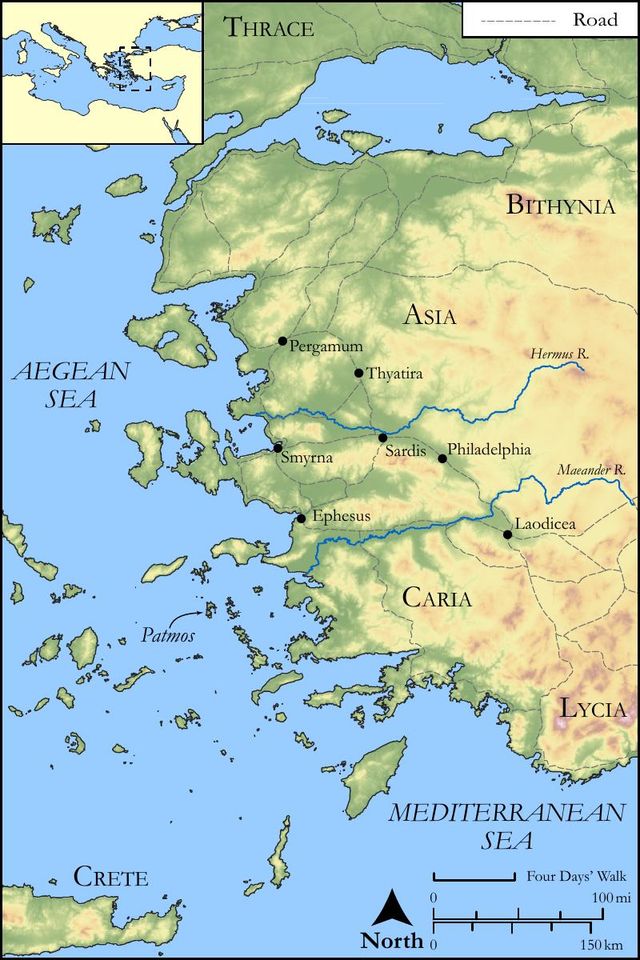
See on the biblical-era maps

Study this verse
Public-domain commentary
Matthew Henry
From his Commentary on the Whole Bible. Henry comments on passages, not single verses — this entry covers Revelation 9:1–12.
Upon the sounding of this trumpet, the things to be observed are, 1. A star falling from heaven to the earth. Some think this star represents some eminent bishop in the Christian church, some angel of the church; for, in the same way of speaking by which pastors are called stars, the church is called heaven; but who this is expositors do not agree. Some understand it of Boniface the third bishop of Rome, who assumed the title of universal bishop, by the favour of the emperor Phocas, who, being a usurper and tyrant in the state, allowed Boniface to be so in the church, as the reward of his flattery. 2. To this fallen star was given the key of the bottomless pit. Having now ceased to be a minister of Christ, he becomes the antichrist, the minister of the devil; and by the permission of Christ, who had taken from him the keys of the church, he becomes the devil's turnkey, to let loose the powers of hell against the churches of Christ. 3. Upon the opening of the bottomless pit there arose a great smoke, which darkened the sun and the air. The devils are the powers of darkness; hell is the place of darkness. The devil carries on his designs by blinding the eyes of men, by extinguishing light and knowledge, and promoting ignorance and error. He first deceives men, and then destroys them; wretched souls follow him in the dark, or they durst not follow him. 4. Out of this dark smoke there came a swarm of locusts, one of the plagues of Egypt, the devil's emissaries headed by the antichrist, all the rout and rabble of antichristian orders, to promote superstition, idolatry, error, and cruelty; and these had, by the just permission of God, power to hurt those who had not the mark of God in their foreheads. 5. The hurt they were to do them was not a bodily, but a spiritual hurt. They should not in a military way destroy all by fire and sword; the trees and the grass should be untouched, and those they hurt should not be slain; it should not be a persecution, but a secret poison and infection in their souls, which should rob them of their purity, and afterwards of their peace. Heresy is a poison in the soul, working slowly and secretly, but will be bitterness in the end. 6. They had no power so much as to hurt those who had the seal of God in their foreheads. God's electing, effectual, distinguishing grace will preserve his people from total and final apostasy. 7. The power given to these factors for hell is limited in point of time: five months, a certain season, and but a short season, though how short we cannot tell. Gospel-seasons have their limits, and times of seduction are limited too. 8. Though it would be short, it would be very sharp, insomuch that those who were made to feel the malignity of this poison in their consciences would be weary of their lives, Rev 9:6. A wounded spirit who can bear? 9. These locusts were of a monstrous size and shape, Rev 9:7, Rev 9:8, etc. They were equipped for their work like horses prepared to battle. (1.) They pretended to great authority, and seemed to be assured of victory: They had crowns like gold on their heads; it was not a true, but a counterfeit authority. (2.) They had the show of wisdom and sagacity, the faces of men, though the spirit of devils. (3.) They had all the allurements of seeming beauty, to ensnare and defile the minds of men - hair like women; their way of worship was very gaudy and ornamental. (4.) Though they appeared with the tenderness of women, they had the teeth of lions, were really cruel creatures. (5.) They had the defence and protection of earthly powers - breastplates of iron. (6.) They made a mighty noise in the world; they flew about from one country to another, and the noise of their motion was like that of an army with chariots and horses. (7.) Though at first they soothed and flattered men with a fair appearance, there was a sting in their tails; the cup of their abominations contained that which, though luscious at first, would at length bite like a serpent and sting like an adder. (8.) The king and commander of this hellish squadron is here described, [1.] As an angel; so he was by nature, an angel, once one of the angels of heaven. [2.] The angel of the bottomless pit; an angel still, but a fallen angel, fallen into the bottomless pit, vastly large, and out of which there is no recovery. [3.] In these infernal regions he is a sort of prince and governor, and has the powers of darkness under his rule and command. [4.] His true name is Abaddon, Apollyon - a destroyer, for that is his business, his design, and employment, to which he diligently attends, in which he is very successful, and takes a horrid hellish pleasure; it is about this destroying work that he sends out his emissaries and armies to destroy the souls of men. And now here we have the end of one woe; and where one ends another begins.
Historical interpretation
Six Centuries of Reception
7 surviving comments on this verse. Each one is dated, so this reads as a timeline rather than a list.
Select a marker to jump to its quote. Markers stagger vertically where authors wrote within a few decades of each other.
By the “tails” he speaks of the leaders who have fallen away from the Head of the church, that is, from the Lord, and so those who were the first have become the last. This is as God thought it worthy to say through Isaiah, “The elders who are honored and admired are the head; and the prophet who teaches iniquity is the tail.” Therefore, the “power” of the locusts refers to the character of the false prophets who never desist from attacking the true church by their lying and venomous doctrines.
[The noise of their wings was like the sound of chariots] signifies that the few who were in the lead as the horses have now been multiplied in the chariots [that follow]. This suggests either an increase in the diversity of new opinions or the increase in the number of those who have been led astray. Moreover, they rush into battle because the preachers of error rebel against the truth and fight against unity. The apostle described such persons in a similar fashion, “As Jannes and Jambres opposed Moses, so these men also oppose the truth, men of corrupt mind and counterfeit faith,” and following. … [That they had power in their tails] reminds us of what Isaiah wrote, “The elder and the honored man is the head, and the prophet who teaches falsehood is the tail, and those who bless my people will lead them astray, and those who are blessed have fallen.” It is clear from this that these persons wish to rule that which every saint and teacher of the truth desires at all costs to avoid, namely, the glory of the world and the error of a destructive preaching. That they have power in their tails for five months indicates again the present life where falsehood can be strong and can either capture the useless or torment the spiritual for a short period of time.
Their iron breastplates show their hardness of heart.… We think that the sound of the wings of these spiritual locusts is said to resemble the sound of war chariots because of their speed in the air. For, as the blessed David says, “They make war upon us from on high.” And their tails which are like those of scorpions symbolize the result of sins, the producing of spiritual death. For “sin when it is perfected brings forth death.”
And they had tails like scorpions, etc. Just as a scorpion walks gently but strikes with its tail, so the fraudulent destruction of the wicked appears pleasant and harmless on the surface, but while it secretly kills, it covertly brings death.
Their power to harm men was for six months. This again suggests this life, where lies can prevail either to capture the useless or to torment the spiritually strong temporarily.
And they had tails like to scorpions, and there were stings in their tails. Their power was to hurt men five months. We have already spoken about scorpions' tails. Note also that the apostle calls sin a sting. [1 Cor. 15:56] We have already spoken about the five months in the above; but there he is talking about the good, and here about the wicked, because the locusts torment the people mentioned in the previous passage, but do not kill them, whereas they do not torment the people mentioned here, but kill them when they hurt them, either with wrong doctrine or with temporal power.
After this, the divine evangelist vividly and fearfully describes to us the nature of the worms. In each of the descriptions concerning them, one would marvel at the precision of the account; for he did not say that they had the "teeth of lions", the "tails of scorpions", or the "faces of men", but rather, in each case, he presented a figurative and parabolic representation of what was situated there, not the literal reality. Therefore, either their terrifying and astonishing nature is indicated through these images, or he truly sketched their form.
Continue studying Revelation 9:10 across the web’s major study libraries — every link below opens this exact verse, chapter, or book on the destination site.
Read & Compare
 BibleGatewayThis verse in more than 200 translations and 70 languages.
 Bible.comThe YouVersion reader — hundreds of translations, reading plans, and highlights.
 ESV.orgCrossway's official English Standard Version reader.
 NET BibleThe NET translation with 60,000+ translators' notes on every rendering decision.
 STEP BibleTyndale House's free study tool — original text, vocabulary, and scholarly resources.
 BibliaLogos Bible Software's free web reader.
 USCCBThe New American Bible (Revised Edition) with the U.S. bishops' study notes.
Commentaries
 BibleHub CommentariesDozens of classic commentaries on this verse, gathered on one page.
 StudyLightMore than 100 commentary sets — the largest collection on the web.
 BibleRefPlain-English commentary on what this verse means, verse by verse.
 Enduring WordDavid Guzik's free commentary on this chapter, widely used by Bible teachers.
 Bible Study ToolsVerse commentary alongside Greek and Hebrew study aids.
Original Language & Research
- BibleHub InterlinearThe verse word by word — original language, transliteration, and English.
- BibleHub LexiconEvery word's original-language definition and Strong's entry.
 Blue Letter BibleDeep-study tools — Strong's numbers, concordance, and word studies.
 CNTR CollationThe earliest Greek manuscripts of this verse, collated letter by letter.
Sermons, Hymns & Audio


TrulyRandomVerse is not affiliated with these sites and doesn’t control their content. They’re linked because they’re genuinely useful.
Summary
Revelation 9:10 vividly describes the instruments of torment possessed by the demonic locusts unleashed from the abyss, detailing their scorpion-like tails and stings, and explicitly stating the limited duration of their power to inflict suffering upon humanity. This verse emphasizes the agonizing, non-fatal nature of this divine judgment, highlighting God's precise control over the scope and timing of even the most terrifying manifestations of His wrath.
Context
ShowHideLiterary Context
This verse is an integral part of the fifth trumpet judgment, described in Revelation 9. Following the sounding of the fifth trumpet, a star (often interpreted as a fallen angel or Satan) is granted the key to the bottomless pit, from which a vast horde of supernatural locusts emerges. The preceding verses (Revelation 9:7-9) provide a grotesque description of these creatures, blending features of warhorses, human faces, women's hair, and lions' teeth. Unlike natural locusts that destroy vegetation, their specific commission, as stated in Revelation 9:4, is to torment those who do not bear the seal of God on their foreheads. Verse 10 builds upon this, specifying the exact means of their torment and reiterating the divinely imposed limitation on their destructive capacity.
Historical & Cultural Context
The imagery of scorpions and their painful stings would have been immediately recognizable and terrifying to John's original audience in the Roman province of Asia. Scorpions were a common and feared creature in the wilderness through which Israel passed, known for their excruciatingly painful, though not always fatal, venomous stings. The "five months" period is often interpreted in light of the natural lifespan of locusts, which typically plague crops for about five months (from spring hatching to late autumn death), or as a symbolic, limited period of intense affliction. This specific duration underscores the concept of divine limitation, a recurring theme in apocalyptic literature where God maintains sovereign control even amidst chaos and judgment. The reference to "power to hurt men" rather than kill them aligns with ancient understandings of torture and prolonged suffering as a form of punishment.
Key Themes
ShowHideRevelation 9:10 contributes significantly to several major themes within the book of Revelation and biblical prophecy. Foremost is the theme of Divine Judgment and Wrath, specifically highlighting its severity and the agonizing nature of the torment inflicted upon the unrepentant. This judgment is designed to cause intense suffering, yet it is explicitly not designed to bring death, reinforcing the theme of Painful Torment, Not Death, which is explicitly stated in Revelation 9:5-6. Another crucial theme is God's Absolute Sovereignty and Control, even over demonic forces and their destructive actions. The precise limitation of "five months" and the specific directive to "hurt men" but not kill them, underscore that these terrifying events are not random chaos but are meticulously orchestrated and strictly bounded by God's decree. Finally, the verse reinforces the theme of Symbolic and Apocalyptic Imagery, where grotesque and hybrid creatures serve to convey spiritual realities and the terrifying consequences of rejecting God's authority.
Exposition and Analysis
ShowHideKey Word Analysis
ShowHideThis word refers to the appendage at the rear of an animal. In this context, it is explicitly linked to scorpions, emphasizing the instrument of torment. Biblically, "tail" can sometimes symbolize deception or false prophecy (e.g., Isaiah 9:15), but here, its primary function is literal in its destructive capacity, serving as the vehicle for the sting.
Derived from a word meaning "to prick," kéntron refers to a point, a sting, or even a goad. In the context of scorpions, it denotes the sharp, venomous barb that inflicts intense pain. Figuratively, it can imply a "poison" or "divine impulse," but here it directly signifies the source of the excruciating physical torment.
This term denotes privilege, force, capacity, competency, freedom, or mastery, often implying delegated influence or authority. Here, it highlights that the locusts' ability to "hurt men" is not inherent or unlimited, but rather a specific, divinely granted, and therefore restricted, authority. It underscores God's ultimate control over the extent and duration of their destructive actions.
Verse Breakdown
ShowHide"And they had tails like unto scorpions,"
This clause introduces the primary instrument of torment. The comparison to scorpions immediately evokes an image of excruciating pain, as scorpions were well-known for their venomous and agonizing stings. This simile sets the tone for the nature of the suffering.
"and there were stings in their tails:"
This further clarifies and intensifies the imagery. It's not just that their tails resembled scorpions, but that these tails were equipped with actual "stings," confirming them as active instruments of pain. This reiterates the direct and piercing nature of the torment.
"and their power [was] to hurt men five months."
This final clause defines the scope and duration of the locusts' destructive capability. The word "power" (exousía) signifies a divinely permitted authority, emphasizing that their ability to "hurt" (adikéō, to do wrong, injure) is strictly limited. The specific period of "five months" highlights God's sovereignty over the timing and extent of this judgment, ensuring it is a finite, controlled period of suffering rather than perpetual annihilation.
Literary Devices
ShowHideRevelation 9:10 is rich in Symbolism and Simile. The entire description of the locusts, including their scorpion-like tails and stings, is highly symbolic, representing demonic forces unleashed to inflict divine judgment. The Simile "tails like unto scorpions" is particularly potent, immediately conveying the nature of the torment as piercing, venomous, and intensely painful, drawing on a creature universally feared for its sting. The "five months" serves as a symbolic, divinely appointed duration, signifying a limited period of tribulation rather than endless suffering. The passage also employs Apocalyptic Imagery, characterized by its grotesque and hybrid descriptions, designed to evoke awe, terror, and a sense of the supernatural, emphasizing the otherworldly nature of these agents of judgment.
Theological and Thematic Connections
ShowHideRevelation 9:10 profoundly illustrates God's sovereign control over judgment, even when it involves the unleashing of terrifying demonic forces. The specific, limited duration of "five months" and the restriction to "hurt men" rather than kill them, underscore that divine wrath is not chaotic or arbitrary, but precisely orchestrated according to God's perfect will. This passage serves as a stark warning of the consequences of rejecting God's authority and grace, while simultaneously affirming His ultimate power to set boundaries for evil, ensuring that even the most severe judgments serve His overarching redemptive purposes. It highlights the distinction between temporary affliction and ultimate, eternal judgment, offering a glimmer of hope for repentance during this period of intense suffering.
Reflection and Application
ShowHideRevelation 9:10, while depicting a terrifying future judgment, offers profound insights for contemporary reflection. It reminds us that even in the midst of overwhelming evil and suffering, God remains absolutely sovereign, setting limits and purposes for every event. This should instill both a healthy fear of God's righteous judgment and a deep comfort in His ultimate control. For those who are sealed by God, this passage offers assurance that they are protected from such specific judgments, emphasizing the immense value of being in Christ. For those who are not, it serves as a powerful call to repentance and to seek the divine seal of salvation, which offers deliverance from the wrath to come. The temporary nature of this torment, though severe, also points to the possibility of repentance and the ultimate, eternal consequences for those who remain hardened.
Questions for Reflection
ShowHideFAQ
ShowHideAre the "locusts" in Revelation 9 literal insects or symbolic beings?
ShowHideThe description of the locusts in Revelation 9:7-10 is highly symbolic and fantastical, blending features of horses, men, women, and lions, along with scorpion-like tails. This imagery strongly suggests they are not literal insects but rather supernatural, demonic entities unleashed by God to execute a specific judgment. Their purpose is not to destroy vegetation, as natural locusts do, but to torment unrepentant humanity, further indicating their symbolic and spiritual nature.
What is the significance of the "five months" period of torment?
ShowHideThe "five months" period signifies a divinely appointed and strictly limited duration for this specific judgment. While some interpret it literally as a period of 150 days, many scholars see it as symbolic, possibly alluding to the typical lifespan of a natural locust plague (which lasts about five months) or simply emphasizing that God's judgments are not endless but have a definite beginning and end. It underscores God's absolute control over the timing and extent of the torment, demonstrating that even in judgment, His sovereignty prevails.
Christ-Centered Fulfillment
ShowHideWhile Revelation 9:10 describes a terrifying future judgment, its Christ-centered fulfillment is found in the ultimate victory of Jesus over all forces of evil and the promise of deliverance for those who belong to Him. The torment inflicted by these demonic entities highlights the severity of sin and the consequences of rejecting God's reign, yet it also implicitly points to the One who has already triumphed over "scorpions" and all the power of the enemy (Luke 10:19). Christ's atoning sacrifice on the cross disarmed the spiritual powers and authorities (Colossians 2:15), ensuring that those who are "sealed" by God through faith in Him are protected from the wrath to come (1 Thessalonians 1:10). The limited power and duration of these demonic locusts ultimately serve to magnify the limitless power and eternal reign of Christ, who will ultimately cast all evil, including Satan and his agents, into the lake of fire forever (Revelation 20:10). Thus, this passage, while grim, ultimately underscores the security and hope found in Jesus, the victorious Lamb of God.