


Numbers 18:6
- וַאֲנִיva·'a·Niand IH589Conj-w ¦ Pro-1csPronoun Personal 1st Singular common genderוַandאֲנִיI
- הִנֵּהhi·Nehhere!H2009PrtParticle Interjection
- לָקַחְתִּיla·Kach·tiI have takenH3947V-Qal-Perf-1csVerb Qal Perfect 1st Singular common gender
- אֶת'et<obj.>H853DirObjMParticle Object Indicator
- אֲחֵיכֶם'a·chei·Khemyour brothersH251N-mpc ¦ 2mpNoun Plural Masculine Constructאֲחֵיbrothersכֶםyour
- הַלְוִיִּםhal·vi·Yimthe LevitesH3881Art ¦ N-mpNoun Gentilic Plural Masculine AbsoluteהַtheלְוִיִּםLevites
- מִתּוֹךְmi·Tokhfrom amongH8432Prep-m ¦ N-mscNoun Singular Masculine Constructמִfromתּוֹךְamong
- בְּנֵיbe·Nei[the] people ofH1121N-mpcNoun Plural Masculine Construct
- יִשְׂרָאֵלYis·ra·'ElIsraelH3478N-properNoun Proper Location
- לָכֶםla·Khemto <the> youPrep-l ¦ 2mpSuffix Personal 2nd Plural Masculineלָto <the>כֶםyou
- מַתָּנָהma·ta·Naha giftH4979N-fsNoun Singular Feminine Absolute
- נְתֻנִיםne·tu·NimassignedH5414V-Qal-PassPrtcpl-mpVerb Qal Participle Passive Plural Masculine Absolute
- לַיהוָהla·Yah·wehto YahwehH3068Prep-l ¦ N-properNoun Proper TitleלַtoיהוָהYahweh
- לַעֲבֹדla·'a·Vodto serveH5647Prep-l ¦ V-Qal-InfVerb Qal Infinitive Constructלַtoעֲבֹדserve
- אֶת'et<obj.>H853DirObjMParticle Object Indicator
- עֲבֹדַת'a·vo·Dat[the] service ofH5656N-fscNoun Singular Feminine Construct
- אֹהֶל'O·hel[the] tent ofH168N-mscNoun Singular Masculine Construct
- מוֹעֵדmo·'EdmeetingH4150N-msNoun Singular Masculine Absolute
English is a literal word-by-word gloss of the Hebrew, not the KJV's wording. Why?
This is the original text the KJV's translators worked from — each Hebrew word with its own literal English meaning in this verse, prepared by scholars at Tyndale House, Cambridge. The KJV translates whole sentences, not word by word, so its wording differs: one Hebrew word can become several English words, and the KJV may choose “the LORD” where the gloss reads “Yahweh”. Both are faithful — they answer different questions. For the KJV's own rendering, switch to the KJV text.
Details
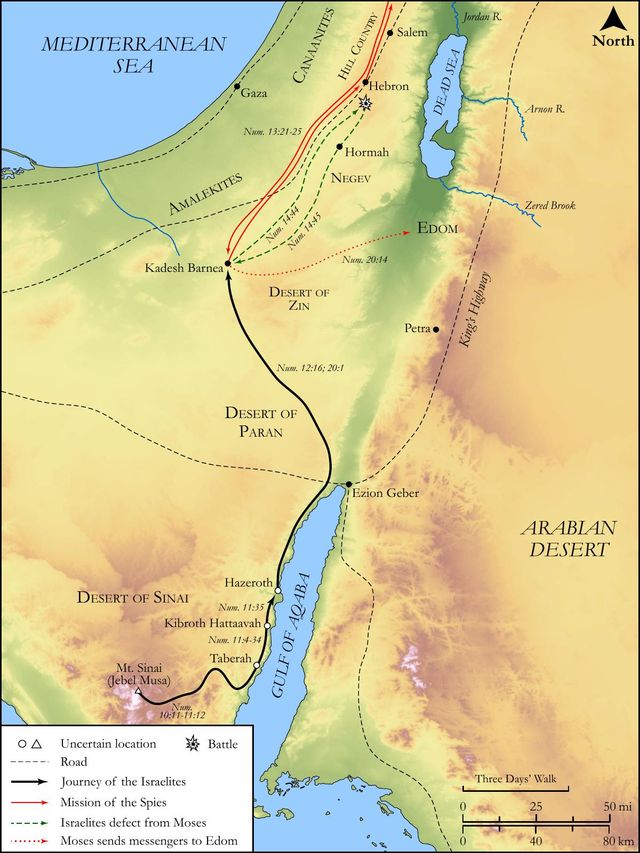
See on the biblical-era map
Study this verse
Public-domain commentary
Matthew Henry
From his Commentary on the Whole Bible. Henry comments on passages, not single verses — this entry covers Numbers 18:1–7. His three-level outline is real structure in the source text, so it is rendered as structure.
The coherence of this chapter with that foregoing is very observable.
I.The people, in the close of that chapter, had complained of the difficulty and peril that there were in drawing near to God, which put them under some dreadful apprehensions that the tabernacle in the midst of them, which they hoped would have been their joy and glory, would rather be their terror and ruin. Now, in answer to this complaint, God here gives them to understand by Aaron that the priests should come near for them as their representatives; so that, though the people were obliged to keep their distance, yet that should not at all redound to their disgrace or prejudice, but their comfortable communion with God should be kept up by the interposition of the priests.
II.A great deal of honour God had now lately put upon Aaron; his rod had budded and blossomed, when the rods of the rest of the princes remained dry, and destitute both of fruit and ornament. Now lest Aaron should be puffed up with the abundance of the favours that were done him, and the miracles that were wrought for the support of him in his high station, God comes to him to remind him of the burden that was laid upon him, and the duty required from him as a priest. He would see reason not to be proud of his preferment, but to receive the honours of his office with reverence and holy trembling, when he considered how great was the charge committed to him, and how hard it would be for him to give a good account of it. Be not high-minded, but fear.
1.God tells him of the danger that attended his dignity, Num 18:1. (1.) That both the priests and Levites (thou, and thy sons, and thy father's house) should bear the iniquity of the sanctuary; that is, if the sanctuary were profaned by the intrusion of strangers, or persons in their uncleanness, the blame should lie upon the Levites and priests, who ought to have kept them off. Though the sinner that thrust in presumptuously should die in his iniquity, yet his blood should be required at the hands of the watchmen. Or it may be taken more generally: "If any of the duties or offices of the sanctuary be neglected, if any service be not done in its season or not according to the law, if any thing be lost or misplaced in the removal of the sanctuary, you shall be accountable for it, and answer it at your peril." (2.) That the priests should themselves bear the iniquity of the priesthood; that is, if they either neglected any part of their work or permitted any other persons to invade their office, and take their work out of their hands, they should bear the blame of it. Note, The greater the trust is of work and power that is committed to us the greater is our danger of contracting guilt, by falsifying and betraying that trust. This is a good reason why we should neither be envious at others' honours nor ambitious ourselves of high places, because great dignity exposes us to great iniquity. Those that are entrusted with the charge of the sanctuary will have a great deal to answer for. Who would covet the care of souls who considers the account that must be given of that care?
2.He tells him of the duty that attended his dignity.
(1.)That he and his sons must minister before the tabernacle of witness (Num 18:2); that is (as bishop Patrick explains it), before the most holy place, in which the ark was, on the outside of the veil of that tabernacle, but within the door of the tabernacle, of the congregation. They were to attend the golden altar, the table, and candlestick, which no Levite might approach to. You shall serve, Num 18:7. Not, "You shall rule" (it was never intended that they should lord it over God's heritage), but "You shall serve God and the congregation." Note, The priesthood is a service. If any desire the office of a bishop he desires a good work. Ministers must remember that they are ministers, that is, servants, of whom it is required that they be humble, diligent, and faithful.
(2.)That the Levites must assist him and his sons, and minister to them in all the service of the tabernacle (Num 18:2-4), though they must by no means come nigh the vessels of the sanctuary, nor at the altar meddle with the great services of burning the fat and sprinkling the blood. Aaron's family was very small, and, as it increased, the rest of the families of Israel would increase likewise, so that the hands of the priests neither were now nor were likely to be sufficient for all the service of the tabernacle; therefore (says God) the Levites shall be joined to thee, Num 18:2, and again Num 18:4, where there seems to be an allusion to the name of Levi, which signifies joined. Many of the Levites had of late set themselves against Aaron, but henceforward God promises that they should be heartily joined to him in interest and affection, and should no more contest with him. It was a good sign to Aaron that God owned him when he inclined the hearts of those concerned to own him too. The Levites are said to be given as a gift to the priests, Num 18:6. Note, We are to value it as a great gift of the divine bounty to have those joined to us that will be helpful and serviceable to us in the service of God.
(3.)That both priests and Levites must carefully watch against the profanation of sacred things. The Levites must keep the charge of the tabernacle, that no stranger (that is, none who upon any account was forbidden to come) might come nigh (Num 18:4), and that upon pain of death, Num 18:7. And the priests must keep the charge of the sanctuary (Num 18:5), must instruct the people, and admonish them concerning the due distance they were to keep, and not suffer them to break the bounds set them, as Korah's company had done, that there be no wrath any more upon the children of Israel. Note, The preventing of sin is the preventing of wrath; and the mischief sin has done should be a warning to us for the future to watch against it both in ourselves and others.
Continue studying Numbers 18:6 across the web’s major study libraries — every link below opens this exact verse, chapter, or book on the destination site.
Read & Compare
 BibleGatewayThis verse in more than 200 translations and 70 languages.
 Bible.comThe YouVersion reader — hundreds of translations, reading plans, and highlights.
 ESV.orgCrossway's official English Standard Version reader.
 NET BibleThe NET translation with 60,000+ translators' notes on every rendering decision.
 STEP BibleTyndale House's free study tool — original text, vocabulary, and scholarly resources.
 BibliaLogos Bible Software's free web reader.
 USCCBThe New American Bible (Revised Edition) with the U.S. bishops' study notes.
Commentaries
 BibleHub CommentariesDozens of classic commentaries on this verse, gathered on one page.
 StudyLightMore than 100 commentary sets — the largest collection on the web.
 BibleRefPlain-English commentary on what this verse means, verse by verse.
 Enduring WordDavid Guzik's free commentary on this chapter, widely used by Bible teachers.
 Bible Study ToolsVerse commentary alongside Greek and Hebrew study aids.
Original Language & Research
- BibleHub InterlinearThe verse word by word — original language, transliteration, and English.
- BibleHub LexiconEvery word's original-language definition and Strong's entry.
 Blue Letter BibleDeep-study tools — Strong's numbers, concordance, and word studies.
 SefariaThe Hebrew text with Rashi and centuries of Jewish commentary.
Sermons, Hymns & Audio


TrulyRandomVerse is not affiliated with these sites and doesn’t control their content. They’re linked because they’re genuinely useful.
Summary
Numbers 18:6 articulates a pivotal divine decree concerning the Levites' unique role within ancient Israel's sacred economy. This verse, spoken by God directly to Aaron, establishes that the Levites were divinely chosen and separated from the broader Israelite community, then "given" to the priestly line as a consecrated "gift for the LORD." Their essential function was to perform the practical and physical "service of the tabernacle of the congregation," thereby supporting the priests in maintaining the sanctity and operational integrity of God's dwelling place among His people.
Context
ShowHideLiterary Context
Numbers 18:6 is strategically positioned within a critical section of the Book of Numbers that meticulously re-establishes and clarifies the distinct roles of the priesthood and the Levites. This clarification follows the severe challenge to divine authority presented by Korah's rebellion in Numbers 16, which questioned Moses and Aaron's leadership and the divinely ordained priestly order. God's dramatic vindication of Aaron's exclusive right to the priesthood, evidenced by the budding of his staff in Numbers 17, sets the stage for chapter 18. This chapter then provides a detailed blueprint for the responsibilities, privileges, and provisions for both the priests (Aaron's direct descendants) and the Levites. Verse 6 serves as the foundational declaration for the Levites' indispensable, though subordinate, role, emphasizing their divine origin and dedication to the Tabernacle service, thereby preventing any future unauthorized encroachment on sacred duties and reinforcing the established hierarchy.
Historical & Cultural Context
The unfolding narrative of Numbers takes place during Israel's formative forty-year sojourn in the wilderness, a period crucial for the establishment of their national and religious identity. The Tabernacle, a portable sanctuary, served as the tangible manifestation of God's presence among His people, functioning as the central hub of their worship, communal life, and legal system. While many ancient Near Eastern cultures possessed priestly classes, Israel's system was uniquely distinguished by its direct divine institution and stringent requirements for holiness. The Levites were uniquely set apart from the other eleven tribes, not receiving a territorial inheritance in Canaan but being consecrated entirely to the service of God. This distinct arrangement was rooted in the concept of substitution, as the Levites were taken in place of the firstborn of Israel, whom God had claimed as His own after the climactic Passover judgment in Egypt, a divine claim explicitly detailed in Numbers 3:12-13.
Key Themes
ShowHideThis verse powerfully contributes to several overarching themes woven throughout the Pentateuch and the Book of Numbers. It profoundly underscores the theme of Divine Appointment and Sovereignty, as God emphatically declares, "I, behold, I have taken your brethren the Levites from among the children of Israel." This highlights that their sacred role was not a human choice or a tribal agreement, but a direct, authoritative divine ordination. This separation for sacred service echoes the broader concept of Israel as God's chosen people, set apart for His unique purposes. The verse also emphasizes Order and Holiness in Worship, as the clear delineation of responsibilities between priests and Levites ensured that the sacred space and holy objects were approached with the utmost reverence and according to God's precise instructions. This meticulous order was crucial to prevent the kind of unauthorized access that previously led to severe divine judgment, as seen in Numbers 3:10 and the tragic events involving Nadab and Abihu in Leviticus 10:1-3. Finally, it highlights the theme of Dedicated Service and Substitution, framing the Levites as a "gift for the LORD," signifying their complete dedication to God's purposes and their unique role as a consecrated offering from the tribes of Israel, standing in for the firstborn.
Exposition and Analysis
ShowHideKey Word Analysis
ShowHideThis primitive root means "to take (in the widest variety of applications)." In this context, it signifies God's active, sovereign selection and separation of the Levites from the general population of Israel. It implies a divine claim and ownership, highlighting that their unique status and role were not self-acquired but were the result of God's personal initiative and authoritative act of setting them apart for a specific, sacred purpose.
This primitive root means "to give, used with greatest latitude of application." Here, in a passive construction, it emphasizes that the Levites' dedication and transfer to the priests' care were divinely orchestrated. They were literally "given over" or "dedicated" by God Himself, underscoring their consecrated nature and the fact that their service was a divine offering, not merely a human assignment.
This feminine noun means "a present; specifically (in a good sense), a sacrificial offering." This term reinforces the idea that the Levites were not just assigned a duty but were a sacred offering, a consecrated dedication from the people of Israel to the Lord, fulfilling God's claim on the firstborn. Their service was thus inherently an act of worship and devotion, mediated through the priestly line.
Verse Breakdown
ShowHide"And I, behold, I have taken your brethren the Levites from among the children of Israel:"
This opening clause is a powerful declaration of divine initiative and absolute sovereignty. The emphatic repetition "I, behold, I" underscores that this is a direct, authoritative pronouncement from God Himself, not a human decision or a suggestion. God personally selected and separated the Levites from the general populace of Israel, setting them apart for a unique and sacred purpose. This act of "taking" implies a divine claim and ownership over them, highlighting their distinct status and the divine origin of their calling.
"to you [they are] given [as] a gift for the LORD,"
This phrase clarifies the dual recipient and ultimate purpose of the Levites. While they are "given to you" (referring to Aaron and his priestly descendants) to assist them, their ultimate dedication is "for the LORD." The term "gift" (H4979, mattânâh), coupled with the passive form of "given" (H5414, nâthan), signifies that their service is a sacred offering, a consecrated dedication to God. This reinforces the idea that the Levites served not merely as human assistants but as a divinely appointed and consecrated offering, fulfilling God's claim on the firstborn of Israel.
"to do the service of the tabernacle of the congregation."
This final clause specifies the precise function of the Levites. Their "service" (H5656, ʻăbôdâh) refers to the practical, physical duties associated with the Tabernacle. This included the arduous tasks of dismantling, transporting, and reassembling the Tabernacle during Israel's journeys, guarding its precincts, and maintaining its various components. This role was distinct from the priests' more sacred, ritualistic duties (e.g., offering sacrifices, entering the Holy Place), but it was absolutely essential for the proper functioning and sanctity of the "tabernacle of the congregation" (H168, ʼôhel and H4150, môwʻêd), the designated meeting place between God and His people.
Literary Devices
ShowHideThe verse employs several significant literary devices that amplify its theological weight and underscore the divine authority behind the Levitical institution. Divine Address is paramount, as the words are a direct declaration from God to Aaron, lending supreme authority and immutability to the decree. The striking Repetition of the first-person pronoun ("And I, behold, I have taken") serves to emphasize God's personal agency and sovereign choice in setting apart the Levites, leaving no doubt as to the divine origin of their calling. The language itself is highly Legal and Covenantal, functioning as a divine mandate that establishes a foundational aspect of the Mosaic covenant's structure for worship and community life. Furthermore, the concept of the Levites being "given as a gift for the LORD" carries strong Symbolic weight, representing not only their dedication but also their role as a substitutionary offering, standing in for the firstborn of Israel, a theme central to the redemption narrative.
Theological and Thematic Connections
ShowHideNumbers 18:6 is a foundational text for understanding the Old Covenant's intricate system of worship and the enduring principle of dedicated service. It underscores God's meticulous concern for order, holiness, and the proper approach to His sacred presence. The divine selection of the Levites highlights the concept of election—God's sovereign choice of individuals and groups for specific purposes within His redemptive plan. Their role as assistants to the priests, yet ultimately dedicated "for the LORD," illustrates the principle that all service within God's kingdom, regardless of its apparent prominence, is ultimately directed toward Him and contributes to His glory. This verse also implicitly connects to the broader theme of substitution, as the Levites served as a consecrated replacement for the firstborn, a concept that finds its ultimate fulfillment in Christ.
Reflection and Application
ShowHideWhile the specific Levitical system belongs to the Old Covenant, the profound principles embedded in Numbers 18:6 offer enduring lessons for believers today. Just as the Levites were uniquely chosen, separated, and dedicated to God's service, so too are all believers under the New Covenant called to a life of consecrated service. We are no longer defined by tribal lineage but by our identity in Christ, becoming a "royal priesthood" and a "holy nation," set apart for God's purposes. This verse challenges us to consider our own lives as a "gift for the LORD," to be offered in dedicated service within the body of Christ and in the world. It reminds us that every role, whether seemingly prominent or behind-the-scenes, is vital for the effective functioning of God's kingdom and should be performed with diligence, humility, and reverence, knowing that our ultimate service is to God Himself. Our dedication should reflect the divine initiative that called us, mirroring the Levites' response to God's sovereign choice.
Questions for Reflection
ShowHideFAQ
ShowHideWhat was the primary role of the Levites compared to the priests?
ShowHideThe primary role of the Levites was to assist the priests (Aaron's direct descendants) in the physical and practical "service of the tabernacle of the congregation." This included tasks such as dismantling, transporting, and reassembling the Tabernacle during Israel's journeys, guarding its precincts, maintaining its various components, and preparing items for priestly rituals. In contrast, the priests performed the most sacred and ritualistic duties, such as offering sacrifices on the altar, burning incense, entering the Holy Place, and blessing the people. The Levites ensured the Tabernacle's operational functionality and sanctity, allowing the priests to focus on their more direct mediatorial roles.
Why were the Levites considered a "gift for the LORD"?
ShowHideThe Levites were considered a "gift for the LORD" because they were divinely chosen as substitutes for the firstborn of every Israelite family. Following the Passover in Egypt, God claimed all the firstborn as His own, but He later accepted the Levites in their place as a special dedication to His service (see Numbers 3:12-13). This act signified God's ownership of them and their unique, consecrated status. Their dedication was a special offering from the tribes of Israel, highlighting that their service was not merely a human assignment but a sacred, divinely ordained offering to God Himself, performed through the hands of the priests.
Christ-Centered Fulfillment
ShowHideNumbers 18:6, with its emphasis on consecrated service and the orderly administration of God's dwelling, finds profound Christ-centered fulfillment in the New Covenant. The entire Levitical system, including the priests and their assistants, served as a shadow pointing to the ultimate reality in Jesus Christ. He is the true and perfect High Priest, who offered Himself as the once-for-all sacrifice, thereby fulfilling and superseding the need for the Levitical sacrificial system. Through His finished work on the cross, the barrier between God and humanity was removed, and the physical Tabernacle (and later the Temple) was rendered obsolete because God's presence now dwells in a new way. Now, the Church, comprised of all believers, is the spiritual temple where God dwells by His Spirit. In Christ, all believers are made part of a royal priesthood, no longer needing human mediators to approach God. Just as the Levites were "given as a gift for the LORD" for service, so too are all believers now gifted by the Spirit with diverse spiritual gifts to serve the body of Christ and the world, offering spiritual sacrifices of praise and good deeds to God (see 1 Corinthians 12:4-7). The principle of dedicated service to God, once confined to a specific tribe and its duties, is now universally applied to all who are in Christ, empowering them to participate in the ongoing work of God's kingdom as a direct response to His sovereign grace.