


Numbers 16:43
Bible text: King James Version (1769 Blayney text) · Public domain
Bible text: King James Version with Strong's numbers · Public domain
Bible text: Berean Standard Bible · Public domain
Bible text: American Standard Version (1901) · Public domain
Bible text: World English Bible, Messianic edition · Public domain
Bible text: Geneva Bible (1599) · Public domain
Bible text: Young's Literal Translation · Public domain
- וַיָּבֹאvai·ya·Vo'and he cameH935Conj-w ¦ V-Qal-ConsecImperf-3msVerb Qal Consecutive Imperfect 3rd Singular Masculineוַandיָּבֹאhe came
- מֹשֶׁהmo·ShehMosesH4872N-proper-mNoun Proper Masculine
- וְאַהֲרֹןve·'a·ha·Ronand AaronH175Conj-w ¦ N-proper-mNoun Proper MasculineוְandאַהֲרֹןAaron
- אֶל'eltoH413PrepPreposition
- פְּנֵיpe·Nei[the] face ofH6440N-mpcNoun Plural Masculine Construct
- אֹהֶל'O·hel[the] tent ofH168N-mscNoun Singular Masculine Construct
- מוֹעֵדmo·'EdmeetingH4150N-msNoun Singular Masculine Absolute
English is a literal word-by-word gloss of the Hebrew, not the KJV's wording. Why?
This is the original text the KJV's translators worked from — each Hebrew word with its own literal English meaning in this verse, prepared by scholars at Tyndale House, Cambridge. The KJV translates whole sentences, not word by word, so its wording differs: one Hebrew word can become several English words, and the KJV may choose “the LORD” where the gloss reads “Yahweh”. Both are faithful — they answer different questions. For the KJV's own rendering, switch to the KJV text.
Details
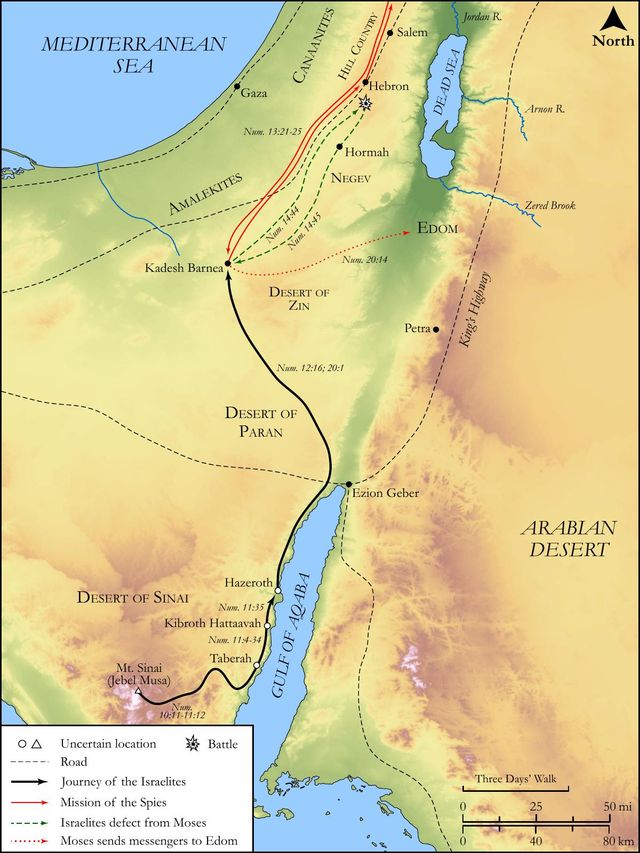
See on the biblical-era map
Study this verse
Public-domain commentary
Matthew Henry
From his Commentary on the Whole Bible. Henry comments on passages, not single verses — this entry covers Numbers 16:41–50. His three-level outline is real structure in the source text, so it is rendered as structure.
Here is, I. A new rebellion raised the very next day against Moses and Aaron. Be astonished, O heavens, at this, and wonder, O earth! Was there ever such an instance of the incurable corruption of sinners? On the morrow (Num 16:41) the body of the people mutinied. 1. Though they were so lately terrified by the sight of the punishment of the rebels. The shrieks of those sinking sinners, those sinners against their own souls, were yet sounding in their ears, the smell of the fire yet remained, and the gaping earth was scarcely thoroughly closed, and yet the same sins were re-acted and all these warnings slighted. 2. Though they were so lately saved from sharing in the same punishment, and the survivors were as brands plucked out of the burning, yet they fly in the face of Moses and Aaron, to whose intercession they owed their preservation. Their charge runs very high: You have killed the people of the Lord. Could any thing have been said more unjustly and maliciously? They canonize the rebels, calling those the people of the Lord who died in arms against him. They stigmatize divine justice itself. It was plain enough that Moses and Aaron had no hand in their death (they did what they could to save them), so that in charging them with murder they did in effect charge God himself with it. The continued obstinacy of this people, notwithstanding the terrors of God's law as it was given on Mount Sinai, and the terrors of his judgments as they were here executed on the disobedient, shows how necessary the grace of God is to the effectual change of men's hearts and lives, without which the most likely means will never attain the end. Love will do what fear could not.
II.God's speedy appearance against the rebels.
When they had gathered against Moses and Aaron, perhaps with a design to depose or murder them, they looked towards the tabernacle, as if their misgiving consciences expected some frowns thence, and, behold, the glory of the Lord appeared (Num 16:42), for the protection of his servants, and the confusion of his and their accusers and adversaries. Moses and Aaron thereupon came before the tabernacle, partly for their own safety (there they took sanctuary from the strife of tongues, Psa 27:5; Psa 31:20), and partly for advice, to know what was the mind of God upon this occasion, Num 16:43. Justice hereupon declares that they deserve to be consumed in a moment, Num 16:45. Why should those live another day who hate to be reformed, and whose rebellions are their daily practices? Let just vengeance take place and do its work, and the trouble will soon be over; only Moses and Aaron must first be secured.
III.The intercession which Moses and Aaron made for them.
Though they had as much reason, one would think, as Elias had to make intercession against Israel (Rom 11:2), yet they forgive and forget the indignities offered them, and are the best friends their enemies have.
1.They both fell on their faces, humbly to intercede with God for mercy, knowing how great the provocation was. This they had done several times before, upon similar occasions; and, though the people had basely requited them for it, yet, God having graciously accepted them, they still have recourse to the same method. This is praying always.
2.Moses, perceiving that the plague had begun in the congregation of the rebels (that is, that body of them which was gathered against Moses), sent Aaron by an act of his priestly office to make atonement for them, Num 16:46. And Aaron readily went and burned incense between the living and the dead, not to purify the infected air, but to pacify an offended God, and so stayed the progress of the judgment. By this it appeared,
(1.)That Aaron was a very good man, and a man that had a true love for the children of his people, though they hated and envied him. Though God was now avenging his quarrel and pleading the cause of his priesthood, yet he interposes to turn away God's wrath. Nay, forgetting his age and gravity, he ran into the midst of the congregation to help them. He did not say, "Let them smart awhile, and then, when I come, I shall be the more welcome;" but, as one tender of the life of every Israelite, he makes all possible speed into the gap at which death was entering. Moses and Aaron, who had been charged with killing the people of the Lord, might justly have upbraided them now; could they expect those to be their saviours whom they had so invidiously called their murderers? But those good men have taught us here by their example not to be sullen towards those that are peevish with us, nor to take the advantage which men give us by their provoking language to deny them any real kindness which it is in the power of our hands to do them. We must render good for evil.
(2.)That Aaron was a very bold man - bold to venture into the midst of an enraged rabble that were gathered together against him, and who, for aught he knew, might be the more exasperated by the plague that had begun - bold to venture into the midst of the infection, where the arrows of death flew thickest, and hundreds, nay thousands, were falling on the right hand and on the left. To save their lives he put his own into his hand, not counting it dear to him, so that he might but fulfil his ministry.
(3.)That Aaron was a man of God, and ordained for men, in things pertaining to God. His call to the priesthood was hereby abundantly confirmed and set above all contradiction; God had not only saved his life when the intruders were cut off, but now made him an instrument for saving Israel. Compare the censer of Aaron here with the censers of those sinners against their own souls. Those provoked God's anger, this pacified it; those destroyed men's lives, this saved them; no room therefore is left to doubt of Aaron's call to the priesthood. Note, Those make out the best title to public honours that lay out themselves the most for public good and obtain mercy of the Lord to be faithful and useful. If any man will be great, let him make himself the servant of all.
(4.)That Aaron was a type of Christ, who came into the world to make an atonement for sin and to turn away the wrath of God from us, and who, by his mediation and intercession, stands between the living and the dead, to secure his chosen Israel to himself, and save them out of the midst of a world infected with sin and the curse.
IV.The result and issue of the whole matter.
1.God's justice was glorified in the death of some. Great execution the sword of the Lord did in a very little time. Though Aaron made all the haste he could, yet, before he could reach his post of service, there were 14,700 men laid dead upon the spot, Num 16:49. There were but few comparatively that died about the matter of Korah, the ring-leaders only were made examples; but, the people not being led to repentance by the patience and forbearance of God with them, justice is not now so sparing of the blood of Israelites. They complained of the death of a few hundreds as an unmerciful slaughter made among the people of the Lord, but here God silences that complaint by the slaughter of many thousands. Note, Those that quarrel with less judgments prepare greater for themselves; for when God judges he will overcome.
2.His mercy was glorified in the preservation of the rest. God showed them what he could do by his power, and what he might do in justice, but then showed them what he would do in his love and pity: he would, notwithstanding all this, preserve them a people to himself in and by a mediator. The cloud of Aaron's incense coming from his hand stayed the plague. Note, It is much for the glory of God's goodness that many a time even in wrath he remembers mercy. And, even when judgments have been begun, prayer puts a stop to them; so ready is he to forgive, and so little pleasure does he take in the death of sinners.
Continue studying Numbers 16:43 across the web’s major study libraries — every link below opens this exact verse, chapter, or book on the destination site.
Read & Compare
 BibleGatewayThis verse in more than 200 translations and 70 languages.
 Bible.comThe YouVersion reader — hundreds of translations, reading plans, and highlights.
 ESV.orgCrossway's official English Standard Version reader.
 NET BibleThe NET translation with 60,000+ translators' notes on every rendering decision.
 STEP BibleTyndale House's free study tool — original text, vocabulary, and scholarly resources.
 BibliaLogos Bible Software's free web reader.
 USCCBThe New American Bible (Revised Edition) with the U.S. bishops' study notes.
Commentaries
 BibleHub CommentariesDozens of classic commentaries on this verse, gathered on one page.
 StudyLightMore than 100 commentary sets — the largest collection on the web.
 BibleRefPlain-English commentary on what this verse means, verse by verse.
 Enduring WordDavid Guzik's free commentary on this chapter, widely used by Bible teachers.
 Bible Study ToolsVerse commentary alongside Greek and Hebrew study aids.
Original Language & Research
- BibleHub InterlinearThe verse word by word — original language, transliteration, and English.
- BibleHub LexiconEvery word's original-language definition and Strong's entry.
 Blue Letter BibleDeep-study tools — Strong's numbers, concordance, and word studies.
 SefariaThe Hebrew text with Rashi and centuries of Jewish commentary.
Sermons, Hymns & Audio


TrulyRandomVerse is not affiliated with these sites and doesn’t control their content. They’re linked because they’re genuinely useful.
Summary
Numbers 16:43 captures a pivotal moment in the wilderness narrative where Moses and Aaron, confronted by a divinely sent plague ravaging the Israelite congregation, instinctively and urgently approach the tabernacle of the congregation. This immediate action underscores their divinely appointed role as mediators between God and His rebellious people, setting the stage for a desperate act of intercession to halt the spreading judgment and seek divine mercy in the very presence of the Lord.
Context
ShowHideLiterary Context
This verse is situated at the climax of the severe divine judgments described in Numbers 16. The chapter opens with the audacious rebellion of Korah, Dathan, and Abiram, along with 250 prominent leaders, who challenge Moses' divinely ordained leadership and Aaron's consecrated priesthood. God's response is swift and terrifying: the earth swallows Dathan and Abiram's households, and fire consumes Korah and his 250 followers (see Numbers 16:31-35). Despite this overwhelming demonstration of divine authority, the very next day, the entire congregation of Israel grumbles against Moses and Aaron, accusing them of causing these deaths (see Numbers 16:41). This persistent defiance provokes the Lord's immediate wrath, and a plague breaks out among the people (see Numbers 16:42). It is in this dire, rapidly escalating crisis, with the plague already consuming lives, that Moses and Aaron, having been summoned by the Lord, move towards the tabernacle, the designated place for divine encounter and atonement. Their action is a direct precursor to Aaron's swift and decisive intercession that ultimately halts the plague.
Historical & Cultural Context
The setting is the Israelites' wilderness journey, a period defined by God's direct presence and miraculous provision, but also by the people's frequent rebellion and God's disciplinary judgments. The "tabernacle of the congregation" (or "tent of meeting") was the central, portable sanctuary where God's glory (the Shekinah) resided among His people. It was the focal point of Israelite worship, where sacrifices were offered, laws were revealed, and God communed with Moses. Culturally, the concept of a holy space where God's presence was manifested was foundational to Israel's identity and covenant relationship, emphasizing God's transcendence and His condescension to dwell among His people. Priests, like Aaron, were divinely appointed intermediaries, responsible for maintaining the sanctity of this space and for offering atonement on behalf of the people. Moses and Aaron's action reflects their understanding of this sacred order and the necessity of approaching God through the prescribed means in times of national crisis, acknowledging that only God, from His holy dwelling, could provide salvation from His wrath.
Key Themes
ShowHideNumbers 16:43 contributes significantly to several overarching themes within the book of Numbers and the Pentateuch. Firstly, it powerfully reinforces the theme of Divine Authority and Judgment, demonstrating God's absolute sovereignty and His severe response to rebellion against His established order and chosen leaders. The plague is a direct consequence of the people's persistent grumbling, even after witnessing miraculous judgments. Secondly, it highlights the crucial theme of Mediation and Intercession. Moses and Aaron consistently serve as intercessors, standing between a holy God and a sinful people, pleading for mercy. Their immediate movement towards the tabernacle underscores their understanding that only through seeking God's face at the designated place of atonement could the plague be stopped, a role that culminates in Aaron's swift action to make atonement in Numbers 16:47-48. Lastly, the verse emphasizes the Significance of the Tabernacle as the locus of God's presence, the place where reconciliation could be sought, and where God's will was revealed, as seen throughout the wilderness narratives, for example, in Exodus 40:34-35. This sacred structure served as the tangible representation of God's covenant faithfulness and the means by which a sinful people could approach a holy God.
Exposition and Analysis
ShowHideKey Word Analysis
ShowHideThis verb (H935) means "to go or come (in a wide variety of applications)." In this context, it signifies an urgent, purposeful, and immediate movement. It is not a casual approach but a decisive action taken in response to a dire crisis and divine instruction. The sense is one of drawing near to God for a specific, critical purpose, highlighting the immediacy of their obedience and their role as active intercessors.
This word (H6440), often translated as "face" or "presence," indicates proximity and direct encounter. To "come before" the tabernacle means to enter into the immediate presence of God, or at least the designated space where His presence was manifested. This emphasizes the directness and solemnity of Moses and Aaron's approach, indicating their intent to engage with God directly concerning the unfolding judgment.
This noun (H168) refers to a "tent" or "dwelling," specifically the "tent of meeting" or "tabernacle." It was the portable sanctuary where God's glory resided and where He met with His people. Its significance lies in its function as the physical manifestation of God's covenant presence (the Shekinah) among the Israelites. Moses and Aaron approaching it was an act of seeking God's direct intervention at the very heart of His dwelling place among them, the only place where atonement could be effectively sought.
This term (H4150) refers to an "appointed time," "assembly," or "place of meeting." When combined with "tabernacle" to form "tabernacle of the congregation" (or "tent of meeting"), it signifies the divinely designated place where God had appointed to meet with His people, reveal His will, and receive their worship and offerings. It underscores that this was not just any tent, but the sacred locus of divine-human encounter, making Moses and Aaron's destination supremely significant for intercession.
Verse Breakdown
ShowHide"And Moses and Aaron"
This opening phrase immediately identifies the two key figures who consistently serve as God's chosen leaders and mediators for Israel. Moses is the prophet, lawgiver, and primary communicator of God's will, while Aaron is the consecrated high priest, responsible for the sacrificial system and atonement. Their combined presence signifies both prophetic insight into God's will and priestly authority to intercede and offer atonement. Their unity in this action underscores their shared responsibility and complementary roles in leading the people, especially in times of dire national crisis.
"came before"
This phrase denotes their immediate, urgent, and direct approach. Given the context of a rapidly spreading plague and the Lord's command to "get away from among this congregation, that I may consume them in a moment" (Numbers 16:45), their movement is one of desperate urgency and purpose. It is an act of seeking divine intervention and mercy, placing themselves in a position to mediate on behalf of the afflicted people, rather than fleeing from the divine wrath.
"the tabernacle of the congregation"
This specifies their destination and the sacred locus of their appeal. As the dwelling place of God's visible presence and the designated place of meeting between God and Israel, the tabernacle was the only place where direct communion and atonement could be sought. Their approach to it signifies their understanding that only God, from His holy dwelling, could halt the plague and provide salvation from His wrath. It was the designated point of encounter between the divine and the human, where mercy could be found through prescribed means.
Literary Devices
ShowHideNumbers 16:43 employs several literary devices that enhance its impact and theological significance. The most prominent is Foreshadowing, as Moses and Aaron's urgent approach to the tabernacle immediately anticipates Aaron's subsequent act of atonement with the censer, which dramatically halts the plague (see Numbers 16:46-48). This brief verse sets the stage for the dramatic resolution, building tension and highlighting the critical role of priestly intercession. There is also a strong element of Symbolism, where the tabernacle itself symbolizes God's accessible presence and the designated place of mercy amidst judgment. Their movement towards it is a symbolic act of seeking refuge and redemption in God alone, emphasizing that salvation from divine wrath is found only in His presence and through His appointed means. Furthermore, the verse functions as a moment of Juxtaposition, contrasting the people's continued rebellion and grumbling (despite witnessing overwhelming judgment) with the faithful, selfless, and intercessory actions of their leaders, Moses and Aaron, who despite being the targets of the people's accusations, selflessly seek their salvation. This highlights the stark difference between human sinfulness and divine grace mediated through faithful servants.
Theological and Thematic Connections
ShowHideNumbers 16:43 powerfully illustrates the profound theological truth that in moments of divine judgment, the only recourse for sinful humanity is to draw near to God through His appointed means of grace and mediation. The plague is a stark reminder of God's absolute holiness and His intolerance for sin and rebellion against His established order, yet His provision of a means for atonement through His chosen leaders also highlights His boundless mercy. Moses and Aaron's immediate action models the essential role of intercession, standing in the gap between God's righteous wrath and humanity's desperate need. This act of "coming before" the tabernacle, the place of meeting with God, underscores the necessity of a designated, holy space and a consecrated mediator for reconciliation with a holy God, laying a foundational principle for understanding the nature of atonement and access to God.
Reflection and Application
ShowHideNumbers 16:43, though brief, offers profound and enduring lessons for believers today. It serves as a sobering reminder of the gravity of rebellion against God's authority, whether expressed through direct defiance, open grumbling, or subtle disrespect for those He has placed in leadership. The swift and severe judgment underscores God's unwavering holiness and the seriousness with which He views sin, urging us to cultivate a reverent fear of the Lord and a humble submission to His will. More redemptively, this verse highlights the indispensable role of intercession. Just as Moses and Aaron rushed to stand in the gap for a rebellious people facing imminent destruction, believers are called to pray fervently and sacrificially for others, especially in times of crisis, spiritual need, or societal brokenness. This verse also points to the vital importance of seeking God's presence. For ancient Israel, the tabernacle was the physical locus of God's dwelling; for us, through Christ, we have been granted direct and intimate access to God's throne of grace. Our response to sin and judgment, both personal and corporate, should always be to draw near to God, not to flee from Him, trusting in His mercy and the atoning work of our Great High Priest.
Questions for Reflection
ShowHideFAQ
ShowHideWhy did Moses and Aaron go to the tabernacle of the congregation?
ShowHideMoses and Aaron went to the tabernacle of the congregation because it was the divinely appointed place where God's presence resided and where He met with His people. In the context of a rapidly spreading plague that was a direct result of God's wrath against the people's rebellion, they understood that the only way to halt the judgment and seek mercy was to approach God directly at His dwelling place. The tabernacle was the locus of atonement and intercession, making it the natural and necessary destination for them to mediate on behalf of the afflicted congregation. This action was taken in response to the Lord's command for them to "get away from among this congregation, that I may consume them in a moment" (Numbers 16:45), prompting them to quickly seek a means of reconciliation.
What was the "tabernacle of the congregation"?
ShowHideThe "tabernacle of the congregation," also known as the "tent of meeting" (Hebrew: 'ohel mo'ed'), was the portable sanctuary that served as God's dwelling place among the Israelites during their wilderness wanderings. It was the central place of worship, where God's glory (the Shekinah) was manifested, where sacrifices were offered for sin, and where God communicated His laws and will to Moses. It symbolized God's covenant presence with His people and was the focal point for all religious and communal life. Its significance lay in its role as the designated place for humanity to meet with a holy God and seek atonement and reconciliation, as described in texts like Exodus 40:34-35). It was the physical embodiment of God's desire to dwell among His people, even in their sinfulness.
What happened immediately after Moses and Aaron came before the tabernacle?
ShowHideImmediately after Moses and Aaron came before the tabernacle, the glory of the Lord appeared, and the Lord spoke to Moses, commanding him and Aaron to "get away from among this congregation, that I may consume them in a moment" (Numbers 16:45). Recognizing the urgency and the dire nature of the situation, Moses then instructed Aaron to quickly take a censer, put fire from the altar in it, and incense, and go quickly to the congregation to make atonement for them, because the plague had already begun and God's wrath had gone forth. Aaron obeyed, ran into the midst of the congregation, and stood between the dead and the living, and the plague was stopped (Numbers 16:46-48). This swift action demonstrated the efficacy of priestly intercession and atonement in averting divine judgment.
Christ-Centered Fulfillment
ShowHideNumbers 16:43, with Moses and Aaron's urgent approach to the tabernacle to intercede for a rebellious people facing divine judgment, powerfully foreshadows the ultimate and perfect intercession of Jesus Christ. Just as the tabernacle was the physical locus of God's presence and the place where atonement was made, Christ Himself is the true "tabernacle" or "tent" where God dwells among humanity, as John 1:14 declares, "And the Word became flesh and dwelt among us, and we have seen his glory." Moses and Aaron, as imperfect human mediators, could only temporarily avert judgment through ritual sacrifice and priestly action; their work pointed to the profound need for a perfect, once-for-all sacrifice. Jesus, our great High Priest, did not merely "come before" a physical tabernacle, but "entered once for all into the holy places, not by means of the blood of goats and calves but by means of his own blood, thus securing an eternal redemption" (Hebrews 9:11-12). He stood in the gap not with incense, but with His very life, taking the full wrath of God for our rebellion, becoming the ultimate atoning sacrifice for sin (Romans 5:8). Through His finished work on the cross, believers now have direct and confident access to God's throne of grace (Hebrews 4:16), no longer needing an earthly tabernacle or human priests, for Christ Himself is our eternal Mediator and Advocate (1 Timothy 2:5). He is the ultimate "tent of meeting," where God and humanity are reconciled forever.