


Micah 7:17
Bible text: King James Version (1769 Blayney text) · Public domain
Bible text: King James Version with Strong's numbers · Public domain
Bible text: Berean Standard Bible · Public domain
Bible text: American Standard Version (1901) · Public domain
Bible text: World English Bible, Messianic edition · Public domain
Bible text: Geneva Bible (1599) · Public domain
Bible text: Young's Literal Translation · Public domain
- יְלַחֲכוּye·la·cha·Khuthey will lick upH3897V-Piel-Imperf-3mpVerb Piel Imperfect 3rd Plural Masculine
- עָפָר'a·FardustH6083N-msNoun Singular Masculine Absolute
- כַּנָּחָשׁka·na·Chashlike <the> snakeH5175Prep-k ¦ N-msNoun Singular Masculine Absoluteכַּlike <the>נָּחָשׁsnake
- כְּזֹחֲלֵיke·zo·cha·Leilike [things which] crawl ofH2119Prep-k ¦ V-Qal-Prtcpl-mpVerb Qal Participle Plural Masculine Constructכְּlikeזֹחֲלֵי[things which] crawl of
- אֶרֶץ'E·retz[the] earthH776N-fsNoun Singular Feminine Absolute
- יִרְגְּזוּyir·ge·Zuthey will quakeH7264V-Qal-Imperf-3mpVerb Qal Imperfect 3rd Plural Masculine
- מִמִּסְגְּרֹתֵיהֶםmi·mis·ge·ro·tei·Hemfrom their strongholdsH4526Prep-m ¦ N-fpc ¦ 3mpNoun Plural Feminine Constructמִfromמִּסְגְּרֹתֵיstrongholdsהֶםtheir
- אֶל'eltoH413PrepPreposition
- יְהוָהYah·wehYahwehH3068N-properNoun Proper Title
- אֱלֹהֵינוּ'e·lo·Hei·nuour GodH430N-mpc ¦ 1cpNoun Plural Masculine ConstructאֱלֹהֵיGodנוּour
- יִפְחָדוּyif·Cha·duthey will be in dreadH6342V-Qal-Imperf-3mpVerb Qal Imperfect 3rd Plural Masculine
- וְיִרְאוּve·yir·'Uand they may be afraidH3372Conj-w ¦ V-Qal-ConjImperf-3mpVerb Qal Conjunction+Imperfect 3rd Plural Masculineוְandיִרְאוּthey may be afraid
- מִמֶּךָּmi·Me·kafrom youH4480Prep ¦ 2msPrepositionמִמֶּfromךָּyou
English is a literal word-by-word gloss of the Hebrew, not the KJV's wording. Why?
This is the original text the KJV's translators worked from — each Hebrew word with its own literal English meaning in this verse, prepared by scholars at Tyndale House, Cambridge. The KJV translates whole sentences, not word by word, so its wording differs: one Hebrew word can become several English words, and the KJV may choose “the LORD” where the gloss reads “Yahweh”. Both are faithful — they answer different questions. For the KJV's own rendering, switch to the KJV text.
Details
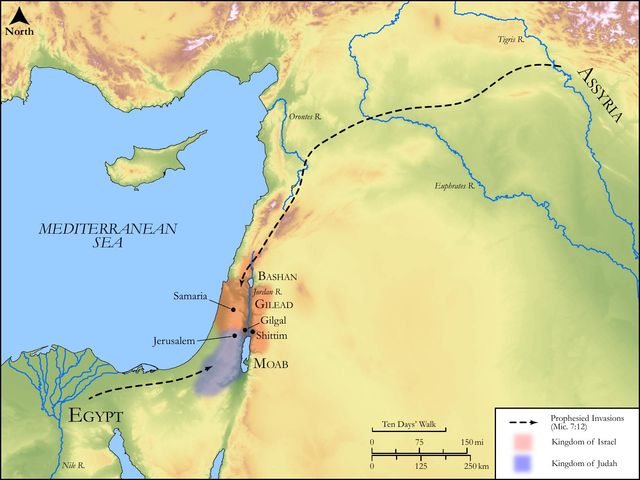
See on the biblical-era map
Study this verse
Public-domain commentary
Matthew Henry
From his Commentary on the Whole Bible. Henry comments on passages, not single verses — this entry covers Micah 7:14–20. His four-level outline is real structure in the source text, so it is rendered as structure.
Here is, I. The prophet's prayer to God to take care of his own people, and of their cause and interest, Mic 7:14. When God is about to deliver his people he stirs up their friends to pray for them, and pours out a spirit of grace and supplication, Zac 12:10. And when we see God coming towards us in ways of mercy, we must go forth to meet him by prayer. It is a prophetic prayer, which amounts to a promise of the good prayed for; what God directed his prophet to ask no doubt he designed to give. Now, 1. The people of Israel are here called the flock of God's heritage, for they are the sheep of his hand, the sheep of his pasture, his little flock in the world; and they are his heritage, his portion in the world. Jacob is the lot of his inheritance. 2. This flock dwells solitarily in the wood, or forest, in the midst of Carmel, a high mountain. Israel was a peculiar people, that dwelt alone, and was not reckoned among the nations, like a flock of sheep in a wood. They were now a desolate people (Mic 7:13), were in the land of their captivity as sheep in a forest, in danger of being lost and made a prey of to the beasts of the forest. They are scattered upon the mountains as sheep having no shepherd. 3. He prays that God would feed them there with his rod, that is, that he would take care of them in their captivity, would protect them, and provide for them, and do the part of a good shepherd to them: "Let thy rod and staff comfort them, even in that darksome valley; and even there let them want nothing that is good for them. Let them be governed by thy rod, not the rod of their enemies, for they are thy people." 4. He prays that God would in due time bring them back to feed in the plains of Bashan and Gilead, and no longer to be fed in the woods and mountains. Let them feed in their own country again, as in the days of old. Some apply this spiritually, and make it either the prophet's prayer to Christ or his Father's charge to him, to take care of his church, as the great Shepherd of the sheep, and to go in and out before them while they are here in this world as in a wood, that they may find pasture as in Carmel, as in Bashan and Gilead.
II.God's promise, in answer to this prayer; and we may well take God's promises as real answers to the prayers of faith, and embrace them accordingly, for with him saying and doing are not two things. The prophet prayed that God would feed them, and do kind things for them; but God answers that he will show them marvellous things (Mic 7:15), will do for them more than they are able to ask or think, will out-do their hopes and expectations; he will show them his marvellous lovingkindness, Psa 17:7.
1.He will do that for them which shall be the repetition of the wonders and miracles of former ages - according to the days of thy coming out of the land of Egypt. Their deliverance out of Babylon shall be a work of wonder and grace not inferior to their deliverance out of Egypt, nay, it shall eclipse the lustre of that (Jer 16:14, Jer 16:15), much more shall the work of redemption by Christ. Note, God's former favours to his church are patterns of future favours, and shall again be copied out as there is occasion.
2.He will do that for them which shall be matter of wonder and amazement to the present age, Mic 7:16, Mic 7:17. The nations about shall take notice of it, and it shall be said among the heathen, The Lord has done great things for them, Psa 126:2. The impression which the deliverance of the Jews out of Babylon shall make upon the neighbouring nations shall be very much for the honour both of God and his church.
(1.)Those that had insulted over the people of God in their distress, and gloried that when they had them down they would keep them down, shall be confounded, when they see them thus surprisingly rising up; they shall be confounded at all the might with which the captives shall now exert themselves, whom they thought for ever disabled. They shall now lay their hands upon their mouths, as being ashamed of what they have said, and not able to say more, by way of triumph over Israel. Nay, their ears shall be deaf too, so much shall they be ashamed at the wonderful deliverance; they shall stop their ears, as being not willing to hear any more of God's wonders wrought for that people, whom they had so despised and insulted over.
(2.)Those that had impudently confronted God himself shall now be struck with a fear of him, and thereby brought, in profession at least, to submit to him (v. 17): They shall lick the dust like a serpent, they shall be so mortified, as if they were sentenced to the same curse the serpent was laid under (Gen 3:14), Upon thy belly shalt thou go, and dust shalt thou eat. They shall be brought to the lowest abasements imaginable, and shall be so dispirited that they shall tamely submit to them. His enemies shall lick the dust, Psa 72:9. Nay, they shall lick the dust of the church's feet, Isa 49:23. Proud oppressors shall now be made sensible how mean, how little, they are, before the great God, and they shall with trembling and the lowest submission move out of the holes into which they had crept (Isa 2:21), like worms of the earth as they are, being ashamed and afraid to show their heads; so low shall they be brought, and such abjects shall they be, when they are abased. When God did wonders for his church many of the people of the land became Jews, because the fear of the Jews, and of their God, fell upon them, Est 8:17. So it is promised here: They shall be afraid of the Lord our God, and shall fear because of thee, O Israel! Forced submissions are often but feigned submissions; yet they redound to the glory of God and the church, though not to the benefit of the dissemblers themselves.
III.The prophet's thankful acknowledgment of God's mercy, in the name of the church, with a believing dependence upon his promise, Mic 7:18-20. We are here taught,
1.To give to God the glory of his pardoning mercy, Mic 7:18. God having promised to bring back the captivity of his people, the prophet, on that occasion, admires pardoning mercy, as that which was at the bottom of it. As it was their sin that brought them into bondage, so it was God's pardoning their sin that brought them our of it; Psa 85:1, Psa 85:2, and Isa 33:24; Isa 38:17; Isa 60:1, Isa 60:2. The pardon of sin is the foundation of all other covenant-mercies, Heb 8:12. This the prophet stands amazed at, while the surrounding nations stood amazed only at those deliverances which were but the fruits of this. Note,
(1.)God's people, who are the remnant of his heritage, stand charged with many transgressions; being but a remnant, a very few, one would hope they should all be very good, but they are not so; God's children have their spots, and often offend their Father.
(2.)The gracious God is ready to pass by and pardon the iniquity and transgression of his people, upon their repentance and return to him. God's people are a pardoned people, and to this they owe their all. When God pardons sin, he passes it by, does not punish it as justly he might, nor deal with the sinner according to the desert of it.
(3.)Though God may for a time lay his own people under the tokens of his displeasure, yet he will not retain his anger for ever, but though he cause grief he will have compassion; he is not implacable; yet against those that are not of the remnant of his heritage, that are unpardoned, he will keep his anger for ever.
(4.)The reasons why God pardons sin, and keeps not his anger for ever, are all taken from within himself; it is because he delights in mercy, and the salvation of sinners is what he has pleasure in, not their death and damnation.
(5.)The glory of God in forgiving sin is, as in other things, matchless, and without compare. There is no God like unto him for this; no magistrate, no common person, forgives as God does. In this his thoughts and ways are infinitely above ours; in this he is God, and not man.
(6.)All those that have experienced pardoning mercy cannot but admire that mercy; it is what we have reason to stand amazed at, if we know what it is. Has God forgiven us our transgressions? We may well say, Who is a God like unto thee? Our holy wonder at pardoning mercy will be a good evidence of our interest in it.
2.To take to ourselves the comfort of that mercy and all the grace and truth that go along with it. God's people here, as they look back with thankfulness upon God's pardoning their sins, so they look forward with assurance upon what he would yet further do for them. His mercy endures for ever, and therefore as he has shown mercy so he will, Mic 7:19, Mic 7:20.
(1.)He will renew his favours to us: He will turn again; he will have compassion; that is, he will again have compassion upon us as formerly he had; his compassions shall be new every morning; he seemed to be departing from us in anger, but he will turn again and pity us. He will turn us to himself, and then will turn to us, and have mercy upon us.
(2.)He will renew us, to prepare and qualify us for his favour: He will subdue our iniquities; when he takes away the guilt of sin, that it may not damn us, he will break the power of sin, that it may not have dominion over us, that we may not fear sin, nor be led captive by it. Sin is an enemy that fights against us, a tyrant that oppresses us; nothing less than almighty grace can subdue it, so great is its power in fallen man and so long has it kept possession. But, if God forgive the sin that has been committed by us, he will subdue the sin that dwells in us, and in that there is none like him in forgiving; and all those whose sins are pardoned earnestly desire and hope; to have their corruptions mortified and their iniquities subdued, and please themselves with the hopes of it. If we be left to ourselves, our iniquities will be too hard for us; but God's grace, we trust, shall be sufficient for us to subdue them, so that they shall not rule us, and then they shall not ruin us.
(3.)He will confirm this good work, and effectually provide that his act of grace shall never be repealed: Thou wilt cast all their sins into the depth of the sea, as when he brought them out of Egypt (to which he has an eye in the promises here, Mic 7:15) he subdued Pharaoh and the Egyptians, and cast them into the depth of the sea. It intimates that when God forgives sin he remembers it no more, and takes care that it shall never be remembered more against the sinner. Eze 18:22, His transgressions shall not be mentioned unto him; they are blotted out as a cloud which never appears more. He casts them into the sea, not near the shore-side, where they may appear again next low water, but into the depth of the sea, never to rise again. All their sins shall be cast there without exception, for when God forgives sin he forgives all.
(4.)He will perfect that which concerns us, and with this good work will do all that for us which our case requires and which he has promised (Mic 7:20): Then wilt thou perform thy truth to Jacob and thy mercy to Abraham. It is in pursuance of the covenant that our sins are pardoned and our lusts mortified; from that spring all these streams flow, and with these he shall freely give us all things. The promise is said to be mercy to Abraham, because, as made to him first, it was mere mercy, preventing mercy, considering what state it found him in. But it was truth to Jacob, because the faithfulness of God was engaged to make good to him and his seed, as heirs to Abraham, all that was graciously promised to Abraham. See here,
[1.]With what solemnity the covenant of grace is ratified to us; it was not only spoken, written, and sealed, but which is the highest confirmation, it was sworn to our fathers; nor is it a modern project, but is confirmed by antiquity too; it was sworn from the days of old; it is an ancient charter.
[2.]With what satisfaction it may be applied and relied upon by us; we may say with the highest assurance, Thou wilt perform the truth and mercy; not one iota or tittle of it shall fall to the ground. Faithful is he that has promised, who also will do it.
Historical interpretation
Historical reception
1 surviving comment on this verse from the historical church.
(Verse 14 and following) Feed your people with your staff, the flock of your inheritance, dwelling alone in the forest of Carmel. They will graze in Bashan and Gilead as in ancient times, as in the days when you came out of the land of Egypt, I will show (or have shown) them wonders. The nations will see and be ashamed of all their might. They will lay their hands over their mouths; their ears will become deaf. They will lick the dust like serpents; they will tremble from their hiding places. They will fear our Lord God, and they will fear you. LXX: Feed your people with your staff, the sheep of your inheritance, who dwell alone in the woods. They will be fed on the mountains of Carmel, in Bashan and Gilead, as in days of old, as in the days when you led them out of the land of Egypt. I will show them wonders. The nations will see and be ashamed of all their might. They will put their hands over their mouths; their ears will be deaf. They will lick the dust like snakes, moving along the ground. They will be in distress in their own territories. They will fear and be afraid of our Lord God; they will fear you. This is what is said: Feed your people with your staff, God the Father speaks to the Son, that is, to our Lord Jesus Christ, that because he is a good shepherd, and he lays down his life for his sheep (John 10), he may feed his people with his staff, and the sheep of his inheritance. And lest we think that the same people are both the sheep, in another place we read: But we are your people, and the sheep of your pasture (Psalm 78:21). The people refers to those who are rational, but the sheep refers to those who are not yet using reason, being content only with simplicity, and they are called the heritage of God."] Both the people and the sheep need the shepherd's staff, of which the Apostle also speaks: 'What do you want? Shall I come to you with a rod, or in love and a spirit of gentleness?' (I Cor. IV, 21). I think it was for this reason, because the people of Israel were stiff-necked and always longed for Egyptian meat, that Moses used the staff not only against the Egyptians, whom he struck with ten plagues, but also against the people in the wilderness, with the legal staff, the striking staff, and by breaking all the earthen and fragile vessels. But the Apostles of the Lord Savior, who spoke wisdom among the perfect (I Cor. II), the staff was shaken out of their hands, because perfect love casts out fear (I John IV). But if anyone opposes us, how can it now be said to Christ, that is, to the good shepherd, who is certainly greater than the Apostles, and better, that he should use a staff, when it is a greater advancement not to have a staff, than to use a staff to correct peoples and sheep: we will respond to them according to what the Lord promises to his Apostles, that they will perform greater signs among the people than he himself has done (John XIV). And because the Lord was still speaking to the carnal Israel, and not yet to him who could fully understand the mysteries, therefore it was said about him that he would feed the people and his flock with a rod. However, the apostles had the rod taken from their hands, and the severity of the Law was tempered by the mercy of the Gospel. Furthermore, these people and these sheep are struck and fed with a rod because they had dwelt alone in the wilderness. Indeed, we can apply this to those who, separating themselves from the Church, engage in feasts and friendships with the heathens, as well as to those who, out of hatred for the human race, seek a solitary life, such as we read about Timon in Athens. Not because a solitary and prophetic life, like that of Elijah (1 Kings 17 and 19) and John (Matthew 3 and 11), should be condemned, but because if one despises others and exalts oneself, living in the wilderness of vices, the rod should be corrected. He who dwells alone, and does not dwell in the wilderness, is to be praised for his virtues; but he who is alone and does not do the works of justice, and enjoys only the pleasure of rest, and does not toil in the work and labor of Christ, nor seeks food with his own hands as the Apostle commands (I Cor. IV), and is lifted up in pride: he dwells in the wilderness and wanders among barren trees. However, because he is a good shepherd, his staff strikes in order to correct, and a better prophetic word promises, saying: They will graze on the Carmel and the Galaadite, according to the days of eternity, and according to the days of your departure from Egypt. Carmelus interpretatur scientia circumcisionis: Basanitis confusio, et Galaad transmigratio testimonii. Populus ergo Dei, et oves pascuae ejus, quae prius pascebantur absquegrege Domini, et extra Ecclesiam ejus, in saltu versabantur errorum, postea transferentur ad notitiam verae circumcisionis, et servient Deo in spiritu, et gloriabuntur in Domino, et non in carne confident, et erunt vera circumcisio, et non concisio. And when they have been nourished with spiritual circumcision, understanding their former sins, they will be confounded in their vices, and they will be ashamed, and they will be in the confusion that leads to life (Ecclesiastes 4), for there is another confusion that leads to death, in which Og, the king of Bashan, once dwelt, for Bashan means confusion: concerning which worst confusion, the Lord promises to deliver his people: The Lord said, I will bring again from Bashan, I will bring again from the depths of the sea (Psalm 68, 23). And when we know true circumcision, and are confounded concerning our sins, then we shall be in Galaad, which is interpreted as the transmigration of testimony, in the Church of Christ, to which the testimonies of the Law and the words of the Prophets have transcended, and this will happen to us according to the ancient days, according to the days when we went out of the land of Egypt, of which Moses says: Remember the days of eternity (Deut. XXXII, 7), not the days of this world, which are called evil, but eternal days. But he remembers the days of eternity, which does not look at the present, and rose with Christ, and sits with him in heavenly places, now assuming in mind that he has been liberated from the days of the present age. The divine word also promises that it will show to its people and to the sheep of its inheritance wonders: Then, it says, the nations will see and will be confounded in all their strength, because they had once devastated and prevailed against the people of God, and their confusion will have profit, when they understand their own evils. For they will place their hands upon their mouths, and evil deeds will take away from them all freedom of speech. In the same way that the hands of impious nations close their mouths, so will the hands of the righteous unlock their mouths, receiving the ability to speak with God from the good work of those who accept it. Their ears will also become deaf, for wickedness has not only blinded the sight of their eyes, but it has also made their ears deaf; for they refused to hear the voice of those who enchant, and the wise sorcerer. And according to Isaiah: They have heard heavily with their ears (Isa. XXXIII): although it is much less to hear heavily than to not hear at all, and to become deaf to the word of truth. After so many evils are spoken of them, it is said that they lick the ground like serpents, which drag the earth, walking in their belly, and eating the earth all the days of their life (Gen. III). And of the flesh, that is, doing earthly works, and dragging them with themselves until the day of vengeance and visitation of the Lord, not dust, not the small traces of the earth, but the whole ground. And when they have done this, and come before the judgement of God, and have been convicted and disturbed, they will be disturbed and convicted as long as the earth they have drawn upon remains in them, like serpents. But when that departs from them, they will be astonished and amazed, not in the Lord their God (for they have not yet deserved to be called the Lord their God), but in the Lord our God. And suddenly there is a turning towards Christ and it is said to him: And they will fear you. For the beginning of wisdom is the fear of the Lord (Proverbs 7). And these things will happen so that the nations may see and be confounded in all their strength of evil; and they will place their hand over their mouth, and their ears will be stopped, and they will lick the ground like serpents that drag the earth, so that they may be brought to a close and be troubled by the closure, and then, terrified, be astonished by the Lord God of the holy ones, and in the end, they themselves may also fear Him. This is according to the Septuagint (LXX). Furthermore, because our edition does not differ much from theirs, at least in the present context, we believe that what was said in their edition is also said in ours.
Continue studying Micah 7:17 across the web’s major study libraries — every link below opens this exact verse, chapter, or book on the destination site.
Read & Compare
 BibleGatewayThis verse in more than 200 translations and 70 languages.
 Bible.comThe YouVersion reader — hundreds of translations, reading plans, and highlights.
 ESV.orgCrossway's official English Standard Version reader.
 NET BibleThe NET translation with 60,000+ translators' notes on every rendering decision.
 STEP BibleTyndale House's free study tool — original text, vocabulary, and scholarly resources.
 BibliaLogos Bible Software's free web reader.
 USCCBThe New American Bible (Revised Edition) with the U.S. bishops' study notes.
Commentaries
 BibleHub CommentariesDozens of classic commentaries on this verse, gathered on one page.
 StudyLightMore than 100 commentary sets — the largest collection on the web.
 BibleRefPlain-English commentary on what this verse means, verse by verse.
 Enduring WordDavid Guzik's free commentary on this chapter, widely used by Bible teachers.
 Bible Study ToolsVerse commentary alongside Greek and Hebrew study aids.
Original Language & Research
- BibleHub InterlinearThe verse word by word — original language, transliteration, and English.
- BibleHub LexiconEvery word's original-language definition and Strong's entry.
 Blue Letter BibleDeep-study tools — Strong's numbers, concordance, and word studies.
 SefariaThe Hebrew text with Rashi and centuries of Jewish commentary.
Sermons, Hymns & Audio


TrulyRandomVerse is not affiliated with these sites and doesn’t control their content. They’re linked because they’re genuinely useful.
Summary
Micah 7:17 is a powerful prophetic declaration foretelling the profound humiliation and terror that will overcome the enemies of God's people. It vividly portrays their utter defeat and abject submission, likening them to serpents licking dust and worms crawling from their hiding places. This imagery underscores the absolute sovereignty of the LORD, who will cause these adversaries to acknowledge His supreme authority and to fear Him because of His unwavering presence with His chosen nation, ultimately vindicating His covenant faithfulness and bringing about the restoration of Israel.
Context
ShowHideLiterary Context
This verse is strategically placed within the concluding section of the book of Micah, specifically in a passage (Micah 7:14-20) that marks a significant shift from lament and confession of national sin to a triumphant affirmation of God's enduring faithfulness, power, and boundless mercy toward His covenant people. Following a period characterized by national distress, moral decay, and the threat of foreign invasion, Micah looks forward to a future restoration and the decisive defeat of those who oppressed Israel. The verses immediately preceding, particularly Micah 7:15-16, describe God's mighty acts on behalf of His people, reminiscent of the Exodus, which will cause the nations to be utterly ashamed of their own might and power, setting the stage for their complete humiliation as depicted in verse 17. This verse serves as a stark contrast to the previous boasts of the nations, demonstrating that their pride will be brought low before the sovereign God.
Historical & Cultural Context
Micah prophesied during a tumultuous period for Judah (late 8th century BCE), marked by the rise of the Assyrian Empire, which posed an existential threat to both Israel (the Northern Kingdom, which fell in 722 BCE) and Judah. The cultural backdrop includes the practice of vanquished enemies showing abject submission to a conqueror, often by prostrating themselves and "licking the dust" as a sign of complete subjugation and disgrace. This was a common trope in ancient conquest narratives, signifying the absolute triumph of the victor and the utter debasement of the defeated. The imagery of "holes" (Hebrew: miçgereth) refers to fortified places or hiding spots, emphasizing that no refuge will protect these enemies from God's judgment, forcing them into the open like vulnerable creatures. The "fear of the LORD" was a foundational concept in Israelite culture, denoting not just terror but also reverence and acknowledgment of divine authority, a response the nations would be forced to adopt.
Key Themes
ShowHideMicah 7:17 powerfully contributes to several overarching themes within the book of Micah and broader biblical theology. Foremost is the theme of Divine Judgment and Humiliation, where the imagery of "licking the dust like a serpent" and "moving out of their holes like worms" signifies utter defeat, submission, and disgrace for those who opposed God and His people. This is a complete reversal of fortune for the proud and oppressive nations. Secondly, it underscores the Sovereignty of God, emphasizing that this abasement is a direct result of the LORD's irresistible power. The enemies "shall be afraid of the LORD our God," acknowledging His supreme authority over all nations and forces, a theme echoed in Micah 4:3. Finally, the verse highlights the Vindication of God's People. The phrase "and shall fear because of thee" refers to God's people, Israel. Their enemies will be compelled to recognize that God is with Israel, protecting and defending them, thereby vindicating His chosen nation and demonstrating His unwavering commitment to His covenant promises, a promise found throughout Micah 7.
Exposition and Analysis
ShowHideKey Word Analysis
ShowHideThis primitive root signifies the act of "licking" or "lapping up." In the context of Micah 7:17, it vividly portrays an act of abject submission and humiliation. When combined with "dust," it evokes the image of a defeated foe prostrating themselves in utter disgrace, a common gesture of complete surrender to a conqueror, as when the psalmist says of the king, "his enemies shall lick the dust." It is a powerful metaphor for total subjugation and debasement.
Derived from a root meaning "to hiss," this word refers to a snake or serpent. In biblical imagery, the serpent often symbolizes cunning, deception, and hostility, notably linked to the curse in Genesis 3:14. Here, the comparison of the enemies to a serpent licking the dust emphasizes not only their humiliation but also their reduction to a cursed, lowly state, stripped of their former power and malice.
This primitive root carries a dual meaning: to be afraid (terror, dread) and to revere (awe, respect). In Micah 7:17, it encompasses both. The enemies will be filled with terror at the LORD's power, but this terror will also force them into a position of acknowledging His supreme authority and the reverence due to Him. It implies a forced, grudging recognition of God's might and His presence with His people.
Verse Breakdown
ShowHide"They shall lick the dust like a serpent"
This clause immediately establishes the theme of profound humiliation and defeat. The "they" refers to the nations or enemies who have oppressed God's people. The act of "licking the dust" is a biblical idiom for ultimate submission and debasement, often associated with a curse or complete subjugation. The simile "like a serpent" reinforces this, drawing on the image of the serpent cursed to crawl on its belly and eat dust, symbolizing a fall from power and dignity to a state of utter disgrace.
"they shall move out of their holes like worms of the earth"
This phrase continues the imagery of vulnerability and forced exposure. "Holes" (Hebrew: miçgereth) refers to hiding places, strongholds, or places of refuge. The enemies, who once felt secure in their fortified positions or schemes, will be forced out into the open, stripped of their defenses. The comparison to "worms of the earth" emphasizes their utter powerlessness, insignificance, and vulnerability when confronted by divine might, highlighting that no hiding place can shield them from God's judgment.
"they shall be afraid of the LORD our God"
This clause reveals the direct cause and consequence of their humiliation: it is the LORD who brings about their downfall. The enemies will experience a profound and terrifying fear, not merely of Israel, but of "the LORD our God" – the God of Israel. This signifies their forced acknowledgment of His supreme power and authority, realizing the futility of their opposition against Him.
"and shall fear because of thee"
The final clause specifies the object of their fear and awe. "Thee" refers to God's people, Israel. The enemies will not only fear the LORD but will also fear because of His presence with and defense of Israel. This implies a recognition that God is actively with His covenant people, making them formidable. It serves as a powerful vindication of Israel and a demonstration of God's unwavering commitment to His promises, forcing even their adversaries to acknowledge His divine favor upon them.
Literary Devices
ShowHideMicah 7:17 is rich in Imagery and Simile, painting a vivid picture of the enemies' humiliation. The comparison of the defeated adversaries to "serpents" and "worms of the earth" uses Simile to evoke a sense of utter debasement, vulnerability, and a cursed existence. The imagery of "licking the dust" is a powerful biblical Idiom for complete submission and defeat, drawing on the submission of the conquered and the Genesis curse. There is an element of Irony present, as those who once oppressed and boasted are now reduced to the lowest of creatures, forced to acknowledge the very God they defied. The description also employs Hyperbole to emphasize the extreme nature of their humiliation and the totality of their defeat, underscoring the overwhelming power of God's judgment.
Theological and Thematic Connections
ShowHideMicah 7:17 profoundly illustrates God's unwavering commitment to justice and His covenant faithfulness. It serves as a powerful reminder that while evil and oppression may seem to triumph for a time, God is ultimately sovereign, and He will bring about the ultimate vindication of His people and the decisive defeat of His adversaries. This verse highlights the theological truth that the fear of the LORD is not only the beginning of wisdom but also the inevitable response of all creation to His manifest power and righteousness. It assures believers that their ultimate security lies in God's protective hand, and that those who stand against Him and His purposes will inevitably be brought to their knees, acknowledging His supreme authority.
Reflection and Application
ShowHideMicah 7:17 offers profound encouragement and a call to trust in God's ultimate sovereignty for believers today. In a world often marked by injustice, oppression, and the apparent triumph of evil, this verse serves as a powerful reminder that God is actively at work, bringing about His perfect justice. It assures us that no enemy, no matter how powerful or cunning, can ultimately stand against the LORD and His purposes for His people. This should inspire us to persevere in faith, knowing that our vindication and ultimate security rest in Him. Furthermore, the verse implicitly calls us to cultivate a reverent fear of the LORD in our own lives, recognizing His supreme authority and living in humble submission to His will. When we truly fear God, we are freed from the fear of man and the anxieties of this world, confident that He will defend His own and bring all things to their appointed end.
Questions for Reflection
ShowHideFAQ
ShowHideWho are "they" in Micah 7:17, and why are they described in such a humiliating way?
ShowHide"They" refers to the enemies of God's people, specifically the nations that oppressed Israel and Judah, such as Assyria or Babylon, and by extension, any adversary of God's purposes. They are described in such a humiliating way—licking the dust like a serpent and crawling out of their holes like worms—to vividly portray their complete defeat, abject submission, and utter debasement before the sovereign power of the LORD. This imagery signifies a reversal of fortune, where the proud and powerful are brought low, stripped of their dignity and strength, and forced to acknowledge God's supremacy. It's a powerful statement of divine judgment and the vindication of God's chosen people, ensuring that no one can stand against the LORD (see also Isaiah 41:11-12).
What is the significance of the enemies being "afraid of the LORD our God" and fearing "because of thee"?
ShowHideThis phrase highlights the dual impact of God's judgment. First, the enemies will be "afraid of the LORD our God," signifying their forced recognition of His supreme power and authority. Their fear is a response to the overwhelming might of the God of Israel, whom they previously defied. Second, they will "fear because of thee," with "thee" referring to God's people, Israel. This means that the enemies will be compelled to acknowledge God's active presence with and protection over His covenant nation. Their fear will stem from the realization that God is fighting for Israel, making Israel formidable and untouchable. It underscores the truth that God's people are not to be trifled with, as their ultimate defense lies in the LORD Himself (compare Romans 8:31).
Christ-Centered Fulfillment
ShowHideMicah 7:17, while describing the historical humiliation of Israel's enemies, finds its ultimate and most profound fulfillment in the person and work of Jesus Christ. The "fear" and "abasement" of the nations before the LORD foreshadow the universal acknowledgment of Christ's sovereignty. Just as the enemies of Israel were forced to lick the dust, so too will every knee ultimately bow and every tongue confess that Jesus Christ is Lord, to the glory of God the Father (Philippians 2:10-11). The serpent imagery, particularly, points to the ultimate defeat of Satan, the ancient serpent, whose head was crushed by Christ's sacrifice and resurrection (Genesis 3:15; Romans 16:20). The "worms of the earth" imagery speaks to the utter powerlessness of all spiritual and earthly opposition against the resurrected Christ, who has triumphed over all principalities and powers (Colossians 2:15). The vindication of God's people, Israel, finds its ultimate expression in the Church, the body of Christ, against whom the gates of hell will not prevail (Matthew 16:18). Thus, Micah 7:17 is a prophetic glimpse into the final, glorious triumph of Christ over all His enemies, establishing His eternal kingdom and bringing ultimate peace and justice to His redeemed people.