


Mark 13:29
- οὕτωςhoutōsSoG3779ADVAdverb
- καὶkaialsoG2532CONJConjunction
- ὑμεῖςhumeisyou yourselvesG4771P-2NPPersonal pronoun Nominative 2nd Plural
- ὅτανhotanwhenG3752CONJConjunction
- ἴδητεidēteyou may seeG1492V-2AAS-2PVerb 2nd Aorist Active Subjunctive 2nd Plural
- ταῦταtautathese thingsG3778D-APNDemonstrative pronoun Accusative Plural Neuter
- γινόμεναginomenacoming to passG1096V-PNP-APNVerb Present Middle Or Passive Deponent Participle Accusative Plural Neuter
- γινώσκετεginōsketedo knowG1097V-PAM-2PVerb Present Active Imperative 2nd Plural
- ὅτιhotithatG3754CONJConjunction
- ἐγγύςengusnearG1451PREPPreposition
- ἐστινestinHe isG1510V-PAI-3SVerb Present Active Indicative 3rd Singular
- ἐπὶepiat [the]G1909PREPPreposition
- θύραιςthuraisdoorsG2374N-DPFNoun Dative Plural Feminine
English is a literal word-by-word gloss of the Greek, not the KJV's wording. Why?
This is the original text the KJV's translators worked from — each Greek word with its own literal English meaning in this verse, prepared by scholars at Tyndale House, Cambridge. The KJV translates whole sentences, not word by word, so its wording differs: one Greek word can become several English words, and the KJV may choose “charity” where the gloss reads “love”. Both are faithful — they answer different questions. For the KJV's own rendering, switch to the KJV text.
Details
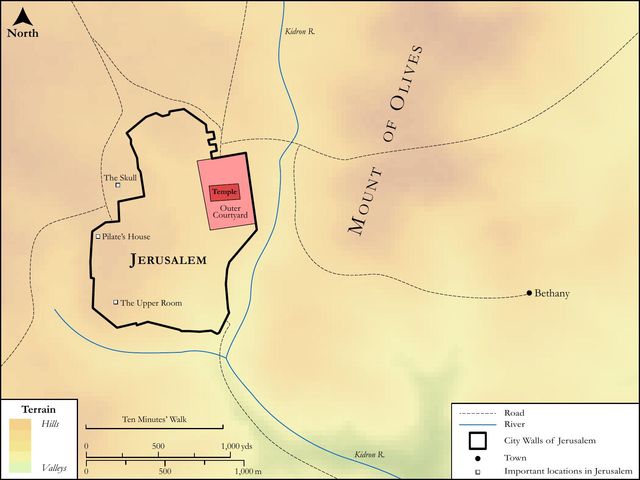
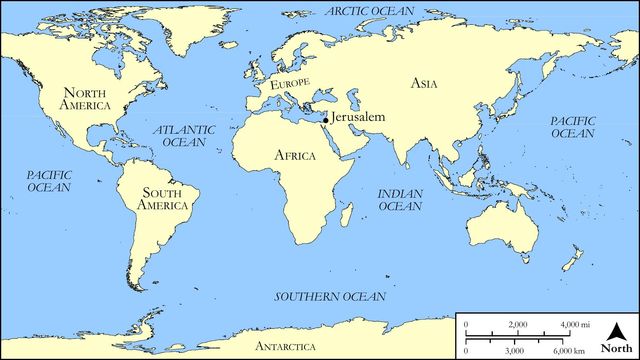
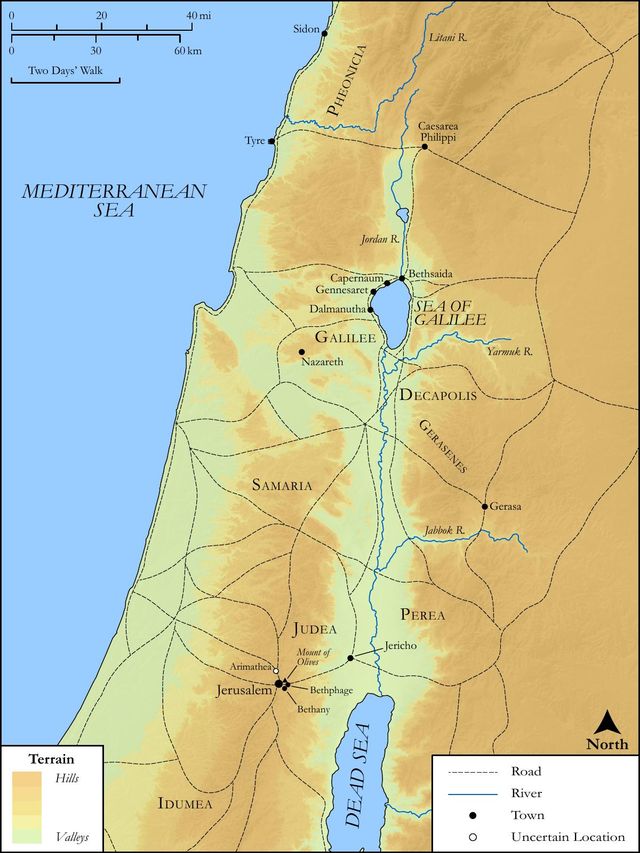
See on the biblical-era map
Study this verse
Public-domain commentary
Matthew Henry
From his Commentary on the Whole Bible. Henry comments on passages, not single verses — this entry covers Mark 13:28–37. His three-level outline is real structure in the source text, so it is rendered as structure.
We have here the application of this prophetical sermon; now learn to look forward in a right manner.
I."As to the destruction of Jerusalem, expect it to come very shortly; as when the branch of the fig-tree becomes soft, and the leaves sprout forth, ye expect that summer will come shortly, Mar 13:28. When second causes begin to work, ye expect their effects in their proper order and time. So when ye see these things come to pass, when ye see the Jewish nation embroiled in wars, distracted by false Christs and prophets, and drawing upon them the displeasure of the Romans, especially when ye see them persecuting you for your Master's sake, and thereby standing to what they did when they put him to death, and repeating it, and so filling up the measure of their iniquity, then say that their ruin is nigh, even at the door, and provide for yourselves accordingly." The disciples themselves were indeed all of them, except John, taken away from the evil to come, but the next generation whom they were to train up, would live to see it; and by these instructions which Christ left behind him would be kept from sharing in it; "This generation that is now rising up, shall not all be worn off before all these things come to pass, which I have told you of, relating to Jerusalem, and they shall begin to take effect now shortly. And as this destruction is near and within ken, so it is sure. The decree is gone forth, it is a consummation determined," Dan 9:27. Christ doth not speak these things, merely to frighten them; no, they are declarations of God's fixed purpose; "Heaven and earth shall pass away, at the end of time; but my words shall not pass away (Mar 13:31), not one of these predictions shall fail of a punctual accomplishment."
II."As to the end of the world, do not enquire when it will come, for it is not a question fit to be asked, for of that day, and that hour, knoweth no man; it is a thing at a great distance; the exact time is fixed in the counsel of God, but is not revealed by any word of God, either to men on earth, or to angels in heaven; the angels shall have timely notice to prepare to attend in that day, and it shall be published, when it comes to the children of men, with sound of trumpet; but, at present, men and angels are kept in the dark concerning the precise time of it, that they may both attend to their proper services in the present day." But it follows, neither the Son; but is there any thing which the Son is ignorant of? We read indeed of a book which was sealed, till the Lamb opened the seals; but did not he know what was in it, before the seals were opened? Was not he privy to the writing of it? There were those in the primitive times, who taught from this text, that there were some things that Christ, as man, was ignorant of; and from these were called Agnoetae; they said, "It was no more absurd to say so, than to say that his human soul suffered grief and fear;" and many of the orthodox fathers approved of this. Some would evade it, by saying that Christ spoke this in a way of prudential economy, to divert the disciples from further enquiry: but to this one of the ancients answers, It is not fit to speak too nicely in this matter - ou dei panu akribologein, so Leontius in Dr. Hammond, "It is certain (says Archbishop Tillotson) that Christ, as God, could not be ignorant of any thing; but the divine wisdom which dwelt in our Saviour, did communicate itself to his human soul, according to the divine pleasure, so that his human nature might sometimes not know some things; therefore Christ is said to grow in wisdom (Luk 2:52), which he could not be said to do, if the human nature of Christ did necessarily know all things by virtue of its union with the divinity." Dr. Lightfoot explains it thus; Christ calls himself the Son, as Messiah. Now the Messiah, as such, was the father's servant (Isa 42:1), sent and deputed by him, and as such a one he refers himself often to his Father's will and command, and owns he did nothing of himself (Joh 5:19); in like manner he might be said to know nothing of himself. The revelation of Jesus Christ was what God gave unto him, Rev 1:1. He thinks, therefore, that we are to distinguish between those excellencies and perfections of his, which resulted from the personal union between the divine and human nature, and those which flowed from the anointing of the Spirit; from the former flowed the infinite dignity of his perfect freedom from all sin; but from the latter flowed his power of working miracles, and his foreknowledge of things to come. What therefore (saith he) was to be revealed by him to his church, he was pleased to take, not from the union of the human nature with the divine, but from the revelation of the Spirit, by which he yet knew not this, but the Father only knows it; that is, God only, the Deity; for (as Archbishop Tillotson explains it) it is not used here personally, in distinction from the Son and the Holy Ghost, but as the Father is, Fons et Principium Deitatis - The Fountain of Deity.
III."As to both, your duty is to watch and pray.
Therefore the time is kept a secret, that you may be engaged to stand always upon your guard (Mar 13:33); Take ye heed of every thing that would indispose you for your Master's coming, and would render your accounts perplexed, and your spirits so too; watch for his coming, that it may not at any time be a surprise to you, and pray for that grace which is necessary to qualify you for it, for ye know not when the time is; and you are concerned to be ready for that every day, which may come any day." This he illustrates, in the close, by a parable.
1.Our Master is gone away, and left us something in trust, in charge, which we must give account of, Mar 13:34. He is as a man taking a far journey; for he is gone to be away a great while, he has left his house on earth, and left his servants in their offices, given authority to some, who are to be overseers, and work to others, who are to be labourers. They that have authority given them, in that had work assigned them, for those that have the greatest power have the most business; and to them to whom he gave work, he gave some sort of authority, to do that work. And when he took his last leave, he appointed the porter to watch, to be sure to be ready to open to him at his return; and in the mean time to take care to whom he opened his gates, not to thieves and robbers, but only to his Master's friends and servants. Thus our Lord Jesus, when he ascended on high, left something for all his servants to do, expecting they should all do him service in his absence, and be ready to receive him at his return. All are appointed to work, and some authorized to rule.
2.We ought to be always upon our watch, in expectation of his return, Mar 13:35-37.
(1.)Our Lord will come, and will come as the Master of the house, to take account of his servants, of their work, and of the improvement they have made.
(2.)We know not when he will come; and he has very wisely kept us at uncertainty, that we might all be always ready. We know not when he will come, just at what precise time; the Master of the house perhaps will come at even, at nine at night; or it may be at midnight, or a cock-crowing, at three in the morning, or perhaps not until six. This is applicable to his coming to us in particular, at our death, as well as to the general judgment. Our present life is a night, a dark night, compared with the other life; we know not in which watch of the night our Master will come, whether in the days of youth, or middle age, or old age; but, as soon as we are born, we begin to die, and therefore, as soon as we are capable of expecting any thing, we must expect death.
(3.)Our great care must be, that, whenever our Lord comes, he do not find us sleeping, secure in ourselves, off our guard, indulging ourselves in ease and sloth, mindless of our work and duty, and thoughtless of our Lord's coming; ready to say, He will not come, and unready to meet him.
(4.)His coming will indeed be coming suddenly; it will be a great surprise and terror to those that are careless, and asleep, it will come upon them as a thief in the night.
(5.)It is therefore the indispensable duty of all Christ's disciples, to watch, to be awake, and keep awake; "What I say unto you four (Mar 13:37), I say unto all the twelve, or rather to you twelve, I say unto all my disciples and followers; what I say to you of this generation, I say to all that shall believe in men, through your word, in every age, Watch, watch, expect my second coming, prepare for it, that you may be found in peace, without spot, and blameless."
Historical interpretation
Seven Centuries of Reception
5 surviving comments on this verse. Each one is dated, so this reads as a timeline rather than a list.
Select a marker to jump to its quote. Markers stagger vertically where authors wrote within a few decades of each other.
Or else, the leaves which come forth are words now spoken, the summer at hand is the day of Judgment, in which every tree shall show what it had within it, deadness for burning, or greenness to be planted with the tree of life. There follows: Verily I say unto you, This generation shall not pass, till these things be done.
(Epist. 119, 11) All that is said by the three Evangelists concerning the Advent of our Lord, if diligently compared together and examined, will perchance be found to belong to His daily coming in His body, that is, the Church, except those places where that last coming is so promised, as if it were approaching; for instance in the last part of the discourse according to Matthew, the coming itself is clearly expressed, where it is said, When the Son of Man shall come in his glory. (Matt. 25:31) For what does he refer to in the words, when ye shall see these things come to pass, but those things which He has mentioned above, amongst which it is said, And then ye shall see the Son of Man coming in the clouds. The end therefore shall not be then, but then it shall be near at hand. Or are we to say, that not all those things which are mentioned above are to be taken in, but only some of them, that is, leaving out these words, Then shall ye see the Son of man coming; for that shall be the end itself, and not its approach only. But Matthew has declared that it is to be received without exception, saying, When ye shall see all these things, know that it is near, even at the doors. That which is said above must therefore be taken thus; And he shall send his angels, and gather together the elect from the four winds; that is, He shall collect His elect from the four winds of heaven, which He does in the whole of the last hour, coming in His members as in clouds.
"So you also, when you see these things happening, know that the kingdom of God is near." As if He openly said: Just as the approaching summer is known from the fruit of trees, so from the ruin of the world it is recognized that the kingdom of God is near. By these words it is certainly shown that the fruit of the world is ruin. For it grows in order to fall. It sprouts forth in order to consume with disasters whatever it has sprouted. But the kingdom of God is rightly compared to summer, because then the clouds of our sorrow pass away, and the days of life shine bright with the radiance of the eternal sun.
(ubi sup.) Under the example of a tree the Lord gave a pattern of the end, saying, Now learn a parable of the fig tree, when her branch is yet tender, and putteth forth leaves, ye know that summer is near. So ye in like manner, when ye shall see these things come to pass, know that it is nigh, even at the doors.
(ubi sup.) This fruitbearing of the fig tree may also be understood to mean the state of the synagogue, which was condemned to everlasting barrenness, because when the Lord came, it had no fruits of righteousness in those who were then unfaithful. (Rom. 11:25) But the Apostle has said, that when the fulness of the Gentiles is come in, all Israel shall be saved. What means this, but that the tree, which has been long barren, shall then yield the fruit, which it had withheld? When this shall happen, doubt not that a summer of true peace is at hand.
(ubi sup.) By generation He either means the whole race of mankind, or specially the Jews.
(ubi sup.) The heaven which shall pass away is not the ethereal or starry heaven, but the heaven where is the air. For wheresoever the water of the judgment could reach, there also, according to the words of the blessed Peter, the fire of judgment shall reach. (2 Pet. 3) But the heaven and the earth shall pass away in that form which they now have, but in their essence they shall last without end.
As if He had said, As when the fig tree puts forth its leaves, summer follows at once, so also after the woes of Antichrist, at once, without an interval, shall be the coming of Christ, who will be to the just as summer after winter, but to sinners, winter after summer.
Or else, This generation shall not pass away, that is, the generation of Christians, until all things be fulfilled, which were spoken concerning Jerusalem and the coming of Antichrist; for He does not mean the generation of the Apostles, for the greater part of the Apostles did not live up to the destruction of Jerusalem. But He says this of the generation of Christians, wishing to console His disciples, lest they should believe that the faith should fail at that time; for the immoveable elements shall first fail, before the words of Christ fail; wherefore it is added, Heaven and earth shall pass away, but my words shall not pass away.
Continue studying Mark 13:29 across the web’s major study libraries — every link below opens this exact verse, chapter, or book on the destination site.
Read & Compare
 BibleGatewayThis verse in more than 200 translations and 70 languages.
 Bible.comThe YouVersion reader — hundreds of translations, reading plans, and highlights.
 ESV.orgCrossway's official English Standard Version reader.
 NET BibleThe NET translation with 60,000+ translators' notes on every rendering decision.
 STEP BibleTyndale House's free study tool — original text, vocabulary, and scholarly resources.
 BibliaLogos Bible Software's free web reader.
 USCCBThe New American Bible (Revised Edition) with the U.S. bishops' study notes.
Commentaries
 BibleHub CommentariesDozens of classic commentaries on this verse, gathered on one page.
 StudyLightMore than 100 commentary sets — the largest collection on the web.
 BibleRefPlain-English commentary on what this verse means, verse by verse.
 Enduring WordDavid Guzik's free commentary on this chapter, widely used by Bible teachers.
 Bible Study ToolsVerse commentary alongside Greek and Hebrew study aids.
Original Language & Research
- BibleHub InterlinearThe verse word by word — original language, transliteration, and English.
- BibleHub LexiconEvery word's original-language definition and Strong's entry.
 Blue Letter BibleDeep-study tools — Strong's numbers, concordance, and word studies.
 CNTR CollationThe earliest Greek manuscripts of this verse, collated letter by letter.
Sermons, Hymns & Audio


TrulyRandomVerse is not affiliated with these sites and doesn’t control their content. They’re linked because they’re genuinely useful.
Summary
Mark 13:29 is a pivotal verse within Jesus' Olivet Discourse, serving as a direct application of the preceding parable of the fig tree. Here, Jesus instructs His disciples that just as the budding leaves of a fig tree indicate the imminent arrival of summer, so too will the signs He has enumerated signal the drawing near of the consummation of prophetic events, including His own return. This verse emphasizes the need for spiritual discernment and watchfulness, assuring believers that the unfolding of these predicted signs serves as a clear indicator of the proximity of the "end."
Context
ShowHideLiterary Context
Mark 13:29 immediately follows the parable of the fig tree in Mark 13:28, which provides a natural analogy for understanding the timing of the "end things." This parable, in turn, is presented after a detailed exposition by Jesus concerning various signs that will precede His glorious return. These signs, outlined in Mark 13:5-27, include the destruction of the Temple, widespread deception, wars, natural disasters, persecution of believers, the preaching of the Gospel to all nations, and significant cosmic disturbances. The overall discourse is a response to the disciples' questions about the timing of the Temple's destruction and the signs of Jesus' coming and the end of the age, as recorded in Mark 13:4. Thus, verse 29 serves as a concluding interpretive key, urging the disciples to connect the observed signs with the certainty of the prophetic fulfillment.
Historical & Cultural Context
The Olivet Discourse was delivered by Jesus on the Mount of Olives, overlooking the Temple in Jerusalem, a site pregnant with prophetic significance. The disciples' initial question regarding the Temple's destruction (foretold in Mark 13:2) would have resonated deeply within their Jewish understanding of God's dwelling place and the center of their worship. The "signs" Jesus describes—wars, famines, earthquakes, and persecution—were not unfamiliar concepts in the volatile Roman-occupied Judea of the 1st century, though Jesus predicts their intensification and specific alignment as indicators. The agricultural imagery of the fig tree would have been immediately understandable to His audience, who lived in an agrarian society where seasonal changes were intimately observed and understood as reliable indicators of future conditions. This cultural familiarity with natural cycles grounds the abstract concept of prophetic fulfillment in a tangible, relatable reality.
Key Themes
ShowHideMark 13:29 contributes significantly to several major themes within the Olivet Discourse and the broader Gospel of Mark. Firstly, it underscores the Discernment of Signs, emphasizing that believers are not to be ignorant but are to actively observe and interpret the unfolding of prophetic events. Jesus provides these signs not for fear-mongering or date-setting, but for informed watchfulness. Secondly, the phrase "nigh, even at the doors" highlights the Imminence of the End once these signs begin to manifest. It conveys a sense of urgency and certainty regarding the proximity of the culmination of God's redemptive plan, encouraging a posture of readiness. This imminence is not about a precise timetable but about the undeniable progression of events. Lastly, the verse reinforces the Certainty of Prophetic Fulfillment. Just as the natural cycle of the fig tree reliably predicts summer, so too will Jesus' words concerning the end times be fulfilled with absolute certainty, affirming the divine authority and truthfulness of His pronouncements, a theme also echoed in Matthew 24:35.
Exposition and Analysis
ShowHideKey Word Analysis
ShowHideThis verb means "to see" literally or figuratively, and by implication, "to know." In Mark 13:29, it signifies not merely a casual glance but an attentive observation and understanding. The disciples are called to perceive and comprehend the significance of the "these things" (the prophetic signs) as they unfold, leading to a confident knowledge of what is approaching.
This word means "to cause to be," or reflexively, "to become" or "come into being." It speaks to the active manifestation or occurrence of the predicted events. The signs are not static concepts but dynamic realities that will actively "happen" or "unfold," confirming the progression towards the end.
This adverb means "near" or "close," whether literally in terms of place or figuratively in terms of time. Its use here conveys the immediate proximity of the "it"—the culmination of the prophetic events. The addition of "even at the doors" further intensifies this sense of being right on the threshold, emphasizing that the final events are not far off once the signs are observed.
Verse Breakdown
ShowHide"So ye in like manner,"
This phrase directly links the disciples' understanding to the preceding parable of the fig tree. Just as one naturally interprets the budding of a fig tree as a sign of summer's nearness, so too should the disciples apply this same principle of observation and deduction to the prophetic signs Jesus has described. It calls for a logical and perceptive response.
"when ye shall see these things come to pass,"
This clause establishes the condition for the "knowing." The "these things" refers to the specific signs and events detailed earlier in the Olivet Discourse (e.g., wars, famines, cosmic disturbances, persecution). The emphasis is on the actual manifestation and unfolding of these events, not just hearing about them. The command is to observe them as they occur.
"know that it is nigh, [even] at the doors."
This is the imperative conclusion. Upon observing the predicted signs, the disciples are to "know" with certainty that "it"—the culmination of the age, the coming of the Son of Man, the end of the prophetic timeline—is "nigh." The phrase "even at the doors" is an idiomatic expression that vividly portrays extreme proximity, suggesting something or someone is right on the threshold, about to enter. It conveys an urgent sense of immediacy and certainty once the signs are in motion.
Literary Devices
ShowHideMark 13:29 masterfully employs several literary devices to convey its urgent message. The primary device is Analogy, as the verse explicitly draws a parallel ("in like manner") to the natural process described in the parable of the fig tree. This grounds the abstract concept of prophetic timing in a tangible, easily understood natural phenomenon. This analogy functions as a Simile, comparing the recognition of prophetic signs to the recognition of seasonal changes. Furthermore, Jesus uses powerful Imagery with the phrase "nigh, even at the doors." This vivid picture of something or someone standing right at the entrance heightens the sense of immediate proximity and impending arrival, creating a strong visual and emotional impact. The entire discourse, including this verse, is an example of Prophecy, as Jesus reveals future events and their indicators, serving as a divine disclosure of God's sovereign plan.
Theological and Thematic Connections
ShowHideMark 13:29 is a profound statement on divine providence and human responsibility. It assures believers of the certainty of God's prophetic word, demonstrating that just as natural laws operate predictably, so too will God's sovereign plan unfold according to His revealed will. The "knowing" Jesus speaks of is not mere intellectual assent but a confident understanding born from observing the signs, leading to a life of watchful readiness rather than passive waiting or fearful speculation. This verse underscores the importance of spiritual discernment in the "last days" and calls the church to a posture of active expectation and faithfulness, understanding that the Lord's return is not a distant, abstract concept but a nearing reality once the prophetic indicators begin to appear.
Reflection and Application
ShowHideMark 13:29 serves as a profound call to spiritual alertness and discerning engagement with the world around us. It challenges believers to move beyond a passive understanding of prophecy to an active, watchful posture. Rather than encouraging fear or obsessive date-setting, this verse fosters a healthy sense of urgency and readiness. We are to be like wise stewards, recognizing the "season" of God's unfolding plan, not to predict the exact moment, but to live purposefully in light of His certain return. This means living with a renewed commitment to holiness, evangelism, and justice, ensuring our lives reflect the values of the kingdom that is drawing near. The signs are not meant to terrify but to awaken us to the reality that our redemption draws nigh, motivating us to be found faithful and actively engaged in the Lord's work until He appears.
Questions for Reflection
ShowHideFAQ
ShowHideWhat "things" is Jesus referring to when He says, "when ye shall see these things come to pass"?
ShowHideJesus is referring to the various signs and events He detailed earlier in the Olivet Discourse, specifically in Mark 13:5-27. These include the destruction of the Temple, the rise of false Christs and prophets, wars, famines, earthquakes, the persecution of believers, the global preaching of the Gospel, and cosmic disturbances like the darkening of the sun and moon. These are not isolated events but a sequence of indicators that collectively point to the approaching culmination of the age and His glorious return.
Does "nigh, even at the doors" mean we can know the exact day or hour of Christ's return?
ShowHideNo, this phrase emphasizes the proximity and certainty of the events once the signs begin to unfold, but it does not provide a precise timetable. In fact, Jesus explicitly states in Mark 13:32 that "of that day and that hour knoweth no man, no, not the angels which are in heaven, neither the Son, but the Father." The purpose of the signs and the "nigh" declaration is to encourage watchfulness and readiness, not to enable date-setting. It's about recognizing the season, not pinpointing the exact moment.
Christ-Centered Fulfillment
ShowHideMark 13:29, though part of an eschatological discourse, finds its ultimate fulfillment and meaning in the person and work of Jesus Christ. He is not merely the predictor of these "things" but the very subject of their culmination. The "it" that is "nigh, even at the doors" ultimately refers to the establishment of His eternal kingdom and His glorious second coming, as described in Mark 13:26-27. Jesus, the Son of God, is the one through whom all prophecy is initiated and brought to fruition. His first coming inaugurated the "last days" (as seen in Hebrews 1:1-2), and His promised return will bring about their consummation. Therefore, when believers observe the signs, they are not just seeing abstract prophetic events, but the unfolding of the divine plan centered on the triumphant return of their Lord, Jesus Christ, who will gather His elect and establish His righteous reign, a hope beautifully articulated in Revelation 22:20.