


Luke 12:44
Bible text: King James Version (1769 Blayney text) · Public domain
Bible text: Berean Standard Bible · Public domain
Bible text: American Standard Version (1901) · Public domain
Bible text: World English Bible, Messianic edition · Public domain
Bible text: Geneva Bible (1599) · Public domain
Bible text: Young's Literal Translation · Public domain
- ἀληθῶςalēthōsOf a truthG230ADVAdverb
- λέγωlegōI sayG3004V-PAI-1SVerb Present Active Indicative 1st Singular
- ὑμῖνhuminto youG4771P-2DPPersonal pronoun Dative 2nd Plural
- ὅτιhotithatG3754CONJConjunction
- ἐπὶepioverG1909PREPPreposition
- πᾶσινpasinallG3956A-DPNAdjective Dative Plural Neuter
- τοῖςtoistheG3588T-DPNDefinite article Dative Plural Neuter
- ὑπάρχουσινhuparchousinpossessionsG5225V-PAP-DPNVerb Present Active Participle Dative Plural Neuter
- αὐτοῦautouof himG846P-GSMPersonal pronoun Genitive Singular Masculine
- καταστήσειkatastēseihe will setG2525V-FAI-3SVerb Future Active Indicative 3rd Singular
- αὐτόνautonhimG846P-ASMPersonal pronoun Accusative Singular Masculine
English is a literal word-by-word gloss of the Greek, not the KJV's wording. Why?
This is the original text the KJV's translators worked from — each Greek word with its own literal English meaning in this verse, prepared by scholars at Tyndale House, Cambridge. The KJV translates whole sentences, not word by word, so its wording differs: one Greek word can become several English words, and the KJV may choose “charity” where the gloss reads “love”. Both are faithful — they answer different questions. For the KJV's own rendering, switch to the KJV text.
Details
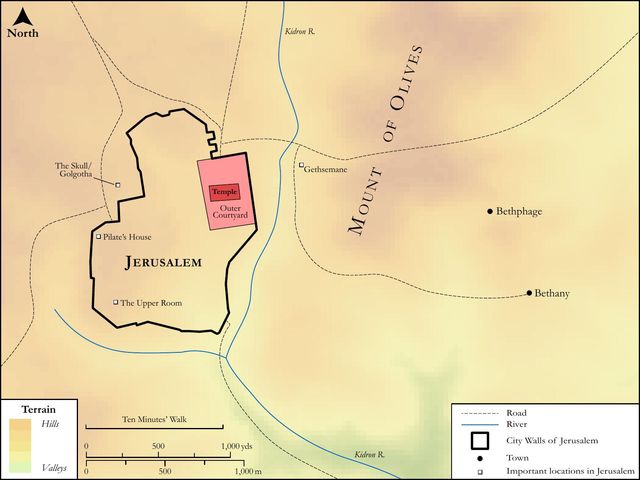
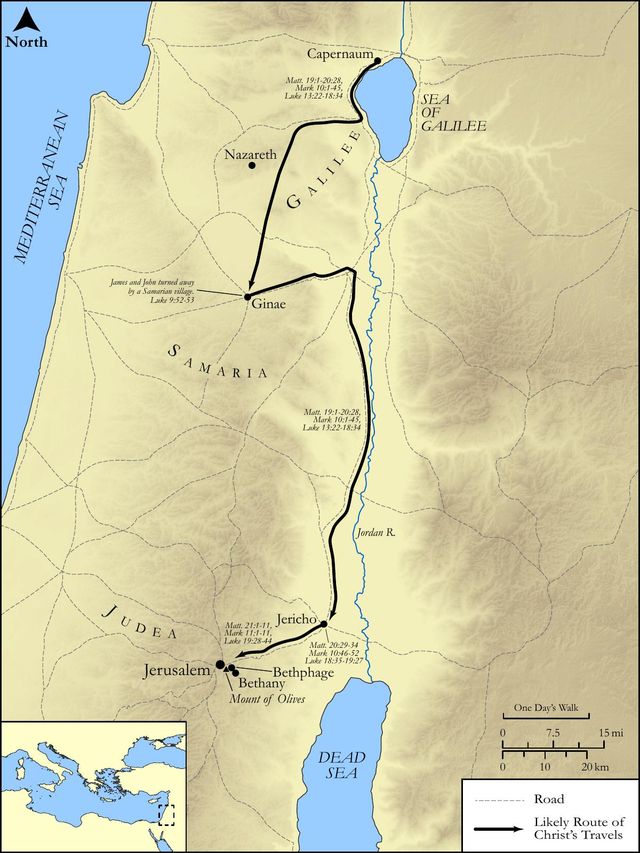
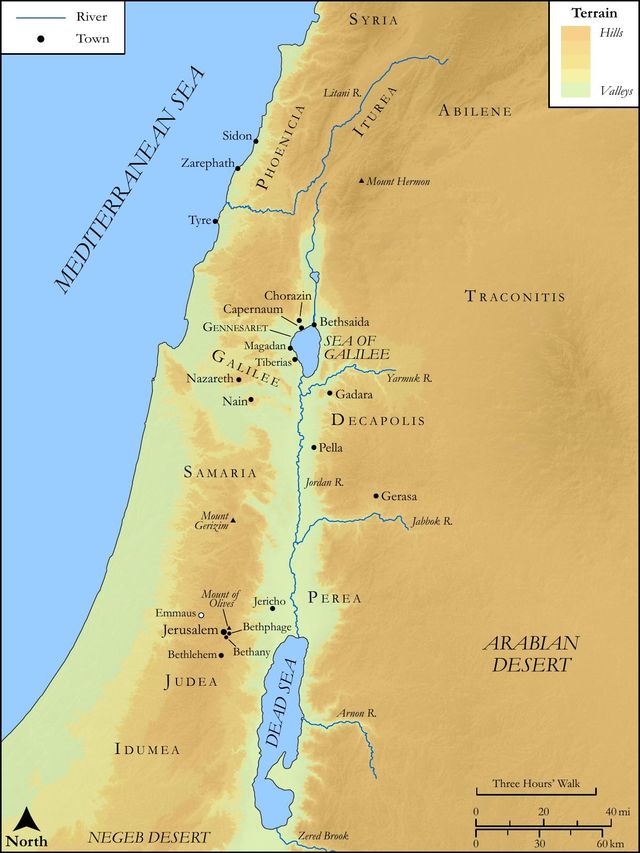
See on the biblical-era maps
Study this verse
Public-domain commentary
Matthew Henry
From his Commentary on the Whole Bible. Henry comments on passages, not single verses — this entry covers Luke 12:41–53. His three-level outline is real structure in the source text, so it is rendered as structure.
Here is, I. Peter's question, which he put to Christ upon occasion of the foregoing parable (Luk 12:41): "Lord, speakest thou this parable to us that are thy constant followers, to us that are ministers, or also to all that come to be taught by thee, to all the hearers, and in them to all Christians?" Peter was now, as often, spokesman for the disciples. We have reason to bless God that there are some such forward men, that have a gift of utterance; let those that are such take heed of being proud. Now Peter desires Christ to explain himself, and to direct the arrow of the foregoing parable to the mark he intended. He calls it a parable, because it was not only figurative, but weighty, solid, and instructive. Lord, said Peter, was it intended for us, or for all? To this Christ gives a direct answer (Mar 13:37): What I say unto you, I say unto all. Yet here he seems to show that the apostles were primarily concerned in it. Note, We are all concerned to take to ourselves what Christ in his word designs for us, and to enquire accordingly concerning it: Speakest thou this to us? To me? Speak, Lord, for thy servant hears. Doth this word belong to me? Speak it to my heart.
II.Christ's reply to this question, directed to Peter and the rest of the disciples.
If what Christ had said before did not so peculiarly concern them, but in common with other Christians, who must all watch and pray for Christ's coming, as his servants, yet this that follows is peculiarly adapted to ministers, who are the stewards in Christ's house. Now our Lord Jesus here tells them,
1.What was their duty as stewards, and what the trust committed to them.
(1.)They are made rulers of God's household, under Christ, whose own the house is; ministers derive an authority from Christ to preach the gospel, and to administer the ordinances of Christ, and apply the seals of the covenant of grace.
(2.)Their business is to give God's children and servants their portion of meat, that which is proper for them and allotted to them; convictions and comfort to those to whom they respectively belong. Suum cuique - to every one his own. This is rightly to divide the word of truth, Ti2 2:15.
(3.)To give it to them in due season, at that time and in that way which are most suitable to the temper and condition of those that are to be fed; a word in season to him that is weary.
(4.)Herein they must approve themselves faithful and wise; faithful to their Master, by whom this great trust is reposed in them, and faithful to their fellow-servants, for whose benefit they are put in trust; and wise to improve an opportunity of doing honour to their Master, and service in the family. Ministers must be both skilful and faithful.
2.What would be their happiness if they approved themselves faithful and wise (Luk 12:43): Blessed is that servant,
(1.)That is doing, and is not idle, nor indulgent of his ease; even the rulers of the household must be doing, and make themselves servants of all.
(2.)That is so doing, doing as he should be, giving them their portion of meat, by public preaching and personal application.
(3.)That is found so doing when his Lord comes; that perseveres to the end, notwithstanding the difficulties he may meet with in the way. Now his happiness is illustrated by the preferment of a steward that has approved himself within a lower and narrower degree of service; he shall be preferred to a larger and higher (Luk 12:44): He will make him ruler over all that he has, which was Joseph's preferment in Pharaoh's court. Note, Ministers that obtain mercy of the Lord to be faithful shall obtain further mercy to be abundantly rewarded for their faithfulness in the day of the Lord.
3.What a dreadful reckoning there would be if they were treacherous and unfaithful, Luk 12:45, Luk 12:46. If that servant begin to be quarrelsome and profane, he shall be called to an account, and severely punished. We had all this before in Matthew, and therefore shall here only observe,
(1.)Our looking upon Christ's second coming as a thing at a distance is the cause of all those irregularities which render the thought of it terrible to us: He saith in his heart, My Lord delays his coming. Christ's patience is very often misinterpreted his delay, to the discouragement of his people, and the encouragement of his enemies.
(2.)The persecutors of God's people are commonly abandoned to security and sensuality; they beat their fellow-servants, and then eat and drink with the drunken, altogether unconcerned either at their own sin or their brethren's sufferings, as the king and Haman, who sat down to drink when the city Shushan was perplexed. Thus they drink, to drown the clamours of their own consciences, and baffle them, which would otherwise fly in their faces.
(3.)Death and judgment will be very terrible to all wicked people, but especially to wicked ministers. It will be a surprise to them: At an hour when they are not aware. It will be the determining of them to endless misery; they shall be cut in sunder, and have their portion assigned them with the unbelievers.
4.What an aggravation it would be of their sin and punishment that they knew their duty, and did not do it (Luk 12:47, Luk 12:48): That servant that knew his lord's will, and did it not, shall be beaten with many stripes, shall fall under a sorer punishment; and he that knew not shall be beaten with few stripes, his punishment shall, in consideration of this, be mitigated. Here seems to be an allusion to the law, which made a distinction between sins committed through ignorance, and presumptuous sins (Lev 5:15, etc.; Num 15:29, Num 15:30), as also to another law concerning the number of stripes given to a malefactor, to be according to the nature of the crime, Deu 25:2, Deu 25:3. Now,
(1.)Ignorance of our duty is an extenuation of sin. He that knew not his lord's will, through carelessness and neglect, and his not having such opportunities as some others had of coming to the knowledge of it, and did things worthy of stripes, he shall be beaten, because he might have known his duty better, but with few stripes; his ignorance excuses in part, but not wholly. Thus through ignorance the Jews put Christ to death (Act 3:17; Co1 2:8), and Christ pleaded that ignorance in their excuse: They know not what they do.
(2.)The knowledge of our duty is an aggravation of our sin: That servant that knew his lord's will, and yet did his own will, shall be beaten with many stripes. God will justly inflict more upon him for abusing the means of knowledge he afforded him, which others would have made a better use of, because it argues a great degree of wilfulness and contempt to sin against knowledge; of how much sorer punishment then shall they be thought worthy, besides the many stripes that their own consciences will give them! Son, remember. Here is a good reason for this added: To whomsoever much is given, of him shall be much required, especially when it is committed as a trust he is to account for. Those have greater capacities of mind than others, more knowledge and learning, more acquaintance and converse with the scriptures, to them much is given, and their account will be accordingly.
III.A further discourse concerning his own sufferings, which he expected, and concerning the sufferings of his followers, which he would have them also to live in expectation of. In general (Luk 12:49): I am come to send fire on the earth. By this some understand the preaching of the gospel, and the pouring out of the Spirit, holy fire; this Christ came to send with a commission to refine the world, to purge away its dross, to burn up its chaff, and it was already kindled. The gospel was begun to be preached; some prefaces there were to the pouring out of the Spirit. Christ baptized with the Holy Ghost and with fire; this Spirit descended in fiery tongues. But, by what follows, it seems rather to be understood of the fire of persecution. Christ is not the Author of it, as it is the sin of the incendiaries, the persecutors; but he permits it, nay, he commissions it, as a refining fire for the trial of the persecuted. This fire was already kindled in the enmity of the carnal Jews to Christ and his followers. "What will I that it may presently be kindled? What thou doest, do quickly. If it be already kindled, what will I? Shall I wait the quenching of it? No, for it must fasten upon myself, and upon all, and glory will redound to God from it."
1.He must himself suffer many things; he must pass through this fire that was already kindled (Luk 12:50): I have a baptism to be baptized with. Afflictions are compared both to fire and water, Psa 66:12; Psa 69:1, Psa 69:2. Christ's sufferings were both. He calls them a baptism (Mat 20:22); for he was watered or sprinkled with them, as Israel was baptized in the cloud, and dipped into them, as Israel was baptized in the sea, Co1 10:2. He must be sprinkled with his own blood, and with the blood of his enemies, Isa 63:3. See here,
(1.)Christ's foresight of his sufferings; he knew what he was to undergo, and the necessity of undergoing it: I am to be baptized with a baptism. He calls his sufferings by a name that mitigates them; it is a baptism, not a deluge; I must be dipped in them, not drowned in them; and by a name that sanctifies them, for baptism is a name that sanctifies them, for baptism is a sacred rite. Christ in his sufferings devoted himself to his Father's honour, and consecrated himself a priest for evermore, Heb 7:27, Heb 7:28.
(2.)Christ's forwardness to his sufferings: How am I straitened till it be accomplished! He longed for the time when he should suffer and die, having an eye to the glorious issue of his sufferings. It is an allusion to a woman in travail, that is pained to be delivered, and welcomes her pains, because they hasten the birth of the child, and wishes them sharp and strong, that the work may be cut short. Christ's sufferings were the travail of his soul, which he cheerfully underwent, in hope that he should by them see his seed, Isa 53:10, Isa 53:11. So much was his heart set upon the redemption and salvation of man.
2.He tells those about him that they also must bear with hardships and difficulties (Luk 12:51): "Suppose ye that I came to give peace on earth, to give you a peaceable possession of the earth, and outward prosperity on the earth?" It is intimated that they were ready to entertain such a thought as this, nay, that they went upon this supposition, that the gospel would meet with a universal welcome, that people unanimously embrace it, and would therefore study to make the preachers of it easy and great, that Christ, if he did not give them pomp and power, would at least give them peace; and herein they were encouraged by divers passages of the Old Testament, which speak of the peace of the Messiah's kingdom, which they were willing to understand of external peace. "But," saith Christ, "you will be mistaken, the event will declare the contrary, and therefore do not flatter yourselves into a fool's paradise. You will find,"
(1.)"That the effect of the preaching of the gospel will be division." Not but that the design of the gospel and its proper tendency are to unite the children of men to one another, to knit them together in holy love, and, if all would receive it, this would be the effect of it; but there being multitudes that not only will not receive it, but oppose it, and have their corruptions exasperated by it, and are enraged at those that do receive it, it proves, though not the cause yet the occasion of division. While the strong man armed kept his palace, in the Gentile world, his goods were at peace; all was quiet, for all went one way, the sects of philosophers agreed well enough, so did the worshippers of different deities; but when the gospel was preached, and many were enlightened by it, and turned from the power of Satan to God, then there was a disturbance, a noise and a shaking, Eze 37:7. Some distinguished themselves by embracing the gospel, and others were angry that they did so. Yea, and among them that received the gospel there would be different sentiments in minor things, which would occasion division; and Christ permits it for holy ends (Co1 11:18), that Christians may learn and practise mutual forbearance, Rom 14:1, Rom 14:2.
(2.)"That this division will reach into private families, and the preaching of the gospel will give occasion for discord among the nearest relations" (Luk 12:53): The father shall be divided against the son, and the son against the father, when the one turns Christian and the other does not; for the one that does turn Christian will be zealous by arguments and endearments to turn the other too, Co1 7:16. As soon as ever Paul was converted, he disputed, Act 9:29. The one that continues in unbelief will be provoked, and will hate and persecute the one that by his faith and obedience witnesses against, and condemns, his unbelief and disobedience. A spirit of bigotry and persecution will break through the strongest bonds of relation and natural affection; see Mat 10:35; Mat 24:7. Even mothers and daughters fall out about religion; and those that believe not are so violent and outrageous that they are ready to deliver up into the hands of the bloody persecutors those that believe, though otherwise very near and dear to them. We find in the Acts that, wherever the gospel came, persecution was stirred up; it was every where spoken against, and there was no small stir about that way. Therefore let not the disciples of Christ promise themselves peace upon earth, for they are sent forth as sheep in the midst of wolves.
Historical interpretation
Eight Centuries of Reception
11 surviving comments on this verse. Each one is dated, so this reads as a timeline rather than a list.
Select a marker to jump to its quote. Markers stagger vertically where authors wrote within a few decades of each other.
For we must perceive and confess that the so disordered ruin arising from that affliction, which has in a great measure laid waste, and is even still laying waste, our flock, has visited us according to our sins, in that we do not keep the way of the Lord, nor observe the heavenly commandments given to us for our salvation. Our Lord did the will of His Father, and we do not do the will of our Lord; eager about our patrimony and our gain, seeking to satisfy our pride, yielding ourselves wholly to emulation and to strife, careless of simplicity and faith, renouncing the world in words only, and not in deeds, every one of us pleasing himself, and displeasing all others, -therefore we are smitten as we deserve, since it is written: "And that servant, which knoweth his master's will, and has not obeyed his will, shall be beaten with many stripes." But what stripes, what blows, do we not deserve, when even confessors, who ought to be an example of virtuous life to others, do not maintain discipline?
When I consult the New Testament, I find that our Lord Jesus Christ does not absolve from punishment even sins committed in ignorance, although he attaches a harsher threat to deliberate sins. “And that servant who knew his master’s will but did not make ready or act according to his will shall receive a severe beating. But he who did not know and did what deserved a beating shall receive a light beating.” I hear something like this from the lips of the only-begotten Son of God and consider the anger of the holy apostles against sinners. I observe that the sufferings of those who have transgressed in even one particular are not less serious but rather more serious than those cited from the Old Testament. I then comprehend the severity of the judgment. Our Lord says, “To whomever much is given, much will be required of him.”
(in Proœm. in reg. fus.) He says not, 'doing,' as if by chance, but so doing. For not only conquest is honourable, but to contend lawfully, which is to perform each thing as we have been commanded.
(in lib. de Sp. San. c. 16.) The body indeed is not divided, so that one part indeed should be exposed to torments, the other escape. For this is a fable, nor is it a part of just judgment when the whole has offended that half only should suffer punishment; nor is the soul cut in sunder, seeing that the whole possesses a guilty consciousness, and cooperates with the body to work evil; but its division is the eternal severing of the soul from the Spirit. For now although the grace of the Spirit is not in the unworthy, yet it seems ever to be at hand expecting their turning to salvation, but at that time it will be altogether cut off from the soul. The Holy Spirit then is the prize of the just, and the chief condemnation of sinners, since they who are unworthy will lose Him.
Or else, the form of the first command is a general one adapted to all, but the following example seems to be proposed to the stewards, that is, the priests; and therefore it follows, And the Lord said, Who then is that faithful and wise steward, whom his Lord shall make ruler over his household, to give, them their portion of meat in due season?
(Hom. 77. in Matt.) But our Lord here asks the question not as ignorant, who was a faithful and wise steward, but wishing to imply the rareness of such, and the greatness of this kind of chief government.
(Hom. 77. in Matt.) But our Lord not only by the honours kept in store for the good, but by threats of punishment upon the bad, leads the hearer to correction, as it follows, But if that servant shall say in his heart, My Lord delayeth his coming.
Now to the courageous rightly belong the great and difficult of God's holy commandments, but to those who have not yet attained to such virtue, belong those things from which all difficulty is excluded. Our Lord therefore uses a very obvious example, to show that the above-mentioned command is suited to those who have been admitted into the rank of disciples, for it follows, And the Lord said, Who then is that faithful steward?
Thus the faithful and wise servant prudently giving out in due season the servants' food, that is, their spiritual meat, will be blessed according to the Saviour's word, in that he will obtain still greater things, and will be thought worthy of the rewards which are duo to friends. Hence it follows, Of a truth I say unto you, that he will make him ruler over all that he hath.
What is our Lord's reply? He makes use of a clear and very evident example to show that the commandment especially belongs to those who occupy a more influential position and have been admitted into the rank of teachers. "Who," he says, "is the faithful and wise servant, whom his lord will set over his household, to give the allowance of food at its season?" ...This is the simple and plain meaning of the passage. If we now fix our mind accurately upon it, we will see what it signifies and how useful it is for the benefit of those who have been called to the office of apostle, that is, to the office of teacher. The Savior has ordained faithful men of great understanding, and well instructed in the sacred doctrines, as stewards over his servants who have been won by faith to the acknowledgment of his glory. He has ordained them, commanding them to give their fellow servants their allowance of food. He does not do this simply and without distinction but rather at its proper season. I mean spiritual food, as is sufficient and fitting for each individual.
(l. 3. Ep. 170.) It was added also in their due season, because a benefit not conferred at its proper time is rendered vain, and loses the name of a benefit. The same bread is not equally coveted by the hungry man, and him that is satisfied. But with respect to this servant's reward for his stewardship, He adds, Blessed is that servant whom his Lord when he cometh shall find so doing.
(Hom. 13. in Ev.) Or else; unknown to the master the thief breaks into the house, because while the spirit sleeps instead of guarding itself, death comes unexpectedly, and breaks into the dwelling place of our flesh. But he would resist the thief if he were watching, because being on his guard against the coming of the Judge, who secretly seizes his soul, he would by repentance go to meet Him, lest he should perish impenitent. But the last hour our Lord wishes to be unknown to us, in order as we cannot foresee it, we may be unceasingly preparing for it.
Our Lord had taught two things in the preceding parable unto all, even that He would come suddenly, and that they ought to be ready and waiting for Him. But it is not very plain concerning which of these, or whether both, Peter asked the question, or whom he compared to himself and his companions, when he said, Speakest thou to us, or to all? Yet in truth by these words, us and all, he must be supposed to mean none other than the Apostles, and those like to the Apostles, and all other faithful men; or Christians, and unbelievers; or those who dying separately, that is, singly, both unwillingly indeed and willingly, receive the coming of their Judge, and those who when the universal judgment comes are to be found alive in the flesh. Now it is marvellous if Peter doubted that all must live soberly, piously, and justly, who wait for a blessed hope, or that the judgment will to each and all be unexpected. It therefore remains to be supposed, that knowing these two things, he asked about that which he might not know, namely, whether those sublime commands of a heavenly life in which He bade us sell what we have and provide bags which wax not old, and watch with our loins girded, and lamps burning, belonged to the Apostles only, and those like unto them, or to all who were to be saved.
For whatever difference there is in the merits of good hearers and good teachers, such also there is in their rewards; for the one whom when He cometh He finds watching, He will make to sit down; but the others whom He finds faithful and wise stewards, He will place over all that He hath, that is, over all the joys of the kingdom of heaven, not certainly that they alone shall have power over them, but that they shall more abundantly than the other saints enjoy eternal possession of them.
Observe that it is counted among the vices of a bad servant that he thought the coming of his Lord slow, yet it is not numbered among the virtues of the good that he hoped it would come quickly, but only that he ministered faithfully. There is nothing then better than to submit patiently to be ignorant of that which can not be known, but to strive only that we be found worthy.
In this servant is declared the condemnation of all evil rulers, who, forsaking the fear of the Lord, not only give themselves up to pleasures, but also provoke with injuries those who are put under them. Although these words may be also understood figuratively, meaning to corrupt the hearts of the weak by an evil example; and to eat, drink, and be drunken, to be absorbed in the vices and allurements of the world, which overthrow the mind of man. But concerning his punishment it is added, The Lord of that servant will come in a day when he looketh not for him, that is, the day of his judgment or death, and will cut him in sunder.
Or He will cut him in sunder, by separating him from the communion of the faithful, and dismissing him to those who have never attained unto the faith. Hence it follows, And will appoint him his portion with the unbelievers; (1 Tim. 5:8.) for he who has no care for his own, and those of his own house, has denied the faith, and is worse than an infidel.
Peter, to whom the Church had already been committed, as having the care of all things, inquires whether our Lord put forth this parable to all. As it follows, Then Peter said unto him, Lord, speakest thou this parable unto us, or even unto all?
The above-mentioned parable relates to all the faithful in common, but now hear what suits the Apostles and teachers. For I ask, where will be found the steward, that possesses in himself faithfulness and wisdom? for as in the management of goods, whether a man be careless yet faithful to his master, or else wise yet unfaithful, the things of the master perish; so also in the things of God there is need of faithfulness and wisdom. For I have known many servants of God, and faithful men, who because they were unable to manage ecclesiastical affairs, have destroyed not only possessions, but souls, exercising towards sinners indiscreet virtue by extravagant rules of penance or unseasonable indulgence.
Whosoever then has been found a faithful and wise steward, let him bear rule over the Lord's household, that he may give them their portion of meat in due season, either the word of doctrine by which their souls are fed, or the example of works by which their life is fashioned.
Or, he will make him ruler over all that he hath, not only over His own household, but that earthly things as well as heavenly shall obey him. As it was with Joshua the son of Nun, and Elias, the one commanding the sun, the other the clouds; and all the Saints as God's friends use the things of God. Whosoever also passes his life virtuously, and has kept in due submission his servants, that is, anger and desire, supplies to them their portion of food in due season; to anger indeed that he may feel it against those who hate God, but to desire that he may exercise the necessary provision for the flesh, ordering it unto God. Such an one, I say, will be set over all things which the Lord hath, being thought worthy to look into all things by the light of contemplation.
Now from not considering the time of our departure, there proceed many evils. For surely if we thought that our Lord was coming, and that the end of our life was at hand, we should sin the less. Hence it follows, And shall begin to strike the man servants and maidens, and to eat and drink and be drunken.
Rightly also shall the unbelieving steward receive his portion with the unbelievers, because he was without true faith.
Continue studying Luke 12:44 across the web’s major study libraries — every link below opens this exact verse, chapter, or book on the destination site.
Read & Compare
 BibleGatewayThis verse in more than 200 translations and 70 languages.
 Bible.comThe YouVersion reader — hundreds of translations, reading plans, and highlights.
 ESV.orgCrossway's official English Standard Version reader.
 NET BibleThe NET translation with 60,000+ translators' notes on every rendering decision.
 STEP BibleTyndale House's free study tool — original text, vocabulary, and scholarly resources.
 BibliaLogos Bible Software's free web reader.
 USCCBThe New American Bible (Revised Edition) with the U.S. bishops' study notes.
Commentaries
 BibleHub CommentariesDozens of classic commentaries on this verse, gathered on one page.
 StudyLightMore than 100 commentary sets — the largest collection on the web.
 BibleRefPlain-English commentary on what this verse means, verse by verse.
 Enduring WordDavid Guzik's free commentary on this chapter, widely used by Bible teachers.
 Bible Study ToolsVerse commentary alongside Greek and Hebrew study aids.
Original Language & Research
- BibleHub InterlinearThe verse word by word — original language, transliteration, and English.
- BibleHub LexiconEvery word's original-language definition and Strong's entry.
 Blue Letter BibleDeep-study tools — Strong's numbers, concordance, and word studies.
 CNTR CollationThe earliest Greek manuscripts of this verse, collated letter by letter.
Sermons, Hymns & Audio


TrulyRandomVerse is not affiliated with these sites and doesn’t control their content. They’re linked because they’re genuinely useful.
Summary
Luke 12:44 stands as a profound promise within Jesus' parable of the faithful and wise steward, encapsulating the ultimate commendation and promotion awaiting those who demonstrate unwavering diligence and trustworthiness in their God-given responsibilities. It highlights the generous nature of the Master, who, upon His return, will elevate the proven servant to a position of profound authority and oversight, entrusting them with the entirety of His possessions as a reward for their faithful management during His absence.
Context
ShowHideLiterary Context
This verse is embedded within a larger discourse by Jesus to His disciples concerning vigilance and readiness for His return, beginning in Luke 12:35. Jesus first urges them to be prepared, likening His unexpected arrival to a master returning from a wedding feast (Luke 12:36-38). He then uses the analogy of a homeowner prepared for a thief (Luke 12:39-40) to underscore the necessity of constant readiness. Peter's question in Luke 12:41 prompts Jesus to narrow the focus from general readiness to the specific responsibilities of those entrusted with leadership and stewardship within God's household. The parable of the faithful and unfaithful steward (Luke 12:42-48) then unfolds, with verse 44 presenting the climactic reward for the faithful steward, starkly contrasted with the severe judgment awaiting the unfaithful one.
Historical & Cultural Context
Under Rome, wealthy households often employed a trusted steward (Greek: oikonomos) to manage their affairs, especially when the master was absent. This steward was typically a highly valued slave or a freedman who possessed significant administrative skills and was granted considerable authority over the master's property, finances, and other servants. Their duties included overseeing the daily operations, ensuring the household ran smoothly, and, crucially, distributing provisions to the other servants at the proper time. The master's absence could be for extended periods, necessitating a high degree of trust and autonomy for the steward. The expectation was that the steward would act in the master's best interests, demonstrating integrity, diligence, and fairness. Failure to do so would result in severe penalties, while proven faithfulness could lead to greater responsibilities, elevated status, and even freedom. This cultural backdrop makes Jesus' parable immediately relatable and highlights the gravity of the steward's role and the significance of the master's commendation.
Key Themes
ShowHideThis verse contributes significantly to several overarching themes within Luke's Gospel and broader biblical theology. The most prominent is Faithful Stewardship, emphasizing that all believers are entrusted with God's resources—whether spiritual gifts, material possessions, time, or opportunities—and are expected to manage them wisely for His purposes. The faithful steward in the parable exemplifies this principle by consistently providing for the household, underscoring the importance of serving others diligently, as seen in 1 Corinthians 4:2, where faithfulness is highlighted as the primary requirement for stewards. Another crucial theme is Divine Reward for Obedience, where faithfulness in small or specific tasks leads to greater responsibilities and blessings. The promise of being made "ruler over all that he hath" signifies a profound promotion and increase in authority, reflecting God's generosity in rewarding dedicated service, a concept echoed in the parable of the talents in Matthew 25:21. Finally, the verse implicitly reinforces the theme of Accountability and Readiness. While focusing on the reward, it is part of a larger discussion that contrasts the faithful steward's commendation with the unfaithful servant's condemnation (Luke 12:45-46), highlighting the necessity of living in constant readiness for the Master's (Christ's) return and being prepared to give an account of one's stewardship.
Exposition and Analysis
ShowHideKey Word Analysis
ShowHideThis adverb, derived from the Greek word for "true," signifies certainty, reality, or genuine affirmation. When Jesus uses "alēthōs," He is emphasizing the absolute veracity and certainty of His statement. It is not merely a possibility or a suggestion but a guaranteed outcome, underscoring the reliability of the master's promise to the faithful steward. It adds solemnity and weight to the pronouncement of reward.
This verb means "to place down (permanently)," "to designate," "to constitute," or "to appoint." It denotes a formal, deliberate act of establishing someone in a position of authority or responsibility. It's not a casual recognition but a significant promotion, signifying that the master is formally entrusting the steward with a higher level of trust and responsibility, reflecting full confidence in their proven character and capability. The action is decisive and permanent.
This term, a neuter plural of the present participle active of hypárchō, refers to "things extant or in hand," encompassing property, possessions, or substance. In the context of the parable, it signifies the entirety of the master's estate or wealth. The promise is not merely a portion but a comprehensive grant of authority over all the master's belongings, indicating an unparalleled level of trust and shared management. It suggests a complete delegation of oversight, reflecting the master's immense satisfaction with the steward's performance.
Verse Breakdown
ShowHide"Of a truth I say unto you,"
This introductory phrase, marked by the emphatic "Of a truth" (alēthōs), serves to underscore the absolute certainty and solemnity of Jesus' following declaration. It signals to the audience that what He is about to say is not merely a hypothetical scenario within the parable but a profound spiritual truth with direct implications for their lives and future. It's a divine guarantee.
"that he will make him ruler"
This clause reveals the nature of the reward for the faithful steward. The master, upon his return and finding the steward diligently performing his duties, will formally "appoint" (kathístēmi) or "set" him as ruler. This signifies a significant elevation in status and authority, moving beyond mere management to a position of comprehensive oversight. It is a direct act of the master's will, bestowing honor and power.
"over all that he hath."
This concluding phrase specifies the scope of the steward's new authority. The faithful steward will not just be given a larger portion or a specific new task, but rather comprehensive dominion "over all" (pâs) the master's "possessions" (hypárchonta). This hyperbole within the parable emphasizes the immense and complete trust placed in the steward, signifying the highest possible commendation and the sharing of the master's own authority and resources. It speaks to a profound partnership and co-regency.
Literary Devices
ShowHideThe passage makes effective use of several literary devices. The primary device is Parable, a narrative form Jesus frequently employed to convey spiritual truths through relatable earthly stories. The parable of the faithful and unfaithful steward uses the familiar social structure of a master and servant to illustrate profound theological concepts about God's relationship with humanity, particularly concerning stewardship and accountability. There is also clear Symbolism at play: the "master" represents God or Christ; the "steward" symbolizes believers, especially those in positions of leadership or responsibility; the "household" can be understood as the Church or the Kingdom of God; and "all that he hath" symbolizes the spiritual blessings, resources, and authority God entrusts to His faithful servants. Furthermore, the passage employs Contrast by juxtaposing the fate of the faithful steward with that of the unfaithful one (Luke 12:45-46), thereby highlighting the consequences of both obedience and negligence. The phrase "over all that he hath" might also contain an element of Hyperbole, an exaggeration for emphasis, underscoring the magnitude of the reward and the completeness of the trust bestowed upon the faithful servant.
Theological and Thematic Connections
ShowHideLuke 12:44 offers profound theological insights into God's character and His relationship with His people. It reveals a God who not only holds His servants accountable but also delights in rewarding faithfulness with abundant generosity and increased responsibility. This verse underscores the eschatological hope for believers, pointing to a future where diligent service in this life will be met with divine commendation and a share in Christ's eternal reign. It teaches that true spiritual wealth is not merely about accumulating blessings, but about faithfully managing what has been entrusted, leading to a deeper participation in God's ongoing work and kingdom. The promise of being made "ruler over all that he hath" signifies a profound partnership, where God's faithful servants are invited into a co-regency with Him, reflecting His desire to share His glory and authority with those who have proven trustworthy.
Reflection and Application
ShowHideLuke 12:44 provides a powerful impetus for believers to re-evaluate their lives through the lens of stewardship. It challenges us to recognize that everything we possess—our time, talents, resources, relationships, and even our very lives—are not our own but have been entrusted to us by God. This verse calls us to live with intentionality and integrity, understanding that our daily faithfulness, even in seemingly mundane tasks, contributes to a larger divine purpose. It encourages us to cultivate a mindset of diligent service, not for personal gain, but out of love and devotion to the Master who will one day return. The promise of being made "ruler over all that he hath" is a profound motivation, assuring us that our present acts of obedience and sacrifice are not in vain but will be abundantly rewarded with increased responsibility and participation in God's eternal kingdom. It fosters a hopeful anticipation of Christ's return, knowing that our faithful service will culminate in a glorious commendation and a deeper fellowship with Him.
Questions for Reflection
ShowHideFAQ
ShowHideWho is the "ruler" referring to in this verse?
ShowHideThe "ruler" refers to the faithful and wise steward described in Jesus' parable. In a broader spiritual sense, it represents any believer who diligently and responsibly manages the gifts, resources, and opportunities God has entrusted to them. While the parable has particular implications for those in leadership positions within the church, its core principle of faithfulness and reward applies to all disciples of Christ in their respective spheres of influence.
What does "all that he hath" mean in practical terms for believers today?
ShowHide"All that he hath" signifies an immense and comprehensive reward, representing increased responsibility, authority, and participation in God's eternal kingdom. While not necessarily literal material possessions, it speaks to a profound sharing in the Master's affairs. For believers, this could mean greater spiritual authority, a more significant role in God's redemptive plan, deeper intimacy with Christ, and a richer experience of His glory in the age to come. It implies a deeper level of trust and partnership with God, as seen in the promise that we will reign with Christ.
Is the reward promised in Luke 12:44 only for church leaders or those with prominent ministries?
ShowHideNo, the principle of faithful stewardship and divine reward extends beyond formal church leadership to every believer. While the parable's immediate context might have specific implications for apostles and leaders (as Peter's question in Luke 12:41 suggests), the broader message of readiness and accountability applies to all who follow Christ. Every believer is a steward of God's grace, talents, and resources, regardless of their public role. Faithfulness in seemingly small or hidden acts of service is just as valued by God and will be equally rewarded, as emphasized in other parables like the talents or minas (Matthew 25:14-30 and Luke 19:11-27).
Christ-Centered Fulfillment
ShowHideLuke 12:44 finds its ultimate and profound fulfillment in Jesus Christ Himself, who is the quintessential faithful Steward and the ultimate Master. As the Son of God, Jesus perfectly embodied faithfulness in His earthly ministry, diligently carrying out the will of His Father (John 6:38). He was entrusted with "all authority in heaven and on earth" (Matthew 28:18), and He faithfully managed the Father's "household"—the people of God—even to the point of laying down His life for them (John 10:11). Because of His perfect obedience and sacrificial service, the Father has indeed "made Him ruler over all that He hath," exalting Him to the highest place and granting Him a name above every name (Philippians 2:9-11). Furthermore, through Christ, believers are invited to participate in this divine rulership. Our ability to be faithful stewards is empowered by His Spirit, and the promise of being made "ruler over all that He hath" for us is realized in our co-regency with Christ in His kingdom (Revelation 5:10). He is the true Master who rewards His faithful servants by sharing His own glorious dominion, making us "heirs of God and joint-heirs with Christ" (Romans 8:17).