


Job 38:10
Bible text: King James Version (1769 Blayney text) · Public domain
Bible text: Berean Standard Bible · Public domain
Bible text: American Standard Version (1901) · Public domain
Bible text: World English Bible, Messianic edition · Public domain
Bible text: Geneva Bible (1599) · Public domain
Bible text: Young's Literal Translation · Public domain
- וָאֶשְׁבֹּרva·'esh·Borand I brokeH7665Conj-w ¦ V-Qal-ConsecImperf-1csVerb Qal Consecutive Imperfect 1st Singular common genderוָandאֶשְׁבֹּרI broke
- עָלָיו'a·Lavon itH5921Prep ¦ 3msPrepositionעָלָיonוit
- חֻקִּיchu·Kimy boundaryH2706N-msc ¦ 1csNoun Singular Masculine Constructחֻקִּboundaryיmy
- וָאָשִׂיםva·'a·Simand I set in placeH7760Conj-w ¦ V-Qal-ConsecImperf-1csVerb Qal Consecutive Imperfect 1st Singular common genderוָandאָשִׂיםI set in place
- בְּרִיחַbe·Ri·acha barH1280N-msNoun Singular Masculine Absolute
- וּדְלָתָיִםu·de·la·Ta·yimand doorsH1817Conj-w ¦ N-fdNoun Dual Feminine Absoluteוּandדְלָתָיִםdoors
English is a literal word-by-word gloss of the Hebrew, not the KJV's wording. Why?
This is the original text the KJV's translators worked from — each Hebrew word with its own literal English meaning in this verse, prepared by scholars at Tyndale House, Cambridge. The KJV translates whole sentences, not word by word, so its wording differs: one Hebrew word can become several English words, and the KJV may choose “the LORD” where the gloss reads “Yahweh”. Both are faithful — they answer different questions. For the KJV's own rendering, switch to the KJV text.
Details
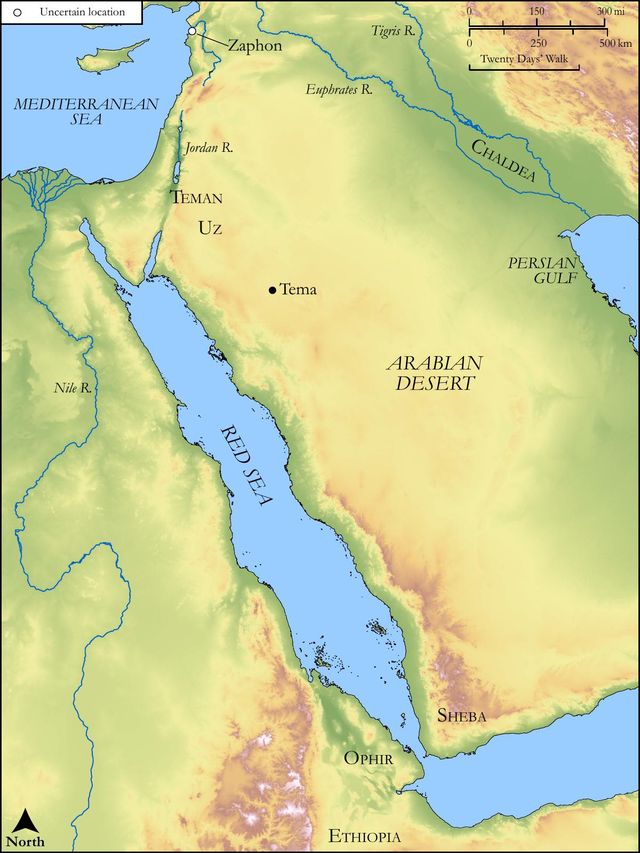
See on the biblical-era map
Study this verse
Public-domain commentary
Matthew Henry
From his Commentary on the Whole Bible. Henry comments on passages, not single verses — this entry covers Job 38:4–11. His three-level outline is real structure in the source text, so it is rendered as structure.
For the humbling of Job, God here shows him his ignorance even concerning the earth and the sea. Though so near, though so bulky, yet he could give no account of their origination, much less of heaven above or hell beneath, which are at such a distance, or of the several parts of matter which are so minute, and then, least of all, of the divine counsels.
I.Concerning the founding of the earth.
"If he have such a mighty insight, as he pretends to have, into the counsels of God, let him give some account of the earth he goes upon, which is given to the children of men."
1.Let him tell where he was when this lower world was made, and whether he was advising of assisting in that wonderful work (Job 38:4): "Where wast thou when I laid the foundations of the earth? Thy pretensions are high; canst thou pretend to his? Wast thou present when the world was made?" See here,
(1.)The greatness and glory of God: I laid the foundations of the earth. This proves him to be the only living and true God, and a God of power (Isa 40:21, Jer 10:11, Jer 10:12), and encourages us to trust in him at all times, Isa 51:13, Isa 51:16.
(2.)The meanness and contemptibleness of man: "Where wast thou then? Thou that hast made such a figure among the children of the east, and settest up for an oracle, and a judge of the divine counsels, where was thou when the foundations of the earth were laid?" So far were we from having any hand in the creation of the world, which might entitle us to a dominion in it, or so much as being witnesses of it, by which we might have gained an insight into it, that we were not then in being. The first man was not, much less were we. It is the honour of Christ that he was present when this was done (Pro 8:22, etc., Joh 1:1, Joh 1:2); but we are of yesterday and know nothing. Let us not therefore find fault with the works of God, nor prescribe to him. He did not consult us in making the world, and yet it is well made; why should we expect then that he should take his measures from us in governing it?
2.Let him describe how this world was made, and give a particular account of the manner in which this strong and stately edifice was formed and erected: "Declare, if thou hast so much understanding as thou fanciest thyself to have, what were the advances of that work." Those that pretend to have understanding above others ought to give proof of it. Show my thy faith by thy works, thy knowledge by thy words. Let Job declare it if he can,
(1.)How the world came to be so finely framed, with so much exactness, and such an admirable symmetry and proportion of all the parts of it (Job 38:5): "Stand forth, and tell who laid the measures thereof and stretched out the line upon it." Wast thou the architect that formed the model and then drew the dimensions by rule according to it? The vast bulk of the earth is moulded as regularly as if it had been done by line and measure; but who can describe how it was cast into this figure? Who can determine its circumference and diameter, and all the lines that are drawn on the terrestrial globe? It is to this day a dispute whether the earth stands still or turns round; how then can we determine by what measures it was first formed?
(2.)How it came to be so firmly fixed. Though it is hung upon nothing, yet it is established, that it cannot be moved; but who can tell upon what the foundations of it are fastened, that it may not sink with its own weight, or who laid the corner-stone thereof, that the parts of it may not fall asunder? Job 38:6. What God does, it shall be for ever (Ecc 3:14); and therefore, as we cannot find fault with God's work, so we need not be in fear concerning it; it will last, and answer the end, the works of his providence as well as the work of creation; the measures of neither can never be broken; and the work of redemption is no less firm, of which Christ himself is both the foundation and the corner-stone. The church stands as fast as the earth.
3.Let him repeat, if he can, the songs of praise which were sung at that solemnity (Job 38:7), when the morning-stars sang together, the blessed angels (the first-born of the Father of light), who, in the morning of time, shone as brightly as the morning star, going immediately before the light which God commanded to shine out of darkness upon the seeds of this lower world, the earth, which was without form and void. They were the sons of God, who shouted for joy when they saw the foundations of the earth laid, because, though it was not made for them, but for the children of men, and though it would increase their work and service, yet they knew that the eternal Wisdom and Word, whom they were to worship (Heb 1:6), would rejoice in the habitable parts of the earth, and that much of his delight would be in the sons of men, Pro 8:31. The angels are called the sons of God because they bear much of his image, are with him in his house above, and serve him as a son does his father. Now observe here,
(1.)The glory of God, as the Creator of the world, is to be celebrated with joy and triumph by all his reasonable creatures; for they are qualified and appointed to be the collectors of his praises from the inferior creatures, who can praise him merely as objects that exemplify his workmanship.
(2.)The work of angels is to praise God. The more we abound in holy, humble, thankful, joyful praise, the more we do the will of God as they do it; and, whereas we are so barren and defective in praising God, it is a comfort to think that they are doing it in a better manner.
(3.)They were unanimous in singing God's praises; they sang together with one accord, and there was no jar in their harmony. The sweetest concerts are in praising God.
(4.)They all did it, even those who afterwards fell and left their first estate. Even those who have praised God may, by the deceitful power of sin, be brought to blaspheme him, and yet God will be eternally praised.
II.Concerning the limiting of the sea to the place appointed for it, Job 38:8, etc.
This refers to the third day's work, when God said (Gen 1:9), Let the waters under the heaven be gathered together unto one place, and it was so.
1.Out of the great deep or chaos, in which earth and water were intermixed, in obedience to the divine command the waters broke forth like a child out of the teeming womb, Job 38:8. Then the waters that had covered the deep, and stood above the mountains, retired with precipitation. At God's rebuke they fled, Psa 104:6, Psa 104:7.
2.This newborn babe is clothed and swaddled, Job 38:9. The cloud is made the garment thereof, with which it is covered, and thick darkness (that is, shores vastly remote and distant from one another and quite in the dark one to another) is a swaddling-band for it. See with what ease the great God manages the raging sea; notwithstanding the violence of its tides, and the strength of its billows, he manages it as the nurse does the child in swaddling clothes. It is not said, He made rocks and mountains its swaddling bands, but clouds and darkness, something that we are not aware of and should think least likely for such a purpose.
3.There is a cradle too provided for this babe: I broke up for it my decreed place, Job 38:10. Valleys were sunk for it in the earth, capacious enough to receive it, and there it is laid to sleep; and, if it be sometimes tossed with winds, that (as bishop Patrick observes) is but the rocking of the cradle, which makes it sleep the faster. As for the sea, so for every one of us, there is a decreed place; for he that determined the times before appointed determined also the bounds of our habitation.
4.This babe being made unruly and dangerous by the sin of man, which was the original of all unquietness and danger in this lower world, there is also a prison provided for it; bars and doors are set, Job 38:10. And it is said to it, by way of check to its insolence, Hitherto shalt thou come, but no further. The sea is God's for he made it, he restrains it; he says to it, Here shall thy proud waves be stayed, Job 38:11. This may be considered as an act of God's power over the sea. Though it is so vast a body, and though its motion is sometimes extremely violent, yet God has it under check. Its waves rise no higher, its tides roll no further, than God permits; and this is mentioned as a reason why we should stand in awe of God (Jer 5:22), and yet why we should encourage ourselves in him, for he that stops the noise of the sea, even the noise of her waves, can, when he pleases, still the tumult of the people, Psa 65:7. It is also to be looked upon as an act of God's mercy to the world of mankind and an instance of his patience towards that provoking grace. Though he could easily cover the earth again with the waters of the sea (and, methinks, every flowing tide twice a day threatens us, and shows what the sea could do, and would do, if God would give it leave), yet he restrains them, being not willing that any should perish, and having reserved the world that now is unto fire, Pe2 3:7.
Historical interpretation
Two Centuries of Reception
4 surviving comments on this verse. Each one is dated, so this reads as a timeline rather than a list.
Select a marker to jump to its quote. Markers stagger vertically where authors wrote within a few decades of each other.
He keeps [the sea] firmly within a sort of barrier, and in some perfect prescriptions of docility, as if he had given it precise commands. I have spoken, he says, and it did not reply, because that happens not only when no constraint forces it but also if the violence of an unchained power whips it quite hard. God has not allowed the sea to stand still and calm, in order that it may proclaim his power, because its nature fights against his commandments, and his commandment rules it everywhere. If water stood still, many people would have attributed its tranquility to the nature of the water; but since, in reality, it is restless and rises from inside, but without the strength to exceed its limits, its restlessness proclaims the power of God.
38. What is designated by ‘doors,’ but holy preachers, and what by the ‘bar,’ except the Lord Incarnate? For He has in truth opposed these doors as a firmer barrier against the force of the swelling sea, the more He has strengthened them by barring them Himself. For because these doors of Holy Church are strengthened by this bar being placed against them, they could be battered indeed by the waves, but they could not be broken through: so that though the wave of persecution might dash on them from without, yet it could not penetrate to the centre of their heart. And because holy Preachers open themselves by their preaching to their followers, but close themselves by their authority against those who oppose them, they are, not improperly, called ‘doors,’ that is, open to the conversation [al. ‘conversion’] of the humble, and closed to the terrors of the proud. They are, not improperly, called ‘doors:’ because they both open an entrance for the faithful, and again oppose themselves to the entrance of the unbelieving. Let us consider what a door of the Church was Peter, who admitted Cornelius, when enquiring into the faith, and rejected Simon when seeking miraculous powers for a price; saying to the one, I have found in truth that God is no respecter of persons, [Acts 10, 34] he graciously opened the secrets of the kingdom. Declaring to the other, Thy money perish with thee, [Acts 8, 20] he closes the entrance of the heavenly court by a sentence of strict condemnation. What are all the Apostles but doors of Holy Church, when they hear by the voice of their Redeemer, Receive the Holy Ghost; whosesoever sins ye remit, they are remitted unto them; and whosesoever sins ye retain, they are retained? [John 20, 22. 23.] As if it were plainly said to them; By you, those to whom ye open yourselves shall come in to Me; and those to whom ye close yourselves, shall be rejected. Whilst then the sea rages, the Lord opposes His bar and doors; because whilst the storm of persecution spreads itself out in the world from bitter and faithless hearts, God exalts the glory of His Only Begotten, and the reverence of His preachers; and while He makes known the mysteries of the Divine strength, He breaks in the ungodly the waves of wrath.
5. For the Lord surrounds this sea with His boundaries, because He keeps low within the limits of contemplation our heart which is still agitated by the plague and trouble of its corruption; that (though it desires more) it may not ascend higher than the limit assigned to it. Or certainly the Lord surrounds this sea with His boundaries; because He calms by the secret distributions of His gifts our heart swelling with temptations: at one time keeping a wicked suggestion from arriving at pleasure, and at another a wicked pleasure from breaking out into consent. He then, Who watches the unlawful motions of the heart, and in some cases keeps them from coming as far as to consent, but in others restrains them even from delight, doubtless imposes boundaries on the raging sea, that it burst not forth in act, but that the gently murmuring wave of temptation may dash itself within the secret recesses of the mind. But because it is then mightily restrained, when it is opposed by delight in God and by inspired virtues.
The Lord surrounds the sea with His boundaries, because He so restricts the wrath of persecutors by the dispensation of His judgments, that the swelling wave of their mad wrath is broken on the level shore of His secret dispensation.
Continue studying Job 38:10 across the web’s major study libraries — every link below opens this exact verse, chapter, or book on the destination site.
Read & Compare
 BibleGatewayThis verse in more than 200 translations and 70 languages.
 Bible.comThe YouVersion reader — hundreds of translations, reading plans, and highlights.
 ESV.orgCrossway's official English Standard Version reader.
 NET BibleThe NET translation with 60,000+ translators' notes on every rendering decision.
 STEP BibleTyndale House's free study tool — original text, vocabulary, and scholarly resources.
 BibliaLogos Bible Software's free web reader.
 USCCBThe New American Bible (Revised Edition) with the U.S. bishops' study notes.
Commentaries
 BibleHub CommentariesDozens of classic commentaries on this verse, gathered on one page.
 StudyLightMore than 100 commentary sets — the largest collection on the web.
 BibleRefPlain-English commentary on what this verse means, verse by verse.
 Enduring WordDavid Guzik's free commentary on this chapter, widely used by Bible teachers.
 Bible Study ToolsVerse commentary alongside Greek and Hebrew study aids.
Original Language & Research
- BibleHub InterlinearThe verse word by word — original language, transliteration, and English.
- BibleHub LexiconEvery word's original-language definition and Strong's entry.
 Blue Letter BibleDeep-study tools — Strong's numbers, concordance, and word studies.
 SefariaThe Hebrew text with Rashi and centuries of Jewish commentary.
Sermons, Hymns & Audio


TrulyRandomVerse is not affiliated with these sites and doesn’t control their content. They’re linked because they’re genuinely useful.
Summary
Job 38:10 is a pivotal declaration within God's challenging discourse to Job, where the Almighty vividly portrays His absolute sovereignty and unparalleled wisdom in the act of creation. Following the dramatic depiction of the sea's tumultuous birth, this verse continues to unveil God's meticulous and powerful establishment of inviolable boundaries for the vast, primeval waters, asserting His supreme control over chaos and His deliberate ordering of creation.
Context
ShowHideLiterary Context
Job 38:10 is situated within God's first direct speech to Job, commencing in Job 38:1. This divine address, delivered from a whirlwind, marks a dramatic shift in the book, moving beyond the dialogues between Job and his friends. God's questions are profoundly rhetorical, designed not to elicit answers from Job but to expose the vast chasm between human understanding and divine omnipotence. Verses 8 and 9 describe the chaotic emergence of the sea, likened to a baby bursting from the womb, emphasizing its wild and untamed nature. Verse 10 then immediately follows, detailing God's decisive act of containing this primordial force, setting the stage for a series of rhetorical questions that highlight God's exclusive knowledge and power over creation, from the depths of the sea to the constellations of the heavens, echoing the foundational acts of ordering found in the creation account.
Historical & Cultural Context
The imagery of a chaotic, untamed sea (often associated with primeval waters or "the deep") is found in Scripture, where God alone sets the bounds of the waters, as the psalmist sang: "Thou hast set a bound that they may not pass over." In the biblical worldview, however, there is no struggle; God's command alone is sufficient. The Book of Job itself is a masterpiece of wisdom literature, likely set in a patriarchal, pre-Mosaic era, possibly in the land of Uz. The cultural understanding of the sea as a powerful, often destructive, and mysterious entity makes God's act of "setting bars and doors" for it an even more profound demonstration of His absolute, uncontested power. This portrayal would have resonated deeply with an audience familiar with the unpredictable nature of large bodies of water and the human inability to control them.
Key Themes
ShowHideThe primary message conveyed by Job 38:10 is God's Divine Sovereignty over Creation. He is not merely the originator but the active governor of all creation, meticulously managing and limiting even the most formidable elements. The "decreed place" and "bars and doors" are powerful metaphors for the impenetrable, divinely established boundaries that contain the sea, ensuring its function within God's ordered design rather than allowing it to revert to chaos. This act underscores the theme of Order from Chaos, where God's intervention transforms a potentially destructive force into a regulated part of His creation. This divine ordering is a testament to His infinite wisdom and foresight, demonstrating that His plans are deliberate and purposeful. Furthermore, the verse powerfully asserts God's Unchallengeable Power, presenting an act of control over the mighty ocean that is far beyond any human capability, thereby emphasizing the immense, unbridgeable gap between the Creator and His creation, a theme prevalent throughout God's discourse in Job 38.
Exposition and Analysis
ShowHideKey Word Analysis
ShowHideThis word (H2706) fundamentally denotes an 'enactment,' 'ordinance,' 'limit,' or 'boundary.' Stemming from a root meaning "to engrave" or "to inscribe," chôq emphasizes that the boundaries set for the sea are not arbitrary or temporary, but are established by immutable divine decree. The KJV's parenthetical "[place]" accurately captures the implied spatial dimension of a divinely appointed and fixed sphere of existence. It reflects God's deliberate, purposeful, and eternal design for creation, implying a legal, binding, and unalterable command from the ultimate Authority.
This term (H1280) refers to a 'bolt' or 'bar,' typically used to secure a gate or door. In the context of the sea, it vividly illustrates the strength and permanence of the divine limits. It conveys the idea that the sea is not merely contained by a natural barrier but is securely locked away by God's omnipotent will, as if behind an unyielding fortification.
This word (H1817) refers to a 'door' or 'gate,' specifically the 'valve' or 'leaf' of a door. Paired with "bars," it completes the architectural metaphor, emphasizing the impenetrable nature of the boundaries God has established for the sea. Together, "bars and doors" signify the absolute security and unyielding nature of these divine limits, underscoring God's complete mastery over the forces of nature.
Verse Breakdown
ShowHide"And brake up for it my decreed [place]"
This clause describes God's active, forceful intervention in the primordial chaos. The verb "brake up" (H7665, shâbar) implies a decisive, powerful act of breaking or bursting forth, here used to denote the forceful establishment or separation of a specific domain. It suggests God's power to carve out and define a precise, bounded area for the sea. The phrase "my decreed [place]" further emphasizes that this boundary is not a natural development but a direct, intentional, and sovereign imposition by God Himself, according to His pre-ordained plan and authority.
"and set bars and doors"
This second clause elaborates on the nature of the "decreed place," providing a concrete, albeit metaphorical, image of its security. The verb "set" (H7760, sûwm) implies a deliberate and purposeful placement. God does not merely define a boundary; He fortifies it. The "bars and doors" signify the absolute and unyielding nature of these divine limits. They convey the idea that the sea, despite its immense power and potential for destruction, is utterly confined and controlled, unable to transgress the boundaries God has established for it. This imagery powerfully communicates God's complete mastery over the forces of nature, ensuring order and preventing chaos from overwhelming the created world.
Literary Devices
ShowHideJob 38:10 is rich in Imagery and Metaphor, drawing upon the familiar human experience of building and securing structures to describe God's work of creation. The sea, often personified as a wild, unruly infant in the preceding verses, is here depicted as a formidable entity that requires containment. The most prominent device is Anthropomorphism, where God is portrayed as an architect or gatekeeper, "breaking up" ground and "setting bars and doors" for the sea. This human-like action makes God's power relatable, yet it simultaneously elevates the scale of His work to an unimaginable level. The "decreed place" functions as a Metaphor for the divinely ordained and immutable boundaries of the sea, while "bars and doors" are powerful Metaphors for the strength and permanence of these limits. Together, these devices create a vivid picture of God's absolute control, transforming the abstract concept of divine sovereignty into a tangible, awe-inspiring reality.
Theological and Thematic Connections
ShowHideJob 38:10 profoundly illustrates the biblical doctrine of God's absolute sovereignty, not only as Creator but as Sustainer and Governor of all things. It reveals a God who does not merely initiate creation and then withdraw, but one who actively imposes order upon chaos, setting limits that even the most powerful natural forces cannot transgress. This divine act of containment speaks to God's meticulous design and His ongoing providential care for creation, ensuring its stability and functionality according to His wise purposes. The same power that bridles the sea also governs the affairs of humanity and the trajectory of history, assuring believers that no force, however overwhelming, operates outside of His ultimate control. This truth provides a deep well of comfort and a call to humble submission to His supreme authority.
Reflection and Application
ShowHideJob 38:10 offers profound comfort and a powerful challenge for believers today. In a world that often feels chaotic, unpredictable, and overwhelming, this verse serves as a potent reminder that the same God who set unyielding boundaries for the raging, primeval sea is also sovereign over the storms of our lives. When personal circumstances feel like an untamed ocean, threatening to engulf us, this divine declaration calls us to remember God's omnipotence and His ability to establish order even where we perceive only disorder. It encourages a posture of profound humility and unwavering trust, knowing that our lives, like the vast oceans, are ultimately contained within the sovereign will and wise plan of God. This truth can bring immense peace, assuring us that nothing is truly out of His control, and that His boundaries, though unseen, are eternally secure, protecting His creation and His people.
Questions for Reflection
ShowHideFAQ
ShowHideWhat is the significance of God "breaking up" a decreed place for the sea?
ShowHideThe phrase "brake up for it my decreed [place]" signifies God's powerful and deliberate act of establishing a fixed, unchangeable boundary for the sea. It's not a gentle shaping but a forceful, authoritative act of separation and containment. Among the nations round about, the sea often represented chaos and disorder. By "breaking up" a specific, divinely "decreed" (or ordained) place, God asserts His absolute authority over this chaotic element, creating order and setting the stage for the habitable world. This highlights that the boundaries of nature are not arbitrary but are a result of God's intentional design and sovereign will, ensuring that the sea does not "cover the earth" again, as seen in Genesis 9:11.
How do "bars and doors" apply to a body of water?
ShowHide"Bars and doors" are powerful anthropomorphic metaphors used to convey the absolute and unyielding nature of the boundaries God set for the sea. Just as a fortified gate with strong bars and doors prevents entry or exit, God's divine decree acts as an impenetrable barrier for the ocean. It means the sea is not merely contained by natural coastlines but is fundamentally restrained by God's omnipotent word and will. This imagery emphasizes the strength, permanence, and security of God's control, demonstrating that the sea, despite its immense power, cannot transgress the limits He has established, as also affirmed in Jeremiah 5:22.
Christ-Centered Fulfillment
ShowHideJob 38:10, with its majestic portrayal of God's sovereign power over the chaotic sea, finds its ultimate and most profound fulfillment in the person and work of Jesus Christ. As the divine Son, Christ is not merely an agent of creation but the very means by which all things were made and are sustained. Colossians 1:16-17 declares that "by him all things were created... and in him all things hold together." The power that "broke up" a decreed place and "set bars and doors" for the sea is the same inherent power that Christ demonstrated when He walked on water, calmed a raging storm with a mere word, saying, "Peace! Be still!" to the wind and waves. This act was not merely a miracle but a divine demonstration of His co-equal sovereignty over creation, revealing Him as the very Lord who spoke to Job from the whirlwind. Furthermore, Christ's victory over sin and death, the ultimate chaos in the spiritual realm, mirrors God's triumph over the primordial waters. He is the one who brings order, peace, and new creation, ultimately establishing an eternal "decreed place" for His redeemed people, where there will be no more sea, symbolizing the complete absence of chaos and separation, as envisioned in Revelation 21:1.