


Jeremiah 46:28
- אַתָּה'A·tahyouH859Pro-2msPronoun Personal 2nd Singular Masculine
- אַל'almay notH408NegParticle Negative
- תִּירָאti·Ra'you fearH3372V-Qal-Imperf-2msVerb Qal Imperfect 2nd Singular Masculine
- עַבְדִּי'av·Dimy O servantH5650N-msc ¦ 1csNoun Singular Masculine ConstructעַבְדִּO servantיmy
- יַעֲקֹבya·'a·KoJacobH3290N-proper-mNoun Proper Masculine
- נְאֻםne·'um[the] utterance ofH5002N-mscNoun Singular Masculine Construct
- יְהוָהYah·wehYahwehH3068N-properNoun Proper Title
- כִּיkithatH3588PrtParticle Conditional
- אִתְּךָ'i·te·Kha[am] with youH854Prep ¦ 2msPreposition Definiteאִתְּ[am] withךָyou
- אָנִי'A·niIH589Pro-1csPronoun Personal 1st Singular common gender
- כִּיkithatH3588PrtParticle Conditional
- אֶעֱשֶׂה'e·'e·SehI will makeH6213V-Qal-Imperf-1csVerb Qal Imperfect 1st Singular common gender
- כָלָהkha·Lahcomplete destructionH3617N-fsNoun Singular Feminine Absolute
- בְּכָלbe·kholon allH3605Prep-b ¦ N-mscNoun Singular Masculine Constructבְּonכָלall
- הַגּוֹיִםha·go·Yimthe nationsH1471Art ¦ N-mpNoun Plural Masculine Absoluteהַtheגּוֹיִםnations
- אֲשֶׁר'a·SherwhereH834RelParticle Relative
- הִדַּחְתִּיךָhi·dach·Ti·khaI have driven away youH5080V-Hiphil-Perf-1cs ¦ 2msVerb Hiphil Perfect 1st Singular common genderהִדַּחְתִּיI have driven awayךָyou
- שָׁמָּהSha·mahthere towardsH8033Adv ¦ SfxAdverbשָׁמָּthereהtowards
- וְאֹתְךָve·'o·te·Khaand <obj.> youH853Conj-w ¦ DirObjM ¦ 2msParticle Object Indicatorוְandאֹתְ<obj.>ךָyou
- לֹאlo'notH3808NegParticle Negative
- אֶעֱשֶׂה'e·'e·SehI will makeH6213V-Qal-Imperf-1csVerb Qal Imperfect 1st Singular common gender
- כָלָהkha·Lahcomplete destructionH3617N-fsNoun Singular Feminine Absolute
- וְיִסַּרְתִּיךָve·yi·sar·Ti·khaand I will discipline youH3256Conj-w ¦ V-Piel-ConsecPerf-1cs ¦ 2msVerb Piel Consecutive Perfect 1st Singular common genderוְandיִסַּרְתִּיI will disciplineךָyou
- לַמִּשְׁפָּטla·mish·Patto <the> justiceH4941Prep-l ¦ N-msNoun Singular Masculine Absoluteלַto <the>מִּשְׁפָּטjustice
- וְנַקֵּהve·na·Kehand certainly <to leave unpunished>H5352Conj-w ¦ V-Piel-InfAbsVerb Piel Infinitive Absoluteוְandנַקֵּהcertainly <to leave unpunished>
- לֹאlo'notH3808NegParticle Negative
- אֲנַקֶּךָּ'a·na·Ke·kaI will leave unpunished youH5352V-Piel-Imperf-1cs ¦ 2msVerb Piel Imperfect 1st Singular common genderאֲנַקֶּI will leave unpunishedךָּyou
English is a literal word-by-word gloss of the Hebrew, not the KJV's wording. Why?
This is the original text the KJV's translators worked from — each Hebrew word with its own literal English meaning in this verse, prepared by scholars at Tyndale House, Cambridge. The KJV translates whole sentences, not word by word, so its wording differs: one Hebrew word can become several English words, and the KJV may choose “the LORD” where the gloss reads “Yahweh”. Both are faithful — they answer different questions. For the KJV's own rendering, switch to the KJV text.
Details
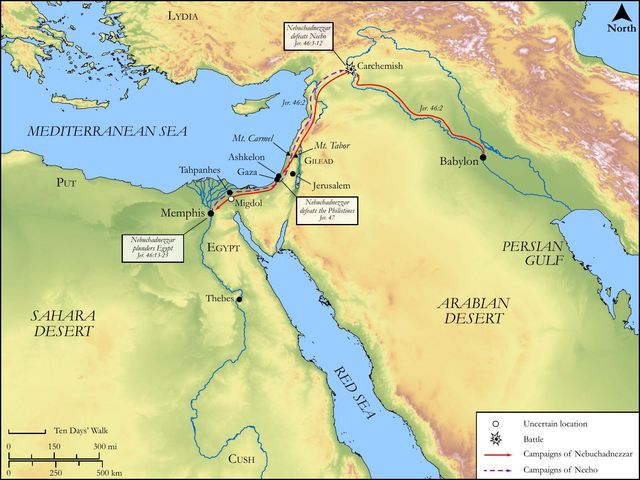
See on the biblical-era map
Study this verse
Public-domain commentary
Matthew Henry
From his Commentary on the Whole Bible. Henry comments on passages, not single verses — this entry covers Jeremiah 46:13–28. His three-level outline is real structure in the source text, so it is rendered as structure.
In these verses we have,
I.Confusion and terror spoken to Egypt.
The accomplishment of the prediction in the former part of the chapter disabled the Egyptians from making any attempts upon other nations; for what could they do when their army was routed? But still they remained strong at home, and none of their neighbours durst make any attempts upon them. Though the kings of Egypt came no more out of their land (Kg2 24:7), yet they kept safe and easy in their land; and what would they desire more than peaceably to enjoy their own? One would think all men should be content to do this, and not covet to invade their neighbours. But the measure of Egypt's iniquity is full, and now they shall not long enjoy their own; those that encroached on others shall not be themselves encroached on. The scope of the prophecy here is to show how the king of Babylon should shortly come and smite the land of Egypt, and bring the war into their own bosoms which they had formerly carried into his borders, Jer 46:13. This was fulfilled by the same hand with the former, even Nebuchadnezzar's, but many years after, twenty at least, and probably the prediction of it was long after the former prediction, and perhaps much about the same time with that other prediction of the same event which we had Jer 43:10.
1.Here is the alarm of war sounded in Egypt, to their great amazement (Jer 46:14), notice given to the country that the enemy is approaching, the sword is devouring round about in the neighbouring countries, and therefore it is time for the Egyptians to put themselves in a posture of defence, to prepare for war, that they may give the enemy a warm reception. This must be proclaimed in all parts of Egypt, particularly in Migdol, Noph, and Tahpanhes, because in these places especially the Jewish refugees, or fugitives rather, had planted themselves, in contempt of God's command (Jer 44:1), and let them hear what a sorry shelter Egypt is likely to be to them.
2.The retreat hereupon of the forces of other nations which the Egyptians had in their pay is here foretold. Some considerable number of those troops, it is probable, were posted upon the frontiers to guard them, where they were beaten off by the invaders and put to flights. Then were the valiant men swept away (Jer 46:15) as with a sweeping rain (it is the word that is used Pro 28:3); they can none of them stand their ground, because the Lord drives them from their respective posts; he drives them by his terrors; he drives them by enabling the Chaldeans to drive them. It is not possible that those should fix whom the wrath of God chases. He it was (Jer 46:16) that made many to fall, yea, when their day shall come to fall, the enemy needs not throw them down, they shall fall one upon another, every man shall be a stumbling-block to his fellow, to his follower; nay, if God please, they shall be made to fall upon one another, they shall be made to fall upon one another, every man's sword shall be against his fellow. Her hired men, the troops Egypt has in he service, are indeed in the midst of her like fatted bullocks, lusty men, able bodied and high spirited, who were likely for action and promised to make their part good against the enemy; but they are turned back; their hearts failed them, and, instead of fighting, they have fled away together. How could they withstand their fate when the day of their calamity had come, the day in which God will visit them in wrath? Some think they are compared to fatted bullocks for their luxury; they had wantoned in pleasures, so that they were very unfit for hardships, and therefore turned back and could not stand. In this consternation,
(1.)They all made homeward towards their own country (Jer 46:16): They said, "Arise, and let us go again to our own people, where we may be safe from the oppressing sword of the Chaldeans, that bears down all before it." In times of exigence little confidence is to be put in mercenary troops, that fight purely for pay, and have no interest in theirs whom they fight for.
(2.)They exclaimed vehemently against Pharaoh, to whose cowardice or bad management, it is probably, their defeat was owing. When he posted them there upon the borders of his country it is probably that he told them he would within such a time come himself with a gallant army of his own subjects to support them; but he failed them, and, when the enemy advanced, they found they had none to back them, so that they were perfectly abandoned to the fury of the invaders. No marvel then that they quitted their post and deserted the service, crying out, Pharaoh king of Egypt is but a noise (Jer 46:17); he can hector, and talk big of the mighty things he would do, but that is all; he brings nothing to pass. All his promises to those in alliance with him, or that are employed for him, vanish into smoke. He brings not the succours he engaged to bring, or not till it is too late: He has passed the time appointed; he did not keep his word, nor keep his day, and therefore they bid him farewell, they will never serve under him any more. Note, Those that make most noise in any business are frequently but a noise. Great talkers are little doers.
3.The formidable power of the Chaldean army is here described as bearing down all before it. The King of kings, whose name is the Lord of hosts, and before whom the mightiest kings on earth, though gods to us, are but as grasshoppers, he hath said it, he hath sworn it, As I live, saith this king, as Tabor overtops the mountains and Carmel overlooks the sea, so shall the king of Babylon overpower all the force of Egypt, such a command shall he have, such a sway shall he bear, Jer 46:18. He and his army shall come against Egypt with axes, as hewers of wood (Jer 46:22), and the Egyptians shall be no more able to resist them than the tree is to resist the man that comes with an axe to cut it down; so that Egypt shall be felled as a forest is by the hewers of wood, which (if there by many of them, and those well provided with instruments for the purpose) will be done in a little time. Egypt is very populous, full of towns and cities, like a forest, the trees of which cannot be searched or numbered, and very rich, full of hidden treasures, many of which will escape the searching eye of the Chaldean soldiers; but they shall make a great spoil in the country, for they are more than the locusts, that come in vast swarms and overrun a country, devouring every green thing (Joe 1:6, Joe 1:7), so shall the Chaldeans do, for they are innumerable. Note, The Lord of hosts hath numberless hosts at his command.
4.The desolation of Egypt hereby is foretold, and the waste that should be made of that rich country. Egypt is now like a very fair heifer, or calf (Jer 46:20), fat and shining, and not accustomed to the yoke of subjection, wanton as a heifer that is well fed, and very sportful. Some think here is an allusion to Apis, the bull or calf which the Egyptians worshipped, from whom the children of Israel learned to worship the golden calf. Egypt is as fair as a goddess, and adores herself, but destruction comes; cutting up comes (so some read it); it comes out of the north; thence the Chaldean soldiers shall come, as so many butchers or sacrificers, to kill and cut up this fair heifer.
(1.)The Egyptians shall be brought down, shall be tamed, and their tune changed: The daughters of Egypt shall be confounded (Jer 46:24), shall be filled with astonishment. Their voice shall go like a serpent, that is, it shall be very low and submissive; they shall not low like a fair heifer, that makes a great noise, but hiss out of their holes like serpents. They shall not dare to make loud complaints of the cruelty of the conquerors, but vent their griefs in silent murmurs. They shall not now, as they used to do, answer roughly, but, with the poor, use entreaties and beg for their lives.
(2.)They shall be carried away prisoners into their enemy's land (Jer 46:19): "O thou daughter! dwelling securely and delicately in Egypt, that fruitful pleasant country, do not think this will last always, but furnish thyself to go into captivity; instead of rich clothes, which will but tempt the enemy to strip thee, get plain and warm clothes; instead of fine shoes, provide strong ones; and inure thyself to hardship, that thou mayest bear it the better." Note, It concerns us, among all our preparations, to prepare for trouble. We provide for the entertainment of our friends, let us not neglect to provide for the entertainment of our enemies, nor among all our furniture omit furniture for captivity. The Egyptians must prepare to flee; for their cities shall be evacuated. Noph particularly shall be desolate, without an inhabitant, so general shall the slaughter and the captivity be. There are some penalties which, we say, the king and the multitude are exempted from, but here even these are obnoxious: The multitude of No shall be punished: it is called populous No, Nah 3:8. Though hand join in hand, yet they shall not escape; nor can any think to go off in the crowd. Be they ever so many, they shall find God will be too many for them. Their kings and all their petty princes shall fall; and their gods too (Jer 43:12, Jer 43:13), their idols and their great men. Those which they call their tutelar deities shall be no protection to them. Pharaoh shall be brought down, and all those that trust in him (Jer 46:25), particularly the Jews that came to sojourn in his country, trusting in him rather than in God. All these shall be delivered into the hands of the northern nations (Jer 46:24), into the hand not only of Nebuchadnezzar that mighty potentate, but into the hands of his servants, according to the curse on Ham's posterity, of which the Egyptians were, that they should be the servants of servants. These seek their lives, and into their hands they shall be delivered.
5.An intimation is given that in process of time Egypt shall recover itself again (Jer 46:26): Afterwards it shall be inhabited, shall be peopled again, whereas by this destruction it was almost dispeopled. Ezekiel foretels that this should be at the end of forty years, Eze 29:13. See what changes the nations of the earth are subject to, how they are emptied and increased again; and let not nations that prosper be secure, nor those that for the present are in thraldom despair.
II.Comfort and peace are here spoken to the Israel of God, Jer 46:27, Jer 46:28.
Some understand it of those whom the king of Egypt had carried into captivity with Jehoahaz, but we read not of any that were carried away captives with him; it may therefore rather refer to the captives in Babylon, whom God had mercy in store for, or, more generally, to all the people of God, designed for their encouragement in the most difficult times, when the judgments of God are abroad among the nations. We had these words of comfort before, Jer 30:10, Jer 30:11.
1.Let the wicked of the earth tremble, they have cause for it; but fear not thou, O my servant Jacob! and be not dismayed, O Israel! and again, Fear thou not, O Jacob! God would not have his people to be a timorous people.
2.The wicked of the earth shall be put away like dross, not be looked after any more; but God's people, in order to their being saved, shall be found out and gathered though they be far off, shall be redeemed though they be held fast in captivity, and shall return.
3.The wicked is like the troubled sea when it cannot rest; they flee when none pursues. But Jacob, being at home in God, shall be at rest and at ease, and none shall make him afraid; for what time he is afraid he has a God to trust to.
4.The wicked God beholds afar off; but, wherever thou art, O Jacob! I am with thee, a very present help.
5.A full end shall be made of the nations that oppressed God's Israel, as Egypt and Babylon; but mercy shall be kept in store for the Israel of God: they shall be corrected, but not cast off; the correction shall be in measure, in respect of degree and continuance. Nations have their periods; the Jewish nation itself has come to an end as a nation; but the gospel church, God's spiritual Israel, still continues, and will to the end of time; in that this promise is to have its full accomplishment, that, though God correct it, he will never make a full end of it.
Continue studying Jeremiah 46:28 across the web’s major study libraries — every link below opens this exact verse, chapter, or book on the destination site.
Read & Compare
 BibleGatewayThis verse in more than 200 translations and 70 languages.
 Bible.comThe YouVersion reader — hundreds of translations, reading plans, and highlights.
 ESV.orgCrossway's official English Standard Version reader.
 NET BibleThe NET translation with 60,000+ translators' notes on every rendering decision.
 STEP BibleTyndale House's free study tool — original text, vocabulary, and scholarly resources.
 BibliaLogos Bible Software's free web reader.
 USCCBThe New American Bible (Revised Edition) with the U.S. bishops' study notes.
Commentaries
 BibleHub CommentariesDozens of classic commentaries on this verse, gathered on one page.
 StudyLightMore than 100 commentary sets — the largest collection on the web.
 BibleRefPlain-English commentary on what this verse means, verse by verse.
 Enduring WordDavid Guzik's free commentary on this chapter, widely used by Bible teachers.
 Bible Study ToolsVerse commentary alongside Greek and Hebrew study aids.
Original Language & Research
- BibleHub InterlinearThe verse word by word — original language, transliteration, and English.
- BibleHub LexiconEvery word's original-language definition and Strong's entry.
 Blue Letter BibleDeep-study tools — Strong's numbers, concordance, and word studies.
 SefariaThe Hebrew text with Rashi and centuries of Jewish commentary.
Sermons, Hymns & Audio


TrulyRandomVerse is not affiliated with these sites and doesn’t control their content. They’re linked because they’re genuinely useful.
Summary
Jeremiah 46:28 serves as a profound divine declaration, distinguishing God's sovereign dealings with His covenant people, Israel, from His judgments upon the surrounding nations. Amidst prophecies detailing the comprehensive destruction of Gentile empires that served as instruments of divine discipline, the Lord assures "Jacob my servant" of His unwavering presence and enduring faithfulness. While acknowledging the necessity of chastisement for Israel's unfaithfulness, God promises that He will not bring a complete end to them, but rather correct them with measured justice, thereby ensuring their preservation and ultimate restoration.
Context
ShowHideLiterary Context
Jeremiah 46:28 concludes a significant oracle against Egypt, specifically following the detailed prophecy of Egypt's defeat by Nebuchadnezzar at Carchemish (Jeremiah 46:1-26). This verse marks a pivotal shift within Jeremiah's prophecies against foreign nations (Jeremiah 46-51), moving from the specific judgment on a powerful Gentile empire to a direct, comforting, yet sobering word addressed to God's own people, Israel. Its placement immediately after the pronouncements of universal judgment underscores God's absolute sovereignty over all nations while simultaneously highlighting the unique, covenantal relationship He maintains with "Jacob." The repeated prophetic phrase "Fear thou not" often introduces a divine assurance of protection and presence, contrasting the fear induced by external threats with the security found in God's faithfulness.
Historical & Cultural Context
The historical setting for Jeremiah 46 is the late 7th and early 6th centuries BCE, a period of immense geopolitical upheaval. The Neo-Babylonian Empire, under Nebuchadnezzar, was rapidly ascending, challenging and ultimately dismantling the established powers of Assyria and Egypt. Judah, caught between these superpowers, often made ill-advised alliances, leading to its eventual subjugation and exile to Babylon. Jeremiah's prophetic ministry occurred during this tumultuous era, addressing a people facing national crisis, displacement, and the destruction of Jerusalem. Culturally, the appellation "Jacob my servant" is deeply significant, recalling the patriarch Jacob (Israel) and emphasizing the nation's unique identity as God's chosen covenant people, set apart from the pagan nations who worshipped idols and lacked such a divine relationship. This covenantal distinction is fundamental to understanding the differential treatment God promises to Israel compared to other nations.
Key Themes
ShowHideThis verse encapsulates several foundational themes woven throughout Jeremiah and the broader biblical narrative. Firstly, it powerfully asserts Divine Sovereignty, demonstrating God's ultimate control over the rise and fall of empires and His use of even formidable powers like Babylon as instruments of His will, as seen in Jeremiah 25:9. Secondly, it highlights God's unwavering Covenant Faithfulness; His promise not to make a "full end" of Jacob is rooted in His unbreakable covenant with Abraham, Isaac, and Jacob, ensuring the preservation of His chosen people despite their repeated unfaithfulness, a truth echoed in Leviticus 26:44-45. Thirdly, the theme of Redemptive Discipline is prominent; God's correction is not arbitrary destruction but a measured, purposeful act intended to refine, purify, and restore His people, leading them to repentance and spiritual renewal, much like a father disciplines his child (Deuteronomy 8:5). Finally, the assurance "I am with thee" reiterates the profound theme of Divine Presence and Comfort, a recurring motif throughout Scripture that offers solace and strength in times of fear and uncertainty, as beautifully articulated in Isaiah 41:10.
Exposition and Analysis
ShowHideKey Word Analysis
ShowHideThis primitive root (H3372) primarily means "to fear," "to dread," or "to be afraid," but also carries the moral sense of "to revere" or "to stand in awe." In the imperative "Fear thou not," it functions as a divine command to Israel to overcome terror and anxiety in the face of overwhelming circumstances (exile, judgment on nations). It implies that God's active presence and unwavering promises should instill confidence and reverence, displacing debilitating fear. The command is not a denial of danger but an assurance that God's power negates the ultimate destructive force of that danger over His people.
Derived from the root H3617, this term signifies "a completion," "utter consumption," or "destruction." It can also mean "a final riddance" or "annihilation." The deliberate contrast within the verse—God making a "full end" of the nations but not of Jacob—is profoundly significant. It emphasizes the definitive, irreversible, and total nature of the judgment meted out to the nations that opposed God, while simultaneously highlighting the unique, enduring, and preserved status of Israel, a direct consequence of God's unbreakable covenant.
This primitive root (H3256) means "to chastise," either literally (with blows) or figuratively (with words), and by extension, "to instruct" or "to reform." It describes a disciplinary action that is not merely punitive but remedial, pedagogical, and ultimately redemptive. God's correction of Jacob is depicted as a fatherly act, designed to teach, refine, and bring about spiritual restoration and repentance, rather than annihilation. The phrase "in measure" (H4941, mishpâṭ, meaning "judgment" or "justice") further underscores that this discipline is just, purposeful, and limited in its scope, aimed at their good.
Verse Breakdown
ShowHide"Fear thou not, O Jacob my servant, saith the LORD: for I [am] with thee;"
This opening clause is a direct, tender, yet authoritative divine address. The command "Fear thou not" is immediately followed by the reason for courage: God's personal, active, and sustaining presence ("I am with thee"). The appellation "O Jacob my servant" highlights Israel's unique covenant relationship and purpose, providing the foundational context for God's special promise of preservation.
"for I will make a full end of all the nations whither I have driven thee:"
Here, God declares His absolute sovereignty over global history and the destiny of nations. The nations, including Babylon who served as the instrument of Israel's exile, are portrayed as mere tools in His hand ("whither I have driven thee"). He promises their complete and utter destruction, signifying that their power and existence are temporary and ultimately subject to His definitive judgment, providing a stark contrast to Israel's fate.
"but I will not make a full end of thee, but correct thee in measure;"
This is the pivotal contrast of the verse, articulating God's unique covenant faithfulness to Israel. Despite their sin and the severe discipline they face, God explicitly promises that their existence will not be utterly consumed like the other nations. Instead, their suffering is framed as divine "correction," administered "in measure" (i.e., with justice and purpose). This implies a just, purposeful, and limited discipline, designed for their spiritual good and not for their annihilation.
"yet will I not leave thee wholly unpunished."
This final clause reiterates God's unwavering justice and holiness. While His discipline is measured and redemptive, it is undeniably real and necessary. Israel's sin will not go unaddressed or unpunished. This ensures that God's character as a righteous judge is upheld, even as His covenant faithfulness guarantees their ultimate preservation. It underscores that divine grace and covenant love do not negate the demands of justice, but rather work through them for a higher, redemptive purpose.
Literary Devices
ShowHideJeremiah 46:28 is masterfully crafted with several literary devices that amplify its profound message. The most prominent is Contrast, which forms the very backbone of the verse's meaning. God explicitly contrasts the "full end" (Hebrew: kâlâh) He will bring upon the nations with His steadfast refusal to make a "full end" of Jacob, thereby emphasizing Israel's unique covenant status and God's enduring faithfulness. This contrast is further underscored by the powerful Repetition of the phrase "full end." The opening command, "Fear thou not," functions as a classic Divine Oracle or Assurance, a recurring prophetic trope that immediately signals a message of comfort, divine presence, and sovereign control amidst overwhelming circumstances. The address "O Jacob my servant" is a significant Appellation, serving as a constant reminder of Israel's identity as God's chosen people and their special, albeit often strained, relationship with Him. The concept of God "driving" the nations and correcting Israel "in measure" employs Anthropomorphism, attributing human-like actions (driving, correcting) to God to vividly convey His active involvement and sovereign control over both global historical events and the lives of His people. Finally, there is an underlying Paradox at play: God's deep love for His people necessitates their discipline, yet this very discipline serves as a paradoxical guarantee of their preservation rather than their destruction, demonstrating His commitment to their ultimate good.
Theological and Thematic Connections
ShowHideJeremiah 46:28 powerfully articulates the intricate balance of God's justice and mercy, particularly within His covenant relationship with Israel. It underscores the profound theological truth that while God is absolutely sovereign over all nations and will bring decisive judgment upon those who defy Him, His dealings with His chosen people are uniquely governed by an enduring covenant love that ensures their ultimate preservation and refinement, not their annihilation. This distinction reveals God's unwavering faithfulness to His promises, even when His people are unfaithful. The "correction in measure" signifies that divine discipline is always purposeful, rooted in love, and aimed at restoration and sanctification, reflecting God's character as a just and loving Father. This verse serves as a foundational text for understanding the nature of God's discipline as a tangible sign of His unwavering care and commitment to His people's spiritual well-being and holiness.
Reflection and Application
ShowHideIn a world perpetually characterized by fear, uncertainty, and the rise and fall of earthly powers, Jeremiah 46:28 offers profound and enduring encouragement for believers today. Just as God assured Jacob (Israel) of His steadfast presence and ultimate preservation amidst the comprehensive destruction of formidable nations, so too does He promise His children today a secure future and an unwavering presence in Him. This verse calls us to cultivate a deep trust in God's absolute sovereignty, recognizing that even when our personal circumstances are overwhelming, or when we witness global turmoil, He remains actively at work, orchestrating all events for His ultimate purposes. It challenges us to embrace divine discipline not as punitive abandonment, but as a loving, measured correction from a Heavenly Father who desires our growth, holiness, and conformity to His image. When we face personal trials, national crises, or global anxieties, we are profoundly invited to "Fear thou not," resting in the glorious assurance that God is intimately with us, His discipline is always redemptive, and His ultimate plan for His people will never, ever fail.
Questions for Reflection
ShowHideFAQ
ShowHideWhy does God discipline His people if He loves them?
ShowHideGod disciplines His people precisely because He loves them, much like a wise and good parent disciplines a beloved child. Jeremiah 46:28 states, "but correct thee in measure; yet will I not leave thee wholly unpunished." This "correction" (Hebrew: yâçar) is not arbitrary punishment but a purposeful act of training, instruction, and refinement. It's intended to lead His people away from sin, back to righteousness, and into deeper communion with Him. The Bible consistently teaches that divine discipline is a mark of sonship and a pathway to holiness, as seen in Proverbs 3:11-12 and Hebrews 12:6-11. It profoundly demonstrates God's unwavering commitment to our spiritual well-being and His desire for us to share in His holiness.
How is Israel's fate different from that of the other nations mentioned in Jeremiah?
ShowHideThe key distinction lies in God's unique and irrevocable covenant relationship with Israel. While God declares He will "make a full end of all the nations whither I have driven thee," He explicitly states, "but I will not make a full end of thee." This means that the destruction of other nations, like Egypt and Babylon, would be complete and irreversible, leading to their disappearance as distinct entities or their permanent subjugation. However, for Israel, despite facing severe judgment and exile due to their disobedience, God promises preservation. Their discipline is corrective and redemptive, not annihilative. This unique treatment is rooted in God's eternal covenant promises to Abraham and his descendants, ensuring their continued existence as a people and their ultimate restoration. Amos 3:2 powerfully highlights this unique relationship: "You only have I known of all the families of the earth; therefore I will punish you for all your iniquities."
Christ-Centered Fulfillment
ShowHideJeremiah 46:28 finds its ultimate and most profound fulfillment in Jesus Christ, who perfectly embodies God's true servant and the means of our eternal preservation. The divine assurance "Fear thou not, O Jacob my servant, saith the LORD: for I [am] with thee" resonates deeply with the promises of the New Covenant. Jesus, the true "servant" of the Lord, perfectly fulfilled the righteous role Israel failed to maintain, becoming the Suffering Servant who bore the sins of many (Isaiah 53). Through His sacrificial life, atoning death, and glorious resurrection, He secured the ultimate "full end" of the powers of sin, death, and the spiritual "nations" of darkness that held humanity captive, triumphing decisively over all principalities and powers (Colossians 2:15). For all who are "in Christ" by faith, the promise "I will not make a full end of thee" becomes a glorious and eternally secure reality. While we, like ancient Israel, experience God's loving "correction in measure" for our sanctification and spiritual growth (Hebrews 12:7-11), the ultimate and full "punishment" for our sins was borne by Christ on the cross, who "became sin for us" (2 Corinthians 5:21). Therefore, for believers, there is now "no condemnation" (Romans 8:1), and we are assured of eternal preservation and God's constant, abiding presence through the indwelling Holy Spirit, fulfilling the very essence of "I am with thee" until the consummation of the age (Matthew 28:20).